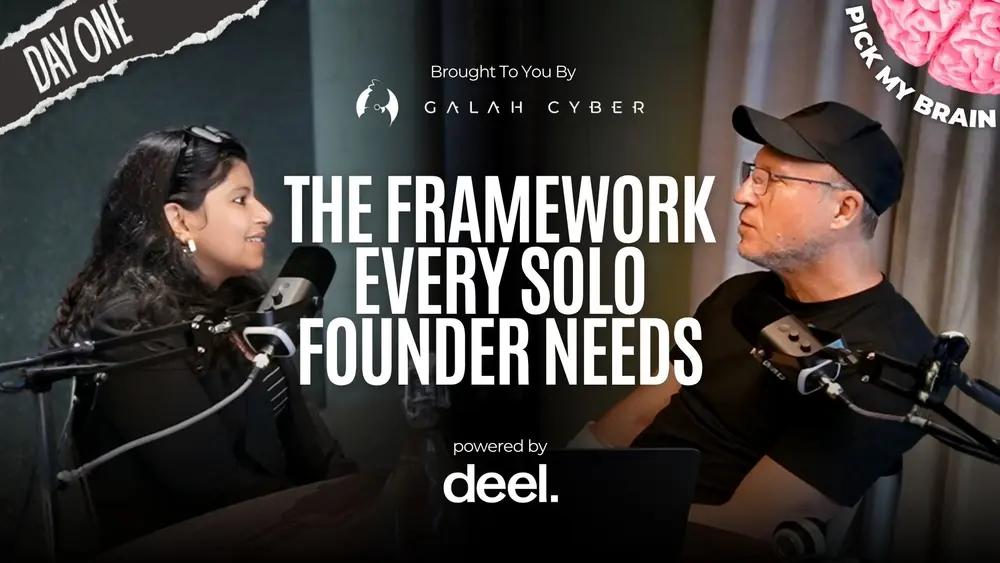
Transcript Synced · select any line to jump ▾ 0:01 Speaker: Founders scale faster on Deel. Set up payroll for any country in minutes, hire anyone anywhere, get visas handled fast, and get back to building. Visit deel.com/dayone. That's D-E-E-L.com/dayone. We help what is a bit of a nightmare of a process when lawyers work on helping their clients buy and sell a business. 0:30 Alan Jones: It'll be a given that it works. The question is, how great is it to be a customer of, of, of Diligence versus its competitors? 0:38 Elena Tsalanidis: B2B SaaS sales is hard. 0:40 Alan Jones: How do I make sure that I build something defensible that my customers can't touch? 0:45 Elena Tsalanidis: How do we bring clarity to a crowded market where there are these more general purpose tools and you're a vendor of a point solution? 0:54 Speaker: Welcome to Pick My Brain, the podcast where we help startup founders improve their pitches to better connect with customers, co-founders, and investors. My name is My name's Allan Jones and I'm an ex-startup founder myself, but now I'm an angel investor with quite a bit of experience helping new businesses find their footing and achieve their goals. But first, I'd like to acknowledge that this podcast is being recorded on Gadigal land, land that was never ceded. I pay my respects to their innovators and leaders past, present, and emerging. Now on Pick My Brain, you'll hear the real story straight from founders as they pitch their startups, tackle the challenges we all face, and try to make their ideas into a successful company. Each episode, we'll see if I can help these founders take their startups another step forward with advice, ideas, and maybe a little constructive criticism. Thanks for joining me. Let's get started. You're listening to a Day One FM show. As a startup founder, you're juggling multiple priorities from the expected, like finding product market fit, to the unexpected, like customer requests for SOC 2 or ISO 27001 certification. But achieving compliance is time consuming, and time spent on that is time away from the needs of your business. That's where Vanta comes in. Vanta is the all-in-one solution for startups to become compliant quickly and build a security foundation with ease. With a combination of automation, an extensive partner network, and a security marketplace, Vanta provides the necessary tools and expertise for startups to achieve compliance seamlessly, no matter how urgent your needs are, and at every phase of growth. Over 10,000 leading companies, including Cypherstash, Handle, and Indetted, trust Vanta to automate compliance so they can focus on growing their business. Startup customers like you get $1,000 off Vanta at dayone.fm/vanta/brain. That's Vanta, V-A-N-T-A, at dayone.fm/vanta/brain. Today we're joined by Eleanor Tsalonidis, who is a co-founder of AI legal tech startup Dealigence. That's D-E-E-L-I-G-E-N-C-E, an AI-powered legal due diligence platform. Thanks for joining the show, Elana. You and I have met before, but for the benefit of the Pick My Brain audience, we should maybe run through what Diligence is, who it's for, how long you've been doing this, and how much progress you've made so far. 3:17 Speaker: Sure. Thanks for having me, Alan. I'm so pumped to be here. So what is Diligence? Who are we? What do we do? We are an AI-powered Monday.com that helps corporate mergers and acquisitions lawyers move through a due diligence process in half the time with great accuracy. And so understandably, our customers are mid to large Australian and New Zealand law firms. We help what is a bit of a nightmare of a process for when lawyers work on helping their clients buy and sell a business. So typically that's done through Excel, emails, calls. As a lawyer, I'd be working until 2:00 AM and it was objectively the worst part of my job. And so we make that process much more smooth for the lawyers and help them deliver the work faster and more accurately to their clients. 4:11 Alan Jones: Great, thank you. 4:12 Elena Tsalanidis: I, I think you asked who am I. I, as I touched on, like, I have an ex-lawyer, so I lived and breathed this work. I also worked at a different legal tech startup, so I think that that's meant that I have the experience working understanding what good looks like in a venture-backed company and how to help lawyers equip themselves with great technology to improve what they do. 4:35 Alan Jones: Cool. What you were doing before starting your founder journey is one of my standard questions. And the other standard question that nobody gets to escape is when you were a kid, what did you want to be when you grew up? 4:46 Elena Tsalanidis: This is so nerdy, but fresh off of like a year 6 school camp to Canberra, I was convinced I was going to be the Speaker of the House of Representatives. Saw the person kind of at the top of the chamber of the House, and I was like, I can do that. I can manage the voices. And I was like, I am or was super into politics, and I thought that would be the job for me. When I did one of those like assessments at school about, you know, what are you inclined to be, it had leadership, military drill sergeant. So I was like, great. This sounds good, but I'm not a military drill sergeant, but I am leading a team now. So in a weird way, it all kind of came to fruition. 5:37 Alan Jones: I hope that sounded like a good thing when you were a kid, when they told you you should be a drill sergeant in the military. 5:45 Elena Tsalanidis: I didn't really know how to take the drill sergeant bit. I think one of the girls in my class got garbage collector. Not that there's anything wrong with that, but she was a bit confused as to what had kind of like indicated that. But Yeah, from prep, my prep report card said Eleanor is going to, Eleanor is the manager of the classroom. So I think that eldest child, eldest daughter, which is like a whole corner of the internet, has definitely rung true for me. 6:15 Alan Jones: Yeah, yeah, you've been in charge since the early days. 6:18 Elena Tsalanidis: Very much. 6:19 Alan Jones: That's very cool. I love that. Thank you. I thank you. Now, sometimes on Pick My Brains, we talk specifically about how founders should be pitching to investors and sometimes it's to customers and sometimes as to potential employees. I think you've got some questions today about the relationship with customers and how to differentiate your business. Should we talk about that? 6:41 Elena Tsalanidis: Yeah, let's do it. So I had a couple questions today about things we're thinking about in our business. We're an AI company that leverages the best-in-breed large language models to deliver a solution to corporate lawyers and these are complex systems that we plug into. Sometimes people ask us, did you build your own model? There are very few companies who have the capital to do that. And many people like us at Diligence are thinking about how to deliver AI services on top of preexisting LLMs that we all know and have heard of. We think we've built a thick wrapper with our pipeline because what we do is summarize a contract and provide a really accurate and reliable summary to a lawyer. But my question for you, Alan, is how do you assess true product differentiation when moats are relatively thin, given the fact that most AI companies are being powered by the same underlying models? 7:44 Alan Jones: Yeah, thank you. Great question. And it's definitely something which is top of mind for customers that are considering adopting AI tools and also for investors like myself. How should we consider investing in companies if they're all going to be basically some sort of thickness of wrapper around off-the-shelf foundational models? And I think it's a challenge for people who are thinking about joining a startup as well. If these companies are kind of similar based on the same kinds of things, where should I go to work? So it's definitely top of mind. I've been thinking about it a lot as a result. And where I sit at the moment, and I'm often wrong, so I could well be wrong. One of the things I've been thinking about is that software has evolved from something where the people building software, the early-stage startups who were selling software that ran on hardware that the company itself also owned, right? When I was an early employee of Yahoo, for instance, we would have one of the servers that we owned would have a disk drive failure or something and one of us would have to go to the colocation facility where that server was housed and take a special set of keys, open up the cage, open up the server, take that drive out, put in a backup drive, shut the lid, reboot the server, and then wait to check and see that everything was running again. So now we have the cloud, right? So we don't own the hardware anymore. Nobody from my team has to go out there with a set of keys to go and replace a drive. AWS or Microsoft are Google will take care of all of that for us. But that then becomes kind of invisible to most of us in the team, right? And certainly our customers, it's probably not a question, maybe it is actually in legal clients, but in most industries customers aren't asking you, well, who's your cloud hosting provider? Who's your compute provider in the cloud? And so, you know, again and again, they're having layers upon layers built on top of that hardware that everything runs on. You know, there's operating system layers, there's application layers, and there are third-party vendors providing part of our software stack that we connect to with APIs. And now we're starting to build all new generations of companies built on top of these foundational large language models provided by a variety of different companies. And I think what will happen over time is at the moment we're probably putting too much concern and thought into, well, which of these companies should I be choosing? And I think over time that will become less and less important to us. It'll just become a bit more invisible. Those large language models will either go very, very vertical and specialist, or they'll continue to be very, very generalist and just get more and more capable of supporting more and more different kinds of application. But as a startup built on top of those models, I don't think we need to be too concerned about that. I think that will become kind of immaterial. It will be like worrying about what sort of content management system we're going to run our landing pages on. 10:48 Elena Tsalanidis: All right. 10:48 Alan Jones: And you know, that it will just become a given that we won't have built our own website, hardcoded, hand-coded from the beginning. We'll be using content management system in the same way. Most of our customers won't be too concerned about, about where we're getting our, our, our LLMs from. Mm. 11:06 Elena Tsalanidis: Yeah. Interesting. I think in professional services, I think about, you know, like that point you touched on with security. So making sure for us that the LLM we plug into, we're adding these layers of controls around it. And then also the user experience is something I think about here too, like making sure that it fits into how someone's doing a job. So in our case, the way a lawyer is reviewing a contract and progressing work for a client, like that's what we think sets us apart. But I imagine it probably is super industry specific. 11:35 Alan Jones: Yeah, I can buy a box of nappies and 2 liters of milk and a loaf of bread from Woolworths online, from Coles online, probably from IGA online, haven't checked, and maybe Harris Farm online, and also maybe Amazon right now. And how I'm going to choose, you know, the functionality is pretty much the same, right? And their credit card payment gateways are probably pretty similar. And they're probably all hosted on AWS or Google or Microsoft. All of that doesn't matter to me as the consumer. What matters to me as the consumer is how hard is it for me to find the products that I buy all of the time? How great is the customer experience in adding those products to a shopping basket, checking out with my saved credit card details? And then how reliable is the delivery and does it, you know, does it get damaged in transit, right? So all of the soft stuff is much, much more important in the long term than the hard stuff of does it work or not? It'll be a given that it works. The question is, How great is it to be a customer of Dealigence versus its competitors? 12:31 Elena Tsalanidis: Mm, I like that, that way of thinking. How much value can you add to the process? 12:40 Speaker: Adam here from Day One. Just a quick message from one of our sponsors. Standard Ledger is your trusted partner for end-to-end financial support. They provide core accounting services plus expert financial guidance when you're ready to scale. Whether you need help with bookkeeping, payroll, R&D, or even fractional CFO services, their team supports founders across Australia to manage finances, raise capital, and grow their businesses. Visit dayone.fm/standard today to book your free chat. Yeah, you touched on the moat there. So let's explain for those people in the audience that haven't heard about what a moat is. 13:23 Elena Tsalanidis: Yeah. 13:24 Alan Jones: So first of all, a definition. So back in ye olde days when people built castles and then defended them from other people that wanted the castle, you dig a big ditch around it, you'd fill that with water and sadly not crocodiles, but it would've been awesome if you could. But it was Europe and it was too cold for crocodiles. But anyway, you'd have this big ditch around your castle to protect it from the bad guys. And that was called a moat, M-O-A-T. And one of the strategies in building a startup is to think think about what's my defensive moat? How can I make sure that we don't lose customers to our competitors? How do I make sure that I build something defensible that my customers can't touch? And there's a lot of thinking around this right now, particularly because, partly because AI is involved and AI is coming from a number of foundational AI vendors out there, but also because— 14:19 Elena Tsalanidis: Yeah. 14:19 Alan Jones: AI allows us to make software much more flexible and changeable more rapidly than the way software has been built without AI before. I've got 20, 30, 40 software startups in my portfolio where a good part of the valuation of that company is tied to the fact that it would be very expensive and very time-consuming to just copy that company and build a clone of it, right? So it would be hard to compete with, even if you had a team of 50 engineers, it might still take 3 years to get your startup to the point where this other startup that I've invested in is there right now. So that's part of the moat, if you like. It's too late for most other competitors to come and just go, "Oh, I'll just carbon copy that." But it looks like AI, one of the things that AI is doing is making software engineering massively faster and almost free. And so it may be possible in a few years for anybody who wants to just go and clone a copy of any software vendor and say, please make me another copy of that app and just rebrand it as this other thing. And that's what I want to use. 15:24 Elena Tsalanidis: Hmm. 15:25 Alan Jones: Now the jury is out right now as to whether or not individual businesses might do that. So in your case, an individual law firm may be at a scale where they go, you know what, you know, Diligence and all of its other competitors are out there, kind of do something close to what we want to do, but you know, we actually want to have something that's tightly, tightly tailored for us. And so we're actually going to go work with an AI and an engineer to build something ourselves much, much more rapidly. And we'll still be able afford to do it because that engineer or that team of 2 or 3 engineers will be doing the work of 50. The hard lessons for organizations to learn along the way there is that obviously building software is not just about engineering. It requires customer experience thinking and user interface design and product management and so many other things, security and yada yada. But there will be some potential customers that will go down that path. 16:14 Elena Tsalanidis: Yeah. 16:15 Alan Jones: And so I think we have to think about what's involved there and how we differentiate. I think really the main defensive mode that still exists in the software engineering world now is distribution. So in many cases, in many verticals in software startups, the winner in most categories is most likely to be the company which is most successful at distribution, at getting their product in front of as many target customers as possible, more quickly than their competitors do and more successfully. So signing up more of those potential customers. Than their competitors do. I think a lot of software verticals are going to become naturally monopolistic markets where there is a perceived leader in that market and that perceived leader, their defensible moat will just be the fact that everybody knows that they're the biggest. 17:09 Elena Tsalanidis: Mm. 17:10 Alan Jones: They're the most widely known. They're the choice that, and nobody would be shocked if you chose them as well. And I think that becomes a bit of a flywheel if that goes well. 17:19 Elena Tsalanidis: Yeah, well maybe with, with that in mind, I, I had a question that relates to sales. So obviously we're a SaaS company, we're B2B SaaS sales. Our customers are large law firms and we help them manage a really complicated process. In B2B SaaS, there's all these theories about how many stakeholders you have to meet and engage with. I think it's something between 6 to 10 to close a deal. So our sales cycles are quite long, but when we do land a customer, they are very sticky and the contract value is very high. So curious for your thinking, Alan, around how does deal size feed into your thinking about sales cycle length and the right ratio for founders like me? 18:03 Alan Jones: Yeah, I think this is an equation with a number of interesting variables in a business, in enterprise sales, particularly where there is a long sales cycle involving a number of people on both sides, on both organizations. Your and theirs. And I think we only really know the relationship between those variables over time. So it's really not possible or easy for us to predict how much influence some of those variables may have. So, so average contract value or customer lifetime value are two of the variables in the equation. The higher those two variables, then the more it's worth spending months and months and months or maybe even years with that customer to win them over. I think one of the ways forward that many startups take is to bite off a small chunk at a time. We don't try and eat the whole elephant, we just get started on part of the ear. And that's always been my favorite part of an elephant. I don't know about you, but it looks soft and tasty. 19:01 Elena Tsalanidis: Now I'm imagining eating an elephant. No thanks, but bite off, well, essentially low-hanging fruit is what you're getting at there. 19:08 Alan Jones: Yeah, perhaps low-hanging fruit, but certainly going for some part of the organization which is not on the margins, which is close to the center the core, but which is small enough that it's able to make a rapid decision with fewer stakeholders involved. So sometimes we'll go, okay, we've got a large global law firm on board, but we've got their Hobart office. With the greatest of respect to my Tasmanian brothers and sisters out there, it's not the biggest office in the whole chain in that global law firm. But we then get to put put that logo on our pitch deck and say to investors, "Yes, we've got large multinational law firm engaged in a commercial pilot with us now." So that has a risk of, that's certainly low-hanging fruit. It's closer to us, it's a smaller team. They have probably more autonomy because they're furthest away from the HQ over in Chicago or New York or something. But at the same time, it's going to be a lot of heavy lifting to get from the Hobart team to the Chicago team. So what would be better is if we can find a small, lively autonomous team within the Chicago head office. So rather than the low-hanging fruit, perhaps the smallest but juiciest fruit, maybe the blueberry or the cranberry inside the organization. 20:25 Elena Tsalanidis: So being selective about your approach to essentially get the biggest bang for the buck. 20:32 Alan Jones: Yeah, yeah. In many large enterprises, there's a whole tier of people who get to go to a lot a lot of innovation conferences. They'll get to go to TED every year, they'll get to go to South by every year. But when they go to TED or by South by, they're wearing a collared shirt and if they're a man, maybe a jacket. But they're not really of the startup industry itself, but they're employed by the large enterprise to go out and understand all of the innovation happening and that might affect the enterprise one day. Those people can be great advocates for our company when we meet them. So it's worth getting along to those conferences. just to find those people who are there representing BHP but trying to be as cool a startup sort of person as they can be on the day. Because those people are employed to digest a whole bunch of information about what's happening in the relevant fields and then regurgitate it in summary form for leadership, for the board, for divisional heads and so on. So they can be helpful. 21:33 Elena Tsalanidis: Mm-hmm. 21:33 Alan Jones: But they also play another role. They also play a role as a firewall that prevents us from getting past them into the real decision makers in an organization. So usually when we get to know those people well, we find out that they have no budget to spend on actual software like Alice, right? They're just there to say, "Yeah, I met this amazing person at South By in Sydney the other day and they're doing great things and we should really have a coffee with them." And they'll be very happy to have a coffee with you because that's one of the metrics that they're measured on, that their performance is measured on. How many startup founders did me, you know, in broad terms. And how many interesting white papers did you write for the rest of the organization to read based on what's happening in AI legal tech innovation? So it can be hard to get past that person. We may actually get a relationship with that person, I think we're doing really well, but then that person's actually going to kind of roadblock us from the rest of enterprise 'cause they don't want to lose us. We're important to their performance metrics. 22:28 Elena Tsalanidis: Yeah, it's things we think about because we not only talk to the lawyers at the coalface who experience the problem, but many mid to large law firms have procurement teams, innovation teams who can advocate for a technology and can also block a technology because they are aware of the entire firm's priorities. So it means that you're kind of dealing with different personas in the same sales cycle because a partner in the corporate team might want to use your platform tomorrow, but the innovation team have oversight over every single practice group's wants and needs of the firm. And those things can sometimes conflict. So B2B SaaS sales is hard. 23:08 Alan Jones: Yeah, it is. Finding if the organization does have an innovation or procurement team or both is a really important early step, right? Because if that team gets the sense that we have had a relationship with that partner for too long, then they're likely to block us from adoption in the organization just because they want to discourage that partner and other partners making their life harder, so that they want to be the entry point, they want to be the gatekeeper. So just sit down with our partner first time you meet them and say, is there a procurement team inside the organization? Is there a team that specifically looks at innovation? I'm still going to absolutely tell you everything that I can and I'm going to encourage you to use our product, but as a next step, I would love to sit down with them and find out what's going on for them. One of the things that we need to find out when we sit down with those centralized teams is what are the other SaaS tools are widely adopted across the organization. So there will probably be corporate licenses for all kinds of things, but we can get a sense for how likely an organization is, if we start with the low-hanging fruit, how long might it take us to get global adoption inside the enterprise? 24:24 Elena Tsalanidis: Mm-hmm. 24:24 Alan Jones: And we can look at the other sort of software licenses that that team controls and say, You know, how many people do you think are currently using Notion or Airtable or, you know, Microsoft productivity suite? That can give us a better sense for how influential is that centralized team in pushing stuff out to the rest of the enterprise. 24:44 Elena Tsalanidis: Totally. I think that makes a lot of sense. It actually leads me onto another question for you, Allan, around, you know, for us Yes. Understanding our potential customer's tech stack is always really important because there's a lot of tightening of budgets that's happening in this economic environment. And so you have firms who rightly so are looking at what exists on their shelf and saying, can we use one of those things to help us with due diligence? Or do we need to look to a provider like you guys at Diligence to really overhaul this process? And so It's something I hear a bit around maybe more general purpose tools, whether we can cobble them together to make them be a point solution. And so my feelings is that that's really tricky to do. But I guess my question for you is, how do founders like me who are in that spot of being a really niche, hyper-targeted solution that solves a specific problem and that without a doubt outperforms a more general tool, but a general tool is out there more prominent. You mentioned some names before, the big names in tech, right? How do we bring clarity to a crowded market where there are these more general purpose tools and you're a vendor of a point solution? 26:05 Alan Jones: Yeah, that's not a problem unique to just the software industry or to enterprise though, right? Like there are, I have an electrician in my house right now fixing a security light. That's maybe a job I could manage myself without getting electrocuted, but I'm time poor. I want it done properly the first time and I want somebody to do it who's certified and insured to minimize the risk of anything going wrong. So all through our lives, there are opportunities for all of us and for organizations to go, we'll take something off the shelf and we'll try and adapt it ourselves to our needs, or we'll try and build something out of a bunch of commonly combined tools and build something for ourselves. So I think it's just a matter of first of all, recognizing that we're not going to win every client this time around. Sometimes we need to let a client, a customer go off into the wilderness and try and build their own, you know, rain shelter out of bits of wood and, you know, vines and stuff like on one of those survivor shows. Knowing that when they're wet and cold and dark and they haven't been able to light their own fire, they'll come back back to us, right? And we'll have a nice tent set up for them and some warm soup and a cozy sleeping bag. So sometimes, you know, customer sales journeys go in unlikely places and we feel like we're losing a customer. Sometimes we have to let them go. And if they come back, then we always had them. 27:36 Elena Tsalanidis: And like, I'm a bit bullish on the fact that I think, you know, law firms aren't tech companies. You know, there are some firms who hire engineers and who try and build things internally And there's only really a handful that have those capabilities. But I do think when you live and breathe a problem like we do, we will win every day of the week. But how do you handle a conversation where you've demonstrated there's a pain at a customer, you're shining light on a problem, and then they're like, oh well, maybe, you know, we can hobble together a solution internally. Like, I mean, my approach is I kind of say, we're here when you need us. But is it worth kind of pushing back and letting them know why you think that that's a bad idea or the limitations? 28:22 Alan Jones: Yeah, I think, you know, we can be constructive in our caution. And I think, you know, one of the challenges with selling to the legal profession is that, you know, they are trained and by nature critical and skeptical. That's a necessary mindset then in being a lawyer. But at the same time, I think those people are also more aware, less optimistic, more concerned about future downside risk. So we can say, look, off you go into the wilderness, best of luck. Here's a canteen with some water in it and a little axe that you can chop down your own woodpools. And I'm here for you. Anytime you want to call, get in touch. Mm-hmm. But I'm just gonna set up the tent here in the next clearing along and, and come around anytime. We'll sing songs around the campfire, which I've already built and is burning. 29:22 Elena Tsalanidis: Yeah, exactly. I, I think that's right. The other thing is like with lawyers, if you do try to build something internally, you have to have lawyers test it and lawyers are really expensive and have billable targets that they need to deliver for clients. So. I'm always like, it's not an— it's not a, okay, we think it will take us this long. It's also the fact that you've got to test and offer support. There's all these other things that are part and parcel of being a tech company that I think are easy to discount. And if you've got a lawyer who spends 10, 15, 20 hours, it's probably even more cost effective to just buy an out-of-the-box vendor because they've done all that already. 30:01 Alan Jones: Yeah, we can think about a successful law firm as a fast-moving money-making machine. It's got a lot of moving parts and they're moving very quickly and all of the gears and all the cogs have to mesh beautifully together. If there's too much friction or if they fail to mesh, then bits start falling off and very expensive people leave who are very hard to replace. And so there can be quite a bit of resistance to change inside a fast-moving money machine because it's really, really expensive to switch part or all of the machine off. Switch out some of the cogs, put new cogs back in, and then turn the machine back on. And we tend to only do it when those cogs are really failing. So when one process, when one department, when one team or one software tool is no longer fit for purpose, there'll be great stresses involved, right? There'll be a lot of pressure on people, a lot of emotions at play. And then we say to them, stop, we're going to put in a new tool and that's going to fix everything for for you. Often that's not going to be, we're not going to be taken out of word when we say that, there will be some resistance. So sometimes we get introduced to an organization where everything's on fire and everybody's running for the exits, which is a difficult time to do orderly, constructive, methodical, and detailed evaluation of a new technology platform. So wherever we can, we need to look for opportunities where we can go to potential customers and say, everything's great and you're a fast-moving money machine, but you know what, if we add this one more cog over here, it's going to multiply the money-making part of this machine by potentially accelerating the way it builds clients. So professional services firms of all kinds are at least very accountable. You can directly see a relationship between time build and profitability in the business, whereas in many other kinds of enterprise, it could be much, much harder to get a sense of how the inputs relate to the outputs. 32:04 Elena Tsalanidis: Mm. 32:04 Alan Jones: So we have both the pluses and minuses of trying to persuade our clients to shut down part of the machine and do a proper test with us of how much more value we can add. But on the other hand, they're all always intimately aware of how those inputs and outputs relate. 32:20 Elena Tsalanidis: I think that's so true. I experience that every day because lawyers are so time poor. So to get their attention away from client work to talk to you is challenging. But once they understand the depth of a problem and understand that they can be doing it better. The great ones are like, yeah, let's, let's figure out a way to make sure that we are staying competitive in market, delivering better services to our clients. And maybe that is replacing a cog or rethinking how the machine, which is humming, could work even better and more effectively. 32:52 Alan Jones: So one thing I've seen work quite well in, in some other professional services industries is, is when a startup has said, let's let's see if we can pull together a little community gathering of, of the sorts of people in our industry that we would love to be clients of ours so that they can come together and discuss those, those friction points in, in their businesses in a Chatham House rules kind of way. Um, and, and maybe have some of those people come together with a, a little hack that they've designed, a little solution they have to a problem that other people in other firms may face. 33:29 Elena Tsalanidis: Mm-hmm. 33:29 Alan Jones: And I know Laura is very sensitive about what information they share with anybody. 33:37 Elena Tsalanidis: Yeah. 33:37 Alan Jones: But I've seen that work in edtech and in health tech before. Just a regular meetup where you are effectively just the convener, the host. You pay for a few bottles of wine and a couple of beers, and then you invite one or more people each meeting to come along and talk about what's been going on for them and their organization, the challenges that they face, and hopefully some of the little hacks that they they've come up with that help them in their work. 34:04 Elena Tsalanidis: Mm. Yeah. That sounds awesome. Sounds like a good idea. 34:08 Alan Jones: So Elena, thanks very much for joining me. Um, and thanks to our audience for, uh, joining on every episode of Pick My Brains, the advice podcast for every startup founder. Thanks for listening. Thanks for joining me for this and every episode of Pick My Brains, the advice podcast for every startup founder. Never mind the "don't forget to like and subscribe" bullshit that every podcast host goes on about. Instead, please take a moment to think about someone you know who could use some of the advice I've shared and tell them that they should listen to it. I don't know, maybe they'll choose to like and subscribe. Anyway, I'm not a lawyer or an accountant, and what you've heard today is not intended as financial or legal advice. You should always seek that from a qualified professional before making the big decisions. And I'm not a superhero either, so don't I forget that sometimes I'm fallible and very occasionally I might even be wrong. Please let me know when you think I might be so I can get better at this too. Just reach out to me on any of our social channels or email the show at pickmybrain@startupfoundercoach.com. Speaking of startupfoundercoach.com, that's where you might sometimes find show notes, transcripts, and bonus bloopers if I have the time. The Pick My Brain podcast is produced, edited, and been directly to your ears by the hardworking and understaffed team at Day One, the podcast network for founders, operators, and investors. Find out more at dayone.fm. Thanks for listening.


 ▶
▶  ▶
▶  ▶
▶  ▶
▶  ▶
▶  ▶
▶  ▶
▶ ▶
▶ ▶
▶