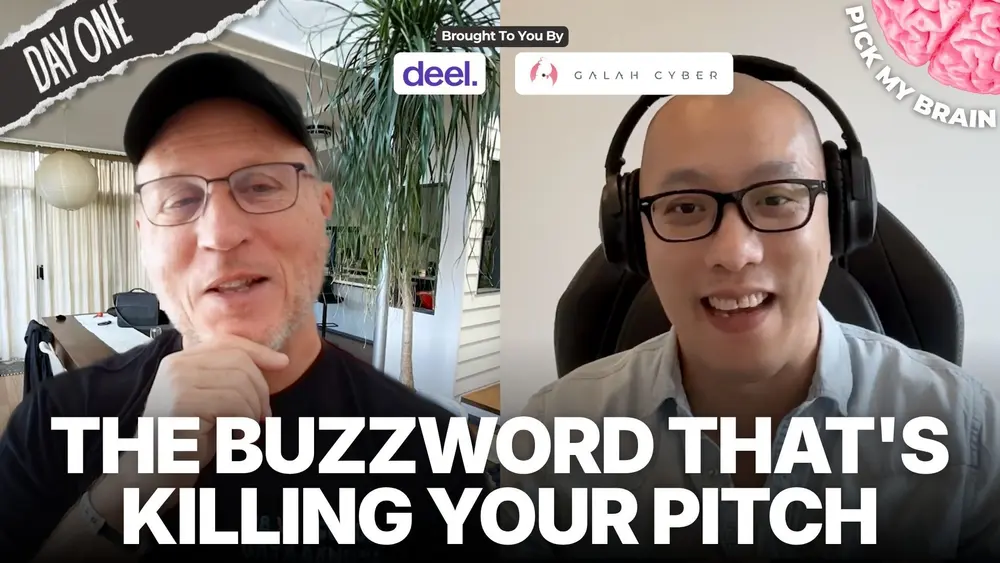
Transcript Synced · select any line to jump ▾ 0:02 Speaker: Founders scale faster on Deel. Set up payroll for any country in minutes, hire anyone anywhere, get visas handled fast, and get back to building. Visit deel.com/dayone. That's D-E-E-L dot com slash day one. The issue that we see a lot of the time with AI, be like spitting out a whole house and then you say, look, I don't like the porch. I want to update the porch and it just spits out a new whole house with a different porch. Torch, which isn't great. 0:34 Alan Jones: Aviata Consulting was recognized in the AFR Fast 100. Tell us about why they picked you, where you ranked, and what was all that about? 0:42 Ben King: At the moment, between Anthropic and Gemini, Gemini are a bit like developers. They favor an AI tool like their religions. 0:49 Alan Jones: Tabs and spaces, when are we going to resolve that one? 0:51 Ben King: Yeah, but never. 0:54 Speaker: Welcome to Pick My Brain, the podcast where we help startup founders improve their pitches to better connect with customers, co-founders, and investors. My name's Allan Jones and I'm an ex-startup founder myself, but now I'm an angel investor with literally decades of experience helping new businesses find their footing and achieve their goals. But first, I'd like to acknowledge that this podcast is being recorded on Gadigal land, land that was never ceded. I pay my respects to their elders and innovators past, present, and emerging. On Pick My Brain, you'll hear the real story straight from founders as they pitch their startups, tackle the challenges we all face, and turn their ideas into a successful business. Hopefully. Each episode, we'll see if I can help these founders take their startups another step forward with some advice, some ideas, and maybe a little constructive criticism. Thanks for joining me, audience. Let's get started. 1:43 Speaker: You're listening to a Day One FM show. Wondering how your AppSec program really stacks up? Golar Cyber's application security assessment gives you a quick 10-minute pulse check built around the 5 core principles of AppSec: inform, integrate, influence, innovate, and iterate. In just 10 minutes, you'll get a clear snapshot of your maturity across each of these principles, along with practical insights you can put to work straight away. Head to glasscyber.com.au/assess and take the assessment today. That is glasscyber.com.au/assess. 2:23 Speaker: Today we're joined by Ben King, who is the founder and CEO of Aviato Consulting. Thanks for joining the show, Ben. How are you going? 2:30 Speaker: Yeah, well, thanks, Allan. 2:31 Speaker: Cool. Ben, before we get going, two standard questions that I love to ask every guest that comes on the show, just to give a bit of a sense of who you are. First question is, when you were a kid, what did you think you wanted to be when you grew up? 2:43 Speaker: A cop or a soldier. I managed to do the soldiering for a brief period of time, but ended up in tech. 2:50 Alan Jones: So you thought early on you were pretty keen on rules and the enforcement of? 2:55 Ben King: Not really. I think I just liked action and adventure more than— More than rules. 3:02 Alan Jones: Right, right, right. Running around throwing sticks at other kids. 3:05 Ben King: Yep. That was me. 3:07 Alan Jones: Cool. So what were you doing immediately before you got involved in startups? Obviously you weren't a policeman. 3:15 Ben King: No. Yeah, I did army for a year, but a long time ago. I was basically doing the same thing at Google. So Google has, Google Cloud has professional services team that will implement Google Cloud for large enterprise customers. Very big day rate. So I was running the app modernization team for Asia Pacific. There and then started this, which is basically doing the same thing, but refining that to, well, we're now doing Asia Pacific as well, but when we started it was Australia and New Zealand. 3:40 Alan Jones: What does app monetization mean? 3:42 Ben King: Yeah, so it was app, sorry, app modernization. So taking old apps and turning them into new cloud native apps. And that also covers building new apps. The business now does a lot of AI and data and infrastructure and other things. So it's expanded in the scope of services we offer. At Google, I had different teams for infrastructure and security and app modernization. 4:03 Alan Jones: Is the company name Aviato Consulting a callback to a long-running HBO show, a longtime favorite of mine, Silicon Valley? 4:12 Ben King: It is, it is. When I started the company, it was not meant to be this. It was just a way of doing a bit of a side hustle, I guess. And the accountant asked me for a name and I said Aviato, and he just went like, well, spell it. And that's kind of how it came about. And then as I decided to leave Google and went full-time, I had the company already set up. So instead of shutting it down and starting a new one, I reused it, but it's a good in-joke for a lot of engineers at conferences. They come up and ask that same question. 4:41 Alan Jones: But it's advice I've given many, many times before. If you're new to the tech startup industry, see if you can find the episode. I think there were 6 series of Silicon Valley. It's one of the best primers on how the tech industry really works that you're ever going to find. And it's also hilariously funny. 4:59 Ben King: Funny because it's true. 5:01 Alan Jones: Funny because it's true. You will, you know, there are characters on that show who are based on real people and also like real stereotypes, real kinds of people that exist again and again in our industry, don't they? 5:11 Ben King: 100%. 5:12 Alan Jones: I think one of my favorite episodes is the episode where this guy who's incredibly wealthy billionaire, he co-founded his business in his parents' garage and he's leading some young startup founders through, you know, wants to show them the museum, which is now the garage and then steps out through a different door and they realize that they're in this enormous hangar. The garage is inside this enormous hangar and there's like a private jet over here and a helicopter there and, you know, four-wheel drives and it's crazy. It's a really, really good show. 5:46 Ben King: It is a great show and it's still funny now, like even though it's like a decade old, I guess. 5:50 Alan Jones: Well worth checking out. It is like, it was early cloud and there's edge processing. They talk about that and there is the dawn of AI. There's a few very, very funny episodes where AI runs rogue and starts destroying things. 6:05 Ben King: Orders 4 tons of beef burgers or something like that. Yeah. 6:08 Alan Jones: Yes, that's right. And then there's the classic, uh, um, Hot Dog or Not Hot Dog episode too. 6:13 Ben King: Yep. 6:13 Alan Jones: Which is a, a great lesson on being very careful when you're, when you're briefing technical people for what you want built. You may get exactly what you ask for. 6:20 Ben King: Yeah. And, but there's people building apps that do that now, like identifying whether something is or isn't a, in that case, a hot dog, which is not very useful. Um, but there's whole apps built off that kind of stuff today. 6:30 Alan Jones: Yeah, for sure. For sure. This is a pedestrian. This is not a pedestrian. 6:33 Ben King: Yep. 6:36 Alan Jones: Mate, Aviolo Consulting was recognized in November in the AFR Fast 100. Tell us about why they picked you, where you ranked, what was all that about? 6:51 Ben King: Yeah, so it's based off your financials. So they take your audited financials, so your accountant needs to send a letter for the last 3 years and they just calculate the compounding annual growth rate. And we, we ranked 6th. The first one like blew everyone else out of the water and then everyone kind of fell in fairly evenly behind them. The, I can't remember the name of the first one, but they were absolutely killing it. So it's, it's based off, yeah, the financial numbers. So when I used to read that and be like, how do these companies do this? Like how do you get like a couple of hundred percent or a couple of thousand percent growth? And then we ended up in it. So it's a little bit surreal to be honest. And when you're in the business, you don't really step back and, and have a look at what you've done. But when you have those kind of events, you're like, oh wow, where, where'd we got here? How did this happen? 7:34 Alan Jones: So you need 3 good years. 7:36 Ben King: Yeah. Well, the first year doesn't need to be good. The second 2 do. 7:39 Alan Jones: Yeah. And then you can implode after that. So if anybody wants to appear in the AFR Fast Launch, just like, just do whatever it takes for 3 years and then, you know, just collapse. 7:52 Ben King: Exactly. 7:55 Alan Jones: Whatever is necessary. Let's get a little bit more granular about, you know, what you do. Software development has changed so much over the generations. I first got involved in my first startup in 1995. It was pre-cloud, it was pre-smartphone, and yet we still see around the place a lot of people building things using frameworks and coding tools and languages that predate when I got into startups in 1995. That's still true, right? 8:27 Ben King: Yeah, 100%. And we're still looking at really old apps. People occasionally asking us to look at some old COBOL app and refactor into something more modern. Obviously now we're using AI to accelerate that process 'cause previously these would be like, you know, 18-month, 2-year-long processes once it's all tested and security reviews. But with AI, we're kind of bringing that timeline down to 6 months. 8:49 Alan Jones: COBOL is C-O-B-O-L for people playing along at home. And I think that dates back to the, 1960s, I think. 9:00 Ben King: It was before my time. 9:01 Alan Jones: And it's still around in places like banking, insurance, manufacturing, control systems, things like that. And it still performs. One of the challenges is that it gets less and less compatible with modern hardware. And another challenge, it gets less and less compatible with modern software engineers who aren't trained to run these things. And so, you know, the elderly engineers as they pension out, as they start to suffer macular degeneration, you can't replace these workers and you do have to migrate to something new. 9:35 Ben King: 100%. And you see Commonwealth Bank now is running fully on cloud. They're all on AWS, like core banking systems, which is the first. So they've probably got minimal, if no, COBOL, but all the other financial institutions in Australia will have some poking around somewhere doing something probably pretty important. 9:50 Alan Jones: It's pretty amazing. And somewhere, you know, if you've seen a science fiction movie or a James Bond film from the '60s to '70s, there'll be that air-conditioned room with the big vertical cabinets with two giant spools of tape that are spinning around and that, you know, they were kind of like the, that's memory storage and backup. And there are still systems that are backed up to giant, like giant cassette tapes and just a big reel of plastic tape with little patterns of magnetic dots on it. 10:22 Ben King: Yeah. They still have those in data centers now. The tapes are smaller, but they'll be in a big machine with robotic arm that'll pull them out and, you know, once they get 2 years old, it'll rewrite new backups on them. These massive, they're as big as this room. Super interesting. Same, exactly the same technology, just updated a little bit. 10:41 Alan Jones: So for our audience of early and new startup founders, all of this can remain invisible and is not necessary. Too much if you're just at the idea stage or if you're just getting started. But it's always a good idea to understand our history, our history of our industry, history of civilization. If you're able to understand history, then you're able to avoid some of the mistakes that have been made in the past, right? 11:13 Ben King: Yeah, what's that? 11:14 Alan Jones: Some of the mistakes that have been made in the past is avoiding obsolescence. 11:18 Ben King: Yep. What's the saying? History doesn't repeat, but it definitely rhymes. 11:22 Alan Jones: It definitely rhymes. Absolutely rhymes all the times, he says. Ben, tell us about kind of the nature of most of the work you're doing these days. 11:33 Ben King: Yeah, I think we've probably hit 50% of our work is now AI. When anyone, especially large enterprise, gets started with the cloud, they want to have security controls and they want to set up networking and things that a lot of startups don't need to worry about. So we always start with that. We can do that for startup in a day because they don't have an on-premise data center network. They need to connect to the cloud. So that skips like a ton of work, but having those controls so they don't accidentally put some customer's information on the internet publicly exposed, which a lot of large companies have done and regretted it. That's the first part. So we do that. It's not a huge amount of work and we only, we do that fast and cheap because it typically leads into doing something that's a little bit more interesting, such as data analytics. And then AI being, yeah, 50% of the business at the moment, probably. 12:19 Alan Jones: So when you say we, is that the royal we or tell us about the team behind the business? It's not just you, right? 12:26 Ben King: No, we hit, um, 95 people. I think maybe 96. We've got someone joining, um, Monday possibly. It's grown fairly rapidly. I think we've got 16 people in Australia, um, one in Singapore and then the rest in India. So it's impossible to find good engineering talent at scale in Australia, especially on Google Cloud, which is probably, uh, behind Amazon in, um, skillset as well. And you'll see this with startups. If you go on any of the startup forums in Australia, there's a ton of people on there looking for a CTO or a founding engineer that has knowledge of like front end, back end, cloud, and a bit of AI. And these people are extremely rare and very difficult to find in Australia, especially for a decent price because they can go and get $200,000 to $400,000 on the market from working in an enterprise. 13:16 Alan Jones: Why do you think they are rare? Everybody agrees that Australia needs to be a, you know, a smart, innovative nation. 13:22 Ben King: Yeah, well, the universities, I think, aren't pumping out the required number of graduates that stay here. We get a lot of foreign students and they'll go to wherever country they move after they leave Australia. Some of them will stay here and be good, but I just don't think we've got the volume that we need, especially compared to, I think India does 600,000 STEM graduates every year, which is just mind-blowing when you think Australia's got less than 30 million people in the entire country. 13:49 Alan Jones: Yeah, that is pretty mind-blowing. You work a lot with people in remote locations. How do you manage culture? How do you help everybody feel like they're part of Aviato Consulting and not just jumping on a bunch of Google Meets 6 times a day? 14:09 Ben King: Well, we do jump on a bunch of Google Meets, but yeah, we do, we try and do every quarter an event where the team can get together. So we've got our kickoff in Goa, which is like a beach resort kind of town in India. That's in, in early January. And then the, some of the team, the front-end engineers just went to a Flutter conference in Bangalore. So they'll get together and have that in-person face-to-face time. They'll get a meal and build those relationships. It was super important. When we have customer kickoffs, we'll try and get people to come out depending on the size of the project to meet the customer. I think those face-to-face interactions really help make things move a bit more smoothly. So with doing entirely remote, I don't think works. Once a quarter is probably the least you could do, just so that there are those connections between team members. And if something is causing a problem, someone would be more comfortable saying, hey, Alan, this is kind of annoying me, rather than letting it turn into a massive problem and then have a huge blowup at the end of it. 15:07 Alan Jones: Got it. Got it. Are you employing the team directly or through a third party? 15:19 Ben King: No, we have a wholly owned subsidiary in both Singapore and India. And we kind of have to do that. Some of our, and this might be interesting for startup founders, some of our large enterprises, we have a master services agreement with them. So these are like, you know, ASX 300s. And in there it'll say that we cannot sub-con or the sub-con must be listed in the master services agreement. So our agreements always have Naviato India and Naviato Singapore in there. So that we can do that. 15:43 Alan Jones: So just sorry for, for people new to the term, subcon is short for subcontractor. Yeah. 15:48 Ben King: Yeah. And the master services agreement's just a contract that goes over and they'll, they'll last for 3 years and negotiating them can be painful. But it will say that we will subcontract to the Indian or, or Singapore subsidiaries only. 16:01 Alan Jones: How much of an effect do foreign exchange movements have when you're paying people in their local currency and earning revenue from Australian businesses? 16:10 Ben King: Yeah. So the rupee has weakened about 10% against the dollar this year. So it's been fantastic for me. I think that will turn around. We also get paid in USD from some clients overseas and NZD a little bit as well. So it, there is that risk when we take, we do work for a company that pays us in USD. We convert that into AUD. We're losing a percent and a half or something on that. And then when we pay employees or transfer the money to the Indian subsidiary, we lose another 1.5%, and then India has some funny tax laws where we actually have to keep 15% profits on that in India for a period of time as well. 16:48 Alan Jones: Yeah. Yeah, that's complicated. 16:51 Ben King: Yeah. 16:52 Alan Jones: Modernizing people's technology platforms, I guess first requires understanding what's been built. Tell us a bit about that investigative process. What kind of questions do you need to ask to find out, you know, what it is that you're being asked to modernize? 17:08 Ben King: Yeah, AI is actually good at that if you can get access to the code base. You can run AI tools across the entire code base and say, break this down for me, write a comprehensive document, create a product requirements document, which is fairly common in the industry to explain all of the things that that software does. And that's some of their step to refactor code using AI. We found if you take COBOL and say, turn this into JavaScript, it'll do a reasonably good job of it. If you take the COBOL and say, write a product requirements document that outlines every feature that this code has, and then you take another agent to take that product requirements document, turn it into code, we actually get a better result. I think, and we're not sure why, AI is a bit of a black box, but we think it's just trying to rewrite the code as it's written. And sometimes that code is, you know, 4 decades old and it's got lots of Band-Aid fixes and other things in there that you probably wouldn't do if you rewrote it from the ground up. So we actually get a better result going with the intermediary step of having some documentation being written, which is— interesting if, if especially for anyone wants to try that themselves. 18:09 Alan Jones: Yeah, cool. That's great advice. Great advice. Tell us about some of the AI tools that, that you're using in the team. 18:16 Ben King: Sure. For, for coding, we're mostly using Gemini. We've tried Anthropic previously. At the moment, between Anthropic and Gemini, Gemini, there's not much in it. Like some people will favor one, some will favor another, but that's like developers. They, they favor religions and AI tools like their religion. 18:35 Alan Jones: Sorry. Tabs and spaces. When are we going to resolve that one? 18:39 Ben King: Yeah, but never. 18:40 Alan Jones: No. 18:41 Ben King: I've given up. The reason we use Gemini is we've got basically a fairly high free tier as part of using Google's Gemini Enterprise. So there's, part of that is Gemini Code Assist. So our developers get that for free up to a certain usage limit. And the cost of running agents that aren't being run by humans, Gemini is about 10% the cost of Anthropic as well. So depending on your usage, you may want to factor that in, but no one yet has complained about the price of AI for the value that they've seen. Or actually, we've had multiple people shocked at how cheap it is, not how expensive it is. 19:16 Alan Jones: Great advice. Great advice. So I know I see a lot of tools marketed to non-technical founders as a magic bullet, super solution in one box. Just write just a quick narrative of what you'd like your MVP or your prototype what to do, or your fully functioning mobile app, and away it goes, and it's going to build you something, and 48 hours later you'll be up there in the App Store making hundreds of thousands of dollars a month. How close or far from reality do you think that is in your experience? 19:57 Ben King: I think if you are building a prototype, it's incredible. The issue that we see a lot of the time with AI spitting these things out, it'll, it'll be like spitting out a whole house. And then you say, look, I don't like the porch. I want to update the porch. And it just spits out a new whole house with a different porch, which isn't great. Some of the newer models are getting better at fixing things, but they don't understand the full consequences of the changes they're making. So you might fix a problem in one part of the app and you'll create 3 new problems. So as soon as you're in production, you've got a paying customer on there. If you're breaking something every week, they're very quickly going to churn. But getting to the point where you've got an app that's built, you've tested it out, you've got a few customers partners that maybe aren't paying you what you should be charging, um, just to kind of build the platform and get feedback. It's, it's a huge accelerator. You can really test something out with minimal effort. One-person companies getting something with 20 users on it and going, okay, I've got this thing, I've got 20 users, most of them are paying, the two that aren't are case studies, and I need some funding to kind of hire a dev team. And taking that to a VC like yourself is really, really smart. 21:02 Alan Jones: I think, um, You know, early stage investors are always looking for visible proof that you're solving a valuable problem for a customer. And I think the difference between paying $0 for something and paying $1 for something is much, much bigger than the difference between paying $99 and $100. 21:20 Ben King: Yep. 21:21 Alan Jones: You know, so when an investor can see that you're solving a problem, even if the customer's only paying a very small amount, it matters so much. You know, early in the days of software as a service, we all believed the, you know, the orthodoxy was you give everybody a free trial, 14 days or 7 days or 30 days or whatever it was you wanted to do. Or even you just said, look, I don't have faith that this version of the product, this prototype or MVP is actually commercially going to keep a customer. So I'm just going to offer for free right now and call it a public beta. And I think the problem for investors then is you're actually not showing them what they really need to see. They don't need to see that people might use something. They need to see that people might get enough value out of using something that they might pay for it. And I think being able to connect up Stripe to that little prototype that you've asked something like Replit to build for you is, you may as well give this a try. You're not going to have the marketing budget to reach hundreds of thousands of potential customers a month, but you might be able to reach 5 or 10. And if those first 5 or 10 pay you $5 to use your prototype app and they don't like it and they churn, that's okay. You can easily go and find another 5 or 10 customers a day. There are millions and millions and millions of customers in the world. So I would really encourage people to have a crack at a prototype in an AI, hook it up and actually process some transactions so you can show people that might be interested in getting involved, whether they're investors or co-founders or potential team members, that this might actually be a real commercial thing and not just a passion project. 22:56 Ben King: 100%. I'd agree with that. 22:58 Alan Jones: I used to be a product manager. That was most of my career in startups. And so I'm probably pretty biased towards the value that product managers bring to a project. But I do think garbage in, garbage out. And one way to get good use of an AI coding tool is to be good at writing a brief. And that's actually not a common skill, certainly not taught in school. 23:21 Ben King: No, it's not. And we've got a few product owners and product managers on the team, and some of the projects that don't have those on them always have problems, 'cause there's a big disconnect between what the business needs, and we mainly do B2B, but what the business needs the consumer needs and what the engineers are building. And so if you, if you have an AI or an engineer that is amazing, can write great, high-quality code that's very secure, if they build something that your customers or users don't want, then you've just wasted a lot of time and effort. And I think that product person is the glue that lines those things up so that you can be quite successful. 23:58 Alan Jones: Yeah. 23:59 Ben King: And then when you start getting feedback from users in the terms of you've spoken to them or they've emailed you and said this sucks or this is great, and in the metrics where you're seeing they all drop off on page 5 of the signup flow and then you go and realize the button doesn't work. 24:11 Alan Jones: Yep. 24:11 Ben King: Having that kind of person in that loop is gonna fix that problem. 'Cause if you've got an app and you're growing really quickly and someone pushes a change and all of a sudden everything drops off, the product person should see it first and tell the developers and make sure it's fixed. So it's, it's very key. 24:24 Alan Jones: Totally. It seems to me like AI performs pretty well at the briefing side of being a product manager, you know? So, so I can ask AI to, to, to be my product manager and I say, this is who I think my ideal customer is. And this is the problem I want to solve for them. Write a brief for a software development team on what this app should do, how it should perform, what platforms it's on. It seems to do a pretty good job of that. And another helpful thing that I found is that AI can do a pretty good job of impersonating theoretical ideal customers. I can say, I want you to be 25, 30. Each agent is a different version of my ideal customer and I interview them about what they expect to see in the app that I want to build. That can be a really helpful exercise. 25:13 Ben King: We haven't tried the second one. We've definitely used the AI to write the brief. And we've always refined it a little bit. There's always been stuff in there that it's missed or new ideas that we've had or ideas that we've had after we've read what it's written and been like, oh, actually that's good, but we can build on that. But actually using it to interview an agent that's pretending to be your ideal customer is a very interesting use case. 25:35 Alan Jones: So if you've written the brief and you give to the AI and say, it could be a really helpful question to say, what do you think I've missed? 25:43 Ben King: Yep. 25:45 Alan Jones: And if you're working with, if you're collaborating with the AI and developing this document, it can also be, you know, just as beneficial to say, what do you think we've missed so far? And it'll just become a new version of itself and take a look at it from a fresh perspective. 26:02 Ben King: Yep. 26:03 Alan Jones: Really, really great way forward. Like it'll come up with a, tell me 20 things that we've missed and 18 of them will be trivial and not relevant, but 2 of them will just rock you back in your chair and you go, oh, how did I miss that? 26:16 Ben King: Yeah, it truly is. It's incredible. And the amount of time it saves, like you would've done that previously by going out and taking that to a friend that was also a product manager and being like, what do you think? And they would've been like, oh, I just thought about this one extra thing. But AI will give you 2 in 10 minutes, which is way faster than your friend would be able to read the email. So it's, yeah, people, a lot of the enterprises that we work with are using it in some of their workflows. But it's amazing how many people are not using it or are not using it to their full potential. 26:44 Alan Jones: Is, is, is there a part of your sales and marketing at Aviato that, um, where you're using AI? Are you using it for like scaling up outreach or communications to existing customers or anything like that? 26:57 Ben King: Yeah, in sales I use it to write our statement of work. So we have a template statement of work and we'll have a meeting with a customer. We'll take the transcripts, put it into AI and say, update this statement of work for this use case. And it'll get most of the way there. We'll obviously need to go through and refine it because there's gonna be things in there that it didn't understand. And once it's refined, we'll then send it back through and say, check that we haven't missed anything in the out of scope section or test those other things. And it does an incredible job. So our turnaround time for a statement of work is, sub one day, whereas previously it would be like a couple of days by the time it's been reviewed. 27:34 Alan Jones: Yep. Yeah, that's great advice too. That's great advice. You know, running through transcripts of video calls is absolutely what it was born to do. It has an unlimited attention span. It never gets bored by the customer droning on. 27:51 Ben King: Yeah. And even Google Meet now, it's got Gemini in the sidebar. So I'll join a meeting late because one's gone over and it's kicked off and I'll be like, summarize the discussion to date. And it's like 3 bullet points on my I'm like, sweet, and I'm straight away up to speed. And then at the end of the meeting, I'm like, give me all the action items. And then I put them into my HubSpot and follow up. So it's, it's incredible time saver until occasionally I've had it once or twice where there's been an issue with it. It hasn't worked. And I've been like, I didn't take any action items. I'm trying to go back through and remember what we discussed. 28:18 Alan Jones: Yep. Yep. Do you find yourself subject to a, do you increasingly get unsolicited inbound sales emails that have been generated by AI? I get a heck of a lot of that these days. And it's frustrating to me because almost none of it is appropriate for me. It's, you know, I invest in early stage product-led startups from Australia and New Zealand. It's basically those three things. And 90% of the startups pitching me are from outside of Australia. They're at idea stage and there's no technical people in the leadership team, so it's not product-led. And it's probably doing something that I have some sort of ethical or moral disagreement, trying to encourage people to speculate on the next generation of NFTs or it's online gambling or something. And it's just like AI, I'm so out there with what I look for. Like why would you erode your own brand perception out there in the world with strangers by just shotgunning everybody out there with the same stupid message. I think that's a real failure. I encourage everybody, you go ahead and use AI-powered sales tools, but please like, you know, look at the people that the AI is, the leads is harvesting for you and go and check a few of them out yourself. And I think you'll find probably, you know, it's pretty low-quality leads and you're going to hurt your business more than help. 29:52 Ben King: Yeah, and there's a lot of tools now. We've used a few of them, but our approach is fairly different. We'll filter down very specifically and get high-quality leads and actually send them physical goods because people don't do that much anymore. So that's, it's a very different strategy. It's much more expensive where I could be sending out 10,000 messages a day, 10,000 emails a day. It's very lazy, but as you said, like you can tell as soon as it's AI and I just say stop or no thanks so that the AI will stop bothering me because sometimes they send follow-ups every day and you're like, I'm like, well, then you go back and you're like, you sent me 15 messages and I've not responded to one and it's clearly an AI, which is really frustrating. 30:29 Alan Jones: Yeah. Yeah. 30:31 Ben King: Voice notes is the alternative that we've seen recently now. So there's so much AI that people have started sending me voice notes on LinkedIn. If you send me a voice note, I will not be listening to it. I do not have time for that. Some of them are 4 minutes long. I'm like, I don't have 4 minutes to listen to some random person's nonsense. 30:45 Alan Jones: Yeah. Yeah. I need chapter markers, you know, just, yeah. Give me a 3-bullet point summary of what this voice node is about. And then maybe, maybe then. So Ben, what's coming up in 2026? What can startup founders expect to see? Do you think we'll expect to see some consolidation in the sort of AI-powered development tools that we use? Will anybody get knocked out of the race, run out of funding, go bust, get acquired? You know, if I wanted to be working on a platform which is gonna make it through the next 3 years of craziness, what should be in my stack, do you reckon? 31:28 Ben King: I see people signing, like large enterprise signs a 3-year deal with OpenAI and I'm like, this is such a fast-moving space. They might not even be around in 3 years. Like that's how fast it's moving. And there's a lot of people speculating that they are gonna go bust because of this circular economy. I'm not gonna get into that because there's finance doctors that have written way better articles on it than me, but there is a risk that that will collapse. 31:49 Alan Jones: Hmm. 31:50 Ben King: If you're using Amazon or Google, you can use the Anthropic models. I think Microsoft, you can now use Anthropic models as well. Their models are always in the top 3. If you're using Amazon's native model, it's nonsense. Like, no one has ever said that it's great. Maybe if you work at Amazon, you might. Microsoft, they've got the OpenAI kind of one that you can use through theirs. I hate that Azure interface and Google's got Gemini as well as all of the image and video ones, which are actually always at the top of the leaderboards on them. So I kind of look at the platform that you're using and say, do I want to put all of my money on OpenAI? Probably not the best bet because they, they might fail. So look at something where you can change the model very quickly and Google's got Vertex. So I can use Anthropic, I can go to DeepSeq as in DeepSeq running on Google's hardware, not in China. And then I can use Gemini and whichever models I want. So there's a ton of different open source source options. And you might have, you might be building a business where different models for different uses. If you've got a chatbot, it needs to be really low latency because if it takes a minute to respond, people will close that tab. But if you're rewriting some software, you can take half an hour because software engineers would take a day. And it can cost away a huge amount. If you're paying $10 to have some software written, you'll be fine with having a $10 bill to respond to a chat message. Obviously that's it's not financially viable. So looking at the, the model that you use, and then we kind of get into the point of evaluating those models. So for your use case, Google will have Gemini 2.5 and you might be using Pro because you tested a few of them and think it's good. When they release Gemini 3, do you just upgrade? Because it might break some stuff. 33:31 Alan Jones: Hmm. 33:32 Ben King: Definitely do things slightly differently. And then factor in the cost as well. So evaluating which models you use on an ongoing basis is kind of becoming pretty important to a lot of businesses at the moment as as well. 33:42 Alan Jones: Cool. Cool. I particularly like your advice about not signing 3-year contracts. You know, 12 months is probably the longest you should be signing at this point in the growth curve, right? 33:53 Ben King: Yep. 33:54 Alan Jones: Crazy shit could happen next year. 33:56 Ben King: And for startup founders, they should be getting credits at AWS and Google. I don't know if Azure does them as well. I don't know any startups that use Azure. It's such a terrible, just the interface bothers me. So you should be getting 2 years of free runway with either AWS or Google. The, the thing that I see a lot of founders do, they'll start using a proprietary database. So Google has a database that you can't run on Amazon. You could just run SQL or Postgres, which you can run on both those clouds. So when they start using these credits, make sure that you're using services that are transferable. So when you run out of credits on Amazon, if you haven't raised a Series A and no longer care about credits, you can just move that workload to Google or vice versa and maximize that free cloud computing that you're going to get, which should cover all of your AI usage as well. 34:38 Alan Jones: That's all great advice. And I know there will be many contrary opinions and we encourage them. Get those comments coming in. This gets posted to TikTok, it gets posted to YouTube, it gets posted to Spotify, it gets posted to LinkedIn. Hop in, tell us what you think. Tell us when you think Ben and I are right or wrong. Come in with, especially with other ideas and better solutions. Like if we share openly, constructively, and with respect, then we all make better progress. Ben, look, thanks so much for coming on the show today. It was great to hear about Aviato and how rapidly it's grown. Congratulations on being the 6th fastest company in the AFR Fast 100 this year. And thanks very much for joining me today. 35:30 Speaker: Awesome. Thanks, Alan. Thanks for having me. 35:32 Speaker: Thanks too to listeners and viewers of this and every episode of Pick My Brain. The Advice Podcast for Every Startup Founder. Thanks for listening and watching. And if you enjoyed this episode, never mind the don't forget to like and subscribe bullshit that every podcast host goes on about. Instead, please take a moment to think about someone you know who could maybe benefit from some of Ben's advice that we've heard today and tell them that they should listen to it. Maybe they'll choose to like and subscribe. That'd be nice. That said, I'm not a lawyer and neither is Ben. I'm not an accountant, neither is Ben. And what you've heard today is not intended as financial or legal advice. Advice. You should always seek that from a qualified professional before making the big decisions. And neither of us is a superhero either. So don't forget that sometimes I'm fallible and very occasionally I might even be wrong. So please let me know what you think and when you think I might be so I can get better at this job too. So just reach out to me on any of our social channels or email the show at pickmybrain@startupfoundercoach.com. That's pickmybrain@startupfoundercoach.com. thepickmybrainpodcast is produced, edited, and beamed directly to your ears by the hardworking and greatly appreciated team at Day One, the podcast network for founders, operators, and investors. Find out more at dayone.fm. See you next time. Thanks for joining me for this and every episode of Pick My Brains, the advice podcast for every startup founder. Have you been listening to the show and wishing you could ask for a little advice about your startup? Well, here's your chance to do just that. We're trying something new and you can be part of it too. Leave me a voicemail message with a question you'd like answered in a future episode and I'll do my best to give you the best advice I can. Just go to speakpipe.com/pickmybrain and leave me your most pressing question, request, or just some feedback and support for the show. Go to speakpipe.com/pickmybrain or follow the link in the show notes.


 ▶
▶  ▶
▶  ▶
▶  ▶
▶  ▶
▶  ▶
▶  ▶
▶ ▶
▶ ▶
▶