Transcript Synced · select any line to jump ▾ 0:02 Speaker: Founders scale faster on Deel. Set up payroll for any country in minutes. Hire anyone anywhere. Get visas handled fast and get back to building. Visit deel.com/dayone. That's D-E-E-L.com/dayone. 0:22 Justin Hansky: There was a lawyer in the US, to be clear, a very bad lawyer, I would say. They were suing an airline and he had ChatGPT draft his legal arguments. 0:32 Elena Tsalanidis: We can't afford to have hallucinations such that then people are giving advice that is wrong or fake. And we've all seen the headlines of people using AI in courtrooms and it not working. 0:42 Georgie Healy: But can it replace junior lawyers? 0:44 Elena Tsalanidis: I think it's likely that we may need less junior lawyers. 0:48 Georgie Healy: But if everyone can bring something to market, how do you, how do you compete? 0:52 Elena Tsalanidis: Good luck trying to get a bot to figure out how to do due diligence. Effectively, like it's just not going to happen in a way that lawyers would be happy and confident using. 1:03 Justin Hansky: The billable hour being less prominent as we move on. I don't think we'll be able to kill it fully. I think it's incredibly stubborn and it's survived many waves of assault, but it's definitely getting eroded. 1:14 Elena Tsalanidis: We think about AI as supercharging what lawyers do, not replacing what lawyers do. 1:20 Speaker: Hello everyone. Before I introduce this week's episode, I have really exciting news. We will be having our first ever In the Blink of AI live show. If you love the show, it's gonna be an amazing chance to experience it in person on Thursday, May 29th at the University of New South Wales. We're really excited to have the guest, Andrew McCarthy. He's head of APAC and Asia at Notion. So tickets are in the description below. I would love to see you there. Hello and welcome to In the Blink of AI, where I talk to the brightest AI startups and innovators each week. I'm Georgie Healey, and this week I'm speaking to two people, Justin and Elena from Diligence, and what incredible guests they were. We talked about how AI is disrupting the legal industry, something that I've been really passionate about covering on the pod, and this episode is a real treat. We unpacked how Diligence intelligence accelerates the M&A due diligence process, how these founders' legal domain expertise ensures trust and accuracy, aka, you know, those scary/hilarious headlines of fake AI-generated content being used in courts. They avoid that, which we unpack. We also talk about the scalability of legal diligence in other markets. We even have some tips for favorite legal TV shows and so much more. They were such good sports with, you know, they were completely unflinching in even the spicy hot takes. They actually added some of their own hot takes without me prompting them as well. Couldn't have had more fun on this episode. I can't wait for you to hear it. Let's dive in. Hey, Justin and Alaina. Thank you for joining in the Blink of AI. I am so pumped because it's the first time I've ever had two guests on the show at the same time. Please tell me about yourselves and what you do at Diligence. Elena, can you start us off? Sure. 3:32 Speaker: So, um, hey, I'm Elena. I'm one of the co-founders of Diligence. Justin and I are both ex-lawyers. Uh, maybe you never stop becoming a lawyer, but we left the corporate law world and started a tech company that helps lawyers move through legal due diligence in half the time with greater level of accuracy than just a human alone. And I guess like my story personally is making it out of the corporate world, seeing a problem that we could solve, and feeling really energized and excited about the tech space, especially around AI and what it can do for folks in law, or really in professional services more broadly. 4:12 Speaker: Hi, I'm Justin. I used to be an M&A lawyer, so that's the kind of lawyer who works buying and selling businesses. And then I worked in legal technology over in the UK where I helped very large law firms like Linklaters and Ashurst find good things to do with technology. So I've sort of been at the intersection of law and process and tech for a while and really bring that lens to Diligence where I look after the tech and product side of our business. 4:37 Georgie Healy: I'm so pumped to have you guys. Law and how it's being disrupted by AI is constantly in the headlines, at least for me. I keep seeing that, you know, the entire legal industry is being changed through AI. While I've got you, Justin, what are some key factors that go into M&A due deal? 4:57 Justin Hansky: Due deal. I like it. 5:00 Georgie Healy: I'm, I'm super down with you guys already. Now I'm your third co-founder. 5:04 Justin Hansky: Amazing. Yeah, it's, I mean, people often call it DD as well. So if we do that, that's what we're talking about. So basically most people aren't going to know what due diligence is. It's generally done, at least the way, the part of it that we look at is in the context where someone wants to buy a business. When you're looking at a business, you don't know much about it. And so what you end up getting given access to is a big pile of documents and you're looking for needles in a haystack that are going to affect, you know, what you pay for the business, whether you need to do some things to fix it before you actually take control. There's lots and lots of people involved. It's not just lawyers. You have bankers, corporate advisors, accountants. There's lots of people who make plenty of money off this process. But really, for the lawyers, it's just a tick box exercise. So, you know, the people who are about to spend $50 million on a company want to know that it does what it says on the tin. And so they pay their lawyers to read documents cover to cover. I used to do this. It's incredibly grim. There's lots of miserable things about doing it, but I think a few factors that are kind of interesting as to why it's pretty miserable for lawyers. The first one is, despite everyone's belief based on Suits that all lawyers can do every kind of law, lawyers are actually very specialized. And so what you end up with is a team of half a dozen very specialized lawyers coming together briefly for a project and then going away never to work with each other again. So it's really got a big herding cats element to it, especially if you're the person running the project. The second piece is really reading contracts cover to cover is incredibly dreary, mundane work. Summarizing them for the clients is mind-bendingly dull. And after 16-hour days of doing this back to back, you will probably do what I did, which is look for the exit door and go and do an MBA or something, basically anything else. 6:51 Georgie Healy: It blows my mind too, because you guys are the smartest people in the world. The guys that get into law, the girls that get into law, the top scorers at high school, you have to be Genius level. I definitely wasn't. I wanted to get into law and then you are just reading these contracts. What is that about? Thank you so much for explaining. I'm not surprised you wanted to get out. Elena, on your website it says AI accurately summarizes contracts, but why use Dealigence for this? Can't I just dump a contract into ChatGPT and be like, yo, summarize this. 7:26 Elena Tsalanidis: So short answer, no, it doesn't work. We actually even tried it. Um, we had a collaboration tool first and foremost before we layered AI into our platform, and our customers were rightly so asking us like, how do we use AI in our practice? How do we speed up and help what our lawyers are doing in a due diligence? And so essentially like We can't put something in lawyers' hands that isn't amazing, but also highly confidential and protecting their information. So if you think about lawyers, like many other fields, like probably a bit like medicine or a pilot on an airplane, you really don't want them making a mistake. And there's this culture of perfectionism in what they do. And so I guess like with an AI lens over that, we can't afford to have hallucinations. Such that then people are giving advice that is wrong or fake. And we've all seen the headlines of people using AI in courtrooms and it not working. Without spilling all the beans, worked with a team of 3 machine learning PhDs to spend many months figuring out how to scan a contract and accurately summarize it in a diligence context. And it's frankly beyond the scope of most lawyers. We're talking, you know, thousands of words in prompting, showing it, you know, what good looks like. And really to get to a point where you can help a lawyer scan a contract and summarize the relevant parts, like ChatGPT is not going to give you the answer that you want without a lot of work. And so we took the view, let's do all that work and then just equip the lawyers with a tool in their hands to do it more effectively. So these models, like the big LLMs, they don't know what good looks like because at due diligence, it's often really complex, highly confidential information. And so like if you're a lawyer, like PSA at a firm, you shouldn't be using ChatGPT because you've got confidential client information. And so our system makes sure that there's no gap, no spillage of any of that information. It's all protected in a highly confidential walled garden. So that's how we think of it. 9:43 Georgie Healy: Amazing. Great point. Like, and should apply to anyone. Don't put any of your work-related content into these LLMs that we just don't know where they're going, right? Very dangerous. 9:53 Elena Tsalanidis: What's so interesting here is like, we've been in conversations with partners at law firms, and I think we're all guilty of it, where you're like, I just have a quick question. I'll ask an LLM. Like, that cannot happen when you have— and this would be like for consultants or bankers or anyone in professional services— you have duties of confidentiality to your clients. So you can't be asking an LLM with any sort of identifying information about that. So figuring out a tool that works for you that's going to keep all that info secure, that's where players like us come in to change how they work. 10:28 Speaker: I love it. Uh, back to the news headlines though, What does the legal profession look like in this AI future, Eleanor? 10:37 Elena Tsalanidis: Yeah, so I don't think we are doing lawyers out of a job anytime soon in the short term. Lawyers are, and I would really apply this, Georgie, to even a more broader set of folks who are, you know, professional services workers, right? They are highly skilled. They might be sued if something goes wrong. AI is not at a point where we can trust it wholeheartedly and send work directly off to a client. There's this famous Henry Ford quote, you know, ask people what they want and they want a faster horse, not a car. I think we're at this point now with AI where people are looking for a faster horse, but there's no reason in future why that's not going to drastically change. So for us as business owners, we are delivering on that. the faster horse, the more accurate horse to get people from point A to point B. And I think we'll have this second, later wave where we're able to step back and say, you don't need a horse, you need a car, and here's the car. So, I think right now it's incredibly naive to think that lawyers are going to be replaced by artificial intelligence in droves. We're seeing a step change, and maybe in 6 to 9 months we might seeing more, getting to that car or that spaceship. But really, we still need that lens of that senior human in the loop to check the outputs. So we say to our customers, we're going to give you this incredibly accurate AI-generated summary. You need to check that summary and ensure that it is the way you want to answer that question and the way you want to deliver that work. And so for right now, that's where we're at. But I think our long-term, big hairy audacious goal is to actually be doing the entire workflow and then having a very senior lawyer check that rather than biting off a part of the process. But as I mentioned before, these perfectionist lawyers, which we are in that group too, we've got to give them something that's really good right now to build that competency before we can deliver them the car or the spaceship. 12:41 Georgie Healy: This is why I love speaking to entrepreneurs. I'm, I'm definitely the slightly faster horse mindset, and then you need an entrepreneur that's like, yeah, but what if we thought outside of that? But not yet, right? Okay, take me to the billable hour model, something that I didn't know existed 2 weeks ago, um, and now it's like all I can hear about, especially in the legal context. What is it, and like how is it being disrupted or not? 13:13 Elena Tsalanidis: Yes. Okay. So when we think about the billable hour, that is breaking up an hour into 10 parts, which equals 6-minute increments. And so the bane of every lawyer's existence is having to keep time on a task. The way the billable hour has traditionally worked is that time spent equals amount charged equals output. It's kind of, I guess, a bit of a perverse incentive because the longer something takes you, typically the more you can bill for it rather than being aligned to value generated. Some innovative firms are thinking about how they can do value-based pricing, but really the default at most places is switching on a, a stop clock and billing by the hour. I guess we're in a unique point in time because AI is changing the speed at which, at, with which work can be delivered. So we have this billable hour model being completely undone because AI can scan and summarize contracts and suddenly you can move through something much quicker and more accurately. So the great firms that I'm speaking with are thinking about how we apply this model, how we think about it going forward. You know, time spent by a lawyer used to be how long their task took them. And now really it's around the intellectual property of the firm and their precedent bank as to how long that task can now take them with a great AI tool. So all the best firms are thinking about how they can respond to this step change in pricing models. I'm not sure if anyone's landed on the perfect solution just yet, but we're engaging in some really interesting dialogue around how professional services charge clients for work that they know now they can deliver much quicker. Or in our case, they can deliver it quicker and do more work in that time. Okay, are you charging a client more? Are you delivering a better client service? Are you charging them the same? Are you reducing the fees they need to pay? These are all the sorts of things that they're, they're talking about. In diligence specifically, this is an area of law where people typically set fee caps. So where we can help firms deliver that work for less is actually great because often they run over and they can't really bill everything that it took them to deliver the work. So for us, we're helping them get it done within the, the time frame that they allocated. 15:37 Georgie Healy: Uh, when you were explaining it to me, it reminds me of this very salty quote about Charles Dickens. Apparently he was paid by the word. So people that aren't like Charles Dickens reader are always like, oh, you could so tell he was paid by the word. Okay. He's way too verbose. But maybe there's a world in law how this is like win-win. Like as a client, you aren't paying for additional time that you wouldn't necessarily need to. And maybe for the lawyer, it's more meaningful time. I'm not sure if you agree, Justin. I'm about to ask you a question, but would love your response to that. 16:11 Justin Hansky: Yeah, and I think there's also a level of competition that happens in the market and people are becoming more savvy buyers of legal services and they know what things should cost. And there's a lot of push from clients now to get firms using AI to deliver quicker. And so all of these things are starting to filter through the system and will sort of lead to, I guess, the billable hour being less prominent as we move on. I don't think we'll be able to kill it fully. I think it's incredibly stubborn and it's survived many waves of assault, but it's definitely getting eroded. 16:41 Georgie Healy: Wow, that's a really great take, guys. Thank you. We talked about AI used in the wrong way in the legal services, creating fake court cases that might look real and then being used in a courtroom. I know I'm using the wrong terminology here, but are your customers, are your M&A customers aware or engaged if a model gives them the wrong steer and Do they need to be if they use Diligence instead, Justin? 17:09 Justin Hansky: This is something we've thought quite a lot about because we are dealing with a probabilistic technology here, right? Like I can ask the same question of an LLM 10 times and get 10 slightly different responses. We've built our system in a way that we're seeing very high levels of accuracy, north of 90% for what we're doing. But what we actually do is meticulously source all the bits of evidence that we've used in order to construct our answer. And highlight those in the contract for the lawyer to very easily say, well, is this true or is this not? And so the lawyers are still very much applying that sort of critical thinking lens to the final product, but what we're doing is we're enabling them. And I guess one of the risks with these is if people don't understand the technology properly, they can do silly things, right? So, you know, you talk about convincing legal arguments, there's actually a really famous case. There was a lawyer in the US to be clear, a very bad lawyer, I would say. They were suing an airline and he had ChatGPT draft his legal arguments and it gets submitted to the court at the end. And one of the things you include in there is all of the cases that you use to make your arguments. And the other lawyers got a look at it. They had a look at the cases and they're like, I've never heard of any of these. Turns out they'd all been completely hallucinated by ChatGPT. And so then the lawyer had to own up. And point out to the judge when the judge was like, hey, I think you've fabricated all of your evidence here. He was ultimately disbarred. There's a whole big kerfuffle. And I think this is kind of interesting, but probably for me, what's more interesting is what happens next. All of a sudden, every law society is warning its lawyers saying, hey, just be careful, this thing hallucinates, you can't use it for everything. And so I guess the question is like, what do you think happened after this? You know, do you think this is something that we've seen a lot? You think it was sort of one and done? And the answer was it just keeps happening. 18:57 Elena Tsalanidis: Really? 18:57 Justin Hansky: Yeah. You'll just see every few months there'll be someone else who'll just throw up ChatGPT submissions. They obviously keep discovering it incrementally. And I think what's interesting for me is it sort of reminds me that we're very much in the 1% here of people who are super engaged with learning about this technology, understanding how it's going to work. And outside of our world of VCs, of startups, people are just not as like top on top of what these tools do as we are. And so we need to be really mindful of that when we build. 19:27 Georgie Healy: I love that take. And it also tells me that lawyers really want to leverage AI. So if they could only do it in a way that doesn't land them in hot water and use the wrong tools, right? 19:42 Justin Hansky: Yeah, that's what we do. 19:44 Georgie Healy: I have one more question for you, Justin, on this. Have you You just, you just answered that. Never mind. We cut that out. Thank you for answering that one. Elena. 19:58 Elena Tsalanidis: Hi. 19:59 Georgie Healy: Give us a peek behind the curtain. No secret sauce. What specific AI models or techniques do you use to enhance the Judele efficiency? Like how technically do you try and create that model or train it? 20:16 Elena Tsalanidis: Sure. So we are always assessing the best-in-breed LLMs for every part of our pipeline. We work with the ones that work best, and as we know, they are constantly changing, annoyingly for us. Things are changing fast. So there's really a big difference in cost between models, and so we're tweaking and figure out which parts of that pipeline makes sense and swapping bits out where needed. There is a bit of a trade-off between speed and quality with certain providers and models. So we are also assessing what specific, specific tasks they need to perform. And then the big challenge for us, we're an Australian company, is ensuring that we are training our system on an, on a corpus of Australian. commercial contracts and that are relevant to Australian law. We joke like between our founding team that sometimes LLMs are fed a bit of a dumpster fire of training data and it can be really overwhelmed with this US-centric knowledge base. And so for us thinking as well about how we make sure that this looks good and in an Australian or Kiwi or UK context. Is something that, yeah, keeps us up at night. 21:38 Georgie Healy: I love it. I love hearing what actually goes on behind the scenes of creating an incredible AI-driven company. Speaking of incredible AI-driven companies, I know that there's many VCs that really are doubling down on this vertical AI, specific industries adopting AI, like legal tech. We also had Angela from Empathetic AI, that's in the tax space. It allows you to go really deep on a topic and unpack it with your domain expertise. But Justin, how do you unpack— you guys combined many years of experience and put it into an AI product exactly? Like, is it a— is it like Justin and Elena's like third co-founder? Is it more Justin or more Elena? Like, what's the model like? 22:26 Justin Hansky: Yeah, so I think probably having driven the product side of things, it's definitely got my personality and style, I would say, in the way it writes and expresses itself. 22:38 Georgie Healy: What is your style? 22:39 Justin Hansky: Concise, very few wasted words. Yeah, sort of, so me and other big law lawyers, people who are used to producing, you know, really high quality output for clients in the context of large law firms, have actually put that into our super opinionated AI product. We take a view on exactly what lawyers are looking for in a particular context. So I might get a little bit specific here and hopefully I won't bore the listeners to sleep. Please. But if a lawyer's looking at the confidentiality obligations in a contract, they sort of are looking at it in that context and they're basically asking themselves two questions. The first is, is it there? Which is easy for AI to answer. And the second is, is there anything weird about it? And asking that question straight to an LLM, you're not going to get a very useful answer back because it doesn't know what weird looks like. But having practiced law in Australia, I know what's market, I know what's unusual. And so I can give the, the AI a list of 5 things and say, these things are completely normal, ignore them. Anything outside of that, you should definitely be mentioning it. And so we've definitely spoken to a few people along the journey, AI engineers who looked at this, I guess, like legal tech gold rush that's going on at the moment and thought they'd have a piece. And they'd often do a dozen customer interviews, build a pretty bad MVP, and then run away with their tails between their legs once they realize just how much of a gap there is in terms of domain expertise that needs to go into it to make it really, really great for lawyers specifically. 24:12 Elena Tsalanidis: Mm-hmm. 24:13 Georgie Healy: I love this. Thank you. And the human in the loop aspect, Eleanor, uh, you talked about, you know, you, you leverage PhDs, uh, in machine learning to help you build your product. You guys both have incredible domain experience, but, but can you just hand it all over to the AI model now, or, or is there still that human element? 24:35 Elena Tsalanidis: Something that's perhaps not obvious to non-lawyers is that lawyers totally have a monopoly on providing legal advice. So if you're not a lawyer, you you cannot provide legal advice, which is why all those chatbots say, "This is not legal advice," and people probably wrongly start relying on it. So without a human in the loop, Georgie, you're not able to call it legal advice. So this really is a domain, I think understandably, where we want experts to be providing their lens over work before it goes out into the world, because those consequences can be so drastic. So I think where we're going to get to in a diligence perspective is, you know, a 200-page report that instead of taking a team of 20 lawyers 4 weeks to produce for their client, might be something that a senior lawyer reviews in a couple of days with the benefit of AI. But we still are going to need that, that human as that backstop with that context and additional clarity that You know, we can do our best to get our system at, you know, 90, 95% accurate, but still having that purview of a human on top, that additional layout. So I think it's vital that there remains a human in the loop. We think about AI as supercharging what lawyers do, not replacing what lawyers do. 25:56 Georgie Healy: Beautiful. And Justin, speaking about this is not legal advice and those, those disclosures, also privacy's a big thing. I'm sure when, when, you know, your M&A customers are coming to you with with these contracts. How do you, how do you wade through those waters of privacy and security and that kind of thing? 26:15 Justin Hansky: Yeah, so security is just a non-negotiable. I remember looking back to when we were building our MVP a couple years ago, and it just made it so much more expensive because we had to be built for incredibly sensitive data from day one. We work with very large law firms, so data has to stay in Oz. It's hosted across clouds that represent shorthand for security, so you know, we use AWS and Azure. It sadly means we just have to wait sometimes to get access to really the best frontier models. We just can't send our customers' data directly to OpenAI in San Francisco. Our customer security teams would melt down. I mean, we wouldn't even get through the information security process if we did that. But it's reality of competing in our, our industry. 26:57 Georgie Healy: Amazing. And last, one last one on this, this kind of area of security, compute, building a model. Elena, I love to ask founders, where does your capital go? Is it going into compute? Is it going into a team and employment because it's got such domain background? Like, where is most of the pool of capital going into? 27:20 Elena Tsalanidis: I mean, I would say great people demand great salaries, number one. And so our team is exceptional. And I think there is capital that has to be directed to having an engaged and excited team who are just legends and superstars. That's number one. But the way we think about our technical bills, especially around AI, is that, and it's something that every B2B SaaS company has with AI, is that there is a pricing problem. So, customers want price certainty over a platform that they're using and product that they're buying. And we as a vendor have to think, how do we build in fail-safes to ensure that someone doesn't try scan 1,000 documents and the cost blows out, but also enables them to use the platform effectively without thinking about cost. So there is absolutely, Georgie, a cost of computing. I think— We have a usage-based AI system, so it's a big input into our cost layer, and that's how we think about it. So we do that by tracking the amount of contracts that our system is scanning, but I'm guessing probably different businesses have different metrics for capturing their AI usage. 28:33 Georgie Healy: You're clearly so, both of you are so engaged in a not only incredible product that's very meaningful for a very specific audience, but also you've got that perfectionist lens. Have you thought future focus in terms of once you've scaled Australia, New Zealand, would you go elsewhere? Can you go elsewhere? Is it a scalable product? Justin, maybe you can answer this. 29:00 Justin Hansky: Yeah, sure. So the nature of legal tech is in order to be able to produce venture-scale returns, you have to be a global business from day one. So for us, that means next on the agenda, we're looking at the UK, looking at the US. Expanding beyond our current borders. We're going to sort of start our move into the UK later this year. And can the model be scaled? So the way we've built the system is actually very flexible in being able to spin up new provisions, new jurisdictional information. Like overwhelmingly the process is the same whether you're sitting in an office in Melbourne, in London, or New York. But in terms of some AI provisions, you might be looking for some different stuff in New York. Than you would in London. And so we can spin those up really quickly, sort of within a day or two, given the good work we've put in already. So— 29:49 Georgie Healy: That blows my mind. I clearly do not know enough about law, 'cause I was always like, it's the most, you know, specific to the country, you know, and the laws of that country. But clearly you guys are all over that. That's awesome. 30:03 Elena Tsalanidis: I think Georgie, it's this specific space. So I used to work in litigation, which was appearing before a judge in court, and I used to work for a judge. And that is very, very specific to a jurisdiction. Rules of the court engagement. This bit of the law is pretty uniform or relatively similar across different jurisdictions. So that's a plus for us as we push into the UK and US. It's a similar exercise, if not identical, in some of these neighbouring jurisdictions. So these English language jurisdictions, it's not too dissimilar. for this specific space. So I think you're right. 30:39 Georgie Healy: You guys are like, that wasn't an accident when we built this company. We knew what we were doing. That's awesome. 30:47 Justin Hansky: But seriously though, like we, there are things that we could be doing that don't scale well jurisdictionally. And so for now we're choosing not to do those things and focus instead on where we can have leverage that will expand and will travel really well. So it's definitely a consideration. 31:03 Georgie Healy: Well, don't tease me. What does doesn't scale? 31:05 Justin Hansky: Well, I can't, I can't get into the specifics of that, unfortunately. 31:09 Georgie Healy: Can't tell me? Okay, yeah, yeah, that's for the next pod. Time will tell. Okay, have you faced any skepticism from law firms, um, maybe due to these scary headlines, or maybe due to— I don't know if there's a cultural thing around lawyers and not adopting tech or change, uh, how have they received it and And please both answer this for me. I'd love it. 31:32 Elena Tsalanidis: Maybe I'll jump in here. I think lawyers are highly skeptical, really switched on people. So you can't pull the wool over their eyes. Like we know that our barrier to entry in this market is bloody high. They are time poor. If your product doesn't work out of the gate, they'll never use it again. So we know that we've got to put something in lawyers' hands that is amazing, or else you just won't get the time of day. It will become shelfware. Have we faced skepticism? Yes, but I find that the customers that we're engaging with are the ones that are really excited about the power of artificial intelligence or are really excited because they, they see and they know viscerally that so much of their day-to-day practice is mundane and repetitive and really can be leveraged not only with AI, but simple and clever automation. I think if you pulled like a bunch of lawyers on the street and you said to them, are there parts of your day that are mundane, repetitive, boring, that aren't actually strategic legal work? You would be astounded to know that it is maybe a majority of their day because they've got to get through those kind of drudgery tasks. Yeah. To then focus on the strategic work. And so I think, yes, there are always going to be skeptics. There are always going to be people that you can't win over, but really the majority of people, and this is even senior leadership, are excited about what tech can do. And even like senior leaders at law firms are thinking to themselves, AI is changing the game. We need AI. How do we implement it? So, I think it's really an exciting point in time to be a legal tech vendor because the— I think the floodgates are open and we're seeing all these people crop up with amazing innovative solutions. 33:23 Georgie Healy: They're seeing lawyers in cars and they're still on their horse being like, oh my God, I missed something major. 33:31 Justin Hansky: Yeah. And I think in terms of the skepticism, so some law firms can be quite traditional places. There are some partners who won't even write their own emails, so they're not using technology that was invented in the 1990s, let alone technology being made today, and these people will want work delivered to their office with a red pen so that they can write the little notes in the margins and then send it to someone else to type up. We're not going to win those people over. 33:58 Elena Tsalanidis: No. 33:59 Justin Hansky: Old dog, new tricks. So we have to focus on the people who are really interested in doing things differently. It's the junior lawyers. They're the people who are used to using ChatGPT in their personal life. They're used to using modern consumer apps, they know what technology can be, and so they're the ones who are hungry for something new. 34:16 Georgie Healy: I'm sure this is a huge market in and of itself when you've just played with any of these tools and you realize how rewarding they can be. Look, I've been looking forward to this section the whole show. You guys are so good at cutting through the, the noise and giving great insights. We are at the hot takes part of the chat. Are you ready? Ready. 34:39 Elena Tsalanidis: Let's do it. 34:41 Georgie Healy: Okay, just give me one hot take each around AI currently. Eleanor, can you start us off? 34:48 Elena Tsalanidis: My hot take is that as, as the founder of now an AI company, AI is obviously incredibly powerful and amazing, and we're at this watershed moment in time. I also think what's amazing and powerful is great products that may or may not have AI. And we talked just before around how we're engaging with law firms that are incredibly excited. And I've heard things said to me like, well, we're just engaging with AI platforms and no one else. And I kind of think that we're missing a trick there. I think first and foremost, understand a problem that you have, whether you're a lawyer, a consultant in your professional practice, and figure out what the best tool is. So let's reverse engineer the best way to get you a great solution. So my hot take is I think AI deserves the hype, but let's not overcook it. Like, let's not ignore, you know, great tools out there that exist that do a great job. So that's my hot take. 35:50 Georgie Healy: I love it. I love it. I love it. What about you, Justin? 35:54 Justin Hansky: This is probably gonna come back and bite me, but I think the whole thing around AI agents at the moment is either completely overcooked or poorly misunderstood. So it looks good on a website if you can talk about AI agents. We heard from, you know, an innovation team at a very large law firm that the partners are bringing them up and saying, hey, what are we doing with AI agents? 36:15 Georgie Healy: Because they just— What is an agent? 36:16 Justin Hansky: Yeah, well, I think that's a really good question, right? Which is, well, what is an agent? Is an agent an autonomous system that can actually go and do things in the real world by itself, or is it what we have at the moment, which is, well, you might have an AI system refine its own prompts and then decide how it might go about solving a problem, at which point you use normal software to implement the solution anyway. 36:37 Georgie Healy: And it's like— 36:38 Elena Tsalanidis: Yes. 36:39 Justin Hansky: It's not really an agent in a true sense. It's just another software system. So I think that that term is a little overcooked. I think when we start to see actual agents going out in the real world, doing real things, taking phone calls, etc., I think that's going to be a huge change. But I don't think we're there yet and everyone's yelling as if we are. 36:56 Georgie Healy: But Justin, it's the year of the AI agent. Okay. That's what everyone's told me. So we need an agent. Okay. And I don't know what it is, but I need one because Microsoft is talking about it. 37:07 Justin Hansky: Well, that's it. 37:08 Georgie Healy: Who knows? We actually had Steve Hind from Lorakeet. They've got like agentic customer prompting and feedback. And even he says like the way he talks to customers, he'll explain the product to them and they'll be like, oh yeah, but we're looking for an agent. He's like, I can re-explain what our product does and call it an agent, and then are you interested? And they're like, yes. 37:32 Justin Hansky: About where we're at. 37:35 Georgie Healy: That's the trick. What about your thoughts on the funding landscape of AI companies? I can give a hot take here. It seems like VCs are only interested in AI companies. I'm happy to go on record to say that it's all I ever see in the headlines. What do you guys think? 37:51 Justin Hansky: I think that's probably right. But I think, you know, this AI wave has made it easier to build companies that can scale so fast in a way that we haven't really seen in a while. It's almost like the early days of the internet, but maybe 1999 in a slightly grim sense. And I think, you know, if we look at something like these sort of Copilots that are making notes during medical consultations, right? Like that's an idea that everyone can have. It's an idea that most people can execute on. And so you've got these companies because it's obviously a very painful problem that have grown insanely fast. But when something's relatively easily understood and easy to do, that means there's gonna be heaps of competition and they're gonna compete on price. Yeah. The cost of acquiring customers is gonna be super expensive. And with dozens of players in the market, no one's gonna make any money. And so it has to go one of two ways, I think. Either you'll see sort of intense consolidation, end up with 2 or 3 players, the market settles down, they make a decent margin, or Microsoft releases Copilot for Doctors and just like obliterates the segment, kind of like Teams and Slack. But it sort of feels like everyone's on a hiding to nothing here, even though the revenue numbers are looking great. 39:07 Georgie Healy: I think that that needs to be a social promo. But yeah, it's democratized the ability to bring something to market, as you've said. Said, but if everyone can bring something to market, how do you, how do you compete? And that's, that's a fascinating take. What do you think, Helena? 39:23 Elena Tsalanidis: How we compete and what we think we're doing differently is like, good luck trying to get a bot to figure out how to do due diligence effectively. Like, it's, it's just not going to happen in a way that lawyers would be happy and confident using. We have spent such a huge amount of time, resources, and effort, building that expertise, building a model that can, you know, spin out great summaries of contracts in a diligence context. So I mean, deep domain expertise, I think, wins every day of the week for these niche, niche tasks. And we are a niche tool. Like, we are not doing everything for everyone. We are doing due diligence amazingly, and that's what we stand behind. 40:07 Georgie Healy: So— And frankly, like, can you imagine Gemini or like, you know, AWS or Google or OpenAI ever going after this. They never would, even if they could, right? This is just not where they would focus their attentions. Do you agree? 40:24 Elena Tsalanidis: Look, who's to say what the future holds, but there are, there are players in our patch as well who are more generic-based tools. And, you know, we speak to lawyers who have tried them in the diligence context and say to us it doesn't work. And so those tools might do a whole host of things that diligence we could never contemplate doing, but we know that we can do due diligence really effectively. And that's where we think we are different, what we are experts in. 40:55 Georgie Healy: Yes, love it. A hot take from the show that I'm getting is that horizontal AI, let— leave that to the incumbents perhaps, and then What are you 10 out of 10 at? What have you got such a vast knowledge and expertise in? And that's where you could possibly focus. Given the rapid acceleration and advancements in AI, how do you stay innovative? How does the model stay up to date, current? More cases are coming in. Justin. 41:24 Justin Hansky: There's a couple of pieces. The first is we are always testing the state of the art when new things are coming out. And as they come out, we take a holistic look back and we think, well, what does this unlock for us that wasn't feasible previously? And, you know, looking at these new reasoning models, we're now seeing a lot of opportunity that just wasn't there even sort of 3, 6 months ago. So we do a product exercise every quarter where we sit back and we look and we think, well, sure, this is what we're doing, but what's going to be disrupting us? Like, what is— what's coming for us? And then we look at that and then we start to build it. Because if you're not doing that at the moment with the pace of change, you're just going to get wiped out. 42:09 Georgie Healy: Amazing. I feel really bad asking this, especially because through this interview you guys have been so generous and taught me so much. But I have to have mean hot takes in here too, just, just to balance it out. Eleanor, there's a clip from The Simpsons where the famous horrible lawyer Lionel Hutz shares his vision of a world without lawyers, and it's everyone standing in a circle holding hands and singing and there's rainbows. Are lawyers bad guys, Elena? 42:38 Elena Tsalanidis: Look, humans are flawed people. There are amazing humans and some flawed humans. 42:43 Georgie Healy: Who among us? 42:44 Elena Tsalanidis: Who will cast the first stone? 42:46 Georgie Healy: No. Yeah. It's so mean though. 42:50 Elena Tsalanidis: I mean, Lionel Hutz is probably not the best example. Um, I always laugh. There's a Pixar movie where it calls lawyers mosquitoes because they are considered to be bloodsucking parasites. Every time I hear that, I laugh. I think it's very funny. But no, like, if we think about the Suits context, you're going to have some lawyers that are Harvey Specter and some that are— 43:11 Georgie Healy: Oh, sexy lawyers. 43:13 Elena Tsalanidis: Look, probably they're pretty chic on Suits, and I can't say that all law firms are so represented. 43:19 Georgie Healy: You could marry a prince, Eleanor. Have you considered this? 43:24 Elena Tsalanidis: No, I didn't see that on my bingo card for this year. Um, for sure. 43:28 Georgie Healy: Not too late. There's gotta be one out there. 43:32 Elena Tsalanidis: I think there are good and bad folks, whichever way you wanna skin it. Um, I think to be human is to mean that you're gonna have issues and problems. And if you having an issue and a problem, probably you may or may not need a lawyer. So for as long as we are flawed as humans, we're going to need legal representation. So I hope we could be in this. Utopia where we're all holding hands and singing and there are no problems, but I don't think that's realistic. And so there are going to be lawyers that, you know, fight on both sides well and not so well, and that, that's the future that I see. 44:07 Georgie Healy: Well, don't feel too bad. When we had VC from Main Sequence, Danielle, um, I called her a vulture capitalist. So that's, you know, it's, you know, you're amongst, you're amongst really smart, lovely company. Elena, while I've got you, how do you respond to headlines that say AI is going to replace junior lawyers in the future? You've kind of touched upon, you know, the types of things AI can support with, but can it replace junior lawyers? 44:33 Elena Tsalanidis: So I think it's likely that we may need less junior lawyers because junior lawyers often tackle sometimes, and this was me too, like the grunt work at a law firm. I think that feels like the first cab off the rank of work that AI can take over, but I don't think we're doing them out of a job. I think we are changing the type of job that they have. So, a ripe example is as a junior lawyer, I used to attend a meeting with my partner and take notes of that meeting, type up a file note after, and put it on the file. We now have AI tools to capture a meeting, summarize it, and probably write a much better file note than any junior lawyer out there. So yes, that task has been taken off a junior's plate. What hasn't been taken off their plate is they were present and at that meeting, they will be wanting to read that note and add any additional details. So their job has changed from filling in that file note to adopting a strategic lens over the work that is delivered and making sure it's accurate. That churn work, that drudgery, sure, um, that will be the sort of thing where we will be, I guess, carving out from law firms. That's how I foresee it. But look, like, 10— There's not enough partner roles at a law firm for the amount of juniors. Like, there is an attrition as you move up in the levels of seniority, rightly or wrongly. We know that not everyone's going to hang around and make it to the top spot. Maybe we're going to ensure that we have less attrition and the people that we keep are being treated well, boring tasks are removed from their day to day, and they're leveraging technology to get there. So I'm not sure what it looks like, Georgie, but I think in the coming years we'll see how the nature of this role is really shifting if you're more junior. 46:26 Georgie Healy: A really insightful take. And as you were speaking, I realized how many people in my family clearly got better high school grades than me, uh, did law degrees and never did anything with it past graduation. And it makes you wonder why. Like, maybe it was the drudgery of these junior roles that you're talking about. Thank you for giving some context and insight into that. Let's end on a really deep and serious one. Justin, what's your favorite, favorite legal TV show and why? 46:58 Justin Hansky: I think for me, a lot of them are quite unrealistic, I would say, the dramatized ones. But that's why I love Fisk. I don't know if you've seen it. It's with Kitty Flanagan. She's absolutely hilarious. And they've captured— it's this comedy set in like a suburban Australian law firm. There's this old judge. It captures just how mundane the day-to-day of law is. And I think it's absolute gold. 47:23 Georgie Healy: The Office, but for law, or? 47:26 Elena Tsalanidis: Yes, exactly. 47:27 Justin Hansky: Yeah, exactly. Like utopia but for law. And— 47:31 Elena Tsalanidis: Oh my gosh. 47:32 Justin Hansky: Yeah, we have a, we have a friend who works in like an equivalent of the firm from the show, which is called Gruber and Associates. That's the one in the show. And he watched an episode of it and I asked him how it was and he was like, I can't watch it. It's way too close to home. It's just too stressful. 47:48 Georgie Healy: It's like just staying at work all day. 47:50 Elena Tsalanidis: Yeah, exactly. I mean, every industry has its idiosyncrasies, right? And sometimes, like, when they nail it, you're like, oh, that rings true. 47:57 Georgie Healy: Have you guys watched Silicon Valley, like the HBO show? 48:01 Elena Tsalanidis: I have it, but I've been told— 48:03 Justin Hansky: I think you're talking to two of the only people in tech that have never watched that show. 48:07 Georgie Healy: You guys, okay. 48:10 Elena Tsalanidis: Um, is it great? 48:11 Georgie Healy: It's— I have no words for how great it is. And because Australia's like a little behind on San Fran, It's all still so relevant here. You guys would adore it. I cannot speak more highly of that show. That's your homework after this episode is to start watching it. It's incredible. And you know how you talk about, you know, legal stereotypes and tropes? There's so many of those for software engineers and VCs and, and very thinly veiled actual people in the ecosystem in San Fran that they've got actors for. It's fantastic. 48:49 Elena Tsalanidis: I watched, um, We Crashed recently, the one about WeWork. 48:53 Justin Hansky: Oh yeah. 48:53 Elena Tsalanidis: It was really good. I, I left— I mean, obviously there are some characters in that show that are deeply problematic and flawed, um, but I left being like, maybe I don't have enough hustle. Like, he was just going for it, wasn't he? 49:07 Georgie Healy: He still came out very wealthy from that. Like, and now he's got another startup. Yeah, you know what, uh, double down. 49:17 Elena Tsalanidis: Yeah, I mean, don't lie. 49:20 Georgie Healy: Maybe the lying wasn't great. 49:23 Elena Tsalanidis: Yeah, yeah. I think it showed how incredible a salesperson he was. Like, painting a vision is something that you have to do as a founder, whether you're hiring a new team member or speaking to investors. And it's always something you can get better at, you know, the act of storytelling. And I left that show thinking, wow, he must have been best in class. At storytelling and painting that vision. 49:44 Georgie Healy: Exactly right, because the kinds of investors he got, normally you're like, their track record, you'd think they'd see through that in the due diligence process. Um, you know, like, it's just mad the amount that he was able to raise and the prestige of his cap table as well. Yeah, I need to watch that. 50:06 Elena Tsalanidis: Yeah, it's really good. 50:07 Georgie Healy: You all got homework. 50:09 Elena Tsalanidis: Adam Hathaway's in it, but they're just great. I thought they were really compelling characters. 50:12 Georgie Healy: It was a great show. You guys are full of amazing hot tips and amazing insights. Thank you so much for being on the show. I don't want you to leave without shouting out to the listeners something they need to know about diligence or you guys or where to go or where to follow. Eleanor, can you close us out? 50:29 Elena Tsalanidis: Sure. So, I mean, we help corporate lawyers. If you are one and you want to change the way diligence is delivered at your firm, please do reach out. And secondly, we're not raising at the moment, but, um, we're really excited about our international expansion happening this year. And so we will be, um, heading towards a seed raise later this year, which is pretty exciting. 50:50 Georgie Healy: Amazing. We'll get you back on the show after your big launch and your seed raise to hear all the updates. Thank you guys so much. This was so fun. 51:02 Speaker: Thanks, Georgie. 51:03 Georgie Healy: Bye. 51:04 Justin Hansky: Awesome. Thank you. Bye. 51:05 Georgie Healy: See ya. Thank you for listening to In the Blink of AI. You can check out the show notes for anything discussed in this week's episode, and we will be back next week. This podcast was produced by Day One with music by Dan Hansen and visual artwork by Sophie Tyrell. If you loved the episode, please tell your mates, and I love AI news. Please share your thoughts and suggestions to georginarosehealy@gmail.com.

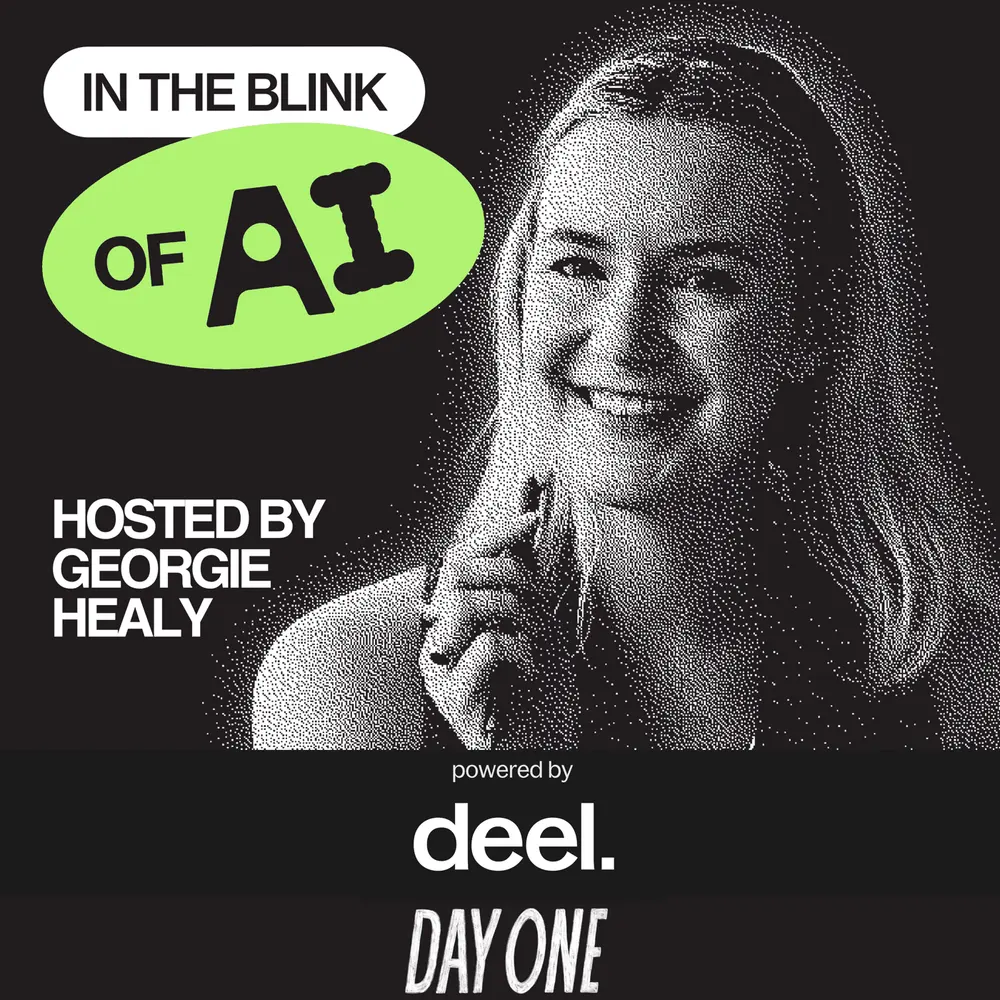 In The Blink Of AI with Georgie Healy
Presented by Deel & Stripe
In The Blink Of AI with Georgie Healy
Presented by Deel & Stripe 




 ▶
▶  ▶
▶  ▶
▶  ▶
▶  ▶
▶ ▶
▶ ▶
▶