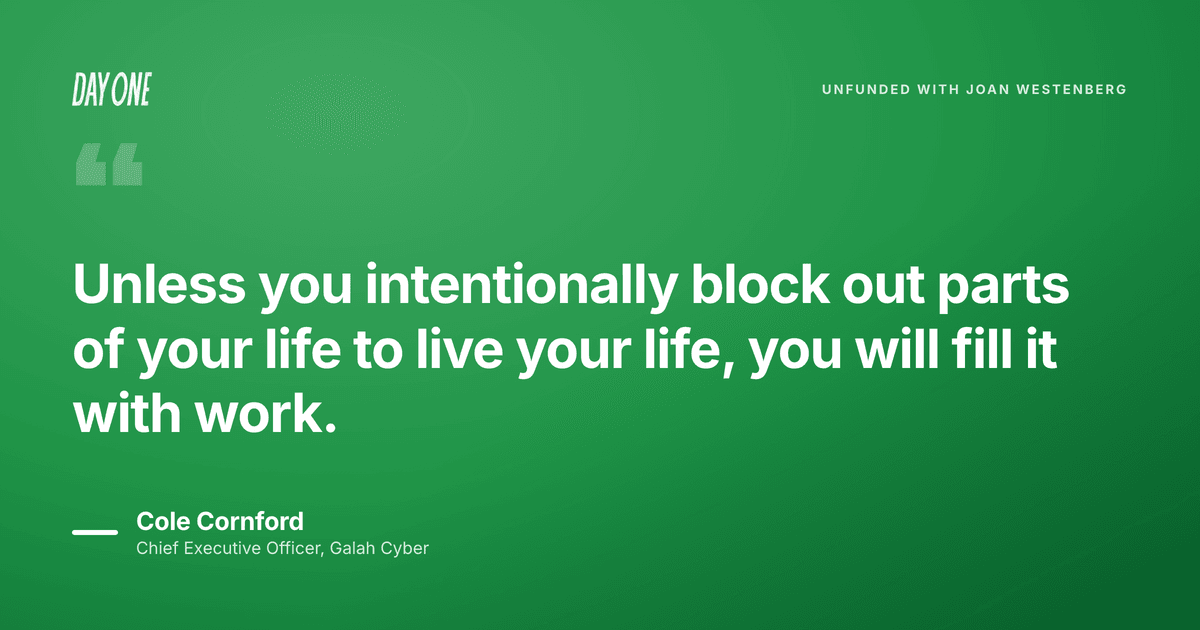
Transcript Synced · select any line to jump ▾ 0:00 Speaker: You're listening to a Day One FM show. 0:07 Speaker: Pick My Brain is the podcast where founders pitch me their startup and I try to give them some useful advice so they can connect better with potential co-founders, investors, media, and of course, customers. My name's Alan Jones and I was a founder myself for about 15 years, and after that, an angel investor for another 15 years. So yeah, old. Some of my ventures have been successful and some failed disastrously, But I like to think I've learned a thing or two along the way, and maybe some of that can help you. So if you'd like to learn how to tweak your pitch, subscribe to the Pick My Brain show now, wherever you like to listen to podcasts. 0:41 Joan Westenberg: Hello and welcome back to the Unfunded Podcast. I'm your host, Joan, and with me today I have Cole. Welcome to the show. It's good to have you. 0:51 Speaker: Thank you. It's an absolute pleasure to be here. It's a bit weird being on the other side because normally I run my own podcast. So yeah, I'm good to be in hot seat today. 1:00 Joan Westenberg: Well, you can critique me if I'm asking the wrong questions. You can just hold up a yellow card or something, you know, just redirect me. 1:07 Cole Cornford: I'll make sure to have the red cards or the blue ones here ready to go. 1:11 Joan Westenberg: So you've got to have them. Got to have them. So Cole is the founder of Galar Cyber. I'd love to hear the story of that startup. How did you come to build that company? Take us all the way back. 1:23 Speaker: Yeah. So around that period of time, I'd signed up to move to the States basically and had a visa, and then COVID hit around 2020. I was basically working US hours. So I started at 2 AM, finished at 11. Time was ephemeral during the pandemic, so it didn't really matter. 1:38 Joan Westenberg: Yeah. 1:38 Cole Cornford: Around that time, my wife, who comes from China, she said to me, hey, in China we have this concept of 996, and I know that you just like to finish work at 11 o'clock and then just go swimming in your pool, having a beer, and just doing nothing useful of your life. Why don't you consider starting a business? And I was like, all right, how hard can that be? So then I just started ringing up a bunch of my friends and saying, Hello, do you need software security? And eventually a few of them said yes. And the first year was very much me just like kind of figuring out, oh, this business thing, I can probably actually turn it into something. Cause I had no idea or concept about how to even run a business. Like second year was very tough. 2:17 Joan Westenberg: Yeah. 2:17 Cole Cornford: But I think that's what happens when most people go from being an independent contractor to scaling out a company. But the third year and now coming into my fourth year, It's really exciting to see what the future is, and I feel like I've definitely figured it out. But I guess we'll say that in the 5th year, we come back and it's just like, nah, I didn't figure it out. 2:33 Joan Westenberg: So what made you decide to go down purely the bootstrap route, not trying to seek about external funding for the safety net, that kind of thing? 2:42 Cole Cornford: It was challenging to raise funding, but also at the same time, I just didn't understand that entire segment at all. I'd worked with companies that had raised capital and then done that whole thing. And for me, I wanted to like basically move to the States. I wanted to go find a partner and settle down a bit, and then in the future potentially look at raising capital and building a business. But it wasn't really high on my priority list. So I started out bootstrapped and just figured, ah, this is just how people start businesses, and didn't really have too much of an awareness of the VC ecosystem until a few years in when people started knocking and asking if they could invest in my company. Yeah, nowadays I'm hyper aware of the obligations of taking the sword of Damocles. And— 3:25 Joan Westenberg: Oh yeah. 3:26 Cole Cornford: Now I just like to spend time with my daughters. So— 3:30 Joan Westenberg: So you have two kids? 3:32 Cole Cornford: Yes. So one's 10 and she plays tennis and likes to do Minecraft with me. I'm mostly building redstone contraptions to do stuff. I don't understand it too well, but she follows the guides and My 1.5-year-old likes to run up to me and grab my legs and give me a cuddle. So she's adorable. 3:50 Joan Westenberg: Adorable, yeah. My son is almost 8, and yeah, Minecraft and Roblox, those are the big things. That's what we have to talk about day in, day out. 3:58 Cole Cornford: Oh yeah, my daughter, apparently there was a new release in Minecraft or something, and now you can get different colored wolves. They're not all white. So there's like brown wolves and there's black wolves and there's green, like, I don't know. So she's telling me she's super excited for all of these different wolves in the game, and that's what my next weekend's going to be is just learning about wolves, I guess. So. 4:18 Joan Westenberg: Every time. Yeah, every weekend. Okay, so going back to the initial launch, did you launch with a product or a service? What was your approach to getting, getting Glass Cyber into your customers' companies? 4:31 Cole Cornford: I started initially with services and we're still with services at the moment, but have basically productized our service offering. It's the way I talk about it. And that's through effectively making a lot of mistakes and learning about what the market wants. And how I can position what we do in a way that's attractive and consumable for businesses. Turns out just calling people up and saying, "Do you need application security?" doesn't work that well as a sales. 4:57 Joan Westenberg: Unfortunately, yeah. 4:58 Cole Cornford: But I wish it worked that well. And I learned a lot about things from sales qualification to having an ideal customer profile to doing like using a MedPick framework to being able to source MQL, all by myself over the last couple of years, but it was really challenging at first. And I'm lucky I had a few people who take a risk on me because they just thought there was a lot of potential. And nowadays I'm getting a reasonable amount of inbound, um, people wanting to come and, you know, purchase either our fixed price services or the products that we offer. At the same time, that would never have happened unless I fundamentally restructured how I do business. And, you know, lucky to have advisors who've helped with that. 5:38 Joan Westenberg: The idea of productizing services, it comes up a lot in bootstrapping. Can you walk me through what that is from your perspective and how you managed to achieve it? 5:48 Cole Cornford: I guess with my services, everybody likes to look at day rate consulting. So they'll say that doing something is gonna cost between X and Y amount of money, and then it's easy to do comparisons between different vendors. But ultimately what you're selling is a story and bodies and credibility with your organization. And the real big issue with doing that is you're limited by time. There's never any way to actually say, cool, what we've been able to achieve over 3 weeks, we were only able to charge for 3 weeks, even though the value provided was significantly higher, right? 6:20 Joan Westenberg: Yeah. 6:21 Cole Cornford: So the idea behind productizing is to disconnect the conversation between the two, is we provide a value, some kind of product that people purchase. And services will deliver that. But ultimately that's disconnected from whether it's done with like, you know, takes 2 days, takes 2 weeks, 2 months. And so customers are happy with the outcome, but it means that you can actually scale up what you're doing because there's either significantly higher profit margins if you have good processes in place. But if you don't, then you have to figure out how to make that because they thin out very quickly. I feel like time materials is for people who are lazy at quoting. 6:58 Joan Westenberg: So yeah, yeah, no, I get that. Is there a risk to— when you're prioritizing a service, is there a risk to, I guess, getting math wrong, losing money on that service because you've turned it into a neat package? How do you guard against that? 7:12 Cole Cornford: Yep, so it's about understanding exactly what customers want and knowing what you can do to make sure that you don't get into those situations. So a lot of the activities that we provide are pretty much mostly in the fixed price bucket because we know what the expected price point for the market's gonna be. And we also know we turned it into like a managed offering, for example, where we can scale up and down based on our resources and capacity and what the customer needs. But I noted a lot of companies who are in services, they still basically run as a time and material shop behind the scenes and still think of themselves as— Yeah. We have 3 FTE dedicated to this account. Instead of saying, we're going to be focusing on customer outcomes and having a strategy aligned to getting more of these subscription services or like fixed price buckets happening. It's challenging if you don't have industry experience, you don't know what you're trying to sell or how long things can generally take and what the risks associated with delivery for them are. And that chalks it up to XP. I've been doing software security for over 10 years. And so for me, I know how long a pen test is going to take. I know how long it's going to take to do a code review. I know how— Yeah. Like training, training's easy. It's always gonna take a fixed amount of time. But then it comes back to how do I go ahead and make sure that what I do is compelling and competitive and difficult to do comparisons between other vendors because we're providing a conversation around the value we provide over the amount of time it takes. 8:35 Joan Westenberg: Is that where you build your moat? 8:38 Cole Cornford: Yeah, definitely. Because, well, the moat for me, I'm always aware of keeping an idea out, like looking for competitors in the market. I think— 8:46 Speaker: Yeah. 8:46 Cole Cornford: In Australia, we're quite nascent with building software companies, and so software security is also incredibly nascent too. But I am aware that companies in the States or in Israel or in the UK could suddenly decide to establish an Australian presence and be domestic competitors for me. So I don't want to sit on my laurels. I want to make sure I do everything I can to, you know, preparing for that, right? As a bootstrap business, maybe that's at the point in time where I say, cool, we have competitors entering the market. Now's the time for me to go and look at getting capital. 9:17 Joan Westenberg: And do you think that's something that you would, you would want to do, that, that capital raise? Yeah, if the, if the stars aligned, is it, is it a direction that you'd be keen to go down? 9:27 Cole Cornford: It's, it's an interesting question. I think the answer is yes, but it comes down to timing because I've got two young daughters, and one of the things I know is that when you do take capital, you no longer have the control over the direction of your business based on how much capital you did take. So I know a lot of people have taken a lot of capital and given up most of their control, and because they've given up control, they can't dictate where they need to go in the future. They just have to take— go help, help bend to whatever direction the VC says or what other PE firms invested in their company. And so if I was to take capital, it would be probably— actually, I'd start with financial, like services, like banks, um, before I'd look at going down either private equity or VC, simply because If I need money, I can then pay it back with a set interest rate and maintain complete equity and control over the direction of my business. But if I do need to hyperscale, then there's orders of magnitude more money that I'd need to be able to acquire. And so that's where I need to start having these serious conversations. But it comes back to, I have values. My values are that I have a young family. I need to be able to spend time taking my daughter to art club, and I need to make sure that Monica can see her dad. 10:36 Joan Westenberg: Mm-hmm. And that's so important, you know, like you don't want to get onto a hamster wheel where your kids never see you, but you say to them, hey, look, it'll be worth it in 20 years' time when you've moved out of home and then I can spend time with you. That's not— that's not the goal, right? 10:49 Cole Cornford: Yeah. And I feel like there's a lot of people who are sold on that mission that like, hey, yeah, you know, you're going to be— you are going to be rich. It will happen. And I know that that is not true. And in fact, you say sell to 100 people and only one of them out of that 100 gets to that level and the other 99 crash and burn and burn a bunch of money, right? 11:07 Joan Westenberg: Yeah. 11:07 Cole Cornford: And so it's silly, I've— for me to think that that's going to be the status quo. So I know that if I do take the money, the expectations are really high, the work ethics can be really high. And well, there's 99 other people who are like me who are taking capital. 11:23 Joan Westenberg: They— 11:24 Cole Cornford: I might not be the 1%. 11:25 Joan Westenberg: So it's not always about skill or execution or anything. Like sometimes with a VC-backed business, it's time, it's Yeah, there's a degree of luck involved. And you know, when you, when you stay independent, you still get to be, I guess, guiding and shaping that luck. Whereas if you take that outside capital, you've got that runway pressure, you've got that, that boiler room. 11:48 Cole Cornford: Yeah. Yeah. And I think that's one of the— like, there is a lot of pressure. We're still running a bootstrapped company, by the way. So I think a lot of people misunderstand that unless you've like screwed up terribly, like I did on my second year, you may not understand, like, if you've just been reasonably successful by default or by taking capital, so you don't understand it's not your own money. Like, when you do mess up with your own money, it hurts you really personally, and you know not to make those same mistakes. 12:15 Joan Westenberg: Oh yeah. 12:16 Cole Cornford: And so I'm hyper aware, hyper aware. If I take capital, I know not to spend it on stupid stuff like a floor in Martin Place or like, you know, kitted out desks for everybody. If It's about how are we going to be able to like accelerate the growth of this company. 12:31 Joan Westenberg: Yeah, rosé on tap, things like that. 12:34 Cole Cornford: Yeah, yeah, yeah. Let's— oh man, I feel like for me it'd probably be apple juice. So I'm very pathetic. 12:40 Joan Westenberg: So yeah, look, I've been— I'm 5 years sober myself. I don't like apple juice. My, my goal for my own office would just be a really old-school coffee pot like McDonald's in the '90s. That's all I want, that kind of cracky percolated coffee. That's the drink. 12:56 Cole Cornford: Oh, I feel like I'd have a Barista Express on, like, that's about it, because I make myself like the Breville coffees every morning and it's like the routine. Have some raisin toast, have a, have a Barista Express double espresso and sit there and just wait for the chaos of my kids for school run to kind of subside and then get into it. 13:15 Joan Westenberg: So— Oh yeah. 13:15 Cole Cornford: I just can't imagine a day where I'd get up at like 5 AM and start having calls with US VCs and anymore. 13:24 Joan Westenberg: I'm just— Oh God, no. Yeah. 13:25 Cole Cornford: Past that at this stage in my life with a young baby. 13:28 Joan Westenberg: So I'd be keen to hear a bit about, about that routine, um, because you've spoken about, I guess, maintaining control, maintaining that work-life balance. What is that routine like on a day-to-day basis, running Galar, being a family man? 13:42 Cole Cornford: One thing that will always happen is if you are committed to your business, then you're going to fill up every instant of your life with your business where it is available. So unless you actually intentionally block out parts of your life to live your life, you will fill it with work. And so I make sure that my Mondays and Tuesdays afternoons and evenings are art club, tennis club, and playing Minecraft. Fridays is daycare with my, like, baby. She goes to daycare, so I get to make sure I have a nice lunch with my wife. And on the weekends, I try to put away everything and only catch up on work where I really need to. But if you don't put that structure into your life, then you're just going to fill up everything with work. And like, I notice on my Wednesdays where I get up at 5 and I come home at 2 AM because I go to Sydney from Newcastle and do— that's, that's my kind of grind hard day. A lot of people would just keep doing that day over and over again. And then I wonder why I see so many founders who are just like tired, exhausted. sad, miserable, probably rich, but then they're worried about they're losing their hair, their health's going away, their kids, their wife doesn't love them anymore. And I haven't had that yet. So. 14:56 Joan Westenberg: Yeah. 14:58 Cole Cornford: One day. 14:59 Joan Westenberg: Touch wood. Yeah. Thinking about bootstrap resources. Okay. So we've talked a little bit about time. Let's talk about customer acquisition. 'Cause that's where a lot of VC money gets spent is trying to scale up customer acquisition. How do you approach that, that marketing, that sales with limited bootstrap resources? 15:18 Cole Cornford: Yep. So firstly, I wouldn't hire internal marketing or sales capability. I'd be running it yourself. As a founder, it is your responsibility to go acquire new business, and you understand your product best. Now, that said, there are agencies that can support you, and they can do it cost-effectively, but ultimately it comes down to having a really compelling story, and then being able to meet the right people at the right time. I went with Gala for a very simple reason, is that almost all the cybersecurity— all of their swords and shields, black and red, us versus them, warfare metaphors constantly. I figured that they're fairly indistinguishable from men's deodorant commercials. And so because of that, I just said, you know what, I'm gonna make everything like— I got my phone covers bright pink, I got pink everywhere. It's— we're just gonna be fun, approachable. And so it just— people happen to notice it and recognize the brand because it's much better than being wallpaper with 30 other cyber ventures. So I think getting a really good story and having a really recognizable brand will help you build, uh, like an inbound list if you need it. But the second piece is to actually do the work as a founder to do sales. And so most founders that I speak to don't want to pick up the phone and they don't want to, they just assume that I have a great product or, you know, I have all my friends and they're going to buy my stuff from me. But at some point the network disappears and they need to go speak, start cold calling and reaching out to new people or their product just isn't good enough and it's not going to get to number one on Hacker News. And so, and the only way you're ever going to have that happen is if you start doing sales campaigns, right? And that's where you really need to be thinking hard about. Yeah. Who is your ideal customer? For my business, we have two ideal customers. It's either large enterprises or it's like mid-size scaling up businesses. And we sell different to each of those types of customers. But it took me 3 bloody years to figure that out, right? So what I should have been doing is taking advice and doing research and understanding why different customers are buying from me so I could sort out and work out which ones are— 17:28 Joan Westenberg: Yeah. 17:28 Cole Cornford: Likely to transact and why I'd need to transact to those ones and which ones never transact with me whatsoever, right? You gotta do the same. But ultimately it goes down to what I fundamentally believe is that if you start a business and you don't want to do sales, then you need to either find someone who is a great salesperson or you need to learn the skillset yourself. 17:47 Joan Westenberg: Where do you think you picked up that sales skillset? Did you learn it sort of on the job at Golar or was it something that you had learned previously to starting this business? 17:57 Cole Cornford: So before Golar, I've pretty much always been a career IT and cybersecurity professional. I feel that I have a few things that are really going for me, is that my personality is just quite naturally suited to sales, where I'm open, I don't lie about stuff really, I'm pretty relaxed and don't have to worry if I get rejected about things. And I also don't have the pressure Now, I think that's a big piece about sales. If you have like a quarterly target that you need to reach, then you're gonna start compromising on your values or compromising on what you need to do or starting to lie to customers about things that you can deliver. And I think that's where the profession gets a bit of a, you know, stain. But ultimately, I like to think of it as a partnership, right? If you have some skillset or something that the other person needs and they really need it, then you just got to figure out what that looks like to come together and it worked from there. And so like, I don't, I hate the whole anathema about salespeople suck. I hate sales. Sales is terrible. That's what business is built on. 19:00 Joan Westenberg: Yeah. 19:01 Cole Cornford: Yeah. I had to learn it over the years. I would go into people and I'd like misunderstand my pricing. I'd misunderstand why people wanted to buy. I'd hire salespeople and then realize that those salespeople were entirely useless because I had no ability to measure what they were doing. So I've learned how to do that.. But I think the big thing is ultimately people buy because of me. And when I learned that, that's when my business started doing better. 19:25 Joan Westenberg: What percentage of your time would you say that you spend on talking to new business, talking to existing clients, and running the rest of the, the company? What's that kind of breakdown? 19:36 Cole Cornford: I'm going to say it's— I'm trying to do new, new clients like, um, 1 or 2 days a week, and existing clients 1 or 2, and running the business 1. And what I'm finding is that running the business has turned into free. So I'm actively looking to be hiring an operations manager so I'm not just grinding 7 days a week because I need someone to be doing all the things like building commercial contracts, you know, hiring and firing people, sending out invoices, doing the taxation accounting stuff, almost all back of house. That's like not the most interesting thing for me to be doing personally and is— Yeah. Like that you do do as a bootstrap founder because you don't have the money to be able to hire someone to do that kind of stuff yet, right? I'm in a situation where I can, and that allows me to scale out what I'm really good at, which is selling and marketing. Because, um, like delivery I'm fine at, but I'm at this point where people want me as a person to come and oversee something, and they trust in my brand. It's not so much that they want me to go do a penetration test or a code review personally. So— Yeah. So I really want to be getting away from doing as much operations and delivery work as possible and then focusing more on sales and marketing to grind out, like, make my company scale faster. 20:51 Joan Westenberg: So at what point do you think you would hire somebody to take over sales and marketing? Like, what's the, um, what's the point where a founder should step back from that? 20:59 Cole Cornford: That's a good question. Um, I think for my business, my long-term plan is to really focus very heavily on my personal brand, and so it's, it's not for a long time. And I think that I have an extremely compelling value proposition. I close really well and I market myself extremely well to people. And so I'm not, I don't think it's going to be happening within the next couple of years. That said, there is sales enablement and marketing, marketing enablement, which you absolutely do need to be hiring. And that could be something like, yeah, I'm not going to go and do 100 outbound cold calls per week with 20 discussions turning into 4 meetings. I can get someone else to send me the 4 meetings and that's where I close and people, you know, okay with that. So I feel like getting those SDR, BDR resources is important to grow your business. But as the founder, ultimately you should have the direct relationship with the customers. As for marketing activities, some activities are going to be a lot more bang for buck than other ones. And so if you're writing blog content or you're, um, you know, going out and doing public speaking, or you're doing a podcast like we both do, that kind of stuff resonates, and people buy into your story, and that you can really set yourself apart from your peers who are using AI-generated shit constantly. Yeah, it's everywhere. I swear, if I see another, um, in today's ever-changing cybersecurity landscape, we need to be prepared for the adverse— 22:25 Joan Westenberg: Oh my God. 22:26 Cole Cornford: Literally the same thing of every single marketing copy I've ever seen just upsets me. But it's easy to separate yourself if you write clear. 22:34 Joan Westenberg: Oh yeah. 22:35 Cole Cornford: And like, you know, sensible prose. And so I would say that a founder should still have their handles on like how they market. But a lot of the things like preparing social media tiles or, you know, just sending out like ghostwritten copy or email letters and stuff like that, you probably don't need to be as involved in any of that as well. So I, I'd say, um, look at engaging someone who's a B2B marketing specialist, or if you're— if you are direct-to-consumer, B2C. But, um, yeah, you should get out of that if it's not about relating to your own thought leadership. 23:10 Joan Westenberg: So can I ask, how are you thinking about things like artificial intelligence? Is this something that you are concerned about in your field? I feel like it's going to touch on some aspects of cybersecurity sooner or later. Yeah. 23:24 Cole Cornford: Yeah, so the question was, how is AI going to affect cybersecurity? 23:27 Speaker: Is that right? 23:29 Joan Westenberg: Yeah, how are you thinking about, about AI for your customers, for you? Is it a threat? Is it an opportunity? Does it keep you up at night? 23:37 Cole Cornford: Um, no, I'm actually very comfortable with artificial intelligence. I think that if people I don't spend the time to learn something, then that's where the fear comes from. But I understand the strengths and limitations, and I think that there are some aspects in my business I'd absolutely be leveraging AI for. Like the idea of recording conversations with people and then having clear summaries and agendas about it. That sounds great to me because people are really notoriously bad at note-taking. The same with doing software development and submitting a pull request. Yeah, let, let it summarize what is happening in there. What I don't want AI to be involved in whatsoever is anything to do with customer communication. So if I'm marketing, because everyone else is using AI to market, then it means that by not using AI, I'm actually separating myself as a valuable company that cares about, you know, quality, attention to detail, and having fundamentally unique insight. And if you're using AI, it's going to produce shallow, fluffy, crappy language that I would expect out of a Year 7, like, university or high school assignment, right? That's fine. It's because sometimes you need that. But for the people I'm trying to cut through to, I want them to have a conversation with me, not because I provide a service, but because I provide value to their business. And so— Well, I'm hyper-aware about always telling people, don't use artificial intelligence if you're writing a report or giving suggestions or doing anything with any customer. That's never going to happen right now. I know that a lot of other consultancy firms are using it to get leverage, but I'm instead using it to improve our reputation, right? 25:19 Joan Westenberg: Yeah. 25:19 Cole Cornford: And, but there's other aspects, like you can accelerate the pace that you're delivering on certain activities by using AI. And especially with operations, you can use like Zapier mixed with ChatGPT to start doing stuff like automatically curating a distributed marketing list, or you can use it to tell you about who's done what on the internet last week related to something, or you can make it fill out job descriptions. Like, that kind of stuff, fine. But I would never be using, saying, hey, I wrote this report and it was actually written by ChatGPT, because that would be career suicide for my business. 25:57 Joan Westenberg: So. So a core part of what you do as a founder, it sounds like you, you are scaling yourself, um, which is a hugely powerful thing to be able to do. Are there any tools or resources that you use to do that? 26:11 Cole Cornford: Have, have a business model that allows that to happen. If you are related, just like always going back to time materials as a principle in your job, then at some point you're going to hit a cap where value is associated with a day rate. And then if that's the case, then you are not going to be able to ever exceed that. A King's Counsel gets paid $15,000 to $25,000 per day, but they're never going to get up to $30,000 or $40,000, no matter how good they are at like doing constitutional law and stuff, right? And so if you have to disconnect that and have people have conversations with you about the value that you provide to a business rather than using you personally as an individual. Another thing is recognizing what your strengths and weaknesses are and what you're doing for the business and hiring the right people to fill the gaps. Or like identifying the tasks at a low value and getting either automation to solve that kind of stuff, or yeah, again, people if automation is not available. Like I said, AI can be used for some of these things, but I certainly don't want artificial intelligence to be sending out incorrect invoices. 27:13 Joan Westenberg: Yeah. 27:13 Cole Cornford: To the wrong people. And so there's no room for that in my, in my business. But hiring the right people who are committed on my vision have shared values and understand that we're not here to just hockey stick to Jupiter tomorrow. It's going to be a slow methodical increase is the way to go for me. 27:34 Joan Westenberg: Thinking about the future, we've, we've talked a little bit about 2 years, 3 years, 4 years ahead, um, what you're kind of planning there. What's the end goal though? Would you want to see Golar acquired? Um, would you want to to take some other way, um, to exit the business? Is there, is there a plan there that you've got deep down inside? 27:55 Cole Cornford: The idea for me is to just have options. Just, just have options. I don't know where I'm going to be in the future, and so I need to just present myself with something like run my business in a way that just introduces a lot of options to me. It's why I'm a big fan of productizing services, because then I can have a recurring revenue-based model which gives me more options for exits in the future because companies are more like VC and PE companies are more interested in businesses with that kind of model than just traditional consultancy firms, right? But ultimately, if I'm closing doors and just, I only have a few pathways to exit, then I've fundamentally failed. So I'm very cautious about, you know, how I present myself, who I speak with, looking after people. You don't know where they're gonna be. But it comes back to just knowing, having some idea about what I really wanna be doing in the future. Number 1 is that I'd love my daughters to just be able to travel and experience the world reasonably well, and my wife as well. I guess I do that through my business, but we need to have spare cash flow to be able to do that. Number 2, it'd be nice to have a nice house at Merriweather. It's not too expensive, but, um, would be good to live in proper Newcastle instead of out in the sticks. So I guess that's the financial reward to look forward to. But I guess number 3 for me is also, if I was to exit Golar, I reckon I'd get pretty bored super quickly. So I'd probably look at raising capital. And so I want to make sure I have access to the right networks and having a global presence available so that if I do need to go raise capital, it's on my own terms. 29:34 Joan Westenberg: Mm-hmm. 29:34 Cole Cornford: And not on the VC's terms. 29:37 Joan Westenberg: So it's funny to think about, isn't it? Like, we're both parents. Back in the day, you know, like 50, 60 years ago, the, the plan for a business that we run would be, I'm gonna bring my kids up in the business and they're gonna take it over one day. But it just doesn't work like that anymore, does it? 29:54 Cole Cornford: No. Like, my, my— so Suni always says to me, hey, look, it's, it's cool, I, I like computers, I'm happy to go learn about cyber security, And then I always take a step back and say, yeah, you're learning Redstone programming in Minecraft, but I don't think you'd particularly like working in the jobs that I do. In fact, I want her to have options, right? And the only way for her to have options is to invest in her education and in her life experiences and into meeting interesting people. And so I just say, go do things that you find fun and I'll facilitate that. But I don't, I don't want to be having her in 5, 10 years coming into my business and taking over it. 30:29 Speaker: Yeah. 30:29 Cole Cornford: I also don't think that Since it's based on my personal brand, it's going to be kind of hard to transition it down to someone who's less experienced than me at that point. 30:39 Joan Westenberg: So yeah. Do you have any, any thinking about one day I'm gonna separate my personal brand from the business, kind of wind down that aspect of it? Or are you happy to, to keep on being the face of Golar, the, the identity of Golar? 30:55 Cole Cornford: Yeah, so I am absolutely going to be doing that. It's just on the horizons. Um, I'm thinking 5 to 7 years, and the reason is that like galah is very recognizable domestically, but ultimately won't be a recognizable bird outside of Australia and New Zealand, right? 31:14 Joan Westenberg: I guess not. 31:15 Cole Cornford: Yeah. Whereas I personally can have a brand to grow internationally, right? And so I don't know, maybe I'm going to make Cardinal Cyber over in the States and like, I don't know, Bald Eagle Cyber somewhere or something, but To me, the idea is that I can be much bigger than just being a software security business, like, because I'm really reasonably, I don't know, maybe I just need to stop drinking my own Kool-Aid, but I feel like in the next couple of years I can really have a platform and build a brand that people trust and respect. And it's just down to setting myself up to have the options to choose what that looks like. But yeah, I will over time separate myself from Golar. Because if your identity is attached to your business and the business does badly, then you've got nothing but to feel bad yourself. And that's why I'm very happy to do all the other stuff in my life. 32:03 Joan Westenberg: If you're going back and doing it all again, do you think you would have taken the same approach with the brand? 32:07 Cole Cornford: I think the brand is absolutely like done super well, super recognizable, very happy with it. I think there's definitely things I would not do a second time around. There's a bunch of really easy, like hiring the wrong people, expanding in an economic downturn, you know, not having any idea about business before you start. But I think, um, it's very hard to go and get an MBA and then go start a business and then it's all good. I actually reckon it's far easier to start a business, fail miserably at running a business, and learn from your failure than to go be academic. Yeah. So I wouldn't change anything really about how I run stuff, but I'd say that the sticking point that I'm really happy with is just how much the brand resonates with people, because cybersecurity is a very scary topic. And then having just a cute little bird as someone you can talk to, turns out that that resonates pretty well. 33:02 Joan Westenberg: Is there any advice you would give to other founders who are looking to bootstrap a business or productize an agency or take the kind of approach that you have taken? 33:12 Cole Cornford: I think that the most important thing is to probably get the right mentors. It's really challenging, but you have to go outside of your own bubbles and find people who are just in unrelated industries. I'm very privileged to have a couple of people in the Newcastle region who are willing to have conversations with me just because I have helped them out every now and then, just with no expectation of anything coming my own way. But ultimately, those mentors will be setting you on the right path for growing a sustainable business and to like getting you to pull your head in when you're about to do something really bloody stupid. So, um, get, get your board of directors set up or get yourself personal mentors and start with that. Number 2, I'd say that you absolutely need to care about the fundamentals. And a lot of people get super hyped in like having an innovative, um, company and having an amazing brand, but like businesses run over profit, cash flow, and doing their operations well. And so you should be spending the time on getting these 3 things sorted because in my first couple of years, it's easy when you're by yourself, you don't care about that. But when you've got other people's livelihoods on the line, then you need to make sure that you take them very seriously and don't delegate that responsibility to someone else because ultimately you are accountable as a CEO. So yeah, look at the money and go find the right people. 34:30 Joan Westenberg: Look, that's, that's it in a nutshell. I couldn't have, I couldn't have asked for a better answer to that one. Um, I like the practicality of it. I guess there's a lot of business advice out there that is, here's what NVIDIA can teach you about running a two-person startup, and so much of it is, it's not applicable. It is, it is bullshit, for lack of a better word. 34:50 Cole Cornford: And I think that's what I really enjoy about these conversations is, yeah, yeah, I figured that when you get to the stage where you're taking advice from someone who's made it, they've made it, and that advice is not particularly relevant because what they're talking about is the last 5 to 10 10 years experience where they've been at somewhere like Netflix or Facebook or whatever, and they've take— they're at a billion dollar valuation before they even write the book, right? Um, but what you've got to get to is a $2 million valuation. And how do you get to that stage? Well, like business fundamentals, you need to sell, you need to market, you need to hire and fire the right people, and you need to be willing to stick into it for the long run. And I, a lot of people just, they shy away from these conversations because it's not sexy, you know. Everyone wants to talk about how, hey, I raised $100 billion in capital, therefore I am the best person ever. And, um, no one wants to talk about, oh, last night I spent like 6 hours filling in timesheets for XYZ enterprise company because those timesheets are what helps me have cash flow for the next 2 to 3 months, right? Like, no one wants to talk about that part, but that's the more important part than saying like going on the internet talking about your tribulations as a founder and how hard it is and how life is so, so hard. So you're working so hard for the future and you're going to be an NVIDIA. So, which is very LinkedIn right now. 36:09 Joan Westenberg: So, mate, this has been very refreshing. I really enjoyed this. Thank you for that. I, I appreciate the honesty. It's, it's good to hear. 36:18 Cole Cornford: No worries. It's, uh, I always try to be because, um, Again, people, they spend too much time focusing on the wrong aspects of running a business. And like every time I have a conversation with a founder, I almost always go back to how do you ensure that you're taking care of your family and that you're not compromising on your values and making sure that you have something that's profitable and sustainable. And people forget about profit and then they close their business in 6 months or they don't, they do peaks and troughs and crash and burn constantly. 36:47 Joan Westenberg: So thank you very much for joining me today, and thank you for putting it out on the line and just being really open and honest about what it takes to build a business and all this stuff. I appreciate it, and it's been a great conversation. Thank you. 37:00 Cole Cornford: No worries. Happy to be here. 37:01 Joan Westenberg: Thank you.