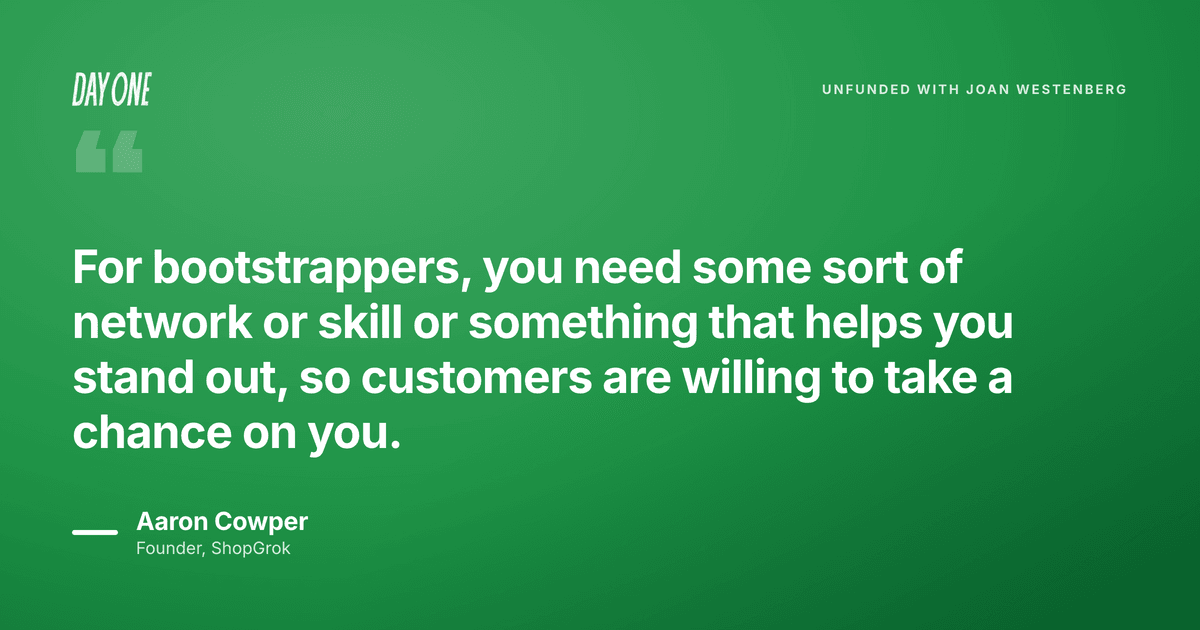
Transcript Synced · select any line to jump ▾ 0:00 Speaker: You're listening to a Day One FM show. 0:07 Speaker: Pick My Brain is the podcast where founders pitch me their startup and I try to give them some useful advice so they can connect better with potential co-founders, investors, media, and of course, customers. My name's Alan Jones and I was a founder myself for about 15 years, and after that, an angel investor for another 15 years. So yeah, old. Some of my ventures have been successful and some failed disastrously, But I like to think I've learned a thing or two along the way, and maybe some of that can help you. So if you'd like to learn how to tweak your pitch, subscribe to the Pick My Brain show now, wherever you like to listen to podcasts. 0:42 Speaker: The alternative was maybe go back and get a job, definitely not go and get funding, because I just knew that going and getting funding, especially at that early stage, it just creates this binary outcome. 0:55 Joan Westenberg: Folks, hello and welcome to another episode of the Unfunded Podcast. Where we tell stories of founders building impactful and independent businesses without relying on venture capital or external funding. Unfunded is part of the Day One Podcast Network dedicated to sharing the real startup stories to inspire founders, operators, and investors. I'm your host, Joan Westenberg, and today I am here with Aaron Cowper, who is the founder of Shopgraap. Aaron, welcome. 1:22 Speaker: Hi Joan, how you going? Great to be here. 1:24 Joan Westenberg: Not too bad. Look, I understand it's, uh, quite an early one for you there, 4 AM. Is that, is that your regular schedule? 1:30 Aaron Cowper: It is at the moment, yeah. My family and I, my wife and I and our 3 kids, we're here in Madrid for 4 months and we're just having a bit of a family experience and also trying to expand the business while I'm here in Europe. And so I'm overlapping with the Aussie afternoon and starting at 4 AM or 5 AM each day. 1:50 Joan Westenberg: That takes a lot of dedication. I admire that. 1:53 Aaron Cowper: Yeah, I think that the Spanish team here at the coworking space, I mean, thought it was extremely odd that I wanted to start. I was asking about 24-hour access and wanted to start at 5 AM when most Spanish people, I think, are just finishing. 2:06 Joan Westenberg: That's bootstrap life though, right? 2:09 Aaron Cowper: Yeah, exactly. 2:11 Joan Westenberg: So look, diving into it, the Unfunded podcast is about telling stories of the companies who do things their own way. And so I'd like to hear about the Shopgrok story. Now, you guys started back in 2018, is that right? 2:23 Aaron Cowper: That's correct, yeah, early '18. 2:25 Joan Westenberg: And what was the catalyst for creating this company? It's quite a unique company. So I'd love to hear the whole story. 2:32 Aaron Cowper: Yeah, for sure. So I mean, I'd wanted to start something since I did an MBA in 2011, 2012. So basically I started the company in 2018. I'd spent about 15 years in various different corporate roles. I worked in consulting for McKinsey in Singapore, and then I came back and worked for Woolworths in Australia as head of price strategy. Previously that I'd done an MBA over in Spain. So it's one of the reasons why I'm back here now. And I'd wanted, since the MBA, I'd wanted to do something, but I'm quite risk first. So it wasn't like I, and I, you know, I had a family at the time. I still already had a mortgage and family and I think we're up to our second kid then. So it wasn't like I could just, you know, take a few years off and give it a crack. I had to, you know, I had to make money fairly quickly, you know, in order to survive. So it was quite calculated move. I waited till, you know, bonuses were paid out that year. And then, and I also took out a, ostensibly a second mortgage for a renovation, but it was sort of enough money. Yeah. That we had in the bank to keep us going for about 12 months in case I didn't make any money. But that was basically my runway. And then, yeah, just did it, just cut the cord. And thankfully have a very patient wife and very supportive wife. And she was right behind me and we just decided we'll give it a go at 12 months. And if it makes money, it makes money. If it doesn't, it doesn't. So. For me, I think that, yeah, it was always going to be bootstrapped. I don't think, I mean, at the very beginning, I suppose I did when I was a little bit naive, I kind of was looking at funding, but I'm glad I didn't go down that road because it just, you know, it kind of changes the whole outcome for a founder. It's a very all or nothing kind of approach. Thankfully we got through that survival stage and now I'm sort of more in the kind of growth stage, I guess you would say. So really, really glad I did it the bootstrapped way in the beginning. 4:27 Joan Westenberg: So going back, what was the gap that you saw that Shopgrok was going to fill? What was that problem that you wanted to solve? 4:34 Aaron Cowper: So I'd been in retail for a while. So I should probably explain. Shopgrok is a SaaS product for retailers and brands. We help retailers and brands optimize their pricing and their promotions and their product range through benchmarking them to the market. So we collect a lot of data from the web and other sources, and then we take our customers' data and, you know, provide analytics to help them make better decisions. So I'd been doing similar things in my prior corporate role. So at Woolworths, I was very much doing similar stuff as the head of price strategy and price analytics there. And prior to that, I was, as I mentioned, in consulting. I was based in Singapore, but working with— it wasn't at that time, I was sort of working in pricing, not necessarily just retail. So I was doing pricing for Lots of different industries, but ended up liking, you know, retail the most. And so sort of built up a bit of expertise in that area. And then while I was at Woolworths, we were buying a lot of data from different places and also trying to get some competitive insights. And just a lot of the data we bought from places like Nielsen was very expensive and not very good, not very accurate. So there was a particular product we used to buy called Homescan, which still exists. Which is like a panel. Nielsen does it. It's a panel of 10,000 Australian consumers that take home their shopping every week and they give them a scanning gun and those people use that information to build their, they scan their shop and then Nielsen aggregate the information and sell it back to retailers. But the data is very biased towards certain demographics and very low quality in terms of accuracy. So the idea originally for Shopbop was to build something that would compete with that product. But eventually, a few pivots later, it doesn't exactly, it's not exactly in that space, but it's, you know, similar, similar space, I would say. So I realized it was going to take probably some funding to build something competitive to a Nielsen Home Scan because it would take a lot of consumers to come on board through some sort of panel or other program. In Mm-hmm. order to collect data. So I think that one, you know, was going to take a bit of funding to get to something that was a meaningful dataset. So in the end, I took a couple of consulting roles with a couple of different retailers and then they needed insights. And so I built them a couple of tools that would help track them against the market. And then really that became the tool. So, you know, I sort of did the old, you know, pivot until you find something that, you know, that works for a customer and then just double down on that. And so, yeah, I've been doing, been doing that ever since. Um, at the beginning I was sort of a little bit, um, I guess you would say ashamed, I suppose, of the product. I think a lot of founders say that you should, you know, you should always be ashamed of the first version. 7:23 Joan Westenberg: Oh yeah, you should be embarrassed of that first iteration because it should be scrappy. Yeah. 7:27 Aaron Cowper: Yeah, for sure. Um, but I think, you know, I was, you know, imagining building this, you know, machine learning based, you know, really complicated modeling of shopping behavior and patterns and things. And first version of the tool was nothing like that. It was simply collecting data from the web and benchmarking my customers' range to the market. And really the current product is really doing just that. It does have a lot more in it now and we have built somewhat of a moat, but So yeah, as a founder, you probably, you don't necessarily need to go and build something that's completely super complex and a big intellectual challenge. A lot of the time it's more about execution and just building something that works for your customers. 8:14 Joan Westenberg: So when you were building that MVP, was that based on conversations that you were having with potential customers? Like, were you actually building this for a specific customer or did you have something built that you can go and show people? 8:25 Aaron Cowper: So I'd started out, I was sort of in the very beginning of building this competitor to Nielsen Homescan. So the idea was for it to be a shopping companion. It would help consumers shop better, but at the same time it would aggregate data from shopping patterns and then that data would be, so it would help shoppers, you know, it would need to be free or cheap for consumers to use, but then the revenue would come from the aggregated data that would be shared with retailers and brands. So I'd sort of started building that. I was in the very early stages, but then I got this consulting job with Myer down in Melbourne. So I went down there and I had a friend who was the head of Myer's MyerOne program, the rewards program. So he brought me in and I did a piece of pricing strategy work that wasn't really related to what I was building at Shoprock at the time. Yeah. And they needed some competitive insights on pricing. So I built them a tool and then throughout that process realized that that actually was something that retailers were asking for. Amazon was about to join, was about to enter Australia and a lot of retailers were kind of panicking about price at the time. So yeah, throughout that I just realized that I'd probably, you know, get to something that was generating revenue quicker if I if I kept doubling down on that competitive pricing kind of angle. So I kind of dropped the shopping. I kept it going for a while. I actually did the incubate program at Sydney Uni. 9:55 Joan Westenberg: Oh yeah. 9:55 Aaron Cowper: The startup accelerator, which was fantastic. You know, they don't take any equity and they give you a little grant of $3,000, I think it is. Some office space, et cetera. And so, and James Alexander and his team were fantastic at the time. So they gave me a lot of advice and in the end throughout that incubate program, I decided I was running, I was building the app, the shopping companion app, and I was also, um, had this, um, work going on with Maya. And I, at the time, I just kind of decided to drop the app and just continue building the, um, the competitive pricing tool. And thankfully I did, like, I sort of ended up being the main thing throughout that process. I also, we won a couple of other customers and I just got so busy with those customers on the competitive pricing, um, insights that, um, the app just, I didn't have enough time to build it anyway. So. probably a good problem to have. 10:45 Joan Westenberg: So next steps after that, you'd got a few versions of this product up and you'd spoken to customers. How'd you start building a team or at what point did you start building a team? 10:55 Aaron Cowper: My first employee was a dev, Vivid. I should bet he joined us during that sort of first year just to help, yeah, with some of the, you know, he's a fairly junior dev, but he helped me build a lot of the early web crawlers and different things that we were building to help collect data. And I had just enough cash to pay his salary and I wasn't paying myself a salary at all. 11:17 Joan Westenberg: Yeah. 11:18 Aaron Cowper: So I still, you know, still wasn't making enough money there. And then thankfully we won a tender. So I was invited by Super Retail Group. So they have Supercheap Auto, BCF, and Rebel Sport. They were doing a tender for their competitive insights provider. They had an incumbent that they weren't happy with and Thankfully, I got in— someone that I knew was sort of involved with the tender and knew of me and sort of reached out and invited me to tender because they'd done a scan and, you know, we didn't even have a website at the time, so we wouldn't have shown up in any kind of search for vendors. But thankfully, I got invited to tender and we ended up winning that. So it was a reasonably big deal. So they agreed to pay annually upfront on it. I think it was an initial 3-year deal. 12:08 Joan Westenberg: Huge. 12:09 Aaron Cowper: Yeah. Yeah, that was huge for us. So I was able to go out and hire Briante, who's still with us now. She's like my 2IC. She's our, she's recently changed her role from head of analytics to chief operating officer. And she's been with us ever since and she's been instrumental in our growth. So yeah, just lucky. It was, I guess, scrappy. We're lucky to get in that in some ways., you know, I had a bit of a reputation in, in, in a bit of a network, I suppose, in retail. Um, so that helped. Um, I think, I think for bootstrappers, you need to have some, some sort of network or, or some sort of skill or something that's, you know, stand, helps you stand out a little bit. Um, so that customers are willing to, you know, take a chance on you. Thankfully got through that. 12:52 Joan Westenberg: You need some kind of alternative to capital, whether it's like, um, network capital, intellectual capital. 12:58 Aaron Cowper: Yeah, exactly. Absolutely. Yeah. Yeah. So yeah, so that was, that was the beginning. And then, you know, thankfully kept growing from there. It wasn't, it was definitely a bit of a bumpy road. So very soon after that, that Super Retail tender win, I had a really serious accident on a motorbike on the way to like a scooter. 13:17 Joan Westenberg: Oh my God. 13:18 Aaron Cowper: Had a cheap little motor scooter that I was riding to. We had the office at Sydney Uni. So I was riding to Sydney Uni. Early on a Monday morning, got hit by a car. 13:27 Joan Westenberg: Yes. 13:27 Aaron Cowper: 2 weeks after that tender win. So I had, um, had Ashmit and then Priya had just agreed to join. I think she'd been with me for a week and then— 13:37 Speaker: Wow. 13:38 Aaron Cowper: I got hit by a car, so I broke, you know, 15 bones in my body or something. 13:43 Joan Westenberg: Oh my God. 13:44 Aaron Cowper: Yeah. And it was quite a, uh, yeah, quite— That's a rough one. Literal, a literal survival process. Yeah. So, um, yeah. So it was, yeah, it was not a fun time. It was, you know, thankfully I was able to kind of walk out of hospital 2 days later. 14:01 Joan Westenberg: Yeah. 14:02 Aaron Cowper: But I was in a lot of pain. I was on, you know, painkillers for a couple of months and I had my arm in a sling and, but I had to just sort of go back to work because I didn't have any employees and we just won this contract and— 14:13 Joan Westenberg: Yeah. 14:14 Aaron Cowper: So it was sort of, you know, I had to have a stand-up desk because I couldn't sit down. So it was quite a— 14:20 Joan Westenberg: That is going through the fire, I tell you. 14:22 Aaron Cowper: Yeah, absolutely. Yeah, it's quite a harrowing couple of months. We just had our second child as well, so. 14:26 Joan Westenberg: My God, never rains but it pours. 14:28 Aaron Cowper: Yeah, yeah. 14:29 Joan Westenberg: I mean, in all that chaos, were you ever tempted to just go, okay, I wanna get some funding and make this easier? Did that ever cross your mind? 14:37 Aaron Cowper: No, I don't think the funding, it was, the alternative was maybe go back and get a job. Definitely not go and get funding. 'Cause I just knew that, you know, going and getting funding, especially at that early stage, it just creates this binary outcome where I guess selfishly, you're not gonna be able to pay yourself a wage several years. There's no way I could live off the typical, you know, VC ramen salary. 14:58 Joan Westenberg: Yeah. 14:58 Aaron Cowper: Given that I had a mortgage and things like that. So I just knew that it wasn't going to be a financially viable route for me as a founder. 15:06 Joan Westenberg: Yeah. 15:06 Aaron Cowper: In the short term, you know, and I'm not also not chasing, you know, I'm not chasing billions of dollars of wealth. So that was really never, you know, certainly financial security is something I am chasing, but, you know, I don't need billions of dollars. So yeah, definitely during that period I was sort of thinking maybe I, maybe I should go back and get a job. But, uh, you know, if I had, if I had been injured while I was in a corporate role, I could have just taken some time off and got paid for it and that kind of thing. So that was certainly running through my head at the time. But, um, yeah, just, just pressed on. And, um, thankfully, you know, thankfully, I think maybe if I hadn't won that contract, that, that certainly would have been maybe what I did. But thankfully we had the contract and I just really was thinking about, no, I just need to deliver. I don't think they actually believed me that I had this injury as well, because we were sort of probably a little slow in getting them on board. And it wasn't until I flew to Brisbane— 16:01 Joan Westenberg: But the dog ate the homework. 16:02 Aaron Cowper: Yeah, exactly. And I flew to Brisbane and they're like, oh my gosh, you've actually got like your arm in a sling and you've got your foot in a cast. 16:08 Joan Westenberg: It's a real thing, it's legit. 16:10 Aaron Cowper: Yeah, yeah, exactly. So yeah, it was an interesting, interesting time. I'm I wouldn't do it again, but, um, I'm glad, I'm glad we got through it. 16:18 Joan Westenberg: So what, um, what's your thoughts about when, uh, when a founder should start paying themselves a salary? Like, obviously if you're bootstrapping, you kind of have to start doing that right away, you know. Would you say that's right? 16:29 Aaron Cowper: Yeah, I think you should start paying yourself as soon as you can. Like, I know that VCs tell you the total opposite. They say, oh, you know, you've got to put in putting money into the business, and— but, you know, obviously they're getting paid their 2% or whatever they get paid. And you know, and they have all these young, young founders, some of them naive, some of them, some of them are fully aware of what's going on, but you know, they're risking at least 5 to 10 years of their career to, you know, to build this business. So I think any founder should be paying themselves a market wage as soon as they can. 16:58 Speaker: Yeah. 16:58 Aaron Cowper: And you know, it's also good for the business. The business can't, you know, can't afford to, to pay the talent that's working for the business, which includes the founder. Then, you know, it's not really a viable business. So yeah, I think that was, that was probably, and it was also for me, it was a, a, a mental kind of goal that I was getting towards, like paying, getting to the stage where I can pay myself essentially what I'm, what I would've been paid in the, in the corporate world. And it took, you know, a few years to get there, but it was definitely a bit of a milestone. You know, like I'm, I've sort of made it to the point where I'm more or less equal to where I was salary-wise in the corporate world. And so, and that was, I think that was, that was kind of like the point of no return. Like, I, I'm gonna do this for at least the medium term. I'm not, I'm not going to go back and get a job anytime soon. And I think, I think at this stage I'd be not, not a great employee either. So I'm glad that, glad that I've made it this far. 17:53 Joan Westenberg: What are you thinking about the, the long term? Can I ask about what your, what your long-term goal is? Are you thinking about acquisitions? Are you thinking about eventually going public and making this— you said not a billion-dollar company, but making it something bigger? 18:09 Aaron Cowper: Um, yeah, I think it certainly— the, the horizon like gets longer as you get through the different stages. You know, you get— I think we're through that zero-to-one stage now, and you know, we're a viable business. We won't go out of business anytime soon, but I've got unlimited runway. We're profitable. So we've made it through that part, and, and definitely now I'm more shifting towards how do we grow faster. And then, yeah, I mean, I'm not sort of chasing an exit or anything at this stage, but certainly thinking about my future, like, do I want to do this forever? And what would I do next? And that kind of thing. And so it'd be good to have some optionality, I suppose, to be able to sell the business at some point if I wanted to. It's certainly not at that point right now. 18:53 Joan Westenberg: Yeah. 18:54 Aaron Cowper: So I've started cultivating some relationships with with M&A folks and people who know their stuff around acquisitions and valuations and all of that stuff. And basically what they say is, you kind of need to be a bit bigger. So I think minimum sort of $5 million revenue plus to get sort of a valuation or a multiple that you'd be happy with. I think you need to be sort of growing at a relatively fast pace, 30% to 50% Annual growth, something like that would be, you know, get you a premium valuation. And, but the, probably the main one is the business needs to be less reliant on me day to day. So at the moment I'm, you know, I mean, I'm still in the weeds and I'm still, you know, on the tools as it were. So need to kind of work on systems and processes and getting a layer of management in eventually that will allow the business to just sort of run on its own two feet and And also to diversify the revenue base a little bit. So at the moment we're very much, because of mainly because we grew organically, we're very much Australia, New Zealand focused. But part of me being here in Europe is to try to expand the business, you know, find some customers in Europe and in the US eventually. 20:10 Joan Westenberg: Yeah. 20:10 Aaron Cowper: And so it's a bit more of a fully fledged organization as opposed to a, you know, a kind of a one-man band with a, You know, a team working with him. 20:20 Joan Westenberg: Why Europe first instead of the US first? What's your thinking there? 20:24 Aaron Cowper: Oh, I think if it was purely a business decision, I'm almost certain we would've gone to the US. But yeah, this was probably being in Europe is more of a family decision than anything else. We're here to, you know, the kids, our oldest two kids are at school here now and doing a semester in a Spanish school. My wife and I were here 10 years ago together when I was studying and doing my MBA. And we just, we just love the lifestyle here. And so we thought, yeah, now whenever the kids are young enough that they can pick up a bit of language maybe and, and not be too disrupted school-wise. So, yeah, that's definitely the main reason we're here. And, but, you know, it made sense to also obviously have a crack while we're here at trying to grow the business as well. 21:11 Joan Westenberg: So. 21:11 Aaron Cowper: Yeah. Um, we, we, I definitely will look towards the US, maybe do something like this, or maybe more, um, to try, try from Australia and then maybe set up an outpost in the US. Looking, looking to probably do that later this year. 21:24 Joan Westenberg: So thinking about, um, your market, you're in a pretty niche market. Do you have a lot of competitors that you're fighting up against? 21:31 Aaron Cowper: Um, funnily enough, I mean, there are certainly competitors out there. Um, in, in Australia though, um, there probably aren't as many that they have. There are a couple there. One of them actually dropped out. There's a company called Revionics, which is a US-based venture capital-based company that do lots of different stuff in retail, but they did have a product that was competitive with ours. 21:56 Joan Westenberg: Yeah. 21:57 Aaron Cowper: But they actually decided to cut down that product in Australia, which worked for us because we were able to go and pick up a lot of the customers that they had. There's a couple of other competitors that exist, but I think we would be the largest of our kind in Australia now. 22:12 Joan Westenberg: Yeah. 22:13 Aaron Cowper: But it's interesting, like there definitely is more competition here in Europe and in the US. So it's, it's going to be an interesting time while I'm, while I'm, you know, going to market here because I think it depends on the market as well. It's quite fragmented, but you know, retailers here tend to be, they seem to be at least in the early stages of my discussions. More aware of vendors out there that would be analogous to us. And we're definitely competing more head-to-head against other vendors as opposed to competing against some internal solution that a retailer might've built for themselves. 22:47 Joan Westenberg: Do you ever feel worried about that kind of competition when you don't have like a VC war chest to draw on? 22:54 Aaron Cowper: A little bit. I mean, I think if it was like a Google or an Amazon that we were we're coming up against, I'd be worried. 23:01 Joan Westenberg: Yeah. 23:02 Aaron Cowper: But I think those guys would have something like what we do internally, but then they wouldn't sell it to others. So in that way, we're a little bit shielded, I think. And then there are VC-backed competitors, but on the product side, I think we have a fairly superior product and we put a lot of time into it. And at the end of the day, you're really only competing against, you know, a few product managers. I think it went in a VC-funded company. 23:25 Joan Westenberg: Yeah. 23:26 Aaron Cowper: But you are committing, it's usually a huge marketing arm and a big sales team, which is probably the main concern. 23:33 Joan Westenberg: Yeah. 23:34 Aaron Cowper: It's definitely a risk that VC-funded company will pop up. But I think in some ways, because our area is a little bit niche, if you were a VC-funded company in our area, would we be a candidate to return the fund and potentially be a $100 million or a billion-dollar company? I'm not sure. We could probably, if I wanted to, I could probably make that argument. I don't know if it really lends, it's a little bit probably, the product itself is not necessarily scalable in a way that a venture capital company would be interested, maybe. I think our area maybe attracts a little bit less venture capital, thankfully for us, at least. So it's remained a little bit niche. 24:17 Joan Westenberg: I'm glad you mentioned marketing, because this is something that I always wanted to dive into with bootstrap companies. Marketing is so expensive and it is the number one thing that people spend VC funding on. How have you approached marketing without that, um, that big war chest? Has it been a specific marketing strategy or have you kind of been, um, doing it organically? 24:37 Aaron Cowper: Yeah, we've done all— I mean, up until about a year and a half ago, I did literally zero marketing at all. We didn't even really have a website. Um, so the, the first 3, almost 4 years of the business. We had a website that I built in WordPress on, on like day 2, and it was like a one-pager website. And really the growth all came through my network and, and word of mouth and, and a bit of LinkedIn and just kind of hand-to-hand combat, really. Just, just kind of reaching out cold to, to, uh, either contacts or, or contacts of contacts and that kind of thing. So it was very much organic growth. at the beginning, which worked for us. And also I think retail is a little bit of a small pool. So, so, you know, someone would go from retailer A that we'd worked with to retailer B, and then they would tell, you know, their team at this new retailer, hey, we worked with Shoprock and they were pretty good, so let's reach out to them. So we did have a lot of that, which thankfully helped us grow at the early stages. We're also going after larger retailers and brands. So we had kind of a smaller number of large customers and with a larger kind of annual average contract value. So we weren't having to go and chase, you know, hundreds or thousands of $100 deals. We were chasing, you know, tens or fives of, you know, $20,000 to $50,000 deals sort of thing. 26:00 Joan Westenberg: Hmm. 26:00 Aaron Cowper: So, you know, just the, I guess the nature of the business and the nature of the product allowed us, allowed it to be just me that was doing the selling and Even in the last couple of years, I've now got a marketing coordinator who's fantastic. Raffy, he's a student. He only works a couple of days a week. We've had our website sort of redone with some success stories, et cetera. So it does look a little bit more professional, but we're not doing any paid marketing still. But, you know, we have, you know, our go-to-market strategy is essentially that we build lots of insights decks. So thankfully we have a lot of data. So we're able to usually build some interesting insights decks. And then reach out to relevant folks through LinkedIn or other channels and usually get a first coffee meeting with like, hey, you know, we've got an insights guide for baby retail in Australia this year or outdoor retail in Australia this year. You know, do you want to have a read of it? Something. And that usually, you know, at least piques some interest, might get me a coffee meeting and then I can, you know, go and talk to them. And I think a lot of, you know, it works in Australia because, you know, It's familiar. I can have experience in retail. I can talk about anecdotes and sort of, I can usually talk to a retailer about things that they may not be aware of in their market or provide some outsiders kind of viewpoints. 27:20 Joan Westenberg: Good. 27:21 Aaron Cowper: It's going to be interesting now though in Europe and then in the US going very cold to the market, that go-to-market may not work as well. We'll have to figure it out. But yeah, I think you definitely have to find like a scrappy approach that works for you that you can repeat. The first few years it wasn't a repeatable approach. And also every time we'd win a new customer, I'd have to be back on the tools kind of onboarding them. So it was very patchy. The funnel would dry up, you know, after we'd win a big customer, then I'd be back on the tools and the funnel would dry up. And then a few months later I'd be,, you know, back out there trying to find new customers. So it wasn't exactly like, yeah, a kind of repeatable model in that first few years. And we probably, we certainly could have grown a lot faster if we had a marketing team and a few more salespeople or something. But it meant that, you know, we built a product that the customers actually use a lot. And, you know, and thankfully we've had really good retention. So, you know, we've grown slower than the typical VC company, but. You know, I think we've built a lasting product and we're now well positioned to grow faster. 28:29 Joan Westenberg: So as a founder doing something like this, how do you avoid burnout and how do you keep that passion and that energy for what you're trying to do? Are there any rituals or habits that are helping you to stay on it? 28:41 Aaron Cowper: Yeah, it's definitely an ongoing challenge for sure. Especially, you know, with a family. I think we'll always try to prioritize family and make sure that you know, the job, you know, it's at the end of the day, it really is just a job. So, and it's no, no more important than what your partner does or what your family's up to outside of work, etc. 29:02 Joan Westenberg: So that is such a healthy perspective that you don't often hear from VC-backed founders. I think they drink the Kool-Aid to some degree and they see themselves as being much more important than anything else. So it's a cool perspective to hear. 29:14 Aaron Cowper: Yeah, for sure. I think you gotta, you gotta stay humble and grounded at the end of the day. It's, it's, it's, yeah, we're not I'm not saving the world here. I think it'd be great if— It'd be great if— I think part of my thinking ahead into the future is I'd love to do something else that is giving back in some way or doing something in other areas that maybe is a bit more impactful. But I'm here right now. But yeah, I think my rituals tend to be— make sure that I'm home for, you know, to see the kids when they get home from school and we have dinner together and that kind of thing. So that's always been part of it. And then also, you know, working on the weekends, etc. Well, at least I was working very long hours at the beginning, but mainly in the evenings. So it was sort of sacrificing my sleep as opposed to sort of time with family, I guess. 30:06 Joan Westenberg: Yeah. 30:06 Aaron Cowper: Yeah, just finding ways. I've sort of gone through different phases. I definitely was facing a bit of burnout maybe 12 months ago. And I think you have to sort of reinvent what you're doing and also the team structure and things like that. Reading lots of books, talking to other founders, particularly bootstrap founders who go, you know, everyone goes through similar things. Trying to exercise as much as I can. You know, I was also after the motor accident, thankfully part of the insurance was providing some mental health support. and I was seeing a therapist for the first time there, and it was super helpful. It was— she sort of said, like, you know, you don't have any kind of, uh, thankfully, um, don't have any kind of depressive tendencies, but you do have, like, sort of stress and anxiety. And she said, but it's also rational. It's— she said it's sort of— 30:57 Joan Westenberg: This is very rational. 30:58 Aaron Cowper: Rational stress. Yeah, you're stressing about things that, that actually exist, you know. You're, you're trying to, you know, support a family and you've got a, you know, a business that requires long hours working, et cetera. So, like, so it was more about like, you know, how to reduce that stress, you know, through, through meditation and exercise and just taking time out and things like that. So yeah, definitely aware of that. Also, you know, trying to reduce things like alcohol during the week, which is an ongoing challenge and just, yeah, having interests outside of work as well. So. Yeah, it's not, it's not all-consuming. 31:33 Joan Westenberg: Honestly, that is such a healthy take. I agree with a lot of that, you know, especially the part about being home when your kids get home from school. Yeah, it's so important to me that I'm always, I'm always here when my kid finishes school. He gets to come home and see me. Like, it matters, doesn't it? Like, what we're doing as founders matters, but that kind of thing is what your kid is going to remember. 31:51 Aaron Cowper: Yeah, for sure. It's been great actually here in Spain because I'm working the, I'm working the early shift here, so I'm starting 5 AM Spain time, which is at the moment 1:00 PM Sydney time. So I get 4 hours of overlap with the Sydney afternoon, which is good. It's enough to cram in all my meetings. And then— 32:09 Joan Westenberg: Yeah. 32:10 Aaron Cowper: At the moment, I'm then having a coffee with my wife and my 3-year-old, usually at about 10:30, 11:00 AM Spain time. And then I'm picking up my kids from school at like 3:30, 4 o'clock. So I'm actually sort of doing more families, you know, it's again sacrificing my sleep, but I'm actually getting more family time right now than I probably am even at home during the week. So yeah. Yeah, so far so good. It's been great. And the kids are happy to see me pick them up from school, which happens less. 32:39 Joan Westenberg: And you don't have that external, like, investor pressure to just go, why aren't you spending more time on this? Why aren't you working every waking hour? Why aren't you doing this and that? And you can actually manage your own schedule, which I think is like I mean, a lot of people start a business because they want to be their own boss, but you can easily wind up with a bunch of investors being your boss. 32:58 Aaron Cowper: Yeah, for sure. I actually caught up with a friend of mine who's a founder, who's a VC-backed founder, who's kind of taken one round and now he's trying to go profitable. But he said the same thing. He said, oh, you know, I could never really do what you're doing. I'd have to kind of, even though he's apparently his VC is fairly supportive. He said, I'd have to still justify it and, you know, it probably wouldn't work out. So yeah, definitely have a lot more freedom now. You know, I think you, you definitely sacrifice more in the beginning. It's probably more risky and, you know, financially perilous, but, but if you make it through the other side, then yeah, you definitely end up with a lot more freedom. And that's probably the main reason I did this whole thing to start with. I was sort of in these corporate roles where I knew, you know, it was either you keep doing it kind of climbing the corporate ladder and, but you never really slow down. So you keep, you know, incrementally make a bit more money or get a bigger role, but it's not like you ever get more freedom. You actually, it's kind of the opposite. You work more hours and you end up having more pressure and more stress. So. 34:02 Speaker: Yeah. 34:03 Aaron Cowper: In this bootstrapping gig, I suppose you at least have some light at the end of the tunnel. Like maybe one day I'll, you know, get a bit, I'll be able to retire a little bit earlier. I'll be able to kind of get the business to a point where I can work a little bit less through during the week, through during my, you know, while my kids are growing up or something like that. So that's, that's kind of what keeps me going is the possibility of some future freedom. 34:26 Joan Westenberg: Yeah. 34:27 Aaron Cowper: Time, time freedom. 34:28 Joan Westenberg: Is there any advice that you would give to people who want to bootstrap a company? Looking for something practical here. You know, it's so easy to give the, the aspirational advice, you know, follow your dreams, that kind of stuff. But very practically, What could a founder do if they want to follow this path? 34:43 Aaron Cowper: Yeah, so there's definitely a few areas. I mean, cash flow is like the number one thing in, you know, especially at the beginning. You just really want to be on top of cash flow. Be kind of crafty in the way that you find sources of cash. Obviously, customers are the number one way to get cash. So, and then, you know, some customers you can convince to pay upfront. So as I mentioned, in one of our first big customers, I was able to, I gave them a discount. I think it was like a 10% discount. Which probably is too big of a discount, but my cost of capital was so high that it made sense. So they paid me annually upfront and that really helped. I've had, you know, certainly not financial advice, like kind of do what works for you, but I've had credit cards. I mentioned I had a mortgage. I've had a director loan for a while. Grants are good as well. So obviously the MVP grant was useful. I did the startup accelerator that had a grant associated with it. Yeah. Definitely, you know, looking to all of that. And then managing cash flow, you just need to be on top of it week to week. So you could, you know, it could put you out of business or it could put you into kind of bankruptcy if you didn't, you don't manage it. So especially, you know, paying your employees, paying people on time, make sure you do that. So that's kind of a hygiene thing. 36:00 Joan Westenberg: Hmm. 36:01 Aaron Cowper: And then on the product side, I guess it's all the standard stuff around, you know, the Lean Startup stuff, the whole bootstrapping. Mantra, I suppose. I read, when I was first starting, I read kind of as many books as I could and the Eric Ries, the Ash Maurya, kind of Lean Startup books, talk to as many customers as you can, try and build something quickly and test it in front of customers and get feedback. 36:26 Joan Westenberg: Yeah. 36:27 Aaron Cowper: And then just keep iterating on the product as much as you can. Just do the things, keep every day, if you keep compounding and doing the, the kind of next best, uh, thing that's on your, on your list, which is— your list is always going to be bigger than what you can achieve in a day. Um, so as long as you're, you're working on, you know, either the most urgent things or the most important things, um, eventually over time, if you, if you keep showing up, you'll, you'll build something that's, that's worthwhile. 36:56 Joan Westenberg: Did you have any, um, mentor or peer relationships that helped you get along the way? Any, anyone who's in there for, to get that sounding board, that source of advice? 37:06 Aaron Cowper: Uh, yeah, I've had, I've had lots. Probably that one of the early ones was my friend Bernie Wilson. He's, um, he's the same guy who worked at Myer and brought me in there at the beginning. Um, so he was, he was, he's a friend of mine. He was working at Woolworths when I was there and has been sort of an advisor to the business since the beginning. And then I've had Yeah, like lots of other founders, I just, I seek out other founders that are in similar stages or even slightly ahead of where I am. And I've found that to be really helpful. So I've got sort of a group now of 4 or 5 founders that I check in with once in a while. And every time I speak to them, you know, we have so much in common, even though our businesses are totally different. And whether it's around team structure and dynamics or cash flow or, you know, managing stress or, you know, pretty much anything really, you'll find that if you can, if you can find other, other people who have done it before you, like in the recent, um, recent past or are doing it right now, you'll definitely, um, get a lot out of, um, building those kind of relationships. The, the, the Incubate program, as I mentioned earlier, that was, that was really helpful, especially because I'm a sole you know, sole founder on my own, the main reason for doing that accelerator was just to get some outside feedback early on and a bit of a push in the right direction. 38:34 Speaker: Hmm. 38:35 Aaron Cowper: Some founders will go and build like a kind of advisory board. I did think about that at the beginning, but I would say I'd be hesitant to do that unless everyone on that board is going to add something that you don't already have. 38:50 Speaker: Yeah. 38:50 Aaron Cowper: And it's not just gonna create like lots of questions that are just not gonna lead you anywhere. I think it's, you're better off kind of building almost like lots of different one-to-one relationships where each of those relationships will offer you specific advice. And do you have, I have a product question, so I'm gonna go to the person I go to about product, or I have a, you know, more of a financial question, I'm gonna go there, or an M&A question, or a, you know, a customer question or a team question. So you kind of want to find someone that is an expert in that topic in your context and have that, you know, that list of people that you can reach out to. 39:27 Joan Westenberg: Okay, and then look, lastly, for customers or anyone who's interested in connecting and learning more about Shopgrok, what is the best way to get in touch and engage with what you're doing? 39:37 Aaron Cowper: You can have a look at our website, shopgrok.com, and give you a bit of information about what we do. You could definitely email me directly, aaron@shopgrok.com. And yeah, happy to have a chat. I love talking anything retail, you know, whether or not you're interested in Shopgrok's products or not. Happy to have a chat and always willing to, yeah, to think about, you know, retail ideas and anything related to data or analytics or— pricing, kind of the areas that we play in. So yeah, we'd love to chat to anyone that wants to chat. 40:17 Joan Westenberg: And any final thoughts for bootstrapping founders? 40:20 Aaron Cowper: Oh, I just hope that it's a growing, it continues to grow. I think, you know, these days there's so many resources available for bootstrap founders. It's getting easier and easier to start at least. It's to kind of then get to, you know, a sustainable product is the hard part. But I'll just, yeah, I'll just encourage anyone who's wanting to do it to go and do it. And, you know, do it in a calculated way. Don't just kind of like drop your, drop everything and just hope for the best. You do need to kind of make sure that you're building something that people will buy, but definitely go and do it and give yourself 12 months or 18 months, timebox it, you know, put some pressure on yourself. Yeah. And, um, hopefully you'll, you'll come up with something. Because if you get through the other end, I think it's a great career choice long term. 41:11 Joan Westenberg: Thank you. Awesome. Look, Aaron, it's been great having you on the podcast today. It's been awesome hearing about your story, and I wish you all the best in Madrid. 41:19 Aaron Cowper: Thanks, John. Great to chat.