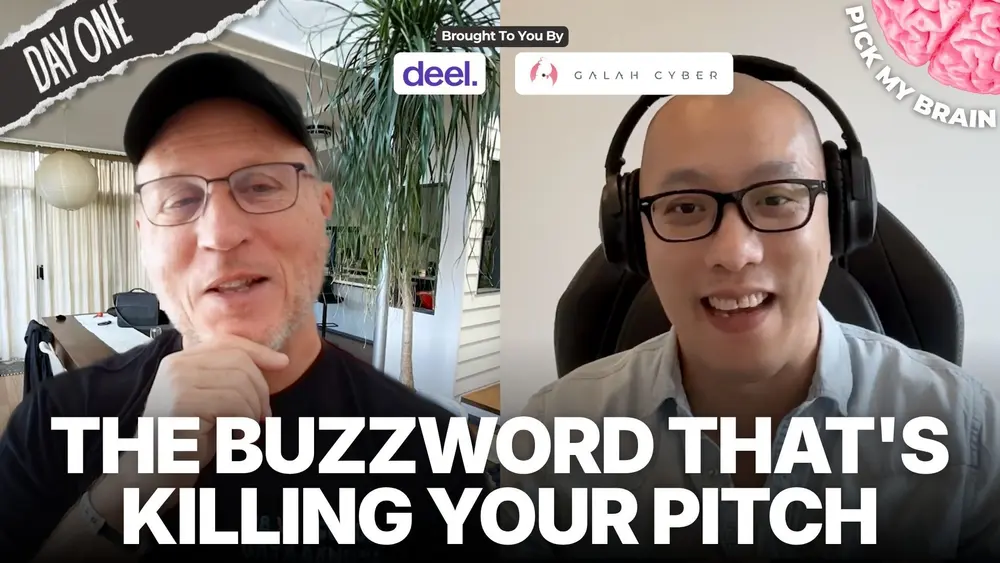
Transcript Synced · select any line to jump ▾ 0:02 Speaker: Founders scale faster on Deel. Set up payroll for any country in minutes. Hire anyone anywhere. Get visas handled fast and get back to building. Visit deel.com/dayone. That's D-E-E-L dot com slash day one. 0:22 Luke Marshall: When you get hundreds of applications, you actually don't get a meaningful answer or information out of that. It's sort of like looking for a needle in a haystack. And the value doesn't really come until you meet someone. 0:34 Alan Jones: A 27-second video, that seems very specific. It's not 20 and it's not 30, it's— why 27? 0:41 Luke Marshall: Sometimes you just gotta listen to your gut and follow the intuition and then the data will follow. 0:48 Alan Jones: Welcome to Pick My Brain, the podcast where we help startup founders improve their pitches, better connect with customers, co-founders, and investors. My name's Allan Jones, and I'm an ex-startup founder myself, but now I'm an angel investor with decades of experience helping new businesses find their footing and achieve their goals. I'd like to acknowledge first that this podcast is being recorded on Gadigal land, land that was never ceded. I pay my respects to their innovators and leaders past, present, and emerging. On Pick My Brain, you'll hear the real story straight from founders as they pitch their startups, tackle the challenges we all face, and try to make their ideas into a successful company. Each episode, we'll see if we can help these founders take their startups another step forward with advice, ideas, and maybe a little constructive criticism. 1:34 Speaker: You're listening to a Day One FM show. 1:38 Speaker: As a startup founder, you're juggling multiple priorities from the expected, like finding product market fit, to the unexpected, like customer requests for SOC 2 or ISO 27001 certification. But achieving compliance is time-consuming, and time spent on that is time away the needs of your business. That's where Vanta comes in. Vanta is the all-in-one solution for startups to become compliant quickly and build a security foundation with ease. With a combination of automation, an extensive partner network, and a security marketplace, Vanta provides the necessary tools and expertise for startups to achieve compliance seamlessly, no matter how urgent your needs are, and at every phase of growth. Over 10,000 leading companies, including Cypherstash, Handle, and Indetted, Trust Vanta to automate compliance so they can focus on growing their business. Startup customers like you get $1,000 off. Vanta at dayone.fm/vanta/brain. That's Vanta, V-A-N-T-A, at dayone.fm/vanta/brain. 2:44 Alan Jones: Thanks for joining me. Let's get started. Today we're joined by Luke Marshall, who heads up growth at Useverb, a video job application tool. Luke, you're another industry veteran. You've been around for quite some time since kind of the dawn of the digital media world. 3:01 Luke Marshall: Yeah, I think when Twitter started hitting the scene, that's when I did as well. And Twitter's no longer called Twitter anymore, is it? 3:09 Alan Jones: No, no, it's not. And I miss it probably as, I'm sure as much as you do too. Mate, before we get into, into Useverb, I'd like to kind of warm up with a couple questions that help me understand who somebody is and where they're coming from. And the first of those is, when you were a kid, what did you think you wanted to be when you grew up? 3:30 Luke Marshall: Good question. I think what I wanted to be growing up was, I think it was a marine biologist. I just loved the sound of that, you know, and when the first Jurassic Park movie came, science looked really cool. And I thought, I'll either do something around cool science or computers. 3:51 Alan Jones: Cool. Name a great marine dinosaur. 3:55 Luke Marshall: I think the one that springs to mind is that ichthyosaur, which it looks like a Diplodocus, but has fins and is quite large. And even looking at its size and how cumbersome it looks in the pictures, it's like, how did this thing even swim? 4:13 Alan Jones: Oh, yep, yep. I know exactly what you're, kind of like a Loch Ness monster, but in real life, right? 4:18 Luke Marshall: Yeah, an actual one. 4:20 Alan Jones: Yeah, yeah, yeah, yeah, yeah. I still love those too. And I think there were some marine dinosaurs in a couple of the Jurassic Park movies, if memory serves. So, second question was, it seems like you started in startups pretty early in your career journey. What were you doing immediately prior to getting into startups? 4:41 Luke Marshall: Before touching startups for the first time, I, I guess, cut my teeth in the digital marketing world at agencies. I worked at sort of big ticket agencies, media agencies like ZEDO and UM, Universal McCann, working on blue chip clients and basically running their media buying and trying to, you know, use data and get results, spend this amount of money and get this amount of signups or conversions or whatever it was. And for someone who was in their early to mid-20s, I was in charge of, very large budgets and probably irresponsibly so. No one should be in charge of $6 million online. Like, I would kill for those budgets now with the startup money that we have. 5:23 Alan Jones: Yeah, yeah. We've all gotten ruthlessly efficient over the years, haven't we? 5:28 Luke Marshall: Certainly. And I think it's probably gotten easier to measure, but I'd also say almost to a fault, there's a lot of information and data out there that is easy to get overwhelmed by. And often I find working with founders, it's easy to get stuck in that and trying to divine a picture. Sometimes you just gotta listen to your gut and follow the intuition and then the data will follow. 5:52 Alan Jones: That's good advice for everyone. Tell me a bit about Yousework. It's a video job application tool. How long has it been around? How big's the team? How big's the business? How's it going? 6:02 Luke Marshall: Yeah, it's a video job application tool and it actually started, you know, over 10 years ago. It's started by a founder named Paul Duchard, and he's a multi-exit founder who, definitely a polymath, very charismatic guy, sold his first startup for a large sum to a mining company. And, you know, had this itch about evergreen sort of industries and areas. And an evergreen industry and area that wouldn't go away for him was the fact that no matter, since the dawn of time, people are always looking for employment and people are always looking to hire. Yeah. And so he is like, okay, we need to play in this space and how can we add value? And one of the sort of insights was, okay, in the standard interview cycle, the most important part is meeting someone and it'll usually happen at the interview stage, which is, you know, rightly or wrongly how it happens. And if you can short circuit that and actually meet everyone you want to put through a hiring cycle at the start, we think it's a better way to do that. And so built the tech, launched, big budgets, you know, probably some big egos and big lessons yet to be learned. Really, it didn't, fizzled a bit. It didn't quite get the traction that we were after. And he sort of went back to the drawing board again and again. The team at peak was over 100 employees and now is down to under 10. And he moved back to Australia and we're like, okay, what does reloading the chamber look like? And now we're sitting on something with video, B2B, Cleara ICP are about to go to market in the next month or so with agents. And we're like, okay. Yeah. I think we're sitting on something pretty exciting here and we're just starting to get the glimmers and traction that we think can catapult it again. 7:45 Alan Jones: Cool, cool. So what are the challenges in front of the business now? 7:49 Luke Marshall: Yeah, I think a predictable pathway to growth is absolutely the problem that needs to be solved. I think cracking a clearer product-market fit, getting that repeatable traction, and obviously bringing in revenue to help fund that is gonna be key. And I think we're not out of the woods. This is a current problem we're working through. I, you know, have worked with a lot of clients on growing them with the digital and the nature of what we're doing is very experimental and we're running a lot of experiments at once on the tools with new tools and probably old tools as well, basically seeing what sticks. And what we're seeing is our ICP and sort of the clients that get the most value out of us tend to be multi-location hospitality venues or sales venues like customer-facing roles or retail. They have 5 to 20 stores, and they're generally understanding that they need a people system that helps vet for that really quickly. And so Yousef, by nature of being video first, it works really well with high volume, and it can actually help do the recruitment for those locations on site with hiring posters that go up and, and just keep a pipeline of talent coming all the time. That's what we're seeing at the moment and we're like, okay, well how do we blow this up? 9:06 Alan Jones: Okay, all right, great. There must be competitors in this space. This seems like adding video to interviews seems like a pretty straightforward insight. Who else is out there and how to differentiate in a crowded space? 9:19 Luke Marshall: Video interviews has been around for some time and I'd correct you there because the bit that we focus on is the video application. So cover letters, resumes, When you get hundreds of applications, you actually don't get a meaningful answer or information out of that. It's sort of like looking for a needle in a haystack, and the value doesn't really come until you meet someone. And so with our tool, it's a 27-second video application that you yes or no, swipe left or right, you get a gut check and a feel for the person and then vet for skills. I just went through this hiring process ourselves, dogfooding our own product for our first marketing hire, and being able to quickly assess and then check for the gut check in interviews, it really saved a lot of time and helped us sort of make a hire much more quickly than we otherwise would. 10:09 Alan Jones: Okay, you said something unexpected there. I just wanna dig into a little further. You said a 27-second video. That seems very specific. It's not 20 and it's not 30. Why 27? 10:20 Luke Marshall: Yeah, I think 30 is obviously, you know, sort of under 30 would be the default. I think it's just simple marketing here. A 27-second video, video is a very specific, it's a more memorable number and sort of goes into the anchoring sort of psychology around pricing and things like that. 10:42 Alan Jones: Okay. Do you tell the candidate before the video interview begins that they've got 27 seconds to leave an impression? 10:49 Luke Marshall: Yeah, I just went through this with a number of candidates now and it's the onboarding for the job seeker is what we call them is really clear. It's like you coached every step of the way, you can reshoot and refilm if you need to. You can give yourself captions and a teleprompter if you want. You've got full control over that video. And speaking to a candidate this week, they said, "I'll be honest, I tried 3 times." I'm like, "That's cool. Like, you clearly care and are passionate about this role and you wanted to put your best foot forward." And I think what we find this delivers is an authentic feel for a person. You know, it's under their control. They've got their best chance to put their foot forward. Yeah. And then on the other end, you know, you're seeing someone give it their best shot transmitting their energy through video. 11:37 Alan Jones: Okay, cool. So they can record a few takes and you get to see how many takes they've taken. Do you get to see all of the takes that they've recorded and the one that they feel like they did best on, or? 11:48 Luke Marshall: No, nothing like that. We're not trying to trip them up. It's like they give us the final deliverable, the video. They've got full control over the editing. They've got full control over the video. They can withdraw their application at any time. And this is more in the language of the sort of people we're hiring. It's generally Generation Z. They're extremely video literate. And I think one thing that's played to Yousef's advantage over this period of time that they've been around is probably that TikTokification where that generation is far more comfortable speaking to a portrait video than I'd say you or myself are. 12:24 Alan Jones: Okay, cool. Great, thank you. So who's the customer persona? Who in an organization are you trying to reach and what do you know about the ideal? Customer profile? 12:34 Luke Marshall: Yeah, so we sort of gave you an ideal customer profile in terms of the account, but generally this person is either the business owner, someone managing their operations for the business owner, or a sort of overworked HR resource. It's generally a people team of 1 to 3. And the way we sort of talk to these people, it's different because if we're talking to a head of talent and that's inundated, we're like, you know, how are you going? With the hundreds of CVs you're seeing every week. We know how much time that takes. The data tells us. Interested in having a chat about, you know, solving that for you. And yeah, there's been some warm receptivity there. Whereas a business owner, we've learned they're generally not interested in the specifics. They're just interested in getting another problem off their plate. They're overworked. And we find we need to hit them either on the phone or outside sort of normal business hours because they're usually up against it during the day. 13:32 Alan Jones: Mm-hmm, great, great. And so what does the current funnel look like? How does it work? 13:40 Luke Marshall: Yeah, so I thought I'd just talk through the growth strategy in broad strokes and get your feedback, Alan. I am currently running a layer of outbound through a tool called SmartLead and getting lists of customers that are within that ICP and then testing different messaging with the outbound and seeing what they respond to and what doesn't. Or does a heavily researched email work better than a non-researched email? What size and things like that. The next start of another element to our funnel that we're testing is organic social. We know that portrait videos are working exceedingly well right now. It's just appeared on LinkedIn. We know it's obviously, it's already all over TikToks, all over Instagram Reels. We're actually seeing some early promise from YouTube Shorts as well. And so we're just getting into the cadence of uploading videos as much as we can to see what works, what doesn't, what's getting engagement and look to fill that top of funnel awareness. We've got retargeting up to the wazoo. So if anyone comes to our website that is curious, we're retargeting with a series of ads that we have running at length to try and get them to sign up and prompt them to sign up. And we've got some website visitor tracking. So— 14:53 Alan Jones: Oh good. I look forward to seeing those. 14:55 Luke Marshall: Yeah. Yeah. So if someone comes on to our site, sometimes like the accuracy is about 15 or 30%. We've got a chance of seeing the domain and personally reaching out if we need to. And then LinkedIn cadence and prospecting because we know email is only one channel. We're sort of cycling through that and approaching different plays like connection requests, personalized connection requests, seeing if they're chatty, engaging with their posts and testing that with some software as well. 15:26 Alan Jones: Yeah. 15:26 Luke Marshall: And then probably some lower-tech stuff like manual outreach, calling in favors, hitting our network, and just seeing if we can get some more information and feedback. And then going through our old customer lists and looking what they hated or loved about the platform and then seeing if we can find more of them. 15:44 Alan Jones: Right, that sounds like you're hitting every possible channel known to humankind. That's great if it's manageable. It's, it's interesting, this, this, um, new generation of portrait video. What's your hypothesis on, on why it's proving popular? 16:05 Luke Marshall: Yeah, I think what changed either when TikTok arrived or later as TikTok's algorithm got better, it sort of shipped the needle from, say, keyword-based interests or what we're searching for on the web to basically what are people engaging with the most on a highly visual format like video. And what this did was have a knock-on impact onto the other, you know, social media and video companies as well. The YouTube algorithm right now is insanely good. Like I am looking up, you know, complex Nathan workflows, building with multi-tools, plugging into an LLM and getting a result. Yeah. And then the next day I'm getting 10 or 15 recipes for that particular thing at the same time as showing me gaming content for Slay the Spire and NBA. And it, you know, it just absolutely knows who I am and what I am about. And so instead of things being reliant on me going to discover, feeds now are all about for you content. And so your job isn't to try and get it in front of the eyeballs. 17:15 Alan Jones: Yeah. 17:15 Luke Marshall: Trust that the algorithms are going to lead the right eyeballs to the content. So the goal for us with video in particular is just unleashing as much as it can and creating a rapid learning curve because the eyeballs that find it the most interesting or engaging that lead to conversion will arrive at that. And it seems like— You remember when SEO sort of became mainstream around, say, 15 years ago, and if you got in early and had a good domain,, you could create a bit of a moat and even, you know, big massive businesses off the back of it. I feel like we're at that precipice now with portrait video and YouTube, obviously a massive company. I still think it's a sleeping giant. There's not enough marketers, founders, startups leaning into this. And the data I'm seeing, you know, from sort of other practitioners of my ilk is that it's nuts. And so if you can lean into it and solve for speed and getting that learning as fast as you can, there's market share to be captured. 18:14 Alan Jones: Yeah, cool. So you're breaking down little nuggets of content in portrait mode videos, sharing them across those platforms. There's less competition there. The recommendation algorithms are doing a better job of serving that to the right potential customer for you, and you're giving them something to watch which is kind of educational and value. And the fact that UseVerve is delivering the content that's kind of adjacent to it, but sooner or later you're counting they're going to click on a link and, uh, and then start a trial, right? 18:44 Luke Marshall: Yeah, obviously our tool works very well with portrait video as well, so that adjacency is, um, very helpful. I think something we're testing and leaning into is different messaging. I think we still haven't cracked our messaging on, on the landing pages we're running or the conversion funnel post-signup. And so We're like, okay, it's like TikTok for Yousefurb or TikTok for hiring, or is it a rapid tool where we're leaning more into the QR codes element? And so we're still working that out, but I think setting up the right channels to test these messages and then just seeing what data comes through and repeating it, I feel like we're on the right track. And I feel like the problems to be solved aren't necessarily standard marketing problems like. 19:31 Alan Jones: Yeah. 19:31 Luke Marshall: How do we set up a page, how do we set up our email onboarding, how do we set up automation? It's more, how do we get as much content going as efficiently as possible, still being brand safe in a way that leads our prospects back to where we want them to go? 19:46 Alan Jones: Yeah, cool. I think there are some changes required as well in our creative teams when we move from focusing on landscape to portrait video content. The old landscape days, you had kind of the middle third of the screen was where your presenter was, and then you had the right margin and the left margin available there for information and maybe some titles at the top. So you could be using the left and right-hand side of the screen to kind of supplement what the presenter was delivering. Now in portrait video, you're getting more of the presenter in shot and that the presenter's much closer to the lens than before. There's much less, space top and bottom around. But at the same time, I think the TikTok content generation have become much more tolerant of overlays, you know, so stuff that's actually partially obscuring the presenter and the information. And so for the editors and content creators that grew up in the 16:9 generation, landscape generation, it's quite a different kind of way to make content and a way to plan content out. You're gonna be much, much closer to your audience than you used to be in the old landscape days, then you're also gonna need to be kind of thinking about cramming stuff in. And as long as it's just flashing up for a second or two and then going away again, you're not losing that eye-to-eye contact between presenter and audience. And I think Gen Z's high tolerance for stuff overflowing on screen and also their high tolerance for, like, they seem to be able to comprehend something on screen much, much more quickly than Millennials and Gen X. Yeah. And so it can just flash and be gone and flash and be gone. I think it's also really interesting how much of their content is self-referential, is full of callbacks, is full of memes. And, you know, the subtler that stuff is, the more it seems to stick. And, you know, we are now seeing the older representatives of Gen Z become the mid-career worker. You know, they're coming into their 30s soon or now. And so, you know, they are the people who becoming the subject matter experts. If the boss says, hey, you know, how else can we deal with our, with our challenge about processing job applications for open roles? They are, or soon they're about to become the subject matter experts. The people say, hey boss, there's this new thing that I'm seeing. So I do think now is the time for all online marketers to really take the time to understand Gen Z and to fill, you know, some positions in the team with those people and listen to what they say. 22:25 Luke Marshall: Yeah, listen to what they say and trust what they're saying and seeing. Like, some of the most fascinating conversations I have is with my friends' kids, and I just say, you know, what are you into? Hey, and one story he shared is, hey, he really, you know, wanted to impress this girl at the arcade, and there was a crew that was doing the dance moves that you bounce, and I'm messing it up as an old guy, but he kept practicing, and then on a local Discord, someone said, did you see that white guy doing all those moves on the machine? He was amazing. And he got in touch and he's now, that's now his girlfriend. It's like, you know, this is the generation they're in and how they interact and work. And that whole story, that's just mind-blowing to me because, you know, we were going to clubs trying to dance next to girls and hoping that they might, you know, engage with us. 23:18 Alan Jones: That's a great story. Yeah, it is. The future is a foreign land and we're just visitors in it. 23:27 Luke Marshall: Yeah, yeah. 23:28 Alan Jones: But we can also be ethnographers and sociologists and study and appreciate the difference and learn something at least about how to behave and how to interact in that world, even if we'll never be actual natives ourselves. 23:42 Luke Marshall: Yeah, and I think one tick in favor of older people as well is that we've seen a lot of change and seen, done a lot of adapting working in digital or tech already. And so that, I guess, interactions and seeing what has crashed and burned in the past and learnings from it can be a steady head as well. But I think it benefits from combining that with all the things we've talked about and sort of finding what's interesting being done by these natives and running with it. 24:12 Alan Jones: So email marketing to the business owner is still a big part of how you get that purchase decision maker on board. What sort of cost per acquisition do you expect to see out of those sorts of campaigns at the moment? 24:27 Luke Marshall: Yeah, good question. The stack that we're running, it probably costs, it's running, it ebbs and flows based on credits and usage, but the stack we're running with sits at around, let's say $500 to say $2,000 a month for the tech. And then we're plugging things in and running with them as we go. We are yet to sort of, you know, get any sort of significant traction in terms of, you know, acquiring customers and sort of having cracked that code yet. We're definitely making inroads. Yeah, the average sort of customer value for something like our tech sits at around $5,000 to $15,000 per year. And so we're quite comfortable with the responses we're getting, the engagement we're getting, what we're seeing from our existing customers now, and just sort of still in that experimenting phase to figure out, okay, well, you know, if we can predictably acquire these, we've got a war chest to play with. And when we see a channel that's starting to light up with the approach, that's when we'll look to scale up and sort of start investing more heavily. We have made it, you know, we're about to make our first sort of junior level marketing hire. And I think we're starting to ratchet it up because the data I'm seeing is promising. 25:57 Alan Jones: Cool, that's great. Have you experimented with using AI to generate email copy and predict deliverability and response rate? 26:08 Luke Marshall: Not so much prediction, although I am seeing some new tech sort of going into that area that seems pretty interesting. We're absolutely using AI to help with copy. I think we pump it through some verification tools first and enrich the data to sort of make sure, you know, we're talking to the right person at the right time. And then we started running, you know, matched audience ads, you know, across the channels to sort of try and get— just make them more aware of us at the start. And then with the copy, Yeah, we use AI to sort of help either have templated elements that are sort of repeatable, but then custom elements based off what we've researched and know. We find that combination works exceedingly well because we can say, hey, we saw you hired, you had 80 open roles last year. You've grown and your employee count has jumped to 200 and you're probably getting about 30 applications on each job. Which adds up, if you added up every application's 3 minutes, yeah, that's about 50 days a year that you're spending just looking at applications. Do you want to have a quick chat about this? And that combination of, say, template plus some well-researched information seems to work really well. The other thing that I'd probably call out about the generative AI and sort of running with it is you do want to make it, make it not quite templated. And by that, I mean, try and break from script a bit because there's a lot of information now out there about hooks and what works. And this is a bulletproof cold email template, but if it's out there, it's already dead. Like you know, it's sort of need to add your own spin to things. And what seems to be working for us is adding a bit of personality and sort of lowercase into the language and you know, being quite goofy sometimes just to, you know, see what we can do to elicit a smile. 28:03 Alan Jones: Great. Well, you got one from me just then. That's promising. Luke, are you running different landing pages for different campaigns or is everybody landing on the same landing page? 28:15 Luke Marshall: Yeah, one experiment we ran late last year was, okay, well, how nuts can we go with the personalized landing pages? And so we grabbed a list of about 500 targets put it into Airtable, and then connected it to a tool called Make, ran it through AI, and then had it generate pages in Webflow. And what this would do is say, hey, John, I see you working at this particular location. You actually advertised the role on Seek recently. Click here and we'll automatically onboard you with a free account. And we thought, you know, this is the hottest offer since sliced bread. What we actually learned was it was probably too personalized because the engagement we got on these pages was very little. And the ICP at the time, like who we were targeting, was more individual hospitality venues. And it tanked, like despite how clever we thought we were being. One of the bottlenecks for us right now is generating enough landing pages at scale as a one-man team. I can do a lot of things and roll up the sleeves. Design is probably my Achilles heel. 29:20 Speaker: Mm-hmm. 29:21 Luke Marshall: And so we're looking to outsource that. And basically get a solution for that in the next few weeks so we can spin up more landing pages that look a certain caliber, but also test different structures like short page versus long form, more video versus not, and individualize to either the kind of role that we're targeting or the industry. 29:43 Alan Jones: Yeah, I think role and industry targeting is pretty good. I think what you've touched on there is sometimes when we personalize landing pages too much, we end up in uncanny valley. You know, we freak our user out. We just, we know way too much about them already and they don't feel like they've given us consent to do that. So I think, yeah, that seems like something that's quite likely to happen with that level of personalization. At the same time, I think it's a really good idea to A/B test ideas around, you know, industry specialization and maybe role. It does require potentially, you know, require a lot of case study, you know, client case study content to make that work. One thing that I did observe about the default landing page that I go to when I come to use Verve is that the case studies and the customers on that landing page are all white men. And the combination of very Anglo and the combination of very male. May result in, in, in reduced response rates from, from people who aren't from that same gender and same ethnicity. 30:54 Luke Marshall: Yeah, I, I completely agree. And, um, it's something we need to obviously bolster and improve. And I think by nature of this business being around for a long time, um, and sort of not quite hitting its straps in terms of traction, there's work to be done in sort of creating more studies that are more diverse. And if we think about the ICP I've described, one of them being heads of talent at these fast-scaling organizations, usually younger, skews female, and definitely wouldn't resonate with just pure Anglo-sized white old men. And so I love that you've called that out, and I think we have work to do to sort of improve for that. 31:35 Alan Jones: Yeah, the landing page I see has Hoffman from Liquor Shed and Ben from Lakeside Recreation Center and and Jason from Specsaver. And, you know, they're gonna appeal to business owners that they're a close match for, but yeah, they're probably not gonna respond as well. Whereas the little looping GIF animation up the top next to the call to action, see who's applying, there's a lot more diversity in that little clip and a lot more action. There's a lot more stuff happening there, which I think is gonna appeal to that younger demographic. Yeah. 32:07 Luke Marshall: 100%. 32:08 Alan Jones: I think in general it's a pretty great general purpose landing page. I like that there's just a straight up obviously YouTube video there, interview with Gage Rhodes. I think that's helpful. It might be necessary to look at either using YouTube's premium options or switching to something like Vimeo or something to take out YouTube's habit of recommending other videos you should now watch. You know, so, so there's a, there's a pre-play screen and a, and a post-play screen where they're showing you other things you should watch. And everybody's very familiar with that from, from YouTube. But if somebody's not really sure how they landed on this page or why, because they, you know, clicked on a link, but then they got a phone call or, or called out to, to see a customer at the front counter, and they come back to that page and they see a bunch of other YouTube videos that the, the recommendation algorithm is serving them. There may actually be a reason just to click off our landing page for now. 33:02 Luke Marshall: Totally agree. And I love what you said about people getting a call or clicking away. And one of the things we did probably in the last month was install Microsoft Clarity, where you get to see sessions recorded and how they behave on the landing page. And one of the things that's completely demoralizing is you see, say, a prospect view the page, click on a menu, scroll up and down, and then it just stops. For 30 minutes, and the reason is they've gone to another tab, they've taken a call, and then they never come back. And you're like, ah, you've worked so hard to get them to the page, and then you need to battle that as well. 33:36 Alan Jones: Yeah, yeah. A day later, it's tab number 76, and they start running out of memory, and then they just quit and reopen their browser, and you lost them. Have to go and retarget them again. 33:48 Luke Marshall: And we all do it. We've all been there, Allan. Like, I've, you know, I'm guilty as anyone. I've experimented with trying to minimize run with one tab. It just doesn't work. Our brain's no longer wired that way, unfortunately. 34:01 Alan Jones: Oh, the temptation is too strong. Too, too, too strong. Look, is there anything else I can help you with with UseVogue today? 34:09 Luke Marshall: No, look, great to get the spot feedback, sense check the thinking, get your takes on it. Love the input around diversity and a spot check on the homepage. I think in terms of anything else that would be helpful, It would be, you know, if you do come across customers that fit that ICP or are grumbling about their current people systems, we'd love to talk to them even for user research and interviews. And our sort of policy at the moment is very open door. I think we're aggressively going after a market that's a step up and an echelon higher than what we've used to speak to. And we've got a lot of learning to do that we need to do quickly. And so we're here to help and help And I think, you know, it's great to sort of appear on something like this and jam with you and appreciate the offer of help. 34:54 Alan Jones: I really enjoyed speaking with you today, Luke. Thanks very much for coming on. Thanks for telling us about Useverb as well. 35:04 Speaker: Thanks for joining me for this and every episode of Pick My Brains, the advice podcast for every startup founder. 35:09 Alan Jones: Never mind the don't forget to like and subscribe bullshit that every podcast host goes on about. 35:15 Speaker: Instead, please take a moment to think about someone you know who could use some of the advice I've shared and tell them that they should listen to it. I don't know, maybe they'll choose to like and subscribe. Anyway, I'm not a lawyer or an accountant, and what you've heard today is not intended as financial or legal advice. You should always seek that from a qualified professional before making the big decisions. And I'm not a superhero either, so don't forget that sometimes I'm fallible, and very occasionally I might even be wrong. Please let me when you think I might be, so I can get better at this too. Just reach out to me on any of our social channels or email the show at pickmybrain@startupfoundercoach.com. Speaking of startupfoundercoach.com, that's where you might sometimes find show notes, transcripts, and bonus bloopers if I have the time. The Pick My Brain podcast is produced, edited, and beamed directly to your ears by the hardworking and understaffed team at Day One, the podcast network for founders operators and investors. Find out more at dayone.fm. Thanks for listening.



 ▶
▶  ▶
▶  ▶
▶  ▶
▶  ▶
▶  ▶
▶  ▶
▶ ▶
▶ ▶
▶