Transcript Synced · select any line to jump ▾ 0:00 Speaker: Shit at the speed of light is still shit. 0:04 Amy Tucker: Really didn't think we'd end up here. We both got laid off within 3 weeks of each other and it was kind of this beautiful moment where we're like, okay, what the fuck are we gonna be doing? 0:14 Speaker: Paper called Artificial Hive Mind. They asked 70 language models to give me a metaphor for time and 69 outta 70 models all said time is a river, time is a river, time is a river over and over again. Flint is a model that is designed not to give you the average answer. It is designed to break the distribution and so that instead of giving you the same repetitive answer regardless of who you are, we give you something different every single time. 0:39 Speaker: In this world where there's a SaaS-pocalypse and everyone's talking about everything being copyable, what matters? What should people be thinking about when they're building, do you think? Hello and welcome to "In the Blink of AI." We have the incredible Springboard's team today. All 3 co-founders, Amy, Pip, and Kieran, are joining us on the show, and they have an incredible announcement. Now, I've known these, these guys for years, and I first met them through the Google AI Accelerator, a very prestigious accelerator only for AI-native companies. You know, we had Google engineers vetting each of these companies to get into the final cohort, and they were just so well liked by all the Googlers. Yes, they had these incredible IQ and product-market fit product that ticked all the boxes, but they're just a genuinely honest and likable team. And I think you'll see that on the episode today. But yes, you've probably also seen them in the, um, the big headlines. You've probably seen them on Forbes, on the front cover of The Australian. But today they have a big announcement with their model, Flint. It's available now. It's unlike anything that you've ever seen before, even if you use all the existing other AI models and LLMs out there. And we go behind the scenes of what it took to build the model, but also the decision-making process and the benchmarks that they assessed against. Fascinating episode, fascinating discussion. I can't wait for you guys to hear it. Let's dive in. 2:18 Amy Tucker: Hi. 2:18 Speaker: You're listening to a dayone.fm show. 2:21 Georgie Healy: Frontier models are getting smarter, faster, and more polished while their outputs are getting eerily similar and more repetitive. Please tell us about Flint. 2:32 Speaker: Yeah, it's mega exciting. So I guess this is almost like the culmination of everything we've been doing for 3-odd years. And so when we first started playing with Springboards, it was always designed to help inspire ideas in people. We've never been a big believer of letting machines do creative work or doing it well. We always think that that should be a human thing and that humans are actually naturally just better at it. And so one of the things that we've been doing for a very long time is driving variation in outputs of models. So when I ask for, like, I'm trying to come up with a creative idea for a campaign, We want to drive lots of variation to put the, the power into the person to go, well, that's good, that's shit, what if I take this somewhere else, what can spark an idea in someone's head. Um, and very early on in the piece, we started to realize that all of these models are, one, very, very repetitive, but two, have started to converge into the exact same space. And so that little magic trick, we'll round it on between 1 and 10, be it a 7, a 3, or 9, every time you ask, it doesn't matter what model you use, who you are, where you live, they give you the same answers. And so there was a white paper that won one of like the, was it NeurIPS, Kieran? 3:47 Amy Tucker: NeurIPS. 3:48 Speaker: NeurIPS conference last year. One of the most awarded papers or recognized papers was this paper called Artificial Hive Mind. And it looked at the convergence of all these models. And so what they found is that regardless of how these models have been trained, they've all spitting out the exact same answers. So the highlight example of that paper was they asked 70 language models to give me a metaphor for time. 69 out of 70 models all said, "Time is a river, time is a river, time is a river," over and over again. And so this is a really long-winded way to say that FLINT is a model that is designed not to give you the average answer. It is designed to break the distribution. And so that instead of giving you the same repetitive answer regardless of who you are, we give you something different every single time. And that is different to every model. in the world. So we call it a divergence model. Um, we've just said that because it kind of mirrors like more of a creative place, a place of going wide, uh, whereas every other model converges into the same place. 4:50 Georgie Healy: Incredible. Fascinating. And am I correct in saying there is no other model like this in the world, right? 4:57 Speaker: Not that we're aware of. 4:59 Speaker: Um, no, not, not entirely. I mean, there are— there's certainly like increasing like research awareness of this problem, and we're seeing like the Hive Mind and many other papers are talking about the kind lack of output diversity of these models. There are other attempts to solve this kind of problem. There's a model called CRPO. 5:17 Speaker: It's not publicly available, is it, as well? 5:20 Speaker: I think it's open source, yeah. Which takes a different approach. 5:24 Georgie Healy: It doesn't really have the same ring to it as Flint though, I will say. It's like a Star Wars character. I mean, you guys are really passionate about this. You have been passionate about, I feel, creativity and original thinking since the beginning. 5:39 Speaker: Is that correct? 5:40 Georgie Healy: Like, I mean, maybe for the listeners that don't know you guys, why, why, why are you guys uniquely positioned to care about this? And what, what might have brought you guys into this as a problem worth solving? 5:52 Amy Tucker: Yeah, well, we all, we always joke we're kind of accidental founders. Um, we really didn't think we'd end up here, um, and we kind of Started this journey. So Pip and I are both ex-advertising people. So worked in media agencies, creative agencies, in-house teams, both in Australia and San Francisco. And we both got laid off within 3 weeks of each other. And it was kind of this beautiful moment where we're like, okay, what the fuck are we gonna be doing? And we did consultancy work for a little while and we were playing around with these tools as they were, you know, bubbling out into the world. And it was very immediate that we kind of realized that they weren't really good at helping us in the right, in the way that we needed to be helped. And so we taught ourselves very badly to code the very, very first version of Springboards and kind of created a system or a, you know, versions of the things that we needed. And we presented it back at a conference in Sydney and people wanted to buy it, they wanted to invest and they wanted to join us. And then we obviously, brought in Kieran as our technical co-founder to build it better. But it kind of, yeah, I guess originated from the problem that we're now solving today, which is the problem variation and these models, their ability even then to be creative and to think divergently and to inspire you and take you in places that you otherwise wouldn't go. So interestingly, like that's how it started and that's kind of like still the problem where, We're trying to solve. 7:29 Georgie Healy: Yeah. Wow. And having AI and creativity, it sounds almost like an oxymoron, but it— but you guys are so incredible in how that, that is— you've doubled down on both. It's a model with entropy in the right places. I loved reading this, but I've kind of forgotten first year thermodynamics. So for the listeners, what is entropy and what do you mean by in the right places? Is it hallucinating wildly or is it it knows when to do that. 7:58 Speaker: You want to take this one? I'll take this one. Yeah. 8:01 Georgie Healy: I'm definitely not taking this one. I wanted to say in all the right places like that, but you know. 8:07 Speaker: Yeah, so I think entropy, the kind of vernacular sense that you have of that word is good enough for the definition as it stands. Entropy, I suppose, in the kind of way that we measure it in, large language models is a calculation of the randomness over a probability distribution. So whether people realize it or not, large language models, they generate text token by token. Token is probably a word that you've heard thrown around. And the way that it works is the model fundamentally is taking all of the previous tokens, whether it's the prompt that the user passed in or the tokens that the model has generated so far, and it's creating or generating a probability distribution over all of the possible tokens. And so entropy is a way of kind of summarizing how random or how kind of chaotic that output is going to be. And what we've found, and certainly like this is a kind of— this explains why we're seeing so little output diversity, is that even for very open-ended questions, even for places where there are lots of possible paths where language could unfold, the models are producing very, very skewed, very, very low entropy distributions. So for instance, it'll give 90% probability that the number 7 should come in that kind of generation. And so yeah, we're really trying to focus on these critical tokens, these moments where different paths could unfold, and train to spread out and increase the entropy at those moments. 9:44 Georgie Healy: Give me a question that you guys would ask Flint and a high entropy answer that could be offered perhaps. So like, what's a prompt that you, that I could write into the model? And if I put into Claude, ChatGPT, Gemini, we know what kind of answer it would get. And then what might Flint offer? 10:06 Speaker: There is any open-ended prompt. Okay. And so the ones we often show is anything from random numbers to give me a random car. If you ask a, a, one of the traditional models for a random car, you will likely get a Toyota Corolla a Corolla or a Camry followed by a Honda Civic followed by a Ford Mustang. These models are very, very capable of telling you any car model in the world. They give you the same damn 3 car models every single time. Pizza toppings, I'll give you pepperoni followed by mushrooms followed by olives usually. Our model will give you like blue cheese and like barbecue chicken wings if you want that instead. And it's not to say that like barbecue chicken wings or blue cheese is a better response than pepperoni or mushrooms, but it's a valid response if I'm trying to like think about what I should eat for dinner, which is more interesting than pepperoni and mushroom cheese. It works in like taglines and manifestos. It works on like, where should I go on holiday in Europe? If you don't want to go to Europe, Paris, or France, and you might want to go to, Kieran always says Cork, or— 11:02 Georgie Healy: Yeah. 11:02 Speaker: Like some tiny little town in Italy. Like these models have the capability to tell you these things, they just don't. And it's because all of that probability that Kieran was just talking about gets assigned to a single token, which is the most likely answer that the model thinks you want to hear. And so this has been happening because all of these language models in the world, they're not competing to be great creative assistant aids, or they're not created to help you explore different pizza toppings or where to go on holidays. They're trying to be the front page of the internet, and they're trying to be encoding agents. And in those worlds, you want the right answer. But in open-ended questions, regardless of what that open-ended question, when the world is your oyster, You don't want the same thing over and over and over and over and over and over and over and over again. And so like, yes, we've built Flint specifically within Springboards to start with to help service a commercial creative industry in advertising and marketing. But we actually think the model, although even if it's not our model, the way of training these models of creating diverse different outputs is applicable to just so many other fields and people when they just want something different. If they don't want the world to turn to gray and mush and everyone starts going to the same places and having like whatever, I just think there's just, there's such a much more interesting world if we give people like true open-ended options instead of forcing everyone into the same place. 12:36 Georgie Healy: Couldn't agree more. I hate it when someone wears the same outfit as me, let alone like they're all in Paris at the same time. Fascinating, so cool, so obviously makes sense. I don't know about your guys' social media algorithm. I feel like founders are often using models like build me a unicorn, make no mistakes. And then even for that, it's like you're getting the same advice of how to build something. And if you are only using that, there's no competitive landscape, right? 13:04 Amy Tucker: And I think for the, like the world that we live in, right? Like we're obviously servicing the advertising and marketing industry. Like everyone gets the same brief. Whether you're in a pitch scenario or a client to an agency, it's the same brief. And it's the humans that have spent years sharpening the craft, knowing what good looks like, taking that, you know, blue cheese on a pizza idea into a completely interesting new direction that is then brand safe and feels like it works for the audience that we're talking to, to make it applicable and interesting for that brand. But if everyone is using these models and to get the topping ideas, for example, they're all gonna be responding back to the client with the exact same TV script, the exact same out-of-home poster that's, you know, a pepperoni pizza. And what a terrifying world if we're all kind of creating the same stuff and we all, you know, inherently think that we're being creative. That's also terrifying. 14:10 Georgie Healy: Agree. I mean, how frustrating when you are 20 minutes in a movie, like, I see where this is going. 14:17 Amy Tucker: Yeah. 14:17 Georgie Healy: And then you just switch it off because you're like, I don't need to spend that time. And it's just so predictable. It's like bigger scale, bigger consequences, right? 14:27 Speaker: It's like, it's even a problem though in like the image model space as well a lot of the time. And so like even if you just go on search on Google and say, AI-designed homepage and look at Google Images, they'll all be blue and purple. And so, like, because these— this problem is, is a function of probabilities. And, and so I think this, this problem is actually probably transferable to both images models and language models. Like, obviously we're not building image models, but the language model space is just like frighteningly similar, which is, I think, really scary when everyone's rushing to, like, building agent architectures, um, which go off and do their own things and make their own decisions without any human in the loop. And so those, those well-worn paths are going to get further and further well-worn when you give every single decision in the hands of an agentic system. It's like it's actually going to double down on the averageness that you will get from these models. 15:28 Georgie Healy: What a gray world. I'm very excited you guys are pushing against that. Pip, when we spoke last, you called it a tiny but interesting model. I wanna get into specifics, and Kieran, this might be one for you. How can you make a, how can you tune this model in a way that is meaningful without, Going too long and too time intensive and too much compute. Like, how do you play with tuning a model? I honestly don't know what goes behind it, and I'm sure a lot of people don't as well. How does one get Flint at the end? 16:08 Speaker: Yeah, well, the first thing to say is if you kind of go down the well-worn path of fine-tuning, you won't get Flint. We kind of spent a lot of time running experiments and trying to crack this nut before we really got to this place. Fine-tuning, for those who don't know, really is most of the time one and the same with training. Fine-tuning is used to refer to a moment when you're training a model that's already been trained for something else. What we had to figure out in order to make this work was really a fine-tuning process that isn't just going down the same path of, if I give you this, you give me that, which tends to be the kind of way these models are trained in a kind of supervised fine-tuning paradigm. So really, in this kind of circumstance, we want more variation. We want a flatter distribution, that kind of piece. Does that answer the question? 17:08 Georgie Healy: Yeah, it does. It does. What about size though? Like, when it comes— like, I know you guys are Blackbird-backed, but like, you've got these companies with $122 billion that can build from ground up. Like, how do you, how do you justify and how big can you go and still say it's worth the time and energy and getting something special out of it at the end? 17:32 Speaker: Yeah, well, something we learned from the Creativity Benchmark project we did last year sometime is that amongst our kind of expert human evaluators from the advertising industry, there wasn't really a strong correlation between model size and preference of output, with maybe one exception, which was the GPT-3.5 Turbo underperformed pretty significantly. Beyond that, size doesn't seem to matter all that much, at least in the context of, here's an idea, how good is it? I've always said, at least, you know, internally, that I think we should try and get away with the smallest model we can. There's a bunch of benefits for doing that. One is it costs less, takes less power, creates less e-waste, uses less water. 18:23 Speaker: Faster. 18:24 Speaker: Runs faster. And so for us, it's always been like, how can we enact this change in a kind of like, how can we get as far as we can with the limited resources that we have, given that we're not, we don't have $100 billion to burn. 18:38 Georgie Healy: That is fascinating. So many people don't know what goes behind, yeah, what's under the hood. Tell us about Novelty Bench and what it means to double the score on Novelty Bench. It sounds like a pinball machine, but please clarify what this is. 18:55 Speaker: Sure. So AI models, they tend to get evaluated and report on benchmarks. And so benchmarks are kind of think of it like a set of challenges that models are put through that give a— what is meant to be an objective score of how well they perform in a particular— for a particular kind of use case. And so a lot of the benchmarks that are being— that the models that you hear about tend to be reported on are sort of traditional single ground truth question-answer things. Coding is a big deal. STEM questions, mathematics, reasoning. There's one called Humanity's Last Exam, which is meant to measure AGI, but— 19:38 Georgie Healy: Oh my gosh. 19:39 Speaker: It's a whole other conversation. Novelty Bench is not super widely known, and it's not one that I think the kind of big players seem to care about all that much, which probably just indicates they don't really care about the novelty problem itself, particularly, but it's a pretty easy one to understand. They have 100 curated open-ended questions and they run that same question through a model 10 times over and they count up the average number of distinct answers that you get back from the model out of 10. So on average, I think the kind of big state-of-the-art models that people would be aware of usually get somewhere in the kind of 1s or 2s. Maybe early 3s. So it's really just another way of saying, like, if you do ask the model the same question, probably we'll see the same output pretty frequently. Now, our model is kind of hitting a 7.5 while maintaining a pretty good kind of quality and coherence. So that's pretty awesome. Uh, it caps out at 10, but to be honest, you can't really get to 10 on Novelty Bench because there are a bunch of questions in there that don't have 10 valid answers. Like, for instance, one is name a member of Pink Floyd. I think there's maybe 4 or 5. I'd have to look it up. 21:03 Georgie Healy: Keep going. 21:04 Speaker: Yeah. 21:05 Georgie Healy: Make them up. 21:06 Amy Tucker: Yeah. 21:07 Georgie Healy: That is novel. 21:08 Speaker: Yeah. So that's novelty bench. 21:11 Georgie Healy: Wow. So you guys more than doubled in many cases the score. 21:16 Speaker: The scores is doubled, but it's like you can't really quantify how big of a jump that is. Because of like what— 21:24 Georgie Healy: Yeah, yeah, it's not always 10. 21:25 Speaker: Yeah. And even like some of the confusing things is that like, um, one of the questions is like, uh, write me a dad joke, for instance. Um, and GPT 10 out of 10 times will be something to do with skeletons, and they might rephrase or rewrite it slightly different. And so because it's an LLM as a judge, sometimes it may judge that as two separate things even though it's the same underlying idea or same underlying concept. Whereas you run that one on Flint, you'll get 10 very, very different versions, which is kind of cool. I'd rather— 21:57 Georgie Healy: Did you specifically train the dad jokes? 21:58 Speaker: No, I didn't. 21:59 Amy Tucker: That's— 21:59 Speaker: we didn't, we didn't set the questions, we just fucking answer them. But I think one thing I'll just add to what Kieran was talking about, like kind of the size of the model and how it's trained and why it's interesting, why I think it's particularly interesting, is that although we like significantly increase the entropy and the variation and the, the the options that can come out of the model, we didn't degrade the base performance of the model. And so when we do our benchmarks, of course we focus in on Novelty Bench, but we also run those same maths and STEM question benchmarks to say, hey, are we actually screwing up the base model by driving more and more variation? And Flint passed the maths test. It got like, I think the 4— we did a 4 billion parameter one, got like a 51% score on a high school maths test, and now it's getting like 70% on it. And so like we didn't degrade its ability ability to answer maths questions or science or physics questions accurately, but we did increase the variation when it counted. And for us, that's a really exciting thing because it's a, it's a path forward to go from a small, small model being 30 billion parameters up to wherever we want to get it to without the trade-offs that Kieran talked about earlier, which is cost, time, speed, environment, and everything else that you want to kind of bundle into the advantages of a small nimble model versus a behemoth trillion billion parameter. I don't even know how to say trillion billion in the same sentence. Yeah, it surely doesn't— 23:26 Speaker: Billion billion that hasn't been fully released is meant to be 10 trillion, they say. 23:31 Speaker: 10 trillion billion parameters? 23:32 Speaker: No, no, no, 10 trillion. But really, you know, unfathomably big. 23:40 Georgie Healy: Guys, I'm sorry, I want to play with this model. Am I allowed to play with the model? Like genuinely, I know you come from an agency background. I know this is great for pitching to companies that have campaigns and branding. 23:54 Speaker: Yeah. 23:55 Georgie Healy: But it sounds like I can kind of use it for other things as well. Yeah. 24:00 Speaker: Yeah. 24:00 Georgie Healy: Will you let me use it? 24:01 Amy Tucker: Yeah, it's now very exciting as of last, end of last week, it's now open to everyone. So whether you are a freelancer, whether you are, you know, in advertising or marketing and you are consulting, whether you are in a small agency team, or whether you just wanna have a play and play around with creative questions, write a song, I don't know. You know, do a structure for a podcast. You can jump in. So you can, there's a free trial. So a 14-day free trial, or you can subscribe annually. 24:32 Speaker: Free version as well. 24:34 Amy Tucker: Yeah, free trial. And yeah, we can, yeah. 24:38 Georgie Healy: I'm just envisaging like websites are really boring. Like personal websites are really boring. They all look the same if you vibe code them in lovable. Even like I use Claude to kind of, this is everything about a person, a company, a brand, help me feed that into vibe coding tool. It is all kind of same, same. So that's kind of an interesting thing that I'm like, I wanna play with this. 25:01 Amy Tucker: We even did like the exercise, I think recently in a talk where we kind of looked at like all the book covers and all the logos of cars and all the, The world's been going this way for a long time. And weirdly, like the world has slowly been diverging into the same space with regard to that. And this is before AI. So I can imagine like with, as you are saying, like websites and stuff and the fact that people can now spin up more shit, like more stuff is even more important for us to make something that creates meaningful work. Because if you can't cut through, particularly now as there's more stuff, the work isn't gonna work. And we all know how hard it is to get the work to work in the first place. So— 25:48 Speaker: Yes. 25:48 Georgie Healy: And how to differentiate, like I was so cranky at myself that I chose like that lime brat green color for the podcast because it's South by Southwest. It's like everyone loves this lime green, especially in tech, especially in AI. And it's very signature. Very specific lime green, and now everyone has it. And I'm like, to change the brand now, it's really hard, right? 26:10 Speaker: There's a quote I love, which is, um, shit at the speed of light is still shit. And like, just because you can do things faster and cheaper doesn't mean it's going to be any good, doesn't mean it's going to work. And so I think like The weird thing with like a model like Flint is that like we're gonna— we might— the answers may not be as good as what you're going to get from something else, but it's up to you to decide what is good and what you like. And it puts like the power back in the person's hands instead of just being waterboarded by a language model and convinced that the output is good, because they're highly, highly convincing tools. So yeah, I think it's just— 26:52 Georgie Healy: I'm so glad you brought this up because I had this question that I wanted to ask you guys, and then this morning it really reinforced it. Gosh, who was it? MIT released a study last year. Heavy AI use is causing cognitive atrophy. We're getting dumber, right? Using AI. This morning I had a couple of friends being like, I'm using Whisperflow, the voice tool. I'm using Granola. My emails are automatically being responded to through Notion. And I just feel like my brain is turning into like— 27:23 Amy Tucker: Marsh. 27:24 Georgie Healy: Marsh. Is that happening with creativity too, do you think? And to your point, if you're using Flint, are you forcing people to start using their brains a little bit and making decisions again? 27:37 Amy Tucker: I was gonna say, I don't think, I mean, our belief has always been, I don't believe that these things will ever, and AI will ever take over that because humans are very good at identifying something that makes them feel something and they have the taste and, you know, particularly in our industry, spent a lot of time sharpening their craft and identifying how to take that creative leap from an insight and how to tackle problems in interesting and different ways. And innovation, right? Like innovation has come from new thinking, not from historical thinking and repeating the past. So I think, yeah, I don't believe that without humans. And I mean, our whole mission is about keeping creative humans in the creative equation. Like, we don't believe inherently that it will ever get taken over by these machines because, as Pip kind of alluded to earlier, they're giving everyone the same stuff. 28:39 Speaker: Yeah. The problem is, is that humans are notoriously lazy because it's like a, it's an evolutionary advantage to be lazy and to find the path of least resistance. And so for a lot of people, the path of least resistance is going to be totally fine, and their brains will atrophy and will turn to mush because they won't use them, because it is muscle just like anything else. Um, and so we're like, in our tool, we've actually always avoided like executions, anything that looks like too polished or too finished, because we think it's more interesting to be a thinking partner than instead of to being an answering tool. Um, What, like, you can't stop the way that people use it though. You can only put something in, into the world and hopefully the people that buy into what you're trying to do value the same stuff, because if they don't, they can just go to something else instead. Um, and so yeah, it just depends on the person really. I think the more people know about this problem though, the better. 29:36 Amy Tucker: Yeah. 29:37 Georgie Healy: Yeah. 29:37 Amy Tucker: And I think like even the process of creativity, um, like a lot of people that we talk to are they want the friction, they want the mess, they wanna be part of the solving. Like, I mean, we've all been in that. We've got a brief and we're like, fuck, what do we do? They've got blank page syndrome. I'm never gonna get out of this. I've got a deadline. How am I gonna get there? And there's that sensation and that purpose and that energy that comes from muddling through the mess, through synthesizing it into something interesting and then actually like getting through the other side that I think human beings need. They need to have purpose and a sense of being in the world. And chatting to a creative the other day, they're like, we love that you have left some of that open in the platform and space for us as the craft expertise to be in the problem and in the mess and connect some of the dots. Like, we're so happy you've left that part of the craft that we love and adore and what gets us up in the morning to come to work. Thank you for leaving that in the product and not giving us a tight bow around things. 30:50 Speaker: Yeah. There's something to be said for like time as an ingredient as well. And I think people undervalue how important time is in a lot of things. Like in the evolution of the world, if we go back to the evolution, it takes a damn long time to get where we are today. Even in like the difference between good bread and shit bread is time. Like that's why like sourdough costs you $10, you gotta wait a day for the damn thing to rise. And it's the same with alcohol. Like alcohol takes time. 31:15 Amy Tucker: Yeah. 31:15 Speaker: And I think it's the same with creativity and anything that is like good and worthwhile takes time because you wanna let things sit and digest and ferment in a way like this. Yeah, I don't know. 31:29 Georgie Healy: Agree. But you know what, guys? All three of you are very cool. You've got high taste. I feel like you build things that are beautiful and I'm getting a sense that you don't judge other creative processes. You can confirm or deny. I was at a restaurant the other day and I kid you not, two people sitting across from each other, both on their phones looking, I could only see one side, looking at AI-generated fruit eating other fruit for the entire dinner. Just looking at them going, that's creative. Someone built that. That is a creative idea of fruit eating fruit. I kind of want you guys to judge. I kind of want you guys to be like— 32:09 Speaker: What? 32:10 Georgie Healy: We will not allow that hideous concoction to come out. Tell me I'm wrong. What am I missing? 32:20 Speaker: Yeah, I think like creative is very subjective and if people want to like eat fruit, watch fruit eating fruit, then let them fucking do it. Like, I think I hate telling people what to do or what to think. So like each to their own. Doesn't mean that I don't have to like it though, and like I can have my own point of view and thought on that. Although I kind of do like the sound of fruit eating fruit, so I am personally going to go check it out. 32:47 Georgie Healy: I apologize, your next dinner, that's all you're going to be doing. 32:50 Speaker: Yeah, exactly. 32:51 Georgie Healy: Very interesting. Do you ever feel like you would judge taste? Like taste is such a concept that people keep talking about. Kieran, you judge taste? 33:04 Speaker: Oh, I mean, I just wonder Kieran's point of view because taste building, like, this is something that was a big part of like going through art school is like the value and importance of taste and the role of like being part of a community of practice in taste building. So I think, you know, part of what it is to work in the advertising industry or to be a programmer or to to do anything where you're making something is to have that process of building taste and to have that feeling of when you see something that's been made of going, yeah, I wouldn't have done it that way. Or, ah, that's amazing. I haven't seen that before. I think that's not to say that like we are here or really capable by the tool itself of saying we ban fruit eating fruit. 33:53 Speaker: One thing that we do do, which we haven't talked about though, is that like, Another thing that makes this very, very different from like a traditional language model is that if someone subscribes to Swing Notes annually, we help train them not about AI, not about creativity, but about developing their own taste. And so every month we put on like a free webinar with like literally some of the best people that are headlining talks around the world, and we pay them to speak to people to help develop their own taste and craft. And so we do that, and we're about to launch a new thing called Disco Tab or Discovery Tab, which is like how do you bring inspiration from the outside world in. And so it's not just about AI inspiration all the time. It's like, hey, help the people develop their own sense of craft. Also give them inspiration from, like, the real world. Mm-hmm. And then you've got a tool with AI inspiration baked in as well if you want to go down that path. But it, like, we think there's something actually really interesting about helping people develop their taste, show them what good work looks like, and then, like, let them on their way. And so, like, it's a It's not like it— just like AI shouldn't be the answer to everything. There's other ways to do stuff more effectively. Like the objective for us is to put a spark in someone's head and how we do that doesn't really matter. 35:04 Georgie Healy: That's fascinating and like such a beautiful service because I am being asked a lot about where do you get creative ideas from? And it's hard, right? Like I do want to ask someone that at least I trust to be able to help filter out who would be worth speaking to and listening to. That is fascinating. Who can join that? 35:26 Amy Tucker: Sorry. 35:27 Speaker: Just give us their money. 35:28 Georgie Healy: Okay, deal. 35:28 Amy Tucker: It's only $300 a year. 35:30 Georgie Healy: There's a website, find it. 35:32 Amy Tucker: Yeah, no, it's open to all our annual subscribers. So yeah, for a dollar a day, just to add a plug, you can now subscribe annually and you'll get access to all the tools, Flint, our model, and all the other models that are in there. And also this amazing educational series that will be led by some of the industry's like most, most interesting and yeah, experts in their field. Zoe Scaiman is kicking us off and she's, I think I'm even excited to see her talk. I can see that. She's amazing and yeah, many others. So yeah, check it out. 36:10 Georgie Healy: Wow. Wow, that is our disco tab. I love it. That's so cool. 36:14 Speaker: It might be called Discovery, but I like to call it disco. Disco. 36:18 Georgie Healy: I've got the emoji in my mind. Yeah. Okay, so I do want to also ask if people are inspired by Flint and what you guys have achieved and done, and they've got their own idea for a model that they think needs to exist that isn't like, you know, the ones that we're all familiar with. Kieran, how do you choose a tech provider? And this isn't— we're not sponsored by anyone. Like, is it based on compute? Is it based on cost? Like, how do you choose? 36:49 Speaker: Yeah, look, I mean, we could have been much more strategic about this than maybe we were. Um, our experience of, of being a startup is you have a bunch of cloud providers reach out and offer you very generous credits to try and like bring you over. It's a lot easier to bring over a company when they're small and still figuring things out than once they're kind of embedded in and don't want to break production. Um, in the end we went with Google Cloud because that's just what I was familiar with, having worked at Google for a couple of years. And we also got some very generous credits in that front as well. 37:25 Georgie Healy: What's the switching cost like? If it was me, I'd be like, give me the free credits here, now I'll go over here. Now, can you do that now that you've got Flint built in the way it has? 37:34 Speaker: It would be, you certainly could. And I think it depends on, the bigger you get, the harder it is to switch, right? You could always do a kind of multi-cloud approach and host some services on AWS and some services on Azure and some services on Google Cloud. But like, any good platform provider, they really try their best and can make it very convenient to just stay within the one platform. Certainly it makes, uh, like security a lot easier because you can keep things within one network, send stuff privately between all your services. So it's not sexy, but, uh, but yeah, compliance-wise it's, it's going to be much easier to stay in one place. 38:20 Georgie Healy: Found it hard enough to switch from ChatGPT to Claude, so you can only imagine. Okay guys, we're about at the rapid fire. Amy, anyone can build a technical product, right? I could ask Claude to build Flint for me now that Flint exists. What matters? What should people be thinking about when they're building, do you think? What do you think in this world where there's a SaaS-pocalypse and everyone's talking about like everything being copyable? 38:51 Amy Tucker: Yeah. 38:51 Georgie Healy: What matters? As a founder? 38:53 Amy Tucker: Well, I think where we started and why we accidentally built this thing came right back to the purpose of what we were trying to build for. And at that time, it was solving the need of making something that was more creative and worked within the advertising marketing flow and helped give people shortcuts at the time for that advertising process. And so, and our decisions have always been centered around the customer. And that's how we had product market fit very, very early on, is that we, we, we kind of identified that need and we built for that need versus, I think sometimes what happens is it's like, I can build all these things now, I'm just going to go and build all these things. 39:38 Georgie Healy: Mm-hmm. 39:38 Amy Tucker: And I think it has to always come back to the customer that you're in service of. And this is how I guess our business has evolved is that, you know, very early on, As I mentioned, that's how we started, but then we had customers very early on saying, oh, there's too much repetition in the product. And that kind of spurred the journey of Kieran kind of exploring, okay, how do we solve that technically? And we obviously explored that in a multitude of ways, but got to a point where it's like, okay, we actually just need to build our own model that then fires underneath our actual product. And so at every step in the journey, we're always listening to customer feedback and building purposely, not just because we can and because we could, you know, build 1,000 things. It's like, okay, is this a need? Can we solve it? And if not, like, let's kind of put it into our research team and figure it out. 40:31 Georgie Healy: Yeah, it's not like you built Flint out of the— like, it took time for you guys to build that use case, right? And that business need, right? 40:39 Amy Tucker: Totally, yeah. 40:40 Georgie Healy: I would assume, and maybe I'm wrong, Kieran, but It's kind of a cool thing to be able to build such a unique model, like, in and of itself. 40:49 Amy Tucker: But— 40:49 Speaker: Yeah, it's amazing. And like, it's my cue to shout out the team that worked on it, which, you know, we have a relatively small AI/ML team. Obviously, there's the product team as well who also deserve a lot of kudos. But yeah, particularly Ninand Bhatt and Ben Virag, kind of part of the team that works on the AI/ML side of things, along with myself. 41:11 Georgie Healy: Amazing. We're going to finish the interview with some rapid-fire questions. Are you ready? 41:23 Speaker: Mm-hmm. 41:24 Georgie Healy: Just an easy one for you, Pip. We had Jack River. She's an ARIA-nominated artist on the show. She's campaigning closely with Copyright Law, right? She believes artists, journalists should be paid to have data. Ingested in the model. Do you think they should be paid? 41:38 Speaker: Yeah, you— this is the only reason I can imagine to actually go and build a foundation model now, is to like rewire how you can actually get IP back to the people that you trained that model on. So I 100% agree with that, but you would need a shit ton of money, time, and the ability to build a foundational model that does that. 42:00 Georgie Healy: We need Blackbird to hook you guys up. Fix, fix that whole industry for us, please. Okay, Amy, you're always in the headlines, guys. I want, I want to kind of like explain that headline from you. 42:15 Speaker: Okay. 42:16 Georgie Healy: For the people that are just listening, can you explain what this, this is a photo of and tell us about behind the scenes, that cover shoot? 42:25 Amy Tucker: This is actually a very funny, we joke that, so this is the COVID of The Australian, which is they release every single year and it's the top 100 innovators in Australia. And they very kindly put us on the COVID which we never really expected. And almost joke internally that it's our boy band, Christian rock band cover photo in case Springboards goes bust. So thank you, The Australian, for making us cover this. 42:55 Georgie Healy: Tell us about the body language. What are you guys all doing? And like, paint a picture for us. It was so fucking cool. 43:00 Amy Tucker: Really? So cold. And I think we're like all crossing our arms because we're freezing. We realized very quickly that we're not models, nor do we want to be. And it's actually a very hard job. It was 5 a.m. on a— yeah. 43:16 Speaker: Middle of winter. 43:17 Amy Tucker: Middle of winter beach. And at one point the photographer wanted us to take our shoes off and get up to the neck in— 43:24 Speaker: No. Waist deep in the water. 43:25 Amy Tucker: In the water. And we were like, we can't. I'm so sorry. So, yeah, these This is the version of that we ended up with, which was on top of a rock with our shoes on, thank goodness. But yeah, the crossed arms, I think, is just— we're just legitimately freezing. 43:40 Georgie Healy: For the record, you guys look baller in that photo. I was like, I know those guys. Oh my gosh, that's amazing. And if you are listening, you should look at it on YouTube. We'll make sure we've got a clear version on the screen. And the second photo I want you to discuss is this one. What— give us the— Behind the scenes of this one, please. 44:01 Amy Tucker: Oh, this is, we decided to do a press release. We had secured funding with Blackbird, which was very, very exciting, a $5 million seed round. And we thought, oh, we should tell some people about it. So we wrote a press release and realized we needed a photo for it. And I had a 3, Pip and I had a 3-month-old at the time. So we tagged her along and she ended up being in some of the photos, which the journalists are so wrong. I was gonna say, what happened to your fourth co-founder, guys? 44:33 Georgie Healy: Awkward story or? She's very cute. 44:36 Amy Tucker: Yeah, very, very cute. 44:36 Georgie Healy: Was she good behind the scenes? 44:38 Amy Tucker: Yeah, she just walked around the floor, like crawled around the floor and yeah, she was fine. 44:43 Georgie Healy: Thank you so much for explaining those headlines. 44:46 Speaker: No worries. 44:46 Georgie Healy: That's amazing. Okay, and Kieran, someone going to the Eumundi markets for the first time, what should they pick up? 44:57 Speaker: So, such a good question. We actually spent a lot of our time at the Yandina market. So, that's tip number 1, is if you actually need fresh fruit and veggies, head over to Yandina. But no, the Yumundi markets are pretty amazing. I had, I reckon, the best strawberry I've ever had in my life at Yumundi markets. And I know it was from a strawberry farmer because that was all they sold. And if you need something else, maybe pick up a cigar box guitar. 45:21 Georgie Healy: What's that? 45:22 Speaker: It's a guitar made out of an old cigar box. 45:25 Georgie Healy: Oh, so cool. Nothing like Imandi, I tell you. That's incredible. Okay, last question, guys. This time a year ago, you reportedly called yourselves a self-loathing AI company. Are you guys all still self-loathing, or have you actualized now, do you think? 45:46 Speaker: I still hate myself some days when I look in the mirror, and sometimes I like myself. 45:51 Georgie Healy: Okay. 45:52 Speaker: I think all of us don't really love AI all that much. It's something we fell into out of curiosity and play, um, and we still do that. I think there's so many cool things about it, but there's just so many shitty things about it as well. Um, so for me it's still true. 46:13 Speaker: Yeah, I mean, to echo that, it's like, it's, it's a cool technology. It's like something that I think it's easy to forget If you told someone 10 years ago that you'd just be able to write arbitrary text to a computer, they wouldn't believe it because it just seems totally impossible. But I think the thing that we don't like about it is the kind of hype cycles, the connection to these outrageous claims, threats of the end of work, and these things that we don't really take very seriously. We don't really want to be a part of that part of the scene. We really like value the craft and we want to be a company that really stands by those values. 46:52 Georgie Healy: Yeah, beautifully said. Amy, you still loving AI so much or kind of built out your own special universe in the AI space that you're happy to be in? 47:08 Amy Tucker: I just think like anything, just know what you're getting into. And I think like realize, and we've talked a lot about this, but realize what it's good at, realize what it's not good at, and really have some self-worth and know that humans are also great at so many things and it's not going to steal your jobs. And we can evolve with technology like we always have. But yeah, just know, just, just do your, do your homework. Yes. Yeah, and then use it for what it's good at and let it go for everything else. 47:44 Speaker: Springboards, thank you so much for being on the show. Amy, how can people find you guys? How can they sign up? Give us the website, give us everything. 47:56 Amy Tucker: springboards.ai is our website, /signup if you wanna sign up, or /pricing if you wanna kind of figure out what plan you wanna start on. And yeah, there's more info there. 48:08 Georgie Healy: Thank you so much, guys. This is awesome. Thank you. 48:13 Amy Tucker: Cheers. 48:13 Georgie Healy: Thanks. Yay. How is my timing? Am I still— I'm so good at it, dude. The internal clock is wild. 48:19 Speaker: I'm an hour long as well with podcasts. 48:24 Georgie Healy: Thank you for listening to In the Blink of AI. You can check out the show notes for anything discussed in this week's episode, and we will be back next week. This podcast was produced by Day One with music by Dan Hansen and visual artwork by Sophie Tyrell. If you loved the episode, please tell your mates, and I love AI news. Please share your thoughts and suggestions to georginarosehealy@gmail.com.


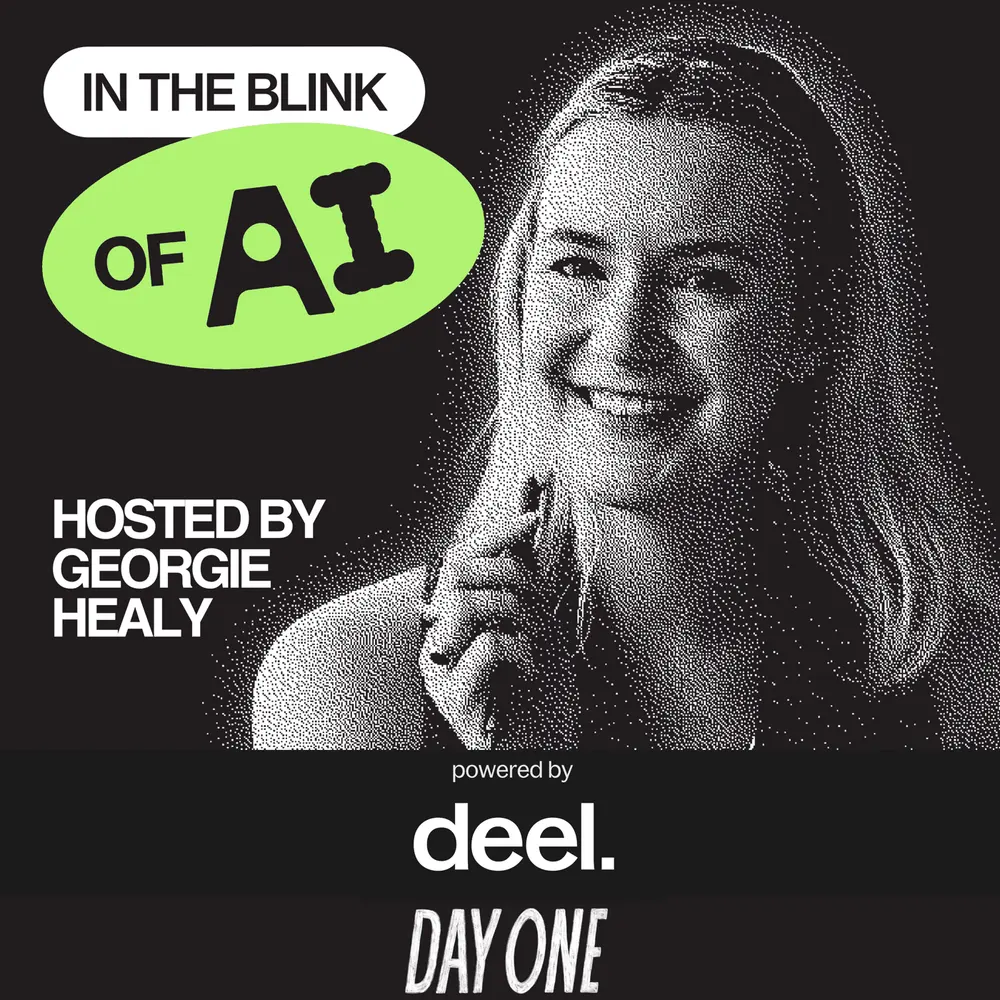 In The Blink Of AI with Georgie Healy
Presented by Deel & Stripe
In The Blink Of AI with Georgie Healy
Presented by Deel & Stripe 


 ▶
▶  ▶
▶  ▶
▶  ▶
▶  ▶
▶ ▶
▶ ▶
▶