Transcript Synced · select any line to jump ▾ 0:02 James Horan: Founders scale faster on Deel. Set up payroll for any country in minutes. Hire anyone, anywhere. Get visas handled fast and get back to building. Visit deel.com/dayone. That's D-E-E-L.com/dayone. Consumers lose billions to scams and miss out on trillions in savings each year. Meanwhile, we find that the industry just really continues to replace spreadsheets. But we think this Our solution is Money on Autopilot, a product with AI guidance that is securely grounded by your financial data and leads to smart automation that finds and acts on ways to save. Introducing Finly, the smart AI financial assistant providing an all-in-one platform uniting global banking, investing, and everything money. 0:49 Alan Jones: If you're pitching a room with, with 30 other fintech startups, what we want to achieve out of this is for the audience to walk away remembering you. Not the other 29. Welcome to Pick My Brain, the podcast where we help startup founders improve their pitches to better connect with customers, co-founders, and investors. My name's Allan Jones, and I'm an ex-startup founder myself, but now I'm an angel investor with decades of experience helping startup founders find their footing and achieve their goals. But first, I'd like to acknowledge that this podcast is being recorded on Gadigal land, land that was never ceded. I pay my respects to their innovators and leaders past, present, and emerging. On Pick My Brain, you'll hear the real story straight from founders as they pitch their startups, tackle the challenges we all face, and try to turn their ideas into a successful business. Each episode, we'll see if I can help them make that progress with another step forward, maybe some advice, some ideas, maybe a little constructive criticism. Thanks for joining me. Let's get started. 1:49 Speaker: You're listening to a Day One FM show. 1:55 Ad: Wondering how your AppSec program really stacks up? Golar Cyber's Application Security Assessment gives you a quick 10-minute pulse check built around the 5 core principles of AppSec: inform, integrate, influence, innovate, and iterate. In just 10 minutes, you'll get a clear snapshot of your maturity across each of these principles along with practical insights you can put to work straight away. Head to glasscyber.com.au/assess and take the assessment today. That is glasscyber.com.au/assess. 2:30 Alan Jones: Today we're joined by Jimmy Horan from Findly. Thanks for joining us, Jimmy. What's going on? 2:36 James Horan: Great to be here and thanks for having me. 2:38 Alan Jones: Mate, I have two standard questions. If you've listened to the show before, you'll know what they are. The first question is, when you were a kid, what did you think you wanted to be when you grew up? 2:50 James Horan: When I was a kid, I wanted to be a builder. I didn't really have much of a traditional kind of like interest in kind of computing or kind of the traditional kind of like programmer, had an interest in gaming. I had a real big interest in robotical engineering and actually wanted to be what was called a robotical scientist. But I basically just ended up kind of having this non-traditional career into like digital marketing and project management and like of kind of complex technical projects and went down the kind of like engineering routes from there. And yeah, was fascinated by building software as opposed to robotics. Robotics is still kind of a bit of an interest of mine, but it's kind of like a side hobby in the garage on the weekend when I get a little bit of time. 3:32 Alan Jones: Before you started, became a startup founder, what were you doing? 3:37 James Horan: Yeah, I've always had a little bit of like a kind of, little bit of an eye on like the startup scene, either working for early-stage startups or working like on a previous founder startup that was a peer-to-peer marketplace for parking. Learned the hard lesson that two-sided marketplaces are probably the hardest thing to do. And that parking is an interesting problem that everyone wants to solve, but no one really wants to help solve. So then, you know, bootstrapping that two-sided marketplace was really, really hard. So I had some really good lessons from that. But also prior to that, I was working at Commonwealth Bank and worked at Safety Culture as a software engineer and kind of like product builder. 4:15 Alan Jones: Okay, so it was not your first rodeo. 4:18 James Horan: Yeah, kind of. I don't go around calling myself a second-time founder, but a lot of lessons from either kind of helping early-stage startups, being like the first or second hire, or kind of like that peer-to-peer parking app, a lot of scars from a two-sided marketplace. But yeah, I have a lot of sympathy for people trying to do that now. 4:37 Alan Jones: Well, I don't mind if you walk around saying that about yourself. Mate, how can we help you on the show today? You're going to pitch me Finly and I'll see if I can give you some advice and support. 4:51 James Horan: Amazing. Yeah, I'd love to just kind of dive into my pitch and show you my kind of like in-person live pitch deck and talk through it. And yeah, love candid feedback and love hearing the hard truth. 5:03 Alan Jones: All right, mate, let's go. 5:04 James Horan: Cool. So consumers lose billions to scams and miss out on trillions in savings each year. Meanwhile, we find that the industry just really continues to replace spreadsheets. But we asked this question, what if everyone had their own team of financial experts working for them 24/7? I'm James. I'm a product lead engineer with deep payments, AI, and digital experience, and the founder of Finly. And with a great team of early advisors and builders across product, growth, compliance, and data, we're solving this really big and complex unsolved problem of how financial tools are failing everyday consumers. We all kind of know someone that gets their money advice from TikTok or ChatGPT. If you don't, it's probably you doomscrolling on Instagram for millennials and TikTok for Gen Z. This advice really used to come with a warning, but nowadays it's kind of disguised and lacks the context and verification that's needed. And with the cost of living skyrocketing, there's really no wonder that everyone's turning to these money hacks. But this results in a cycle, or kind of results in a cycle of fees, overdrafts, and misguided savings and investment opportunities. And we think the solution is quite simple. We think the solution is Money on Autopilot, a product with AI guidance that is securely grounded by your financial data and leads to smart automation that finds and acts on ways to save. And in the background, it can protect you from fees, overdrafts, and missed bills. Introducing Finly, the smart AI financial assistant providing an all-in-one platform uniting global banking, investing, and everything money. Finly has a continuous learning model to adapt to changing financial landscapes and your personal situation and provides users intuitive interfaces and actionable insights. The product is simple. How does it work? Finly reviews your financial accounts and surfaces only what you want to share with it. It provides you insights, risks, and simple next steps. Take action from one tap, from canceling a subscription to switching providers to getting a higher yield on tax savings. Control how involved you want to be. Stay fully hands-on, let the assistant take care of those routine tasks. You decide what to approve and when. Intent is kind of key at what we're trying to do here. You're always informed but never overwhelmed. Finley's idea is to keep your money moving and your admin sorted. 7:28 Speaker: We can work in the background and give you transparency. 7:33 James Horan: The average user is saving over $1,000 in savings with Finly. We've connected and started tracking over 20,000 institutions to date, and we started partnering with 4 major financial firms for distribution. And we were one of 40 to be backed by Vercel through their Global AI Accelerator program in July this year. The global opportunity is massive with $488 billion in unlocked consumer savings each year, and the global personal financial, finance software market growing from $3 billion to $4 $1 billion by 2026. The opportunity is huge. In one year, in year one, we're focused on savings-based revenue where we take a percentage of money saved through cost optimizations. No kind of traditional freemium model where we give it away for free. We're focusing on helping customers get real savings and taking a small percentage of what they've saved, not what they have to pay. In year two, we're rolling out a premium subscription for what we call Henry, or what's known as high earner, not rich yet consumer market. Users that are wanting advanced automation and more control over getting better yields and better kind of control. And we're also partnering with mortgage brokers in year 2 to connect with those needing more kind of bespoke help and advice from mortgage brokers. And we take a commission on home loan referrals. Why now? With the cost of living peaking globally and AI shifting the unit economics on personalized automation, consumers and the industry have really never been more ready for Finly. 2026 will be the inflection point for AI-powered personal finance. And by 2030, we predict 1.2 billion people will have an AI agent managing their finances and money, and Finly plans to own this market. We're building the most powerful and actionable AI money assistant for billions of people, and we're currently raising on a pre-seed safe note, if anyone wants it, uh, uh, $800,000 on a safe note, uh, to hit 1, uh, 4.5 million in annual revenue within 18 months. And that's pretty much it. 9:32 Alan Jones: And that's pretty much it. Okay. Well, that's a great way to wind up the story. Look, thanks, Jimmy. There's nothing very much broken with the pitch. So it's a good foundation, but you know what? It could be so much better. You know, I feel like if it was you against 20 other fintech startups, that you'd blend in more than stand out. And I know that that's not what you want to happen, right? 10:09 James Horan: Yep. 10:10 Alan Jones: You wanna be top of the class. 10:12 James Horan: But if our tech's gonna be top of the class, we need to stand out top of the class, so yeah. 10:17 Alan Jones: Yeah, the problem with tech is we can't show usually when we're pitching, right? 10:23 Ad: Mm-hmm. 10:24 Alan Jones: Particularly when, when we're dealing with, with fintech startups, there's so much involved in, in signing up and, and using a service that it's not really feasible to, to say to most, you know, investment pitch audiences, you know, get started signing up now. I mean, maybe they will, but unless they, they're in your target demographic and unless they really want to learn about what you're working on, it's gonna be difficult for someone to really experience how good your product's going to be in a pitch. Like you, you tick all the boxes, got everything in the pitch that needs to be there. What we now need to add is something which is going to surprise our audience. And maybe that's the way you get to stand out in front of your competitors here. 11:07 James Horan: Hmm. 11:08 Alan Jones: What we want is if you're pitching a room with 30 other fintech startups who are all using AI, either to make businesses' finances work better or consumers' finances work better, you know, that's a Venn diagram that I think pretty much covers all of fintech, or maybe, you know, financial fraud. What we want to achieve out of this is for the audience to walk away remembering you, not the other 29. We need to surprise people with something probably that teaches them something about themselves that they didn't know, or something they learn about the world around them that they didn't know. 11:43 James Horan: I see, yes, yeah. 11:44 Alan Jones: When we're pitching to kindergarteners, they know almost nothing about the world or themselves. And so we can tell them nearly anything. You know, we can tell them about poop. 11:53 James Horan: Yeah. 11:54 Alan Jones: Tell them about poop and they'll be amazed and wonder, right? But when we're pitching to adults, most adults think, yeah, I understand how the world works. And also, you know, I understand myself, you know, so my physical self, but also my psychological self. So one way for a fintech startup to stand out ahead of its fintech competitors is when you're pitching is to be able to tell your audience something about your own financial behavior as an audience. 12:23 James Horan: Yes. 12:24 Alan Jones: You know, it's very likely you are the person who says that you do this, but actually when we study your behavior, you do that, you know, and you're not alone. You know, in our research, it looks like, you know, 87%, you know, or 3 out of 4 people that we've studied. Say they do exactly what you say you do, but instead you do this instead. So getting into some of the behavioral economics of how people behave with their finances might be a good way to get going. 12:56 James Horan: It's kind of making it personal. So kind of like making it personal in the way that you, you know, you in particular that are sitting in the audience could actually, you know, is kind of losing this much in potential savings. Every week, month, year. Is that kind of what you mean? 13:13 Alan Jones: Yes, exactly. 13:14 James Horan: When I was in San Francisco about a month and a half ago and I pitched this at the Vercel Demo Day, I was actually kind of overwhelmed by the amount of kind of customer interest from the pitch when obviously like the goal was to go and actually get kind of investor feedback and have conversations around that. There wasn't investor feedback, but an interest, but the amount of customer interest from obviously like those kind of, Henry's high net worth individuals that were in the room of the 300 people that demoed it. So just kind of, I think some of that, I did have some interesting feedback on like, obviously those numbers are kind of like those savings aren't big enough personally for some of them, but for obviously the average Australian, those savings are actually quite kind of, yeah, but I think making it personal and makes a lot of sense. 14:01 Alan Jones: Another way to stand out is that, the power of the information in a pitch deck at a fintech event, knowing that all of the information is in there in the deck tends to make us read out what's on the slides. 14:16 James Horan: Mm. 14:17 Alan Jones: And that's never a great thing. If I'm a busy investor who's taken time out of their evening to go along to a pitch event and every founder I see gets up there on stage and just reads what's on their pitch deck, then I go away thinking, well, I could have spent more time with my kids and my partner tonight and they had a nice, and one more glass of wine before dinner. And somebody could have just sent me all the PDFs of all the decks. That would've been fine. One easy way to stop yourself doing that, 'cause you were totally doing that in the first few slides, is you were reading the headings. 14:51 James Horan: Mm. 14:51 Alan Jones: Right? So you're reading the heading of each slide. Now, when you're pitching to investors, they know what each slide is about. They know even the order in which my slides come. Yours is a little bit different in that you have the team slide, I think, in team. Team slide comes up front, which is appropriate because you've got a big team and it's an impressive team with a big track record. So it's a good thing to have it up front. Lead with your strengths and then finish with your strengths, right? So have strengths at the beginning of a pitch and then strengths at the end. The challenge that you face though is that your audience and you are going to start reading the slides. If you've got headings on each slide, take those out and that will make it that much harder for you to actually read what's on the slide. If you're presenting from a script that you've rehearsed, then go back through that script, change the script so that what's on the slide and what's in the script are different, like related, but you're not actually, you know. 15:55 James Horan: You're making a counterpoint or like a backup points. 15:58 Alan Jones: Yeah. Exactly. Right. So, so think about your pitch deck as supporting you telling the story, not taking the place of you telling the story. And early stage investment is about becoming confident that you understand the, the person who's pitching. You know, I'm going to have a coffee with this person because they sound interesting to me, or I think they're really across the space. I want to learn more from them. So you need to capture and hold their attention through the pitch, not the deck, right? So if you're saying something different to what the pitch is saying, and the pitch is there to be visual support, and that's actually going to help them focus on you and not on the deck. 16:37 James Horan: Yeah, that's good to know. I actually was doing that earlier. I was reading from a script, but I think the kind of, the shortfall there is that the script is probably a little bit based on obviously the slides. I tried to tie in each slide as well, especially towards the start in the middle, kind of like make each slide flow into the next one to tell a bit more of a story. But I think, yeah, probably need to do a bit more work on the script and probably a little bit more visuals on the slides, especially some of the early slides. That's great to know. 17:08 Alan Jones: Number one takeaway from all of this to me is that like this is a very, very rational, very logical, you know, very logical side of the brain kind of appeal to people. And I think if you do that, you'll be pretty similar to everybody else who's at the event that you're pitching against. So think about use of color, think about use of images rather than use of words, and think about trying to surprise your audience with something about themselves that they didn't previously know, or something about the world that they didn't previously know. 17:44 James Horan: Those just the two to kind of, you're almost trying to bring a bit of emotion in so they go away kind of having that feeling stim. Is that what you're kind of saying? 17:54 Alan Jones: Yeah. When they get back home to their life partner, kids, dog, cat, whatever, ideally that person's going to say, you know, how was the event tonight? Did you see anything interesting? And they're going to say, yeah, did you know that? And that'd be something that you've told them. 18:10 James Horan: Yeah. Yeah. 18:11 Alan Jones: Gotcha. There's two very powerful things about pitching to an audience. The first powerful thing is you can, you can reach all those people in that audience. But imagine what happens if all of those people go home or they go to work the next day and they get the opportunity to tell your story again, like a very shortened version of it. But the thing that's going to make them remember enough to be able to pitch your business to other people is, is that surprising thing that you told, told them about themselves, about the world that they're in. 18:37 James Horan: It's also a growth ladder if you can have people pitching your own product for you. So. 18:42 Alan Jones: Yeah, absolutely. Yeah. 18:43 James Horan: Cool. 18:44 Alan Jones: Hey, so Jimmy, thanks very much for joining me on this episode of Pick My Brain. If somebody wants to find out about Finly, I guess they go to phinly.com. Is that correct? 18:56 James Horan: .com. That's it. Yeah. Jump onto finly.com, you guys. 19:00 Alan Jones: phinly.com. Follow the Finly journey. Look out for Jimmy Horan, um, and his awesome team. Thanks for joining us on this episode of Pick My Brains, the advice podcast for every startup founder. Thanks for listening. And if you enjoyed this episode, never mind the don't forget to like and subscribe bullshit that every podcast host goes on about. Instead, think about someone you know, somebody else in startups who could use some of the advice I've shared and tell them, maybe they'll listen to it. Maybe they'll like and subscribe. I don't really care. Advertisers would though. 19:30 James Horan: That said. 19:30 Alan Jones: I'm not a lawyer or an accountant, and what you've heard today is not intended as financial or legal advice. You should always seek that from a qualified professional before making big decisions. I'm not a superhero either, so don't forget that sometimes I'm fallible. Very occasionally I might even be wrong. Please let me know when you think I might be so that I can get better at this too. I've got thick skin. Just reach out to me on any of our social channels or email the show at pickmybrain@startupfoundercoach.com. The Pick My Brain podcast is produced, edited, and beamed directly to your ears and eyes by the hardworking and understaffed team at Day One, the podcast network for founders, operators, and investors. Find out more at dayone.fm. Thanks for listening. Thanks for joining me for this and every episode of Pick My Brains, the advice podcast for every startup founder. Have you been listening to the show and wishing you could ask for a little advice about your startup? Well, here's your chance to do just that. We're trying something new and you can be part of it too. Leave me a voicemail message with a question you'd like answered in a future episode, and I'll do my best to give you the best advice I can. Just go to speakpipe.com/pickmybrain and leave me your most pressing question, request, or just some feedback and support for the show. Go to speakpipe.com/pickmybrain or follow the link in the show notes.





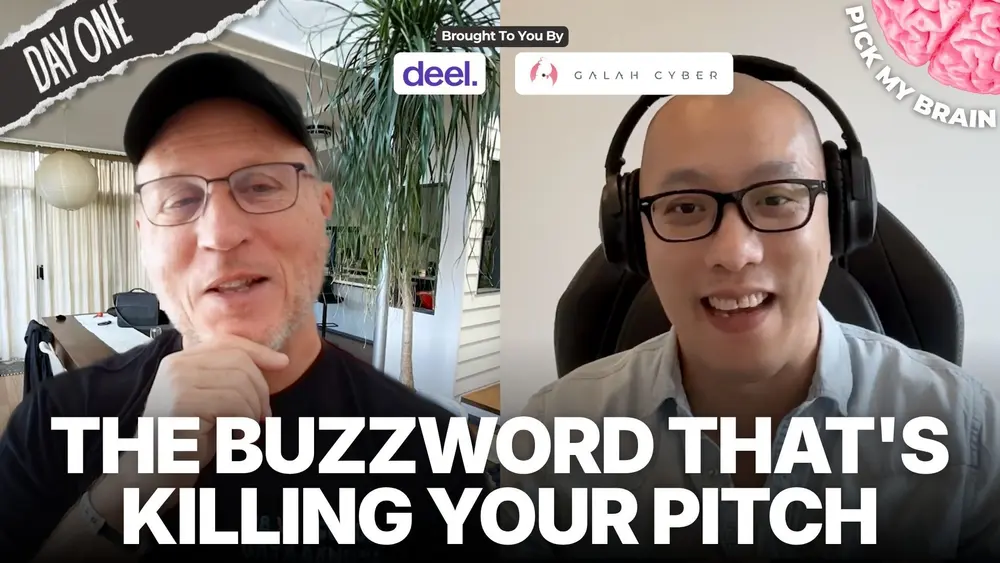 ▶
▶  ▶
▶  ▶
▶  ▶
▶  ▶
▶  ▶
▶  ▶
▶ ▶
▶ ▶
▶