Transcript Synced · select any line to jump ▾ 0:02 Speaker: Founders scale faster on Deel. Set up payroll for any country in minutes. Hire anyone anywhere. Get visas handled fast and get back to building. Visit deel.com/dayone. That's d-e-e-l.com/dayone. 0:21 Speaker: This is why venture investors hate consumer, right? Like why are humans buying Laboos? 0:28 Speaker: Why? They're so ugly. 0:29 Speaker: People might lose their jobs, but they'll find other ones. And, you know, Skynet might take over, but we'll fight back. Just like, you know, there was way too much horse poop in the street and they invented cars. Like, humanity, we figure it out. 0:40 Speaker: I love that that was the catalyst for you. Like, horse poop was the reason we invented cars. I'm not sure that that is actually what drove Ford, but like, let's just leave it. 0:49 Speaker: Maxine, don't let the truth get in the way of a good story, okay? 0:53 Speaker: Sorry, sorry, you're right, you're right. 0:54 Speaker: Poo. 0:55 Speaker: Yeah, I still don't have an agent. I'm still not even 100% sure what an agent is. 0:59 Speaker: Adoption of AI at the moment in the market is kind of like sex in high school because everyone wants to do it. They're all kind of semi-talking about it, but there's a little bit of shame associated with it. So they're all like, oh wait, have you done it yet? Because like, I want to do it and I think I'm doing it right. Maybe I'm not, but I don't really want to tell you how I'm doing it. So I'm just going to continue to fumble my way through it, but I'm going to pretend to the world that I'm like doing it all the time and it's amazing and it's working really well. But only if you are. 1:27 Speaker: You're actually giving me so much FOMO. I didn't think I wanted to be an angel investor until this exact moment, and I'm like, oh, hell yeah. Hello and welcome to In the Blink of AI, your weekly front row seat to the AI revolution. I'm Georgie Healy, and this week I'm glad I've been speaking to my therapist ChatGPT because we have the one and only Cheryl Mak, CEO of Aussie Angels, and Maxine Mentor, the general partner of CoVentures, on the show. We've combined forces. We talk about how investors approach AI companies, including where they see hype versus real when it comes to AI startups, when their bullshit radar goes off in those pictures, and the role of personal brand in venture capital. Am I going to be competing with VCs out there on the socials? As always, we've got AI hacks, we've got hot takes that you've all been waiting for, and fair dues, guys, for this episode. It might be PG-rated, nothing crazy, but if you've got little ones in the car, maybe a good one for the Bluetooth headphones. Now, if you want more unfiltered insights from this amazing duo, I strongly recommend their podcast, First Check. And if you're a first-time listener of In the Blink of AI, hi, welcome. We drop episodes every Friday. Next week we have an episode that was not meant to go to air. I managed to scrounge up a recording. It's more valuable than the Abbey Road original vinyl. So if you subscribe to the show, if you follow me on socials down in the description below, you won't miss it. Let's get on with the show. 3:10 Speaker: You're listening to a Day One FM show. 3:14 Speaker: As a startup founder, you're juggling multiple priorities from the expected, like finding product market fit, to the unexpected, like customer requests for SOC 2 or ISO 27001 certification. Achieving compliance is time-consuming, and time spent on that is time away from the needs of the business. And that's where Vanta comes in. Vanta is the all-in-one solution for startups to become compliant quickly and build a security foundation with ease. With a combination of automation, an extensive partner network, and a security marketplace containing 385+ pre-built integrations, Vanta provides the necessary tools and expertise for startups to achieve compliance seamlessly, no matter how urgent your needs are and at every phase of growth. Over 10,000 leading companies, including Cypherstash, Handle, and Indebted, trust Vanta to automate compliance so they can focus on growing the needs of their business. Here's the important part. Startup listeners of the show get $1,000 off if they go to day www.melissa.com.au/blinc. Sheryl, are you an AI advocate or are you an AI skeptic, or would you call yourself AI curious? Like, where are you on that spectrum? 4:40 Speaker: Definitely an advocate with a little bit like curiosity mixed in, because I don't know what the hell I'm doing. So I'm very curious about all things AI, but also I believe that it's going to change our lives. So I'm like advocate, but somebody point me in the right direction. 4:55 Speaker: Love it. 4:56 Speaker: I love it. 4:58 Speaker: What about you, Maxine? 4:59 Speaker: First of all, I wanna say thanks so much for having us on. I'm really excited about this collaboration and you being on ours. We had a really fun time thinking about how to like merge our various formats for this. So excited to kind of sprinkle in bits of First Check and bits of In the Blink of AI as we play around with it. But I think for me, I am very much an advocate, but I think if you're in AI at the moment and not curious, like you are stuffing up because it's moving so quickly, right? Even today, I was having a really interesting conversation with a founder building in a completely different space, but within the AI umbrella. And so, I feel like I'm starting from scratch again, learning about a new space. And so, it's one of my favorite parts of the job, but it means that you have to be curious all day, every day about how you might be able to use it, where you might be able to get the most out of it. But I definitely think I'm an AI advocate. I— I'm obsessed. I get so much value out of it every single day. And so, I've definitely trended in that direction. 5:54 Speaker: I'm just all curious and advocates, but I will admit I also get a little bit scared sometimes too. Every now and then I get this like, "Oh, I'm not sure how I feel about the future of work." But anyway. 6:07 Speaker: I'm just way too optimistic. I'm like, "We're gonna figure it out. It's gonna be fine." Like, people might lose their jobs, but they'll find other ones. And, you know, Skynet might take over, but we'll fight back. Like, I'm just, I just like, you know, the, there was way too much horse poop in the street and they invented cars. Like humanity, we figure it out. 6:25 Speaker: I love that that was the catalyst for you. Like horse poop was the reason we invented cars. I'm not sure that that is actually what drove forward, but like, let's just, we'll leave it at that. 6:34 Speaker: Maxine, don't let the truth get in the way of a good story. Okay. Sorry. 6:38 Speaker: Sorry. You're right. You're right. Poop. Yeah. Poop being the, the catalyst. The, the, yeah, exactly. 6:45 Speaker: It's the seed of innovation. 6:47 Speaker: Yeah. 6:48 Speaker: It probably had seeds in it. 6:49 Speaker: It probably did. 6:50 Speaker: It probably did. Onto other things. We have a question for you, Georgie. We typically ask our guests what's the first thing that they ever invested in, but if you have something that you've recently invested in, share, share with us. 7:03 Speaker: I got cold sweats as soon as I realized that you guys are investors and would probably ask me something about investing. I'll answer both for you. Quickly. My first real investment was in my education. I have quite a healthy, uh, HECS debt from doing an undergraduate and a master's just to kind of, you know, feel like I'm even on par with everyone else in the industry. And, uh, yeah, I'll be paying that off probably forever. And recently I did buy a few little new gadgets for the podcast. Early days I was like, do not, you know, I know enough about startups to be like, don't focus on, you know, building something fancy and just see if you like it and see if you can focus on getting attention and traction. And now I have a key light, so if I look really beautiful today, that's why. 7:54 Speaker: And— 7:54 Speaker: I'm into it. 7:55 Speaker: I'm super into it. 7:56 Speaker: I'll take a photo for you guys later. It's quite big and I'll probably get a headache from how bright it is. And a new webcam because my last one was horrible. And can recommend, they're not even that expensive, so. 8:08 Speaker: Yes. Amazing. I love those investments. It is, you know, wonderful to see economics playing out, right? It like gets more successful and then you can reinvest the profits from that success figuratively or literally into making it more successful. And that cycle continues. 8:24 Speaker: Exactly. We will see if this investment in better lighting improves my ROI or like makes it worse because people can see all my pores and they're horrified. Go back to the old cam. All right, guys, I am so pumped to get investors on the show to unpack something that is still in the headlines. It's been in the headlines for probably ever since AI started, and it's still in the headlines. Are we in an AI bubble? You know, aka, for those who are used to my show before and not used to your show, like, If we are investing in all these AI startups and it actually is, is like a flash of the pan, what does that mean? I would love to know what you guys first and foremost think about whether we're in an AI bubble or not, and then maybe unpack what the signs and symptoms of a bubble would be. 9:20 Speaker: Yeah, I mean, I think we often ask this question when there has been a large degree of change in an asset class, right? Like when you say bubble in tech, a lot of people think like crypto, NFT, of the most recent one, maybe the one before that was like social media, like mobile tech generally, like startups being a bubble. 9:44 Speaker: And the original one was like the dot-com bubble, right? 9:47 Speaker: Totally. Yeah. Dot-com bubble was the one that we think of in tech. 9:50 Speaker: Or the daffodil bubble in like Holland. 9:54 Speaker: Right. 9:55 Speaker: Okay. 9:55 Speaker: Sorry. 9:56 Speaker: I mean the original tech-related bubble was the dot-com bubble. 10:00 Speaker: Right. Like, but I think I think that's an important point, right? Is like humans forever have been going through this kind of bubble. Like a lot of change happens and a lot of people start to buy into that change. And then that creates a feeling of like too much change too quickly. And then it reverts back to some, you know, adjusted state and then rebuilds over time. I'm essentially kind of describing a Gartner hype cycle, right? Like we, what we're talking about here are hype cycles. And the fear that you are at the top of that correction from, you know, maximum hype to reversion. And then the secondary fear that it will never get back to the top of that hype. For example— 10:44 Speaker: Sorry, sorry to cut you off just on that fear. As a consumer, I'm not scared. If it's a bubble, I'll just stop paying my subscription. This is an investor fear, right? We've invested all our chips into AI and it's actually NFTs again or something, right? 11:01 Speaker: I think that's exactly right, right? Like we, it is mostly people who are trying to kind of make money out of it. Or if you're buying this software in a more kind of long-term commitment way, like imagine you are a CIO for a big enterprise, for example, like you don't wanna do a big kind of tech revitalization of your entire stack into an AI-first environment if you believed it was gonna be a bubble. But that's all to say, Like, I think one of the things to ask yourself is the fundamentals of the technology and the degree to which it's actually delivering value. Like, I am probably going to annoy a lot of people by saying this, but I just don't see any value in an ape picture. I don't care if you're willing to pay $2 million or $0 for it. Like, what is the enduring value of a Bored Ape picture? Like, none. 11:51 Speaker: You could say the same things about Laboobooz though, and like, that company is making billions of dollars, uh, so are a lot of people. So like, I could argue back on that one. 12:01 Speaker: Yeah, I don't— to be honest with you, I don't even know what a Labubu is. 12:05 Speaker: Oh my gosh, Maxine! Oh my gosh, we'll send you a link. They're the hideous little keychains that look like a, like a rabbit with rabies, basically. 12:13 Speaker: Ah, yes, yes, I have seen them around. 12:16 Speaker: Yeah, yeah, yeah. See that? Now you won't miss them. 12:18 Speaker: This is why venture investors hate consumer, right? Like, Why are humans buying Laboos? 12:23 Speaker: Anyway. 12:24 Speaker: It's so ugly. 12:25 Speaker: Right. Like, but that is hype investing. Like you are investing behind a hype cycle. There is not long-term, I would argue there is not long-term value behind what I understand to be a Laboo is, but behind crypto to some degree, there is some long-term value, right? I can't invest in it because I have no idea how to determine if the thing in front of me is long-term valuable or not. But there is definitely long-term value in it driven by the adoption that we're seeing. So it's a very long way of saying is there is so much value in AI, there's no way it's a bubble. 12:57 Speaker: I'm using it every day for hours a day. 13:01 Speaker: That too. But there's also the argument that like there are underlying technologies that sometimes sprout bubbles, right? So the underlying technology of NFTs was this like ability to tokenize digital assets, which I could argue actually has long-term value of like being able to create smart contracts or or like create ownership on something that wasn't like, wasn't being able to be identified as ownership, like owning a digital asset, which there's lots of applications for that. 13:29 Speaker: 100%. 13:29 Speaker: In games. With crypto, yes, like, you know, we've seen big bubbles there and, or lots of small bubbles arguably, but the underlying like blockchain technology, the underlying ability to have a digital currency, that stuff has value. So, if we look at AI in the same sense, like, it could be creating a mini bubble of, you know, ape pictures, whatever the AI equivalent of ape pictures is. But then we need to somehow separate that from like, is the underlying technology still valuable in some sense? And this piece of whatever we're looking at in AI is the mini bubble. 14:06 Speaker: 100%. 14:07 Speaker: I would love to drill down on the fear aspect a little bit too. Has it made— because NFTs and crypto were what, 2021, am I correct? Like around that time? 14:17 Speaker: 19, 20, 2022. Yeah. 14:19 Speaker: I have lost all sense of years. Yeah. 14:21 Speaker: Don't ask me. I'm like, COVID was then, crypto was then. It was a, it was a weird time for all of us. Yeah. 14:27 Speaker: Money was also free. 14:28 Speaker: What, what even is money? It's just like— 14:30 Speaker: What is money? 14:31 Speaker: It's a concept. Monopoly money. Yeah, yeah, yeah. I was a VC investor then, like crazy times. It has, it made you, and have you noticed that other investors are a little bit more critical now that money is not flowing so quick and an AI bubble, like we might not recover from that if we go all in this time. 14:49 Speaker: I might have like a bit of a skewed perspective on this because of the difference between the US ecosystem and the Australian— or sorry, specifically the San Francisco ecosystem and the Sydney ecosystem and Australian ecosystem on this particular topic, right? Like I think that A16 recently came out and said that the average seed stage revenue for companies in their funnel, for consumer AI companies in their funnel is $4 million. Average. 15:17 Speaker: Really? 15:19 Speaker: And they are generating that between 12 and 24 months after they turn on revenue. 15:24 Speaker: Wow. 15:24 Speaker: Like that is an enormous amount of consumer value being delivered to users, right? You could also look at the adoption curve and also rate of daily active users and time in session for OpenAI, which they've published, right? That is going up, up, and up on all three of those categories. And so I think the question with bubbles of fear aspect that you mentioned is the fear that you will, as an investor, right? Invest at a price that you are, that is overinflating the real value today. So I think as you are, like, as we're thinking about this from an investor side, you should be asking yourself the question of like, what does that value actually equate to? Right? How much money am I actually going to make in the short term and the medium term? And what do I have to believe about how quickly this grows and like the amount of value that is being generated from this actual tool. From my perspective, like AI is generating a lot of value for a lot of people, and there's probably even more buckets of value that we haven't fully unlocked yet. Like people want to be able to use it for more buckets, but they haven't worked out how to use it properly for that bucket or like integrated into their organization or any of those kinds of things. And so, Do I think that it is very hypey to invest at billion-dollar valuations at seed stage? Like, yes, that's wild. I think that's really hard to believe that you're going to see a 100x return on that company, on that investment in 10 years, but maybe, right? OpenAI has closed that gap pretty quickly. But on a $10 million valuation, even like $30 million valuation at seed, if you're investing in an AI business that's got genuine line of sight of adding an enormous amount of value to customers. And you can kind of see that. I think on fundamentals, there is a world where you could make that argument. 17:15 Speaker: I mean, you have, haven't you? You've invested on those valuations into AI companies. 17:20 Speaker: Yeah, not quite that high. But that's usually kind of like seed stage, but close. Yeah. 17:25 Speaker: $10 mil though. 17:27 Speaker: Yeah, $10 mil for sure. 17:28 Speaker: Yeah, that used to be Series A, right? Like maybe it's been a few years, but to me that was Series A in the past. Inflation. 17:34 Speaker: Yeah. Like, what have I missed? Yeah. Yeah. Something, something inflation. 17:38 Speaker: Yeah. Something, something to benchmark for you guys. I think the average YC safe is now $25 mil US. So that's seed stage. 17:46 Speaker: Wow. Wow. 17:48 Speaker: I mean, YC is always in front of the market, right? 2020, 2021, I think valuations at seed were like $12 to $18. So obviously it's moved a little bit since then. I think the rule of thumb is valuations generally increase somewhere when it's not a correction market, they're generally increasing like 10 to 20% per year. 18:09 Speaker: Last question on the bubble from me, and I realize we're all hosts here. I just get back into my zone of hosting, so feel free to cut me off. Um, last one from me as the one of three hosts. Uh, okay, so it's value-add AI. We can all see that ourselves as consumers of AI, but I'm guessing not all AI startups are equal. There probably are some that just build on hype. Raise these incredible rounds and then actually don't deliver value. If you were offering suggestions to angel investors or people that are dabbling or curious to dabble, what should they look for when they're not software engineers themselves? 18:51 Speaker: I mean, I first, I think the first point is like a healthy degree of skepticism. You know, we talked at the start of like not being an AI skeptic and I'm certainly not. So I'm, probably not the best to comment on this, but like having a healthy degree of like, is this actually enduring value or is this the ape picture when it comes to that? And then there's a degree of like, you don't know what you don't know. And this is where I struggle the most. And so, Maxine, I'm really keen to hear your answer is that I am not an AI expert. As I said, I don't know where I'm going and what I'm doing, and I'm just super curious about everything, but everything seems like magic to me. So, when I talk to a startup and what they're doing is crazy cool, and I talked to their IT or their co-tech, technical co-founder, and they explained to me all the different layers of how they're getting this, you know, this LLM, and then they're customizing it with their own training, and then they're running it through this other thing, and then they're running it through this other thing. I'm like, you could have just made all of that up, and it sounds legit to me, but I don't really have a way of knowing. And as a very early stage, like, solo investor, I don't have a team of AI experts that I can be like, hey, or even an AI expert on my nonexistent team that I can say, hey, can you look into their tech for me? Can you tell me if this is legit or are they just running it through ChatGPT like I could? Like, I actually don't have a concept there. And I think that's the scary part for me as an investor. 20:12 Speaker: Yeah, yeah, 100%. I think that as a rule of thumb, it's worthwhile always saying like early stage venture investing is a very risky asset class. Very, very risky. So if you're not doing it with a healthy dose of fear, like you should definitely get off the field immediately. Yeah, because you are taking on a whole bunch of risk. And so the, the job is to better understand the risk. And if you really feel like you can't get your arms around that risk, like it's probably not a company that you should be investing in. We do this, for example, right? Like we don't invest in biotech, we don't invest in hardware, we don't invest in a bunch of businesses like material science, just because you could literally be putting in front of me the world's best company that's going to $3 trillion in revenue in the next 4 years. I have no idea, none. I just, you would be speaking gibberish to me and I'm just not the right investor, right? It might be an amazing investment, but it's not a good investment for me. And so, I think as an angel investor, I'd encourage you to make sure that like you feel comfortable enough about the risks that you're taking and the things that you're trying to understand. And as Cheryl said, right? Like knowing the limitations to your expertise and then either bolstering those expertise expertise with, you know, other people that you know to ask some questions about the tech or like ask some questions about the problem or the use case or those kinds of things, or not investing in that asset class. 21:33 Speaker: Right. 21:33 Speaker: Or not investing in that particular company and choosing one that you would actually, you know, you better understand and you feel like you can maybe support or kind of get behind those businesses. But I wonder for you, like, as you are thinking about bubbles, you see a lot of like a very different perspective on this market. Do you think it's a bubble? Are we completely high on our own supply allocating to this asset class? And you're like, actually guys, this is bubble territory. 21:59 Speaker: It's so funny. I, like, I identify as like a community girly, like I'm at all the events and it doesn't matter if it's AI engineers or it's founders or it's operators or it's women in startups. And what I'm noticing, and this is my hot take, for the day is that I am noticing so— that the engineers are the prom queens more than they've ever been before. If you're an investor and you've got a pitch deck in front of you that you don't understand and you've got an AI engineer on speed dial to be like, is this legit? Changes everything. If you're a founder, you want that AI expert in your team more than ever. You can't afford them with these $100 million salaries that Meta are offering. Everyone wants a piece of the AI engineer these days. And yeah, if it's a bubble and you're an AI engineer listening to this, ride that bubble. I can't answer it for you, but like, get that bank. 23:03 Speaker: I do. Yeah, I think actually it's almost like all of the love for engineers that existed like pre-2022 has consolidated just into AI engineers, right? Because actually there's quite a few folks in just kind of general engineering that I think are feeling for the first time a pretty solid reduction in demand for their skills, right? A lot of the companies that we work for are starting to run engineering teams, which is just the founding engineer, the CTO, like the technical co-founder, and a healthy budget on Claude. 23:38 Speaker: Yeah, exactly. The tools. Yeah. And I would almost suggest if you're like a recent high school graduate, software engineering might not be the path if senior engineers are just being asked to leverage AI tools. Like, I just don't know how I feel about that because why get a grad engineer when you could have an experienced engineer that, yeah, can just use Claude and Copilot and things like that. So crazy times. 24:07 Speaker: And that used to be one of the things to study where you're like, nah, like regardless of what the job market looks like when I graduate, I'm gonna be fine. Now it's up for question. 24:17 Speaker: I don't know that I'm as skeptical, mate. 24:19 Speaker: I did chemical engineering and I always have been like, you idiot, why did you not do software? What the hell, man? Imagine how rich I'd be right now, guys. I'd be on an island. 24:32 Speaker: Both of those degrees actually I still think are valuable. Maybe this is a contrarian point of view, but like, I think that they're so valuable. But they're teaching you a way to think and they're putting you on the cutting edge of technical innovation, right? So I think you can learn engineering even today. I think one of the big challenges, if you look at all the graphs on AI adoption, lots of people want to adopt AI, but they still don't necessarily know how to because the gap is the kind of process thinking that you get trained in a science, in a STEM degree or in an engineering degree. but also a kind of sufficient technical understanding that you can think about how you might be able to like automate some of this work. And so there are now tools popping up kind of in that wedge that are trying to help close that gap. But I do think that do not despair if you're currently doing an engineering degree and you're on like what, year 3 of a 4-year degree being like, no, I do actually think there's an enormous amount of value. I thought this was a sure thing. Value. Yeah. I think like you are probably still on the cutting edge of the adoption of these tools. Do I think that that's still true in years, like probably not. But if you've got a kid who is 8 years old or younger, or 7 years old or younger, like you've got time to work out what the skills of the future will look like. 25:48 Speaker: We'll figure it out. 25:49 Speaker: That's me. That's you too, Cheryl, right? Yeah. I'll figure it out. I've got a 5 and a 3-year-old. I'm like, ah, I'll worry about it in 15 years. 25:57 Speaker: Dude, by then they'll be writing better prompts than me. 26:00 Speaker: Yeah. 26:00 Speaker: It'll be fine. 26:01 Speaker: Yeah. Okay guys, deep dive investors in AI. Tell me, are you using AI tools to invest as part of your investment process or no? 26:15 Speaker: Oh, 100%. Yeah. 26:16 Speaker: Really? Tell us all your secrets. 26:18 Speaker: Right. I think it's crucial. 26:20 Speaker: I thought we weren't supposed to talk about it, Maxine. 26:22 Speaker: Oh yeah. 26:22 Speaker: Or is it the other way around? 26:24 Speaker: We're all saying no. No, we're talking about it. Most of the great things that have happened in my life so far are because of a woman called Cass Now. She comes up with most of the good ideas, then she tells me about them, and then I just implement them. One of the summarizations of AI that she has given me, which I think just has like living rent-free in my brain, is that AI, like the adoption of AI at the moment in the market, is kind of like sex in high school, right? Because everyone wants to do it. They're all kind of semi-talking about it, but there's a little bit of shame associated with it. So they're all like, oh wait, have you done it yet? Because like, I want to do it and I think I'm doing it right, but maybe I'm not. And like, but I don't really want to tell you how I'm doing it, so I'm just going to continue to fumble my way through it, but I'm going to pretend to the world that I'm like doing it all the time and it's amazing. 27:19 Speaker: But only if you are. 27:19 Speaker: And it's working really well, but only if you are, you know. And I feel like that is the general vibe I'm getting about adoption of AI generally. 27:28 Speaker: And then when it's like, so when you say sex, what are you actually talking about? And you're like, uh, fuck. 27:35 Speaker: No definition. Yes. Just yes. Just yes. So I think like part of what we wanted to chat about was how like in, to open source that a little bit, to like have the equivalent of sex in high school, birds and the bees chat, but for AI implementation, at least in our business. So yes, definitely I'm using it loads, but I think specifically like how is probably worthwhile talking about. 27:58 Speaker: I feel like I'm still at the very basic edge of how I'm using AI in my investing. It is like analyze pitch decks. I help write up investment memos, take notes during my founder meetings, and then add that into my investment analysis and spit something out that I can then reanalyze with other data that I put in and then also like use ChatGPT or Claude to do all of my like market research for me, and that's about it. So I'm being totally honest that like I'm, I'm maybe at like first base. 28:31 Speaker: 100%. 28:32 Speaker: Oh, are you, are you kissing and below the shirt stage, Cheryl? 28:36 Speaker: Definitely. There's definitely some groping going on. I think it's kind of a wild thing, just if we can take a moment, which is 2 years ago, if I said to you, I will give you a software that will take all of your notes on your investor calls and summarize all of your pitch decks and do a first draft of your investment memo, your decision diary, and will quickly write up a like 6 to 7 page high quality research report for you on every single company you're going to meet and you are going to pay $20 for that. You would've been like, oh my God. That's a funny joke. Let me throw my money at you. And now we talk about it and we're like, oh, it's first base. Like, I don't know that I'm really using it. Exactly. 29:19 Speaker: I'm like embarrassed that it's not more tech. 29:23 Speaker: Yeah, like not more complex. 29:26 Speaker: Exactly. Yeah. Yeah. 29:27 Speaker: It's funny because as you say that, I do the exact same thing. And I think working in AI, working in tech, working in startups, the barometer is so high for what we see as innovative. Like, what do you mean you don't have an AI workflow planning your whole day, doing all your emails? Um, yeah, basically doing your job for you. 29:50 Speaker: Yeah, I still don't have an agent. I'm still not even 100% sure what an agent is. 29:54 Speaker: Yeah, I'm about to run an event on agents and I don't know what I'm gonna say. Yes, you can, you're all invited. But, but to your point, like, is it, is it their groundbreaking and incredible and it's just our lack of being able to understand the tooling? Or is it the fact everyone's gaslighting us and no one has agents and no one really knows how they work, but to look like we're on the frontier of technology, we're saying, oh yeah, I'm using agents. Yeah, yeah, they're totally doing my entire investment thesis. 30:28 Speaker: Hmm. 30:28 Speaker: What do you think? 30:30 Speaker: I think it's probably both, right? Like, I think that one of the nice things about our job is we get to see the frontier of technology, as you said. And so I think like I am constantly meeting companies and being like, oh my God, I really want to use this tool. Can I please? Buy it regardless of whether I invest, right? Because there's lots of great tools that aren't great venture businesses, but there are a bunch, I think, that are like super interesting to use. So I think for us, I would say we're very, very much at the beginning of our adoption curve. I think one of the things that we learned was, I think this is the case for most small businesses or anyone who delivers a service as well as VC funds, is you need good data. Before, and good processes before you can start to automate any of it, right? And I think, so that's been the journey we've been on for the first 6 months, is just getting like sufficient data, starting to collect sufficient data points that we can start to do more sophisticated workflows on top of it before we even start thinking about automating those steps, which Cheryl, noting your, what in gods is an agent even? Essentially an agent is a series of prompts that allows an AI through a series of prompts to complete a workflow for you. So it might be like pulling in certain information, using that information to— 31:48 Speaker: Book a restaurant based on your availability, call the restaurant, like this kind of stuff on your behalf. 31:57 Speaker: Exactly. Yeah. 31:58 Speaker: Yeah. 31:58 Speaker: So like multiple steps usually from one prompt being an input to a second prompt. So at its most fundamental, it's like information comes in, you use a prompt to collect that information and turn that information to a state. And then that state is then consumed by the next prompt to do something, a kind of next step or enrich it in some way or whatever, and then produce an output. So it's actually very appropriate for fairly like clear workflows, right? Like too much ambiguity in that workflow or too much variability in that workflow, actually is a disaster. 32:29 Speaker: I have a question on that actually, because I was speaking to an investor on this the other day. To give permission to go through my calendar, to go through my emails, like in order to integrate all those tasks, right? Scary. Like that's a lot of privacy, that's a lot of room for error. Um, and I hate when investors ask this to startups, but I'm going to ask it to you guys. What's to say Google doesn't do this with— it's already got that integration, it's already What say you? 33:00 Speaker: I hope it does. Then I wouldn't need to figure out how to connect an agent to something. 33:04 Speaker: Love your honesty. 33:04 Speaker: That's my question is like, I don't like, now that I understand what an agent is, I still don't understand how I would connect it to do the workflow. So I kind of hope Google does this. 33:15 Speaker: Well, this is what MCPs are and/or APIs and/or webhooks, right? So like APIs and webhooks traditionally were the way that we in a scalable way pulled out information or put in information into software. And the problem was they're not particularly AI-friendly, right? Whereas MCPs are a useful kind of agent-to-software interface for agents to be able to pull information out in a format that they can actually use. That's why everyone's so hot under the collar about them, because they're gonna fund the most— 33:42 Speaker: It's literally the first time I've ever heard that acronym. What does it stand for? 33:46 Speaker: Model Context Protocol. 33:48 Speaker: That's it. I had Jackie on the show and he explained it like a USB drive almost. Like you plug it in and it integrates everything for you. And they're building agents, so they're like all over this stuff, right? 34:00 Speaker: Right. That's exactly right. And so I think for us, like the open kimono version of what we have built as a fund is a lot of just getting our data in the right place, plus some like very basic summarization, some very basic, as Cheryl mentioned, kind of research report development. It is so delightful to get on a call with a founder and actually be able to make good on the intention of being well-informed in that call because you've had an opportunity to like— we have an automated process where we pull in a bunch of information and then generate a deep research report about that space to help me understand the industry and the space to the extent that I don't already know about it. And to be able to like read about that and then have a conversation from that place, oh my God, it's so good. as opposed to being like, hold on a second, who pays who and where does the money go then? And like, what is the competitive landscape you're operating in? Oh, by the way, we've got 5 minutes left. Do you wanna tell me about your innovation? You know, it's, it's so much better. 35:00 Speaker: That's why Maxine's winning all the good deals cuz she's just having these like elevated conversations. Meanwhile, I'm like, what's an NCP? 35:05 Speaker: It definitely does feel like one of those things. If you're just 5% more technically advanced, like it's almost like you scrape the cream off the top. That's just the vibe I'm getting. So scrape that cream, Maxine. 35:18 Speaker: Yeah. Yeah. So are you, what are you seeing out there, Georgie? Are you, when you're talking to VCs, what are they saying that they're doing? 35:26 Speaker: It's very interesting. It seems like some are vertical players, like they just want to do vertical AI companies. Some are purely horizontal or agnostic, but it's because AI seems to be everywhere. If you're a startup, you're using AI to a small or extent, uh, you— I'm noticing investors are like, we need to be really clear on what our mandate is in this space. And so like, I run an AI accelerator and it's interesting because we have AI tech engineers interview those startups to really pop under the hood and see the AI capabilities. And the investors wanna know the outcome of those conversations, obviously, cuz it's like, like that's a really unique opportunity for them because they've invested based on the vision and probably based on customer interactions, but that is like kind of that next level understanding. I wish I had that level of understanding, but that's something I'm definitely noticing is if you've got any AI engineering support, you kind of— 36:33 Speaker: Mm-hmm. 36:34 Speaker: Yeah, you've got a much better understanding of that. But, you know, I don't know about you guys, I've hung out with engineers my whole life just because my undergrad's in that space, and I would not discount a non-technical founder. Like, if you think of the Steve Jobs of the world, if you think of the biggest tech companies, it's the non-technical founders that really— Steve Wozniak and just go like, we're going to change the world with this vision and actually inspire customers to be part of that journey. Do you guys agree? Like, I just think the non-technical founders are actually the ones that are going to make this special. 37:10 Speaker: 100%. 37:12 Speaker: Yeah. I mean, but I think that was always the case, right? Like, there's a reason generally that like the CEO tends to get more equity than the CTO because they will drive more value for the company in the long run. So, I think that's always been the case regardless of this new AI trend. It's just that, you know, AI engineers are hot because there's a, there's not as many people that have studied this. Like, it's a new technology. 37:35 Speaker: Yeah, I think that, I think that's exactly right. I mean, my, my approach to this is it's not single-factorial, right? It doesn't take one person to build a company, as much as we really love— 37:43 Speaker: What's the bet? 37:44 Speaker: Hypothesizing, like, billion-dollar one-person companies, and they'll definitely happen, uh, but— 37:49 Speaker: Oh yeah, the solo founder, one billion, very fascinating. Yeah, yeah, yeah, right. Do you think we've met those yet? Do you think there are some floating around right now? Not yet? 37:59 Speaker: No, I mean, to get to a billion dollars enterprise value, right? You need to get to like $100 million in revenue or you need to make money free and get to like $30 million in revenue, maybe $10 million in revenue if money is very free. But like you, you're talking about a company, probably it's like $30 to $100 million in top line revenue and growing outrageously fast. Like, I don't know if you've ever been inside a company. 38:26 Speaker: We would know if that existed. 38:28 Speaker: Yeah. Oh, 100%. Yeah. But you also like being inside a company on that kind of growth trajectory, industry, even if it is like an infinitely scalable technology and it's extremely high contract values, like unless you're selling it for $100 million per contract, like you have a number of stakeholders you're managing on the customer side, like you have a product to develop. Like I just don't think that we are at the level of automation yet where that is like conceivably feasible. 100-person companies with $100 million in top-line revenue. I think we're pretty close to that. If not, maybe we've already gone past it. I think there is a company out of India that's got, it's like $33 million per person, which is pretty outrageous. So I think like we're definitely closing in on that, but I think I'd love to know from your side, how are you using it on the accelerator side? How are you doing kind of running an accelerator with AI, if at all? Have you got accel— have you got AI in the operations? 39:26 Speaker: Like in the backend. Um, so like, long story short, it's a global program. So anything that I do would have to be consistent in Israel, in North America, in Canada, blah, blah, blah. And so I can't just be like, oh, I thought I'd run this through this new tool. I thought I'd use Relevance to like create an agent. Uh, all the comms are locked, locked down. Everything is really consistent. Um, the only thing that's really changed for me personally, if I'm honest, is more the community side. I have so many more applications at such a higher— like, if I'm honest, caliber, maturity, prestige, purely because of— I think brand is huge now. And in the last 6 months, if I'm honest, my personal brand has grown a ton. So I don't think my AI skills or anything are attracting better founders. I don't think that will help the, the process anymore. What matters to me is getting the best AI startups. Yeah. In the program, and the only way to do that is personal brand now. I'm curious if for VCs it might not be similar. 40:37 Speaker: I think it's part of it, like definitely depending on the fund, right? Like still for the big funds, like you're working directly with an individual. For the small funds, they're the only person like us, right? Like you're like, you're looking at it. 40:52 Speaker: If you don't like Maxine, you're probably not gonna get involved. Yes. 40:56 Speaker: Not a good choice as a funding partner for you. So I think like personal brand definitely is part of it. And obviously though, there is like operational realities. It's not as simple as like, I like Maxine, and so I'm gonna work with co-ventures. There's also the way that we add value, the kind of operationalizing how you find those companies, how you talk to them, how you collect information about them, how you diligence them, and then how you support them after you invest. Um, all of that I think is really exciting to do now with AI because it's much more scalable. 41:28 Speaker: I mean, you guys are both Aussie household names now that I, I do— I am curious about the, the prestige of having a personal brand and just unlocking at least the first conversations. And then agree, like, if you're actually going to invest in my company and be on my cap table, you've got to add more than just like, oh well, we've got these two and you've heard of them, so that's great. Right? Like, gotta add a little bit of value on top of that. 41:52 Speaker: I think the stage at which Maxine and I invest, uh, personal brand is helpful and reputation is really helpful. Like, when I have founders tell other founders that, oh, Cheryl's been amazing on my cap table, that's very, very helpful. Yeah. Um, but in terms of like those companies approaching us versus us approaching them, like, it doesn't matter as much at this early stage You know, at the later stages, yeah, everyone wants to go get Sequoia and, you know, A16 on their cap table because, you know, they want a big name. Not everyone, but a good chunk of founders. So, I think it, at the later stages, it's much harder for us to compete. But at the earlier stages, like, there's a whole world in which, you know, the larger funds, blackbird, A Tree Square Peg, even in Australia, overlook these small companies that, you know, they're like, oh, well, you know, we may not want to invest in that. And there have been a number of examples where we've been able to get in on deals before those companies come in and invest. 42:49 Speaker: Oh, don't tease me. Like, tell me someone that I, I'd be like, shit, you're on their cap table. Are you allowed to share? I don't know how this works. 42:57 Speaker: I know, Maxine, you've got an— Uh, we, we talk about folks who have talked about us, right? Obviously, um, at the earlier stage of pre-seed, there's a bunch of companies we work for that are still in stealth, all like quietly building. 43:08 Speaker: Hmm. 43:09 Speaker: And it's super hard to, like, we don't have any favorites. It's like picking between children. But some folks recently that we have worked with, actually, I'm sure we'll probably end up talking about them on this call, 4Day. They built Prompt Cowboy, which is amazing. 43:27 Speaker: Oh, hell yeah. Hell yeah. I hear about Prompt Cowboy like multiple times a week. That's awesome. 43:34 Speaker: Oh yeah. They've gone from in May, so we've been talking to the guys for a while, kind of helping finesse the way that they're thinking and kind of decide which part of the adoption gap they're going to start with. And since May, they had 1,800 users and today they're just shy of 60,000. Yeah, it's been a massive growth journey for them. So those guys are doing an incredible job. Then Juno is another one that I think is doing an incredible job out there. I love Juno. 44:01 Speaker: Yeah. 44:01 Speaker: Yeah. 44:02 Speaker: They were co-invested on that one. 44:03 Speaker: We co-invested. I actually have Cheryl to thank for that one. She tagged me in and shared the opportunity actually under the guise of advisory, and then I managed to weasel my way in there over a weekend. And she was incredibly helpful to get me up to go. She essentially spent the weekend educating me on Juno. 44:21 Speaker: You're actually giving me so much FOMO. I didn't think I wanted to be an angel investor until this exact moment. And I'm like, oh, hell yeah. 44:30 Speaker: It's amazing. 44:30 Speaker: It seems like I tend to have that effect on people though. 44:32 Speaker: Yeah. 44:32 Speaker: Yeah. 44:33 Speaker: You're doing your jobs really well. 44:35 Speaker: Yeah, they're just like, honestly, the, like, the products that they're building, like, to get to work alongside these people, it's just, it's a joke sometimes. Like, what they build, the pace at which they build it, the insights that they have, the way that they think about the problem, you're just in constant learn mode. It's really just such a treat to get to work alongside them. So I'm probably biased, but I think everyone should be. 44:58 Speaker: Yeah, Michelle Gilmore, like, the founder of Juno, I think the worst thing she ever did was give me her phone number because every time I see her, I'm like, I love you. She's like, cool, cool. 45:08 Speaker: That's great. 45:09 Speaker: Have a nice day. All right, guys, I don't know about you, but I am desperate to hear your AI hacks. And I think this would be a great way to tie off the show. I usually share an AI hack of the week that, like, I steal them. Like, someone gives me a great AI hack and I steal it and I share it. You're welcome to tell me something that surprised you that you've used. Or I don't know, just an old faithful case or tool that you've been using. I'm happy to go first to give you like 2 minutes. 45:41 Speaker: Yeah, dive in. I'm dying to know. I think you probably spend more time in AI tooling than maybe we do. 45:45 Speaker: Yeah, but you know what the problem is? Having a weekly AI podcast where I have to come up with a weekly AI hack, I start to like really scrape the barrel sometimes. And this is one of those weeks, but still did spark a lot of joy and delight. My friend just got her Australian citizenship. She's Irish and she's celebrating. We're going out to dinner and I said, okay, let's get her a little, like a very tacky Australian, Australiana box of like all different kind of Australian themed stuff. And a few of the other girls in the chat also bought different things. And my friend turned it into like a flatlay using ChatGPT just based on all the different photos that we all all like pitched in, she created a, like, so we could see what it would all look like in the box and all it all together. It looks really great actually. And I thought that was kind of clever. Yeah. 46:36 Speaker: Yeah. That's so clever. And the new world of gift boxing, I can imagine. Exactly. 46:41 Speaker: Exactly. Very chic. 46:43 Speaker: Very cool. Mine, I probably have one that's, I think everyone could use. And then I have one that maybe not as many people would get value out of, but it has been just like amazingly valuable for me. So the kind of crowd pleaser that I use all the time is Prompt Cowboy. For anyone that hasn't experienced it, essentially what they have done is they have taken everything that we currently know about maximizing high-quality prompts, and they have built it into an engine so that you can write what they call your lazy prompt, which essentially just means, like, describe what you want. And then they generate it into a prompt that actually is going to make an incredible output. I use this all the time for preparing research notes. So my workflow is I want to get up to speed on an industry that we're looking at from an angel investment perspective. I put in, you know, I want to learn more about this industry. Let's say it is HR CRMs, just for the sake of top of mind. Um, can you please educate me on HR CRM industry, value creation, and an investment memo or an investment education memo for a VC. And then they turn it into this like maybe 400-word-long prompt with like context information, et cetera. It does it automatically. I copy and paste that into Deep Research and then press deep, then press search. And I get a 6 to 7 really high quality, 6 to 7 page, really high quality research report on like industry players, investment dynamics, value creation, progression, all of those kind of things, which is really helpful when I'm trying to get up to speed on a particular space. So that's my like crowd pleaser. Everyone could use it. The one that I am absolutely crushing on at the moment is Advanced Voice Mode from OpenAI in ChatGPT. So it's the little, if you look at your GPT app on your phone, it's the little circle on the right-hand side with like the 3 voice bars. Mm-hmm. It is essentially the voice interface for OpenAI. They did an update 3 weeks ago, 4 weeks ago, which changed the voice model into something that was actually had like emotional affect to it. And so it feels much more human. And the way that I've been using this is my mum lives 3 hours south of Sydney and I love spending time down there with her, but 6 hours in the car over the course of a weekend at this very moment in my life feels like a lot. So I stockpile all the things I need to brainstorm or I need to make a decision on over the course of my week, and then I queue them for my drive down south. And then I have a conversation, a brainstorm conversation with OpenAI while I'm driving. And then I take the output of that conversation and produce the relevant document or strategy or whatever it is that we need to to produce. So a tactical example is we are very much in the scale journey. Like all early stage businesses, we are making the progression from just like the wild west of comp and salary progression and role progression into a more formalized level system. And so I wanted someone to educate me on what best in market looks like there, and then be a brainstorming partner for what our comp philosophy should be, and then help me put together that document. And because Advanced Voice Mode can search the internet while you're driving. You can like, you know, what examples, what are some benchmarks? Okay, interesting. Can you factor that into this? This is what our comp philosophy is. This is how we're thinking about leveling. Can you put together some levels for me for these 3 roles that we've got in our organization, et cetera, et cetera. And then you finish that process. And then when I got back to my desk, I just said, great, can you summarize the above into a Notion document? And ta-da, that was— Amazing. Our comp philosophy, our leveling process, and our performance review motion for our business. 50:39 Speaker: Oh my God. 50:40 Speaker: Damn. I don't even wanna go, like, I, I got nothing compared to that. 50:44 Speaker: Yeah, you should have gone after me, Cheryl. That was your biggest problem. 50:47 Speaker: I should have. 50:47 Speaker: I, that was, that was the problem. 50:49 Speaker: Actually, can you get Adam, if you're listening to this, our producer, can you switch up the order here? How dare you? Mine was deep. 50:57 Speaker: No, no, yours was great. 50:59 Speaker: Mine should go first. 51:04 Speaker: This is how to change your entire life and career. And mine's like, so have you heard of a flat lay? All right, Cheryl, finish us off. Finish us off strong. No pressure. 51:20 Speaker: Yeah. 51:23 Speaker: Okay. 51:25 Speaker: I have to go really quick. 51:29 Speaker: Uh-oh, she's gone. She's getting into her car and driving away to get out of the AI hack. 51:37 Speaker: Yeah, yeah, she's leaving the building. She doesn't want to answer it. 51:42 Speaker: Nice try, Cheryl. We're onto you. 51:46 Speaker: I know Adam might have to edit this part, but okay. My hack is, and I'm now totally terrified. Hold on, I'm going to make too much noise. Adam, you'll have to edit this. There we go. Okay. But I'm— my hack, and I'm totally nervous that like everybody probably already knows this, but I only found out about it this week. So there's this thing called Google LM Notebook and you can put like a pitch deck and your notes into it and it'll generate this podcast of two people talking about the company. So if I'm meeting with a founder the next day, I can like put all their— put their stuff, which is their pitch deck in there. And then I'd listen to the podcast while I'm showering so that I'm ready for my meeting. 52:23 Speaker: It's great. It's so good. It honestly, I don't think you can understate how valuable that is, especially the cool use case I've seen for this that I think a lot of founders should know about is they use it to summarize what's happened in their company that week. 52:41 Speaker: Huh. 52:42 Speaker: Right? And so like, if you, for example, if you already have a situation where you're asking people to do Slack updates, like summarizing like like, you know, what you spent time on this week or kind of key updates from your business, or at the CEO level, if you've got like ELT reports coming in for you or your like your senior leadership team reports coming in, they put it all into Notebook and they listen to it in a podcast so that they can keep up to date with just the like information saturation that is required as a CEO to stay across what a fast-scaling business is doing. It's amazing. 53:14 Speaker: So good. I use NotebookLM. 'cause I'm obsessed with myself apparently, I put my YouTube podcasts in there to like get inspired for a LinkedIn post to promote it because I can be like, what were the key things that we talked about? Like it kind of, and you know for a fact that they happened and you don't have to like listen to the whole podcast again and be like, quick pause. Okay, they said it like this. It's really great for that. that as well, I find. Guys, this is so fun. Oh my God, maybe I should just like chat to you every week. This is super awesome. Um, if anyone wants to get in touch with you guys, how do they do it, and what would you like them to get in touch with you about? 54:01 Speaker: I mean, like, for me, if you're interested in angel investing, we love being known as the place to write your first angel checks. So come visit us at Aussieangels.com, and we'll, we'll guide you through that process. 54:14 Speaker: Amazing. 54:15 Speaker: Uh, for me, you can hit me up on LinkedIn. I'm quite active there. Just DM me. Um, and if you're building something amazing at pre-seed, I would love to chat to you. If you're an angel investor, um, we run a syndicate on Aussie Angels on Cheryl's platform. And so, um, hit me up. Also, you should join Cheryl's syndicate as well, um, for both of them. And if you're looking to invest in pre-seed companies, We'd love to chat to you because we are a way to help get you exposure to incredible pre-seed companies from Australian founders globally. 54:46 Speaker: And for me, if you want to hear more from the best experts in the ecosystem like Cheryl and Maxine, you better keep watching In the Blink of AI. We have podcasts come out every Friday. Amazing, guys. 55:01 Speaker: Thanks for coming on. Amazing. Thanks for having us. 55:03 Speaker: Thanks for having us. 55:06 Speaker: Thank you for listening to In the Blink of AI. You can check out the show notes for anything discussed in this week's episode, and we will be back next week. This podcast was produced by Day One with music by Dan Hansen and visual artwork by Sophie Tyrell. If you loved the episode, please tell your mates, and I love AI news. Please share your thoughts and suggestions too. GeorginaRoseHealy@gmail.com.

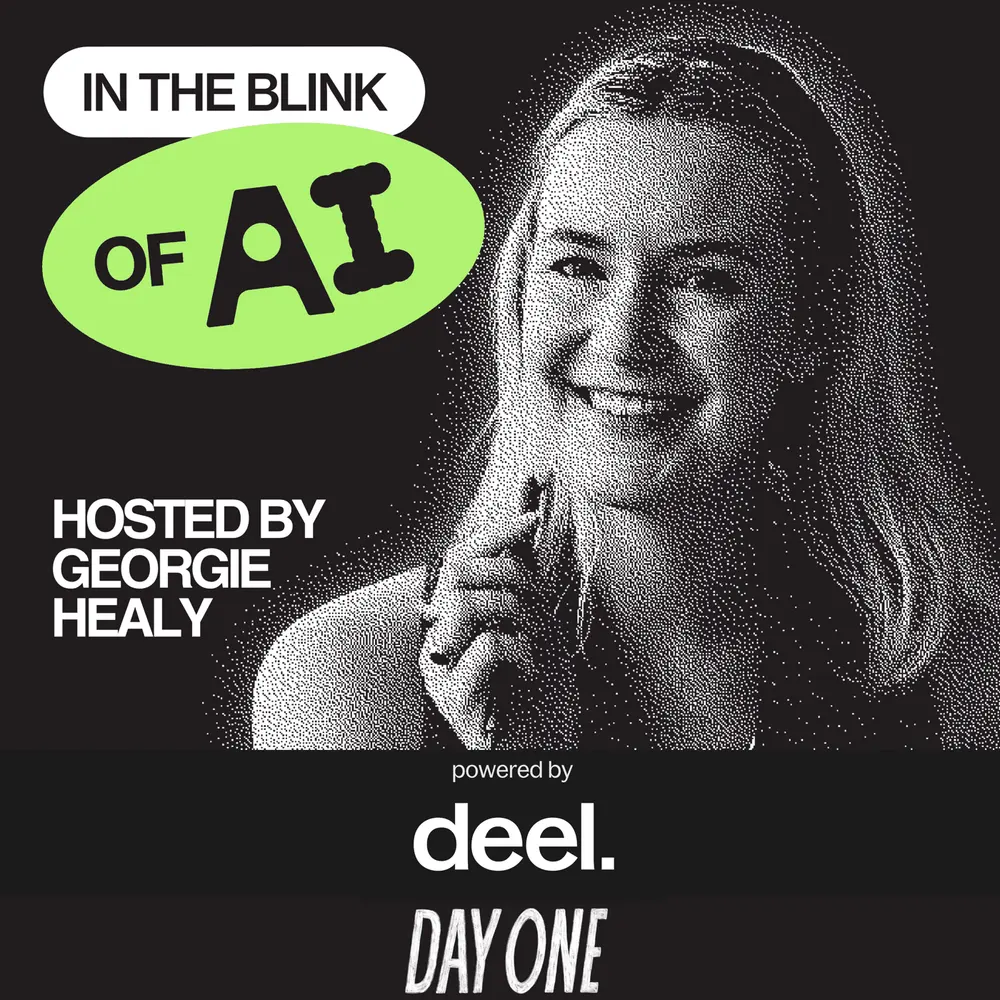 In The Blink Of AI with Georgie Healy
Presented by Deel & Stripe
In The Blink Of AI with Georgie Healy
Presented by Deel & Stripe 
 ▶
▶  ▶
▶  ▶
▶  ▶
▶  ▶
▶ ▶
▶ ▶
▶