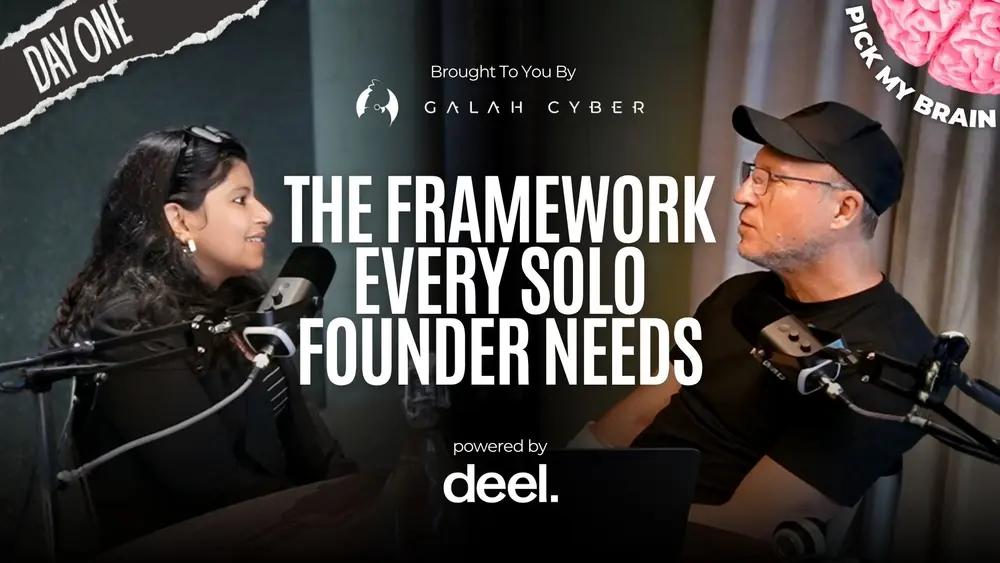
Transcript Synced · select any line to jump ▾ 0:02 Speaker: Founders scale faster on Deel. Set up payroll for any country in minutes. Hire anyone anywhere. Get visas handled fast and get back to building. Visit deel.com/dayone. That's d-e-e-l.com/dayone. I'm building a suite of services for small businesses. We're trying to eliminate the problem of late payments and how it's affecting small business. 0:30 Alan Jones: If this is the right time and the right place to solve this problem, then you won't be the only person working on solving it. 0:36 Stephen Neli: I will personally turn up to your front door. No, wait. But we're looking to partner with verified firms that will help streamline their legal support and collection processes for small business. 0:47 Alan Jones: The thought of enormous Steven filling in the entire doorframe, knocking on my door to collect an unpaid bill. 0:55 Stephen Neli: My startup is only 6 weeks old and they're happy to be on the show. 1:00 Speaker: Welcome to Pick My Brain, the podcast where we help startups startup founders hone their pitches to better connect with customers, co-founders, investors, and more. My name's Allan Jones, and I'm an ex-startup founder and angel investor with a few decades of experience helping new businesses find their footing and achieve their goals. I'd like to acknowledge that this podcast is being recorded on the Gadigal land of the Eora Nation, lands that were never ceded. I pay my respects to the First Nations leaders and innovators past, present, and emerging. On our show, Pick My Brain, you'll hear real stories from founders as they pitch their startups, tackle the challenges of entrepreneurship, and work towards turning their ideas into successful ventures. Pitches. Each episode, I'll be diving deep into these pitches to offer insights, advice, and strategies to help founders take their businesses to the next level. Thanks for joining me. Let's get started. Today we're joined by Stephen Nelly of Zelos. Hi Stephen, would you like to introduce yourself? 1:52 Speaker: Hi there, I'm Stephen. So my startup is Zelos. I'm building a suite of services for small businesses. We're trying to eliminate the problem of late payments and how it's affecting small business. So my startup is only 6 weeks old and happy to be on the show. 2:09 Alan Jones: Congratulations for having the courage to step forward and join the show, mate. I understand you're currently in a pre-accelerator program. Can you tell us about that program? 2:16 Stephen Neli: Yeah, that's correct. So I'm a part of the pre-accelerator cohort at Western Sydney Startup Hub run by Space Cube. So the awesome folk over there, it's been an awesome experience, an eye-opening one for me because this is my first ever startup. I've never done this stuff before. So daunting. 2:34 Alan Jones: That's good. That's good. Mate, thank you for appearing on the show. How about you run through your pitch? But before you begin, tell us who would this pitch be aimed at? 2:43 Stephen Neli: We've got a pre-accelerator pitch presentation night in two nights and it's aimed at them. So it's more of a pitch showcase. I'll be happy to state my pitch now and you can just give me some feedback on what you think. It's 2024 and I feel trust is rare in small business. I was recently on the phone trying to console a good friend of mine one. He's a self-employed contractor, and the company he'd just done work for hadn't paid him in months, just because they could. They even had the audacity to send a fake payment receipt from ANZ. People, it's 2024. This shouldn't be an issue, but the more I speak with small business owners, the more I get a sense that it's getting worse. One in four small businesses fail. Due to late payments. Fail. Not just take a week break and come back, they fail. And only 8% of small business in Australia actually vet their clients before taking on projects. So me, with my decade of experience in financial planning, sales, collections, found an opportunity for change. So I give you Zelis. Onboarding, risk management, cash flow, collections, all in one app that integrates seamlessly into your current accounting software and gives that control back to small business in 3 steps. Step 1: The Z-Filter. Enter in your client's details for a quote on the job, you get an automatic 1 to 5 star risk rating. Now that risk rating is based on AI and live credit reporting. You also get 24/7 live notifications for any significant changes to your current client list. That means red flags, court actions, history of non-payments, voluntary administrations. You need to know who you're going into business with. You need to get that notice and act accordingly. Number 2, flow. For our eligible clients, we are willing to pay you up to 95% of any selected invoice in the first 48 hours because cash flow is survival. Go grow your business. Payroll, supplies, you don't have to wait. Go and be great. Finally, my favourite, collections. I will personally turn up to your front door. No, I won't. But we're looking to partner with verified firms that will help streamline their legal support and collection processes for small business at a click of a button. Xelis is a tier-based subscription model. We're offering premium services, API access, and percent-based fees. My ask today is very simple. I'm looking for connections. I'm looking for partnerships. I'm looking for networks to help build Xalus. And if you're a small business out there, or if you know of someone, please let's connect. Let's talk. Let's build a Xalus Verified environment because I believe that we will be the ones to restore that trust back into small business. Thank you. Thank you. 5:52 Alan Jones: Thank you, Stephen. Here's my applause hands. Well done. That was great. That was a really great pitch for a 6-week-old startup. Let me first of all tell you about some of the things that I loved about it. First of all, you have a credible presentation style and you seem like a hard worker and a determined person while also being friendly and approachable. But you do take the pitch through a couple of moods there, right? So there's a feeling of moving forward quickly and really enthusiasm for solving this problem. And then you take us into a funny moment there where I think all of us, you know, recalled in shock at the thought of enormous Stephen filling in the entire doorframe, knocking on my door to collect an unpaid bill. So there was some real moves there in the pitch. And it also had 3 acts to the story narrative there, right? You were describing the problem, you're describing the solution, how the product's going to work, and then you're describing your ask, what you're looking for from your audience today, but at a nice beginning. Yeah. Middle and end. I also really liked, I bang on a bit from time to time about purposeful gestures because sometimes if you're the kind of person that talks with their hands, we get into paddling hands, you know, just our hands are just involved in the talk and that can get very, very distracting, particularly on a video call. Whereas you had some, some really nice, clear gestures that I think add something to your pitch. I noticed there that you're punching in, you know, on a phone here. that was part of your pitch. And then right after that one, you did, you did this, you drew out something like that. Those are two really good purposeful gestures. Another one was you used the bullet point fingers, right? You gave your audience a sense of, okay, I'm gonna talk about 3 things now, or I'm gonna talk about 4 things, and you check them off with your fingers when you did that. And I thought they were all really great. Another purposeful gesture that you might be able to script into this speech is, is what I call the chopping block. And it's something we're talking about the way things used to be done and the problems that causes and the way we're going in the future. It can be a really good idea to introduce the, here's the chopping block and here's the cleaver and those days are gone. We're moving on, we're outta here. But you've already got some really nice, clear, purposeful gestures and you're not letting your hands get in the way. So, well done for a 6-week-old startup. That was a really great pitch itself. Now let me be an investor for a moment and ask you some of the questions that I would ask if I was considering getting to know the company a bit better. It sounds like you're the only person in the startup at the moment, that you're a solo founder. Is that correct? 8:29 Stephen Neli: Yep, that is correct. I'm the only one in the, in the, uh, Zelos at the moment, but I am looking. So there is a big gap there that I need to fill. 8:40 Alan Jones: So describe that gap to me. Who do you need to fill what? 8:45 Stephen Neli: Uh, so I'm actually looking for someone that's very tech-based, like a tech expert, a CTO essentially, that could come and sort of close that knowledge gap that I have. I am working on a few things to push it towards an MVP. I'm not gonna— I'm not rushing into it, but I'm also don't want to be taking my time. I want to get there very soon. So yeah, I need that CTO or that tech head to help me out. 9:07 Alan Jones: Do you think about how to motivate that tech head to join your startup rather than doing their own startup or trying to work with another startup? 9:18 Stephen Neli: As far as that conversation is concerned, I do know there's other ways I've heard of, you know, the sweat equity and things of that nature to possibly offer people, especially tech heads. But me being very new at this stage, I think that was a conversation I was going to address later. But I'm very— I'm absolutely happy for for you to help me out there because, yeah. 9:40 Alan Jones: I know from previous experience, it can be hard for a non-technical person to find a technical person and motivate them to join the team because skilled technical people have carte blanche. They can go do whatever they want. They can go build their own stuff if they like. 9:56 Stephen Neli: Yeah. 9:56 Alan Jones: And they can certainly join a startup that's gonna pay them a pretty good wage and some equity, some employee equity over time. So I think one interesting way to engage with a good technical person is that, you know, if we imagine that people in that profession have kind of an engineer's mindset, an engineer is quite often somebody that can't walk past an oven or a microwave if the clock is flashing. You know, like they come and visit your house, and they walk into your kitchen to have a chat to you and a beer, and they see that the microwave is flashing, and they're just like, they've got this, they're distracted by it, and they just wanna fix the clock for you. And they say, "Well, how come it's not showing the right time?" "I'll fix that for you." Yeah. So sometimes when we put a problem right in front of a technical person, it can get to their engineer mindset of their brain and make them want to look at this and go, "Oh, you know, I could probably do this bit of it for Stephen." And they're like, 2 days and he seems like a nice bloke and I want to help him and it sounds like a fun thing to do. I could just do that bit of it, right? So sometimes that can be, you know, rather than going to the world and saying, hey, I want a technical co-founder to join me for the next 10 years and help me build a 250-person company. Like sometimes that is a really, really big ask. 11:18 Stephen Neli: Yeah. 11:19 Alan Jones: And if they were gonna do that, maybe they'd want to go and do it themselves. But if we say, I've just got this really specific problem, I'm trying to move from where I am now to this next thing. I'm trying to teach myself a little bit of code and I can't figure out this little bit. Let me describe it in detail and then just put that out there in the world. And sometimes somebody who's a software engineer will go, "Oh." "I can do that." "That's easy. Let me help Stephen." Engineers want to help, right? 11:44 Stephen Neli: Yeah. 11:45 Alan Jones: So that might be a way forward. 11:48 Stephen Neli: Yeah. 11:49 Alan Jones: In order to do that, we have to be transparent though about what's going on. How ready are you to talk to the rest of the world about what's going on in your startup? 11:58 Stephen Neli: Uh, being 6 weeks old, I'm as ready as a 6-week-old startup can be, but I'm ready for any conversation, especially with the— it's interesting you bring up the CTO conversation or the tech. I've never thought of it that way. I guess humans are automatically inclined to want to help. So I think that's an approach that I'll be looking into for sure. But I'm ready for that conversation to happen. I just need to align a few things like partnerships and getting in what my services actually would look like. But yeah, that'll come with time. 12:30 Alan Jones: I think you're sharing a bit about your journey on social media, is that right? Where can I find that? 12:35 Stephen Neli: So my social media journey is on Instagram, so it's Stephen, so @stephen.startupvoyage, and I've just listed there gone through all my experiences from the very start, from starting my Space Cube pre-accelerator cohort experience program, and I've just gone through the whole process. And I actually, 2 weeks ago, I pitched for the very first time at the Innovate Western Sydney 2024. So that was a very daunting experience, and I, yeah, I've put that all in there as well. And I actually came away with the win for the first time ever pitching, so I'm pretty happy about that. 13:14 Alan Jones: I believe that. That doesn't surprise me at all. That doesn't surprise me at all. You did a great pitch just now. So Stephen, if I went to that Instagram, is it all, you know, kind of, you know, mostly positive? 13:25 Stephen Neli: Yeah, very, very much so. It's, I'm trying not to make it my personal diary, but I am trying to highlight key stages that I'm going through. And I'm surprisingly, putting myself out there has allowed people to sort of chip in and chime. And there are people that have reached out to try and, you know, see if they can help me. So it goes back to that point point of putting a problem in front of people and they would always try and help out. So I've experienced that now that I think about it. The content is largely focused on just some milestones that I've hit, problems that I've had, and it's fairly, fairly positive, I think. 14:03 Alan Jones: Great, great. There are obviously, you know, software engineers on Instagram. There are other social media and online community groups where more developers hang out. So don't be afraid to go and explore destinations where more software developers hang out, you know, in the real world community as well. Tag along to software startup events and don't stand with somebody that you already know and talk to them all night 'cause you're afraid to make new friends. 14:33 Stephen Neli: Yeah. 14:34 Alan Jones: See how much of that room you can work and see if you can bump into software engineer along the way. If, if you get a chance to bump into somebody at a startup event, then use that opportunity, you know, to get through, you know, maybe like a 5 or a 10-second version of your pitch, like the way you introduce yourself at the beginning of our chat. 14:54 Stephen Neli: Yeah. 14:54 Alan Jones: And then raise the problem. That's a problem here right now. Trying to do this thing, it's a software engineering thing and here's where I'm stuck. Do you know anything about that? 15:04 Stephen Neli: Yeah. 15:05 Alan Jones: That might be helpful. 15:06 Stephen Neli: Yeah. 15:08 Alan Jones: And then buy them a drink. So Stephen, you touched on partnerships there. What kind of partnerships are you hoping to strike? 15:18 Stephen Neli: So my startup is in 3 sections. So I've got the risk management and onboarding. I've got the invoice financing and then I've got the collection legal support. So all of those 3 functions hinge on partnerships. Obviously for myself to build out these functions from scratch is going to be very, very cost and time consuming as well. But also there's other people out there that have, that, you know, have had this technology accessible, and, and a matter of me bringing this stuff together and delivering it as a, as a, as a complete service. So I'm looking to partner with people like Experian for the, for the credit reporting and the credit insights portion of the startup, and I'm looking at various other invoice and finance companies here in Sydney to fill the gap for the second portion. And for the third portion, this morning I actually just had a conversation with Legal Vision, and I spoke with— shout out to Fiona. She gave me a lot of context on what direction I should be heading and what I should be asking for. So she was awesome. 16:27 Alan Jones: That's great. There's some good people at Legal Vision out there. Let's come back to Experian for a moment. I mean, they are in the business of helping startups like yours and other sorts of companies do credit checks on individuals and businesses, but that's the way they make a living, right? So they're probably more than happy to have Zillis as a customer, but they probably wouldn't describe that as a partnership. So it'll probably be necessary to have a sales relationship with Experian and sign up on something that's affordable for your business. Yeah. Enormous to do that credit reporting. But I'm sure you'll be able to find law firms specializing in small businesses that would welcome new qualified leads, you know, for the legal side of things. And certainly collection agencies that are interested in acquiring leads too. So those two areas, I think that could work really well, approaching people for partnerships there. The challenge though, in the meantime is, You're right. If this is the right time and the right place to solve this problem, then you won't be the only person working on solving it. And we don't necessarily have to be first out of market, but we do have to make sure that we're offering something new and differentiated to customers that we're able to. Tell me a bit about how you're making forward progress on a platform given at the moment you don't have a software engineer working with you. 17:55 Stephen Neli: The work is pretty much based around interviewing customers and that's kind of molding where I'm headed. My— the traction is, you know, getting that validation from the clients and sort of pivoting my idea. So what we have now at the 6-week mark wasn't the same as what it was in the initial 1-week mark. 18:17 Alan Jones: It was— 18:18 Stephen Neli: the startup idea has pivoted quite a lot, but— and it's all part of the process, that learning process, the molding process. So I am Pretty much in the phase of learning my numbers, what I need to, what I need to be, you know, sustainable, what it would cost for clients, for client acquisition. I'm going through the whole process of, you know, just the nuts and bolts of what I need to sort of propel it. And also I'm doing a lot on just drawing out what it is that I need from my app, whether it's just the basic features and functions, is, is what I'm getting into. So I'm going on to things like Figma, and I'm just, just fleshing out what that sort of would look like from a client experience and from a wireframing perspective. 19:09 Alan Jones: Yeah, great, great. When we interview customers that aren't in a business of working with software all the time, they find it really, really hard to picture in their mind what an app or a web platform might look like, right? So a Figma prototype doesn't have to be pretty if a customer can see how roughly the functionality might work right now. You know, I click in this field, I'm gonna type in my ABN, I click in this field, I type in my company name, et cetera, et cetera. And then I click this button and I go to another screen that starts to, you know, ask me to connect my cloud accounting platform, say. Okay. That helps the customer go from way too abstract to a bit more specific. And if we consciously don't make it really pretty, it's unstated, but it's clear that this is not what the product's actually going to look like. And so they can forget about thinking about whether the buttons should be blue or green, and they can actually think about, actually for me, this process will work better if it was in a different order. First, I want you to connect to my accounting platform, and then I wanna add in the details of my business, for instance. 20:18 Stephen Neli: Yeah. 20:19 Alan Jones: So it can be really good idea to gain some practice in mocking stuff up in Figma or something similar. If you're moving from there to a low-code or a no-code tool, then a lot of those low-code, no-code tools now will automatically ingest, you know, they'll suck up your Figma designs and they'll start coding an app based on the designs that you had. So that can be a really good first step forward before you found that technical co-founder that you have to find. 20:48 Stephen Neli: Yeah, yeah, sure. 20:50 Alan Jones: Another really good thing about that process is, is, is that, you know, we get to learn a little about how hard it is to do and how long it takes. So it can be really, really hard to manage somebody, to lead somebody if you don't really know what they do. 21:04 Stephen Neli: Yeah. 21:04 Alan Jones: You know, so any chance we get to, to spend a little bit of time in their shoes is gonna make us a better leader or a better manager of somebody, you know, performing that, that task. 21:15 Stephen Neli: Mm. 21:15 Alan Jones: My place at, at home today, there's a guy sanding the deck for me, probably do an okay job, but having attempted to do something like that in the past, it gives me a rough sense of how long it ought to take him. And that can be really helpful when I'm deciding whether or not he's doing it quickly enough and doing it well enough. 21:35 Stephen Neli: Oh, yeah. 21:37 Alan Jones: Being a founder basically means wearing all of the hats of the leadership functions in the business from day one, right? So Some of the time you're gonna be wearing the commercial and sales hat. Some of the time you're gonna be wearing the marketing hat. Some of the times you're gonna be wearing the CTO hat. Some of the times you're gonna be wearing the people and culture hat. All of these different hats, there's no way that all of them are gonna fit us well, right? And we're gonna look pretty stupid in some of them all the time. But that's part of the founder journey, right? Being prepared to put on a hat that doesn't suit me. You know, for me, it's definitely the CFO hat. Putting that on for a while helps me further my appreciation of the people who are doing that job for me when I'm in a position to be able to hire somebody or when I'm positioned to bring somebody on as a co-founder. So it's not wasted time. Getting uncomfortable wearing that hat, getting comfortable looking a bit silly in that hat is a really good process for being a better leader over time at a later stage. Reaching out to customers one-on-one is a really good idea. We have to be careful though that we're not designing a product and a business that just suits the needs of one customer. So if we get one small business and make them our customer interview customer, we're probably not gonna develop a product that's gonna work for tens of thousands of businesses. On the other hand, if we just say, well, we're just, designing a product for all small businesses or for, you know, all SMBs or SMEs, small and medium enterprises, all of those businesses are very, very different. 23:19 Stephen Neli: Mm-hmm. 23:19 Alan Jones: And so it's gonna be very hard for us to learn anything very concrete, very specific that we can use to build something better for our customers than what they currently use. So it can be a difficult balancing act. You know, you and I are both men over 6 foot, both men over 100 kilograms, we probably don't have a whole lot in common other than that, right? So, you know, we couldn't go into this going, well, I'm just gonna build a product, you know, just for blokes over 100 kilos and over 6 foot tall. You wouldn't really be designing a product that worked for everybody. So see if you can find somewhere in between, something in the middle. One avenue to consider might be approaching professional associations, professional associations that represent a profession are often challenged with, well, how do we find new services that would be of value to our members? We want to provide new services for our members because that's why they pay an annual membership fee. And without their annual membership fee, we don't have an association and I'm out of a job. So, they're always looking for new things to bring to the members, right? So, it might be that by approaching a professional or a trade association, you might be able to get their cooperation with you. To reach out to their members and get, you know, a group of 10 or 20 small business owners in their professional association that might be prepared to collaborate with you, to be there for you for customer interviews, to review mockups with you, to learn more about the problems that they face. And then you're somewhere in the sweet spot between way too big and not targeted enough and way too small and way too targeted. Mm-hmm. See if you, if, if you can approach a few associations that way. 24:58 Stephen Neli: Yeah. 24:59 Alan Jones: Another really fruitful avenue of approach is often these organizations hang out online in places like LinkedIn groups or Facebook groups. You might be able to find the members of an association and you might be able to pick up 10 or 20 of them just by going to the, to the social media place where they hang out rather than going through the, the association itself, through its leadership. Ben, are there any questions that you have for me today? 25:28 Stephen Neli: I do have one. It's, I think it's just around imposter syndrome, and I find that I myself become overwhelmed with positive problems to do with the workflow, and I tend to get a bit insular, and I just wanted to I wanna know what have you done in your previous startups to, or from your experience to overcome the imposter syndrome and do any tips for me? 26:01 Alan Jones: I do, mate, I do. So like you, I struggle with imposter syndrome. I still do today. And when I'm in a position to have an open and honest conversation with anybody else in startups, we've all got it. 26:13 Stephen Neli: Yeah. 26:13 Alan Jones: All of the time. And it never goes away. I really recommend there's a great talk that Mike Cannon-Brookes, one of the co-founders of Atlassian, did at a TEDx Sydney event a few years ago now, but you can find it on YouTube. And he has a talk about his own struggle with imposter syndrome. The thing is, we're all tackling things that we're unqualified to do all of the time. And you'll tackle one challenge and you'll get through that. And then you go, you look around, right, what do I have to do next? Oh no. 26:46 Stephen Neli: Yeah. 26:48 Alan Jones: There's another seemingly impossible challenge that I have to take on now, right? And that's just, if you find yourself for a long period of time with no seemingly impossible challenges to take on, then you're probably not really building a startup or you're probably not advancing a startup at a pace that's going to allow it to succeed in the face of competition, right? So first of all, we can accept that no matter how successful we are, no matter how long we go at this, we're always going to suffer from imposter syndrome. Then we go, okay, well, how do I, how do I deal with it? And the way that Mike has chosen to deal with it and the way that I've chosen to deal with it as well is to learn gradually to get more and more comfortable about being open about how difficult to find some of this, you know. So, like you, I spend some of my time sharing the highlights of my journey in startups on social media channels and blog and email newsletters and sometimes on my podcast. And what I'm trying to do is not just share the highlights, but also the lowlights as well. 27:50 Stephen Neli: Hmm. 27:51 Alan Jones: This is the thing that I just don't know how to do, you know, and I've tried to do it myself. Like, I think it's important to show that, you know, I've had a crack at this and I'm just, I'm just stuck right here. I'm not reaching out explicitly to ask for help, but I'm just sharing with the world out there, with the people who sometimes glance at something that I've written, you know, I'm just, I'm just stuck on this thing. When we put a problem out there in the world, somebody who might have a solution for that might step in and give us some advice or give us a connection. And help us through that. It's natural to feel a little bit of shame. It's natural to feel a little bit embarrassed when we do that, but, um, it can be a really powerful thing when you get into the habit of being able to do that. You can also call back times in the past, um, once, once the, you know, the immediate, the short-term pain has passed of that way you stuffed up, that time you, you took the wrong approach, um, or that time you thought you had it covered and you didn't. 28:47 Stephen Neli: Yeah. 28:47 Alan Jones: You know, it might be 6 months, it might be a year, it might 5 years down the track. But when you look back on something, there's much less pain involved. 28:54 Stephen Neli: Mm-hmm. 28:54 Alan Jones: And, and then it can be a really good example to, to share with somebody. You know, I once spent like a month working on a, on a physical mailout, you know, with real paper and envelopes and a brochure and all of that kind of thing. And I, and I had a budget to work to and I was doing a mailout for 5,000 businesses. And I obsessed about everything that was going into the envelope and the brochure and the copy and the photos, all that kind of thing. And I completely forgot about the cost of postage. 29:25 Stephen Neli: Wow. 29:27 Alan Jones: So I, so I ended up going over budget by like 35% on, on the cost of sending this out. And I had to go to my boss and I had to say, look, I know I told you that you could trust me with this, but I've really stuffed this up. We're gonna be 35% over budget. I'm, I'm so, so, so sorry. It will never happen again. And here I am, you know, 35 years later, I can still recall that mistake. I'm never gonna make that mistake again, right? So, you know, if I'm sending you a t-shirt or a sticker in the mail, or even if I'm doing a large, you know, EDM email out to people, I'm still gonna think, what are the other costs that I have to think about? It's not just about creating the message itself. 30:08 Stephen Neli: It's— Yeah. 30:09 Alan Jones: There's also probably gonna be a cost of distribution. But when you can share that with somebody else, once the pain has passed, it kind of becomes liberating. It takes the power away from that thing that used to give you shame. And now it's just a funny thing that happened. And you know what? You know, I'm still alive. I'm still going. It's all good. No, it's all part of the journey. So I think that's a helpful way to take it on, except that it's always going to be with you. So it's never going to go away. It doesn't matter how successful you're going to be. 30:35 Stephen Neli: Yeah. 30:36 Alan Jones: Except that you're going to get a lot more help and support from people if you can be transparent, not just about the high points, but also the low points. Reach out for help, you know, before you've really messed things up yourself. It's just say, I don't know if anybody can help me with this, but here's, here's where I'm stuck. Here's where I'm worried I'm going to stuff up if I do it wrong. And then a few years down the track, be ready to share those examples of the times you stuffed up with people who are just starting on their journey too. And maybe that'll help them. 31:06 Stephen Neli: Awesome points. Thank you so much. 31:08 Alan Jones: David, it was, it was really, really great to have you on the show today. You're, you're 2 days out from pitching for the second time only to the pre-accelerator cohort. I think it's gonna go really well for you. I'm really looking forward to seeing where you go next with your startup. Just one more time, where can people find Zealous? 31:26 Stephen Neli: So Zealous, you can find me on Instagram. So Stephen, so S-T-E-P-H-E-N dot Startup Voyage, one word. And that's on Instagram. Zealous bracket, AU, and bracket on LinkedIn as well. But yeah, my startup journey has all my links, so if you want to go on there, I've got the highlights, the lowlights, as we spoke about today, and that, that's where you'll find a lot of my content. And yeah, I'm very much looking forward to what the next 6 months looks like, and I'm sure we'll link up again at some point. 32:06 Alan Jones: Definitely. Get along to that if you can. Thanks for being on the show, Stephen. It was a real pleasure to meet you. 32:10 Stephen Neli: Thank you very much. Cheers. 32:15 Alan Jones: Thanks for joining me for this and every episode of Pick My Brains, the advice podcast for every startup founder. Never mind the don't forget to like and subscribe bullshit that every podcast host goes on about. Instead, please take a moment to think about someone you know who could use some of the advice I've shared and tell them that they should listen to it. I don't know, maybe they'll choose to like and subscribe. Anyway, I'm not a lawyer or an accountant, and what you've heard today is not intended as financial or legal advice. You should always seek that from a qualified professional before making the big decisions. And I'm not a superhero either, so don't forget that sometimes I'm fallible, and very occasionally I might even be wrong. Please let me know when you think I might be, so I can get better at this too. Just reach out to me on any of our social channels. Or email the show at pickmybrain@startupfoundercoach.com. Speaking of startupfoundercoach.com, that's where you might sometimes find show notes, transcripts, and bonus bloopers if I have the time. The Pick My Brain podcast is produced, edited, and beamed directly to your ears by the hardworking and understaffed team at Day One, the podcast network for founders, operators, and investors. Find out more at dayone.fm. Thanks for listening.


 ▶
▶  ▶
▶  ▶
▶  ▶
▶  ▶
▶  ▶
▶  ▶
▶ ▶
▶ ▶
▶