Transcript Synced · select any line to jump ▾ 0:01 Georgie Healy: Founders scale faster on Deel. Set up payroll for any country in minutes, hire anyone anywhere, get visas handled fast, and get back to building. Visit deel.com/dayone. That's D-E-E-L.com/dayone. 0:23 Nicole Gibson: Emotion has never had an objective element that allows us to come closer closer to understanding each other. And I was pained, Georgie, right, by this question, why don't we have a more emotionally intelligent world? As I matured and I became more curious in this subject, I realized actually we don't have emotional intelligence because we don't even know what emotion is. Our machine learning starts to show when one emotion ends and another begins. And we started with 5 primary clusters, and now in our models, in a pretty small test group, of just a couple hundred people, we have up to 25 emotions. So when we start to, you know, accelerate that and we have hundreds of thousands, millions of people using the technology, what do you think is gonna happen? Like we're gonna have probably thousands of clusters that we do not have words for. 1:14 Georgie Healy: Oh my goodness. 1:15 Nicole Gibson: And so we're, we're painting finally a picture of the complexity of what it is to be human. 1:23 Georgie Healy: Hello and welcome to In the Blink of AI, where I talk to the brightest AI startups and innovators each week. I'm Georgie Healy, and this week I'm speaking to Nicole Gibson, CEO and founder of InTruth. I first met Nicole at an event during South by Southwest, namely because on 3 separate occasions that night, people were absolutely astounded by the early insights InTruth had been able to capture already. I simply had to meet her. Subsequently have found out that she's low-key famous and absolutely an incredible entrepreneur that's based in Silicon Valley. Now, this episode was recorded just after she was on The Project the night before, and earlier in the week she had a major feature in The Age. So InTruth is attracting a lot of attention and momentum as it's the first company, uh, in the world to track emotions through wearables with clinical-grade accuracy. In the episode, we discussed the technology behind getting emotional data, how to get signals that feed the algorithm, which then provides insights. And it's super interesting. As Nicole shares on the pod, it can mean incredible things for how we understand ourselves and how humans can interact as a whole, and are launching to the public next year. And I'm super excited to be one of their beta customers. Let's jump into the episode. Hi Nicole. Thank you for joining in the Blink of AI. Perhaps you can kick us off with giving us a quick explainer on what InTruth is. 3:00 Nicole Gibson: Sure, Georgie. Happy to be here. So InTruth is the first company in the world to be able to track emotion through biometrics or wearable technology, uh, with clinical grade accuracy. So it's been a big journey, but a very exciting one. 3:13 Georgie Healy: Um, I'm really excited to dive deeply into this today. As the founder and CEO of InTruth, what are you currently working on and what's top of mind for you? 3:23 Nicole Gibson: I don't think a founder's ever working on one thing, right? But we're just about to do another deploy of the app, which will bring some updates to the original alpha testing version, which I'm quite excited about. We just had a meeting about that this morning. And excitingly, there's a lot of kind of media on us at the moment. You know, ride that wave and get an opportunity to talk about InTruth, and some has been very favorable. And actually a segment I did last night, actually on the project, it was interesting to see the angle that they took. It was a very kind of fear-based view on what we're building. So it's interesting, you know, when you, when you're on the leading edge of anything, the way people respond and react, I think, is likely to sit on two ends of an extreme. It's quite fascinating because it's showing me societally actually where we sit, not just with AI, but actually with the concept of emotional vulnerability. 4:16 Georgie Healy: I'm so glad you've mentioned that. This was going to be a question I was going to ask later on, but I'm so glad you've brought this up. I was called out recently by a friend for fixating too much on the risks of certain things, which is not lost on me having an AI podcast and being super excited for what that could mean. There was this Neuralink startup, you know, the more invasive ones, they potentially share your innermost thoughts with other people. And I was, I was focusing purely on like the downside risk. 4:46 Nicole Gibson: Yep. 4:47 Georgie Healy: But then my friend pointed out the upside of how this could— Oh, see. Inform people with paralysis and neurodegenerative diseases and how they can communicate with the world around them. And it really made me think, yeah, the potential upside is so huge. I would love to hear what you said on the project and what the upside benefits are that people that are focusing too much on the risk don't, like, take into account. 5:11 Nicole Gibson: Yeah, I mean, this is a really big conversation. You know, for me, I'm coming from a space of having thought about this problem that we're solving for, you know, 15 years of my life every single day. And I understand that that's not the mainstream. And when a concept is put to a mainstream audience for the first time, they see it in a completely different way. But for me, to increase the level of emotional capacity of humanity at scale, you know, in a hyper-individualized, personalized way, but to be able to achieve that at scale, to me, that is the, the bridge that we're finally able to build to, to a kind of more compassionate world. And— a more honest world. And I think that these kind of what have previously been seen as value-based or character-based qualities can finally become objective qualities, like to actually be able to understand what it means to be emotionally intelligent, to be loving, to be compassionate. As soon as we're able to really see that, we can drive collective momentum in that direction at scale. Because I really believe that we have more than a critical mass of people in our world that want that world, but we don't right now have a way of organizing the emotional state of the collective in a single direction. We're basically beholden to the media, which is always driving fear and anxiety, or, you know, our kind of dopamine reward system that's constantly being manipulated by social media. So all of us have kind of outsourced our vibration, you know, our emotional state, to the things around us, and The point I made, I actually wrote a statement after the segment went up because they interviewed me for about an hour and a half on data sovereignty, but didn't obviously show any of that, which I thought was really interesting. I wrote a statement and basically said, you know, this isn't a matter of whether or not we should build this. This is a matter of which company you want to support to rise to power. As the founder of Intruth, I'm very passionate about that. We build with decentralization in mind. My vision for health data is for every user to own their own health data for that to sit in a wallet, you know, a digital wallet that is encrypted and they can determine who gets access to that data. So when you think about it from that perspective, and as I've said, this is a big conversation, that's actually an improvement in privacy because I'll give you an example. Last time I left Australia to go, I live in San Francisco, so I was going home after a visit to Australia and I went and got a blood test a couple of days before I flew and the results weren't in before I, you know, had to go back. Mm-hmm. And so I called the clinic and did an identity check and the receptionist said, the doctor won't give you your blood results unless you actually come into the clinic. And I said, well, I've left the country. You know, these are my blood results. You know, I've, I've confirmed my identity, give me my blood results. And they wouldn't do it. And so the disposition within the existing healthcare system, right, is the medical system, your doctor owns your data and you have to ask for permission and actually, you know, potentially go into the clinic face-to-face and see that doctor in order for him to release your blood results over to you. Now, I think that that's appalling. I think that that's a system that needs disruption. And this is finally a way that we can improve our level of privacy, you know, not decrease our level of privacy, but it's the way that the story is going to be told to the masses that I think, you know, really matters because a lot of people don't know what you and I know. Yeah. About data. And I think that that's problematic because we're on that acceleration curve, whether we like it or not. And some companies don't care about data sovereignty. And so the consumer should be empowered to make a decision around whether or not that's the company they wanna support. 8:51 Georgie Healy: Yeah. Such an incredible example. I think we've all dealt with these kind of Kafka-esque almost examples of, but it's my data and, and I don't know why I don't have access to it, but someone that I don't even know has access to it. I was involved in building the COVID-19 app, and that was just another example of weird disjointed privacy and security. 9:15 Nicole Gibson: Totally. 9:16 Georgie Healy: Look, taking a step back, you mentioned, and frankly, I'm so glad I Googled you after having met you and asked you to come on the pod because now quite intimidating seeing how much your work is celebrated and how much people are very keen to learn more about you and InTruth and what you've been working on several years in Silicon Valley and here. I encourage listeners to check out previous podcasts and articles because that talks about the emotional background side. But on the podcast today, focusing more on the technology, what technology are you building and how does it relate to overall goals of the business? 9:56 Nicole Gibson: I just wanna sort of flag here that the tech is a way of driving a broader impact. What we're here to do is beyond just build a tech product. And in fact, Love Out Loud, which is actually the parent company of Intruth— so Intruth is a subsidiary of a company I started back in 2018 based on a book I wrote actually called Love Out Loud. And I wrote that book after 10 years, almost 10 years, working in the mental health sector as an entrepreneur, also as a, as a commissioner, just realizing man, we need a more humanitarian approach. Like the system is just, it's so fragmented, you know, when you're dealing with vulnerable people, that's the last thing that's helpful. And there's really no personalized solutions that can scale. There's a lot more to that story, but to kind of give an overview where that landed me was we need to build personalized solutions. And I see the technology that is Intruth kind of being one of the most innovative ways of solving that problem. Because the biggest design question I've had forever, you know, since I started my first organization at 18 years old in mental health, was how do we scale a solution without losing personalization? And this was even before— in fact, if you had told me eventually you're going to move into tech and you're going to start a tech startup, I would have been like, yeah, like what? Like, I had no engineering background or any of that, but it was kind of this iterative first principles thinking that brought me to, to where we are today. And, and what, what I'm very proud of having built with my, my very amazing team, what the tech does. So I'll kind of explain it, you know, as if I was talking to a 7-year-old, and then we can get more. 11:37 Georgie Healy: Please. Yeah, love that. 11:41 Nicole Gibson: It's basically like a, um, a sophisticated mood band. I think we'll all remember the Mood Ring. 11:46 Georgie Healy: I loved Mood Rings, loved them. Like, if it turned a certain color, I would be like, yes, actually I am quite emotional right now. That tracks. Yeah, loved it, loved it. 11:56 Nicole Gibson: Mood Rings were using heat, so temperature, skin temperature, to change the color. So, you know, that they were onto something. It was low-tech, it was very analog, but, you know, that actually, I think, set the tone for the technology that will actually be able to do that. The way that we've built our sort of first version is through I have to get a little bit technical, but I'll try my best to explain. We pull data from what's called a PPG sensor. So a PPG sensor is a sensor that sits in most consumer-grade wearables. So if you wear an Apple Watch or an Oura Ring or a Garmin or a Whoop, um, I'm wearing one right now. 12:33 Georgie Healy: Yeah, I noticed you're wearing an, an Oura Ring. Yeah. 12:36 Nicole Gibson: So the Oura Ring, you know, has these sensors inside. That's called the— and so if you're listening to this and not watching the video, obviously. 12:43 Georgie Healy: Yes. 12:43 Nicole Gibson: Well, but if you're watching the video, these sensors, so this is a Biostrap. This is what's tracking my InTruth data. 12:48 Georgie Healy: Anyone that wears a Fitbit, those green lights that blind you anytime you take on and off your Fitbit watch. Yeah. Amazing. 12:56 Nicole Gibson: These are the same sensors. It's called a PPG sensor. And the, the data that comes out of a PPG sensor is called IBI data. That data is what normally gets processed in existing wearable experiences into things like heart rate, heart rate variability. You know, they're the things that basically track your sleep score. But the, I guess, groundbreaking solution that we've managed to build is our ability to pull that raw IBI data into a machine learning model. Sits in our servers. We process that raw data and we translate it into arousal and valence, which are the data points basically that construct emotion. And once the, the ML has done that, then we, we push it back to the user so that you can actually see your emotional state. Mm-hmm. So obviously on a kind of basic level, you can see your emotional state, but once we combine that data in time against something like your calendar, then we can really start to aggregate complex data and show you complex emotional, very nuanced, complex emotional patterns over time. 14:02 Georgie Healy: Wow. That is genuinely incredible. When you say complex, what's the 5-star version of this? What would you love to see? 14:12 Nicole Gibson: Yeah, this is what we're, we've been raising for actually. I think any founder feels that way, but just so, been so excited to get to the other side of this raise because I wanna build it, you know? And I think that that's a good litmus test, right? If you're that excited to try your own product, I think it's a really good thing. The 5-star version is basically gonna be taking the basic data. So the emotion that we're tracking in time, you know, keep in mind that this is the first, technology really ever to be able to, to do that. So we're passively tracking your emotion without any user input. Once we start to integrate that with a calendar and with generative AI, we can start to experience it more like sort of an AI coach. I like to, without getting too meta, think of it as like a ChatGPT for your own subconscious mind. So it would know, for example, Georgie's having a podcast with Nick, um, from Intruth. And it's tracking you throughout the interview, right? And so then it's meta tagging Nick, InTruth, AI, emotion tech. Like it, it knows all these subcategories of what's related to our conversation. But say you wanted to focus on your and my professional relationship. We did a few other things over the coming months and maybe we hit like a conflict. You could go to InTruth and say, Hey, Antruth, Nick and I are going through this conflict relating to whatever. Can you go back and look in my data? Where do you think this conflict started to arise? What were my vulnerabilities? What are the exact emotional patterns that are going on for me? And how could I meaningfully resolve this? 15:46 Georgie Healy: It's just incredible to think of all the, all the times that I would've found this super valuable in professional circumstances as well as personal ones. Even like I'm projecting here, but it's been a particularly busy week in startups, right? South by Southwest. I'm running a program that just had a boot camp week, got super sick afterwards. Like, like, I'm just thinking that the emotional tax can have a health tax sometimes, right? Totally. 16:16 Nicole Gibson: Obviously my background's been health, and I'm passionate about, about this because I saw it very much in my facilitation work. Emotion is the underlying cause of all, you know, health conditions, in my opinion. And that's, that's through kind of heavy anecdotal observation, but also the research that in truth has illuminated, because the human emotion and behavior has been a lifelong kind of interest. But building this company has forced me to, to really get into the neuroscience of what emotion really is. And this is what I was talking largely at South by Southwest on. Emotion drives 80% of our decision-making. So your emotional patterns are driving the things that you choose, which are ultimately driving any kind of outcome you're experiencing in your life, in your health, in your relationships. You know, I think these concepts that have been a little elusive for people— like, you have thought leaders from back in the day like Louise Hay, who, who wrote The Body Keeps the Score, and I'll look— 17:15 Georgie Healy: Yes. 17:16 Nicole Gibson: And they're like, um, I don't know, you know, it doesn't— it's not very medical. We're starting to really see the, the data that, that makes that true. And it's not as elusive as I think it was originally portrayed. If you think about it in this very pragmatic way, your emotion is driving 80% of your decision-making, which is largely unconscious to you. That's driving you to make these decisions that bring you out of balance, that compromise your health. Well, the intervention then is in being able to realign your behavior and your decision-making to the outcomes that you're actually, you know, seeking. Mm-hmm. Of course, there's going to be, you know, factors that are beyond our control, but ultimately any external factor, for example, you know, a negative environment that we feel we can't control, is still being internalized within our nervous system, creates an emotional response and pattern which then reinforces behavior that's keeping us stuck. Our data is actually able to see that and aggregate that level of complexity that the mind is just never going to be able to to do, you know, by maybe someone who dedicates their entire life to a meditation practice and kind of removes themselves from societal distraction. 18:27 Georgie Healy: You talk about how the, the data that's gathered by the PPG sensor is then leveraged and supported by calendar events, perhaps. How do the insights get given back to the, the wearer? How do you hope to share those insights? 18:46 Nicole Gibson: I don't want our app to sort of say, hey, you're stressed, do some breathwork. Because I find this, you know, really— 18:53 Georgie Healy: That's really stressful. 18:55 Nicole Gibson: Yeah, that doesn't enable. Rather, I want people to think of Intruth as like a mirror into themselves. So what Intruth will be able to do is start to correlate some of these data points. So say you are, you know, trying to overcome an emotional pattern of anxiety, and Intruth knows that that pattern is triggered every time you drink coffee and have a meeting with the CEO and don't go to gym. You know, it will start to actually correlate at the behavioral patterns and the activities associated with certain emotional, or the inflammation of certain emotional patterns. And then it can feed it back to you. It's not going to tell you what to do. We're not here to tell you how to live your life, but I see our job as being able to illuminate awareness that's hard to catch. So once you know that, we want to empower you. Okay. You know, if you want to continue to do that, go right ahead. But now you can see it clear as day in a much more nuanced way than waking up and, you know, looking in my Oura app and Oura tells me you slept terribly again for the 5th day. And I'm like, okay, well I know, but I don't actually know how to sleep better. You know, like what do I actually have to do to sleep better? Our data is gonna reach to that layer that says, well, this is why, this is this is what our data is showing on the days that you do X, Y, and Z. These were your emotional patterns. This is the emotional pattern that you ideally would experience. I think that that's incredibly powerful, you know, but it's amazing, Georgie, how many people rebut that capability and say, well, you know, it's, yeah, it's showing the user data, but it's not necessarily going to change the way that they behave and what they choose to do. And I think that basically what we're saying is self-awareness is not an intervention. Mm-hmm. And I think that that's because we've normalized just giving away our awareness to so many external things. And yeah, you know, someone might say, well, in truth is an external thing. And the way that we've designed it is to continually bring your awareness back to you. And my hope, you know, in 20 years or, or whenever, is that this is something that's very intuitive, you know, that we don't necessarily need. Our mission statement is to awaken the technology within. Mm-hmm. To empower our users to be able to do that on their own. That's the vision I have. 21:11 Georgie Healy: Thinking out loud here, you mentioned the, the sleep trackers, and we've seen those across so many different hardware devices. And it's, as you say, I slept for 5 hours and it's not that insightful to tell me that I had a bad night's sleep. It's like, yeah, I, I know. But what makes me quite excited about what you're building is the variance with our days, weeks, months, the people we interact with, and the insights that can be gained from a moving world. Like sleep is, you know, generally I guess we all need 7+ hours of sleep, right? But to be able to provide insight for me and the people I interact with and how that affects me as a person, maybe Nicole, you're a little bit more emotionally stable than me, and the same interaction with the same person would have a different result on your body. I find that really interesting and really compelling. 22:05 Nicole Gibson: Exactly, yeah. And it's— we've gotta, we've gotta weigh this up. And I actually saw this one, um, some— someone's comment on, on the segment from last night, just before. It was like, the way that we should be weighing any technology up is the prospective upside. Does that actually outweigh the downside. And I think I really encourage everyone, you know, in the world to think more along those lines, because this very binary— something is only good or only bad, you know, that, that extreme binary thinking is not going to get us through the just era that we're in as a, as a civilization and species. We have to think in a far more nuanced way. and we have to be able to, you know, have these debates. I think that that's very important, which means putting all the information on the table, not spinning stories in one particular direction, you know, but to actually give and empower consumers with the facts, you know, for them to be able to decide. Because again, I, I talked about this at South by Southwest. I think tech founders, you know, have unprecedented levels of power. The ones at the top, you know, that have really made it and the ones that, that are about to, I think because we've had a downturn in the market, we're gonna see a, massive uptick in unicorns soon because unicorns are built, you know, in a downturn. These companies, and we hope to be one of them, right? And I'm not shy in saying that, you know, these companies arguably gonna be more powerful than governments. So transparency really matters, you know, that the way that we educate our users around the problems we're solving. And I think there's been so much shame around like, if you're a company that hasn't solved this problem, then, you know, just do everything in your PR to, to sweep that under the rug. 23:47 Georgie Healy: Mm-hmm. 23:49 Nicole Gibson: Maybe it's a little bit idealistic, but the way I really want to grow in my leadership is to be able to say to our trusted clients and consumers, hey, these are the problems we're currently solving and these are our ways of solving them. I think Elon does that quite well, to be honest. He's good at taking people on the journey of the problems they're solving as a company, and I think he creates a loyal customer base as a result of that. 24:15 Georgie Healy: Yeah, I'd love to dive into that a little bit further. He is so polarizing, right? And frankly, you know, would I, would I want to be best mates with him? Not sure. But do I admire him? 100%. 24:28 Nicole Gibson: Yeah. 24:29 Georgie Healy: I heard one person say, I don't know if it was Peter Thiel or someone like that, say for him to go off and build Tesla, we all laughed at him and then he nailed it. But then to build Tesla and SpaceX, that's not an act. Like, that is not— that is genius level. 24:46 Nicole Gibson: Yeah. 24:47 Georgie Healy: Look, you're super familiar with the startups in Silicon Valley. 24:52 Nicole Gibson: You live there. 24:53 Georgie Healy: And let's go there about the fearful mindset. Uber wouldn't exist if we were too scared to get in a car with a stranger. Airbnb wouldn't exist, right? If you pitched it to me and I was an investor for a year, I would have said, stupid, we'll never invest in this, which is why I'm not an investor anymore, by the way. Did not see, did not see the potential upside clearly. When your product hallucinates, it's not a Leonardo AI, it's not a text-to-image. What happens and how do you mitigate against it? And tell me how you are thinking about the potential risk of hallucinations in your AI model. 25:32 Nicole Gibson: Yeah, it is a great question. So because we're using ML and decision trees actually, the, the way the data is actually processed to get your emotion isn't AI-driven. It's, it's classic machine learning, so it doesn't hallucinate, which is great. 25:45 Georgie Healy: Good. 25:46 Nicole Gibson: Yeah, I think that's important. The hallucination, if it comes, will likely come through an, an LLM integration, you know, which, which will sort of fuel the, the generative AI features. And it's not about getting the LLM to give some sort of poetic and creative answer to a philosophical kind of direction for your life based on your emotional patterns. It's simply going to be, hey, what was the exact thing I was feeling in that conversation? If you were to combine every time that I've ever spoken to Nick, what was going on for me? So it's not being asked to be creative in any way. In fact, that, that, that's an important design imperative for me and the team. We're not trying to be creative with the data. We're trying to tell you the data as it stands. 26:31 Georgie Healy: Just for the listeners, um, generative AI products can hallucinate because the machine is coming up with the responses by itself. As Nicole clearly stated, if it's classic machine learning, it doesn't have the risk of doing that because it's based on a set of rules and instructions. Did I explain that properly, Nicole? 26:52 Nicole Gibson: I think you nailed that. 26:54 Georgie Healy: Yeah. Yes. Thank you. Look, you talked about raising You know, AI startups raise often for compute because compute is expensive. Are you raising for compute? Are you building hardware as well? Can you talk to us about what the, what the raise will enable you to do? 27:13 Nicole Gibson: Yeah, great question. So we're not building hardware. It's not off the table for us, but our view is, you know, there's amazing PPG hardware. So when we're not here to build the, the best PPG sensor because The sensors are actually already great and we can simply integrate with that hardware through either an SDK or an API. That might change, I guess, if we could see an advantage of being able to supply, say, like enterprise clients with custom hardware that we likely have already found some solutions. My, my vision there is to be able to drive the hardware price way down to sort of absorb it in the SaaS. Like you said, I think this has amazing professional applications in terms of like just team wellness and direction. Imagine being able to see kind of the subconscious 80% of the decision-making that's happening in a team. And actually this is what the project chose to focus on yesterday in a very obviously fear-based tone of like, why would you want your employee to see your data? And it's like, well, the guy on the project was literally like, what are you going to do? Print out, you know, a report and show your— 28:17 Georgie Healy: Yeah. 28:18 Nicole Gibson: Your boss, your emotional rapport. It's not exactly like that. You know, we're aggregating the data, we're depersonalizing the data. Your employer or your leader, you know, is more so gonna see trends that support them to make decisions that are actually gonna, you know, help the team perform better and feel better. That's the hope. My friend actually voice noted me and said, I really can't see you as like a Mr. Burns behind the scenes, like with your fingers like this. 28:45 Georgie Healy: Yes. 28:45 Nicole Gibson: I can't wait for every employer to be able to surveil all of their employees. 28:50 Georgie Healy: That does not track with your personality to be like big government. 28:55 Nicole Gibson: Exactly. So I think, you know, that's, that's important to state. So, you know, in short, no, we're not, we're not focused on building hardware. We're raising mostly to improve the machine learning model. So what we want to do without going into too much detail, cause it kind of touches on some deep IP of the company, but we've trained the ML on a, on a clinical dataset basically. And we want to be able to expand that clinical dataset to as many countries and across as many people as possible. So obviously the more we do that, the more representative the dataset is. So the research side of what we're doing is actually very exciting. And the family office actually that has closed out, I guess it's like a Series A equivalent because it's non-dilutive funding. So it's a bit of a unique situation, but— 29:40 Georgie Healy: Nice. 29:41 Nicole Gibson: Yeah. We've been talking with, with them about what it would actually look like potentially to separate the commercial imperative of the company with the research into a foundation, which I haven't actually spoken about that, you know, publicly. And it's— I just want to caveat, this isn't a decision we've yet made, but it's a decision we're exploring because I think it's a very good model for us in that obviously if it's in a foundation, then commercially we don't own the data, which I think is, you know, important. B, there's so much utility in the data that we're collecting for research purposes beyond what will drive our commercial outcomes, right? So to have a foundation that can focus on that, I think that there's so much we can learn broadly that's going to help humanity. That's, that's beyond, you know, getting InTruth to market. So that's a very exciting imperative that we're working through at the moment. But yeah, it will also sort of change the budget level that we have for our consumer launch. But I really want InTruth to be like a cultural disruptor. You know, like I don't see our launch being like, hey, let's run some ads and do a lookalike audience of Fitbit and let's go. Like I want artists, you know, like I want Rufus Du Sol playing in the Vegas dome with like everyone wearing InTruth and like AI projections and lighting that's shifting based on people's biometric data. 31:08 Georgie Healy: I literally got goosebumps 'cause I'm like, ah, I'm not even a Swiftie, but I really got into the Taylor Swift concert with the devices we were all wearing. And you'd look at your device and then you'd know which next album would be playing and things like that. But it was completely non-personal. Everyone had a device. It didn't really connect with the artist in any meaningful way. That gave me goosebumps, that idea. Although I'm not really into indie, so we're gonna have to chat about other artists he can make. Collab with, please? 31:42 Nicole Gibson: That's okay. Well, I mean, it's any, right? I personally love Rufus, but it could be any artist. And it's a bit of context, you know, I was actually a performer before I was an entrepreneur, so I have a deep passion for performance. And I was mostly theater, but I do a bit of kind of spoken word stuff and philosophy, and it's a big part of my life. It's what I would be doing if I wasn't doing this. And the opportunity eventually to converge these two things in, in this way is really profound for me because I think performance and art gives people this ability to feel and to be vulnerable and to process, you know, deeper parts of the human experience that often words can't touch. And to be able to combine the power of the art, the arts, with something as personal as kind of the biometric, you know, data that is in truth and converge these experiences so that your inner world starts to reflect fully in the outer world. It's very exciting because I think what it will create is this transcendental experience where we actually unify. It's an emotional thought for me, but that on the consumer side of things, that's the direction. And so when investors ask, you know, oh, well, you know what, you know, Whoop's going to do this or Aura's going to do this, it's very frustrating as a founder because I'm like, these companies don't have the vision we have, you know, at all. And we're often misrepresented in that way. There was a write-up actually that came out on Monday which I was very happy with. It was, you know, shout out to Sydney Morning Herald. 33:19 Georgie Healy: And I saw this article, it was fantastic. Please, please share what, what it explained for the people listening. 33:26 Nicole Gibson: I just think you did a great job, you know, because you can, you can write about in-truth in many ways. You can compare us to the next whoop, and we get that a lot, and like, what's special about you? Or you can really highlight the vision we have to transform the planet. And I feel like that was, that was captured, and the role emotion has in solving that problem as well. Because I think culturally we're resistant to this, right? Like, we don't culturally like talking about our emotions still. 33:54 Georgie Healy: We have— 33:54 Nicole Gibson: Mm-hmm. We have work to do. And I think that that bias, you know, you asked me about raising before, I've experienced that time and time again where I can see that we tick every box, you know, we tick every box. And I know a lot of founders have this, you know, qualm, and I really do take, you know, rejection in my stride. It's, it's not, that's not the point I'm trying to make here. But the point I am trying to make is at times I've seen investors want to invest in us, you know, because our projections, our ideas, you know, our cross-national reach, like everything checks out. But I can see that they're struggling to embrace a future where emotional transparency is celebrated because of their own stuff. And they might not even know that. That's just my observation through the, the sheer quantity of facilitation work I've done over the years. And I can see when people are triggered, you know, by, by something. And so that's been a really fascinating journey. But I think that comes with, again, being on the leading edge. You're going to have people that want to either kind of disqualify what you're doing, or— Yeah. Be afraid of what you're doing, and then you're gonna have people that celebrate you. And, and you've got to find your early adopters and the people that see what you see. And I think for any founder, you have to do your best to not be defensive, like take on feedback. I think that's important, but at the same time, drown it out and just stay true to your vision. 35:16 Georgie Healy: 100%. Being a bit philosophical, do you see humans and their emotions evolving in a major way? Like, like the reason I ask is I'm thinking of the model you're building and the data that it must ingest. So does it change? Like, do we, do our emotions inherently evolve? 35:38 Nicole Gibson: And this is a really amazing and important question as well for the reason that, okay, there's a few things I need to go through one at a time. 35:46 Georgie Healy: Please. 35:47 Nicole Gibson: The first is culturally we use emotion and feeling interchangeably. And we don't understand. And it even happened last night, again referencing this, this segment. 35:56 Georgie Healy: This— 35:56 Nicole Gibson: the, the psychologist that they got to, to come and talk wasn't actually representing what emotion actually is from a neuroscience perspective. She was talking about feelings, but the way neuroscience understands emotion and the scientific model that we build our technology on is raw stimulus, then emotion that's triggered every 200 milliseconds. So it's precognizant. 36:18 Georgie Healy: Mm-hmm. 36:19 Nicole Gibson: Then when those series, those clusters of emotions have been processed, it becomes a feeling. So when I say, hey Georgie, how are you feeling? And you say, I'm feeling happy. You've actually, your brain has aggregated about 30 emotions in order to come up with happy. But those emotions that are preprocessed are the things that are actually driving your behavior. The subjective layer is just the mind's way of making something simple that's very, very complex, just like the rest of the world, right? We're only actually seeing a very small sliver of reality through our belief systems and our, our senses. Well, our mind has to keep up with just how complex our nervous system's ability to experience emotion is. Now what's amazing about that is we don't have words that touch the degree and amount of emotions that we experience. There's a model of emotion that's the most kind of well-known model of emotion. It's called the circumflex model of emotion. And if you Google it and you look at it, you'll see that it's a graph with an X and a Y axis. And our user interface mirrors that. Now what's interesting about the circumplex model is there's no universal, like, agreement because the circumplex model, basically the Y axis is stress and the X axis is our valence, which is sentiment. So negative to positive, low stress to high stress. Mm-hmm. Now you could be sitting like at the extreme of positive and stressed and you'd be excited, right? Or something. 37:51 Georgie Healy: Me right now. 37:52 Nicole Gibson: Yep. 37:53 Georgie Healy: Perfect. 37:54 Nicole Gibson: Great. Good to hear it. I can check on my emotion afterwards. You know, and everything in between. But the way that these circumplex models have been drawn up in neuroscience, there's no objective consensus. So, you know, this is a huge scientific breakthrough to actually be on the precipice of being able to build an objective model of emotion for starters. Means that finally, for the first time ever, when you say happy and I say happy, we can actually know what the eff we mean. Because at the moment we don't, you know. 38:23 Georgie Healy: Ah, so true. 38:25 Nicole Gibson: Okay, someone can say— this is an objection that I've got— yeah, but you know, you look at the sky and see blue, and I look at the sky and I say that that's blue, but we could be seeing different things. But the difference is, at least we have a marker of objectivity. Yes, you could be seeing that blue differently, but whatever you're seeing, whatever I'm seeing, we have something objective to say You know, okay, that's the sky. This is a glass, even if we might see it in a different way. And I'm sure that that's true, right? Beauty's in, in the eye of the beholder. Like there's, there's subjective layers to it. It's multidimensional, but emotion has never had an objective element that allows us to come closer to empathy, closer to understanding each other. And I was pained, Georgie, right? By this question. Why don't we have a more emotionally intelligent world? That question has driven me for, you know, 20 years. Like even before my entrepreneurial journey as a kid, I didn't understand why, you know, we behaved the way that we behaved. And it was so difficult for people to feel like— I was always very empathetic, like I could feel the people around me, but I could see at a very young age that very few people have that ability, you know. And for many years I took it personally. I thought that there was something wrong with me and I blamed myself when people weren't acting compassionately. I, as a child, you think that the world revolves around you. It's the only kind of point of reference you have. Obviously, as I matured and I became more curious in this subject, I realized actually we don't have emotional intelligence because we don't even know what emotion is. You know, the clusters that we're seeing in our ML will transcend, and by clusters I mean our machine learning starts to show when one emotion ends and another begins. And we started with 5 primary clusters. And now in our models, in a pretty small test group of just a couple hundred people, we have up to 25 emotions. So when we start to, you know, accelerate that and we have hundreds of thousands, millions of people using the technology, what do you think is going to happen? Like, we're going to have thousands, most likely, definitely hundreds, probably thousands of clusters that we do not have words for. 40:31 Georgie Healy: Oh my goodness. 40:32 Nicole Gibson: And so we're, we're painting finally a picture of the complexity of what it is to be human. And so when people push back and say, you are trying to paint a world where we become less human, it's like, no, we're gonna show, you know, we're, we're gonna actually validate what the soul is. I think we're gonna validate what, what it means, you know, what humanity actually means. And I think that that's very important cuz we haven't managed to get there. In fact, the more sophisticated we've become societally, the less connected we've become to, to that innate humanity, in my opinion. 41:06 Georgie Healy: Wow. I am so excited to see the data that comes out as well. I didn't even think of what you mentioned about going from one emotion to the next. It made me think of, you know, when someone goes through grief and there's the 7 stages of grief, and first there's denial, and then there's this or whatever the stages are. I'm curious, like, can you ever go from anger to happiness? Or does that just never happen? Or does that only happen to 2% of people? Or is it always anger to sadness and then to— I'm just like, just thinking of all the potential that this could have. 41:45 Nicole Gibson: What I know, you know, through what we've already seen is every human is very unique in how their nervous system emotes. And because there's so many things that have influenced it, right? And I think what we're also going to start to touch— what are the generational impacts? You know, what, what your mom was experiencing and your dad was experiencing before you were born, when you were in utero. Like, we're going to be able to track that. It's going to be very interesting. Like, to give an example, we haven't done this yet, but imagine being able to, you know, track a, a mother who's pregnant and then track her child and actually see the, you know, the similarities in, in the emotional patterns when the newborn's finally able to be tracked. I think that that's really interesting. Like, my partner and I obviously track our data, and I presented this at, at South by Southwest. It was probably the thing that got the most, the, the biggest response, which was interesting. Over time, my partner and I's data started to mirror each other, and now our profiles almost look identical. And what it shows is we co-regulate, you know. So some people might look at it and be like, oh, well, you're similar people. No, we're actually— I mean, sure, in some ways, but, you know, fundamentally no. But together, our nervous systems have reached this place of homeostasis with each other where we now emotionally mirror each other. And that's amazing, you know, the— to be able to prove— I was talking about it in that talk because I was asked to speak on diversity I mean, I see diversity in this in a very different way than I think how the world's trying to have. I think we're— honestly, it's controversial opinion— I think we're going about it in the wrong way. I think trying to fight over identity politics is not it. Like, it's, it's, it's a futile way of trying to go about it because it, it relies purely on subjectivity. And I think that these objective layers of reality actually really important. They allow us to come into, you know, a place of agreement. And if we don't have those places of agreement, then the world's going to be chaos. It's like a post-postmodernist era that will send us towards, which is like everything is subjective, nothing is objective. And I think that that's— I personally think that's dangerous, you know. I think we need to come back to what's actually real and innate so that we can find agreement, or even disagreement, but, you know, find a position so that we can feel balanced in a very complex world, right? And so I was showing through this data, having diversity on your team to me means having people that fundamentally emotionally experience the world in a different way, because it will change the way that they behave, and that those changes in behavior will disrupt any kind of, you know, groupthink that's going on. Because what tends to— happen, you know, is this, this phenomenon of co-regulation. So if you get 10 people that were already the same and then you put them together, you know, that's just going to strengthen, right? If you get 10 people that all have very, very different temperament profiles and you put them together, they're going to co-regulate. You know, if we measured them after working together in an office for 3 months, they're going to start to emotionally mirror each other., but what will happen is it will be the mean average of all of those differences. So that really matters. And, and of course that's going to accelerate the success of your company, of your products, you know, of all of that, because it, it's gonna be more representative and, and inclusive of what the world experience. 45:19 Georgie Healy: It is so incredibly fascinating, especially in a world that, I mean, I don't live in America, but it seems like like politics will make people very binary. And so some people are getting more, more and more similar, but a different group's getting more and more similar, but those two groups are getting further and further apart. And it's just— 45:39 Nicole Gibson: Actually, Georgie, my prediction— I obviously don't have an intrusband on every American, but my prediction would be their emotion profiles look identical but their belief systems are different. Uh, So they're fighting with the same emotion, you know, I'm right, I'm, you know. 45:58 Georgie Healy: Yes. 45:58 Nicole Gibson: Their emotions are probably identical, uh, but their belief systems are different. And again, you know, when you look at it maybe through a spiritual lens, spiritualists will say the journey of spirituality is to kind of become— come into the non-dual. And, you know, it's important that I think we understand that, that if you're on this side of the spectrum, on this side of the spectrum, you know, it's two sides of the same coin. You're actually mirroring each other. Both sides want to feel safe. Both sides probably think that they're fighting for the right thing. I would say they are, you know, both, both parties, whatever. And this is in any conversation— pro-vax, anti-vax, Kamala, Trump. 46:36 Georgie Healy: Yes. 46:37 Nicole Gibson: It's, it's just the same thing with a different set of belief systems that, that make it look different and wrap it in different wrapping paper. But ultimately The real solution isn't for one side to be right and the other to be wrong. The real solution is unification through empathy, which I believe will happen when we can see that we are experiencing exactly the same thing. 47:00 Georgie Healy: I could talk to you for another 3 hours, which would be amazing for me. Um, I do encourage everyone seeks your other incredible materials. I listen to several podcasts just just really enjoying learning from, from the years of research and work you've done, Nicole. We finished the episode with some rapid-fire questions. How does that sound? 47:22 Nicole Gibson: Perfect. Let's do it. 47:23 Georgie Healy: On another pod, you said that if you weren't solving problems with technology— and we've touched on this— it would be music. What genre of music would you be releasing? 47:33 Nicole Gibson: Great question. Probably, um, like EDM, maybe with a little bit of like instrumental influence, but something that people could down to. I think that that's important. 47:44 Georgie Healy: Amazing. Will we see AGI in our lifetime? 47:49 Nicole Gibson: Yeah, I think that we've already began that process. That's my personal opinion. 47:54 Georgie Healy: AI startup other than InTruth that you're most impressed by? 48:00 Nicole Gibson: Um, good question. I'm so siloed day to day and obsessed in what we're, in what we're creating. 48:10 Georgie Healy: You like Elon Musk, I guess. That, that was quite, quite interesting. 48:15 Nicole Gibson: I like, uh, Google LM if we're going to choose a giant. AI-based notebooks is allowing my team and I to build like entire second brains. Actually, Obsidian is a great AI company. It's, uh, an infrastructure to build a second brain, and I think the utility for that's out of control. 48:33 Georgie Healy: Amazing. Favorite AI software or hardware that you like to use? 48:40 Nicole Gibson: I, I use GPT the most, but I think that that's everyone. But I'm, I'm really getting into the, the different ways that we can create inputs. So this is a good hack for anyone that, that's listening. If you get a software like Obsidian, you can even use Notion, and then you have an LLM integration with a bunch of different inputs, like, you know, Fathom AI note taker as an example, or Otter or whatever the other inputs are. Files from your Google Drive. It basically starts to build a second brain. Then you can have a front-end chatbot and you can just ask your questions rather than needing to search, you know, for hours and hours about things. You can aggregate sort of like a sophisticated GPT thread, but for the specific things you want to know. So like what, we'll build one for our company so that when a new team member comes on, they don't need to ask customer service or whatever, a thousand questions that are just silly questions. 49:32 Georgie Healy: Or I've already answered that, or you were in the email thread. Amazing. Yeah, there's a lot written about you online, Nicole. Anything you've read about yourself, or in truth, or heard, or been asked that's complete bullshit nonsense? 49:48 Nicole Gibson: Thank you for asking. 49:50 Georgie Healy: Like, sick of it? 49:51 Nicole Gibson: Uh, yes, definitely. That we have a, you know, a notorious mission. I think like any, any article or reference to us building this with, um, malice intent. I really, you know, I challenge anyone to, to look deeper into what we're doing, and not just me, but my whole team. You know, we all have a shared vision for what the world needs to look like, and that's one of sovereignty and freedom and, you know, equity. We believe in that. 50:24 Georgie Healy: Amazing. Thank you. Finally, what would you like to shout out to the people listening? Anything that we need to be on the lookout for? What would you like us to be signing up for? How do I get involved in Intruth? 50:37 Nicole Gibson: Tell me. Yeah, jump on the beta list. I think that that's probably the easiest way to get updates. So intruth.io, I for, um, individual, o slash beta. If you jump on that list, we're going to send you all the, all the ways, including being a part of our next testing round, if that's interesting to you guys. 50:55 Georgie Healy: Thank you so much for chatting with me. This was genuinely such a fun hour for me. I really appreciate it. 51:02 Nicole Gibson: You're welcome, Georgie. 51:03 Georgie Healy: Me too. Thanks, Nicole. 51:06 Nicole Gibson: Bye. 51:07 Georgie Healy: Thank you for listening to In the Blink of AI. You can check out the show notes for anything discussed in this week's episode, and we will be back next week. This podcast was produced by Day One with music by Dan Hansen and visual artwork by Sophie Tyrell. If you loved the episode, please tell your mates. And I love AI news. Please share your thoughts and suggestions to georginarosehealy@gmail.com.


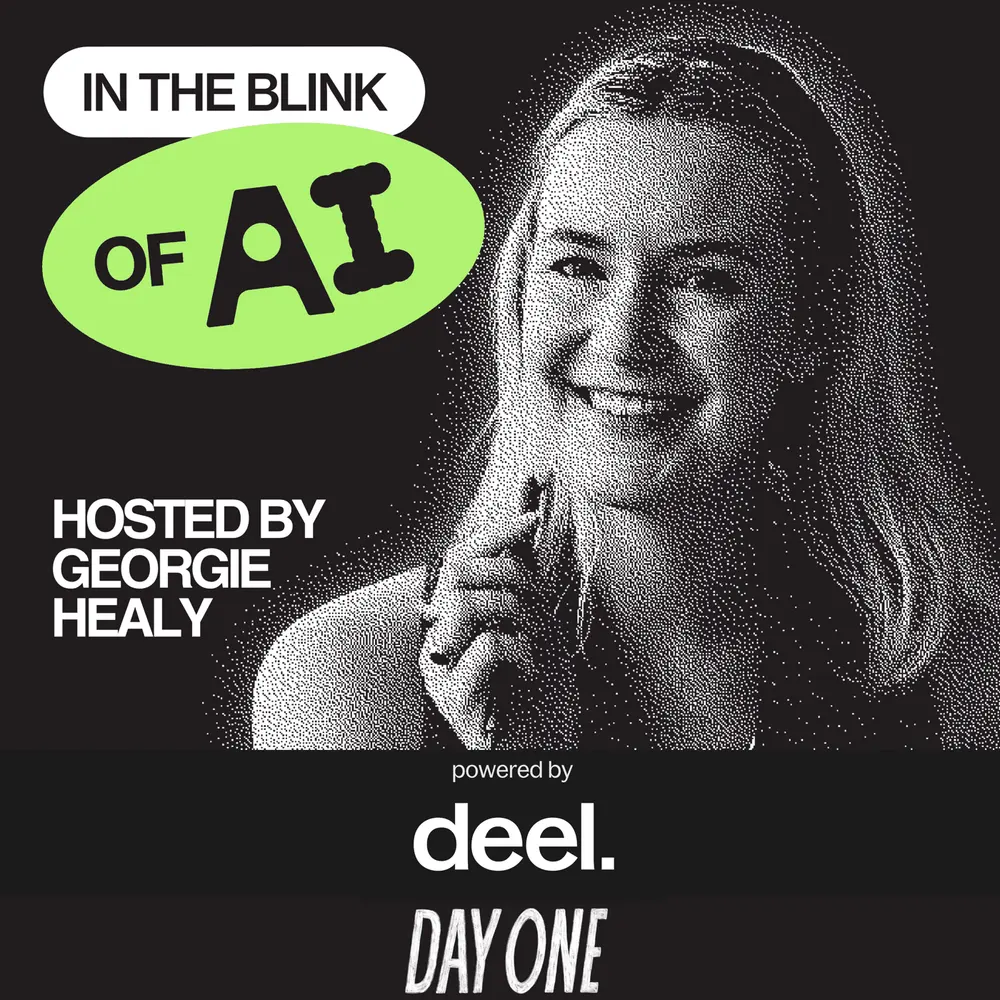 In The Blink Of AI with Georgie Healy
Presented by Deel & Stripe
In The Blink Of AI with Georgie Healy
Presented by Deel & Stripe 


 ▶
▶  ▶
▶  ▶
▶  ▶
▶  ▶
▶ ▶
▶ ▶
▶