Transcript Synced · select any line to jump ▾ 0:01 Georgie Healy: Founders scale faster on Deel. Set up payroll for any country in minutes, hire anyone anywhere, get visas handled fast, and get back to building. Visit deel.com/dayone. That's D-E-E-L.com/dayone. Steve Hines from Laura Keat just raised $14 million from the top VCs in Australia. Since then, a few short months, they've doubled their valuation. They're the hottest thing in AI in Australia. They're stealing all the best AI engineers. Steve does not hold back. 0:50 Steve Hind: People don't realize they're talking to AI or don't believe they're talking to AI. So I think we actually posted it last week on our LinkedIn that someone had kind of got to the end of the conversation and said, "Are you actually AI?" If your product is truly technically brilliant and you can't market it, it's probably less technically brilliant on the dimensions that matter to the market than you think it is. And you know, one of the things I've often encouraged my team to do as a product leader is sort of start from the marketing. 1:16 Georgie Healy: I've heard you on other podcasts refer to Laura Keet as an agentic framework. What's an agentic framework? Hello and welcome to In the Blink of AI, your front row seat to the AI revolution. I'm Georgie Healy, and I'm incredibly zoomed in today, and nobody knows why. Today we have a re-release because in the 6 months since this episode went live, we have had an incredible influx of subscribers. And firstly, if that's one of you, welcome. Thank you for subscribing. Thank you for tuning in. And if you're a longtime listener, Thank you so much for sharing the show. Thank you for diving into my DMs. Thank you for making this such a joy and a privilege. So this episode is with Steve Hines from Laura Keet. When we interviewed them, they had just raised $14 million from the top VCs in Australia. And guess what? Since then, a few short months, they've doubled their valuation. They're the hottest thing in AI in Australia. They're stealing all the best AI engineers. And this is a masterclass in ignoring AI hype. Actually, Steve does not hold back. I highly recommend you follow him on Twitter as well. And in this episode today, he shares insights into how building AI models from scratch does not make you a better AI company. Agents or agentic, whatever, is overhyped. Stealing the best AI talent across tech in Australia doesn't mean that they obsess over AI. They're actually more obsessed with the customer experience. And they prioritize quality interactions over volume of interactions with their customers. Look, the proof is in the Laura Keep pudding. There's no denying these guys are absolutely killing it. And if you want fresh Laura Keep goss, I'm interviewing the other co-founder, Jamie Hall, next month in Make with Notion Day. I will be sharing some behind-the-scenes exciting intel, but you've kind of gotta follow me on Instagram for that stuff 'cause it's not really a podcast-worthy version of Medium. Yeah. Okay, so without further ado, let's dive into the episode. I can't wait for you to hear it. 3:27 Speaker: You're listening to a Day One FM show. 3:30 Georgie Healy: Look, let's start with a quick explainer on what Lorikeet is, please. 3:36 Steve Hind: Yeah, Lorikeet's a platform that companies use to train AI agents that solve complex support queries. That's a relatively crowded market. The key differentiator for Lorikeet is exactly how far up that complexity curve agents can go. And because it goes further than other people, we plan to work with businesses that have very complex support needs, like banks or healthcare companies. 3:55 Georgie Healy: Yeah, that was my next question is the kinds of customers you have. So banks are popular. What other kinds of industries? 4:03 Steve Hind: Yeah, so banks and healthcare companies are kind of where we started and where we see a lot of our customer base just because their support operations tend to be quite complex. But we've also found that there are plenty of marketplaces or SaaS businesses or even e-commerce businesses that have that complexity. But we sort of found strategically, if you start with the hardest customers and you prove that you are the solution of choice for the people with the most complex cases, kind of coming down to simple cases is easy, whereas if you start doing the simplest things for the simplest customers, you know, you're still at square one in terms of going up that complexity curve. 4:33 Georgie Healy: Yeah. And you're the founder of the company. Why were you so compelled to solve this? 4:38 Steve Hind: So, so I worked in kind of product leadership roles at Stripe and at a climate unicorn called Watershed before this. And in both of those roles, worked really closely with operational teams and have seen kind of the challenges that operations in particular has a high growth environment because it's one of those places where by default, as the business grows, you just can keep adding headcount. And that obviously breaks the economic model of most early stage businesses. You know, kind of GPT-3, GPT-3 were coming out. I was spending my nights and weekends playing around with them and just got really convinced that it was going to have a big impact on ops in particular. And if you think about where that technology has kind of moved first, it's been sales and engineering. The classic advice is build for sales and engineering because they have budget. And I thought, okay, cool, but like I think I know ops really well. I've worked with a lot of teams like this. I want to go focus there. 5:24 Georgie Healy: Yeah, I think a few of the recent podcasts you've been on, you're quite a celebrity in startup news at the moment. Check out your LinkedIn. It's a sight to behold for sure. A bit of a cheeky one. If your chatbot had a bit of a personality, who's a celebrity that it would be like? Is it dry? Is it fun? Is it chatty? What's it like? 5:46 Steve Hind: Such a funny question. I was thinking about this. You know, I actually think the answer is it's so customizable that the answer would be different for different customers. And that's sort of the point. You know, we think of Lorikeet as a platform for businesses that really care about customer experience to get their tone of voice just right. And so to give you an example of that, in kind of healthcare and financial settings, it's often the case that people have kind of compromised functional literacy when they're in dealing with complex or high stress situations, and so in those settings, we're able to get the AI to pretty reliably communicate at a 6th grade reading level, which is what global accessibility standards suggest for those settings. In other situations, when it's helping someone with crypto, the users are really down with the lingo and expect that anyone they're talking to be, to be down with the lingo as well, and so we're able to get it to really lean into that for them. So that's a very long way of saying, I don't think there's one sort of celebrity common— almost the point of the platform is that customizability. 6:38 Georgie Healy: Yeah, that's quite fascinating that it can change debate based on the topic. If you just have a general chatbot yourself, Steve, and it's your personal chatbot, what do you like in a chatbot? Do you like the chatty, witty vibe, or do you find that cringe? 6:54 Steve Hind: Kinda cringe. Found that AI interaction is most effective when people feel heard. So actually being able to recognize their issues and empathize is really important, but trying to lay on top sort of a false personality is kind of strange. Ultimately, the right experience should feel like you are understood really well. They understand why your problem is a problem for you, and then they just get straight to solving it. 7:14 Georgie Healy: I find that I have to be polite though, even though I know it's a chatbot. I don't know about you, do you find customers behave weird? 7:22 Steve Hind: This is sort of Pascal's wager of the AI world, right? Which is like, we're probably not gonna get taken over by AI, but like, you may as well be polite to them in case we are. We found most of the time people don't realize they're talking to AI or don't believe they're talking to AI. So I think we actually posted it last week on our LinkedIn that someone had kind of got to the end of the conversation and said, are you actually AI? They were talking to something that said like AI assistant. We see that sort of thing quite often in addition to people kind of ending conversations that they would with a human, like, hey, have a great weekend. This was great. Thank you so much for you being so helpful, which is fascinating. And sort of this insight into one of the core things we focus on, which is that a human quality support experience is actually not about humans. It's about understanding, empowerment, and ability to solve people's problems. And if AI can hit those things, then it's indistinguishable from a human. 8:07 Georgie Healy: I'd love to get your take on this, and then I promise I'll move on, but I find it fascinating. I remember Sam Altman said something about he deliberately wanted to call it ChatGPT because he wanted to remind people this isn't a human, whereas there's other, you know, human-named AI assistants assistants like the Alexa and the Siri and things like that. What's your take on that? Do you think it should sound human? 8:31 Steve Hind: I think ChatGPT is solving a different problem, which is they're giving people this business tool in a new category called AI assistant. And so it's advantageous for them to sort of frame it differently. And if you think, for instance, about their voice assistant, they have this like pulsating blue dot while you're talking to it so that you know it's listening without them having to give you audio feedback. When you move to the custom support world, people's default expectation still is that they're talking to a human. And so it's necessary for it to behave in ways that we enforce that. And so an example, when we're kind of building our voice agent, we actually have some like office background noise that we play quietly in the background so that people have the audio cue that someone is listening and that something's going on, as opposed to it sort of feeling like dead air. Whereas the ChatGPT voice mode has that dead air because you know you're talking to AI. You use a different cue to tell you that it's listening. So I think that context changes quite a bit what you're solving for. 9:22 Georgie Healy: Well, you've clearly put a lot of thought into building the product. It's incredible to listen to. And just briefly, we've got listeners from all over the world. Can you explain what a lorikeet is for those that don't know? 9:34 Steve Hind: Well, we actually found out in the process of choosing that name that it's my and my co-founder's favorite bird. A rainbow lorikeet is like a little parrot, you know, yay big. They're all over the east coast of Australia, but they're actually like everywhere in Surry Hills where our office is and where I live. And they're, in my opinion, just the most beautiful bird in the world. The thing we liked about the name in particular is like lorikeets are loud and they're noticeable and you know, you can't help but hear them, but they also have such kind of beautiful colorful plumage that like when they fly across the sky above you, it really catches your eye. And we like the idea of having something to say, being eye-catching and also being sort of unapologetically from Australia. 10:10 Georgie Healy: I love it so much. It's my favorite bird too. I had two pet lorikeets once, so— 10:15 Steve Hind: I don't know. I remember you saying that. They're amazing. 10:17 Georgie Healy: I'll throw it in the, in the Instagram chat after this episode goes live. Big fan of the name, big fan of the bird, big fan of all of it. Look, let's dive into some of the actual AI technical stuff. You know, it's such a great opportunity to have you on the show to unpack a topic we've never talked about before, which is huge in AI, a concept called RAG. Can you give me the dummies version of what this is and what it stands for? As a startup founder, you're juggling multiple priorities. From the expected, like finding product-market fit, to the unexpected, like customer requests for SOC 2 or ISO 27001 certification. Achieving compliance is time-consuming, and time spent on that is time away from the needs of the business, and that's where Vanta comes in. Vanta is the all-in-one solution for startups to become compliant quickly. And build a security foundation with ease. With a combination of automation, an extensive partner network, and a security marketplace containing 385+ pre-built integrations, Vanta provides the necessary tools and expertise for startups to achieve compliance seamlessly, no matter how urgent your needs are, and at every phase of growth. Over 10,000 leading companies, including Cipherstash, Handle, and Indetted, trust Phanter to automate compliance so they can focus on growing the needs of their business. Here is the important part. Startup listeners of the show get $1,000 off if they go to dayone.fm/blink. 12:01 Steve Hind: So, um, RAG means Retrieval Augmented Generation. And it's actually a solution that emerged a couple of years ago to deal with a problem that was a much bigger problem in AI models then, which was a very short context window. Context window meaning how much information can you give the AI model when you're asking it to, you know, take a next step or send back a message. And the problem was context windows were very short, so you couldn't, for instance, load in all of your help articles. You had to figure out which help article do you load. And so what RAG does is it takes some corpus of material like a help center. And it uses an embedding model to create a vector representation of the semantics of the words, which is a fancy way of saying it's kind of a, a numerical representation of what it all means. Then you get the question that comes in, you vectorize that as well. So you turn that into a numerical representation of meaning, and then you do a vector similarity search, which is basically a way of saying, how semantically similar is this question to all of these articles? So you find the most similar articles. That's very different to sort of previous natural language understanding models that were a bit more keyword-based. So when you're using semantic understanding, it doesn't matter if people use the same words. It's much more about the meaning of the underlying concepts. And then what RAG lets you do is you find, you know, the 3 or 5 or 10 most similar articles and you feed only those to the AI. So it doesn't take up a lot of the context window and you get it to answer using that. A lot of the market that we operate in basically took that architecture, which was sort of available off the shelf 2+ years ago. And commercialized it by applying it to customer support. So a very like technology-first commercialization approach. We actually didn't have RAG in our product at all until midway through last year because we didn't think that process of find the most similar help center article and summarize it was actually the biggest problem our customers were struggling with. And that's a little bit the core of how Laureate ended up with a differentiated product is we just like looked at what people were struggling with and then thought from first principles about how to solve as opposed to sort of taking RAG off the shelf. 13:54 Georgie Healy: And the retrieval part of RAG, how is it any different from me just being like, oh, forget it, I'll just do a Google search myself. I'll just retrieve the information myself. Why would you want to use this? 14:05 Steve Hind: The core idea here is you are controlling what's in that corpus, so you're, you know, what's being retrieved from. So it's not a sort of similarity search across the whole internet or across the large language model's general knowledge. It's a search across a particular database you've exposed. And I think the key thing, especially compared to previous approaches, is that focus on semantic similarity rather than sort of natural rather than like keyword matching. 14:27 Georgie Healy: Okay, so the retrieval is based on some vetted information that you want it to retrieve from. And then the augmented part, what's augmenting what and why? 14:37 Steve Hind: Yeah, great question. So the retrieval of the most similar material is augmenting the generation of the response. So a way to think of that would be you take OpenAI's GPT-4o off the shelf and you ask it, what is lorikeet? There is some amount of general knowledge in that model that will produce an answer. So the problem is not getting an answer, it's getting the answer that you want given your context. And so what you might do instead is add a vector database with a bunch of information about Lorikeet, the company, and then when it does that search, it's going to retrieve that information and use it to augment the generation. So it's going to add extra information to the prompt to the model, and with that extra information, the model is more likely to give an answer that's sort of correct and contextual to the particular thing you're trying to solve. 15:19 Georgie Healy: Mm-hmm. 15:19 Steve Hind: As opposed to kind of using its broad general knowledge. 15:22 Georgie Healy: Love it. And if a customer were to type in a question into Laura Keet, can you give an example of how RAG would work in terms of customer support tickets? 15:33 Steve Hind: Yeah, so one thing we've actually seen, talking to a customer in a sales context, they said, oh, you know, this competing product gave this really creative answer to a question one of our customers had, and it wasn't anywhere in our help center. You know, that was kind of cool, and we were wondering why. Well, the answer is actually, that's the answer that ChatGPT gives. So in other words, you could do customer support, especially for well-known products, just in ChatGPT. Like, don't go to the company's website, just go to ChatGPT. The problem is at that point, the company's not controlling it at all, and there's, you've got no idea whether it's right or wrong. It's just kind of using its general knowledge. So in a customer support context, what you're trying to do is control the information it's using to answer and guardrail and prompt the model so that it only uses information and it doesn't draw from external knowledge. The models that people are using today have really been pre-trained and reinforced to be very helpful. And what that means is they are really overwhelmingly likely to attempt to give an answer to any question regardless of whether or not they actually have the information required to answer. So if you ask, you say to it like, hey, I can't export my document and it knows nothing about your software, it's still going to try to answer. It's going to be like, can you see an export button? Can you find settings? It's usually in the top right and you get these like really vague answers that aren't very helpful. And so the point is you're sort of injecting customer or business-specific context in so that it will actually give it the right answer. 16:49 Georgie Healy: Yes, that's a great example. I've actually, I remember a few times that happening and getting quite frustrated with the model being like, just say you don't know, okay? 17:00 Steve Hind: This is a real problem in the space and it's something we've really tried to focus on is, you know, I think one of the ways in which Lorikeet's model, Lorikeet's Agent is distinct is that it is better at knowing what it doesn't know. We've kind of set it up so that if you ask a question and it can't find a good answer, it will just hand off instead of sort of trapping you in this box and making you fight to talk to someone who actually does know. And then when you get that handoff, that's the opportunity to learn and train the model more and then have it be able to handle it next time. So we really want to think about minimizing the number of bad experiences people have with AI, not maximizing the number of things AI does. 17:31 Georgie Healy: Yeah, I love that. And not wasting people's time, um, just You know, a quick no is better than a drawn-out no, right? 17:39 Steve Hind: 100%. And I think like AI sometimes gets a bad rap for creating bad customer experiences. The thing that creates bad customer experiences is not caring about customer experience. And we're really privileged that, so without an exception, the customers we work with pride themselves on doing support well, and they want to use AI to scale that more effectively so that they keep doing good support as they grow. And if you come to it with that mindset, you're going to get great experiences with AI. And, you know, in the same way you can deliver terrible customer support with humans or good support with humans, it's the same with AI. You can deliver terrible AI customer support, but the reason is not AI. The reason is sort of the intent and the goal of the business. 18:15 Georgie Healy: One last question on this. You were in a podcast recently and said, "We build RAG better than anyone else." And I can kind of see that there must be bad players out there, and that's probably why. Is it low-hanging fruit to build a system that's better than the masses? Like, why are they missing the mark? 18:33 Steve Hind: I'm actually still not sure. When we show that we can solve much more complex queries than other people, I understand deeply why. I think it's quite defensible. It has to do with who we focus on and the architecture we developed. When we've had feedback, you know, in the last few months that we're also providing better RAG responses, it's still a little bit of a mystery to me. But, you know, I think the reason is we are really obsessed with making the experience good. And we're not solving for maximizing the number of AI interactions. We're solving for making the AI interactions good and then growing that good portion over time. 19:03 Georgie Healy: Yes. Okay. One more concept I would love to get the Steve Hind perspective on, please. That is agents. We're apparently in the year of the AI agent. You know, book a flight, make a reservation at a restaurant, that kind of thing I'm thinking of. But I've heard you on on other podcasts refer to LoRA key as an agentic framework. What's an agentic framework? 19:27 Steve Hind: Yeah, I'm not sure there's a stable definition of any of this. I think it's actually a little bit, you know, pretty heavy on marketing. I think you could go debate with people and probably roughly settle on a consensus definition, but like, you know, that's a bit different to what people are saying in the marketing space. But my point is, agentic reasoning tends to be about giving the model a lot of context and having it they'll solve maybe via a step of reasoning or planning how to solve a problem. I'm not sure that's actually a good fit for what you want to do in customer support. In the same way that if you had a really smart human support agent, even if they were capable of sort of coming up on the fly with a way to solve a problem, you kind of want them to actually, you know, follow some set process because as a business, you want predictability, you want control over process, and you want the ability, especially in regulated spaces, to tell compliance or tell regulators how you solve a particular problem. So we sort of think of what we're doing in Lorakeet is setting up a framework that you can use to build and deploy those agents. And I found it unnecessary. It's sort of necessary to say agent because some people want to hear that, but honestly, it's much more about outcomes, I think. And I prefer as much as possible to say that. A funny anecdote, you know, I was talking to a customer about how we help them spot gaps in their help center. So we basically analyze the questions that aren't getting answered by the AI, move to categories, and show you the tickets and then can help you kind of generate articles to plug those gaps. And they said, oh yeah, are we talking to X competitor? And they said they have an agent that reviews the help center and then another agent that drafts new articles. And I was like, yeah, that's the same thing as what I said to you. It just has the word like agent added in. 20:54 Georgie Healy: Totally. Agents are taking over the world. There's all these like headlines about agents. And I had a friend ask me like, is an agent a robot? And I'm like, the marketing's getting out of control. 21:04 Steve Hind: One thing I sort of learned is you don't want to be precious about your language and go and like have a bunch of semantic debates with people. You want in a sales context to say yes and as much as possible. So if it helps people put us in the right category to say agent, I'll say agent, but I'm also happy to go break down exactly what we're doing. And I think ultimately they're going to choose based on our house. 21:21 Georgie Healy: Yeah. Okay. So compute, this is a big part of most discussions I have with founders, but I've never asked before, what's the compute power difference between building RAG versus agents versus, like, can you delineate like that or not really? 21:39 Steve Hind: It's probably the case that using a RAG system will reduce the amount of inference you need to do because it would let you put less things in the context. So with modern models that have millions of tokens in their context window, like some of the Gemini models, you could probably actually, for many businesses, just put your entire help center into the prompt. The challenge is most of the time you're charged on the number of tokens you put in and the number of tokens you take out. So RAG becomes a way of reducing the amount of compute you use, and then that amount of compute also affects the latency response from the model. So if you put in 2 million tokens and ask it a question, it'll be slower than if you put in 200. And so in that way, I think it affects it a little bit. But honestly, the way that inference speed and cost of inference have been speeding up and declining respectively, I think it would be silly as an AI company to be cost optimizing at this point. It's much more important to quality optimize because the cost is sort of taking care of itself. 22:30 Georgie Healy: And huge news in the scaling laws debate. We had this Grok-3 model come out. Has that impacted the way you think about scaling laws? 22:42 Steve Hind: I think, you know, my co-founder Jamie was a researcher at Google Brain who was one of the key people that built LaMDA, which was the model at Google that you may remember someone on Jamie's team thought was sentient, or that was like a big thing a couple of years ago. So he'd been doing this for quite some time. And so, you know, we do kind of keep an eye on it with a bit of an expert lens. But I'd say in general, we've expected that the capabilities of models will continue to improve and the cost will continue to keep down. And what we have is sort of a good abstraction layer that lets us switch between models and a good set of evals that lets us understand their performance in our use case. And what we do is just test and update as we need to. 23:16 Georgie Healy: Yeah. The context for this is, you know, a lot of money and compute and power was thrown at a model and it was, I guess, arguably better in some metrics, right? 23:28 Steve Hind: Well, it's, I think it's a little bit tricky to know. Like one of the things that there's a decent amount of evidence for is intentional or unintentional training to be with specific benchmarks. There was an interesting paper late last year showing that models could very reliably answer specific questions in the benchmark. And that was a strong indication that there is like overfitting to the benchmarks. So when we see a model coming up that is sort of ahead on the specific benchmarks, I don't think it's a slam dunk that it's automatically better. There's probably some degree of contamination and sort of the thing you need to do then is go examine it against your particular use case to figure out if it's actually better. 24:03 Georgie Healy: Fascinating. And you know, based on that, you know, you see the MATH response of one model versus another, does it impact how you choose which model to use and whether you fine-tune based on open resource models, or like, how do you make that decision? 24:21 Steve Hind: So, you know, we don't use a model. We have dozens of percent of users' case models, all of those that you use our model abstraction layer. So we just change on a workload basis. So we're not universally flicking a switch. We're sort of seeing across all these workloads, what's the best model for us? Constantly evaluating and updating that. We actually don't do any fine-tuning. Fine-tuning is a really good way to save money by using cheap models. We don't think the goal is to save money. We think the goal is to increase quality. And fine-tuning also has this problem that as you change, you need to re-fine-tune and you just sort of expense it and slow. Whereas if you use instruction prompting like we do, you can update and probably make changes instantly. So we focus a lot on instruction prompting as opposed to fine-tuning. 25:00 Georgie Healy: Do you think companies that don't build their own models from scratch can't be an AI company? What do you think? Negates that title. 25:09 Steve Hind: I think the proof of being an AI company is in the pudding of helping your customers be successful with an AI product. And I think a place where we were fortunate is because Jamie is like a legit person who's built these models from scratch at Google Brain, we didn't feel the need to do performative AI stuff to justify that we are an AI startup. Like we weren't insecure about it, so we just went ahead and tried to use the state of the art from the foundation model companies to build something impactful for our users. And I would say, you know, in 99% of cases with startups, that's obviously what you should be doing unless you happen to be a foundation model company. I see people get a little bit wrapped around the axle because of insecurity about, am I really doing AI if I'm not fine-tuning? And I would say, forget about what you're doing, just focus on the outcomes for your customers. And if you're using AI to create great outcomes for your customers, you're an AI company. 25:54 Georgie Healy: Yeah, I agree with you. And I don't know what it's like in the founder group. But there definitely seems to be a little bit of a rhetoric that if you're not building your own models, there's some kind of climbing Mount Everest to build a model from scratch. And it's kind of like, if no one's buying it, it's a hobby at that point, right? 26:17 Steve Hind: One of my reflections on the experience of being a founder is the universe offers you infinite ways to distract yourself and waste your own time. And this is probably just another instance of that. Interestingly, I think in founder groups of companies that have got some degree of momentum or escape velocity, those discussions are much less. I think it's probably more earlier stages that people are most insecure about it, which is an example of this, like, you know, you've gotta figure out what matters, focus relentlessly on that, and then kind of tune everything else out. 26:43 Georgie Healy: Yeah, agree. If you were in a company, because I've seen this happen before, and technically you were super brilliant, but the marketing side of things needed work. How much do you double down on just building the most incredible technical product? And I know I'm giving you no market, like, context for this, versus being like, no, the marketing is really key. And at what stage do you have to just move on from building the most technically brilliant product? 27:11 Steve Hind: Well, I think they're deeply integrated. If your product is truly technically brilliant and you can't market it, it's probably less technically brilliant on the dimensions that matter to the market than you think it is. And, you know, one of the things I've often encouraged my team to do as a product leader is sort of start from the marketing. As in, you know, this was a thing that we did at Stripe a lot as well. Like, start the project by writing the blog post that's going to go out when you release this feature. Or start by writing the customer testimonials you hope you're going to get when this feature comes out. Or start with the key messages. That you want to be in your marketing when you release the product. Now, you know, that's not to say be a copywriter, like the marketing team are going to do a better job of that than you, but the idea is first start from what, why is this interesting and different and differentiated? What impact will it have? And then solve back to what do you need to do to make that true? And that's a very useful function because it helps you identify what things would be really important. Like, are your customers going to be raving about latency? And that's the thing that's going to be key to your marketing. Well, If so, you better go make some technical innovations on latency. If you, on the other hand, your customers are gonna be raving about, you know, the capability and the depth of thought, then you're gonna have to make sure that you have that capability. And so you need to kind of solve that way. I, I'd say you have to be very healthily skeptical of telling yourself a story where you have a brilliant technical product and just look at it. There's probably something actually different going on there. 28:32 Georgie Healy: Yeah, I see it with these very technical founders and it's 3 technical co-founders and they all can build AI products, but you know, maybe it's the product that's missing or the marketing that's missing that is just not in their toolbox of skill sets. 28:50 Steve Hind: And— All these things are learnable. And I think the benefit is it's easier to get how to package and deliver something to the market than it is to make huge technical breakthroughs, I think. But the challenge is having the humility to hear that from the market. You know, there are, in my mind, there are two types of businesses you can build. One is you have a vision about the future and you're waiting for people to catch up. And in some percentage of cases, you'll be right and you'll be a visionary. A lot of cases you'll be dead wrong. And that's a very high-risk way to build a business. I think the lower-risk way to build a business is listen to what the market needs and go figure out how to give it to them as effectively as possible. But that requires humility in saying like, okay, well, I had this super cool idea, but the market's not there with me yet. So I'm going to put it on ice and go solve their problem and then come back to my super cool ideas. You win the market is pulling it out of me. 29:36 Georgie Healy: Can I nerd out about product with you for one more moment? What AI products do you go to? What do you love to use in your day-to-day life? 29:47 Steve Hind: In the last month or so, two things I've been spending time on is deep research models, whether it's Perplexity or ChatGPT. I found it's really good for handing off things where I want to get a base level of understanding from desktop research really quickly that I can then use to develop my own perspectives. Or just busy work. Like, you know, I used it on the weekend. My wife was looking for a new pair of shoes for the gym that matched some criteria, and I was like, find what's available. And interestingly, like, the number one recommendation it came back with after, you know, 10 minutes of search was, I think, the same as what her trainer recommended. 30:19 Georgie Healy: Did you use O3 Mini for that? What did you use to do that? 30:22 Steve Hind: Just crank up the max of the models, because honestly, what they can do, and I want to waste the AI's money, was like, I went nuts with that. Then the other one that has had a really big impact the last month is I've been really using Insurf a lot as my IDE. I think the consensus on our team is that Fursa is probably better at generating code in a particular file, but Windsurf is incredibly good at searching the code base. So for me, as someone who's not writing code day to day, you know, I used to be like half our engineering team, now not even a fraction of it. It lets me kind of come in quite quickly, ask a question, orient myself to the right part of the code base. Do I make kind of changes or understand how something is working. And that's been high impact. Without that, probably the inertia of catching back up to the codebase when I have time to jump in would stop me being productive. Whereas now I picked up a piece of feedback I got from Gaten in the sales call last week and kind of banged out a solution for it on Saturday night in 45 minutes, which was awesome. 31:12 Georgie Healy: It sounds like you do dedicate time to learning what's out there and trying the different products. Is that conscious effort or is it you kind of have to? 31:23 Steve Hind: It's both. I mean, I love it. That's, you know, how I like to spend my time is, you know, playing around with stuff like that. But I think you'd be mad not to. I mean, the market is developing so quickly and new capabilities are coming online so quickly. Like you should want to keep up, but also you should be finding which ones are going to help your company and kind of spinning them back in. And so another example I've been using at work a lot is Replit Agents. Basically anytime you need to do like data cleaning, data classification, not on an ongoing basis, but on a one-off basis, I'll get Replit Agent to spin up a script or an app to do it. And I sort of spread that to our fully deployed engineering team, so they're using it all the time now as well. And like, if you don't play around with these tools, you don't understand what they're useful for, you miss the opportunity to then evangelize them into the team. 32:02 Georgie Healy: They are fun to play with once you get your head around them, once you've tried it a few times and just had a play. But what would you say to people listening listening that's finding it a little bit overwhelming, maybe they don't come from a tech background, where would you say to start? 32:19 Steve Hind: Well, in general, like understanding the underlying problem you're trying to solve well is really important. And I think the place where these models are really good is they have infinite patience and they're happy to explain the most basic things to you that you might have been embarrassed to go ask someone. So anytime you get stuck, like maybe you're, you know, in one particular tool, pop up ChatGPT and ask it. Anytime you see a concept that you don't understand or it mentions some framework that you should already know, either ask it to explain or ask another model to explain it. And if you go with that approach of instead of sort of saying, oh, it's technical, I need to stay away from it. If you go with the approach of, I don't know this yet, but I have now this tutor that's available to help me, you can do a lot. And in particular, these models are very good at customizing their explanations to further context you give them. So instead of just saying— Yeah. You know, what is a GraphQL API? You could say, hey, I understand REST APIs really well, help me understand GraphQL and the way in which it's similar or different. You can say, you know, take a common REST API and rewrite it as GraphQL so I can see the differences. Like, you can give it really specific prompts to kind of, to pick up from what you do know and build on top of it. And that's, that's hugely impactful. 33:23 Georgie Healy: I love it. And when you are hiring someone, you know, you've recently had a capital raise, What do you love to see in a CV the most? 33:34 Steve Hind: In a CV, you want to see evidence of performance. Obviously, if someone has got into hard programs or worked at places that are known for having a high talent bar, that tells you a lot. But the thing that tells you the most is sort of outperformance, because that's telling you that this is someone who is sort of an outlier relative to their peers. I like to ask candidates a lot and look for sort of wins over replacement. So I'll say to them like, okay, You had this fantastic 4-year run at this company. You achieved all these things. What do you think you achieved and what made you achieve it beyond someone who would've had the same qualifications who walked in the door? And on the flip side, where do you think someone with just the same qualifications as you would've done better? And that ability to sort of figure out are you getting wins over replacement is really important because especially if they've been at a strong company, like the company itself has a lot of momentum. And so someone might rack up a lot of direct reports or a lot of revenue generated or a or of products shipped. 34:24 Georgie Healy: Do you ever look at like GitHub portfolios and things like that outside of academic, outside of previous career stuff? Would you ever hire completely, you know, someone that just gives you a portfolio of their work and has nothing else to go by? 34:39 Steve Hind: Someone who spent time on side projects that demonstrates some particular capability is very interesting. Actually, the first engineer we hired, Peter, he'd been an architect, like, building architect, more software architect. And in COVID, I just decided like, I'm gonna teach myself software engineering. So number one, those sorts of things are huge evidence of drive and of agency because he, he didn't like his job, so he just decided to change it. That sort of thing is huge. But he actually also had a really thoughtful portfolio of like beautifully designed apps. And you look at that and, and you can't help but notice, well, this is clearly someone who cares a lot about user experience, who thinks very carefully about product experiences. So it makes some of the things that might otherwise be bullet points on a resume real. I'm actually in the process of talking to someone to help us on the marketing side who has a very non-traditional background that has this fascinating just about me website. I'd read it and was like, you can't escape the conclusion that this person is extremely smart and interesting. So that sort of stuff really helps. I think that— The thing I find interesting is when folks reach out about roles, it really only takes 30 minutes at most of thinking to be able to say something in your reach out that will make you stand out from 99% of candidates. And almost no one does it. Like literally reaching out with 2 to 3 observations about the element of the business that you're applying to work on, or observations or thoughtful questions will make you stand out from tons of people and almost no one does it. Instead, they come more, hey, can I get some of your time to like ask you questions about the business? And if you are a top 1% candidate on a CV, yeah, probably people are going to say yes. And otherwise, it, you know, you're actually just coming in asking to take when you could with relatively similar research come in and say something very interesting that would make them want to come and talk to you. 36:17 Georgie Healy: Any specific examples of asking you something that just blew you away or? 36:22 Steve Hind: The kind of marketing candidate I mentioned before reached out with like, hey, you know, I know what I don't know, but just looking at Laura Key's website, here's 3 changes I'd make and here's why I'd make them. You know, I think they'd taken some screenshots, edited some text, like it was all very lo-fi. Again, it's probably the sort of thing that we've taken 30 to 60 minutes and just instantly I'm like, that plus, I go, because that's interesting, I go read their website. I'm like, this is like a smart, interesting person I want to go talk to, find a way to work. Even if everything they said was completely wrong, showing that we have the agency and the independent thought to go and do that is a great way to start the conversation. And it's a way to demonstrate, you know, some of the kind of skills that are relevant to the role. And so I think it's less like, people shouldn't feel like, oh, I have to go do a bunch of free work. It's like, hey, you know, want to be in product? What are some thoughts you have about their product? That seems kind of obvious. 37:10 Georgie Healy: Last question on that, because you've got a product background, how would you feel if someone kind of did come at your product and say that it looked bad or even employee in your team, how do you handle kind of that flat structure vibe or do you kind of think you gotta kind of earn it before you could start throwing swings? 37:29 Steve Hind: I like to think I could write the longest list of anyone in the world of problems with Flowery Heat's products. I'm acutely aware of how we can do better. I love more input on other places where we can learn how we can do better. You know, in many ways, like, identifying what's wrong and what could be done about it is a lot easier than the difficult problem of prioritizing what to fix given the resourcing. So, you know, I would say, like, we're very pro-feedback. The one thing I do think is important is feedback's really got to be anchored in customers. So I'm, you know, I said to the team before, I'm not super interested in people's, like, opinions. On ships, like, if an engineer is driving ahead with something, don't sit there in the peanut gallery and, like, throw ideas at them. Sit there in the peanut gallery and throw user data at them. Or even better, say, hey, can I go show this to some users and get some feedback? Or just, I showed this to this user and here's some feedback they had. So opinions, dime a dozen. Feedback from users, validation from the market is gold, and kind of focusing on that is important. But the way that I got into product at Stripe, I was on the Biz Ops team. I would sit on the weekends and integrate other teams' APIs and write up what we call built a friction log, which was, you know, all of my like stream of consciousness thoughts as I was doing the integration. What was good? What was bad? What didn't work? Oh, this thing got stuck. I filed a support ticket. This thing showed me an error that seems like it's internal that somehow has come out to the app. And kind of something I'd like drop it in that team Slack channel and just be like, hey, I played around with this new feature you're betaing. My lesson thoughts here, happy to chat more if it's useful. No response expected. To doing that like a few times, the kind of product lead for the group, he's now an angel investor in Lara Keep, was like, hey, like, Do you want to be a product manager? So, you know, doing that sort of stuff I think is really useful. Now, if you do a crap job, it won't help, but like if you think you're good, then like what better way to find out? 39:06 Georgie Healy: I love that. Opinions are a dime a dozen. If you actually care, if you actually want to improve things, prove it kind of thing. Like show how you're actually going to go about it and the data to support that. I love it. To finish the interview, you've been so generous. But I'm going to now hit you with the hot takes, spicy questions, just while you were getting comfortable. How does that sound? Are you ready to go? 39:34 Steve Hind: Let's do it. 39:34 Georgie Healy: Let's do it. What is AGI to you, Steve? 39:38 Steve Hind: I think AGI is the point at which a model can go solve a very wide range of problems without you needing to provide it a cognitive architecture. So what I mean is I could use current generation models to write a very good product requirements document because I would provide it the framework for what I think that document should be like, and it would go ahead and sort of fill in the sections that I give it based on the data that I share. 40:01 Georgie Healy: Amazing. That's much more clearance than I can get from most people. Like, you've got a law background, so I wonder if this resonates with you as an ex-lawyer. Apparently in the United States, there was a Supreme Court case describing a threshold for insanity test. I'll know it when I see it. And that's kind of how I feel about AGI, but I could never articulate it that way. Will you know it when you see it, do you think? 40:24 Steve Hind: Not necessarily, because I, in my mind, the amount of kind of cognitive architecture you need to provide is quite important, but often you don't see what's going on under the hood. So businesses may provide you with experiences that feel like AGI that are actually quite architected. I actually think Lorick means a little bit like that, like We have AI support agents helping people replace their lost credit card. That feels pretty magical when it happens, but actually under the hood, there's quite a bit of architecture to make sure that is a good experience. So I, I think it'll be tricky. It'll, it'll be, you'll know it when you see it, when you know how much backing you needed to give it to get to that outcome. 40:56 Georgie Healy: What's an AI headline we can expect to come out of this year? 41:00 Steve Hind: I think there will be some types of work or segments that will get extremely heavily impacted faster than the people working in those segments can get reabsorbed into other parts of the economy. I mean, you know, we used to have typesetters working in publishing houses and newspapers. We don't anymore. The pace of that change was such that, you know, it's not like no one has jobs anymore, right? But I do think some of the disruption in AI this year will be fast enough that that happens. You know, by way of example, Superhuman, the email client, have just released a beta that, that I thankfully talked my way into where, you know, I come in in the morning and it's drafted replies to all the emails in my inbox that needed follow-ups. And people currently pay, you know, $3,000 a month for a virtual assistant in Philippines to do that. And that it's probably slightly better in Superhuman, or it's at least basically good already. And so I think that's the sort of thing where you could see change quite quickly. Now on the flip side, You know, there's a lot of opportunities opening up that people can really, really be allocating to, but the reallocation is going to have to be like very fast. 42:04 Georgie Healy: I was always so jealous of someone I worked with that had a personal assistant. I just thought that was completely out of my pay grade, but maybe one day not so much. 42:12 Steve Hind: At least some parts of it. Yeah, I mean, things like managing emails and calendars, it's moving very, very fast in terms of what it can do. 42:19 Georgie Healy: You've been in the media a lot lately. What have people gotten wrong about you? 42:23 Steve Hind: Geez, what have people got wrong about me? I don't know. I feel like I'm very acutely aware of my limitations and it's very flattering for people to be like, oh, what a cool CV. I'm like, I don't know, I was there at the time. It didn't seem that cool. I think there's some things I'm good at and some things I'm not good at. I'm a little bit anxious about the extent to which, especially maybe in the Australian market, some of this stuff is hanging over me because I feel like I've worked with some really legit people. Silicon Valley who I'd probably pick over me any day. 42:51 Georgie Healy: Man, you've been in the US a while, but that Australian humble, humility, and that still remained with you, which I love. Okay, if you had a nightmare scenario where you had to quit Laura Keet, join another AI startup as an operator, which one would you choose and what role would you like to have? 43:10 Steve Hind: I'm really interested in, in dev tools and sort of democratizing the ability to build software. Obviously, like, I'm I have this like converts passion to software engineering. It's someone who sort of learned it later in life and taught myself. And so I think companies like Replit, Komoso, Windsurf, all of these places where they're fundamentally making it much faster and easier to build software are super cool and I'd love to be part of that. 43:33 Georgie Healy: Amazing. And the last question, you previously said you have a cheeky product release coming at Laureakeet. Any clues you can give the listeners? 43:43 Steve Hind: No, we'll see it soon. 43:48 Georgie Healy: Okay. In like 6 months? In 3 months? 43:51 Steve Hind: We actually did the first version of it last week and learned a bunch, and then we'll be relaunching soon. It's one of those things where there's a big advantage for us in not tipping our hand until we have some escape velocity, but it'll be great. 44:02 Georgie Healy: I'm so excited. I can't wait. Steve, thank you so much for speaking with me. I've absolutely loved this chat. Is there anything you want to shout out to the listeners? 44:10 Steve Hind: No, be nice to the AI. 44:13 Georgie Healy: Be nice to AI. Thanks, Steve. 44:15 Steve Hind: Bye. Peace, buddy. 44:19 Georgie Healy: Thank you for listening to In the Blink of AI. You can check out the show notes for anything discussed in this week's episode, and we will be back next week. This podcast was produced by Day One with music by Dan Hansen and visual artwork by Sophie Tyrell. If you loved the episode, please tell your mates, and I love AI news. Please share your thoughts and suggestions to georginarosehealy@gmail.com.

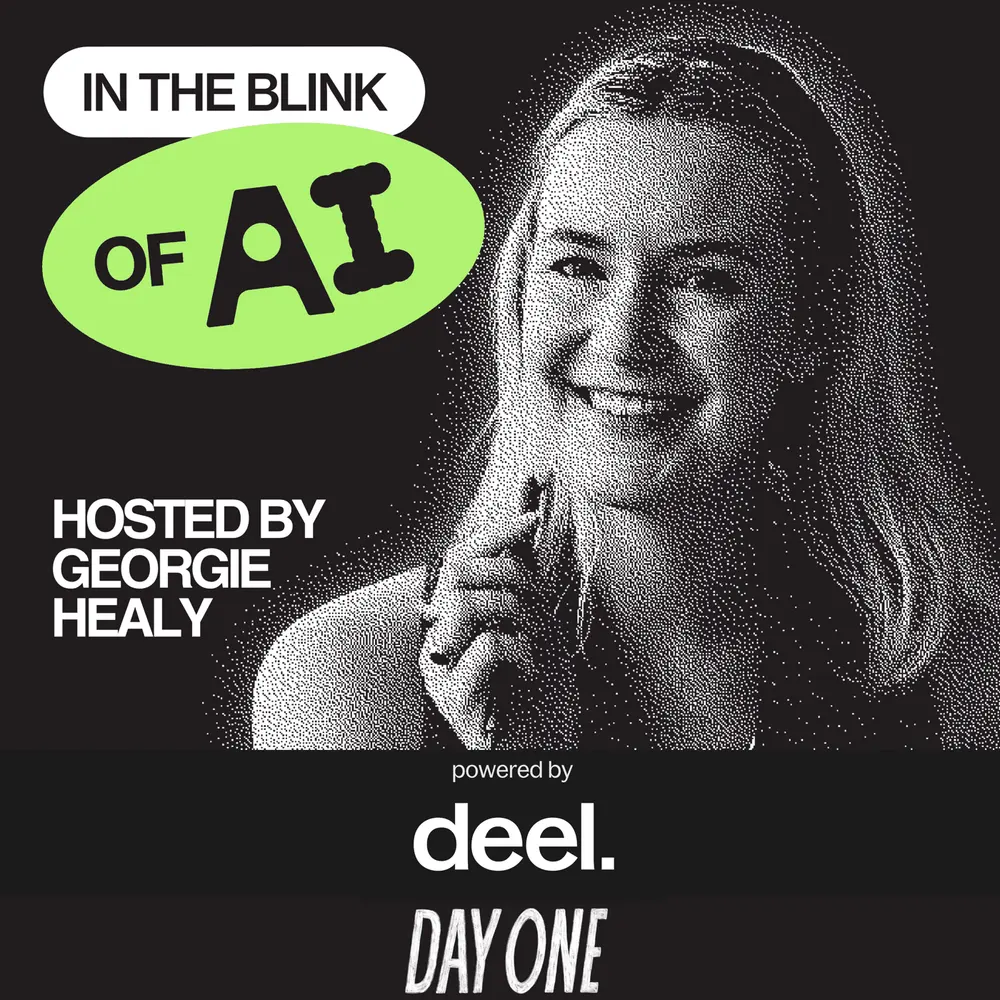 In The Blink Of AI with Georgie Healy
Presented by Deel & Stripe
In The Blink Of AI with Georgie Healy
Presented by Deel & Stripe 
 ▶
▶  ▶
▶  ▶
▶  ▶
▶  ▶
▶ ▶
▶ ▶
▶