Transcript Synced · select any line to jump ▾ 0:02 Speaker: Founders scale faster on Deel. Set up payroll for any country in minutes. Hire anyone anywhere. Get visas handled fast and get back to building. Visit deel.com/dayone. That's deel.com/dayone. 0:20 Georgie Healy: Hi guys, how are we? I'm seeing so many familiar faces. First of all, hands up anyone that's used an LLM before? ChatGPT, Gemini. Yeah, you guys too. Has anyone used the deep research function on any of those? 0:39 Speaker: Hands up. 0:39 Speaker: You guys have all used an agent. I just want you to be aware of that. So I know agents, for me at least, can feel very overwhelming. I saw a hideous stat that was— I'll tell you about it later, but women are not using AI anywhere near as much as men, apparently. And we'll dive into why we think that might be. But I, I just wanna first of all say you guys are really, uh, already killing it. 1:03 Speaker: You're here tonight. 1:04 Georgie Healy: It's a rainy day. So huge round of applause for you guys even being here tonight. 1:08 Speaker: So well done. 1:08 Speaker: So we've got 3 incredible panelists that are a lot more further along their AI agent journey than I am. 1:14 Speaker: And I want you guys to take 3 minutes to just very quickly, it doesn't have to be 3, it could be 2 or even 3 and a half. 1:20 Georgie Healy: Tell us who you are and what you're passionate about solving. 1:24 Beth Lovell: Well, give me license to speak for 3 minutes and I will. I'm Beth, co-founder and CPO of FOBO. So, I'm a product human. FOBO stands for where front of house meets back of house. So, what we're building is AI agents for food and beverage wholesalers. This is an industry that, you know, if you've got a very expensive overpriced iced coffee this morning, you interact with, but most people don't have the level of visibility or appreciation of the complexity and and just how messy it is behind the scenes. So our customers are people who are supplying products in large quantities to bars, cafes, restaurants, what's known as like commercial food services. And the problems that we're solving for them is we're trying to help them scale more sustainably to reduce waste and to help reduce their cost to serve. A bit about me. So my background, I came from Woolies. My co-founder and I both spent a good 7 years like grappling with the problem that we're now solving. I had Never intended to work in wholesale distribution. I don't think anyone really has that on their like 5-year career plan. I was in like a really great place working in product and tech at Woolies X, like, you know, predicting when you're going to run out of milk. That was where I was like having a blast. And then COVID happened. And both my co-founder and I were pulled into like a rapid response squad that was then tasked with getting food to people who were most vulnerable, people living in remote communities, people who couldn't have access to food at that point in time. Mm-hmm. So everyone, when everyone was, you know, hoarding toilet paper and doing all sorts of bizarre things, there were people in the community who simply couldn't get access to fresh food. That was a pretty overwhelming experience for me as someone who's, you know, had incredible privilege in my life. It was now, you know, working 16-hour days trying to coordinate the supply of food across Australia and not understanding why this was such a difficult problem to solve and learned a lot through that process. We were in the office and we were literally printing out purchase orders. I'm like, [FOREIGN LANGUAGE]. Guys, why are we needing to do this? Surely it's a byproduct of COVID And I learned really quickly, nope, that's how B2B trade happens. It's very, very manual. It's highly relationship-driven. I had come from a part of the business that was, you know, building these whiz-bang applications. I was like very naive at the time. Like, guys, surely we could automate this. Doesn't seem that hard. So then spent the next 3 years heading up digital for B2B within Woolies. It was very hard. spent millions of dollars, you know, building very complex functionality in ERP systems, vowed to never touch another SAP implementation, launched these portals, no one used them. And that's because it's really, really hard to change behaviors in an industry like wholesale. It's super relationship-driven, but there's also this messy middle and all of this complexity. So that's where I got to a point with the cushy corporate job. Um, and yeah, my co-founder and I went out and thought, what an incredible opportunity to try and solve this problem and have impact at scale, try to solve the problem for the industry at large, not just for one big retailer. And we were just super fortunate to then ride the wave and have, you know, the technology evolve with us as we've been building. We'd still be solving the exact same problem today, you know, without all of this AI hype, but hell, it's made it a lot easier. That's a bit about me. I think that's probably more than 2 minutes. 4:28 Speaker: No, I love that. Can you share your algorithm for when we're going to run out of milk? Because opening the fridge doesn't seem to work. Like, we're always out. Hi everyone, I'm Sam. 4:37 Speaker: I'm the co-founder of HelloCanopy. 4:40 Speaker: As Angela mentioned, we're an HR tech platform. So, HelloCanopy is a reporting platform that helps employees speak up in organizations about misconduct, cultural concerns, whistleblowing, and then gives HR teams tools and data to be able to respond to those concerns, to be able to investigate them, resolve them, and be able to see that data that helps ensure that we're taking preventative proactive action and making sure it doesn't happen again. My background My background is in HR, so I was a head of people and culture at a couple of different companies. I've worked across multiple different roles in HR. I've also been an employee, and so, you know, I've got both sides of, I suppose, my user groups in that I myself, and I'm speaking to a room of women, you know, and so I think some of you may understand where I'm coming from in that I've experienced sexual harassment at work. You know, I've experienced bullying at work, and in one instance, sexual assaults at work, and I didn't know who to tell. And when I did tell somebody, they told me that sex sells, keep up the good work. So, it was just like, wow, there's just like, there's not a great way to be able to speak up. And then when I was a head of people, I knew full stop that people weren't telling me things. You know, just by the nature of being in HR, it's very scary in order to walk up to somebody and say like, hey, I just have a little concern I want to tell you about. Like, it just, it doesn't happen as much as we would really hope that it does. And so my co-founder, Emma, and I, who's right here, we actually met when we were one of a handful of women who co-founded Grapevine, a not-for-profit that speaks up about sexual harassment and discrimination in the tech and startup ecosystem. And from there, we were like, okay, like, can you just please, like, do something about this? And, and so we set out to build Hello Canopy to help people speak up in a way that feels really safe. Hello, Canopy. Then give HR people like me better tools because HR teams don't have great tools. Give HR teams better tools to be able to do something about it. So yeah, that's me. Probably more than 3 minutes as well. 6:41 Speaker: Sorry. No, thanks so much. I'm Sally. I'm an investment principal at Kingriver. So I spend most of my time looking at AI technology and frontier tech. So I definitely have tested and looked at a few hundred AI agents by this point across all different verticals. All the layers of stack, all the way from data to AI/ML Ops, all the way to the agents themselves and the applications. So I spend a lot of time in the space and trying to back wonderful founders like you and all of you in the room as well. So I guess my perspective is more so I'd love to share what I see in the space. And I truly believe as an investor, and I'm non-technical myself, you have to be in the product yourself to be an amazing investor and really understand what's going on. So I'd love to share my journey as a non-technical person using AI agents on the regular. I have several that run on autopilot, and I'm really passionate about making sure that everyone can find value from these AI agents and be able to 2 to 3x their own workflows. So you find, you know, more time to focus on value, what really matters to you from a work perspective. That's backing amazing AI founders. I want to do that more, not just do my admin. And also just more time back to your personal lives, right? You can work less hours or same hours and be more effective and be able to spend time with friends and family. And that's what really matters. 7:54 Georgie Healy: Very lucky to have the three of you. That's amazing. Thank you, guys. While I've got you, Sally, something that I really love doing as much as possible is asking people what their favorite AI hack is and then stealing them. 8:08 Speaker: What's your favorite AI hack? I'll give you one relevant one and one non-relevant one. So In terms of non-relevant AI hack, please try Replit, everyone. I know there's a lot of hype. You might have all heard of coding agents. So there's Cursor, there's Lovable, there's Bolt. Like, which one to use? So for me, I really like Replit because again, I'm completely non-technical. Something like Lovable can get me to a prototype. Like, hey, it looks like a really cool website, but I actually need all the help to reach the hosting and deployment. So I'd recommend you try Replit. Replit. There's also a mobile app and, you know, my boss built an astrology app. I've built my own personal website, still in progress everyone, but you know, asallyu.com and then I'm doing other fun things. So that's one hack. And then using something like Relevance, you know, as a non-technical person, even though the team spent so much time trying to make it really as friendly and as cute as possible, it's still really overwhelming. So I'd recommend if you go into a platform, look at the templates first. Just look at, you know, an agent that, you know, someone else has already been running. Test out some use cases you might think they're using. So you really just get to understand, get a feel of the platform, what it can do, and then start build your own. Like maybe start from that perspective rather than straight into building, 'cause that's overwhelming. 9:26 Speaker: That's what I did as well. I opened up a template, I used someone else's, and I was like, all right, what's going on behind the curtains? And then pretended I was an expert after that. My hack, I'm gonna go back to like basic basics 'cause I use this one nearly every single day. I'm a sticky note gal when I'm at home, like my walls are in sticky notes. We're working on whiteboards all day. Take a picture, whack it into ChatGPT and say, turn this into a table, turn this into an SOP, turn this into a flowchart, turn it into something, but boy, do not make me write it out. So that is like my number one that I use, that I use probably every single day is not having to rewrite stuff that I've already written Somewhere else. 10:07 Beth Lovell: I'm gonna share a very basic one. And if people haven't like customized their system preferences in, oh, in ChatGPT, you 100% need to. And I've given mine very, very specific. And I think moving away more from like prompt engineering, more into like what context can you give an LLM about you and the problems that you're trying to solve? But in terms of style, like I've asked ChatGPT, be an asshole, be opinionated, like don't sugarcoat it. And I found that it, reduced the verbose nature of all of the answers I was getting dramatically. I've built in shorthand, so when I want a specific style, when I want a specific format, I'll do, you know, certain symbols. I'll do two exclamation points when I want that specific format. I'm also a mad vibe coder. Our tech lead is like, "Please, Beth, stop." Every weekend I like come in on Monday, I'm like, "Alan, look what I've built. It's amazing." He's like, "Okay." So I use, I use Lovable. I think Lovable's terrific. Rayflit's also terrific. I think what is really, really cool about AI is it's reduced the barriers to development and like the marginal cost of developing is coming near to zero. I'm also non-technical, but I dabble and I feel like the, you know, ability to have an idea and see it through to execution, or if you felt like a tool that you're using is rigid or not flexible, you can just rebuild it yourself. And I, like, for me, that mindset shift has just been so incredible. Like, my gym has the worst app and I've rebuilt it for my own specific use cases 'cause I wanted to track my PBs in an entirely different way. And I've now been outsourcing and getting feedback from everyone at my gym. And they're like, "This is amazing. You should sell this to the gym." I'm like, "I've got other business to do." But the fact that like there's, yeah, there's that kind of appetite and you can just truly go out and build something that is truly fit for purpose we don't have to be constrained by these like dated CRUD applications is so, so cool to me. 12:01 Georgie Healy: Are you with Fitness Fest in Randwick? Because I also really need help and help me please. 12:08 Speaker: While I've got you, Beth, look, it's the year of the AI agent. 12:11 Georgie Healy: Has anyone heard this? Agents everywhere. But something I personally am really passionate about is let's not gaslight the non-technical people in the room and say it's super easy. Just click, it's done. And what I wanna really make sure we do today is give people like actual things they can try at home. And by the way, it's that first you don't succeed. In 3 weeks, AI has already progressed so far. So I hope you write down all these tips and I hope you don't like do what I do and try it, it doesn't work, and then be like, maybe I just don't know how to build anything. Like try again in 3 weeks and you'll be so much further along. 12:48 Beth Lovell: Yeah. 12:48 Georgie Healy: So, Beth, tell us about the first useful agent you built and what it unlocked. 12:55 Beth Lovell: Ooh, this is an interesting one. There's an idiom that's like, you know, why spend 5 minutes doing something when you could spend 5 days automating it? And I'm like, AI agents have changed that completely because it now also takes 5 minutes to automate it, and it's amazing. What I've been doing is like taking Carrydog, any task that I've done in a given week that I've done more than 5 times, And that's my like trigger point to be like, you shouldn't be doing this manually anymore. We're doing a huge amount of like cold outreach to try and find great talent. And so I spent about 4 days, you know, 6 months ago, full-stack engineer LinkedIn connecting with every single person who was, you know, had any previous experience in startups. I can't tell you how much time I spent doing research, outbound, and scheduling to try and find great talent. being able to now, you know, plug in an agent for that specific task. Like web scraping has gotten to a point where you can, you know, in even in its most basic form— I can't remember the exact name, it's a YC company, I think it's called Webscrape— but they do an awesome job at taking a natural language prompt and then building a data schema and then going and do performing those web scraping steps. So something that you'd need to, you know, previously have probably Python skills to be able to execute, which I know because I tried to build it like 12 months ago and it broke and I was like, to our basket. You can now do within 20 minutes and set it up and automate it. So that would be, that would be one of mine. 14:19 Speaker: Taking that. Mine would have been my very first one, similar web scraping. I built it in Gumloop and I got it to scrape anything to do with new policy changes. So I'm not sure if anyone's ever been on the Fair Work website. Okay, it's a punish. And so I'm always looking for like updates to legislation. I'm also looking for case law. I'm looking for things that are really relevant to our industry and that I think that our audience, our HR leaders are gonna find interesting. 14:50 Speaker: You really gotta hunt, but I built it into Gumloop where it would scrape. 14:55 Speaker: I would automate to do it like once a week. It would scrape all this relevant information about like sexual harassment and fair work and settlements and case law and all of these different keywords. And then it would bring it through to me and then recommend, okay, I think these are the ones that, you know, you should be writing a, 'Hey, LinkedIn post about.' I was, I need to go back through to it and like get it to produce better outputs of like, this is exactly what you should write and this is the format of it. But it was just really helpful to be able to get that on the regular and not have to be constantly like cross-eyed skimming through Fairwork. 15:24 Speaker: There's a lot of founders in this room, so please don't kill me about this, but it's really to help me with cold inbound. So as a VC investor, I get more than 1,000 a year, so It's just really sometimes it's a one-line email. Some people are really thoughtful, they give me a whole pitch deck. But when they don't give me much information, the AI agent really helps me. It's similar to yours in terms of the researching people. You know, they find the LinkedIn for me, researches the whole company's website, looks at the founder's recent posts, looks at the GitHub, looks at the Product Hunt. Just so I get a much more well-rounded view quickly and I can actually send a meaningful reply to the founder versus someone's just asked me for coffee and, you know, usually it'd take me 15 to 20 minutes because I do spend that time trying to figure it out. But— Yeah. When I have 1,000, that's really hard for me because, you know, I also have things like supporting my founders. So it's really about trying to respond to founders more quickly and also that so they get a clearer response from me. So that has really helped me. 16:20 Georgie Healy: Sally, before you go on, is there any Series B AI startup that you've invested in that we should know about that's really impressive? 16:28 Speaker: Well, I didn't want to be salesy here, but yeah, Relevance AI is obviously one of my favorite companies. I led that investment 2 years ago. How it really started was I love going on Twitter. I have a thing against Elon Musk and Twitter, but for AI tips and hacks, gold. So that's where I actually first found out about AI agents in 2023, and that's when I started trying all the ones out there, like BabyAGI, and I was like, I need to find the best AI agent company right now, and that's gonna be, I think, the focus area in the years beyond, and things like it might really be the case now, but I found this Australian company, like right here, and that's how our whole journey started, you know, 2 years ago with this company. And as I said, give it a go. Caitlin's amazing, and there's also some other people in the team, but it's a really good way for domain experts or people who are non-technical, or even technical folk too, to build agents that are really relevant to you. Like they try to meet you where you are, understand what your workflow is, and do the same thing rather than, you know, asking you to completely change. Yeah. What you do. 17:33 Georgie Healy: I should make it clear, neither Sally nor the Relevance team told me to do that. You can check my notes. But it, you know, it's, it would be mad not to mention. Okay, you guys, you guys are further along than myself at very least, and maybe a lot of people in this room. What do you wish you knew when you were starting out and that you can tell others before you built your first agent? And like, if they get a bit stuck, what, what are your suggestions? 17:58 Speaker: Yeah, I mean, this is a great network and thank you so much, you know, Caitlin and also Relevancy and all of you, Georgie and Sam and Beth and you too, so like, Siki, today. But, you know, use this network, you know, I think it's really helpful to find people to accountable with you that you can ask silly questions. And sometimes it feels embarrassing. I feel that all the time. I know it shouldn't be and no one ever judges me. But find someone who feels safe with and build your best, you know, tools or agents together. And also what I've learned over time is keeping it simple is the best. Sometimes I try to over-engineer and write the perfect prompt and, you know, one-shot it, but it's actually better to try and keep it really simple and get agents that are doing very specific tasks and chain them together rather than building one agent that tries to do an entire person's job. 18:45 Speaker: I would argue that I'm still pretty early in my AI agent journey. What I wish I knew like it's not, it's probably not gonna work the first time, or it's like gonna do something totally weird and whack, and, but like the great thing about a lot of these tools, like Relevance AI, or any others, is that you can actually just go back, and it tells you like, big red error, right? There's a lot of people, like this community, who are also building, and you can just ask them about it. You can reach out to these organizations and say like, hey, I'm getting this error, what does this mean? Or if I'm too embarrassed sometimes to like ask questions, I'm just like sticking to ChatGPT, you know what I mean? Like, isn't that what we all do? 19:19 Beth Lovell: Yeah. 19:19 Speaker: That I would say, like, I wish I knew that I was probably going to get it wrong a bunch, and that doesn't mean that I don't know what I'm doing. It's just like part of the learning journey is like, you're going to do weird stuff. It's going to output stuff that you probably don't want that might not be useful, but you just got to like keep going, tweak, find the errors, tweak again, ask for some help. And then eventually it's, you know, it'll, it'll work itself out. Or you wait 3 weeks and come back later. That's also one of the things. 19:42 Beth Lovell: I might talk a little bit about my experience in terms of what I wish I knew before I started building AI agents that were specific to a domain. And a lot of our our learning has been just how challenging it can be to, one, collect the appropriate data in the format that you need. And like everyone talks about, like garbage in, garbage out. But truly, if you're starting with an absolute mess of, you know, spreadsheets and the like, there's got to be some of that, you know, unsexy grunt work to get, you know, the pipeline set up so that you can have something that's truly scalable. What you don't want to do is create something that you then need to constantly go back and debug and maintain over a period of time. So investing time in the unsexy things around data hygiene and maintenance and how you build a process that can scale over time was incredibly important for us. As well as this concept of onboarding. And I, I now like to think of all of our AI agents as, as a new team member. And when you have a new person joining your team, you don't throw them a manual and say, piss off and never speak to me again. And don't give them any prior context as to what it is you're working on, the type of problems you're trying to solve. So treating any new AI agent like a new member in your team and actually prompting them in that way has been incredibly helpful for us. And it actually helps with how you communicate with humans. Like when you sit down and think, how am I going to onboard this AI agent? I found that I'm doing a much better job of onboarding our team members because you want to make sure that you're giving people all of the context and information that they need to be effectively successful in their role. One of the other things I've been reflecting on as well is like the importance of our interface. And Caitlin and I were just talking about this before, where I think there's the ambition, which is these agents will be purely autonomous and they'll go run everything in the background, and all of us are going to go like sit under a palm tree with a cocktail. I'm like, amazing, sign me up. But the reality is like not there yet. And I think that that process of human in the loop for certain, um, for certain, particularly, you know, quite, um, highly regulated or quite complex industries, um, requires that interface to be designed in a really, really simple and elegant way, and it's quite different from our usual SaaS applications. You've got to think about how you set up the guardrails for something to run in a semi-autonomous or autonomous future, but still helps people to manage by exception or intervene when there needs to be that human-level insight or decision point so that you're not just letting the AI agents run completely free and make decisions where you might want to have that next degree of input. 22:07 Georgie Healy: I keep wanting it to be the palm tree example, and it's tempting to be like, I'm going to wait until we're at the palm tree level and just not use any tech until it's at palm tree. But the risk of doing that, right, is that everyone's so much further along if we wait that long. Yeah. 22:25 Speaker: Shame. 22:26 Georgie Healy: Shame. 22:26 Speaker: Okay. 22:27 Georgie Healy: So I would love to know, we've got spicy rapid fire, but one more question before we get to that. 22:34 Speaker: In the next 6 to 12 months, what, what's your dream agent? 22:38 Beth Lovell: My dream agent. I mean, I could talk from a personal perspective or a work perspective. Like, it sounds lame, but I feel like no one has mastered the, like, the ultimate to-do planner. Like, I'm a Notion power user and I have like notes and I have databases. We're talking about menu planning before. Like, I feel like just the AI super assistant that can truly like run my life, manage my diary. But for the most part, be able to ingest all of the different places that I get messages from and respond to them in my tone of voice. Like I, and I've described myself before as like chronically offline and I have to be for work. And like, I try not to be on social media, but then you miss all of these interactions. And I'd love just one like combined messaging app where I can filter through all of my responses and put it on like, yeah, automate mode. I want that too now. 23:30 Speaker: Well, if we're gonna do a personal one as well, somebody needs to build an agent that like does the thing that it did in Clueless where it like picks out your outfit in the morning. Mm-hmm. I'm not sure. We have it now. 23:43 Beth Lovell: Oh, yes. 23:45 Speaker: Yes. 23:47 Speaker: Oh my gosh. We the people, thank you. Work-wise though, I would say, well, actually, yes. The biggest bane of my existence at the moment is product copy. Like I just, I simply cannot find a better way to write product copy and update product copy than being in a humongo Excel spreadsheet and then updating my engineers every time I need to make changes to product copy. And so I wish there was a way where I could just like speak to an agent and say like, hey, we need to go deploy this product copy in this version of the product for this particular user, like go forth and do the thing because there's considerations of there's UX and UI considerations, there's considerations for our database and for the snippets that our engineering team needs to put in. And so if I could just like tell an agent to go update the product copy and then it goes off and does all of the things that touch our product along the way, that would save me probably so far 100 hours just in the last couple months, I'd say. 24:49 Speaker: Okay, quick question. Who loves Excel? Anyone? Yeah, so Georgiana talked about this, but to me, Excel is still one of the best pieces of software ever built. I think when AI agents can overtake what Excel does in terms of data analysis and put together like insights, I think AI agents have really done it. So that'd be like, I'd love to see something that can do data analysis better than Excel can, and it can really do financial modeling. In my old previous life, I was an investment banker. So if they can do financial models, that's amazing. I'd love to see that. 25:20 Georgie Healy: Okay. Old habits die hard. I've done 40 podcast episodes now, and I always finish with a hot take. 25:29 Speaker: Sam's aware. 25:30 Georgie Healy: Angela's aware. 25:31 Speaker: There's some people in the room that are aware. 25:33 Georgie Healy: Harvard recently did this big study. Women are adopting AI tools at 25% lower rate than men on average, despite the benefits of AI applying to everyone. Why are women not adopting AI, Sally? 25:49 Speaker: I'd be really curious if that's a consumer use case or a business use case. First of all, if I take the business lens, I think just from what I see from investment and talking to people globally about AI, the number one, you know, leading use case right now is AI for coding. And naturally, I think it's been a really long-standing problem that there are not as many women in STEM or women engineers. But I feel I see this really positively because now anyone like me or all of us in the room can code. So I think that's largely going to go away, hopefully. And that, you know, a lot of it's through natural language. But I think that's partially why the winning use case has been that. And but another thing is also AI is a lot of change management and it's all about, you know, how much risk you want to take as well. And I don't like that, but that is a perception that sometimes people think women take less risk in their careers or in their everyday lives. And I don't know if that's a factor. 26:39 Speaker: I would say definitely that it feels like it's a big technical hurdle and, you know, statistically speaking, like there are far less women in quote unquote like technical roles. And it, you know, as we were talking, it sort of occurred to me like petition to change what like non-technical is like, we're all technical here. You know, I'd say just call yourself a non-engineer. We're all technical. But I'm going to maybe take like the spicy take on this. I would say it potentially comes down to some of the morals and ethics of AI, if I'm totally honest, right? There are significant environmental environmental implications of using AI. There are significant implications to working rights for humans and slave labor in training our LLMs. And then the very first outputs that we were starting to see from AI was highly sexualized images of women, deepfake, deepfakes and porn. And it's just like, it really came out as being like, wow, we are really starting to use AI for its worst possible intents, and the downflow effects of that are having impacts on people and the environment. And so I think there is like that implication of like, mm, do I really need this? Because there is some research that shows that women often have like that, like that morality consideration when it does come to decisions that they make in their life. But I would say, and I would argue that you can't put the genie back in the bottle, Christina, like— Mm-hmm. It is already out there. And so if there's a reason for women to be using AI, it was to catch up so we can make better decisions with it, so we can make smarter decisions about the power that it's using and decrease the harm and decrease the bias. And so, 'cause I think if we have a runaway train of the same people using AI and training AI, then we're just gonna get the same thing that we've seen before. And so I think it's a really great reason for women to uptake AI even more. 28:32 Beth Lovell: I think that's such a good take. I interpreted this one slightly different because I was thinking about it and I'm like, okay, why? And for me, like the slightly, or a slightly different question that I was thinking about is who is AI being built for? And, you know, who are the decision makers in this AI-enabled future? And I was thinking of some examples and I was reflecting on the voice agents that we've all been exposed to. Why are they always women's voices? Why did OpenAI choose the sexy Scarlett Johansson voice? Like, you know, why is my husband flirting with Siri? And I was thinking about this deeply. I'm like, it makes sense. These are the people who are designing the products. And so, you know, that is influencing the adoption and the consumption of said products. Apple launched their, their, you know, health tracking app in 2014, and it was profound to be like this. You know, they claimed comprehensive tracking. You could do your sodium intake, your blood alcohol content, you could track your copper levels. I don't even know what copper levels are. Does anyone want to know what they didn't include? Any guesses? 29:36 Speaker: Period trackers. 29:37 Beth Lovell: Period trackers. So you can bet, not a technical limitation, but again, product decisions. This is what the people in that room decided were the comprehensive metrics for people to take consideration of. And so I was thinking about this more and more. I'm like, this is the problem. It is the people in the room that make decisions that influence how these products are built. And I think that that is what is most important in, in driving adoption. So I think it's incredibly important that there are female founders, that there are underrepresented groups responsible for not just, you know, actively adopting AI tools, but for building the AI tools. Um, because they're ultimately going to be the ones who help to shape the decisions. Like, the reality is, is when we outsource, you know, all of the problem solving for the world's most curly challenges, we end up with data that's trained and training on data that's homogenous, and we end up with a default behavior of a straight white man. So yeah, that was my reflection. 30:34 Georgie Healy: Beautifully said, all of you. What about the strengths that the non-engineers, not non-technical, non-engineers have in this space that we're not leveraging enough? We're non-engineers, we're using AI agents and AI tools. 30:51 Speaker: What should we be leaning into more? 30:54 Beth Lovell: I think a key one is empathy. Like, I think a really big part of successfully deploying AI tools is how can it support existing behaviors and how can it augment a workflow instead of expecting a workflow to change. And I think that there is a superpower to sitting with users and understanding their pain points today instead of, you know, going away in a dark room, building an amazing app, and then thrusting it in people's faces and asking why they're not adopting your technology. We've seen that a lot in how we're solving problems. Again, you build a beautiful, amazing portal, and then you're surprised when a chef at 4 in the morning who hasn't finished their shift doesn't want to log in. Yes, they don't want to log in. They want to do whatever is easiest for them. And I think that natural understanding of human behavior and an ability to deeply empathize with your users means that you can have more creative ways to solve these problems. 31:46 Speaker: I would say maybe an extension of that is leaning into our subject matter expertise, right? Like subject matter expert, you know, subject matter expert. I think a lot of us are solving problems that we've experienced ourselves. And so like, we know the space really, really well and we can use that to our advantage when we're using AI because we know it's not that accurate. Like I had the wildest output the other day about positive duty of care around preventing sexual harassment. In the workplace. 32:11 Beth Lovell: I was like, this is, this is like wrong. 32:14 Speaker: Yeah, yeah, yeah, yeah, yeah, yeah. 32:16 Speaker: Wrong. But like someone who's not a subject matter expert in HR would've said like, yeah, that's great. And then put it out there or like baked it into a platform. And that is a massive risk. And so I think, you know, many of us like are gonna be subject matter experts in the thing that we're building. And so like lean heavily into that, make, make your weapon even sharper. Like be a subject matter expert supercharged by AI to make you more efficient at what you're doing, to target your customers even better, to provide solutions to your users that are, yeah, really turbocharged by like your brainpower, like directing AI to do the things that you need it to do. 32:55 Speaker: I think women are often better managers and communicators, and you know, if the world is moving to a vision that, you know, Relevancy is, or I see it where there are going to be people working alongside AI workforces, they're really going to excel because we know how to break down those complex tasks into what the agents should do. You're going to be hopefully someday working with a bunch of AI agents who do tasks just like an analyst or intern would as well. And I think there's a lot of skill in terms of breaking down those concepts in natural language, which is the core interface now that I'm sure most of you experience with applications. And it just can— I think it's going to continue moving that way. So really the written skills, being able to manage dynamics. For example, the next stage really is multi-agents, so getting a whole team of agents working together. So, how do I decide if Lena should work with Debbie the this agent? And I think that's a skill that actually when you're really good managers, so would do fantastic. 33:47 Georgie Healy: Last question for the panel. You guys have been incredible. What should all of us be doing starting tomorrow that you guys have done and it's really helps your careers or your, your work or, or anything, I'm happy to go first. As soon as I started my podcast, I started posting on LinkedIn weekly because I was forced to. I did not want to. 34:10 Speaker: I did not think I had an opinion and I was forced to. 34:14 Beth Lovell: No one had a gun to my head. 34:15 Georgie Healy: I forced myself to post every week and it has been incredible for my career. I became a top voice. I have incredible opportunities like being here tonight. I would really recommend you guys start publicly posting more. That's my— 34:31 Speaker: And also, I'm sure most of you already do, but please follow Georgie on LinkedIn. She has amazing content. Listen to her podcast. No, it's not, but truly, it's really inspiring that, you know, I think it's fine to build in public, fail in public. Sometimes your post will have one like, but who cares? Like, you're putting yourself out there. And not that I've seen any of yours have one like, but I think one tip is really just, as I said, obviously I come from the lens of investor, but just try a bunch of different tools. They're not all going to land for you and if it's not for you, that's fine. 35:00 Georgie Healy: There's literally a thousand waiting for you out there, so just give it a go. 35:05 Speaker: And then one thing I'd definitely say to try is ChatGPT finally launched agent mode for most people here. So if you're, especially for personal use cases, just give it a go. I just asked it to help me plan my trip to Jamaica, which has really helped So give it a shot and you are now using agents, all of you. 35:21 Speaker: LinkedIn is gonna be mine. I'm getting one like these days. What's wrong with the algorithm? So maybe don't take LinkedIn advice from me. Maybe an AI-focused one would be just creating your own GPTs, you know, like just giving them really specific use cases and then going to them to help you create things. Like it just really helps me move my work along quicker. And then maybe another one would be from like a, just like an networking visibility perspective from a founder, I was having this conversation just the other day, like, ask, ask for the thing that you want. There was a, a big conference in people and culture that's happening tomorrow, actually, and I was like, I don't really want to speak at that. It's going to be great visibility, but like, no one was coming to ask me. So I reached out and asked and said, I'd love to speak at this thing. And the organizer was like, yeah, sick. Here's a spot, like, amazing. Go get it. You know, but I think like asking is really scary and I don't do it enough, but every time I do, I'm like, oh shit, I should probably ask more. That would probably be mine. 36:20 Beth Lovell: I have quite a similar one, which as like a recovering perfectionist has been hard for me, but moving into startup land, you're kind of baptism by fire and you're forced to, is being, becoming really, really comfortable with people saying no. And when you're in a startup, you know, you're trying to get customers, you're trying to get investment, and it can be really, really difficult to put yourself out there and, you know, almost thriving in that environment of rejection and then taking learnings from it honestly feels like such a superpower and something that I couldn't have imagined, you know, Beth from 4 years ago who would, you know, overthink an email that didn't even matter. Like the, the, the level of time that you invest in like things that are frankly low value add to then, you know, just having, I think that like action bias when you're not constrained by fear of what other people might think, by fear of rejection and realizing that when someone says no, the worst thing that happens is nothing. You get to move on quicker. Like almost getting to know quickly is an awesome outcome. And I think that like rewiring my brain to see things in that way has helped me move so much quicker. 37:22 Georgie Healy: Round of applause for our amazing panelists. 37:28 Speaker: Thank you for listening to In the Blink of AI. You can check out the show notes for anything discussed in this week's episode. And we will be back next week. This podcast was produced by Day One with music by Dan Hansen and visual artwork by Sophie Tyrell. If you loved the episode, please tell your mates. And I love AI news. Please share your thoughts and suggestions to georginarosehealy@gmail.com.

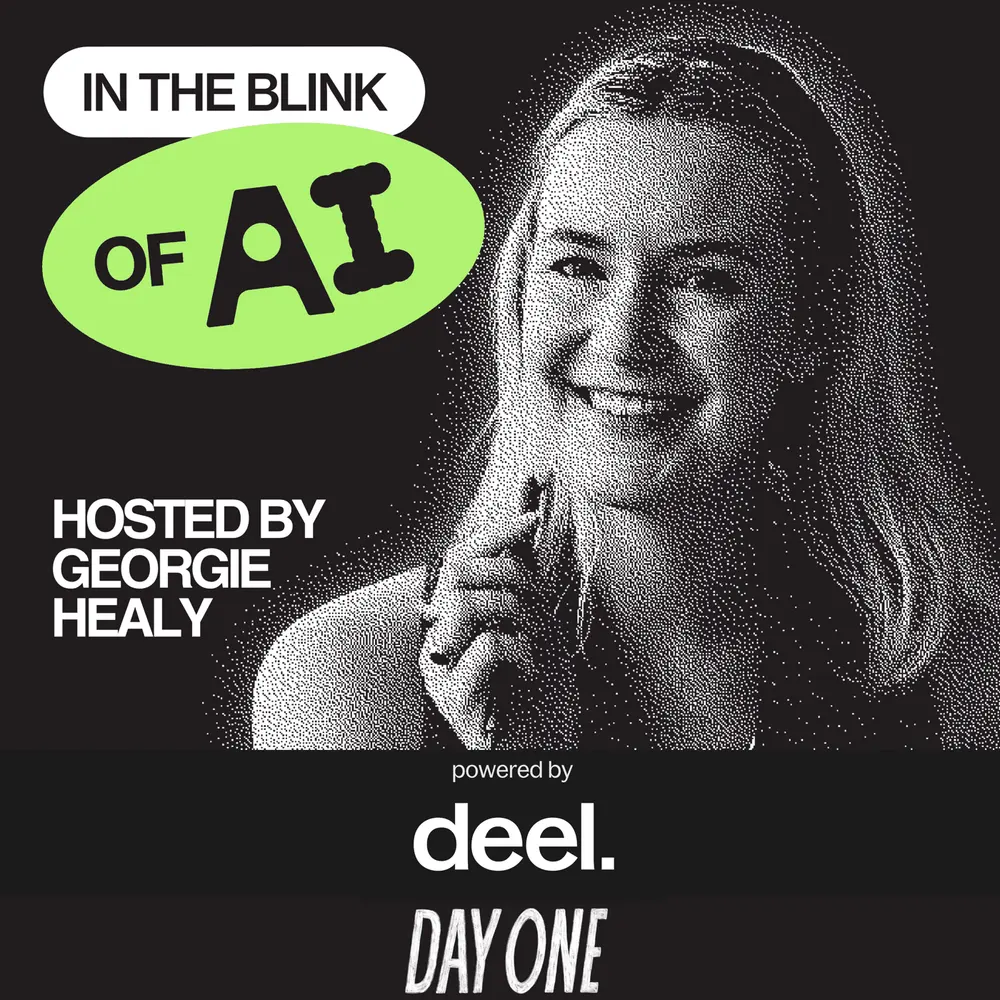 In The Blink Of AI with Georgie Healy
Presented by Deel & Stripe
In The Blink Of AI with Georgie Healy
Presented by Deel & Stripe 


 ▶
▶  ▶
▶  ▶
▶  ▶
▶  ▶
▶ ▶
▶ ▶
▶