Transcript Synced · select any line to jump ▾ 0:02 Georgie Healy: Founders scale faster on Deel. Set up payroll for any country in minutes. Hire anyone anywhere. Get visas handled fast and get back to building. Visit deel.com/dayone. That's D-E-E-L.com/dayone. On December 2nd, Australia finally dropped the National AI Plan, the first update in over 4 years, and Yeah, definitely a bit disappointed. 0:32 Thomas Kelly: It was a bit like Switzerland, you know, not really like trying to pick any industries and not offend anyone, which feels like it's missing the opportunity of like a whole new technology revolution. 0:42 Georgie Healy: I feel like I read the whole thing and I was like, what did I read? I don't know when the timing is. I don't know which industry you're talking about. And you didn't commit to anything. 0:51 Anish Sinha: You need to treat early stage businesses, startups, and high growth companies separately to corporates and enterprises because we don't have the same kind of resources. So if it were to go all out and put out an AI Act, then it should have created a sandbox, which Australia has not typically done within financial services as well as the likes in the UK. 1:09 Georgie Healy: All right, don't tease us. What do you think of the Chief AI Officer? Pro or against? Do you want this role? Anish, would you want to be Australia's Chief AI Officer? You're both shaking your heads. Okay, we have, we have got Australia's AI strategy. We have dissected it. Thank you so much. We are now throwing it out the window. We're done. We're done. We're starting over. Who is in the room, Tom? Who should be planning the next AI strategy? Who should be advised? Who should be asked? Hello and welcome to In the Blink of AI, your weekly front row seat to the AI revolution. We are back from holidays and we're coming in hotter than ever. On December 2nd, Australia finally dropped the National AI Plan, the first update in over 4 years. And we were really excited about this. Everyone couldn't wait for this to be launched. And in the words of one of our amazing guests, Dr. Thomas Kelly, we wrote some things down. We were really looking for a signal that Australia's ready to play, ready to win, either being the most ethical and safe nation across the world or a technologically innovative approach. 2:29 Thomas Kelly: Yeah. 2:29 Georgie Healy: And using what Australia does best with our natural resources and incredible university-trained engineers. But we're dissecting that today with two of the people I trust most in this space: Dr. Thomas Kelly of Heidy Health and Anish Sinha from Upcover. Now, why have we got these two guys? They know what's happening. With, with Tom, he's giving us unfiltered truth. You get what's behind the scenes, not in the AFR articles you see him in, from shipping physical boxes of chips to hospitals to what kinds of AI companies shouldn't even exist. And Anish came with receipts. He benchmarked Australia against the US, the UK, France, Canada, and even the Middle East. It was honestly a masterclass of where Australia stands compared to other nations based on latest findings in under 60 minutes. And that brings me to my promise as a host to you. I know the AI news cycle is overwhelming. Honestly, it's hard to trust. And I've worked in tech for over 15 years, and I know the most incredible builders and innovators in this space, the people that are actually making the decisions and building the tech. And each week I'm gonna get their candid insights to you. So if you follow the show, if you rate the show, if you subscribe on whatever channel you prefer, tell me, ping me. I'm so grateful. Thank you. And I guess that leaves us with diving right into the show. 4:03 Speaker: You're listening to a Day One FM show. 4:07 Georgie Healy: I'm thrilled to be partnered with Stripe for today's episode. Did you know that Stripe Startups offers early-stage venture-backed startups access to Stripe fee credits, expert insights, and a focused community of builders? We love builders on In the Blink of AI. Apply today at dayone.fm/stripe. Okay, Tom, it has been 4 and a half years since the rollout of our previous AI plan in Australia, and I saw your LinkedIn post. I really loved reading that. You said in that, that this moment in technology requires urgency. Did you get a sense for that in this AI strategy or not? 4:51 Speaker: I think it's good that we have a strategy, you know, at least, at least we, we wrote some things down. I think generally the good parts were the idea that there would be, um, try to use existing legislation and not like needlessly create bodies or think tanks that are going to slow things down with red tape and regulation. Um, I think the parts where I was a bit disappointed was there was no in like decisive industries where they had like identified areas where they should tried to meaningfully improve or create a priority to actually improve productivity with AI, I guess. So, you know, like we've seen in other countries, in New Zealand, Health NZ made it a priority to roll out AI to literally like every public health institution in the whole country. And they did it all centrally. So it's like NZ, they picked, we ended up winning. So Heidi got picked and every single ED in the whole country now uses Heidi and they see 1 to 2 extra patients a shift for every doctor that uses it. So it's like on a, literally on a country scale, like rolled out in 6 weeks. So yeah, definitely a bit disappointed. Like felt like it was a bit like Switzerland, you know, playing, not really like trying to pick any industries and not offend anyone, which feels like it's missing the opportunity, probably of like a whole new technology revolution. Um, and like many potential jobs and opportunities we can create. Um, but yeah, it was somewhere in the middle, like C+. 6:20 Georgie Healy: C+. Okay. I love the score. Um, I agree with you. I felt, I feel like I read the whole thing and I was like, what did I read? I don't know when the timing is. I don't know which industry you're talking about and you didn't commit to anything. Um, Anish, what grade would you have given it? 6:37 Speaker: Oh, I would agree with Tom. I think when you, when you think about, uh, government policies, you want something specific, measurable.— you know, as founders we run companies and if we can't measure something we can't get it done. And it's classic, right? You put out a whole lot of initiatives which you don't really quantify with success metrics. There's a lot of good intention there, but intentions don't achieve actions. Roadmap is good, but if it fails execution then it doesn't quite lead to anything. So I think in that sense, it's kind of a rehash of the initial plan that Australia had in 2021 where they put out an AI action plan, but it was not concrete. And especially in these times and age when every other country is doing so much, when you benchmark yourself against what Canada is doing, what France is doing, I think it had to be more substantial than what it is. 7:36 Georgie Healy: I'll put you on the spot there for a second. What has Canada and France done that you really admire from a specific standpoint? Point at? 7:43 Anish Sinha: Yeah, I mean, look, Canada is an interesting case study, right? They're very much like Australia. They're probably 30% bigger in terms of population expenditure, but like for like, if you adjust it per capita, they're very similar to Australia. But when you compare it to the AI research output they put out, the initiatives of the government in terms of the backing with funding, the risk capital, or the ecosystem support that the government is providing in terms of establishing specific initiatives for specific industries, they've done a lot more. France has gone on a whole another level, right? They've gone full-stack sovereign AI, kind of setting up Mistral, tying up with NVIDIA. They're trying to be the spine of Europe when it comes to AI sovereignty and really compete head-to-head with the US. So I think— We don't necessarily need to replicate France, but we can borrow from Canada or from the UK, both of whom are very similar to Australia in terms of their demographic makeup, the capital intensity of the industries, and how they're trying to move into the new age. 8:50 Georgie Healy: Let's get specific on this current plan. So the previous plan in 2021, 10 guardrails, again, very vague. Now 6 core principles. Sure. And these are around business and personal ownership, transparency, creating AI risk registers. Anish, you work in insurance tech. Talk to me about relying on that kind of tech-neutral legal and regulatory framework and what that hopes to achieve or what it's missing and where the gap might be. 9:24 Speaker: Yeah, it's a good question. I mean, look, there are a couple of ways to respond to it, right? One way to look at it is that the government hasn't burdened the business or the industry or the academia with an abstract 200-page AI act, which Europe has done. And we build in a regulated space. So UpCover has its own financial services license. We offer products, we have a general advice model. So we're always going through with a fine-tooth comb on what we can and cannot say when we are referencing insurer policy documents. And the last thing we want is to also then comb through another abstract act. We already have to comply with the FSL obligations, maintain risk registers, we have ASIC product disclosure and distribution obligations, Appraiser Standards. So if there's another AI act that we have to comb through to maintain and feed that into the register, it becomes quite hard, especially if it's vague. And these things tend to be way unless you really involve the industry to say, okay, what are the sort of risk registers? What are the model evals we need to run? How do you log your decisions? All of that, if done, that detail is probably fine, but I'm glad that they've not put out a blanket AI Act in some sense. And thankfully it's tech neutral, so it gives us some leeway. And I think you need to treat early stage businesses, startups, and high-growth companies in a different, separately to corporates and enterprises because we don't have the same kind of resources. So if it were to go all out and put out an AI Act, then it should have created a sandbox, which Australia has not typically done within financial services as well as the likes in the UK. 11:06 Georgie Healy: That's great context. And, you know, speaking of fast-growing startups, Tom, you're in the AFR every second day. This keep Australia safe approach, how do you feel about it from an ambiguity perspective, do you feel like this framework or these core principles, do you feel armed or do you kind of like the fact it's not too set in stone like Anisha is saying? 11:30 Speaker: Yeah, I agree with what Anisha is saying. So I think not, not having, um, uh, specificity is good so long as it's not a legal framework, which it isn't. So we don't really have to pay attention to it, which we won't because we'll, what we care about is our customers. And in medicine, like, they're already very risk-averse, so there's no scenario where they're not going to consider safety, or we're not going to consider safety for patients or doctors. Um, so yeah, it, it's like, what's the purpose of it? Back to what Anisha is saying, like, what are you actually trying to achieve? Um, I think if I was them, I would say, what are the areas in the economy where there is likely to be a slow uptake, or like or there are systems and processes that we currently have that will slow down our adoption. So, you know, if I want to— tomorrow I want to set up a data center for Heidi to run all of our models and transcription resources in Australia, and I need to set up a gas turbine, the projects and the approvals and the process for that would take like probably 3 to 5 years. That's if I'm being like my impatient self. And And that, like, that's just unacceptable. In 5 years, like, whatever I build is probably already deprecated and, like, you know, it's just no longer worth building. So yeah, there's like, I guess that's just like, what are the objectives of the plan is unclear to me. But it, but it's actually like Eddie said, it actually is good that there isn't like an overwhelming set of regulatory things to comply with. Like we already comply with medical device regulation. We already engage with the TGA. But where, where I would have hoped is like to give them an imperative, all of the public health systems, like in every state, if you want to keep getting federal funding, you have to have AI in the hands of all your doctors by the end of 2026. Like I really want our chief medical officers and our department heads and our ED leaders to be the ones picking the tools. And they already want to do it, but they can't get their bosses and their decision makers to move fast enough. So they feel like it's an impossible task to get a decision to be made and it will take 3 years. So I'm just gonna either use ID in secret or, I don't know, like not use it or use it in my private practice but not use it in the public. Um, so yeah, it's just, just being precise, like what are the, what are the things you actually want to achieve? That's, that's what I always want from government. 14:02 Georgie Healy: This is a slight tangent, but based on what you said, it kind of reminds me of the Social Media Act. I've got children way younger than 16, but thank goodness the government is stepping in and making a nationwide law so I'm not the mom going against, you know, all the other parents that are like, yes, you can be on social media. I feel like employees— this is just a gut sense— really want to use AI. But when the government, to your point, is not creating, like, uh, any clear frameworks or, or guides, um, do you think that this creates, like, a lower ceiling to adoption, Tom? 14:41 Thomas Kelly: I'm not too worried. I think because for most businesses, again, I think like they probably just won't pay that much attention to it. So they'll just do what makes sense for them. You know, can we deliver better customer service? Can we build better products more quickly? Can we, yeah, increase the productivity of the team? Like we've definitely seen it. I think in the last 2 months is the first time I've merged code to the Heidi codebase in a long time using some of these tools. And it's incredibly productive. Like it's way, way, way faster. But yeah, but for the government, like what I would worry about is more than likely the tools I'm using have, for engineering, have US processing. So, you know, when I use that tool, like Cursor or something like that, that Cursor is not processing in Australia. They won't, they'll just use whatever's cheapest, the cheapest available model. Yeah. And if I'm Anthropic and I'm using Opus, like, Anthropic, do Anthropic have Australian servers? Will they ever? Why would they prioritize us as a region? So like, these are the questions I would think about if I was them. Like, how do I get Australian knowledge, which is where all this data is going to go, to be run out of Australian offshoots of these companies? Because that would bring talent, that would bring infrastructure, construction, and your tradesmen, like all the work that's required to keep these things going. Yeah. Going. But in order to do that, you'd have to make it like very economically attractive for them. So it'd have to be very cheap, like the power would have to be cheap. You'd have to do like, like maybe multinational deals with like Singapore and others and like NVIDIA and like try to get them to prioritize this region for chips. Maybe government services can only use models that are run out of Australian data centers. I saw that with OpenAI. So like those things are good. 16:39 Georgie Healy: As a startup founder, you're juggling multiple priorities. From the expected, like finding product-market fit, to the unexpected, like customer requests for SOC 2 or ISO 27001 certification. Achieving compliance is time-consuming, and time spent on that is time away from the needs of the business, and that's where Vanta comes in. Vanta is the all-in-one solution for startups to become compliant quickly and build a security foundation with ease. With a combination of automation, an extensive partner network, and a security marketplace containing 385+ pre-built integrations, Vanta provides the necessary tools and expertise for startups to achieve compliance seamlessly. No matter how urgent your needs are and at every phase of growth. Over 10,000 leading companies, including Cypherstash, Handle, and Indebted trust Vanta to automate compliance so they can focus on growing the needs of their business. Here's the important part. Startup listeners of the show get $1,000 off if they go to dayone.fm/automatecompliance. /blink. Well, you've brought me to my favorite part of the report, right? The part about infrastructure. I feel like this is the only time they said something somewhat tangible. What did it exactly say? Specifically mentioned building out data centers. But Tom, you mentioned in your LinkedIn post that we're currently non-competitive in terms of energy infrastructure. Can we go from non-competitive to building out data centers and being a leader in this kind of infrastructure standpoint for APAC with data centers? 18:34 Thomas Kelly: Yeah, I think we can. So there are like physical constraints, you know, with some of these. So let's just like take a product, like a voice product. Whenever you talk with some sort of voice system, you want latency to be really tight. So you just want the, the, whichever, wherever the chips are that are running the experience, you want them to be close to the user. So if I'm building for Australians and I'm trying to build a customer service experience, I want them to be in Australia. So, so you do, I do actually think you have the companies that will build here will want the infrastructure to be here. However, there's a, there's like a willingness to pay. So if, if I'm comparing us to a data center in, you know, AWS in the East or the West Coast, that's maybe run out of, um, Seattle or Texas, and their, their power is 4 or 5x cheaper than Australia, then ultimately that's, that's what the costs are going to come down to. Like, what, what's the cost of power for those data centers? Now, I'm generally not a fan of government subsidy, so it is, it makes this complicated, complicated for government. Like, What are all of the inputs to that price? And what, what are all of the different aspects that we could influence at a policy level? Maybe subsidy makes sense for a period of time. Um, so that we can actually have an equivalent price for an equivalent, like, sort of token or, or, or card or, or like, uh, whatever infrastructure there is. 20:04 Speaker: Right. 20:05 Speaker: Being run out of Australia, because if I had the choice, I would choose Australia every time. I'm imagining where I'm not forced. At Heidi, because of healthcare data, we have to use Australian processing. But I'm thinking of people like Anish or Notion or other companies where they can choose. And if they're choosing, they're going to make an economic choice. And I do think for a product experience, they would generally love to pick Australia, but our experience has been typically the cloud scalers are just not prioritizing us. So we get, you know, maybe like 6 months to a year behind as far as like models and capabilities, which in AI is like a decade, you know, it's ages ago. Like you can run a generation old and even crazier stuff. Like the same model run in Australia is worse because it's using old chips. So it's not as good as the, the US run version of it. Um, so yeah, again, very nuanced, like very tricky. Like the cost of energy is, is complicated. I'm sure there's 7 million different things. Um, pick for them to think about. Like, I don't know, like land ownership and like, um, you know, taxes across all those things. Like maybe they could get rid of all of the taxes associated with building a data center, like let people write it off in, in the way they do with R&D or amortize it over 30 years, or I don't know, like there's different ideas they could experiment. I'm not an economist, but, um, yeah, that's how I'd approach it. Like, what are you trying to influence? And then like, how do you— Um, step backwards to create a list of things that you do as a government. 21:34 Georgie Healy: I find this topic on data centres fascinating because regardless of whether we could be a leader in data centres, from your point, like the speed of the chips and the quality of the chips and all the rest of it. But Anish, if not data centres, what? We're not going to win on foundational models. Like, what is your thought on Australia embracing data centres as an an option to kind of fast-track into the future of AI and technology? 22:02 Anish Sinha: Yeah, Georgie, I mean, I'll kind of try and tie this back to Tom's comments around government support and then jump into what we potentially could do, although I'm imagining there's smarter people who are kind of applying themselves full-time to this, whose whole, you know, whole and sole job is to make sure that we do a good job of it at a national level. There have been successful examples of government market-making specifically the US government. So back in the '90s, '60s, in the '60s and the '70s when Fairchild Semiconductor was putting out IC integrated circuits, the cost was nearly $1,000. And the reason they were able to drive down the prices from $1,000 to $1 and essentially make ICs, you know, a household name was because NASA procured a lot of chips for their Apollo program and drove down the pricing. And so I think institutional buying at that scale does have the ability to create market, which then can lower the cost of goods, which can then make it a bit more consumer-friendly and essentially help small businesses, startups, anyone pushing the envelope of innovation to do more with the resources they have. And then kind of coming back to what we should be looking to do if it's not data center, what it is, I think it's really important, as Tom was saying, to remember these objective. What are we trying to do here? Data centers are a means to an end. Everyone's looking for cheaper compute and compute that's accessible, high quality. How do we enable that? Do we have the infrastructure to be able to make sure that that is available at scale? What does it require? So AI stack, whenever you talk about the AI stack, it can consist of not just compute and cloud, but also like datasets, also like foundational models. We don't necessarily need to play across the spectrum in every single vertical or horizontal of that stack. I think we can try pick and choose and see what we can do better than anybody else. And there are, again, drawing upon examples of the likes of Canada, that's not going head to head with the US in building capability and replicating because maybe they don't have that kind of risk capital ecosystem. And US has a lot of capital and you need a lot of capital to build these kind of capacities. Yeah. There are others like the UK who've kind of tried to find themselves in a position where they can lead with the regulatory aspects of AI and become market leaders. I think it's really important for us to define what our identity is. France, as I said, is trying to take on the US and positioning itself as the alternative. The likes of UAE have built indigenous models like Falcon that allows them to— Falcon. Effectively have a model that is Arabic first because they realize none of these models don't quite localize as well for languages spoken in the Middle East. So I think we need to define our identity of what our AI stack needs to look like. Compute is at the core of it, so we absolutely need to make compute cheaper. And how do we make compute cheaper? Data centers is one way to do it. It's also by being able to support with government companies so that they require more compute. Our compute traditionally has been utilized by universities, not as much by businesses. So there isn't as much capital going into, private capital going into funding AI startups in Australia as much. Heidi's— Heidi is probably, you know, a handful of companies. There are so many more that could be funded. Do we have that capital ecosystem that then creates the demand for compute that then creates a demand for what kind of AI stack we need to build. It should be demand-led rather than, I'm gonna do this because we feel like this is what we should be doing. I think our soul searching needs to be led by market than by a policymaker who feels like this is what the country needs and we're gonna go ahead and implement it in abstract. 25:57 Georgie Healy: Agree. And Tom, you mentioned that, you know, Heidi has to rely on specifically Australia-based inputs. But I was speaking to a very clever engineer recently and he said, you know, if, if we don't build the data centers here in Australia, we're going to rely on other data centers elsewhere and there's going to be a cost to that, whether it's energy, whether it's actual financial costs. I don't know if you've got a perspective on this and whether you believe that it should be here in Australia, even if it's at a worse level. in terms of speed? 26:35 Thomas Kelly: I think so. Definitely for healthcare data, I understand, like, you want it to be sovereign, so you don't want it— even for processing, like, you just don't want things going overseas if you can avoid it. I don't think it has to be inferior. It actually can be as good. It is— for us, it's always like an economic question. So there are data centers in Sydney, and, you know, most of like Google, Azure, AWS have their own data centers here. And the costs are usually similar. It's more availability, like what is actually available and why would they make an investment in Australia ahead of the demand being there. So it's another good example where government could create loan schemes or like invest some risk capital to underwrite the investment. So it could say, you know, okay, we want— We want to have availability of, you know, the best hardware, like Blackwell, NVIDIA GPUs for all of our best companies to to get access to at like a subsidized rate. And, you know, maybe Australian government, like any government-funded institution can only buy from companies that use that, that set of resource. Like that would be an example of something that's strategically smart because then all the companies that want to sell into the government will then use the cloud scalars that have subscribed to this program, which will then, to Anisha's point, give us a chance to get to the kind of scale and volume that would make us internationally competitive, or at least like where we have like a latency of importance or like some other regional importance, like we would just obviously opt to use— it wouldn't be complicated. Whereas like completely unironically, like we are seriously considering sending boxes of hardware to hospitals that we build. Like that's how, that's how like— Um, like non-existent the infrastructure is. Like, like we're considering like buying chips, building like a, for those that were gamers, it's like a pixel collider. You, you put like 4, 8 GPUs in like a big box and just like very simple. And then they can, the doctors can like plug in their phones into it and then it transcribes or something. So there's, yeah, I don't know if we actually do that. 28:55 Georgie Healy: We're actually fighting for our lives, Tom. Like, oh my God. Wow. Yeah. 28:59 Thomas Kelly: It's like You get Heidi and the like $50,000 box that does the processing. Um, anyway, so it's just the main problem with that is that the power requirements would like down the hospital and, you know, we can't have hospitals with no power, like ICU and operating theaters, you know, that's the issue. Um, so anyway, I think the short answer is I do think this infrastructure will be built out locally. Like we'll definitely do some of it if we want it to be something that isn't just. 29:24 Georgie Healy: Yeah. 29:25 Thomas Kelly: Just for like the regulated industries that have to, and, and it, and it could be a strategic asset that gets used maybe by other countries and then something we export, then there has to be some like precise forward investment where like you have to take some risk. You can't just like have principles and ideas. Like you have, you have to have a scheme, like be precise, like, and you have to be able to lose, you know, if you want to win something, which in our case would be like a bunch of jobs and Australia being like a kind of AI hub or a token compute hub, then you would have to put some money at risk to actually make that happen, I think. 30:00 Georgie Healy: Beautifully said. Thank you guys for the nuance around strategy and actually taking a step back and thinking about whether data centers is the right call. I was just of the camp of like, just build them. Like, what else are we doing, guys? Just build— like, we got all that, like, Central Australia, like, Build data centers. 30:19 Thomas Kelly: Yeah. 30:20 Georgie Healy: Oh, look, speaking of where the government is maybe putting capital, they didn't, they didn't confirm. Anish, the AI strategy mentioned AI accelerator funding to back local sovereign AI capability. You and I both came through some founder accelerators in our past, some of us more successful than others, we might say. Should the government be playing here? Should the government be using capital in that way? Is that a good use of money, do you believe? 30:54 Anish Sinha: When we talk about accelerators, it's more about can we, you know, can we provide some level of initial capital so the companies can go out and do what they hope to build? I think when you talk about government initiatives, they have to be long-term, they have to be characterized by patient capital, they have to be able to take on risks that private sector market is probably not positioned to accept right now and to create effectively a market by either being a buyer of early-stage technologies or by investing in long-term infra sort of government procurement process, creating government procurement processes and fast-lane buying procurement process for companies building cutting-edge tech. And I don't think government should be necessarily then as a result of that be playing in the accelerator space. There are enough and more early-stage investors who are willing to back companies who are building either not foundational models, but fine-tuning models so they can adapt it to a particular industry. It's not the government's job, I'd say, to fund accelerators or have sort of accelerator funding. I would much rather have them making long-term bets and commitments. You can often follow someone's actions by their principles by the actions they put in place. The total allocation by the government through the accelerators, I think there isn't much that's being said about that either. There's no stake that's been put in the ground and said, we're gonna invest this kind of capital to create this kind of capability. Whereas when you compare it to the likes of a Canada, and I keep bringing up Canada because they're probably one of the most successful ecosystems outside of the US to have commercialized and put research-grade AI either in terms of citations, in terms of the research output that the country is consistently putting out. They've specifically established an AI compute fund to be able to fund compute credits and to be able to give that to businesses. And so those are the specific initiatives, I think Tom was mentioning some of these as well, that we need to undertake to crowd in private investments over a longer horizon, over the arc of what would be like a 5 to 10 year journey. Mm-hmm. For Australia to become competitive in AI and kind of move away from the short-term announcements of announcing an accelerator or a policy or a $15 million grant, something which probably just makes the headlines but doesn't do anything meaningful to contribute to improving Australia's AI arc. 33:29 Georgie Healy: We're so busy, we just haven't committed anything in particular. Anish, There's one term that I'd never heard of before raised in this report called the GovAI platform. Be honest, what are your thoughts? 33:47 Anish Sinha: Well, I mean, when you hear about it, you think it's some sort of an AI support for public servants. I think when you dig in a little bit, it's effectively for the public servants to have access to platforms like OpenAI, but in their own version so that they're not uploading sensitive government public records into these private clouds and compute platforms. That's kind of my takeaway from it. And I think the government should make some sort of infrastructure available so that people are not using their own systems on a private cloud. They should stay clear of assuming that and building everything by themselves also, having said that. That providing something is important. That's kind of how I understand GovAI. And then, of course, the Chief AI Officer, which had to be announced because you always have to have a chief when you have AI, which is, yeah, that's my takeaway from what the GovAI platform is doing. 34:46 Georgie Healy: All right, don't tease us. What do you think of the Chief AI Officer? Pro or against? Do you want this role? Anish, would you want to be Australia's Chief AI Officer? You're both shaking your heads. 34:59 Anish Sinha: No, I think we're happy. We're happy building. Like we build at the forefronts of kind of technology in our sectors because we feel like we get to like touch the live wires and really improve customer outcomes. In our industry, you know, it's one of the least, there's the least amount of tech that's around in any of the industries, probably comparable to healthcare. Although I'd say like it's even more anachronistic. So I'm happy building in our sector and I don't want any policy titles or anything like that. 35:27 Georgie Healy: Stay away from me with the Chief AI Officer of Australia. What about you, Tom? Do you want to pivot your career career into the Chief AI Officer? And look, what does it look like if they succeed in that role? I don't even know what that would look like. 35:43 Thomas Kelly: Yeah, definitely not. No, thank you. Yeah, I think from our— like, this is, again, I always think of any role in my own experience, and where these initiatives come from an external team, they always fail. So, it's— you want If they were to succeed, you'd want them to somehow enable the existing services to be more effective. A good example is recently Anthropic released Opus 4.5, and I really think it's a meaningful leap in autonomous coding and designing. So it's incredible. You can build whole websites, all your internal tools. It has me wondering why we should have any SaaS subscriptions at all. And, but the, even the engineering team, they're so busy with their work, they, they were using Cursor, but they were using the previous model and they hadn't even updated to the newest one, um, because they've just gotten used to using the ones they had used. So for us, enabling the team and then helping them to like rethink how they maybe should do their work based on the new capabilities is actually useful. So I guess. Chief AI officer would hopefully partner closely with the main operating teams. No slide decks, no presenting strategies, no 10-point analysis of what's going on. I think just work with the partners, understand what problems they actually have, where is productivity at its worst, and then just start to try to implement useful tools for the people that work in the different departments or services. Maybe one quick thing on sovereign AI, just to go back. I just doubled down, totally agree with Anish, like complete waste of money, should not be invested in at all. Like if, if a company needs to be subsidized by the government to be competitive, then it's like not a real company and shouldn't exist most likely. Unless it's what Anish said, it's like building something deeply technical that couldn't otherwise exist unless you had like a 20-year time horizon that a private investor never would. 37:55 Georgie Healy: And what do you mean by that? Like, what could that even be? 37:58 Thomas Kelly: Like, things like the quantum investment. I know it was like sort of controversial, but that is an example of something, right or wrong to do it in the way they did it, is something that a government could and should do because what they've secured is that if quantum turns out to be an important technology and if PsiQuantum is one of the meaningful companies, then You know, one of the largest quantum computing projects will be in Australia, but that may happen in 2040. Like, who knows when and how it's going to be useful. But now, like, that's an example. It's like, yep, we put the money in the ground and we see what happens in 15, 20 years. Another good example would be education. Like, do you invest in some sort of schooling model where it's like completely AI-driven with some sort of like remote education workforce? Because again, like that, or like incentivize companies to build in that model and give parents a way to actually choose schools that adopt this new way of educating people. But then you'll see that generational impact in 20 years. So, so it's very hard as a company to get that to happen because the schooling system is like never going to ever innovate in that way. They'll, they'll create like teachers' tools or like maybe curriculum innovation, but but like if you wanted to do like what, what would it look like if it's completely AI-led and you have tutors or teachers available, but you're no longer like you're going in person to spend time with other students, but it's just like a completely different model. That would be something a government could invest in over a period of time to see what would happen. Do the students have better test scores? Do they perform better? Are they happier, etc., etc.? 39:41 Georgie Healy: I love this. So, okay, for listeners, if you're not aware of PsiQuantum, it's a very successful, exciting startup startup that came out of Queensland, or the founders are from Queensland. Definitely look it up if it's not on your radar. Just before we move on to the workforce, you touched upon education. I was disgruntled by this report because some universities are saying you can't use AI at all, and it's often professor-specific. And then others are like, use AI, just tell me how, like, source it. And, you know, I expect you and want you to use AI to create better, better answers. Do you think this report should have covered that? And I don't know what that is. I don't know what I'm talking about, what we would define that is, but I really wish we, we had an approach. Tom, what do you think? 40:37 Thomas Kelly: Yeah, I just think of like target areas where, where the government can sort of like provide advice or an impetus or basically like energize an otherwise like glacially slow public system. And it's, it's just like, that is really, it is like, it's very bureaucratic. There's no incentive to be a changemaker. There's no profit drive. Like the, the funding's always going to be there. So like what? That is where the government does play a role. So all our public schools, you know, they educate our future generations, like the quality of the, the like how we educate our kids is what, what Australia will be in the next 100 years. We'll be always like that. So any government that is half good should be thinking about how they're investing in education. Um, and the thing that I suspect is like, you can give every Australian kid a private tutor on every subject now that is completely customized to the Australian curriculum and their personal needs. Now, this is like, maybe that's a private company, but perhaps like you could curtain off some of your public funding to give this to every student. That's what I imagine. Now, this is like getting into the details, but I just think like, okay, all public schools have to have AI tutors in like every— every student gets an AI tutor for math, English, like the sciences and humanities. And, you know, We're going to like subsidize any company that does that, you know, fully for 3 years or whatever, or tender for it, or, you know, so I think like that's, it's just a target area that they should go after. It's one where there's unlimited future upside. If, if we do this well, you know, we get more educated people entering the economy as they graduate, they're going to be more innovative. They're going to start more companies. You know, this is, these are good things. So it's back to what I originally said. I just wanted incisive, like pick 5 areas or like pick the areas, give them the directive of what you want to see happen in the world, and then let them figure out how they're going to do it. Or maybe your chief AI officer's job is to make this happen with each of the ministers across these portfolios. That's also a good idea. But just be precise. 42:59 Georgie Healy: I am forwarding this to the AI officers. Here's, here's a direction. Go democratize education, please. And let, let all students have access to the world's internet, please. Anish, let's talk about the APS AI plan. Really rolls off the tongue, this one. Safe, responsible, coordinated use of AI across government. I think— what do you think this could even look like? Because I don't know, I'm trying to picture it. I don't know what this is. 43:26 Anish Sinha: I think just trying to understand what the government does and then how can AI support it and how can AI support the public servants who are part of the government machinery, storage of the data that they're putting in, evaluations around decisions and government budget allocations, how can AI enable in drafting better policies? I think the government is largely trying to achieve all of that. With this Australian Public Service AI plan. Create some level of sovereignty so that our data is secure because even though, even if they're stored in data centers here in Australia, the US companies still can make that data available to the US government under certain kinds of legislations that the government has passed like the CLOUDS Act that allows US government to access that data. So, So, I think it deals with a whole range of issues there. I think it's fair to say that just as we expect employees in our companies, I mean, at UpCover, everyone's got access to the tools and we don't really cap out the use of AI because we want that to become second nature. We'd want public servants to have access to the latest and greatest in AI, so sort of a copilot. 44:44 Georgie Healy: And I'm sorry to cut you off. Your employees at UpCover, you know, bleeding edge of innovation. Do you really think this APS AI Institute have the knowledge and awareness to deem what's risky and what's not? Are these public servants? Like, I've worked in the public service and I feel like we're not at the coalface of innovation. How do you feel about that? 45:09 Anish Sinha: Yeah, I mean, look, I think at the end of the day, the government doesn't have all the, you know, all the people from all different industries, but it definitely has the resources and the mandate of the people. So I think I think when it thinks about doing good or constructing something as precision, as detailed as possible, it needs to get the right stakeholders in the room. And that's how we empower public servants to get the right information so policies can be made. Have you involved builders? Have you involved those who are most likely to be impacted, communities? Tom was talking about educators, schools, How do you create that sort of a group of people who can then come in and contribute? But to kind of go back to what the APS AI plan might also entail is around, I think we haven't spoken enough about the safe use of AI. And so I think there might be some consideration from the government on how response, what responsible AI might look like as well, because— I think in the US they've kind of gone in one direction, with letting market forces dictate and build and progress, whereas the federal and the state seem to be at loggerheads trying to undercut each other with what AI can and cannot do. So I think there might be some role that the government might play with their AI Safety Institute, but that's kind of what I make of the APS AI plan. We'll see what comes of it. 46:38 Georgie Healy: Okay, we have got Australia's AI strategy, we have dissected it. Thank you so much. We are now throwing it out the window. We're done. We're done. We're starting over. Who is in the room, Tom? Who should be planning the next AI strategy? Who should be advised? Who should be asked? 46:55 Thomas Kelly: Yeah, I think people like us. I think not me, but some of the other founders were in Canberra yesterday and we're talking to the TGA and some others. So it is getting better. But yeah, I'd love in every industry, talk to maybe, you know, the top 10 to 20 companies that are building in AI today, understand what their needs are. What kind of productivity and impact that they're having in their industries, like, like the actual data. So, um, not the puffery, like ask for the hospital in our case, or the practices, go actually speak to them, meet them, understand the opportunity. Because if they did that, then I just can't imagine you then, your position is this like very vague kind of like murky perspective. Like, People talk about healthcare a lot, you know, like 1 or 2 extra patients just shift in ED per day. Like there is no, a single intervention, like just they have a scribe. But like, I don't know, there's nothing more productive than that. But then you have states that are banning it for the whole state with like no clear timeline of when they're going to develop an approach. Then you've got other states prioritizing, um, like, like medical record and other like data integration work before this. But it's not linear. Like these are not dependent. Um, like, yeah, we'll integrate with whichever one you pick, but, uh, you know, there's still huge waiting lists. Like we can save literally an hour on that list if you just implement the tool. And to what Anish said, have clear rules about Australian sovereignty, data access, like exactly what Anish said, you know, if, if we tender from a foreign, uh, company, that's fine. I think that's good. I believe in, you know, uh, globalism. And when we go overseas, we want to be able to, um, operate there, but maybe you have to commit investing in the region, like we have to do in Canada. Like we have to hire people in Canada. We have to use Canadian servers. We have to, when we're in Quebec, we have to use stuff in Quebec. So these things are good. Like it means that, that they get our knowledge, they get headcount, they get money and energy for their economy out of their public sector, which makes sense. 49:00 Georgie Healy: Um, Anish, do you know Tom said something on LinkedIn and I'm going to get your take on this one. He said that he would have liked to have seen innovation by default, but targeted proportionate consequences for bad actors, right? What do you think? And what's a bad actor to you? 49:19 Anish Sinha: A bad actor is anyone who makes false promises and doesn't fulfill and has not fulfilled their contractual obligations, has collected money, had malafide intentions. I think there are examples of bad actors, not necessarily in Australia, who've been categorized as bad actors by lawmakers in the US. 49:37 Georgie Healy: Tell me that. I won't tell anyone. 49:40 Anish Sinha: Yeah, I mean, there was this really interesting case of a company that was promising like robo lawyers. So you would like sue for assault, like especially in litigious countries where, and US especially litigious, the cost to litigate is quite high. And so I think the FTC, which is kind of the body which has been looking into a lot of these allegations, they held them responsible and they fined them. Yeah, and then there are the other examples of reviews and information that's potentially not true being written by AI that misrepresents services, service levels of a company. And so there's some examples from the US, largely from the US, but I know in the EU Act, they've also put out specific measures and Spain, I believe, has has said that if falsification is involved, then they have the right to penalize companies. So there's been some movement in this direction, although I think a lot more cases will come to light in the coming years because it's an absolute goldmine and a lot of people are going for it. And that is always the case that, you know, it always invites bad actors as well because people don't really know what they're buying and false promises get made. And And so the legislators need to absolutely look out for that as well. 51:03 Georgie Healy: Tom, when I speak to other clever people in the space, one of the areas they say Australia might be world-class in this future of technology is around ethics and, you know, to Anisha's point around bad actors and mitigating the risk of those. How do you feel about that? Is that somewhere where Australia could really be leading and world-class? 51:26 Thomas Kelly: Yeah, I think so. I think it depends quite a bit on every industry, the degree to which you need to think about it. So obviously in healthcare, it's really important. It's like a key tenet of how we train as doctors, you know, Hippocratic oath, before you do anything, do no harm. So yeah, we think about it a lot. How do we make sure that Heidi transcribes accurately across different accents and languages and doesn't don't like disproportionately worsen the quality of care for some but not others. And I think the only thing I worry about is like sometimes ethics is used as a bit of like a veil for vested interests of unions and others to stop innovation. They'll use it as a way to say, oh, we haven't figured out the ethics of this. Or about headcount loss or job replacement or other things. So if it's truly ethics, like if it's about like, when you think about like from like almost like the philosophy of it, like, is this right? Like, do we believe that AI should be doing this task? Or like, is it important for, I don't know, like in our case, we think about like, what are the things where an AI like could reasonably assist with the task, and what are the kind of things where you just want a doctor to do this, and that's just not an area we would ever go into for an ethical reason. So yeah, I'd say generally we do a good job of it. I do think it's a source of conservatism in a lot of organizations. And sometimes I'm just not really sure what we're worried about, where there's a bit of a— 53:11 Georgie Healy: A— 53:13 Thomas Kelly: Like a bias to what we currently do in protecting the current as if it's perfect. But actually, if that's the attitude, then, you know, why aren't we still riding horses? Like there's, there's a lot of, a lot of innovation. You have to consider the danger, but you also have to consider the cost of not adopting the technology when you assess it. Um, so yeah, risks, um, ethical consideration, biases, these are all important things that you do address. Uh, but, but it's, I don't view it as a, like a traffic, it's like a traffic cone that you navigate, not a like roadblock. 53:48 Georgie Healy: Um, It's like road calming, but not like no through road. 53:53 Thomas Kelly: Yeah. It shouldn't, it shouldn't be like something that we stop early. Because what I worry about is like we stop and then we, we evaluate in like the hypothetical about what could happen. But then, um, like this happened to us in New Zealand, you know, the the Māori population, we engaged extensively as part of that New Zealand rollout. And there were many groups that had a lot of concerns, but then in practice, the experience that the— There's lots of different communities had with Heidi was far superior. They got their notes transcribed in language. They got patient explainers in either Te Reo, which is the Māori language, or in English, which is something that they never would've otherwise been able to do, like instantly after the visit. So again, it's like these, but in the hypothetical, you could, you would want to then do research studies about how good is the English transcript versus the Tureoma transcript. But, but like compared to the current standard, it's just so much better. 54:48 Georgie Healy: It's still an uplift. That is fascinating. Okay, lads, we are at the sprint end part of the show. You have touched upon most of these, but this is probably going to turn into the social one-minute clips. Okay. So I'm going to challenge you to try and answer in a sentence or two. Each of these questions. Are you ready? Tom, what's the easiest, lowest-hanging fruit that Australia should be doubling down on in the short term, in the first half of 2026, when it comes to AI? 55:20 Thomas Kelly: Getting, getting AI tools in the hands of every employee and trying to get infrastructure to be the best locally. 55:29 Georgie Healy: No pressure, Anish, but Tom just nailed it. Anish, is sovereign AI really a space that we should be playing in, and why or why not? 55:36 Anish Sinha: We should be playing in sovereign AI when it comes to critical sectors like defense, healthcare, finance, where we have to hold data, where we would not want proprietary data to be available to private enterprises based in other countries. We should not be looking at building and innovating across the AI stack. I think that's a recipe for disaster. We should pick the battles we can win, be really focused, define targeted outcomes in that, Yeah, just go really hard at deploying risk capital so we can get to the outcome we want rather than being vague about getting superior or becoming superior at AI. 56:12 Georgie Healy: Nailed it. Tom, can we just clarify this once and for all? Can Australia compete on foundational LLMs? 56:21 Thomas Kelly: No. No, probably never. We can compete on fine-tuned models for specific industries and applications. And I actually think they're going to be the more valuable assets in the long run. 56:36 Georgie Healy: Beautiful. Anish, which nation should Australia be looking at when looking for inspiration in AI policy and innovation, and who should we ignore or completely, like, disregard? 56:53 Anish Sinha: I think Canada would be my pick. They have the highest per capita level of research citations on AI I mean, it helps that they have Geoffrey Hinton, who's the father, godfather of AI, who's a Canadian. 57:05 Georgie Healy: University of Toronto. 57:07 Anish Sinha: University of Toronto. I think their government has taken sharp steps towards ensuring that competitiveness because a lot has changed in the AI space in the last decade. So they should be the one we should be borrowing from. We're also very similar when you normalize for size and some of the other factors. Because our countries are very similar. So yeah, we should focus on them, not try and copy, I guess, US from the level of aggression they have towards, yeah, and the capital intensity because we are traditionally not known for going hard with capital, risk capital deployment and taking very long bets. And then also not borrow from China heavily where they have innovating across the stack because the state wants to have visibility over the entire spectrum of data across all actors. I think we can try and pick the best parts from them, but avoid a full-out, all-out copy of their models. 58:09 Georgie Healy: You guys are two of the best in the game. Thank you so much for being on this episode. I am just so grateful, and thank you for sharing your insights. Before I let you go, Tom, Anish, I'm going to let you go one at a time. Share where people can find you, where they can they can follow you and how they can support. 58:27 Speaker: Yeah, uh, so if, if you go to see any kind of clinician and they're using Heidi, that's us. So heidihealth.com, check it out if you're a clinician. Uh, if you're a patient, I mean, your doctor is going to make eye contact with you and it'll be a better visit. Uh, that's it. I'm Tom, or Thomas Kelly. I'm on LinkedIn, you can follow me, uh, for sometimes interesting posts. 58:51 Speaker: Yeah, so UpCover, we are digitizing business insurance. We work with founders, CEOs, CFOs. We help reduce their costs of insurance. We help ensure better coverage. We work with 50 insurers, local and global. Ours is one of the most heavily regulated, but also the most analog industries in the world. And we are trying to move that needle of digitization further and further so we can ensure better outcomes at claims time, in underwriting, in insurance broking. So if you're a business owner, if you're a platform, if you run AI models or you serve coffee to customers, you buy insurance to be in the business, and try considering UpCover as your digital insurance broker. So you can find us on upcover.com, and I'm the founder, so you can always find me on LinkedIn as well. 59:36 Georgie Healy: Thank you, lads. And listeners, if you loved what you heard from Tom and Anish, these are previous guests of the show, I strongly recommend you go on the back catalog and listen to their episodes. Thank you so much, guys. Thank you. 59:50 Anish Sinha: Thank you. 59:54 Georgie Healy: Thank you for listening to In the Blink of AI. You can check out the show notes for anything discussed in this week's episode, and we will be back next week. This podcast was produced by Day One with music by Dan Hansen and visual artwork by Sophie Tyrell. If you loved the episode, please tell your mates, and I love AI news. Please share your thoughts and suggestions to georginarosehealy@gmail.com.


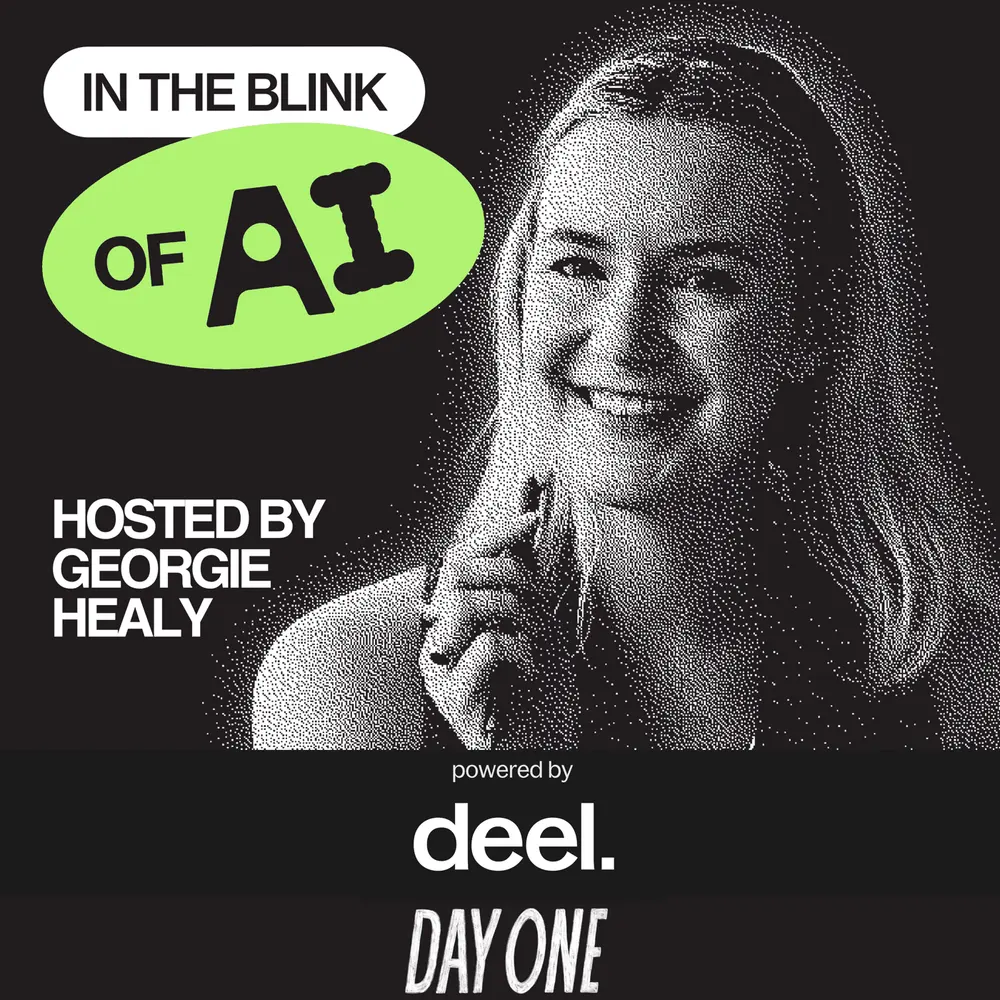 In The Blink Of AI with Georgie Healy
Presented by Deel & Stripe
In The Blink Of AI with Georgie Healy
Presented by Deel & Stripe 


 ▶
▶  ▶
▶  ▶
▶  ▶
▶  ▶
▶ ▶
▶ ▶
▶