Transcript Synced · select any line to jump ▾ 0:02 Georgie Healy: Founders scale faster on Deel. Set up payroll for any country in minutes. Hire anyone anywhere. Get visas handled fast and get back to building. Visit deel.com/dayone. That's D-E-E-L.com/dayone. 0:21 Colm Flanagan: Robotics is the platform that hasn't really been able to leverage large language models to the extent that maybe other industries have. And the main reason for that is that to leverage the benefit of big large language models, they have to have cloud connections so they can actually ping data off to them. Now, when robots are moving around, they very often don't have the luxury of pinging a cloud to get a decision and waiting for it to come back. So they have to have everything embedded on that particular robot within, within reason. You're in a self-driving car and it's tearing down a motorway at 110 kilometers an hour, decisions have to be lightning. And if we want to use machine learning for those decisions, we have to have small models that can be embedded on physical computers. 0:56 Georgie Healy: But when you say there's a robot and it's watching us, that's remembering things. I do get slight ick from that. 1:03 Colm Flanagan: Yeah. 1:03 Georgie Healy: How do you tell people that it's okay? Hello and welcome to In the Blink of AI. I'm your host Georgie Healey, and today we're going, we're going hard on robotics. We've got the incredible Colin Flanagan. He had a PhD in cognitive memory in robots way before it was cool, way back when people were mean to him at dinner parties about it. And now Everybody wants a piece. We dive into how non-engineers like me are finally using API keys and vibe coding and things are working. We go into the next big leap in AI and maybe in the physical world. No spoilers. Have we reached the limits of what neural networks can do? Can we really extrapolate LLMs to get us to AGI? Thank goodness Colm's on the show to dive into that. We also yarn about classical music and engineering and some interesting overlaps there. And fundamentally, this show is going to entertainingly teach you about AI in a way that doesn't feel like homework and feels like fun. With that said, let's dive into the show. People who want to smash 2026 and use AI but not get overwhelmed, do you have a hack of the week for us? 2:18 Colm Flanagan: So I was thinking about this and I probably don't really have a hack because I think, like you were, we were kind of just discussing earlier on, I think people are a little bit bombarded with hacks. I think when you ask a large language model a question, you think you're asking it, what is the answer to this question? What you're actually asking it is, what should the answer to this question look like? So from that perspective, when I kind of started to just fine-tune my approach to how I dealt with these things or use these things, it definitely removed a lot of that frustration. But also I realized that if you actually just get it to say, look, cite me some sources where you're pulling this information from, definitely improve the quality of the answers that I was getting back. Because again, it forced these things to actually try and pull from some recent information that it could then try and answer the question from. And the answers that I was getting were a lot more accurate. 3:01 Georgie Healy: Interesting. And we'll, we'll definitely go into models and things, but is there a specific problem that you were getting frustrated with? Is it a technical problem this often happens in, or is it more of like a business decision-making thing? 3:14 Colm Flanagan: Yeah, I think probably more from the technical side of things. If you're trying to understand some really complicated, nuanced concepts, or if you're trying to get it to help you and, or try to get it to sort of educate yourself on some new things that you haven't really been brought up to speed with a little bit more. That's where I find it particularly helpful. And for things like business decisions, I tend to stay away from large language models of any kind for those types of decisions because there's so much external information that you're— it just cannot possibly be considering that will go into you making those decisions. And a lot of it's gut feel. 3:42 Georgie Healy: This gut feel thing— so I was arguing with my husband about this. He was like, Oh, me and everyone on Reddit removes personalization for AI. I'm like, what do you mean by personalization of the models? And he's like, oh, um, where it remembers my context, my previous history. And I was like, what? No, I need all of that so that I don't have to keep reminding it of context and all of that. Do you like it or dislike it if it's got all of the previous context? 4:10 Colm Flanagan: Uh, it depends really on what are what I'm actually doing. Like, I think if I just open up a new chat and I want to just ask it some random thing, like, just like— 4:19 Georgie Healy: Don't be clouded. 4:20 Colm Flanagan: Yeah, exactly, don't be clouded. Just give me the answer, right? And just give it to me really quickly, especially if it's something like as simple as, how do I reset a Git commit? Which, embarrassingly, I am still asking this thing probably every 2 days. How do I actually do this? 4:32 Georgie Healy: I'm so glad they can't judge us. 4:33 Colm Flanagan: Exactly, I don't want it to be constantly coming back. I was like, well, the last time we went through this— 4:37 Georgie Healy: You asked this yesterday. 4:39 Colm Flanagan: You asked this yesterday. 4:40 Georgie Healy: Your answer is the same. 4:41 Colm Flanagan: My answer is the same. You're not learning. I'm gonna start getting frustrated now. But then if you're obviously, if you're working on a project or you're working on something that requires it to sort of maintain a bit of an understanding, and that's good, but it also, it can be problematic. I mean, there is still a context length to which these things can realistically remember some, remember information from previous conversations. And if it sort of starts going outside of that, again, revert back to, you're not asking this thing the answer to the question, you're asking it, what should the answer to this look like? 5:08 Georgie Healy: Yeah. 5:08 Colm Flanagan: Right. And I think that's where a lot of people are not quite at yet, and that they just assume that these things will be correct 100% of the time. No AI is correct 100% of the time. No machine learning model is ever going to be correct 100% of the time. These are probabilistic models, and they will make mistakes. And any— like, that's just not just large language model, that is any kind of machine learning that's out there. And look at recommendation engines. I mean, how many times do you— does something pop up in your YouTube feed or your Instagram feed, you're like, what has this got to do with me? 5:35 Georgie Healy: Why was this served to me? 5:36 Colm Flanagan: Why was this served to me? And there's, there's probably any number of underlying reasons, many of which we can't possibly begin to understand as to why it's there, but it probably is wrong for you. Um, I still will watch it. 5:47 Georgie Healy: Say this too, because I feel like there's many of us that are like, how dare it be wrong? And it's like, one, have you seen how far they've come in recent years? And two, like, we were never this critical about Google search and stuff, and so much was wrong and inappropriate and not what we were looking for and would waste so much time. My hack is You know, if you follow me on Instagram, I was just so excited because speaking about improvements of models, I remember as a non-engineer who cannot code, being given scripts, copy-pasting them to solve a certain problem, and the number of times it would say to me, no, that definitely is working. And I'd be like, it isn't. 6:29 Colm Flanagan: It isn't, yeah. 6:29 Georgie Healy: It really isn't. That API key is the right one. Soz about the last one. 6:34 Colm Flanagan: Yeah, yeah. 6:34 Georgie Healy: No, it's not. Still not. And I would waste hours just being like mashing the keyboard, copy pasting code that I didn't understand. Nothing was happening. I was like, this is never gonna work. I need to be an engineer. And guess what? It's working for me now. Things are working. 6:51 Colm Flanagan: Yeah. 6:51 Georgie Healy: I had, well, I wanted to do was pull something outta my Gmail. Like every time I got a transcript, save it to this folder, use Gemini to pull certain things out of it, save that to a different folder. I'm using API keys, I'm using— technically, I think they called it an agentic workflow. I don't know if that's true or not, but it's all working and seamlessly. And I'm— I don't know what happened. What happened? 7:19 Colm Flanagan: Yeah, I mean, to be honest with you, I'm not entirely sure what happened. They did— there was just all of a sudden that stuff went from my code doesn't work to all my code works. And now I think that might be something to do with context length. I mean, right when sort of ChatGPT first came out, back about 3 years ago, if you were to give it confined snippets of code, it would always get them correct, right? If you would say like, I need a function to perform this particular duty, it would be correct and the code would be really, really good. And then as you started to expand out and it would start to lose the run of itself a little bit. And that's also true if you look at right back to when transformer neural networks were coming out and we're starting to see the first language models being developed and these would be GPT-1, 2, 3, et cetera. And you'd, you know, you'd put in a prompt and then it'd be really good for like a paragraph and then it would just lose the run of itself. Same thing's happening with code, right? It's just generating code and it was able to generate it up to a certain point really effectively. And I think as these things have gotten bigger, they're just able to deal with more information, they're able to have these longer context windows. Has the actual underlying technology changed a huge amount from those earlier models, or is it just that they're bigger and have more information? Not actually 100% sure. It could be a little bit of both, but I think that's probably what we're seeing. You generate text now and it's a lot more coherent for a lot longer. 8:28 Georgie Healy: Yes. Yes. 8:28 Colm Flanagan: Same with code. Eventually it does hit a limit and it does start to lose the run of itself. 8:32 Georgie Healy: Yes. 8:32 Colm Flanagan: And I think for the most part, most of us never hit that limit because we're not trying to write War and Peace for them, for the most part, right? We're trying, we're trying to just get an email refactored or we're trying to get a snippet of code done. 8:42 Georgie Healy: Yes. 8:43 Colm Flanagan: And so the majority of us never hit those, those, those limits and those windows. 8:45 Georgie Healy: Very interesting. My biggest hack would be if, if you've struggled in the past, give it another go. 8:51 Colm Flanagan: Yeah. 8:51 Georgie Healy: Because I, I was really shocked and impressed by, look, Mom, I'm coding. Okay, I have some big picture headlines that it's like, ask an engineer. 9:05 Colm Flanagan: Yeah. 9:07 Georgie Healy: This rhetoric keeps happening, friends, headlines, the rest of it. How are two things true, Colm? How have we got AI is progressing at lightning speed, people can't keep up, the tooling, the tech, everything, people are overwhelmed, but also I keep hearing, models are not actually incrementally better from one to the next. Is AI speeding up, or is it slowing down, or both? 9:32 Colm Flanagan: To probably answer that question, probably need to just look a little bit about what AI is. And AI is a field, it's a discipline, right? There's lots of different types of AI for solving lots of different types of problems. Some types of AI are still accelerating rapidly, and those might be the types of AI that the majority of us never encounter, right? They're just not really all that relevant, or they're solving problems, sorry, that the majority of us never really encounter. And so it might just be outside of the scope of what we're observing, whereas other things like large language models, as is the flavor of the last 3 years, we do observe them and we can use them. And yeah, I think in my opinion they do appear to be plateauing. I think we're probably not a million miles off a point of saturation as to what we can do in terms of the quality of the responses that we can get out of these systems. Uh, I think we very often see them perform sort of weird tasks that sort of bring us back 3 years. We go, oh, okay, there's still a long way to go here. So I think, yeah, maybe some types of AI are plateauing, other types of AI still accelerating. 10:25 Georgie Healy: That data ceiling, how close are we to it? Have we boiled the internet? Have we ingested all the data in these models? And if yes, how do we improve the models from here? And can we? 10:36 Colm Flanagan: Yeah, it's a good question. To be honest, I don't really know if we have boiled the internet. I think we can probably always give these things more, more data and they'll learn more facts. And they'll be able to regurgitate more facts. Whether or not the quality of the answer in terms of its ability to reason and to actually think about what it's put out there is getting any better, I don't know. So we may have hit a data ceiling. We may find that there's some underlying stuff going on in some of these new companies that have billions of dollars in funding and nothing out there yet, that there's going to be some pretty significant developments coming along. Who knows? Also, I'll give maybe two opinions on this. One is a bit of a throwaway remark, and I'm not going to back it up with any facts or ideas myself. Don't ask any more questions. And it's like, okay, have we actually reached the limit of what neural networks can do, right? Have we actually hit that ceiling of what a neural network itself can do? And if so, do we need to completely rethink the entire theory behind machine learning to get any, any, any better at this? To get this— and I'm sure we'll touch on the AGI topic at some point today, and we've got— I've got my opinions on that. But do we need to completely rethink— if that's what we're going for, do we need to completely rethink the whole theory behind machine learning? Now again, I said I'll throw that out there without actually providing any ideas of my own because I don't really have any at the moment. The other thing that I think we might see from sort of an improvement now in the next generation of models, and I think robotics is gonna have a huge part to play in this because robotics is the platform or is the field or the discipline at the moment that hasn't really been able to leverage large language models to the extent that maybe other types of, or other industries have. And the main reason for that is that Robots are physical entities present in our environments, and if they want to leverage the benefit of big large language models, they have to have cloud connections so they can actually ping data off to them. Now, when robots are moving around, they very often don't have the luxury of pinging a cloud to get a decision and waiting for it to come back. So they have to have everything embedded on that particular robot within, within reason, and particularly with self-driving cars. So if we want robots to be able to leverage the benefits of these incredible machine learning systems, we're going to have to work out how to get them smaller. Now, again, I'm throwing that out there without any real ideas myself as to how we do that. There's probably a whole— say that again, sorry. 12:48 Georgie Healy: Heard it here first. 12:49 Colm Flanagan: Heard it here first. Someone solve this. 12:52 Georgie Healy: Yeah, go ahead and do it. 12:53 Colm Flanagan: Don't get me involved, but go ahead and do it. But I think that probably is what needs to happen or what will happen next. I think robotics will drive a huge amount of the next generation of research that we see, because we're starting to take on robots more and more, right? They're starting to become cheaper, they're starting to become less cumbersome. And drones were the first thing that started to become quite mainstream. Self-driving cars are going to become quite mainstream. And self-driving cars, just one massive glorified robot. So I think as the robotics sector starts to develop more, as robotics start to become more commonplace, particularly within logistics, supply chain, transport— defense is a huge one that's employing robotics— and defense and is in particular has a real requirement for embedded models because very often they're operating in network-constrained environments. They simply can't access something that's on the cloud. If you've got a domestic robot and it's sitting in a corner and you ask it to do, do something for you, okay, it might take a couple of seconds to go off to the cloud, come back with a decision, and then go off and do it. You're not too concerned, right? But if you're in a self-driving car and it's tearing down a motorway at 110 kilometers an hour, decisions have to be lightning. 13:54 Georgie Healy: Yeah. 13:54 Colm Flanagan: And if we want to use machine learning for those decisions, We have to have small models that can be embedded on physical computers. Wow. 14:00 Georgie Healy: I have never heard this take before in my whole life. I'm thrilled to be partnered with Stripe for today's episode. Did you know that Stripe Startups offers early-stage venture-backed startups access to Stripe fee credits, expert insights, and a focused community of builders? We love builders on In the Blink of AI. Apply today at dayone.fm/stripe. You've got a PhD in— let me, let me make sure I say it properly— episodic memory for cognitive robots in dynamic unstructured environments. Did I get that right? 14:43 Colm Flanagan: I think so. It's been a while. 14:45 Georgie Healy: I had to look mine up. I don't have a PhD. I have a thesis though. Interfacial Surface Chemistry and Surfactant Absorption Mechanics in Quarry-Derived Aggregates. We both have some real page-turners, I tell you. Yeah. 14:59 Colm Flanagan: Actually, yours is— Bad time reading. 15:00 Georgie Healy: Yours is around memory and robots. I'm fascinated. What were you trying to figure out with your PhD? 15:08 Colm Flanagan: So, there's a lot of definitions of what a cognitive robot is. In my opinion, a cognitive robot is one that can learn through interactions with its environment. Now, with really any kind of AI, actually, this doesn't really just relate to cognitive robotics, What we're trying to do is we're trying to understand how our brains will perform certain tasks, and we try and formalize the process by which our brains do that, implement it on a computer, test it, and see if it can do things to the same extent that we can do it. Now, learning in neural networks is how we thought that, or how we think currently, information is learnt in, in, in, inside our minds. But, and there are other types of, um, cognitive capabilities that we have and other types of learning or memory that we have. And so what my PhD focused on was looking at concepts like episodic memory. And episodic memory is the part of our memory that retains events that have context to them. So, right now, it's a Wednesday morning in the middle of January, and you and I are sitting here in this room, and we're having a chat on a podcast. Right now, in about a year's time, I'll probably be able to recall that event with maybe a little bit less context around it. I'll know that it was sometime in the middle of summer, and it was somewhere in the CBD, but crucially, the main parts of the event are still there. Now, Semantic memory is just information that we know, right? You know that Abraham Lincoln was the president of the United States in 1860. You don't really know that. 16:21 Georgie Healy: I didn't know the date, but yes. 16:23 Colm Flanagan: Around then. And I probably, I might've gotten that wrong. Any historians out there, please don't correct me. But you know that, you don't really know how you know it, but you just know it. And it's a fact that's embedded in your memory and you can recall it when and if you need it, however often you do need to know that information. Now, what we're trying to look at is, is there a transition between events that are episodic and semantic memories? Is there something that happens? Is there a way in which memories degrade gradually over time such that just the crucial bits of them are remembered and retained for use later on? 16:49 Georgie Healy: Mm-hmm. 16:49 Colm Flanagan: So, for example, and to ground it in a real-world context, we're sitting here, and let's say we make this a weekly event, and we've got a robot that's watching us in the corner. And let's say the robot sees the two of us sitting here having a chat, knows that it's a Wednesday morning, and somebody brings us two cups of coffee, right? So, it's seen two interconnected events. Well, over time, the robot might realize that, well, if Colin and Georgie are sitting here on a Wednesday morning, they drink coffee, I'm just going to go and get that coffee, right? But the specific parts of that event that are relevant are the context to it, the time, the location, who's actually involved. If, say for example, we knock one of those cups of coffee off the table and it shatters, well, the robot should go and get the stuff to actually clean it up. Now, it doesn't matter where that happens. It doesn't matter if that happens in this room, in, uh, the kitchen, in the dining room, outside, the recall or the expected behaviour is exactly the same. So in that particular case, the context that surrounded that event or that type of event was less relevant. And so it was about trying to develop a learning mechanism that robots could engage that would allow them in both situations to, over time, figure out what is and isn't relevant by certain observations so that they could try and more effectively engage the right recall behaviour. 17:58 Georgie Healy: What year did you do this in? 18:00 Colm Flanagan: I think I graduated 2022, 2023. 18:02 Georgie Healy: My gosh, so you're very ahead of people talking about this because this is huge now. 18:07 Colm Flanagan: It is big now, yeah. And I mean, yeah, this is one of the— I think for a lot of people in the AI community, we're both relieved and a little bit miffed that all of a sudden this stuff has kicked off. 18:17 Georgie Healy: You're a hero now. 18:18 Colm Flanagan: Well, exactly. I mean, I've been blue in the face for the last 10 years telling people how amazing this is. And the amount of dinner parties we've been asked to leave, just being like, can't listen to this column, please just stop about the AI, and then all of a sudden it's like, can you come back in and talk about this AI stuff? Like, it's— what were you going on about there? 18:33 Georgie Healy: Yeah, yes. Okay, well, you know, I bring you here and then I'm going to tell you all the things that scare me about robots, which is really nice of me. But, but when you say there's a robot and it's watching us, it's remembering things, I, I do get slight ick from that. Now, I got the ick from Uber, just to be fully candid, I got the ick from Airbnb when I first heard about it. I got the ick from Waymo when I first heard about it, and now I'm obsessed. So, so, you know, that can happen and, and, and evolve over time. But the idea of the privacy aspect, how do you, how do you tell people that it's okay? 19:11 Colm Flanagan: It's, it's a tricky one, um, and it's, it's something that I myself, despite having researched it, would also get a little bit of an ick about. I'm not keen on the idea of a robot sitting in the corner and watching what it is that I'm doing. I like it from a theoretical perspective. I like seeing what can we get these things to do from a theoretical perspective. From a social setting, yeah, I'm less keen on it myself, to be perfectly honest. Now, over time, we'll probably just start to normalize these types of things in the same way that we normalized the fact that we know our phones listen to us and we know they pick up on bits of our conversations and they target ads at us. And initially, when it all started happening, Everyone was a bit freaked out. People should probably still be a bit freaked out if you ask me, but we've kind of just normalized and been a bit sort of desensitized to it all. Probably the same thing will happen with robots. I mean, we have robots in the house already. We have vacuum cleaning robots. 19:58 Georgie Healy: They're there. I have a vacuum cleaner robot. 20:00 Colm Flanagan: And they've got cameras and they connect to the Wi-Fi and they make maps of your house and they make maps of your home because they have to. And that gets stored in the cloud because it has to be. And that information is out there now, right? Your house is mapped. And it's somewhere out there and there's pictures of it all over the place. And we kind of balance up the pros and cons of it and go, well, I'm not going to Hoover myself, so— 20:21 Georgie Healy: Yeah, I've got a cat and a rabbit and two small children. I'm like, yeah, you can take photos of our face. 20:26 Colm Flanagan: Exactly. There's a trade-off that we're willing to accept there. And so once that, I think, trade-off, once the benefits of having these things becomes or outweighs the social qualms that we might have about them, that's when I think we're going to start to see them en masse. Yeah, it is a valid concern. 20:42 Georgie Healy: Yeah. 20:43 Colm Flanagan: Because every aspect of our life is tracked right now. I mean, the reason we can get real-time traffic information on Google Maps is because every single person in every other car has Google Maps downloaded. 20:52 Georgie Healy: Oh my God. 20:52 Colm Flanagan: And Google knows where every single person is at every given time, and therefore can work out how fast everyone's traveling, and therefore work out if there's a traffic jam. And so we're always being constantly tracked, even if Google's— when you open an app and ask, can you use your location? Yeah, very often that's just because they need to know where you are in the background because they're going to be selling that information to somebody like Google who might say, okay, we're going to use that to try and— 21:15 Georgie Healy: I mean, look, you're on YouTube, I'm gonna find an ad related to— 21:19 Colm Flanagan: exactly, exactly. 21:20 Georgie Healy: Yeah. 21:20 Colm Flanagan: Oh my God. So, and that's not new, right? That is not something that's, that's, that's in— that's become in the last sort of 3 years like the rest of the AI revolution has. That's been going for quite a while. It definitely is something that I think we should all be concerned about. Cookies on websites, same thing, right? I mean, when you open up a website and it says, will you accept cookies? Half the time you just go, yes. If it rephrased the question to what it's really doing, which is, can I drop a tracker on you? You go, absolutely not. 21:45 Georgie Healy: Hell no. 21:46 Colm Flanagan: But that's essentially what it is, right? It's a tracker and it's just keeping an eye on what you're looking at and then saying, okay, Georgie's really into this stuff, and we've seen that people who are similar to Georgie are really into this other stuff. Maybe she'll be into this, really, to this other stuff. Target it out and see if we can get it to buy it. 22:01 Georgie Healy: Can I tell you my rant of the week? 22:04 Colm Flanagan: Absolutely. 22:04 Georgie Healy: And maybe I'm wrong. I'd love for you to tell me if I'm missing something. OpenAI just introduced ads for the free tier. How do you feel about this before I tell you my rant? 22:15 Colm Flanagan: Um, well, I think it was probably expected. I think, uh, and again, we probably will come to the, to the whole AGI debate at some point, I've no doubt. But I think OpenAI have raised a lot of money off the back of something that I don't think they can achieve. And they needed to urgently figure out how else to monetize what it is that they have. And advertisements are a great way to do it. I mean, people are using these things. I mean, there's hundreds of millions of people every month using these things to search for stuff. 22:43 Georgie Healy: Yeah. 22:43 Colm Flanagan: And so ads is a really good way for them to actually do it. Now, we knew that at some point they would have to start generating revenue. These things can't— they can't just keep flogging VCs for billions and billions of dollars of cash. At some point they're going to say, when are we going to get that back? So I think we knew it was going to happen. Am I surprised? Am I really that concerned? Probably not. At some point in my life, I'll probably— at some point in my business, I'll probably start to make it— take advantage of that. And truthfully, I mean, it is a good way to try and get your stuff out there. 23:09 Georgie Healy: Yeah. 23:09 Colm Flanagan: Google introduced ads ages ago. YouTube introduced ads ages ago. All these other platforms do it. What I think it might do a little bit is erode away at some of the— well, it's definitely going to erode away at the trust because they came out and said that they wouldn't do it. Now, that was, you know, they had this big qualm about advertising on their platform. They said they wouldn't do it. They're now doing it. So it's a case of, well, what else are they going to start to do now? 23:34 Georgie Healy: They said a lot of things they wouldn't do. 23:36 Colm Flanagan: Exactly. Yeah. And they also said a lot of things they would do that they haven't, right? So I think, yeah. 23:40 Georgie Healy: Shouldn't we have AGI now or something? Yeah. 23:42 Colm Flanagan: I thought it was supposed to be there. Yeah. 23:43 Georgie Healy: Yeah. Look, this is very much shower thoughts, but the reason it upset me is not introducing ads so much. I do— I so agree with you, it was kind of a matter of a time. Um, they have to— their business, they have to, you know, break even at least. But my shower thoughts were more around the inequality of not everyone can pay for subscriptions to, to all the LLMs. $30 a month is just not possible for some people, and they're going to have ads to respond to them in a relationship where many people are using these LLMs as a, as a therapist. 24:22 Colm Flanagan: Yeah. 24:23 Georgie Healy: As a teacher, as a best friend, as a parent figure. Like, like, there's a lot of loaded, um, unlike with, you know, social media where you are the product, we know you're the product because you're not paying for anything, um, or YouTube ads. Maybe people can make the link that these things are a closer relationship, but I feel like a lot of people are seeing that as, yeah, as a bit deeper. 24:48 Colm Flanagan: Yeah. And that's a valid point. And I think, you know, there is going to certainly be an inequality. I think there's an inequality with any technology and access to any technology, and this is going to be no different. AI is not the first time that a lot of people have decided to become reclusive on the internet, right? And to just be alone with their thoughts and to try and find comfort and solace outside of reality, right? So I mean, Instagram and social media has been very, very responsible for this. Uh, one of the— I think maybe if it's done correctly, is that if people are confiding in these large language models because they respond and because they're actually responding to what these people are saying, there might be an avenue by which we can maybe say, uh, maybe actually go and talk to somebody about this, right? I mean, maybe, maybe instead of confiding in me, which is just a bot on a cloud, maybe you should go and talk to somebody about this. Now, whether or not that will happen, I don't know. Whether or not that's a good idea, I don't know. 25:39 Georgie Healy: I don't want to keep them on the platform. Won't that be the best thing for OpenAI? 25:43 Colm Flanagan: For OpenAI, yeah. 25:45 Georgie Healy: To stay on the platform. Don't go speak to someone, speak to— 25:48 Colm Flanagan: speak to me. 25:49 Georgie Healy: Very Black Mirror about it. 25:50 Colm Flanagan: It is very Black Mirror. And this, this will come down entirely to the, to the, uh, ethical principles that OpenAI decide to run the company with. But, uh, I mean, there is, there is an opportunity, unlike say, for example, where people were just consuming, like, content constantly on Instagram and Facebook and YouTube that was really damaging for them, um, and giving them a completely false perception of reality. But they were going deeper and deeper into it and becoming more and more reclusive into it. But it was very one-way, right? It was one-dimensional traffic. It was me looking at something or me observing something. 26:21 Georgie Healy: Yes. 26:21 Colm Flanagan: And nothing— I'm formulating my own opinions on it. Now, whether or not we will be able to reverse that cycle a little bit with large language models, I don't know. Whether or not it's a good idea, I don't know. Again, this is not me actually trying to promote this particular idea. This is something that cognitive psychologists out there will have a much greater understanding of and a much more valuable opinion of than I will. But, you know, it's one possible way that we could utilize these things a little bit more positively. 26:50 Georgie Healy: Look, we have been teasing people about AGI. What is AGI? And if we were going to have it by 2025, '26, or even as late as 2030, as Sam Altman has predicted, what would be the signs that we're getting close or that we're on the path? 27:10 Colm Flanagan: Truthfully, I think it's very difficult for us to say that. So, like AGI, right, if you look at the definition of AGI, it's AI that meets or surpasses human performance in any given task, right? And that's fine. Or human-level intelligence, let's just say, in any given task. Now, there's two challenges to that. There's the theoretical challenge of Can the models that we're currently training do that? There's a philosophical one, which is, can we define what human-level intelligence is, right? Can anybody say to me, this is what human-level intelligence is, and here are the metrics and the benchmarks by which we can establish that you've got human-level intelligence, and therefore if it exceeds all of these— 27:41 Georgie Healy: I don't even know if I have human-level intelligence. 27:42 Colm Flanagan: Exactly, yeah. And people have so many different types of ways in which they're intelligent. And I mean, I think we've all now agreed that IQ tests are a pretty archaic way of addressing somebody's intelligence. And if it were purely an IQ test, these things would have smashed it out of the park already. 27:56 Georgie Healy: Yeah. 27:56 Colm Flanagan: Because it's all just based on questions and whatnot. So I think there's a very philosophical barrier for us to establishing, yes, definitively we have AGI, because we can't quantifiably define what human-level intelligence is. Now, if you then take the other argument of, let's say, okay, well, we know it when we see it. Let's establish that as the benchmark. We know when we see it as like, okay, great. Well, we're nowhere near it at the moment. I think we can all agree on that. Others might have different opinions, but I personally don't think we're anywhere close to it at the moment. And I would have my doubts about whether or not the models that we're currently pursuing, that being neural network-based models, really have the capacity to ever actually get there. These things are still probabilistic models. When you actually look underneath the surface of them, they are making best-guess estimates as to what the answers to these questions should be. They're probabilistic, and I don't know if we do or don't think in probabilistic ways. I don't know how the inner mechanisms of our brain actually work, but it's a lot more complicated. I'm suspecting it's a lot more complicated and nuanced than that. And I don't think, even if we can use that benchmark of, I know when we see it, I don't think we're anywhere near there yet. Will we get there by 2030? Who knows. What are the signals to say that we're getting there? I also don't know. Uh, bear in mind, models that sit on the internet learn from data that's on the internet. It's predominantly text-based data. We learn through a lot of different ways, right? We don't just read the internet and then become intelligent, right? So we learn through observations with our environment, we learn through interactions with each other, uh, through lived experiences, through other people's lived experiences. There are all these things that we ingest that these things are not ingesting, and all of that contributes to our development and to our ability to exist intelligently, if you like, for lack of a better word, in the world that we're in at the moment. So if we're not exposing these things to those types of interactions, are robots going to be the way to do it? 29:39 Georgie Healy: Yeah, maybe. Ooh, interesting. 29:41 Colm Flanagan: If robots are also now getting a lot more of those real-world context cues, maybe they're the clue, the cue to all of this. I don't really know. I think it's going to be an interesting period. I think we'll probably start to see a little bit of the AI hype waning off over the next few years. I think by 2030, even if they do say, oh, we've now got AGI, people will be like— 30:01 Georgie Healy: We don't care. 30:02 Colm Flanagan: Thumbs up. Yeah, good for you. And we've moved on. 30:04 Georgie Healy: It's interesting, isn't it? Because I do remember even a year or two ago, everyone was like, oh, matter of time before we've got AGI. Like that was the thing that we all wanted for some reason. And now everyone's like— well, everyone— a lot of intelligent engineers are saying, "I don't think these models are ever going to get us there." No. 30:21 Colm Flanagan: Or why are we trying to? 30:23 Georgie Healy: Why are we trying to? 30:24 Colm Flanagan: Why are we trying to? 30:24 Georgie Healy: Why does Sam Altman want this so badly? 30:26 Colm Flanagan: I've got no idea. Maybe it's a power thing. Maybe it's because he spent so much time talking about it, he can't now backtrack and go, "Oh, we actually want other things." I think you're right. It might just be that he's got this sort of sunken cost fallacy of, "I'm in too deep here. We need to keep going for this." And I mean, I always describe when people ask me like, what is AI? I'm like, well, AI is the field of study concerned with building machines that think and act like people. Now, the key word there is it's a field of study. It's a discipline. There's lots of different types of AI, each uniquely positioned to solving different types of problems. Think of it like a toolkit, right? Now, if you go to build a house, you will have lots of different types of tools. You'll have hammers, you'll have drills, you'll have large-scale machinery, you'll have all this sort of stuff. That can assist you with building a house, and you will apply different types of tools to different types of problems in constructing that house. And you know, based on the type of problem, what kind of tool is right. If you start painting the walls with a hammer, just because it's a tool that's also used in constructing the house doesn't mean you've actually done any, uh, anything good here. You've actually created more harm. Now, everyone was happy with the toolbox that we had. We were all aware that— and no, no carpenter or builder anywhere has ever said, can I get one thing to do all of this for me? Like, no one's ever asked for it in that context, and I don't know why we're asking for it in this context. Maybe that's just my opinion. I think that the approach of building AI models that are narrow, that are targeted to solving a specific type of problem and doing it really, really well, is a much more progressive path forward. It's a much more beneficial path forward, and it's one that we can leverage a huge amount more from. I don't know what we get from having AGI. I don't know what we really benefit from it, uh, apart from satisfying some egos that you know, we could, we told you we could do this. 32:01 Georgie Healy: Yeah, I truly don't know when that became the North Star for some of these companies and startups. Speaking of which, I'd love your hot take. We've just seen Yann LeCun leave Meta. We've seen 3 founding AI engineers leave Thinking Machines Labs, or when is this nothing? Just people, people move, people change jobs, that's fine. And when is this a big deal? When is it like, oh, this— there might be blood in the water here. 32:33 Colm Flanagan: Yeah, um, I think like any business, uh, there's, there's probably always going to be philosophical differences between co-founders that— as to how we, we run these things. Uh, that might be what's happened here. Uh, there might be just a philosophical difference as to how they're going to try and monetize this, how they're going to try and commercialize it, the, uh, the value that they're trying to actually bring. That might be what's going on here. There might be a much more underlying, um, challenge here, which is that what was claimed during the pitch raise is simply never going to happen. And now there's billions of dollars sitting on the table and people are going, I want nothing to do with this when the revolution comes. And that might be it. Now, I think if it's the former of those two, that's just pretty common place differences that people have and they'll separate and move on. If it's the latter of those two, there's a lot of money being thrown behind some of these big companies. And it's not just Thinking Machines. There's a lot of these companies, like Ilya Sutskever, I think that's his name. 33:22 Georgie Healy: Yes. 33:22 Colm Flanagan: He's also raised billions of dollars, I think, for his company. We haven't really heard about what these guys are trying to do. Now maybe it's going to be that in 6 months' time they come out and they produce something that just blows us all out of the water. 33:33 Georgie Healy: Oh, they're still freaking out in the lab. 33:36 Colm Flanagan: But right now they're still freaking out in the lab and they're still trying to work out— maybe, maybe they're trying to work out what are we trying to do here. I think everybody's going to be disappointed if it's just another language model that comes out in the market. I don't think— I think we're, we're feeling a bit of— 33:47 Georgie Healy: We've got enough of those. 33:47 Colm Flanagan: We've got enough of those. And I think we're feeling a bit of market saturation with, with language models at the moment. Uh, so yeah, It's, it's difficult to know what's going on internally. Like with any company, you'll see it on LinkedIn all the time. I've moved on from so-and-so, and you're always like, oh, what happened there? You always want the gossip and the drama, but it could be something as simple as just they didn't get along, they didn't quite have the chemistry that they thought they were going to have. Or it could be something more substantial, like we've claimed something that we can't do here and we've raised lots of money, and at some point that's going to come back to bite us, and they might just be trying to wash their hands of it. I don't know. 34:19 Georgie Healy: Yes. 34:20 Colm Flanagan: Any number of hypotheses that could be thrown out. There could be other things as well. 34:23 Georgie Healy: Yeah. One day there'll be a tell-all book and I can't wait. 34:26 Colm Flanagan: I can't wait, yeah. 34:27 Georgie Healy: I mean, you're building frontier technology with frontier information, especially in the robotics space. Like, this is very hot right now. How do you play with that balance between getting VCs, like, stars in their eyes and getting them very excited about an idea and actually being like, I just want to follow through on this and prove that I can do something. To your point, your dinner party earlier where you're like, I was so passionate, no one got it then, and now everyone's excited. How do you play with those dynamics and deliver promises and things like that? 34:58 Colm Flanagan: Yeah, I think VCs are becoming a bit more savvy now. And I think to their credit, they're becoming a bit more savvy. They're not jumping to the next kind of shiny thing as much as they were maybe 2 years ago. And they're starting to ask for a lot more market validation and proof points, much to my dismay. Yeah, maybe you want proof. Yeah, I'd much rather they're just like, we get it. 'Take my money, take my money.' Yeah. Now, there is still, for some types of businesses out there that are doing really completely out-there stuff where they come out and be like, 'We've got no idea if there's a market out here for this, but it's really cool technology,' there is still cash getting thrown at that sort of stuff. And I absolutely tip my hat to those people. I've got huge admiration for them that are raising money doing that. And we need it. We need people to just say, 'Yeah, that's interesting, that's innovative.' Even if that specific thing doesn't work in the market, there'll be loads of other things that will come out from it that we can use elsewhere. Great to have all of that. But I think, and to your original question, how do you sort of balance that up? You want to try and play to the hype a little bit, but I think VCs are getting more savvy, investors in general are getting more savvy, and consumers are getting more savvy. 35:54 Georgie Healy: Yeah. 35:54 Colm Flanagan: And we're no longer just believing everything that these big AI companies are claiming. And we're— 36:00 Georgie Healy: If huge companies lie, then it's like, well, yeah, we're a bit on edge. 36:05 Colm Flanagan: We're a bit on edge, yeah. And I think for the most part, businesses should need to prove that there's a market for what it is that they're trying to trying to create here. And when they do that, there will be cash available. I think, yeah, that's probably where we need to start seeing things go again because there's been a lot of money. I mean, when I say a lot of money, like hundreds of billions of dollars invested into pretty outlandish claims. And I'm not entirely sure where that money's going to come back from. 36:28 Georgie Healy: And— Yes. 36:29 Colm Flanagan: I'm no financial expert, so I'm extremely hesitant to go into what I think is going to happen there. 36:33 Georgie Healy: I think I've just watched like from X. 36:36 Colm Flanagan: Yeah, but it's giving Big Short vibes. It's like— It really is. 36:40 Georgie Healy: It really is. Great movie. Um, one more question about you as a founder. I was so thrilled when I did my LinkedIn stalking. Um, you've got a background in music performance, specifically piano. I thought I was a special snowflake having engineering and music in my background, but there's quite a lot of us. Have you noticed this? And firstly, did you learn how to read music, or did you learn to read first? I'm curious. 37:08 Colm Flanagan: It was around kind of the same time. I went to sort of music kindergarten when I was like 3 or 4. 37:13 Georgie Healy: Oh my goodness. 37:14 Colm Flanagan: And where you would have kind of started to learn the equivalent of the ABCs. 37:17 Georgie Healy: Yes. 37:18 Colm Flanagan: So yeah, probably around the same time, learned to start to read both of those. 37:20 Georgie Healy: And do you see a link between the maths and the music or not? Absolutely. 37:27 Colm Flanagan: Oh no, 100%. And I think there's the anecdotal observations that I have of playing in youth orchestras when I was younger, like all the cool kids did. Everybody in those orchestras, for the most part, they were all taking subjects like physics and maths and applied maths and chemistry in, in, in school. And so there was that clear anecdotal observation that I had of a lot of these people are also extremely competent from a mathematical perspective. But then there's also the more empirical, and people have really studied this in, in great detail. And I mean, if you look at music and music composition in particular, it can be very, very regimentally formalized. "Right, we can establish a very clear set of rules and constraints that can't be violated, and when they do get violated, the whole thing very quickly falls to pieces." Sounds like garbage. It sounds like garbage. And I think to them, that really appeals to the mathematical-minded people within the music community, because they have this formalization which they can actually work within. I think much more, we can formalize music, and music composition in particular, much more than we can formalize other types of art form. And again, I will stress I'm not an expert in other types of art forms, so again, if I'm wrong, don't fact-check me. 38:33 Georgie Healy: Yeah, yeah, don't get in the comments. 38:34 Colm Flanagan: Don't get in the comments about this. But we really can formalize music and music composition very, very distinctly, or very, very clearly, I should say. But then if you also look sort of at the composers of the past, look at Bach's music, right? So Bach's music is deeply rooted in mathematical principles, whether intentionally or not intentionally. If you look, I mean, he was a real proponent of counterpointing. 38:53 Georgie Healy: You've beautifully articulated something I've never been able to answer when people are like, "What do you mean you didn't know if you would pick music or engineering. They couldn't be more, like, unalike. Is that a word? But I'm like, no, I genuinely felt like that. I genuinely didn't know which one to pick. Why did you not pick music? You were very good. 39:12 Colm Flanagan: Oh, thank you very much. Thank you very much. 39:14 Georgie Healy: Yeah, why did you not end up pursuing that as your career? 39:17 Colm Flanagan: I mean, look, there's a couple of reasons. One, might have been very good, but money's a big one. I mean, the real sort of— the vanity in me would say, yeah, absolutely. 39:27 Georgie Healy: You gotta pay the bills. 39:28 Colm Flanagan: I took a look at the average salary of a piano player. And that of a roboticist and went, "Eh, I'm gonna go, I'm gonna lose this one." But I think there's a couple of— yeah, I mean, look, you can be very good, but there's— it's such a competitive market. I'm also quite an extroverted person. I like the idea of working with other people, and very often with music performance, you're on your own a lot of the time, right? And you're on your own and you're— 39:48 Georgie Healy: Yes. 39:48 Colm Flanagan: In a room by yourself with nothing but you, your instrument, and the music in front of you, and it can be quite isolating. And that was probably the bit that I didn't, I really didn't, yeah, it's very lonely and I really didn't relate to that side of things all that well. But then there is just, I mean, it's a ruthlessly competitive industry. 40:06 Georgie Healy: Especially for piano, people are like, oh, you know, play piano for an orchestra, there's one, guys, one. 40:11 Colm Flanagan: One, yeah, and very often that's only if it's a piano concerto, otherwise in most symphonies, I think apart from Shostakovich's 10th, if we're gonna get really nerdy again about it, I don't think there is, I don't think there actually for the most part, there's not a huge amount of symphonies that have parts for the piano. So it's, it's only if they're playing a piano concerto, you're very reliant on promoting yourself and promoting yourself above others. And there's a lot of people that are at that exceptional, exceptional level. Uh, it's a huge amount of luck. And I think in industries like engineering, there's just more space to be successful. 40:43 Georgie Healy: And being mathematically minded, you're like, I see the probability, no matter how— 40:47 Colm Flanagan: Exactly. Yeah, exactly. Yeah, yeah. 40:52 Georgie Healy: Look, We are at the spicy rapid-fire questions part. You have to try and answer this in 15 seconds or so. 41:00 Colm Flanagan: Okay, I'll give it a go. Are you ready? Yes, I'm ready. 41:01 Georgie Healy: You excited? 41:02 Colm Flanagan: I'm excited. 41:03 Georgie Healy: Give us names. What are the 3 AI tools everyone should be using this year? 41:08 Colm Flanagan: Oh, I've started using for cold outreach, Instantly AI is fantastic. Really, really absolutely fascinated by Instantly AI. I think, look, keep going with your large language models. You might get frustrated with them, but just keep going. Pick one that works for you. They're all going to be slightly different. And then if you're in the supply chain industry, get in touch with Heroku. We've got some fantastic tools that you might be able to use. 41:28 Georgie Healy: Yes. Yes. We're going to have links in the show notes. I can't wait for people to see it. One sci-fi film that would open up people's creative thinking. 41:37 Colm Flanagan: Okay. Now you've hit on something that I don't know an awful lot about, which is the movie industry. Sci-fi people, creative thinking. We'll go with Jurassic Park. You really have to be a extremely open to artistic interpretation to believe a lot of that's real. 41:51 Georgie Healy: So, uh, I think nature will find a way. 41:52 Colm Flanagan: Nature will find a way. Um, so if I'm to go a little bit left of field, uh, and the first one that came to my mind, that's, that's one. No real justification for it other than that. 42:00 Georgie Healy: It's a classic. 42:00 Colm Flanagan: It's a classic. 42:01 Georgie Healy: Will AI solve something that will win a Nobel Prize if a human were to solve it? 42:08 Colm Flanagan: Not presently, no, I don't think so. I think that what AI currently fails doing is novel, novel concepts, or understanding or creating novel concepts. It appears that they create novel concepts, but actually, very often they're working on things that they've seen before and they're able to regurgitate them. So no, I don't personally believe that in the near future. I'm not going to say never, because we don't know what type of research is going to come out, or what kind of capabilities are going to come out. But I don't think presently that's on the cards. 42:34 Georgie Healy: What's the biggest prediction on what AI might solve that humans have been working on for some time? 42:40 Colm Flanagan: I've got a slightly left-field one on this, and I'm not going to touch on AI. I'm going to talk about quantum for this one. 42:46 Georgie Healy: Oh, great. 42:47 Colm Flanagan: Because I think that quantum is going to be the next big fad. And I think if we can get anything in quantum to work, quantum has the ability to solve a huge amount of our problems. I mean, just something like a cure for cancer, right? Cures for cancer are very much— I don't understand the medical side of this enough, but I know that it's one of these sort of NP-hard problems that we just really have no idea how long it's going to take us to solve this because there's so many permutations. Of how cancer can present itself, and so many therefore different permutations as to how we can try and find a cure for it. Now, quantum computing, it's hypothesized that it is going to be the thing that we get to that will actually crack a lot of these problems. 43:19 Georgie Healy: Wow. 43:20 Colm Flanagan: And break through this barrier. And again, that's a hypothesis. I don't know if that's actually going to be— if that's going to eventuate. And also, we're a little bit away off yet, but I think that's, that's, that's the one that I'm keeping an eye on is quantum computing. 43:31 Georgie Healy: I really hope so. Last question. Andrej Karpathy, leading mind in AI. I'm a big fan. I don't know about you. Coiner of the phrase vibe coding. But in late December on X, a topic we've talked about, he said he's never felt this far behind as a programmer. You're a coder yourself. What is one tip to help those of us who feel overwhelmed? 43:54 Colm Flanagan: With vibe coding or with the kind of— 43:57 Georgie Healy: Everything. But maybe for the non-coders amongst us that are especially overwhelmed by this tech revolution. 44:04 Colm Flanagan: I think it kind of comes back to the don't believe everything you read mantra that we kind of always were told growing up, and particularly with a lot of the stuff that came out in media that might have been fabricated. I think a lot of the time, just sanity check the stuff yourself. I still think that the best way to learn how to code is have a crack at it and break something, right? Because then you have to work out how to figure it out. And if you're trying to learn how to code, I don't think AI is a great tool to try and help you, but it's very easy to also default back to it. Yes, vibe coding is— I'm actually not 100% sure what it is, to be perfectly honest with you, but I've heard that it can be really good and then also really, really problematic if you don't know what you're doing. If you're going to try and vibe code stuff, try and also learn how to code at the same time and learn how to do these things independently of these systems, because that way you'll be able to work a lot more harmoniously with a tool like Claude or some other kind of code generation tool that mightn't be always correct and you might need to actually sanity check this stuff. So I would still— Yeah. Encourage people as much as possible. I know they're saying that software developer as a job is going to become obsolete. I don't think it is, right? And just look at the biggest AI companies in the world, they're still paying hundreds of thousands, if not millions of dollars a year to get top-tier developers in there right now. If they had— or if they were confident enough in their own models to actually develop code and develop novel code, wouldn't be doing that. 45:17 Georgie Healy: Yeah. 45:17 Colm Flanagan: They're not yet. And so still learn to code. If you're, if you're thinking of studying computer science, it's definitely not too late. Definitely do it. I know I've gone a little bit off track what the original question was, but that's— yeah. 45:27 Georgie Healy: I love it. Guys, learn to code. That's a great, great tip to end with. How do people find you? How do they find your business? 45:35 Colm Flanagan: Um, yeah, I mean, LinkedIn is the best way. I, I'm absolutely dreadful with social media. I don't have any other kind of social media apart from LinkedIn, and I check that sporadically now because it's just so much noise. But if people do want to get in touch, by all means, yeah, reach out on LinkedIn. There can't be too many Colin Flanagans in Australia, so, uh— 45:51 Georgie Healy: My favorite one. 45:52 Colm Flanagan: Yes, I appreciate it. Thanks very much for having me. 45:58 Georgie Healy: Thank you. Thank you for listening to In the Blink of AI. You can check out the show notes for anything discussed in this week's episode, and we will be back next week. This podcast was produced by Day One with music by Dan Hansen and visual artwork by Sophie Tyrell. If you loved the episode, please tell your mates, and I love AI news. Please share your thoughts and suggestions to georginarosehealy@gmail.com.

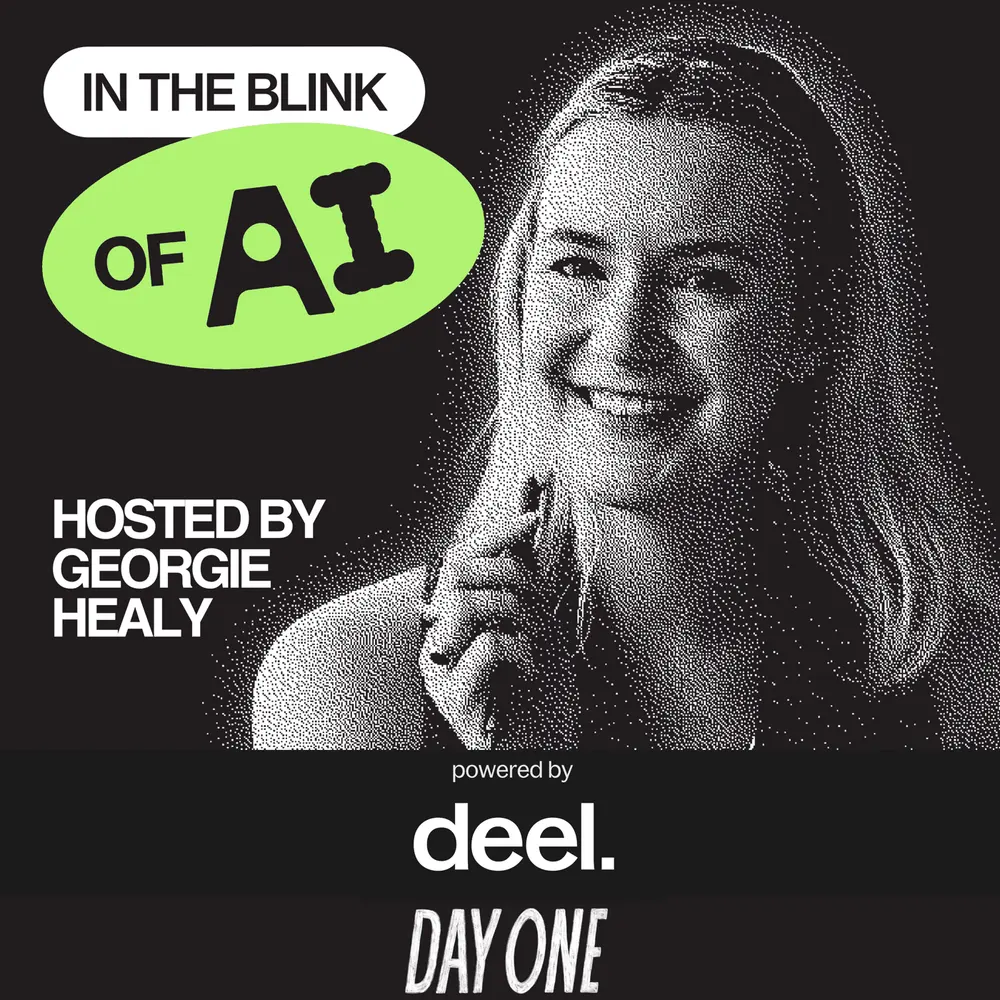 In The Blink Of AI with Georgie Healy
Presented by Deel & Stripe
In The Blink Of AI with Georgie Healy
Presented by Deel & Stripe 



 ▶
▶  ▶
▶  ▶
▶  ▶
▶  ▶
▶ ▶
▶ ▶
▶