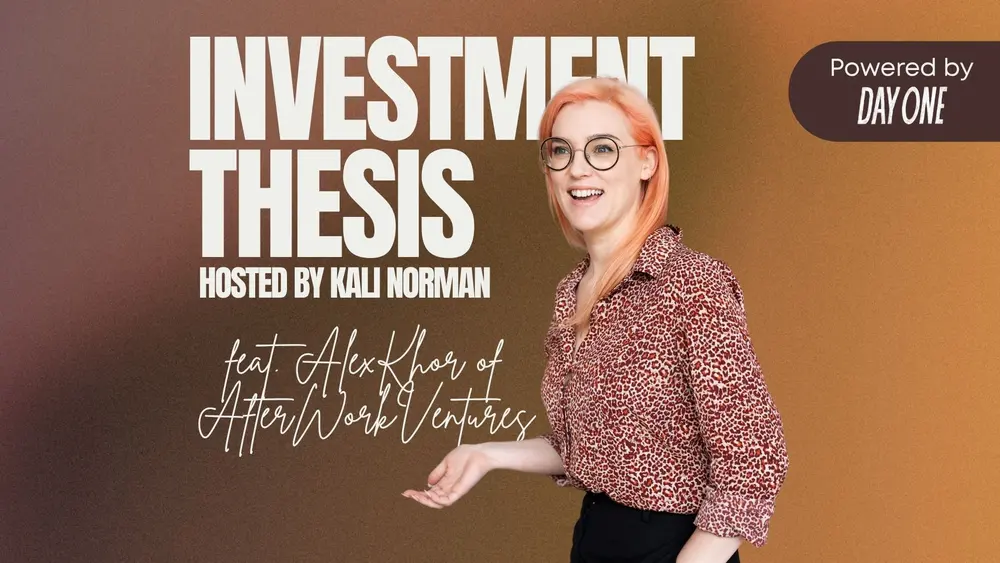
Transcript Synced · select any line to jump ▾ 0:03 Kali Norman: Welcome to Investment Thesis. I'm your host, Carly Norman, and I'm thrilled to invite Maxine Minter onto the podcast today. Maxine cut her teeth running angel syndicates across both Australia and San Francisco whilst also running growth coaching and advisory business Colab. Since then, she's become the first solo female GP in Australia when she launched her fund, CoVentures. Hi Maxine, welcome to the podcast today. 0:38 Maxine Minter: Thanks so much for having me on. I'm excited to chat about theses, a favorite topic. 0:43 Kali Norman: And hopefully soon to be mine as well. Well, let's dive right in. Can you tell me a little bit about your path into investing? 0:49 Maxine Minter: Yeah, so I, I started investing because I was actually really frustrated about the pool of capital that I was able to raise from as a founder. So I had built a couple of companies. If you can count a venture fund as a company, which I definitely do, this is number 7, to varying degrees of success. And so have been an operator and still probably identify as an operator, although maybe now operator and investor. And so was building a company. Actually, only one of the companies that I've built on my journey has been venture-backed, a company called Fairshake, uh, which still exists today. You can look it up. It's a legal tech company. Um, so I, that is actually the only time I've been on the venture raising journey myself, at least on the founder side. And through that journey back in 2017, 2018, there actually wasn't that many people in the US venture ecosystem that weren't white dudes or cisgendered white dudes from engineering backgrounds. And so it sounds kind of controversial to say now, but back then, it was actually fairly— Fairly rare. Novel to have a woman who was investing, especially as an angel investor. So I started angel investing actually as a small act of rebellion to try to get a different demographic that were deploying capital. Also, I loved learning alongside the founders, right? An opportunity to add my voice to the choir, that I was behind them, that I backed them. They got an opportunity to watch them operate, solve problems, and do what I could to help accelerate them through some learning journeys that I had just recently been through. So I started angel investing because a community at the coworking space I was working at, at the time, were putting together an angel investing group. It was all women. We were all founders, operators, later-stage investors, and the group was called The Council. It still exists today. So I was one of the founding members there. Fun fact for you, there was about 9 of us, and I think maybe 80% of us now have our own funds or are partners at big funds. Mm-hmm. Which I think is a pretty amazing trajectory for the group. The council also has a fund now stapled to it, run by the amazing Amber Illig, and they have just graduated. I think Rachel is the new partner there. So cool to see that all come to fruition over that period of time. So the intro for me into angel investing was collaborative, right? Getting to watch how other people were doing it, learn from them, co-diligence with them. So I wrote my first check through that group, and it was a very small check, but that was my entry. 3:16 Kali Norman: Oh my God, that's incredible. And I didn't actually realize that you had started investing in the US. 3:21 Maxine Minter: Yeah, that's right. 3:22 Kali Norman: After your founder journey. 3:24 Maxine Minter: Yeah, actually most of my like venture-backed, in fact all of my venture-backed founder kind of journey and also the beginning portion of my angel investing and venture investing journey was all in the US. So when I left Australia, this makes me feel really old to say this out loud. When I left Australia in 2017, the venture ecosystem was not particularly developed, right? Just to kind of contextualize you, we were probably year 3 or 4 of Blackbird Fund 1. So they were probably just out of their deployment period. Canva was 3 years old. There just wasn't that depth in the Australian ecosystem. Weirdly enough, I knew Sam Wong. I got introduced to her because we had both grown up at Mintel Ellison as lawyers and was kind of like broadly in company building. So met her kind of early in that journey, but there just wasn't like that much in the ecosystem. So, and that's when I left Australia and then just like a classic expat assumed that Australia froze in time and nothing else developed in Australia. And then I went on to the US and that was obviously kind of object in motion. And so it wasn't until like 2018, '19 that I— Mm-hmm. Actually started to meet really interesting Australian founders coming into the Bay Area looking for investors and was like, oh, hold on a second, there's some really interesting stuff going on in Australia. But all of my angel, my like early angel investing journey and my venture operating experience was in the Bay Area. So kind of learned at their knee, so to speak, as opposed to necessarily learning how to angel invest in the Australian ecosystem. 5:01 Kali Norman: We're doubly lucky to have you back and working over here then with that behind you as well. It's things so interesting to have the comparison points between two different ecosystems and see how they both build and develop individually, but as well the common points as well. 5:16 Maxine Minter: 100%. Yeah. I also, I mean, I think a comment on that is that like the US ecosystem has had many reps at this. And so it was a, I'm super grateful to get to learn from those folks and for them to shortcut me on those learnings. I think you and I was talking about this before the podcast, but like knowledge is this amazing substance where it multiplies when shared. And so getting to learn from them was a really wonderful head start on not having to learn all of my own stuff. Although, to be honest with you, there was a lot of learnings along the way. I'm sure we'll talk about them. 5:49 Kali Norman: I'm sure we will, probably as we cry into a glass of wine at one point as well. The learnings are great, but the sting can still exist. So you've been seen investing for quite an extended period of time between the US, between Australia. I imagine things have changed during that period for yourself as well, as well as in the market. But what was that first version of your investment thesis when you started out? 6:14 Maxine Minter: Yeah, so investing into startups wasn't the first thing I ever invested in, but the kind of entry point into angel investing. I'd had a few reps at, you know, buying shares. I had dabbled in crypto. And so it was the first time though that I was like really thinking about building a thesis and working out how to effectively invest into startups. Um, I think, you know, obviously one of the drivers for this podcast is we all know we in theory should have a thesis behind why we're investing. I think it's worthwhile to kind of pause for a moment on like, why, why is it valuable to have a thesis? Because I think that a lot of people, like, it's just received wisdom, but you don't actually think about the fundamentals of why a thesis is important and valuable. So The reason that we think about VCs is to ask the question of where do we see alpha in the market, right? If we are even chasing alpha, and what I mean by alpha is the difference between what the market average is and the return that you will generate. And if there is no difference between those two numbers, you should just invest in an index. And so that means in venture, just like invest a little bit into a bunch of funds or invest into products like AngelList's index fund across startups or similar, right? Actually, Coatue is coming out with a kind of blended cross-market, both private and public markets venture index. Those kinds of things, you should invest in them if you're actually not seeking alpha. Um, but if you are seeking alpha, you have to work out what do you see in the market, where are the opportunities in the, in the market that outperform the average. And that often means that you have a unique perspective on the market, you have unique information about the market, and you have maybe a unique way to access those opportunities above and beyond what the average person or the average investor would be able to access. And so developing a thesis to answer one of those three questions is why we do it. For me, at the time, I was investing. So up until that point, I had built— all of the companies I had built were in the automation of services of some kind, right? A big part of software from, let's say, 2007 when I built my first company through to 2019 was the innovation of, right, software generally. The whole kind of A16Z software's eating the world was the ecosystem that that was happening in. So the advent of websites, the advent of kind of more accessible consumer or prosumer software building was what I was building in. And so it was the automation of a bunch of services that already existed. And so that was my initial thesis, right? I want to invest behind the automation of high-end services. So what does that look like? Either core automation, so think like health tech, legal tech, reg tech, insure tech, etc. I was building at the time in legal tech. Or it then expanded out into the picks and shovels around that to make that possible. So an example might be process automation software. So software that allows people, consumers or prosumers or even companies to start to automate their processes. And then it then expanded out into the future of work because if you believe that services are being automated and you believed that the picks and shovels were being automated, then you would have to believe that the way that we work is gonna change. Mm-hmm. 9:44 Kali Norman: And how has your investment thesis changed over time, and what is it today? 9:50 Maxine Minter: Yeah, so it evolved quite a lot in those first couple years of angel investing, right? Like, I think the thing that Sheryl and I are constantly evangelizing at First Check is like, give yourself the space to learn on those first couple of angel checks, 'cause it will constantly evolve, right? Like, that evolution I just described of automation of services, picks and shovels for the automation of services, future of work, that was a kind of 3-year expansion journey. As I was starting to meet more and more interesting companies. Because something to kind of internalize as you're thinking about thesis development is you want to make sure that your thesis isn't so narrow that you exclude yourself from investing in the best companies. For example, if you were like laser-focused on deep tech and you met Canva at seed and you were— you had an opportunity to invest in Canva, like you would pass on thesis basis. Mm-hmm. You would never even have that conversation, right? Maybe that's the right thing for you, but I can venture a guess if you had $10,000 to invest at the time and you passed and you're now looking at that valuation and being like, oh, I could have actually made $25 million, you're pausing and thinking about your thesis again, I'm sure. So when you are developing your thesis, you need to have kind of find this tension between— or the right outcome between the tension of it needs to be broad enough that I make sure I don't bake in what we call negative selection bias, i.e., I'm just investing in the back half of the power law, i.e., I'm baking in bad returns, versus it's not so broad that I'm going to meet all kinds of companies and actually not be that insightful or have that different perspective against the market. For example, Now, to answer your question, like an evolution for our fund thesis, at CoVentures, we focus on pre-seed. Australian founders all over the world building at pre-seed. In that, obviously, there is some automation of services and baking in a lot of what I learned in those first theses, but there's a bunch of stuff outside of that as well. But we're very clear we have exclusions. For example, we do not invest in deep tech. The reason that we do not invest in deep tech is if you, if I meet a really interesting deep tech founder, Right. I might be really convicted about that founder. I might think that they're an awesome person, but I have absolutely no information against the market on whether the product they're building is high quality, on whether I can help them at all in that build journey. So I'm what you call dumb money on their cap table then. I just hang out, hanging onto their coattails as they go ahead and build an amazing company or don't, right? I have absolutely no way of being able to filter because I don't have expertise in that space. So What's happened over that period of time is my thesis has evolved from what I knew then to what I have learned since about pre-seed, being successful at the earlier stages of a company, what kinds of founders I have observed be successful through that period of coming up with an idea through to mid-level scale, right? Ideally all the way through to kind of an exit. And what I have learned about the opportunity in stages Right, pre-seed is historically underfunded relative to seed, and so there being an opportunity there between specifically those two rounds for us to back. So now today it is a geo focus and a stage focus as opposed to purely a particular thesis, but we have exclusions in that because I don't want to be dumb money on someone's cap table. 13:21 Kali Norman: I've never heard the phrase dumb money before, but I really enjoy it. And you also referenced the power law. Can you expand on that a little bit for us, please? 13:31 Maxine Minter: Yeah, absolutely. So I think if you're investing in venture, so it is crucially important that you understand the historical distribution of returns in this asset class. So if you mapped every single startup on a continuum of returns, you would find that it performs on what's called a power law, i.e., there are a handful of outliers that returned the vast majority of the returns for this entire asset class. And there's this very long tail of companies that returned between $0 and, you know, not enough dollars to have made it worthwhile for you to invest in it. So if you can imagine the power law curve looks like a— actually, it's probably easier for people to Google it than it is for me to kind of verbally describe it. But there is this kind of like parabolic curve up and to the right. Mm-hmm. That will indicate to you actually you need to be invested in those, uh, those outlier companies. The reason for this is a couple of things, just from a fundamentals perspective, is if you can imagine, let's say you invest in 10 companies per year over the course of 3 years, so 30 companies in total. 14:40 Kali Norman: Mhm. 14:40 Maxine Minter: What you will see historically is that across those companies, about 50% of them, if you invested in venture kind of early to Series A, about 50% of them will go to zero. Then the next, I mean, 10 to 20% of them will return 1x your money. You can do quick back of the envelope math that if you're investing for 10 years and you're getting 1x on 10 to 20% and you've lost 50%, you're still upside down, right? You still lost a lot of money and you have held onto that asset for a while. The next 10 to 20% is between 1 to 5x. In terms of a return, even then that has barely paid back your long tail. So all of your outlier returns actually come from the last 10 to 1% of your portfolio, depending on the fund. So it requires that you are invested in those outlier businesses in your thesis. And if you're not, right, if you miss the 3 companies over 3 years, in your thesis that drive most of your returns, then actually you are investing in an asset class that will return you less than the public markets, and you will hold it, an illiquid asset, for between 10 and 12 years. So the short answer is like, you shouldn't invest unless you are convicted you can get into those outlier companies. 16:05 Kali Norman: Thank you so much. And looking, I guess, at how you're identifying and finding those outlier companies, you mentioned that you invest at the pre-seed stage. I've heard someone refer to pre-seed as basically investing in a team and a dream. How important is that balance for you between product at that stage and team when you're looking at an investment? 16:28 Maxine Minter: Yeah, I think it's really tempting to do kind of single-factorial analysis when you're making an early-stage decision, i.e., I'm looking for one thing, and if I see that thing, I'm going to invest. Actually, these are complex systems, so we need to see a collection of things for us to be convicted that there is a high probability or higher than average probability that they will make it through pre-seed and up to being those outliers on that continuum. Um, the other thing I would say is pre-seed, and this is especially something I see in the Australian ecosystem, pre-seed and seed stage investing, increasingly Series A investing, or what I would call input investing, not output investing. What I mean by that is I'm not investing at pre-seed. I'm not investing in what you've built. That's an output, right? I'm investing in the ingredients that are going into this opportunity, which is team, vision, network, ambition, pace of learning, and grit. 17:29 Kali Norman: Right. 17:30 Maxine Minter: If I can see those 6 things, I get really excited. So even if you have built an MVP, even if you have some product traction, they actually are less determinative and less correlated to success than the quality of those inputs. Whereas if I was investing in a company at, say, Series B, right, at Series B, you have built a product, you have scaled that product. Ideally, you have found product-market fit, and then you have started to show that that product-market fit is working. You can then give me inputs that are determinative or correlated to the probability of success. You can show me revenue run rate, you can show me customer profiles, you can show me profit margins. You can show me CAC, etc., etc. If you show me any of that stuff at pre-seed, like, it is a known or a public secret that the probability that a founder at pre-seed who is building for a particular vision for a particular product, the probability that they're building same product for same customer with same go-to-market is exactly zero. I challenge any of your listeners to talk to any seasoned investor and ask them of any investor that they talk to at Series A or Series B, what percentage of the companies that they've invested in building same product for same customer with same go-to-market at the point that they invested at pre-seed and seed, and I will venture a guess they will say exactly 0%. The implications for that then, if you as an investor spend all of the time diligence-ing, oh, what MVP have you built? For who? How have you found those customers? All of that data is completely uncorrelated to probability of success, except to tell you that the quality of the founding team, the way they think through the problem. So that's a very long way of saying I focus on team, I focus on how they have found their market, their fit to that market, how obsessed are they with that problem, right? And then how do they go about the grittiness and the learning velocity to help them move through what is usually a very complex process to get to value creation in a year and a half to 3 years later. 19:37 Kali Norman: And when you're investing at that very early stage, full acknowledgement of what you've just said— the product will probably change, the founders are on their own learning journey, what you're seeing at that pre-seed pitch is a very low chance of being the actual product that goes to market in a permanent sense— what does your sort of deal size and structure look like? 19:59 Maxine Minter: For you? Yeah, so the average deal at pre-seed, if I look at our valuations for— so we've— this fund, we've been investing in '23, '24, and now some of '25. So average valuation has increased somewhere between 10 and 20% per year, uh, over those years. Current average valuation I think is about $8 million AUD. Um, the majority of them, vast, vast, vast majority of them, first investment is done on a SAFE We have a handful of convertible notes and even less priced rounds. Part of the reason for that is the average cost of legals to do a priced round is like anywhere between $20,000 and $60,000. If you're raising $500K and you're spending more than 10% of the capital that you've raised on the lawyers, like there's something wrong there, right? And so the vast majority of that is done on these kind of like easier, quicker, lighter touch legal investment, legal instruments to close that investment. Round size, as I said, is anywhere from $500K through to $1.5 mil. We've had a few outliers on that continuum, but that's the kind of the range, with the majority of them somewhere in the middle, kind of $750K to a mil. 21:07 Kali Norman: Interesting. And then I guess once you've made that investment at a considerable size at an early stage, what do you consider to be an ideal working relationship between yourself as one of those early stage investors and that startup as it grows and develops? 21:22 Maxine Minter: Yeah, I think it totally depends on like your role as an investor. So I can, like, for me being, we are investing out of a fund, we're obviously deploying reasonable check sizes into these companies. And so the expectations we would have and the way that we support companies is different than when I was angel investing. So I think that's a worthwhile distinction to call out for the listeners, right? Which is as an angel, very often you are writing checks below $150K. You know, usually it's something significantly smaller than that. Even— and also, if you're investing through a syndicate, there's like a whole extra layer here. But for most angel investors, like, maybe they're having 1 to 2 touch points with the companies that they're investing in to add like meaningful strategic value. So the kind of expectation I set for founders often is for every single person on your cap table, with the exception of the VCs, expect to engage with them 1 to 2 times on a meaningful kind of strategic inflection point, key customer intro, key product insight, I mean, a key investor intro, and that's kind of it. If you get more out of them, bueno, but that's not necessarily the expectation they should have or you should have. So as an angel investor, something you have to be really careful of is not kind of being in a vertical that's too big for your boots, right? If you're trying to catch up with the founder every 2 weeks and if they haven't asked for it, that is— Yeah. Hard. As a fund, though, it's slightly different. So a big part of our strategy is we are seeking to support that next generation of amazing Australian founders globally by wrapping them with resources and community to help accelerate them through this period. And so a big part of the way that we do that is kind of think of us like an old-school operator, right? The founder picks up the phone and says, can I be connected to X?, and our job is to plug them into X. So the interface that we do that with is we catch up with them anywhere between monthly and quarterly, depending on the cadence that they choose, and do what we call thought partnership calls. Those thought partnership calls are purely that kind of old school operator connecting, and then also, you know, anything, big problems or big opportunities that they're chasing. Also, all of them have my number, and so a lot of them just hit me up on WhatsApp, send me voice notes, send me calls, etc., etc., to ask me like for particular connections or things that they might need on a case-by-case basis. So that is our operating model. But for other bigger VCs, for the founders that might be listening to this, for other bigger VCs, maybe they take board seats and you have that more formal touchpoint with them, and that is your kind of sole touchpoint with them. But for us, we do kind of thought partnership calls, and then we have a bunch of kind of ad hoc support that we provide. 24:05 Kali Norman: Thank you. And so how do you continue to stay sharp and keep evolving your thesis? 24:12 Maxine Minter: Yeah, this is, it is a challenge as an angel investor and it is a real challenge as a VC. So something that I instituted a couple of years ago is what I call self-education blocks. Like they are time I spend educating myself. For context, I love teaching, I absolutely love it. I have taught business building at Stanford, Warwick, and a bunch of universities. And I came to this realization, which I was doing, this work and spending all this time kind of building education modules about business building for other audiences, but I wasn't doing that for myself. So I actually have kind of developed myself my own curricula on things that I need to learn, topics that I want to educate myself on. And it— I started doing this in 2016. It is obviously significantly easier now with AI to do this research and put together these education plans for myself. So I have a bunch of topics, like a workflow where every time there's a topic I want to get smarter on, I add it to my kind of backlog, my self-education backlog. And then I build education modules for myself on particular topics and work my way through that education module through my education blocks. Because the only— I think, like, if we fall behind from an education journey perspective, we're doomed, especially in this moment, right? The particularly exciting thing is the world's best thinking on a lot of topics are now open source, right? Through podcasts, through this kind of building in public norm, the pace at which it takes us to build, you know, write books and those kinds of things. So the world's best researchers are writing kind of some really interesting stuff into the market. They're writing books. Also now with AI summarization, you can start to kind of translate some of the more technical stuff into more consumable versions of it. So I don't think there's ever been a better time for us to consume the world's best knowledge if you know how to kind of structure that. Mm-hmm. For yourself. So for me, that's what I do. I wouldn't say I spend enough time on it, uh, relative to what I would like to be spending on it, but it's the best I can fit in at the moment between building a fund, investing, supporting, living, sleeping. 26:20 Kali Norman: You have a very full diary. It's impressive that you get as much done as you do on the education front. How do you avoid confirmation bias? 26:29 Maxine Minter: This one's hard, especially as a solo GP. And I think, you know, as an angel, that was the case, but as a solo GP, so a couple of things that I try to do. One is tag in, we have a community of venture partners that work alongside us and all of our LPs are value add for the portfolio that we work for. And so I'm often tagging those folks in, sharing a deal that we're thinking about investing and asking, you know, about that space, about that founder to try and collect those information points in my diligence. Process. That's one. The second is doing anti-portfolio reviews, so, and portfolio reviews. So essentially you're looking at what you've invested in and why, and what you haven't invested in and why, to learn about the way you're making decisions. Actually doing this is a really wonderful way of making sure that you're not kind of in your own echo chamber and evolving your thinking over time. So coming to the kind of topic that you, or the question you asked me at the top, like how does your thesis evolve over time, this is one of the ways. If you look at your anti-portfolio and you look at why you invested in certain companies and why you didn't, that can be a really wonderful way to identify, oh, I am actually kind of high on my own supply, so to speak, right? I'm investing in things that just confirm a particular view I have of the world, confirm a particular thesis that I thought I was investing in, confirm particular biases that I have. For example, one of my early ones that I learned was I— Mm-hmm. Conflate credibility, right, the capability of actually doing the thing, with being eloquent and talking with a high degree of energy. They're correlated, but they're not causative. And so I actually evolved the way that I diligence companies when I'm talking to a founder who is either extremely eloquent, high passion, and talks very well on a topic, and actually pressure testing the credibility for how they actually know those things, you know, what sits behind them. Also someone who is fairly reserved, right? Maybe they're like more thinking time, more buffering time to answers. That doesn't necessarily correlate to an absence of depth thinking, to an absence of clarity of thinking. It just means that they are— they don't present in the same way. And so I have prompts now in my decision diary, my diligence process, to make sure I've asked the second order questions to get to credibility underneath them. 28:47 Kali Norman: I love that you do that. So you've already touched on a few of these, but what are two pieces of advice that you would give to somebody like me looking to build their investment thesis? 28:59 Maxine Minter: I think the first piece of advice is that I am a believer that there is all kinds of pockets of alpha in the market at any one point in time. And so I would ask the question, what do you feel like you know that the market doesn't know? And what do you feel like you can value add that not everyone can value add? Those are the two most dominant ways that you can add alpha to an investment. For example, right, if you knew that OpenAI had worked out a way to use large language models to summarize and to create insights in the way that we had currently, we are currently seeing them do that, but you knew that 5 years ago as opposed to 3, What would you invest in that would be accelerated by that trend, or what would you not invest in that would be accelerated by that trend? That would be an example of a thing that you know that the market doesn't know yet. An example of where can you value-add in a way that not everyone can value-add might be, let's say you spent a bunch of time in growth, right? You have deep insights on how a really efficient and effective way for companies to find customers, right? What could you invest in and actually add that insight so that that company can find customers faster and more effectively, and you can participate in those upsides? So thinking about what do you know that no one else knows, and how can you invest behind that change that you're pretty sure is coming, and where can you add value where you're pretty sure no one else or very few other people in the world could do that. Oh, I love that. 30:45 Kali Norman: I'm gonna have to think about if I have any depth of knowledge in anything. That's a great starting point though. I probably, I probably am such a generalist these days. Thank you. And now lightning round, not on the questions that I sent you. If Uber had cold pitched you pre-seed back in the day, would you have invested, yes or no? 31:08 Maxine Minter: Oh, I actually think I would have passed based on— I've talked to a bunch of people that looked at Uber at pre-seed, and at the point that they were at pre-seed, they were a black car hailing company, and Travis wasn't part of the company. And so you had a below-average founding team with a small market and a not particularly inventive idea. And so I actually, I think about this a lot from a pre-seed perspective. There are probably a bunch of companies that will end up being amazing that would have been bad investments for me to make at pre-seed because there just wasn't those inputs that I would need to see. And so maybe the risk materialized and they became an outlier, but it still wouldn't be a good investment for me to make at my stage. 31:54 Kali Norman: Thank you so much, Maxine, and thank you so much for joining me on the podcast today. I'm going to take these away and work on my investment thesis. 32:00 Maxine Minter: Thank you so much for having me on. This has been a delight. 32:02 Kali Norman: Thank you for joining us here today. I've been your host, Carly Norman, and this was Investment Thesis.



 ▶
▶  ▶
▶  ▶
▶  ▶
▶  ▶
▶  ▶
▶  ▶
▶ ▶
▶ ▶
▶