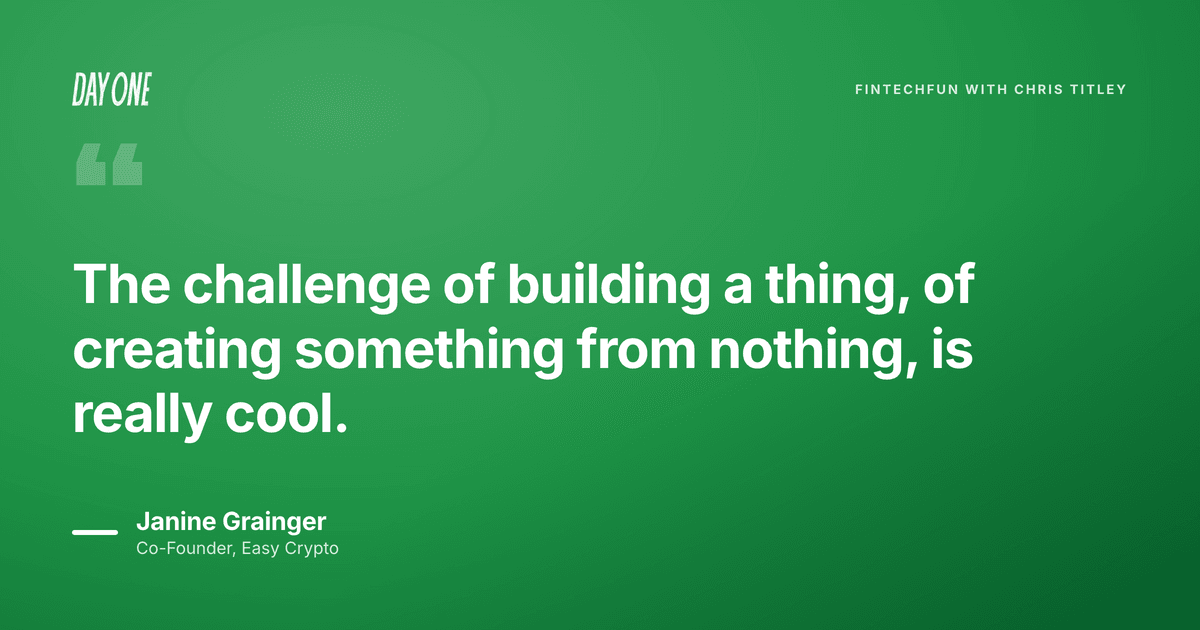
Transcript Synced · select any line to jump ▾ 0:00 Speaker: You're listening to a Day One FM show. 0:07 Speaker: Pick My Brain is the podcast where founders pitch me their startup and I try to give them some useful advice so they can connect better with potential co-founders, investors, media, and of course, customers. My name's Alan Jones and I was a founder myself for about 15 years, and after that, an angel investor for another 15 years. So yeah, old. Some of my ventures have been successful and some failed disastrously, But I like to think I've learned a thing or two along the way, and maybe some of that can help you. So if you'd like to learn how to tweak your pitch, subscribe to the Pick My Brain show now wherever you like to listen to podcasts. 0:40 Chris Titley: Hi, it's Chris Tipler here. As part of the Fintech Fun podcast series, I'm joined by Janine Granger, founder and CEO of EasyCrypto. Thanks so much for being part of this series, Janine. 0:51 Speaker: Thanks, Chris, for having me on. It's a pleasure to be here. 0:53 Chris Titley: Now let's talk about EasyCrypto, the ideation, the early days, how it all began. 1:00 Janine Grainger: Yeah, quite simply, EasyCrypto began, it was started by my brother and myself in late 2017, so about 7 years ago now. And at that time we started in New Zealand and it was really difficult for Kiwis to get access to cryptocurrency. And my brother is a great problem solver. He was like, man, there should be a way for me to automate this, make it easier. So he set about building a site for Kiwis to buy and sell crypto. Developed the whole thing, sort of the first iteration of it end to end in under a week and put it live on the internet where strangers were just buying, you know, crazy digital money off him. At which point I was like, you might need a little bit more wrapped in here, a bit of compliance, bit of customer support, bit of accounting and legal. So I jumped on board to help him with all of the other aspects that go around a business after you've just had a really good idea. So that was how we started. And we quickly became the largest provider in New Zealand of crypto assets within our first year. And then we looked at how how we could help take that ease and simplicity of access to other people and jumped over the ditch to Australia. 1:53 Chris Titley: Wow, fantastic. And dating back to 2017, cryptocurrency per se, do you wanna talk us through the time then around the acceptance of it all and what it was like? 2:04 Janine Grainger: Yeah, it was a fascinating time. I think probably that was when cryptocurrency or Bitcoin first entered most people's consciousness. We had this big bull run in 2017. Mainstream media started talking about it. Bitcoin and blockchain were a bit of buzzwords. At that time I was actually working for, for a bank, one of the big banks that you guys have over in Aussie as well. And it was very much an unknown to them and sort of there's a lot of interest in it, but at the same time not a lot of acceptance. So, you know, we couldn't just spin up a business banking account for our cryptocurrency business. It was a bit fringe and a bit scary for banks. And I think, to be honest, possibly not a lot has changed over the last 7 years. 2:40 Chris Titley: And Janine, being the cryptocurrency of choice for New Zealanders, how big was the market in terms of people wanting to buy and sell cryptocurrency in New Zealand? Versus maybe some other people, you know, in the world that wanted to use your platform? 2:53 Janine Grainger: Yeah, so we predominantly were New Zealand-facing then, just with compliance. It's a lot easier for us to, you know, know our customer, have a limited home market. New Zealand as a market is interestingly not as strong adopters of crypto as Australians are. We've got, you know, Australians much more, I think, facing into this as an investment class, sort of understanding and accepting of the risk involved in it. And you've got some interesting vehicles, things like self-managed super funds that can actually invest in crypto, which is quite a cool hack, I guess, for those who, you know, want to take that higher risk portion in their investments. 3:23 Chris Titley: And Janine, in terms of the growth from 2017, can you talk about some pivotal moments in the company to where it is today, and also some pivotal moments in and amongst the cryptocurrency? 3:34 Janine Grainger: Yeah, so our growth trajectory, like, we came in really at the end, the tail end of that first big bull, you know, that 2017 bull run. For anyone who was around at the time, sort of crypto prices peaked in December 2024— sorry, 2020. What year am I in? 3:50 Chris Titley: I mean, we're in 2024. You're right. And sometimes it gets very confusing and sometimes I don't know what day it is. 3:55 Janine Grainger: You can quote me on that if we reach our new all-time high. 3:58 Chris Titley: There you go. Yeah, that's right. Predicting the future. Well done. 4:01 Janine Grainger: Back in 2017 though, the all-time high got hit in late December and then in January things just fell off a cliff and it was actually great timing for us. Like anyone who's out there, you know, building fintechs in these very volatile, very unpredictable markets will know that If you have a massive influx of demand, if your customers are just piling in the door and you're not prepared for it, it can be really chaotic and challenging for the business. And so we actually had this quite good outcome that we launched at the tail end of a bull run, started to get our name known, started to get out there, but then the markets just dropped off and it really gave us a lot of time to build. So for us, 2018 was all about how do we build great platforms that are really simple and scalable and enable those big bull run rushes to come back without us having to sort of, you know, stress or or be overwhelmed by demand. So that was sort of the next year or two for us. And then we went and did a capital raise in 2021. We actually set the record for the largest first fundraise done by a New Zealand company. We hadn't taken angel or seed investment, went straight into Series A and got quite, you know, a decent size investment out of that. That's been an interesting journey as well. Height of tech stock valuations in October 2021 when we raised. And then obviously since then, crypto markets and tech markets have had, you know, some setbacks and things haven't built back up to where they were at that time. But it's been a good opportunity again for us to like really focus on building. How do we make great product? How do we really understand our customers and what they're looking for? And to your second question around the crypto markets themselves, one of my observations over that period is cryptocurrency has just gotten so much more complex. Like when we started, stablecoins weren't really a thing. Everyone traded in Bitcoin as sort of the base trading pair. We also didn't have multiple networks. You know, when Ethereum, you know, subnetworks like the EVM chain started coming out, that was quite new and novel. And over the last couple of years, the complexity in the space has just massively proliferated. And that's really challenging to run a business on top of an industry that's constantly changing, constantly shifting, and tech that is constantly updating. But it's a cool challenge. 6:04 Chris Titley: I remember in sort of 2020, maybe late 2020, the sort of the uprising of the new coins or the different types of coins that happened. As an exchange and platform yourself, how did you go about managing the ability to trade in some of these coins and what was popular at the time? And I suppose from a product point of view, how many coins and things can you offer now as part of your exchange? 6:25 Janine Grainger: Yeah, so right now we've got around 160 tokens sort of natively supported on the platform and we can really source almost anything. So our OTC desk will do you know, up to 1,000 different currencies for our customers if they want them. How we got there is an interesting one. Like we thought, you know, okay, we started with, I think, 10 currencies. And that was quite a lot at the time, a lot more than our competitors. 6:45 Chris Titley: Yeah, I couldn't name 10. Yeah. 6:47 Janine Grainger: And then because we were also, you know, ourselves investing in a wide range of— can I say shitcoins on this podcast? You know, alternative currencies. You know, there's an appeal to being able to sort of just put little bets on all sorts of random things, right? And so we wanted to give that opportunity to our customers. But we wanted to be responsive to what they were looking for. So we ran a voting system and we still have this today. On our rates page, you can see the coins we have natively listed. And then you can also see, you know, the option to vote for a new listing. And when we put this vote page up there first, we didn't think about how this could be gamed. And that's, you know, probably a common story in some of the mishaps of the businesses. We didn't think through how it might be gamed. And in this particular one, we end up having, you know, these random subreddits that were big supporters of XYZ crazy coin all coming and all voting for our currencies. And, you know, we couldn't necessarily service them. This might be people over in Europe and South America, all around the world. It's like they weren't going to come and buy from us, but they just wanted to support their community by voting up their community's coins. So we subsequently limited it to voting rights are only for customers. Like, if you're actually trading with us, definitely chuck your votes in. But if you're just wanting to pump up your community, that's probably, you know, we don't necessarily want to endorse that because it doesn't help us understand what our customers truly want. 8:04 Chris Titley: That's a good little hurdle that you sort of stop the loophole, I suppose, of people promoting their own stuff. Well, but I mean, it's all part of a community, I suppose, as well. 8:14 Janine Grainger: Exactly. 8:14 Chris Titley: Janine, you did mention about product and building product. I mean, how do you go about building that product? Do you get a lot of feedback from your users or is there the team internally going, actually, we should build this because we think this is the future? 8:27 Janine Grainger: It's a bit of both, right? Because you know the old adage of if you ask people what they want, faster horses is the response. And there's some of it is like we wanna build things that we think people will want and use even if they might not necessarily know it. But then we also want to be really responsive to what are our customers asking for, you know, do they want a dark mode on the site, do they want more coin listings, um, limit orders, different things like that. And so it's really important, you know, as a founder and CEO to kind of juggle that, like, how do you decide, you know, how much do you give people what they want versus try to go out on a limb and leap and make something new? And it's always a bit of both. 8:59 Chris Titley: I'm always interested to know in terms of the success of a trading platform whether there's any macro factors involved. Is there some sort of nirvana that you would really love in terms of business? Is it something like Bitcoin going, you know, to $100,000, or is it— or is it— is it the share market going down, or is it gold going down? There's lots of different things in my head. Is there something out there that you could share? 9:19 Janine Grainger: It's been an interesting one with crypto because, like many people, I sort of, you know, had the expectation, you know, years back that Bitcoin would be a non-correlated asset, right? Like, it doesn't link to the stock market, it's not backed by gold, it should act differently. It also has that, you know, non-inflationary aspect. Um, As we've seen though, Bitcoin has moved a lot more closely correlated with stock markets than one would have expected based on its fundamentals. I do though think that's still based on it being a relatively new asset. I think over time it will decorrelate a bit more. Right now though, the things that really drive trading for us is massive swings in crypto prices. It doesn't matter if it goes up or if it goes down, people want to pile in, pile out. When currency kind of just does a sideways, a turtle market kind of thing, that's when it's less exciting for people and they're less likely to trade. It has been interesting, though, to note, particularly over this year, how Bitcoin responds as a much faster— you know, has a much faster ability to respond to world events. So if there's something like big geopolitical tensions, things like that happening, Bitcoin can respond instantly because it is so highly traded and it's a 24/7 market, whereas traditional stocks, shares, you know, ETFs, etc., can take a couple of days or weeks to respond because they just can't move as fast. So it's quite interesting watching Bitcoin as kind of almost a canary in the coal mine for what is happening with assets more generally. 10:39 Chris Titley: No, very, very good point that, Janine. In terms of education and understanding about investments per se, how important is that for EasyCrypto and to make sure that all the users in your platform are doing things in the right way and are not sort of like throwing their life savings down, you know, into something which goes to zero? 10:56 Janine Grainger: Yeah, super important, right? Like we tend to, you know, our audience is a lot of beginners because we have a really easy platform and we put a lot of education and information out. 11:04 Chris Titley: Hence the name. Yep. 11:05 Janine Grainger: Yeah, exactly. It's clues on the tin. So yeah, we really work on educating our users so they can feel confident with what they're doing because investment can be scary, particularly if you haven't grown up in a household where people talk about investing, if you haven't learned about it in school, understanding what the risks are, what the right way to go about things are. And there's lots of cool tools that people can use in strategies like dollar cost averaging is a great strategy if you're starting out, that helps sort of make it a little bit less scary. The other thing that's super important that we put a lot of investment into is protecting our customers against scams. Because, you know, we're a legitimate platform, we're registered, we're, you know, everything above board. But if people buy crypto through us and then send it to another site, just knowing how legitimate is that site, how reputable, are you at risk that they are, you know, just pure scammers running off with your money? Or are you at risk that you're investing into an asset that maybe isn't very reputable, could be a rug pull? Um, or are you making good decisions and storing your crypto safely? And that's the kind of stuff we really want to help our customers with, of just that certainty and confidence of what they're investing in and where their money's going and how safe it is. 12:10 Chris Titley: And Janine, if we repeat this podcast in, in 12 months' time, how would you have liked the business to have panned out in the next year or so? 12:17 Janine Grainger: I think that we've been laying some awesome foundations over the last year or two in terms of, you know, we've built this really great self-custody wallet, which again, to the point of you know, where is your crypto being held? Self-custody is an amazing way to have confidence that no one else can touch your assets. You're not at risk of any FTX collapses or anything like that. You're fully in control. So we've got this great self-custody wallet. We're also moving more into solving real-world payment problems with our stablecoin. And I'd like to see in 12 months' time that we've got the markets picked up. Everyone's, you know, really happy with how their investments have gone. And we're also getting some great new products out for customers using those foundations we've been building. 12:53 Chris Titley: Now, Janine, you did mention that the crypto markets react on a 24/7 basis to political events, whereas the share market has regulated sort of trading hours. 13:01 Janine Grainger: Mm-hmm. 13:02 Chris Titley: Therefore, it's probably 24/7 in your life. 13:05 Janine Grainger: Yeah. 13:05 Chris Titley: Do you get a chance to actually switch off a little bit when you're not thinking about EasyCrypto? You're not thinking about your customers, you're not thinking about the price of particular digital currencies. What does Janine do to switch off? 13:17 Janine Grainger: Yeah, I have to say it's a challenge. Like, I have an amazing team, but at the same time, as a founder, you always just got that sense of ownership and responsibility. It is hard for me to go on holiday without my phone, without being in contact. But yeah, I do love to have a quite— I'm quite an active relaxer. So switching off for me might be doing some DIY around the house. I love building things and just sort of like, you know, it's probably why I'm a founder as well, right? Just like the challenge of building this thing, of creating something from nothing is really cool. And similarly, I love cooking, like just being able to get in the kitchen, have my hands busy making something that then is delicious at the end of it. Like, to me, that's the ultimate win-win. 13:53 Chris Titley: When it comes to cooking, do you feel like there's nothing else in the world that you need to focus on apart from getting that dish out there? And therefore the brain is just like, this is a fun focus, but you don't need to worry about anything else. 14:04 Janine Grainger: Yeah, exactly right. Like, it's, it's not so easy to multitask when you're cooking, at least not the multitasking that involves you being on your phone. Yeah, you need to get your hands dirty, you're occupied with something, you've got 12 things on the go. And so it's a nice way to sort of get your brain into something, you know, out of work mode and into something else, and I've actually recently started doing pottery as well, and I love it for the same reason. Like, you just cannot multitask with pottery. You're there on the wheel doing a thing, hands are fully engaged, mind's engaged, and it's a really nice, um, you know, step change from, from the face to the laptop, on the phone, 12 things going at once with, with work. 14:37 Chris Titley: I've got 2 questions on the back of that. One, have you got some pottery artifacts floating around your house that you've sort of been testing out? 14:43 Janine Grainger: Yeah, do you want me to show you some pottery? 14:46 Chris Titley: No, you don't. Unless it's handy, you don't need to. 14:49 Janine Grainger: Not quite within reach. Yeah, and I love making like, I've made a whole dinner set, which was quite rewarding, right? Just like plates, bowls, mugs. I'm like, it's actually surprisingly achievable, which is quite fun. 14:59 Chris Titley: And the second question is your signature dish. 15:02 Janine Grainger: Ooh, I don't know that I have one. I'm a very experimental cook. I think I got this from my mother. We never had the same meal twice growing up. And I think I've got that same love of trying new things, testing things out. 15:12 Chris Titley: Wow. I'm a parent of 3 kids. We have the same thing all the time. Maybe I need to experiment with our, our suite of, it just becomes really busy as a parent sometimes. 15:23 Janine Grainger: Yeah. 15:24 Chris Titley: And your favorite meal then? 15:25 Janine Grainger: Oh, my favorite meal. I love like Mediterranean-influenced cuisine. And I think I was just gonna say a good go-to that I do have is a tagine because it looks super impressive, but it's really easy. And it's like the flavors are just mwah. 15:37 Chris Titley: Yeah, it does. It actually sounds complicated, even the saying tagine to me. It sounds like risotto sometimes. But Janine, thank you so much for giving us a bit of an understanding and snapshot of EasyCrypto. Early days, how the business was formed, the progress thus far that you've seen in terms of the growth over the last 7 years or so, and also a little bit of tips in the kitchen of what you like and some downtime tips. So really appreciate you coming on this podcast and looking forward to catching up. 16:04 Janine Grainger: Thanks so much for having me on and I'll see you in 12 months. We can recap how it's going. 16:07 Chris Titley: Absolutely. Sounds a plan.



 ▶
▶  ▶
▶  ▶
▶  ▶
▶  ▶
▶  ▶
▶  ▶
▶ ▶
▶ ▶
▶