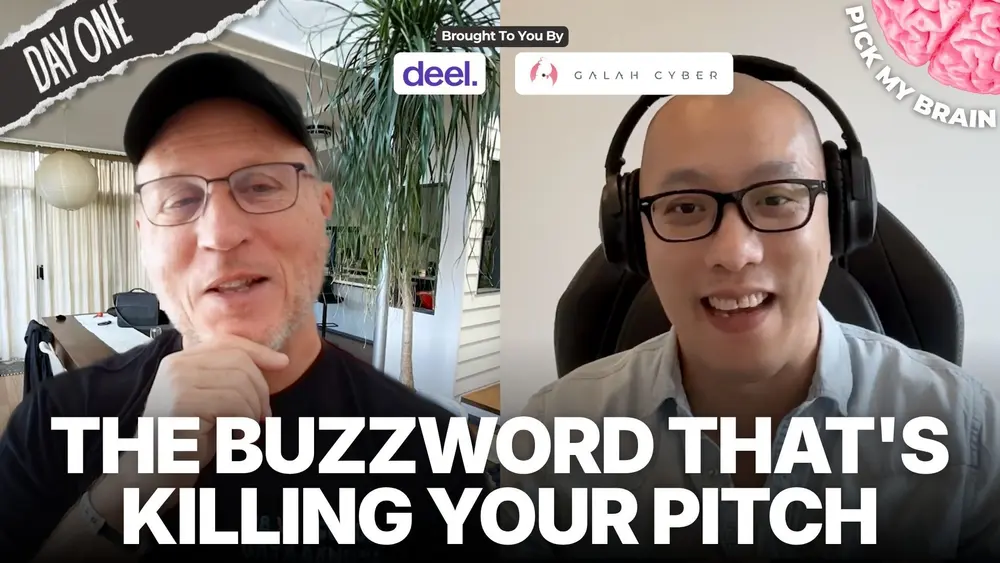
Transcript Synced · select any line to jump ▾ 0:01 Allen Fan: Founders scale faster on Deel. 0:04 Alan Jones: Set up payroll for any country in minutes, hire anyone anywhere, get visas handled fast, and get back to building. 0:12 Allen Fan: Visit deel.com/dayone. That's D-E-E-L.com/dayone. As we all know, climate change is this super big problem that we're all going to eventually need to tackle. The fact is we're losing this battle and we're not going to get there without a properly functioning carbon project and carbon credits. And the fact is carbon credits today is a really fast-growing industry, but all of the projects are managed using Excel, emails, and PDFs. And what does that mean for project developers? That just basically means it takes anywhere from 6 to 30 months to get credits issued. And after they're issued, all of the data is stuck in all of these offline documents, which means buyers cannot actually assess and evaluate these credits effectively. So what we're building is software dedicated specifically for carbon project developers to do their work, and it digitizes all of the information from the get-go, enables digital issuance of the credits, reducing what is usually a 6 to 30 month process, hopefully down to a few weeks. 1:26 Speaker: Welcome to Pick My Brain, the podcast where we help startup founders improve their pitches to better connect with customers, co-founders, and investors. My name's Allan Jones, and I'm an ex-startup founder myself. But that was a long time ago, and now I'm an angel investor with quite a bit of experience helping new businesses find their footing and achieve their goals. On Pick My Brain, you'll hear the real story straight from founders as they pitch their startups, tackle the challenges we all face, and try to make their ideas into a successful company. Each episode, we'll see if I can help these founders take their startups another step forward with advice, ideas, and maybe a little constructive criticism. And I'd like to acknowledge that this podcast is being recorded on Gadigal land, land that was never ceded. I pay my respects to their innovators and leaders past, present, and emerging. 2:13 Speaker: You're listening to a Day One FM show. 2:18 Alan Jones: As a startup founder, you're juggling multiple priorities from the expected, like finding product market fit, to the unexpected, like customer requests for SOC 2 or ISO 27001 certification. But achieving compliance is time-consuming, and time spent on that is time away from the needs of your business. That's where Vanta comes in. Vanta is the all-in-one solution for startups to become compliant quickly and build a security foundation with ease. With a combination of automation, an extensive partner network, and a security marketplace, Vanta provides the necessary tools and expertise for startups to achieve compliance seamlessly, no matter how urgent your needs are, and at every phase of growth. Over 10,000 leading companies, including Cypherstash, Handle, and Indetted, Trust Vanta to automate compliance so they can focus on growing their business. Startup customers like you get $1,000 off. Vanta at dayone.fm/vanta/brain. That's Vanta, V-A-N-T-A, at dayone.fm/vanta/brain. Today we're joined by Alan Fan, who is a founder of B2B SaaS startup, Carbon HQ. Everybody's learning things from B2B SaaS these days. Hey, Alan, thanks very much for joining the show. How are you going? 3:36 Speaker: Yeah, I'm doing well. Thank you so much for having me. 3:40 Alan Jones: Cool, cool. It's a pleasure to have you on the show. Mate, before we really got into it there, I was asking if I should describe Carbon HQ as a carbon accounting platform and you were beginning to tell me that I was wrong about that. Can you please describe what Carbon HQ actually is? 3:56 Speaker: Yeah, I would love to. So carbon accounting platforms, what they are usually is software that's provided to corporates to calculate their emissions, hence carbon accounting. Whereas what we do is we build our software for carbon project developers. So these are organizations around the world that are running carbon projects to reduce or remove CO2 from the atmosphere. And our software basically helps them with managing their data, getting credits issued, and providing providing transparent carbon credits in a way more efficient manner. 4:33 Alan Jones: Great, thank you very much. So this is actually about managing carbon projects rather than actually tracking how much carbon's being emitted. 4:41 Allen Fan: Yeah, that's right. It's all part of the same value chain. So if you think about carbon accounting, corporates need to calculate their emissions and they might have, you know, outstanding balance of emissions. And typically what a lot of companies need to do is to use high-quality carbon credits to offset offset or abate their emissions. And that's where carbon credits come in. And our software basically serves that side of the market. 5:09 Alan Jones: Great, thank you, mate. So for the benefit of our listeners, let's imagine that you and I are sitting opposite each other in a coffee shop in North Sydney, wherever you like to hang out, and we've met so that you can pitch me your startup. So no slides, just, Tell me what it is. I'm an investor. 5:28 Allen Fan: Yeah, sure, absolutely. As we all know, climate change is this super big problem that we're all going to eventually need to tackle. And the fact is we're losing this battle and we're not going to get there without properly functioning carbon projects and carbon credits. And the fact is carbon credits today is a really fast-growing industry, but all of the projects are managed using Excel, emails, and PDFs. And what does that mean for project developers that just basically means it takes anywhere from 6 to 30 months to get credits issued. And after they're issued, all of the data is stuck in all of these offline documents, which means buyers cannot actually assess and evaluate these credits effectively. So what we're building is software dedicated specifically for carbon project developers to do their work, and it digitizes all of the information from the get-go, enables digital issuance of the credits, reducing what is usually a 6 to 30-month process, hopefully down to a few weeks. And it just, you know, gives way more transparent information to the buyers as well so they can make those purchasing decisions easier. 6:43 Alan Jones: Great. One of the things that I already like about Carbon HQ when I go to carbonhq.earth, which is the domain name if you're listening along and wondering where to find out more about the company, is that not only do I see right there on the landing page that there are two co-founders of the business, But also those two photos are actually quite adorable and, you know, just like you being normal people, these aren't, you know, LinkedIn profile shots of, you know, people looking very serious. And the other really cute thing about both those photos is that there's just a really simple little breakdown of who you are and what you bring to the team with some cute little hand-drawn little arrows pointing at each of you. I think that's a really nice touch. Often in this space when we're talking about solving big global problems that are worth billions of dollars and, you know, the fate of the world depends upon them. Often it can be really, really hard to see the human face of a business like this. And I think you've done that really well. Tell me a bit about your co-founder. 7:43 Allen Fan: Yeah, absolutely. So my background is in government project development, accounting, and finance. So I faced these problems myself firsthand, but I obviously can't write software or build the product. And that's where my co-founder comes in. I was very fortunate to meet Eugene through very, you know, fortunate ways, online basically. And he is a very capable software engineer, was one of the early employees at Canva. Before that, he worked in Russia for Yandex, which is the Russian equivalent of Google, and then went on to work at JetBrains before coming over to Australia. Yeah, we make a really good team and we've been doing this for 3 years now. 8:27 Alan Jones: Cool. You met online. Was that through some kind of accelerator or pre-accelerator program or on a Reddit Yeah, so it's actually quite a funny story. 8:38 Allen Fan: So when I got started, I was looking for a technical co-founder that I can build this with. And during that time, when I got started, was around middle of 2022, the tech industry wasn't at a good place. There were a lot of layoffs. So early work and after work ventures during that time came together to create Betweenwork, which is basically an Airtable for all of the laid-off software professionals that are looking for gigs. So I went onto this Airtable and basically sent out a bunch of emails to people. That's how we met. And we also found our first product designer through Betweenwork as well. So shout out to Early Work and After Work Ventures. 9:21 Alan Jones: Yeah, massive shout out to both Early Work and After Work Ventures. That was exactly what that initiative was designed to achieve. And you're far from the only people who found each other and are now building startups based on what they they build for the community. Good on them and good on the two of you. So you've been working on this project for 3 years. It sounds like you've got a platform pretty much built already and out in market. Would that be right? 9:44 Allen Fan: Yeah, so to break that 3-year journey down in a very simple manner is basically first year we're tinkering around with ideas, trying to get like a beta product. And we presented that to some early customers and got some interest. And then we raised, end of 2023, a pre-seed round from Galileo and Investable. And we used that money last year to basically build out a commercially viable product. And the focus of this year is really, you know, just putting that product in front of customers all around the world and, you know, doing early sales. So, so far we've got half a dozen of customers, project developers all across the world. None of them are in Australia actually. We've got customers in Uganda, Kenya, Netherlands, Southeast Asia, Asia as well. And we've just crossed $100K ARR and hoping to get to $500K ARR by the end of the year. 10:43 Alan Jones: That's awesome. Well done. I design and sell a t-shirt for charity that says, you know, I thought we were setting out to build a great technology product and I'm starting to realize that this is mostly about sales and marketing. How's it been for the two of you to, you know, start to discover how to sell something to anybody? 11:02 Allen Fan: I'm still learning. It's incredibly hard. I'm not a natural salesperson. That's just, I guess, not who I am, who I was like raised to be. Both of my parents were accounting professionals, and I was raised to, you know, to be an accountant and to like get all of these qualifications like Chartered Accountant, CFA, and stuff as well. Sales was almost a dirty word in our household growing up. So, you know, breaking that mental mode, I think, was the first challenge. And then I went through this period of reading all of these sales books, listening to all of these sales podcasts, and really try to sound like a salesperson. And I think, you know, the pendulum is like swinging back now where I'm, you know, starting to become more natural and just have a conversation. And I'm starting to realize that's all sales is. It's, you know, talking to someone, building a relationship, showing what product you've built and demonstrating how that solves their problem. problem. 12:04 Alan Jones: Cool. I've always believed that somebody who doesn't set out to become a salesperson and who is able to be their authentic self can be very effective in a sales setting if they also understand the principles of sales psychology and what makes people move forward through a sales funnel and commit to purchase something. So then you have that ability to be authentic and real, which is often hard for people who are you know, focusing on a career in sales and you're often selling to people who are subject matter experts, right? So the fact that you are also a subject matter expert matters in that early stage of building a relationship with someone. Nobody ever buys something if they can help it from somebody that they don't trust. And so building trust is going to be always the first part. Sometimes when you're selling, I don't know, toothpaste, then the customer, the consumer is making a purchase decision based on trust in the brand rather than trust in the retailer or the or the marketer, but it's still based on trust. So when you are the face of Carbon HQ and you are your authentic self and you are a subject matter expert, then you have a real advantage. But it doesn't mean that we can just skip over understanding how sales psychology works and what makes customers buy and designing sales funnels to make sure that we understand where in the purchase decision-making process each customer is and making sure that we follow up even when we don't get a strong signal from the customer that like to move forward, you know, and— Yeah. You know, like you, I suffer from imposter syndrome, but with repeated practice, it does, do you feel like it starts to get a little bit easier just with repeated exposure to the customer? 13:43 Allen Fan: Yeah, I think it does. And yeah, just one of those things that comes with the reps, honestly. I think when I, and I still do this sometimes, is when I'm on a sales call, like half of my brain is focused on the call itself and the other half of my brain is kind of thinking about my my performance, what I'm saying in the call, like kind of in this third-person mode, which is a terrible place to be because you're not able to dedicate 100% of your brainpower to the conversation itself, right? 14:15 Alan Jones: Yeah. 14:15 Allen Fan: And I think as you have more sales conversations, as you get used to those conversations, you're just able to be in the moment a lot more and step out of this constant, like kind of inner chatter of, oh, how am I actually doing? Like, did they respond well to what I said last time? And you know, like they're not nodding along, What is going on? So yeah. 14:39 Alan Jones: Yeah, I can relate. I'm trying to be a podcast host and be a normal human being having a conversation with another human being. It's tricky, it's tricky. Mate, is Eugene sometimes part of your sales conversations or has he put a firewall between him and the sales process? 14:55 Allen Fan: He isn't so much involved in the sales process now. I only loop him in when I see like on the other side there's like a CTO or like a technical person on the call as well and might ask some technical questions. But otherwise, yeah, I try to protect him from all of the sales stuff a bit so he can focus on building the product because we are a really, really small team trying to keep things really lean. It's just me, Eugene, my co-founder, and Oliver, who's our junior software engineer. Okay. That's the full-time team, and then we have a contractor designer as well. So yeah, really important to be able to kind of get them focused purely on building the product. Adam here from Day One. Just a quick message from one of our sponsors. Standard Ledger is your trusted partner for end-to-end financial support. 15:56 Alan Jones: They provide core accounting services plus expert financial guidance where then you're ready to scale. 16:01 Allen Fan: Whether you need help with bookkeeping, payroll, R&D, or even fractional CFO services, their team supports founders across Australia to manage finances, raise capital, and grow their businesses. Visit dayone.fm/standard today to book your free chat. 16:20 Alan Jones: So I said before how pleased I was to see some real authentic team photos right there on the landing page and not hidden behind some navigation or something. Another thing that I was less excited about, maybe a little bit disappointed in, was there wasn't very much tangible information or UI on the landing page either. Is that because the product is changing really rapidly or because it's hard to demonstrate to customers how it might work? What's going on there? 16:48 Allen Fan: Yeah, that's a great observation. And it's basically because that's the website that we had when we first got going like 3 years ago where we didn't really have a product. And we are in the process of spinning up a new website, as we speak actually. So hopefully getting that launched next week with, you know, kind of all of the standard B2B SaaS website set up with, you know, a product screenshot and the various features and stuff like that. Because yeah, I think as a company, we are kind of making that leap from, you know, the initial stages of having an idea or having a product that doesn't really do anything to a product that we can sell repeatedly. 17:31 Alan Jones: Yeah, let's describe it as a minimum viable product rather than a product that doesn't do anything. 17:36 Allen Fan: Yeah, sure. If you want to put it that way, yes. 17:40 Alan Jones: It's going to do so much more very soon, very soon. Just sign up, get on board. 17:45 Allen Fan: Exactly. 17:46 Alan Jones: Another thing that's often a traditional part of B2B SaaS that helps break down those customer objections is something clear on pricing. Often it's a pricing table. Do you have something like that coming up as well? 17:58 Allen Fan: Yeah, we, I don't think that's, we have a page specifically on the website. We thought about whether it would be good to put pricing on our website or not. But yeah, I don't think it's a discussion we've ended up deciding. Do you think it's better to have a pricing structure on the website? 18:19 Alan Jones: I think it's a topic big enough for a whole separate 2-hour special episode on on pricing and behavioral economics. But I do think that every potential customer wants to feel like this product has been designed specifically for their needs. And pricing is one of the ways that we help define that for them. I bet if you and I went and stood on the corner of the Pacific Highway near where you are right now and watched the traffic go past, there'd be all manner of compact 4-door sedans going up and down, some of them literally 3 or 4 times the price of some of the others. And I bet you the buyers of both those cars, both those car brands, are very happy with the purchase decision that they made. And so we expect usually rationally with our rational mind that functionality determines price, features determine price, quality determines price. But actually when we study how this works, sometimes that relationship works in the opposite direction. When we determine a price, it makes people perceive quality that isn't there. It makes people perceive features that are actually just smoke and mirrors. So we need to be really careful about how we set out to determine pricing to make sure that we are appealing to the right kind of customer for the product or service we're trying to sell. So it's not something to rush into. Sometimes I'm an advocate of not doing the traditional B2B SaaS pricing table where there's 4 options to choose from. If you're just getting started, you can try a free trial version and then there's $29.95 a month per head or et cetera. And here's our enterprise pricing column over here. And the reason for that is sometimes we end up pricing that wrong and setting the features wrong and we miss a lot of customers who might've otherwise tried the product. If we can find ways to explore what the right set of pricing options might be for our total customer base without actually marketing to them first in any way, that can be a good way forward. One way to try that that sometimes works for some of the startups that I've spoken to is to atomize your pricing, is to say for every use of our platform, and you define use as some kind of thing that you do regularly for a customer in the backend, every use of the product, we're going to charge you a tiny fraction of what it might cost to subscribe to our product month by month or year by year. And if you set that tiny fraction as low as you possibly can, then allows the customer to let go of, oh, well, every time I log into the product, it's going to cost me something, but it's such a tiny something. And they've given me the first 5,000 uses of the product for free. So I don't even have to go and check with my manager to see if this is something that we really want to do. I can just get started with it. There'll be a bill but it'll be small enough. It can go on my corporate card. Nobody's going to worry about it. So sometimes when we do that, we're able to study a consumer's true use of the product without them being influenced by what it's costing them. And then we can start to see, oh, well, in organizations like this, they tend to use these features more than those other features. And then we can create a price feature table specifically for them, which we've designed according to our observation of their behavior, I should say. So if we can do that with several different kinds of customer over time for a period of time, we might be able to see exactly what our B2B SaaS pricing table might be. And then we're not going to lose anybody around the edge of those columns that we've built. So if that's possible with your platform, sit down with Eugene. I know he's going to tell you, oh, that's going to require a lot more work, but it might be worth something exploring maybe as a side experiment. So are you raising now or soon? 21:55 Allen Fan: Short answer is no, not really. We're trying to maximize revenue at the moment. We feel like with the product that we've built, we can get to, you know, $300, $500K ARR. And if we raise now, we'll be doing ourselves a disservice because that traction on the work that we have done hasn't really come through yet, right? And investors are not going to be able to see that. So yeah, short answer is no. And hopefully we will raise at some point, you know, next year, the year after, see how things go. 22:26 Alan Jones: Great. Great. I guess my advice on that is there's nothing that an investor likes more than investing in a startup that doesn't need investment, right? Because— 22:35 Allen Fan: Yeah, yeah, that's right. Yes, 100%. You only want to invest in the startups that don't need your money. 22:41 Alan Jones: Exactly. Exactly. Because that reduces our perceived risk. If we're investing in a company that's doing really well without our investment, then we feel like our money is a bit safer and we feel like maybe we're part of rock ship growth at its very early stages. Because of course exponential growth looks like it's just regular growth in its very early stages. It's not until everything's at a 45-degree angle up and to the right that it's clear that we're on exponential growth. But if a company is growing without our help, there's nothing that interests us more than getting involved. Very few investors commit very early, particularly in Australia and particularly in these uncertain global economic times. So it can really help to have the occasional conversation with people that you think might be your ideal investors now so that when they're ready and you're really ready and you've got an unbeatable story to tell, then they'll be ready to come on board. And I think they'll be happy to meet with you while you're able to tell a story even in these early days where we're actually focusing on sales growth right now because we want to maximize our valuation. 23:42 Allen Fan: Yeah, absolutely. I mean, when we raised our pre-seed round, we did basically spend 6 months to talk to every single investor in Australia and Singapore and New Zealand. And it was just a such a tiring process, was really, really full-on. It's like a full-time job in itself, right? And it really takes the focus away from building the product. 24:08 Alan Jones: From that point onwards, like you have names and you have contact details, right? So this is not something that you wanna spend all day every day doing 'cause you're focusing on sales and growth, but you might be able to use those one-to-many communication channels that you have available to you to keep those people in the loop. Right? And maybe to add some other people that you meet along the way. So one way to do that is with a regular super brief email directed to current and potential future investors in the company. So have a coffee every now and again with an investor, and at the end of the coffee, say to them, hey, would you mind if I just added you to our little email circulation list? It's going to be a super brief email, just a couple of bullet points. This is what's going well. This is what's not going well. This is how you can help. And this is what we're going to plan to do next. Thanks for reading. That might be one way to keep people on board, and that's probably not going to take too much of your time. Another thing that you might be able to do, and this is just as uncomfortable as sales, but look for opportunities to go to startup community events and get up there on a stage and pitch the startup to people. So that's another one-to-many communication medium that can help people stay in touch, keep you top of mind, and make you think, actually, you know, these are inspiring leaders. I can believe in them. event. For some reason, there's some magic about standing on a stage and doing a good job of a pitch that makes people in the room think, wow, that guy's not just somebody who used to work in this space and is now a startup founder. This is actually somebody who appears to be a potential leader of a valuable company one day. 25:37 Allen Fan: Yeah, yeah, absolutely. Getting up on the stage helps so much with establishing our credibility. And we found that through, even on the customer side, by going to conferences and trying to get up on the stage as a speaker all of a sudden people are so much more interested to have a chat with you. 25:57 Alan Jones: That's great. Alan, thanks for joining me on the show today. And thanks listeners for joining me on this and every episode of Pick My Brains, the advice podcast for every startup founder. Thanks for listening. And if you enjoyed this episode, never mind the bullshit about don't forget to like and subscribe that every podcast host goes on about. Instead, take a moment to think about someone you know in the startup space who you could use some of the advice that we've shared today and tell them, maybe they'll listen to it, maybe they'll like and subscribe. That would be really cool. But that said, I'm not a lawyer or an accountant, or for that matter, anybody knows anything about carbon projects. So what you've heard today is not intended as financial, legal, or carbon advice, and you should always seek that from a qualified professional before making big decisions. I'm not a superhero either, so don't forget that sometimes I'm fallible and very occasionally I might even be wrong. So please let me know when you think I might be so I can get better at this to, just reach out to me on any of our social channels or email the show at pickmybrain@startupfoundercoach.com. Speaking of startupfoundercoach.com, every now and again when I get around to it, there might be some show notes there, transcripts, bonus bloopers if I have the time, but more likely you're going to find our show anywhere you like to listen to podcasts and also at dayone.fm. The Pick My Brain podcast is produced by the hardworking people at Day One FM, the podcast network for founders, operators, and investors. Find out more about us at dayone.fm. Alan Fan from carbonhq.earth, thanks very much for coming on the show today. 27:28 Allen Fan: Thank you so much for having me. 27:30 Alan Jones: We'll see you next time. 27:32 Allen Fan: See you later. 27:41 Alan Jones: Have you been listening to the show and wishing you could ask for a little advice about your startup? Well, here's your chance to do just that. We're trying something new and you can be part of it too. Leave me a voicemail message with a question you'd like answered in a future episode and I'll do my best to give you the best advice I can. Just go to speakpipe.com/pickmybrain and leave me your most pressing question, request, or just some feedback and support for the show. Go to speakpipe.com/pickmybrain or follow the link in the show notes.



 ▶
▶  ▶
▶  ▶
▶  ▶
▶  ▶
▶  ▶
▶  ▶
▶ ▶
▶ ▶
▶