Transcript Synced · select any line to jump ▾ 0:00 Maxine Minter: Actually, I think maybe your ESOP pool is the best performing consumer fund in Australia right now. 0:05 Cheryl Mack: Canva, Koala, and Youq. 0:06 Maxine Minter: Koala and Youq. 0:08 Cheryl Mack: So you just nailed it 3 times in a row. 0:11 Speaker: It was a great closing tool in the process of actual recruitment, is that showed them that they can engage on this topic in a very thoughtful way. And then when they were considering their other alternative options for employment in Sydney ecosystem, they couldn't have that discussion with anyone else. 0:32 Maxine Minter: You say so casually, the complexity of this model, but I would say the average— 0:35 Cheryl Mack: Like it's simpler than you think and then proceeds to explain a very complex model. 0:39 Speaker: One of the things that we've been doing is providing them with a simple Google Sheet model to like plug in your thing and see how much it's worth. Those conversations were actually one of my favorite parts of the job. 0:52 Maxine Minter: Okay, 3, 2, 1. 0:55 Speaker: Hey, I'm Cheryl. 0:57 Speaker: I'm Maxine. 0:57 Speaker: This is First Track, part of Day One, the network dedicated to founders, operators, and investors. If you want to be a better early-stage investor, this is the show for you. So TL;DR, if you don't want to suck at investing, listen up. So I have been suggesting this speaker to Maxine several times over the last like year, and every time she was like, no, no, well, yeah, we'll do him eventually. And this, that, and the other reason. And finally it took you— 1:31 Maxine Minter: I'm glad my reason sunk in. Something, something, something, something. Maybe you'll love him. They did not. 1:37 Cheryl Mack: They did not sink in because all I heard was no. But it finally, it took Juke getting acquired for Maxine to then come back to me and suggest that we get Alexei on as if it was her brilliant idea. 1:50 Maxine Minter: I love the man. I think he's wonderful. And this particular topic is so perfect for him. I'm so glad I waited. So today we're gonna be talking to Alexei about how he built the $300 million ESOP plan that underpins what I think is probably, and actually I think is, the biggest ESOP payout, meaning company payout to employees in Australian history so far. I think probably Canva will be larger when it happens, but for now, this is the biggest one in Australian history. 2:18 Cheryl Mack: And we have that claim to fame. 2:20 Maxine Minter: The architect, the man who built it himself. So Alexei Mitko is obviously my partner at CoVentures. He was also one of the early employees at Koala and also one of the early employees at Koala and around employee number 20 at Canva. So has seen some pretty amazing ESOP plans up close and personal, some pretty amazing scale journeys up close and personal. And he obviously wrote the ESOP guide. We see another reason we're very excited for this, which is, as you can see on the video, you're obviously back after baby number 2. So we took a small hiatus at First Check, but you have gone off, made another human who is actually joining us on the podcast, or may, if we're very lucky, we may see a small foot or a small hand. Oh, there it is. 3:02 Cheryl Mack: Yes, yes. This is our first podcast back after having baby number 2 for me. 2 and done, in case anyone was wondering. But yeah, you may see a little cameo because, you know, she's gotta start that networking and building her profile young, really. So— 3:18 Maxine Minter: Building that personal brand. 3:19 Cheryl Mack: She's gonna be part of the— 3:20 Maxine Minter: Exactly. 3:22 Cheryl Mack: So yes, we are very excited to be back and hopefully you enjoy this next batch of podcasts from us. 3:29 Speaker: You're listening to a Day One FM show. 3:36 Ad: Founders scale faster on Deel. Set up payroll for any country in minutes, hire anyone anywhere, get visas handled fast, and get back to building. Visit deel.com/dayone. That's D-E-E-L.com/dayone. 3:58 Speaker: If you're a founder or operator trying to scale, here's the reality. Australian hiring is getting harder, salaries are at record highs, and the talent you need is increasingly out of reach. The best operators are quietly building offshore teams of engineers, marketers, accountants, and analysts at a fraction of the cost. 4:15 Maxine Minter: PearTree does it differently. They headhunt highly skilled talent from the Philippines and South Africa with full transparency on where every dollar goes. So your team is paid fairly and they are fully focused on your business. 4:27 Cheryl Mack: As a Day One listener, you'll receive a free team audit to identify where offshore talent could move the needle in your business, plus 20% off on your first hire. 4:35 Maxine Minter: You can learn more at dayone.fm/peartree. That's dayone.fm/peartree. Welcome to the podcast. 4:47 Speaker: It's nice to be here. 4:48 Maxine Minter: We obviously get the benefit of talking all the time, but I will say I'm extra excited to chat to you in this format because in the cut and thrust of running a fund together, it can be hard to find enough time to go super deep on some of the incredible wells of knowledge that you've got. So this is a really exciting moment for me to get to pick your brain in a public format on how the kind of— you built the ESOP plan, you built, you know, some pretty amazing stuff in the Australian ecosystem. But before we do that, we always ask everyone the same question. What is the first thing that you ever invested in? 5:19 Speaker: Yeah, I'll go with the stock. So one of the things my father has done, and I think one of the biggest experiences I had, kind of formative experience I had growing up, is that when I was studying in US, he opened up a brokerage account and put a little bit of money in there. I thought that I knew how to stock pick and I invested in General Motors, right? Big a large US company can't go wrong. But that was in 2008, right before the great financial crisis. They were bailed out by the taxpayer and my stock went down 90% pretty much. Interesting thing there. Shoulda, woulda, coulda, if I invested into Ford, I would have 7x'd my money in the same timeframe. So, taught me an important lesson that I can't really stock pick on the public markets. 6:17 Cheryl Mack: Wait, was there a reason you chose GM over Ford though? Like, was that an active choice or you're just like, whatever? 6:24 Speaker: No, no. I mean, I had, I thought about choosing one of the three stocks at the time and there wasn't much thought beyond like very broad thoughts. So, but that's a lesson in itself, right? 6:40 Maxine Minter: Totally. Yeah. I mean, I just think trying to invest in the public markets, it's so valuable as a way to like on-ramp into investing. Such a humbling experience to remember the informational asymmetry between you, the humble individual stock picker, and the entire market. It's, yeah, ouch. 90% write-down is brutal. 6:59 Speaker: I would have been majorly messed up if I invested in Bitcoin because I would have thought that I was a genius. But it wasn't the— 7:08 Maxine Minter: That's true. 7:10 Cheryl Mack: There are a lot of people that did that and do think that they are geniuses. But I actually think that stock, like picking stocks as your first on-ramp is a really val— like maybe it's designed that way because it's valuable to essentially, you have a very high likelihood of losing your money if you pick just one or two stocks. So as an on-ramp to investing, that's probably a great way to be like, hey, do this. Oh, you lost all your money? Lesson learned. 7:35 Speaker: Yeah, yeah, lesson was definitely learned. 7:37 Maxine Minter: Lesson was learned. So, we are gonna talk about ESOP today. You commonly known in the Australian ecosystem as ESOP Guy on multiple of the company conversations we have, you are either known as or introduced as ESOP Guy, so it's nice to— 7:54 Cheryl Mack: Do you have that on your business card, Alexei? ESOP Guy? 7:58 Speaker: No, not yet, but I should make some. 8:01 Maxine Minter: Yeah, now's the time. Now feels like the right time. And so— 8:04 Cheryl Mack: Absolutely. Paper ones as well, for sure. 8:06 Maxine Minter: Paper. That's solid grade paper. So we are talking about ESOP because obviously Eucalyptus has recently sold to Hims as a really successful outcome for everyone on that journey. Early investors, employees, and obviously the founders. And you were instrumental in the way that the ESOP plan was actually designed. At Eucalyptus. So it was, as far as I understand, about $300 million worth of value distributed back to employees, or will be distributed back to employees as part of that transaction, which is huge for the Australian ecosystem. And actually, I think maybe is the biggest ESOP distribution yet in our ecosystem. So we thought it would be really interesting for you to kind of give us a view from the top, so to speak, to give us a sense of how did you build it and what are some of the things we should be thinking about and what can the ecosystem learn about building ESOP plans in a similar way. So let's start. Yeah. All the way at the beginning, reading your ESOP guide, you actually talk about designing your ESOP, right? The actual design decision. So it suggests to me that there are variables you can choose and decisions you can make as a founder and also as an investor looking at these kinds of plans and influencing folks to build these kinds of plans to make them, you know, different shapes for different outcomes. So can you start us from the top? What were some of the design decisions you put in place as you were building? Eucalyptus is Aesop. 9:24 Speaker: Yeah, I think any founder, when they think about equity, they have 3 questions that they are faced with, but I don't think they actually verbalize them clearly. So the first one is like, who do I give equity to? How much do I give in the context of that plan? They're kind of forced to make some kind of a decision on the first 2, and then The third question, uh, why do I have an ESOP plan in the first place? Like, like in my experience, doesn't really get asked. And that's probably the most important ones. And like the how, how do I do the ESOP plan? That's actually very well documented and it's, uh, a fairly standardized way that ESOP plans are done in Australia and, and the US. So there are some peculiarities in the how question, but it's probably more relevant for like a, legal, legal podcasts, not this one. So I think there are a few things that we've done slightly differently. First on the how, sorry, who to give the plan to. So in Canva, I experienced the version of the plan that was given to absolutely everyone, right? If you worked for a company or if you are a contractor at a company painting a mural in in the office, you would be given— 10:46 Cheryl Mack: We've all heard the Facebook story. 10:48 Speaker: There was an equivalent one in Canva. Some founders do that. Some founders just say, I will give it to a very limited circle, and I've seen that happen as well. In Eucalyptus, I think it was important for us that the plan had a reason, the why. So, whoever we gave it to, they needed to be a why behind it. And I'll explain it in a little bit later detail in just a sec. And then the second question is how much to give to everyone. I think that is almost, in my experience, almost no founder has done it. At least the ones that talk to me is like, think through the number of rounds that your company has to go through, the number of people you'll have to hire, retain, and actually see which levels of talent you need in your organization at which stage, and then map out this whole journey. It's maybe 200, maybe 300 times that you'll have to do the grant and then calibrate it across different stages of your company. And if you do that, the how question actually becomes, sorry, the how much question is actually gets placed in a context. So you become very, I guess, intentional about how much a junior at the Series A startup, in your startup, gets offered. And that was important for us because I've seen places where a lot of equity was given upfront to the early employees and there was very little equity remaining at pivotal stages in company formation where you had to hire world-class talent. Mm-hmm., but you weren't able to offer equity, uh, substantial amount of equity to do so. So we didn't wanna be, uh, in that situation. Now, the why question I think is important because equity plans, they are tools to some kind of a purpose. And in my mind, we wanted to use that tool in combination with others to do 3 things. One is we wanted to be able to recruit effectively. We wanted to retain people that we needed, and we wanted to engage people. I think lots of founders, they might think about ESOP as kind of a thing that I need to be doing, and they never think about how that flows through into those three categories, right? If I have an ESOP plan, how do I make sure that it's most effective recruitment tool? What does it actually mean in practice? How do I make sure that the recruiters who are out there understand the ESOP plan, able to articulate it, able to push back in the candidate discussions? How do I market my ESOP plan to the broader market in a context of recruitment? I'm sure we'll talk about that, one of the articles I've written to that extent. And then engagement is probably the most, interesting part for us because it's part of your toolkit to be able to build the culture that you want in your organization. So for us, being able to offer substantial amounts of equity, explain how it works, have people sit with us throughout the years and actually see the things that we say do kind of evolve in, in a way that we have predicted, that builds enormous confidence and trust. And once you have 100 people like that who have had this shared experience and shared ownership, it becomes a very powerful tool to moderate the culture, even if you're not part of those discussions anymore, right? It's just like becomes a shared layer that continues forward. 14:42 Maxine Minter: Yeah, so interesting. I mean, I like, so much to unpack there. So much, so much. Kudos for being so thoughtful about it at the very beginning. I think it's probably one of the spaces that you see experience play out really well, which was you had seen this kind of rep a couple of times, right? Earlier at Canva, then earlier at Koala, you kind of had, I imagine, had some scar tissue on how those programs had played out. And so you could kind of bring that insight into the way that you designed. And I think just like thinking about that, how does this play out as we scale over time? Because one of the things that I see so often is, especially for first-time founders, it just feels kind of like Monopoly money. They're like, oh, you want 10%? Oh, you want 50%? Sure, why not? 15:26 Speaker: And another thing there is like, they haven't thought about how to sell it or how to articulate it. So sometimes it's like number of options. I'll give you 1 million options. Or sometimes it's a strike price multiplied by number of options. So you'll get $50,000 worth of equity. And then it's like all these things without proper explanation and presentation are meaningless, right? So very much like Monopoly money. 15:52 Maxine Minter: Totally. Yeah. And actually I think it's a really elegant way of breaking out of monopoly money problem, which is like, okay, this is your budget. Theoretically spend it over the first, you know, how many people do you need to hire? What does that kind of look like at that shape? It actually forces them to think through the challenges of how they're allocating that between people and hopefully also think about the kind of financial value of it. 16:14 Cheryl Mack: On that point though, like, so on the how much question, Alexei, are you saying that like you modeled out over the course of multiple rounds, like potentially hundreds of employees. Like, he's not— you're nodding as if like this is a thing that like anybody can do, but like you're gonna need to conceptualize this for me. So you're saying that you have some sort of model spreadsheet? 16:34 Speaker: Yes. 16:35 Cheryl Mack: There, uh, that has all of like multiple rounds, multiple employees, different roles, how much equity total, how much like it— like factoring in dilution. Like that sounds bonkers to me. I like— help me understand how this is created. 16:50 Speaker: Less complicated than you make it sound. But the thing, the key thing that you need, like the key thing that comes from experience is actually the number of employees at each fundraising stage, right? So like at Series A, you have maybe 40 to 60 people around the table, right? At pre-seed, you might have like 4 or 5. So like you, you, you, the, this ramp up in employees is, is, is the, that curve is very important for you to kind of understand. And then obviously the plan adjusts as you start getting, deploying it across over the years. It avoids you to misallocation, giant misallocation between stages. And the most important piece is between the seniority levels, right? So what we've done with is we said founder has X, right? At each stage, you are multiple of the founder or a proportion of the founder stake that you would be getting. So if you join us at angel at the very earliest stages, this is your multiple. And then each subsequent funding round, the risk profile changes. So those initial multiples for each junior levels and middle and senior executives, they stay the same. But since the round has changed, that multiple shifts and then that shifts again and shifts again. So it's not like I'm running a Monte Carlo simulation trying to figure out how many people I— 18:21 Cheryl Mack: I still think that you are because you're saying it shifts, but then what about top-ups? Like, are you factoring in Yes. Yes. Top-ups as well. 18:27 Speaker: Top-ups are, are factors. So one of the best resources for that was that I could find is the Wealthfront equity model. And, and it's prevalent in, in Silicon Valley. So that, that is a very useful framework to think about. Top-ups. 18:42 Maxine Minter: Has anyone built a product out of this yet? I know like the Carters and the Cakes of the world have cap table modeling. Tools. But have you come across anyone who's built some of this, like, best practice into a tool that the market can use? Because you say, you say so casually, this, the complexity of this model, but I would say the average— 19:04 Cheryl Mack: Like, it's simpler than you think, and then proceeds to explain a very complex model. 19:08 Speaker: I mean, I mean, Claude can build it for you now, I'm sure. Yeah, in my mind, the model is actually the less complicated part of this whole equation. Right. It's just like being able to be in a mindset where you can say that, hey, actually the equity should be given to all employees versus very small subset of senior managers. That's like a monumental shift in your mindset that has to happen. And some people are like, yeah, sure. That makes sense. And some people are not quite the same. And you can understand that because the actual, like the priority matrix in their mind is different. So some people optimize for like equity stake. The less I can give to achieve what I need, why would I give more, right? But some people have a growth mindset saying like, yeah, I'll give out more, but hopefully I'll get better quality caliber. But then you take it a step further where you not only do that, but be intentional, right? Don't hope for it. Try to weave it into your systems throughout your organization. So recruitment system, retention system, promotions, and of course the storytelling components of it. 20:28 Cheryl Mack: So wait, did you do everybody at Youk? Because you said Canva did the everybody including the mural guy. 20:33 Speaker: Yes. 20:34 Cheryl Mack: Did you go with that model? 20:36 Speaker: We've done similar, but not everybody. Our model, there are some constraints. For example, the doctors prescribing medication that they they couldn't be on equity plans because it creates a conflict in their prescribing decisions. 20:51 Maxine Minter: That makes sense. 20:52 Speaker: So, uh, uh, as an example, also contractors based in Philippines at, in, during my time, that wasn't part of, of the equity plan. So we were broad, but it wasn't a blanket rule. The intentionality was still there for, I guess, a purpose. 21:11 Cheryl Mack: So, it was all full-time employees or all permanent employees? 21:17 Speaker: Part-time as well. Yeah, permanent, permanent employees is a good way to put it. 21:22 Maxine Minter: Yeah. Okay. Very good. That makes sense. So, I think one of the amazing things, you've touched on this a couple of times, is this kind of retention and storytelling piece. One of the things that blows me away is that you personally explained this to, I think it was the first 200 employees, right? As part of that kind of helping them understand, but also that kind of culture layer that you built. Talk me through, like, what did you learn doing that? I mean, personal curiosity, how— but also, how did you do that? 21:49 Speaker: Yeah. Well, I mean, Maxine is on more than 200 calls in any given week. So it's— 21:57 Cheryl Mack: No, I mean, like, how did you bring it up with them? Be like, hey, so I'm going to walk you through this Monopoly money thing. And they're like, yeah, let me sit down with you and go through how I'm going to earn some Monopoly money. That also just seems like a foreign concept. 22:12 Speaker: First and foremost, it was a great closing tool in the process of actual recruitment because of a few things. One is you get to meet one of the founders, right, throughout that recruitment process. But then the second, when I have that conversation, I'm very upfront about how things work. So, I'm bringing new information to the table that that person might have not thought of before. Things like, hey, did you know that there is dilution? Oh, hey, do you know that the equity stack within the business affects the probability of the equity plan being worth anything? 22:51 Maxine Minter: Right. 22:53 Speaker: So do you know what the preference is? So there was a lot of these foreign concepts that I was introducing to these people who have not, never thought about it before. And then obviously I had a personal experience coming from Canva and saying like, look, this is what my experience with the equity was like. Can't promise that it will be the same here, but like, think about this carefully, right? And when I had that discussion, it probably raised more questions in their minds than the answers I have provided. But what it did most importantly is that showed them that they can engage on this topic in a very thoughtful way. And then when they were considering their other alternative options in, for employment in Sydney ecosystem, they couldn't have that discussion with anyone else, right? So that instantly built trust. And once they've signed up with us, those conversations were actually one of my favorite parts of the job, right? Because this topic is interesting. Once you've done it enough, it's a fairly kind of easy way to spend an hour, but it's quite interesting because it allows you to teach somebody how all of this works and be very honest about it. So like one of the things that we've been doing is providing them with a simple Google Sheet model to like plug in your thing and see how much it's worth, kind of a setup, but the first value in that table was zero, right? If we don't succeed, this is worth zero. Yeah. And I would specifically call it out to them, but that was intentional to prepare them for the environment within Eucalyptus. Because in, in Eucalyptus, um, we had open financials in the beginning, right? So they have that frank discussion, then they go and see the open financials, then they see the cash balance going lower every week. 24:47 Maxine Minter: Mm-hmm. 24:47 Speaker: Um, and they obviously get nervous, uh, very, very quickly in the, in the first few weeks. So they turn to their coworkers and be like, I like, have you noticed we only have 6 months of cash left? And they're like, yeah, but the round before and the round before effectively, like if you do your work and we all contribute, this is just a thing to keep us honest in the quality of work that we produce. So if we do that, then it all will be fine. And it has been fine for the last final 2, 3 rounds that we've done. So that all of a sudden kind of brings them into that camaraderie feeling that we had in early Eucalyptus. 25:29 Maxine Minter: That's pretty amazing. Especially as an indirect tool for teaching the power of compounding and investing for people who, you know, even though pretty much every, actually every Australian who has ever worked an employed role and most contracting roles is technically an investor via super. They don't have that same kind of mindset necessarily, because they don't have that space to like practice that muscle. 25:54 Cheryl Mack: Because no one looks at their super. 25:55 Maxine Minter: Very few people do. 25:57 Cheryl Mack: Mind-boggling. 25:58 Speaker: I would push back on this. It's not about, it's not about the financial aspects of it. It's about the ability to teach trust and openness at the early stages when people are very moldable to the culture of your organization. Right? Sure, financial aspects come into play at the latter stages, but that, in my mind, at least, that was not the purpose of that conversation. 26:23 Cheryl Mack: But like, in those first few weeks, going back to the early, like before you obviously after you'd raised round after round and the people that, you know, the new worker or new hire turned to and said, hey, have you noticed the balance is going down? Like, guys, are we screwed? And of course, that person's like, oh, I've been here through several rounds. You know, that creates a lot of high trust. But what about the first round? You know, what about the first 10 people that you hired that you had that conversation with? Then did you have open financials all the way from the very beginning? And if so, they didn't have somebody to turn to. They were the person that was like, shit, are we gonna get our second round underway? Like, to me, as a, like, I could see founders getting really freaked out by doing something like that in the pre-second round. 27:05 Speaker: Yeah, couple things there. One, one is we were, uh, extremely fortunate to hire Nicole and Davina early on. On and they're just a fountain of optimism. And then the second thing there is like, sure, the first few employees, you don't have the same track record, but I mean, we did have track record of operating, right? Before, before starting Eucliptus. And then also you have a superpower in that you can spend a lot more time with those employees and clue them in on all of your thinking. in that process. And that's good in two ways. One is build trust, but also you're training your next rank of senior leaders in our organization. So that's kind of how we've done the first 10. 27:54 Cheryl Mack: That's amazing. 28:00 Ad: Founderscale faster on Deal. Set up payroll for any country in minutes. Hire anyone, anywhere, and get visas handled fast so you stay focused on scaling. Deel takes care of onboarding, HR, IT, EOR, benefits, and compliance so your team can grow without borders. It's why more than 40,000 fast-growing companies trust Deel to move fast. Visit deel.com/dayone. That's D-E-E-L dot com slash day one. 28:31 Maxine Minter: To your point around kind of trust and openness, because the reality is, is that if you take equity, you are effectively investing money into that business. And it can be a very disconcerting activity for some employees. And I know, especially in this era where kind of 2021 and 2022 is such a recent memory, I think it's a really powerful, powerful thing to be that kind of open early both to show that trust, but that openness, but also to have that education journey for your early employees. What did you learn as you were educating them? 29:09 Speaker: Well, a couple things. One is that your ability to take risk depends entirely on the stage of your life, right? And for some people, being all in on equity is absolutely fine because they're living at home with mom and dad, right? And have very low cost base. So that's actually a great space to take risks and some of them have a mortgage and they can't afford to tilt towards the equity component. And in our offers, we've provided that choice. So you can be high salary, probably market rate. And then on the other side of it, you can be probably, I would say like 60% of what you would be getting on open market, but heavy equity. component on the other side. And people decide whatever kind of suits their needs, but they need to make that decision from the point of like knowledge. And that's where I would come in. I would make sure that they have and make myself available until they were confident to do that choice. 30:17 Maxine Minter: Do you think it's changed the way that people showed up in the organization? Maybe like absolutely the trust bit, absolutely the like shared information bit, but the alignment bit, do you think it's changed the way that folks operated at Youk? 30:32 Speaker: I don't think that the way you design an ESOP plan without all the other part makes a difference, right? It's really the combination of tooling, a combination of things that you need to be doing to building that culture. And ESOP is an important component of it, but on its own, it won't do much. 30:56 Maxine Minter: I mean, I think you did a very interesting thing when you joined Canva, right? And you, because what's interesting to me is Canva was your first ESOP journey, or was that not your first ESOP journey? 31:08 Speaker: That was my first. 31:09 Maxine Minter: You had the knowledge to be able to kind of upsize your ESOP in that joining journey. I wonder if you can kind of open source how you thought about it in that moment, kind of what principles where you were applying? Because I think for a lot of people, they will be joining organizations without this level of explanation coming to them. 31:28 Speaker: Well, I had the privilege of working in an accounting firm, right, prior to joining Canva, that serviced a lot of startups. So I had some exposure and I've done a few tax returns for Atlassian folks. So I understood the power of equity. Yeah, in that. 31:49 Cheryl Mack: That's a good example if I've ever heard one. 31:51 Speaker: And one of those things though, that I kept coming in my experience in Canva is like, as I was solving the finance challenges of that particular organization, it was always a great route to find somebody who have done Atlassian's ex, right? So Atlassian and how they went to Philippines, if I could get the law firm that has done something for Atlassian, I knew that I had people, maybe expensive, right? But already switched on and already understand the way that we wanted to operate. I guess in my mind I was like, hmm, Canva is actually on a path here. And then it also helps that when you join, you have 1 million users and halfway through you have 10 million users. You get to start to get clued in that this is a rocket ship in some form. So yeah, I've approached Cliff and he's generously allowed me to invest some of of my own cash in pre-Series A, still on a convertible note. 32:50 Maxine Minter: Amazing. Yeah, very, what a great investment. So we can only dream. Yes, we can only dream. Actually, I think maybe your ESOP pool is the best performing consumer fund in Australia right now. It's like got no zeros and 3 of our biggest consumer outcomes as an ecosystem in it. 33:12 Cheryl Mack: As in like you're saying Canva, Koala, and— 33:15 Maxine Minter: Koala and, and Youk. Yeah. 33:19 Cheryl Mack: So you just nailed it 3 times in a row. 33:22 Speaker: And now I'm partner with, uh, with Maxine at Coventures. I don't know what that says, but hey, make your own conclusions. 33:28 Maxine Minter: I don't know. I will leave it to interpretation, but I, it's, it's an incredible track record. 33:32 Cheryl Mack: Let's just say there's a reason we're invested. 33:35 Maxine Minter: Yes. So, You obviously have built this incredible thing. You have educated over 200 people, well, 200 people directly, and then they have gone on to educate kind of a whole host of people, and you wrote the ESOP guide. And so now you get inundated with questions and outreach around ESOP. So I think you have a really interesting vantage point. I'm wondering if you have any kind of tips or tricks or common mistakes that would be helpful for the audience of both angel investors, but also a lot of founders listening. To kind of shortcut them on some of these pieces? I mean, obviously read the guide. That is a really helpful way to shortcut yourself on a bunch of these. Anything bite-sized? 34:13 Speaker: Yeah, read the guide, reach out to me if you don't have a guide or can't find it. I truly believe that the how question is solved. So there is a pathway for founders to do the ESOP issuance in Australia through the taxation and legal frameworks, and you can do it cheap. Like the documents are available on the ATO website, or you can do it expensive. And there's plenty of law firms that will tailor it exactly how you need it. But the problem I think is a lot of founders, they lack the perspective of how the company evolves across stages if they're first-time founders. And I mean, I can tell them to pay attention to these things, but like, unless it's lived experience, it's really hard to impart it, I guess, in a way. Yeah, I wonder if maybe the two of you have a better way of communicating that, but that's kind of like my experience. 35:15 Maxine Minter: It's such a hard one, isn't it? I come up against it quite a lot, which is like, there's a bunch of things that you can only learn. It's really hard for you to be told. The example that I think of here is I read How to Change Your Mind around psilocybin, and they talk a lot about this in relation to psilocybin experiences. And it's just the example that constantly pops to mind, which is like people have a psilocybin experience and they truly feel that, say, love is the only thing. And then they come back and they tell everyone, "Guys, love is the only important principle." And everyone's like, "Oh my God, you absolute hippie." But actually it feels so profound. 35:52 Speaker: Oh no. That's the magic mushrooms thing. 35:54 Maxine Minter: That is, yeah. It's the active ingredient in magic mushrooms and in LSD. But I find it's a similar thing, which is, you know, when you are growing in a CEO role and the importance of overcommunication in the kind of early stages of growth, especially when you're rapidly scaling, the importance of repeating yourself. And so that everyone fully absorbs the context, you know, just sounds totally like a trope. And then they actually experience and they're like, "Oh, it turns out it's really important that I need to repeat things." So the approach I take is you are just one repetition in what I hope will be a multiple repetition for people and they will absorb it in. Hopefully they will take your advice and shortcut themselves on it. But I find, you know, it's impossible to force someone to really understand that they are on a scale journey, that they're circumstance will be exponentiating, the number of people around them will be growing rapidly, and to kind of think through each of those pieces. 36:50 Cheryl Mack: I actually think in Australia, it's almost, almost, not quite, but like almost this kind of like taboo topic. We almost just like don't talk about it enough and there's a hesitation. I don't know if that's because we haven't seen enough reps, but I get the sense from founders that they almost have this feeling of like, oh, but like, I don't want to talk about it too much because what if we don't What if we fail? What if we don't succeed and they, they get nothing? And then I'm the one that convinced them to take more equity when I, you know, maybe they would've actually preferred a salary. So like, I, when I talk to founders about like how, how valuable it is to talk about the equity piece, there's almost a hesitation. And we probably just as a community need to be better at being like, no, this is actually part of it. Like, look, look at what it, what they've done in the Valley. 37:33 Speaker: Yeah. Well, there are a couple points to that. One is like, We've, we've been giving them a choice between salary and equity. So that definitely takes— 37:42 Maxine Minter: Of course. 37:42 Speaker: Out of our consciousness. Um, but I think the problem in Australia is actually a little bit more structural is that we don't have a secondary market for equity. There is no incentive for individual companies to, to allow, um, outsiders onto their cap table, right? Like one, one of the restrictions there is like it costs money. You have 50 shareholder limits while in US you have 1,000 shareholder limits to remain a private company. So there is no good mechanism for you to have a robust secondary market. So like if you didn't have to wait 7 years for liquidity, right? Then I'm sure people would be talking a lot more about it and maybe saying like, oh, maybe I work in this startup, maybe I should sell down some of the, my stock and buy some of the stock in that company that my buddy works at. And, and that would've naturally opened up a lot more conversations of that nature. But until the legislations change to facilitate that, it's gonna be, uh, an uphill battle. 38:45 Cheryl Mack: It's not just the legislature though, right? Because like even in the US, there isn't a huge incentive, right? Like what's, what's in it for the company to facilitate secondaries for their employees? 38:56 Speaker: Apart from employees wanting liquidity and being anxious about it. 39:01 Cheryl Mack: Apart from that, yes. 39:03 Speaker: But there is a secondary market as a thing, right? So if you're a sophisticated investor and you want a position in a particular company, like there is an established market there. In Australia, the plans, the way that they're designed, they essentially say no transfers of any kind without the company approval. Approval, right? So the, even if you find a buyer, it's, it's really hard to, to do that at, at scale. 39:29 Cheryl Mack: Wait, in the US you can transfer without approval? 39:31 Speaker: I don't know. 39:33 Maxine Minter: I think it depends on the structure of the schemes. In lots of circumstances, they still, they have been structured for approval, but it's much more streamlined and they often do them as part of transactions. It's rarer that they do them like out of cycle. Or they try to transact them at like very significant discounts because of the risk element. I will say that I think that the Australian domestic secondary market is maturing pretty rapidly. We've had like over the last, since 2022, quite a few funds, Second Quarter, Advance VC, and a few others have stepped into market to start to play in that space. And then I think also there's a kind of maturation that's happening in venture generally on being able to kind of transact those secondaries and with investors getting more comfortable comfortable with it, then it kind of flows down to the founders. But I think you raise a really interesting point, which is I think for a lot of Australia, even, I mean, for most of Australia, they aren't spending any time thinking about venture and tech at all. But for even within the kind of tech and venture ecosystem, it still feels very theoretical on what the value of this equity is because in most circumstances it's still paper value. It hasn't started to be like properly distributed back to them. Mm-hmm. Having said that, I think through the end of this year and then maybe next year as we start to see some pretty big liquidity moments, I think very quickly it will go from theoretical to extremely like experienced for lots of people, either because they individually benefited from those programs or they're trying to bid against someone in a property transaction that got some of that equity off the table. 41:04 Speaker: [FOREIGN LANGUAGE] Yeah, yeah. 41:08 Cheryl Mack: While at an auction for that $5 million property on the North Shore. Yeah. 41:12 Maxine Minter: And then in the pain of their loss, they realize that the person walked away with a very large equity check from one of these companies. And that I think will probably help as well catalyze more people. 41:22 Speaker: It's the new mom and dad in the background, right? 41:26 Maxine Minter: Yes. How do you feel being equated to the new mom and dad equity? 41:31 Speaker: Yeah, maybe. But I think like, as long as you don't control directly the choices around your equity stake, like liquidity is out of your control. As an employee in many cases, right? As long as you don't have any active choice, it still remains a very kind of a great thing when it happens, but like, why would I engage in it if I don't have a choice as to when it happens? So that takes a lot to change that mindset. 42:01 Maxine Minter: I think it does, yeah. And I will say I have observed something in the ecosystem to date, which has been pretty worrying, which my hope is that will change over time. And one of the reasons reasons to kind of open source your incredible brain around ESOP, which is, I think, because a lot of people don't understand it. It's experienced, it's very technical, and there's a lot of moving parts. So they just discount it down to zero. Because they don't feel like they can wrap their arms around what it actually could be and the kind of risk profile of it, they just discount equity positions down to zero. So they're not optimizing for them when they're coming into organizations, or they're not thinking about kind of, how do I continue to maximize that? And I will say that's one biggest differences I see in the operators in the Bay Area versus the operators in Australia, which is I frequently have conversations in San Francisco with people talking about decisions that they're making today, operating their businesses. And these are kind of employee-level, not founder-level folks, decisions they're making today or things that they are doing for the company because they can directly say, I believe that this is making my equity worth more. And you'll hear them talk about that. Whereas I haven't yet heard that in the kind of Australian operating ecosystem. 43:10 Speaker: This position of like, hey, just discount it to zero because it's like, it's not worth anything. I wish I could like categorically disagree with that statement, right? But I can't. And I think there's a couple perspectives in that statement. Like one is lots of startups fail, right? So maybe mine will fail as well. I mean, that's a fair point. Like, not all businesses succeed. If you were an optimist, right, and you looked at that statement as if it's saying like, hey, don't do it for the money, right? I would agree with that statement, right? You should be, especially early on in your career, you should be learning, right? So equity is a nice component addition, but it's like not the primary reason that you should be going into the industry. Where I disagree on the worth is that a lot of people don't think about their careers as a sequence of bets, right? So it's fine if one startup failed. I had two startups in my career that went south, right? You don't see them. Actually, you might see them on my LinkedIn profile, but I don't talk about them. And everybody just thinks that I went through a string of successes. But in reality, like if you learn and you're able to ask for bigger and bigger equity pieces as you climb up the experience ladder, eventually one will land and that's enough for you to have a comfortable retirement if you can stomach it. 44:48 Maxine Minter: Perfect. 44:48 Speaker: And that's kind of like my approach and my argument. Saying like, any individual instance, sure, could be worthless. But if you think about it as a statistical exercise across multiple years and potentially multiple decades of your career, then like the net present value is more than zero. 45:13 Maxine Minter: Absolutely. Yeah. I mean, it's a portfolio creation, right? I love that way of thinking about it. 45:18 Cheryl Mack: I wish I could elegant, like as elegantly explain it just like that next time someone asks me or someone says that. 45:24 Maxine Minter: Hey, look, baby cameo finally. Hi, Papa. 45:28 Cheryl Mack: She's like, I agree. 45:31 Maxine Minter: I agree. Plus one to that point. I agree. Yes. I hope that that is one of the biggest takeaways anyone listening to this has, which is if you are working in startups, you have an opportunity to create a portfolio alongside your career. Obviously, ESOP is not the only reason. That you are working at one of these companies, or if it is, immediately quit and go and do something else. But if, you know, it sits alongside what you are doing, better understanding this way of wealth creation, better understanding kind of how to utilize it, how to maximize it in certain circumstances, how to be thinking about it, how it operates, how to make sure you don't fall trap, kind of fall victim to some of these kind of gotchas. So would really recommend reading Alexei's guide. 46:17 Speaker: Also have a mindset that it, it is a multi-decade investment, right? When you get your first ESOP, like liquidity is long way away and life has, will change many times. And people I think are used to having a paycheck hit their account every month and stuck in that kind of month-to-month thinking. But in reality, when I joined Canva to the time I was able to have any liquidity, it has been many years., in between. 46:44 Maxine Minter: Absolutely. Um, we ask everyone the same question. 46:49 Cheryl Mack: Uh, wait, I have one last, one last question, Alex. Uh, I mean, Maxine. Um, the, like, what about as an investor? Uh, the lowly small angel investor over here, any like quick tips that I can use to go to like, to influence my portfolio companies? Obviously I'm not the employee, I'm not the founder, but as an angel investor, what can I do to better prepare my portcos to be better at this? 47:14 Speaker: I mean, like, I think my point about intentionality stands. So discussing this early happens in all venture rounds, but not in the right framing. So in a lot of the cases, people say, or VCs say, oh, do you have an employee plan? How much is it? 47:37 Cheryl Mack: Yeah, how big is your pool? 47:38 Speaker: How big is your pool? And you're like, oh, it's 10%. And they're like, make it 20. And you're like, oh, okay. And, and the reason why they say make it 20 is that because they don't want to suffer the dilution that will— 47:49 Cheryl Mack: Later on. Yeah. 47:50 Speaker: Later on. So take the dilution now. And that, I think that's a very crappy way of positioning. So I do ask about ESOP plans when I do diligence on our deals, but usually in a context of like, oh, cool. You, you haven't thought about it. Here's my guide. "Right, and let's chat about it." And I've lived through that problem before. I think it's a better way of influencing. 48:15 Cheryl Mack: Love it. Excellent. Yeah, I'm with you on that. Like, "How big is your pool? It's not big enough. Get a bigger pool." Why? We're not sure. We just want to make demands. 48:25 Maxine Minter: Yeah, to the point before, if not understood, they just go for hard deadlines or hard demands. So, Alexei, I am actually super excited for your answer to this question. So, the last question we asked ask anyone who joins us on this podcast is, what is the biggest big kahonas moment you've ever had? A moment that you felt super brave. 48:44 Speaker: To be honest, like, I've done a lot of cool things in, in, in my life. Like, I climbed the highest mountain in Europe. I went to boarding school when I was 13, uh, all by myself. Um, I went to the United States by myself. I traveled the world quite, quite a bit. I've done the, actually in Canva, I've done the skydiving piece, but I think the moment I felt most nervous in my life is when I proposed to my wife. So that— 49:18 Maxine Minter: Oh, that's so beautiful. 49:19 Cheryl Mack: That's a sweet answer. How long ago was that? 49:23 Speaker: 7 years ago now. Yeah. 49:27 Maxine Minter: Anniversary last month. I am glad that you did propose to her because she's wonderful and she makes a killer meal. So I'm glad she said yes. And two beautiful boys. I love that. Thank you so much for joining us and thank you so much for sharing your wisdom on ESOPs. 49:43 Speaker: Yeah, no worries at all. 49:44 Cheryl Mack: Very appreciated. 49:53 Speaker: Hello.

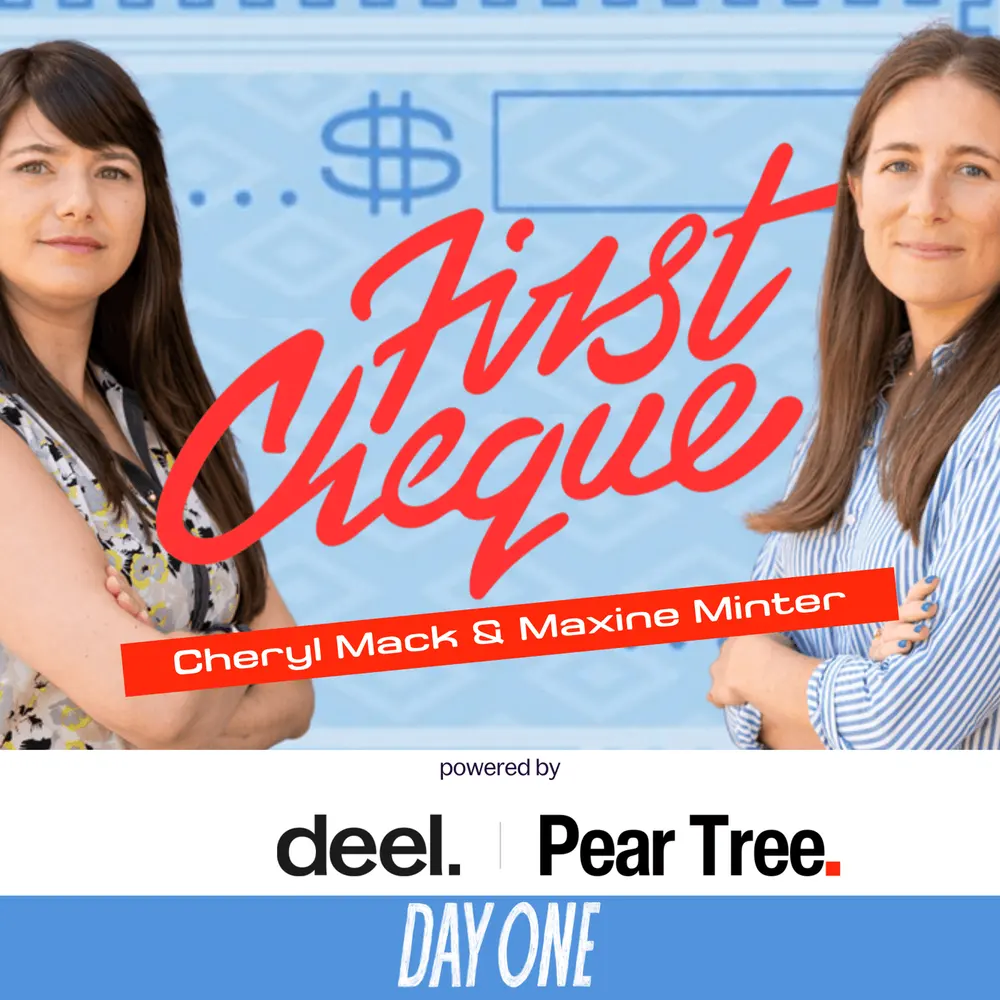 First Cheque with Cheryl Mack & Maxine Minter
Presented by Deel & Pear Tree
First Cheque with Cheryl Mack & Maxine Minter
Presented by Deel & Pear Tree 


 ▶
▶ ▶
▶ ▶
▶