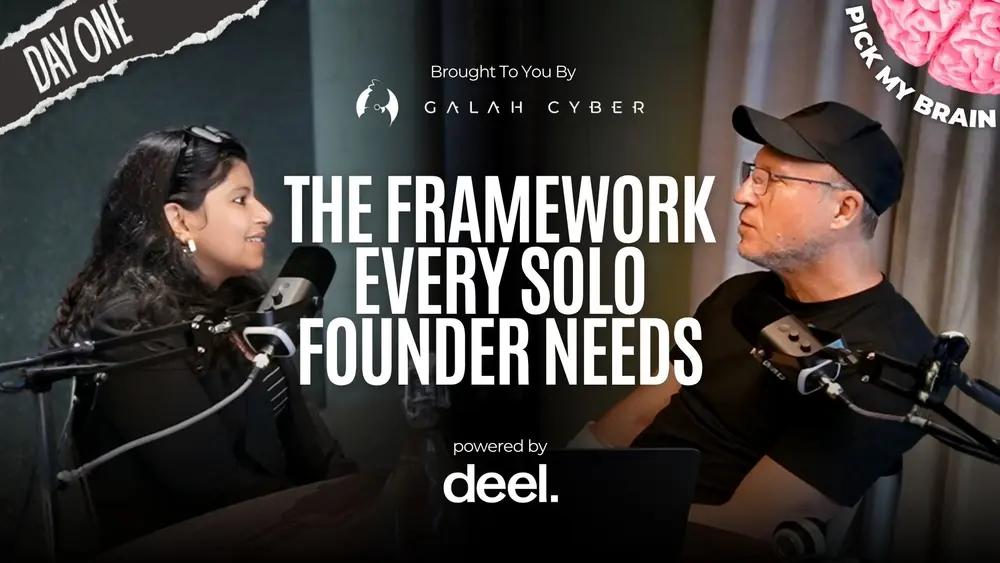
Transcript Synced · select any line to jump ▾ 0:02 Speaker: Founders scale faster on Deel. Set up payroll for any country in minutes, hire anyone anywhere, get visas handled fast, and get back to building. Visit deel.com/dayone. That's D-E-E-L dot com slash day one. 0:22 Kabir Arora: We connect homeowners' backyard spaces to the people looking for alternative and unique outdoor spaces to celebrate any sort of events they might have. 0:32 Alan Jones: So we need to give them something, a hook to engage with before we go deep into all of the problems involved in hosting. 0:41 Kabir Arora: We have about 10 locations and we've booked in our first event. We've generated so far $2,000 worth of revenue and we've hooked into our like service providers, which are like gardening services, which go out now. 0:56 Alan Jones: That's the other kind of, asset, which is really important in, in a two-sided marketplace startup at this stage, right? So, so I'm in the traction, and then I want to believe in the team. And so if you're able to bring that to every meeting you have with somebody, if your co-founders can't be there in person, if, if they can, if, if they can be there on video, that, that can be a great way forward. Welcome to Pick My Brain. We're coming to you today from the Gadigal land of the Eora Nation. Let's take a moment to pay our respects to the First Nations leaders and innovators past, present, and emerging. You're listening to a Day One FM show. Welcome to another episode of Pink My Brain, the show where we help startup founders learn how to improve their pitch to potential customers, co-founders, and investors. My name's Allan Jones, and I'm an ex-startup founder and angel investor. We're joined today by Kabir from Backyard. Kabeer, thanks for joining us, mate. 1:53 Kabir Arora: Thanks for having me, Allan. It's nice to be here. 1:55 Alan Jones: Where are you calling from? 1:57 Kabir Arora: I'm calling from the beautiful land, Northern Beaches in Sydney. 2:02 Alan Jones: Oh, it's my favorite part of the world. Kabeer, let's get started with running through your pitch, and I'm gonna take a few notes as we go and see if I had any advice for you on how to make it even better. 2:13 Kabir Arora: So Backyard, yes, we started about early this year, came up with the idea of why not use the underutilized yards, like when the parents have kids grow up and move out of the homes. And then with this current inflationary times and also mortgage stressful times, wanted to give back to give back some purchasing power to homeowners, help them with generating some income whilst being at home. So came up with this idea of letting them rent out their backyards for events and events only. Given there are similar sort of platforms out there, however, nothing that is absolutely focusing on events. We connect homeowners' backyard spaces to the people looking for alternative and unique outdoor spaces to celebrate any sort of events they might have. 2:59 Alan Jones: Right, okay, that's your pitch, cool. Hey, we spent quite a bit of time waiting to get that pitch deck up, and there's just one slide on it so far, is that? 3:11 Kabir Arora: No, no, no, there is multiple slides. I just didn't want to show you a lot of the texty stuff. 3:17 Alan Jones: Yes, yeah. 3:18 Kabir Arora: Given there are a lot of venues out there which are, of course, limited and it's very hard to get to, you have to spend hours and hours' time to email each one of them and they end up being costly because not only do you get the space but also you have to buy into the drinks and food from the venue. And also, when you're trying to do something externally, there are regulations and also council permission that you need for public spaces to celebrate something private, right? 3:49 Alan Jones: Oftentimes when we are pitching to people, we make the mistake of assuming that our audience is ready and engaged and in the same place as us. And usually actually what's going on for them cognitively is other things, you know, that last text message they just received. Or if you're pitching at an event as one of a number of startup founders, they might be still kind of digesting what they've seen in the previous pitch. So we need to give them something a hook to engage with before we go deep into all of the problems involved in hosting. One really good way to do that is with a bridge. And so a bridge is where we say to our audience something like, have you ever been in a situation like this? Has this kind of thing ever happened to you before when so-and-so occurs? 4:41 Speaker: Right. 4:41 Alan Jones: So I think that would really benefit the pitch that you have today. We make a little bit too much of an assumption that the audience is ready to go deep into the back of problem and the back of customer and the solution that we have for them. I think it would be good to instead make them think for a second about, oh yeah, like I know how that felt when I couldn't get a venue for my party. I think that'd be a great way to go. 5:07 Kabir Arora: That's helpful. 5:09 Alan Jones: Cool. When we bring a title slide up with a company name and hopefully a bit of contact detail, we should move off that title slide right into the rest of the story. And if we are pitching with a deck, we should ensure that the deck marches along with the story that we're telling so that the deck is supporting the story that we tell rather than being a visual accompaniment while the audience is listening to what we're saying. 5:42 Kabir Arora: Got it. So as to not confuse them as to— 5:44 Alan Jones: Yeah. It looks like there's 10 slides in your pitch at the moment. Is that right? And we're on slide 3 at the moment? 5:50 Kabir Arora: Yes. 5:51 Alan Jones: Yes. Should we just run through real quick what's on the other 7? 5:56 Kabir Arora: Sure. Absolutely. So this pitch deck, again, you would have gathered by now, like, this is my first startup that I'm trying to work into. And again, we've not had the opportunity to kind of present this pitch deck to anyone. It was created purely in order to be able to send it through. For someone to have a look at this at their own leisure. And then this is where we basically talk about all things events purely because we are alongside working with the outdoor spaces of homeowners. We are also trying to get along third-party contractors and service providers like caterers and photographers, musicians, and DJs so as to essentially pivot ourselves into a one-stop shop event. Mm-hmm. So this quite quickly gets around to like, you know, where we see ourselves in a couple of years' time and how we kind of are making money. This particular slide that we are on right now is meant to be edited in like in today or coming days' time. So as to show like, you know, the events that we are engaging with aren't going to just be limited to external like in the outdoor spaces of the yards. It might grow into bringing along other underutilized spaces like warehouses or like some Pilates studios, some other spaces that people might have, which is like, you know, not easily accessible through the internet because the spaces can get lost, which are commercial spaces but get lost in the SEO to reach to Google. 7:33 Speaker: Okay. 7:34 Kabir Arora: So I should bring them on board as well. 7:36 Alan Jones: Send me slide 8, 9, and 10. All right, cool. A bit of competitor analysis, great. Something about how the product works, cool. And the final slide, cool, the founding team, fantastic. 7:51 Speaker: As a startup founder, you're juggling multiple priorities from the expected, like finding product market fit, to the unexpected, like customer requests for SOC 2 or ISO 27001 certification. But achieving compliance is time-consuming, and time spent on it is time away from the needs of your business. That's where Vanta comes in. Vanta is the all-in-one solution for startups to become compliant quickly and build a security foundation with ease. With a combination of automation, an extensive partner network, and a security marketplace, Vanta provides the necessary tools and expertise for startups to achieve compliance seamlessly, no matter how urgent your needs are, and at every phase of growth. Over 10,000 leading companies, including Cipherstash, Handle, and Indetted, trust Vanta to automate compliance so they can focus on growing their business. Listeners of the show get 10% off Vanta at dayone.fm/vanta/brain. That's dayone.fm/vanta/brain. And now back to the show. 8:55 Alan Jones: Great, great, great. Right, some diversity and some relevant experience. So that's encouraging. 9:01 Kabir Arora: Yes, so like me and Sunil both have come over to Australia from India. I've been here for like about 16 years and Sunil's been here for close to 7. And Ivona is from Poland, so that kind of gives us the edge to kind of take us international at some stage purely because of her connections in EU and our connections back in India. Sunil's based out of originally from Bombay, and myself from Dabby. 9:28 Alan Jones: Mm-hmm. Gotcha. Great. Thank you. So it could be, thanks a lot for that. This is a pretty detailed deck to send out cold to investors. I think the primary goal of a deck that you send out to investors that haven't met you before would be just to take this one step further down the funnel, right? So when we send a deck out to somebody that we haven't been invited to pitch to before, what we're hoping to do is to get something like this, call with them or a coffee, sit down and have a chat. So the first is to get to a conversation. And oftentimes we want everybody to understand everything about a business and all the potential that we have. And oftentimes that's really not necessary just to get to the point of a first conversation with them. 10:20 Speaker: Cool. 10:20 Alan Jones: When we try and explain too much of our business, especially when our business is still largely hypothetical and, you know, a lot of what we're talking about here is stuff that's going to happen in the future that hasn't happened yet. When we go too deep into that before somebody really knows us, there's a lot of opportunity there for them to get skeptical, to push back, you know, because remember, investors are always looking for reasons to quickly say no because they always see more pitches than they can possibly invest in, right? 10:48 Kabir Arora: Right, just quickly, if I may pause you there, sorry to interrupt. We have about 10 locations and we've booked in our first event. We've generated so far $2,000 worth of revenue and we've hooked into our like service providers, which are like gardening services, which go out now to those listings that we have, providing them discounted services, giving us a bit of a kickback. So it's the things are in progress, very, at a very little. So that's the stage I just wanted to mention we are at currently. 11:22 Alan Jones: Thank you. That's great. So that would actually be a great point to lead with at the beginning of a different kind of deck that I think maybe you should consider sending to cold investors. So that kind of deck is a teaser deck where we don't explain the whole business and we don't explain everything about who we are and where we've come from. We just hit them with something that that hopefully might surprise the right kind of investor and might, might make them say, oh, okay, you're like, I'd actually quite like to have a chat with this person and figure out how they got to here. So one of the big reasons investors often say no to two-sided marketplaces like this one is, is that traction is everything, right? So— 12:03 Kabir Arora: Yes. 12:04 Alan Jones: If you're solving an important problem for both sides of the marketplace, the venue owner and the person wants to hold a function. Then you will have traction even at the very early stages. And if we look at the early history of Airbnb, there was really, there was no platform there. There was no product, but they had traction. They were renting out spare bedrooms to people in busy cities. And so I think that would actually be a great way to lead into a conversation with an investor. Hit them with a teaser deck, something shorter than this with less detail about the business and start with, since we launched in blah, Yeah. We've, we've already done this much transaction value on our platform. We have this many customers, um, up on one side of the platform on the supply side, and this many customers on the demand side, and we're already starting to, to look at diversifying our revenue. Would you like to learn more about the startup that's, that's behind this opportunity? Here's, here's some contact details, or here's the URL of a landing page for you to, to, to go and find out more. 13:03 Kabir Arora: Super. 13:04 Alan Jones: Yep. Awesome, great. So Kabir, you present like a confident entrepreneur and that's gonna be fantastic. It might be good when you get an opportunity to pitch to people over a video call. It's difficult to get co-founders in the room at the same time on the same day, but it could be a really great alternative just to get like a 30-second intro video from Sunil a 30-second intro video from Ivona, just, you know, talking about this is who I am, this is relevant experience that I bring, and this is why I'm excited to be part of Backyard. Because that's the other kind of asset which is really important in, in a two-sided marketplace startup at this stage, right? So, so I'm in the traction and then I want to believe in the team. And so if you're able to bring that to every meeting you have with somebody, if your co-founders can't be there in person, if, if they can, if, if they can be there on video, that, that can be a, a great way forward. 13:57 Kabir Arora: That's a great tip. 13:58 Speaker: Thank you, Alan. Sabir, it was really great to meet you today. Thank you so much for joining us on Pick My Brains. Please stay in touch and let us know how you go with the journey, and I hope there are ways that we can support you in the future. 14:13 Kabir Arora: Absolutely. Thanks, Alan. Thanks for your time. 14:15 Alan Jones: Thank you, man. 14:16 Kabir Arora: Bye. 14:17 Alan Jones: Bye. 14:21 Speaker: Thanks for joining me for this and every episode of Pick My Brains, the advice podcast for every startup founder. Never mind the "don't forget to like and subscribe" bullshit that every podcast host goes on about. Instead, please take a moment to think about someone you know who could use some of the advice I've shared and tell them that they should listen to it. I don't know, maybe they'll choose to like and subscribe. Anyway, I'm not a lawyer or an accountant, and what you've heard today is not intended as financial or legal advice. You should always seek that from a qualified professional before making the big decisions. And I'm not a superhero either, so don't forget that sometimes I'm fallible, and very occasionally I might even be wrong. Please let me know when you think I might be, so I can get better at this too. Just reach out to me on any of our social channels or email the show at pickmybrain@startupfoundercoach.com. Speaking of startupfoundercoach.com, that's where you might sometimes find show notes, transcripts, and bonus bloopers if I have the time. The Pick My Brain podcast is produced, edited, and beamed directly to your ears by the hardworking and understaffed team at Day One, the podcast network for founders, operators, and investors. 15:24 Alan Jones: Find out more at dayone.fm. 15:27 Speaker: Thanks for listening.

 ▶
▶  ▶
▶  ▶
▶  ▶
▶  ▶
▶  ▶
▶  ▶
▶ ▶
▶ ▶
▶