Transcript Synced · select any line to jump ▾ 0:02 Speaker: Founders scale faster on Deel. Set up payroll for any country in minutes, hire anyone anywhere, get visas handled fast, and get back to building. Visit deel.com/dayone. That's D-E-E-L dot com slash day one. 0:22 Maxine Minter: Okay, 3, 2, 1. 0:26 Cheryl Mack: Hey, I'm Cheryl. 0:27 Maxine Minter: I'm Maxine. 0:28 Cheryl Mack: This is First Check, part of Day One, the network dedicated to founders, operators, and investors. 0:32 Maxine Minter: Investors. If you want to be a better early-stage investor, this is the show for you. 0:35 Cheryl Mack: So TL;DR, if you don't want to suck at investing, listen up. Emily's got a really interesting background because she started a computer vision back in the day before AI was a thing, right? 0:53 Maxine Minter: Yeah, like old school AI. I never thought I would say those words. You asked me this question in 2019, like, would I ever say the word the word old school AI, but it was, it was old school AI and that is kind of where she grew up. And now obviously there's been this huge proliferation in AI and new school AI and I'm so excited to get in with her. Like what does she learn in old school AI? Like what is she pulling through into this new generation? How does this accelerate her in her knowledge in AI? And actually what are some of the heuristics that she actually has unlearned? 1:24 Cheryl Mack: I actually just like cannot keep a straight face when you say old school AI, but Let's run with it. She's also another good example of an operator angel, so we can pull some of that in and really get to understand what she's seen over the last several years. 1:40 Maxine Minter: Totally. I'm so excited for this trend in operator angels, by the way. Like, I can't wait to get more of these folks on the show to talk about like how they bring those two expertise in, both investing into companies and bringing that expertise from their operating journey, but vice versa. It's really exciting to see that, that group be investing more. So can't wait to get in with Emily and get a sense of, yeah, how does she apply it? What's she learning and where doesn't it work? 2:06 Cheryl Mack: Yeah, 100%. Let's get into it. 2:08 Maxine Minter: Let's do it. Emily, we are so excited to have you on the pod today to chat all things early stage, deep tech investing, and also hype cycles, 'cause man, are we in one. Thank you so much for coming on. 2:22 Emily Rich: Thank you so much for having me. So excited to be here. 2:25 Maxine Minter: So we ask the same question of every guest when they join us. What is the first thing that you ever invested in? 2:31 Emily Rich: Okay, so I've listened to a few people on the podcast now who talk about their first investment and that it was real estate. And I'm sitting there thinking, well, that is unheard of now. I don't think we'll hear that in the future, that's for sure. 2:45 Maxine Minter: Yeah, fair. That's probably true. Wow, that's a crazy thought. And actually quite sad, right? Like so many of the people who came on and said that, like that was a material— well, most of them was a material leg up. I think Georgie from Tidal, it was a step down. 3:01 Cheryl Mack: She was the only one. 3:03 Emily Rich: Oh, I listened to hers. Yes. Hers was like her return was not good. Not good. Not good. 3:09 Cheryl Mack: But I think that was an outlier. The poor thing. 3:12 Emily Rich: But Sam's was good. 3:13 Cheryl Mack: Sam's was very good. What about yours? 3:14 Maxine Minter: Was yours good? 3:15 Emily Rich: Mine was not real estate, so mine was— Oh, okay. That was sort of an aside that I'd heard a lot of people, and I was thinking, that's never gonna— just, that's never gonna be something that people are gonna say anymore, I don't think. But I think mine actually is, I— as cheesy as it sort of sounds, I started investing in myself, in my education, and not from a university perspective, actually, from a schooling in general. So I didn't really enjoy school, and in year 10 I got kicked out for non-attendance. And I remember this moment where I was like, huh, I can either go back to school and actually attend, or I can go and get a full-time job. And those were the options that were given to me, essentially, by my principal and my mom at the time. And I loved learning. Yeah. But I didn't like the school environment. I suppose it just didn't suit me. So anyway, I chose to go back to school, and I think in those last 2 years of school, I missed like 4 days total, and that was unheard of for me. So that was my first real investment in, hey, this is— I do, I do actually want to be here, and I should be here, and I do want to I do want to continue learning, and I'll learn in this fashion if this is the way that I have to do it. 4:44 Cheryl Mack: Oh, that's so fantastic. 4:45 Maxine Minter: Wow, I love that. I, um, what was it, just a mindset shift? That seems like such a stark change for you, right? 4:52 Cheryl Mack: There's actually data that shows that people who go back to school later in life have a much higher attendance rate, much higher, like, um, like, great— not just grades, but like participation rate and engagement rate, because they are making a conscious choice. And there's even data that suggests that kids who do a gap year and then go back to school are also more engaged because they've had time to decompress and they're like actively making a choice that like, okay, this is what I want to do now. So actually that, that tracks. 5:21 Maxine Minter: Was that what it was like for you, Emily? 5:22 Cheryl Mack: Yeah. It's so interesting because I think whilst you're not being forced to do something almost, you know, it is, it is a real choice that you're making for yourself. And so that probably does track, and the data is— yeah, that makes a lot of sense to me because, you know, you go to school because you have to go to school and it's mandated by law that you go to school. And then when you have someone sitting there going, well, you can go to— you can go to school or you don't have to go to school, and it's like, oh, okay, so now I actually have to make a decision because, you know, it's only mandated to a certain point. So, uh, yeah, then I made the decision. I think that does track with— I really had, yeah, high attendance, got good grades, you know, all of the sort of makings of a good student, uh, which I definitely was not before. So yeah, tracks. 6:20 Maxine Minter: That's so fascinating. I so resonate with the feeling of like being really bad at being told what to do. It is a skill I have just not developed. If someone— like, it is so minor, especially like in our household. Laura, my chief of staff, has to deal with this all the time. She'll be like, or in my household, my partner will be like, hey, can you pass me the salt? And everything in my being is like, no, like, you have a problem. Like, you're lucky you don't work for other people. Some oppositional defiance there, Maxine. Oh, that's so great. 6:51 Emily Rich: I think it's definitely partly that. Yeah. 6:55 Cheryl Mack: That's good to know about you. You just have to like incept ideas. 6:59 Emily Rich: Yeah, you have to influence the ideas rather than just say, hey Maxine, do this. 7:05 Cheryl Mack: This is your idea. You really want to pass me the salt. 7:08 Emily Rich: Yeah, I'm definitely like that. I think that's where it all sort of stems from, really. 7:13 Maxine Minter: Oh dear. Right. It's just that maybe I tell myself this because it makes myself feel better, but there is some suggestions and quite a lot of research that founders are really bad employees. Like great founders are really bad employees. Being told what to do and being like being put in constraints just is a really bad way for founders to kind of thrive in life. And then they step out of it and they're like creating their own thing and they just feel so much better. So I tell myself that that's why, but I think probably I'm just stubborn. 7:46 Cheryl Mack: No, no, data, data suggests that this is— Yeah, data suggests that it doesn't work. You know, pie charts. 7:52 Maxine Minter: It's an identity I chose. It didn't choose me. 7:55 Emily Rich: Well, you've chosen the right field then. 7:59 Maxine Minter: Yeah, right, exactly right. So all three of us are early stage investors. We all invest in pre-seed and seed, and obviously Cheryl and I are constantly pontificating about why that stage is so great and interesting. And I feel like you have a pretty interesting perspective here. So, you know, why did you choose pre-seed and seed as your stage for investment? Why do you believe it's a great place to get in and support founders? 8:24 Emily Rich: Yeah, I think— okay, again, data. I'll start on the data piece. I think it makes sense to invest early for the greatest uplift. It's the largest area of opportunity. That's what the data tells us. I also just love it. Having been a founder myself, I love getting the chance to work with early-stage companies, and in those pivotal moments of growth, I know how much it is make or break. And there's this window of time that almost once you get past that sort of Series A, you know, you found product market fit, you're doing quite well, hopefully, you know, you're strategically aligned. You know, obviously things change and move very quickly, but as companies progress deeper into further rounds, a lot of the foundation's already been set. I love working on the foundation piece. So the ideal version of that for me is working with early-stage companies where I can make a difference. And also the, you know, the second piece on the data and the great uplift that you get from investing in early stage— it's high risk but it's high reward. 9:33 Cheryl Mack: Yeah, there's a reason that you get the, the biggest multiple on that very first investment. And I think if you're Maxine and just don't follow on, then you can just say, yeah, we gotta 50x multiple on that instead of that blended average on the follow-on. But I think there's also a piece there around, like, the most exciting moment in a founder's journey is often that, like, first year where everything is possible and the world is your oyster. And, like, just playing into that and really, like, getting to— like, I love founder meetings because you have an hour to, like, be immersed in whatever future the founder think it thinks exists and can just be a part of that. Do you find that like as you're talking to founders, you are just like really buying into whatever vision they have regardless of how crazy it is? 10:20 Emily Rich: Oh, for sure. Yeah, I love it. I love that everything is possible. Nothing's off the table. There's very few things that are nos, you know, it's so interesting and it's such a fun, stage. And yeah, I think, you know, I spoke about those pivotal moments of growth, and that's just— those are those things where it's in that stage, those are really— it's really, really fun. It's a lot of fun. You can have a lot of fun with it. And I think what I see myself doing, you know, now and in the future is I'm choosing things that I enjoy. And what I really enjoy is that early stage and being part of that that growth at early stage. And I've, I've found that that's, that's just what I enjoy. So why not do it if I can? 11:08 Maxine Minter: Absolutely. I also, I mean, like, you've been an operator, right? Like, yeah, I think having people early on in the journey that get behind you, like, not just with empty words but with their, like, money and their time. I'll, like, speak for myself. I remember Dustin Dogano, who was one of our pre-seed investors, like, he probably has been— I won't say single-handedly, but definitely like a huge influence on my venture-backed building career. Because like, he saw an opportunity in me and my co-founders actually before I really did. Like, it was like him coming in with his background and his credentials that it almost like was a mirror for me that he held up and was like, no, I think you're capable of doing this. But for me, it was like, oh, I don't think I'm allowed to swear on this podcast. S-word. 11:56 Emily Rich: Can we swear? 11:57 Maxine Minter: Have we sworn I don't know, maybe. I mean, I swear all day long, but you know, I don't know if Adam edits it out. I probably should ask him. I swear too. 12:07 Emily Rich: I wasn't sure what the— is it PG? 12:09 Cheryl Mack: Says who? Our audience is all investors. They swear all day long. Yeah. I think that with our audience, they would appreciate this. 12:18 Maxine Minter: Right, right. I apologize. You know, our editing team in advance, if you're gonna have to go through and like bleep all of these. Anyway, but I was like, oh shit, like I actually can do this. And like other people are showing me that I can do this. It's like building my confidence. That is so crucial when you're building one of these venture-backed businesses where you're swinging for the fences, right? You are like putting it all on the field to try and create these outcomes. And so I think one of the enormous privileges, I think for us investing at pre-seed and also at seed is the opportunity to have, like, to show the founders that we see them, we see what they're capable of, we see that they are incredible and we are behind them to accelerate them. And I think it's much like, once you have done all of the work to build a more repeatable business, you found product market fit, you know, the data says, clearly says like, hey, I can invest a dollar and make 2 or 3 or 4 or 5, whatever your— LTV to CAC ratio or any of those things are, the business at that point has been like, no, you can do this because you are doing it. It's currently happening, right? And like that gets behind you. But in those early stages when it's just an idea, I think it can be really impactful, especially for first-time founders. And I think this is something that the Australian ecosystem is getting better at, but is not yet killer at, like having folks like you, mate, around the table. So you come in early and be like, yeah, we see you and we're going to get behind you and like. accelerate you. I think it's so excellent and such a privilege. 13:50 Emily Rich: Yeah, for sure. I think that's what makes such a huge difference. And I think also the privilege of having that experience of being a founder and being in that position and having empathy for how difficult that journey is, especially at that early stage where you really are putting everything into this thing, right? And you believe in it, but there are definitely days where you are like, I do not believe this works anymore at all. And to be a nice sounding board for founders and to give them confidence, not just with your investment dollars but with your time. So, you know, if you're giving up your time and spending it with people at that early stage, you're saying, wow, I really, you know, I really believe in what you're doing. Not only have I invested my money, but I will spend time working with you on your pitch or your commercial negotiations or whatever it may be. And those are the types of things at an early stage where I had people in my life that I felt, wow, you really believe in what I'm doing. I don't just believe in what I'm doing. So 100%, it's, it's great that you're not the only one believing in it. And there are these external people saying, this is, this is really good. What you're doing is right. and keep doing it. 15:13 Cheryl Mack: It probably also influences the outcome, right? Like if you're hyping someone from the sidelines, it's like cheering on an athlete. They're probably gonna run faster. Or at least I like to think that cheering them on from the sidelines makes them run faster. 15:25 Maxine Minter: Yeah. 100% it does. I have never run a long race, not a runner, but I believe like you definitely see them and they will like be like, it perks you up, you know, like having your crew around and like celebrating. So I really like that analogy. You know, it's like you are running a marathon at sprint pace. And so like having crew on the sidelines, like they're not on the racetrack with you, but they are there on the sidelines kind of handing you goo or water or whatever that— I think it's goo, a thing. Definitely not a runner. 15:53 Cheryl Mack: Yeah, the goo pouches, like the yogurt pouches I give my kid, but they're for adults and they're gooey. 16:00 Maxine Minter: Kind of the same. 16:01 Cheryl Mack: Or maybe that was just like a hype product for a while that everyone got excited about. 16:06 Emily Rich: I think they're still doing it. I don't know. 16:08 Cheryl Mack: But speaking of hype products— 16:10 Maxine Minter: Segue. 16:10 Cheryl Mack: Segue. Yes. Speaking of hype products, I think as Maxine said, we're kind of in like the mother of all hype cycles at the moment. Would love to get your sense of like, have you identified, like, how do you identify and navigate hype cycles in the investing world? Like, what have you seen play out? 16:27 Emily Rich: My favorite one is the metaverse. That's my favorite one. It's— because it was so overhyped and no one is spending time in the metaverse yet. I will say yet because I'm sure that eventually people— 16:45 Cheryl Mack: I really thought we were gonna like go into like a Ready Player One, but we're not, we're not there, right? 16:51 Emily Rich: And so there was this huge hype for the metaverse, and I don't know if you, you remember, but brands were starting to begin advertising strategies for the metaverse. Do you remember that? 17:01 Cheryl Mack: Yes, yes. And bands as well. Yeah. 17:03 Emily Rich: And basically no one ever saw ads because no one was just chilling in the metaverse. So it was this, it was this huge overhyped— 17:11 Cheryl Mack: But it was really cheap advertising space. 17:13 Maxine Minter: Did you guys ever watch the first ever Shark Tank episode in the US? Not Shark Tank here, Shark Tank in the US. 17:19 Cheryl Mack: No. What was it? 17:20 Maxine Minter: What was it? I'm pretty sure it was the first episode. And this guy pitched a— it was like back, I guess it would have been in the early 2000s when everyone was wearing those like head, like earpieces for microphones. Remember those things that look like cockroaches with like glowing bums that they would put on their ear? So what his pitch was like, you look silly when you wear one of those. So what we should do is we should implant— 17:45 Cheryl Mack: The iconic ear. 17:46 Maxine Minter: Well, no, he was like, we should implant the microphone and the speaker in the person's ear. So if you call, you just like receive the call in your head and it'll be great. And so you could— 17:58 Cheryl Mack: Yeah, it was called the iconic ear. 17:59 Maxine Minter: Oh wait, are you serious? That's what it was actually called. I thought you were naming it the iconic ear. 18:04 Cheryl Mack: Yeah, I'm telling you, it's called the iconic ear. 18:07 Emily Rich: Did it work? Did it— 18:08 Maxine Minter: like, does it exist? Well, no. So, the sharks, like, absolutely tore him apart. And one of the questions was like, well, wait a second, how does it charge? Oh, wow. And he was like, it's fine. At nighttime, you just lie down and you insert this pin through your eardrum and charge it. That seems legit. And the shark— one of the sharks, I think Damon John was just like, oh my God. No, that is not— 18:30 Emily Rich: Not okay. 18:31 Maxine Minter: That's not it. That's not it. Which, like, at the time, He obviously, like, they obviously put it on reality TV because it was like a step too far. But like, at the time, everyone was wearing these like headphones. 18:41 Cheryl Mack: And Bluetooth devices at the time, like, they were the ones that like went over your ear and were like this long stick. 18:47 Emily Rich: Huge. 18:47 Cheryl Mack: Yes, they were huge. 18:49 Maxine Minter: Yeah, they were fairly large. 18:51 Cheryl Mack: So like, I see that where he's like, dumb, you look dumb. Here, stick something in your ear instead. 18:56 Maxine Minter: Agree with the problem, not so much the solution. 19:00 Emily Rich: And also charge it through a pin? 19:02 Maxine Minter: Yeah, charge it with a pin in your ear. Like, what if you happen to roll while sleeping, like every human on the planet? 19:08 Cheryl Mack: What if you miss? 19:09 Maxine Minter: What if you miss? What about if you need to replace it? There's just so many questions. 19:14 Emily Rich: Can you imagine if that turned into a hype cycle? 19:16 Maxine Minter: Well, no, thank God, no. But I wonder if we're gonna watch that video of Zuck, like, launching the metaverse. 19:23 Cheryl Mack: Oh yes, when he goes the, you know, the metaverse thing and he's like this, like, robot cartoon character and we're all like, just so cringe. Like the Ionic Ear. 19:31 Maxine Minter: Like, I wonder if we're gonna similar moment watching that, you know, in 20 years, like business school classes will be playing it and people will just be like, what? 19:41 Emily Rich: Yeah. 19:42 Maxine Minter: Like, why did they ever think that that was gonna work? 19:46 Emily Rich: I don't, yeah, I'm not convinced about the metaverse yet, but I think that your question was actually how do you identify and navigate them? And I just went straight into like, hey, the metaverse sucks. 19:56 Maxine Minter: And that's not, that's not what I meant. Great answer regardless. 20:02 Emily Rich: You know, another one that I really couldn't— I'm still not— and I know Cheryl, you're, you know, a lot more about blockchain than I do. I know you're more involved and it's one that I'm still like, aren't you? Did I make that up? Probably like by this much though. 20:18 Cheryl Mack: Like, I feel like— 20:18 Maxine Minter: I love the cushioning here. I knew she's just about to be like, I think you invested in hype cycles, but I don't want to like directly target a whole bunch of your investments. So she's like, You know, I think it's fine. Like, it's fine. We all— I'm still learning. It's fine. 20:33 Cheryl Mack: You probably know more about it than I do. So like— 20:36 Maxine Minter: Go for it. Just go straight for the squishy stuff. You think blockchain is a hype cycle? 20:41 Emily Rich: Not at all. I think there is like, okay, so blockchain, everyone started spinning up these niche crypto funds and things like that. And that was pretty crazy. But I think there are some really interesting use cases. I really love the use case of, you know, there's basically food tracking and things like that. I can see some really, really nice uses for it. And then there are some very clear just meme stocks that it was like, come on, really? We're really doing this? And then that was so overhyped and it went into this sort of hype cycle. But I think the— Ultimately how I sort of navigate it is I also own crypto, so I didn't really navigate it, but developing a clear investment hypothesis is probably like the, the thing, right? I think what people did was, because it wasn't in their investment hypothesis, they started spinning up crypto funds because they couldn't invest in crypto in their funds, right? So it was very interesting. 21:36 Cheryl Mack: Yeah, the moment crypto went from a currency to an investment product, then like a lot of other dynamics came into play that impacted the potential usefulness of the technology. 21:49 Maxine Minter: For sure. Yeah. I mean, I remember, I think Charlie Munger said, this is probably more a statement of his approach to social striation than anything, but he's, he kind of gives the advice when he was alive that if your shoe shiner starts giving you stock tips, sell. And I had a similar moment. 22:08 Cheryl Mack: Sell everything or just the stock that he told you about? 22:11 Maxine Minter: I think, I don't know. That's a good question. I wish I could ask him. I think he was referencing like overall, it says, it says to the market, like you are at the top of a hype cycle, like you're at the top of a bubble. And so like you should liquidate. But my moment for that in crypto— 22:28 Cheryl Mack: What's the modern day equivalent? 22:30 Maxine Minter: Well, my modern day equivalent in crypto specifically was I was in Austin and someone drove past with a Lamborghini that was covered with Doge, the Doge dog, like just like the Dogecoin. Yeah, the Dogecoin, but you know, the dog. Like covered. Yeah, repeated all over. Lamborghini zoomed past me in Austin and I was like, if I had crypto, I would be like— I would literally like right now be selling it based on this Lamborghini, specifically the Dogecoin. 22:58 Cheryl Mack: But I just want to say that of all the crypto I bought, and I bought a lot of crypto, uh, Doge had the biggest like multiple, biggest return. I think we got like a 4,000% return on our Doge investment. Incredible. 23:10 Emily Rich: Yeah, it's crazy. It's crazy because it was all hyped and then as long as We sold at the right time. It was fine. 23:17 Cheryl Mack: Yeah. Well, when you like get a 4,000% return, you're like, yeah, okay, sure. I will. Yeah, I'm gonna take that off the table. 23:24 Maxine Minter: Money comes off the table. Yeah. Yeah. I do think the hype cycle question though is quite, quite, quite interesting. Like as investors, right? Our job is to invest in what the future looks like. And so we are supposed to, well, in this line of investing and in this asset class, and especially if we are investing in seed and pre-seed, right? Is really important and can produce some really incredible returns if you're investing in companies that are before the wave. I think Mike Maples talks about this idea of investing in founders who've seen the future. So they've like worked in companies at the cutting edge of technology and then they're building infrastructure that we're going to need, or they're building like products that we're going to need at that stage. And so I think the kind of like activity of working out how to spot some of these dynamics to make sure you're not just kind of forward investing ahead of the curve, which I think for actually for our audience, probably worthwhile mentioning. If you're not familiar with the hype cycle, it's worthwhile something to be familiar with. Essentially, you have a new technology, the technology sparks like building in sentiment of the belief of what's possible. And then you come to some asymptotic point in that curve, where you realize everyone has overestimated what's possible, either right then with the technology or that will ever be possible with the technology. And you go into the— what they call like the pit of despair or the pit of disillusionment. And so you kind of just disappear off this cliff. So you can imagine you kind of like build relatively rapidly up the curve, then you, an asymptote, and you come pretty much straight off that cliff down into the kind of pit of despair, which, you know, in crypto was like February 2022 through to middle of 2023. And then now you've had this kind of like wiggly line of rebuilding and like it's anyone's guess whether they'll actually build value behind them. But you then kind of build over time. 25:09 Emily Rich: I hope so. 25:10 Maxine Minter: What do they call that? I think it's the like build of usefulness or something. So essentially like all of the tourists go home and the people who are like super committed to the technology then kind of iterate over time and actually build something useful out of it. And so that kind of wave that you go on appropriately identifying where you are on that curve, obviously it's really excellent to be investing when the technology just came out, à la Vinod Khosla investing in OpenAI you know, when they were an idea. Whereas right now, where you might be investing in OpenAI at a $150 billion valuation, might be somewhere kind of maybe near the top of that hype curve. And I think the big question for a lot of investors that I'm speaking to at the moment is like, are we getting close to that? You know, and I think Sequoia wrote a really interesting piece a year ago and then rewrote another interesting piece recently on whether AI, like infrastructure that we've put in place, can generate, I think it was $600 billion in revenue, right? So like the valuation that we have already, we've paid the kind of aggregate of all of the infrastructure that we've put in place. 26:14 Cheryl Mack: AI companies. 26:14 Maxine Minter: AI. Well, I don't think it's all of the AI companies. I think it's the infrastructure. So I think it's like NVIDIA and the underlying LLMs. I don't think that they were taking into account the app layer, but edit me there if that's not accurate. But essentially they said with the valuation that we've got in place for that to return a reasonable return, this collection of infrastructure and kind of NVIDIA and the underlying LLMs have to generate in some kind of reasonable timeline $600 billion of revenue. And so the open question is, can they? That's a lot of revenue. Like OpenAI, I think there's some indication OpenAI by itself is at $5 I believe Anthropic is the current front runner in terms of adoption. 26:56 Emily Rich: And in what, in what time schedule though? 26:58 Cheryl Mack: I mean, the standard VC cycle, right? 5 to 10 years. 27:01 Maxine Minter: 7 to 10. 27:02 Emily Rich: 5 to 10 years. Okay. 7 to 10. Yeah, maybe, maybe. 27:06 Cheryl Mack: Potentially. Crazier things have happened. 27:09 Emily Rich: Crazier things. Yeah, I think. Have faith. Yeah. 27:13 Cheryl Mack: I like, I would need to understand a bit more about that data. Like, okay, so $600 million across how many companies? 27:18 Maxine Minter: Billion. 27:18 Emily Rich: Yeah. 27:19 Cheryl Mack: And is it just— 27:20 Maxine Minter: Billion, billion. 27:21 Cheryl Mack: Billions of companies? 27:22 Maxine Minter: No, no, $600 billion, not $600 million. 27:25 Cheryl Mack: Yeah, that's what I said. 27:26 Maxine Minter: Oh, oh, okay. They said $600 million. I'm like, OpenAI like blew it out of the water in the first 12 months. $600 billion. 27:32 Cheryl Mack: No, but like how many, across how many companies? And yeah, we're talking about like 7 to 10 years. And like if we think about the predictability of like how the human workforce can just like triple, 5x productivity, like I mean, I'm an eternal optimist. I'm seeing— 27:47 Maxine Minter: Me too. 27:48 Cheryl Mack: For anyone who isn't on video right now and seeing Maxine's facial expression, she's like, "Hmm, maybe, Cheryl?" Maxine's basically in the corner going, "What?" No, I think it's— 28:03 Maxine Minter: I do not have a clear answer for this, right? If this was like a clear cut and dried, there are so many other people that are much smarter on this topic that I feel like if it was like obvious, they would have, you know, no one would be backing these LLMs. OpenAI would not be raising $150 billion. Sorry, I don't know how much they're raising actually, but on $150 billion valuation— Are we, are we mixing up our billions and millions again, Maxine? It's all black. 28:24 Emily Rich: No, it's, it's a huge amount, but it's also, it's a huge investment that people are putting in. But it wouldn't be crazy to get a huge amount out of that. It's basically being used in almost everything now. And I know, you know, I know we'll get to— we'll talk about it more, but it's— crazier things have happened, I believe, as well. 28:48 Maxine Minter: Yeah, I mean, I guess the question for me, especially with open source, right, and open source models, like, what does this look like in the long term, right? With Llama, I know the Mozilla team are really kind of pounding the drum for open source models. If you look at the graph of adoption, the open source models are growing much faster than, you know, the closed source models. Like, I think it's very interesting. 29:11 Emily Rich: Yeah, the open source models, they are really, really a lot bigger in size. And I wonder what that— actually, I'm interested in seeing how that trend continues. I mean, open source has always been very, very, very important in AI, so I don't see that going away. But it's interesting how we're now splitting things out into you've got these proprietary models and then you've got the open models. So yeah, it's, it's, it's a very interesting time now, I think, that we're sitting in. 29:41 Maxine Minter: Yeah, it is an important point to pull out. I mean, you have a deep tech background, you built a computer vision business like 10 years ago, you've been in the AI space for a really long time. I'm wondering kind of from your vantage point, what has changed? 29:53 Emily Rich: Oh my goodness, so much has changed. It's crazy when I think about that, that was over 10 years ago. And particularly back then in Australia, people, and I say this very generally, people didn't really see the use for AI. It wasn't of particular interest. And all of our customers were in the US. What I will say is they were all very forward-thinking organizations. They were all, still are today, all very work on, you know, working with cutting-edge technology. And so you really couldn't spin anything up out of the box just off of an AWS instance, you know, for example, like you can now. It wasn't the nice days that we have now, which is just, you know, you can really, really easily build or put AI into any of your— anything you're building as well. It was all very new to be using AI in a commercial setting rather than a research setting. AI, computer vision, machine learning. You know, AI is an umbrella term for so many things, but that has been around for decades and decades and decades. So this is not new. This is just new in commercial settings. Of course, there are people that were doing it, but nothing like we see today. So I think there's, there's things that have changed and there's things that have changed slightly. So one of the trends that I see, actually, I was reading an article today which was really timely for this podcast. And one of the fears that still exists now that I was being always being asked about was, are robots going to take over our jobs? And I was looking at this post today on AI tools. So it was, you know, just a generic, hey, here are 10 other AI tools you can use apart from ChatGPT. 31:40 Maxine Minter: Cool. 31:40 Emily Rich: And a number of comments there was— I went through and a number of comments are about 50% of people saying we shouldn't have these, they're ruining our lives, all of this, da da da. And then the other 50% of people are saying they're making our lives better. Oh, I'm so busy. This is— I use ChatGPT every day. I use this every day. I use Beautiful AI. I use whatever. And we're basically singing praise on AI and what it's done for them in their day-to-day lives. And— It's so fascinating because there's still— what we sort of see is, I don't know how much— I haven't looked at the, you know, the actual data on how much, how many people in the population versus how many agree with AI or disagree with AI being used. But from what I'm seeing is there's definitely still this huge divide. I think that it's getting smaller. The divide is shrinking. So we are accepting AI more so into our lives than we were 10 years ago when I was trying to sell an AI product. People were like, why are you doing this? Why would you ever do this? They literally— those are the questions I was getting. I remember being interviewed and I was like, well, why are you doing this? And why are you taking people's jobs? And all these sorts of things. And, you know, I think we're getting less and less of that, obviously, as we, as we progress and as we move on and as there's more awareness around it. And it's used day to day in everything we do almost. 33:11 Cheryl Mack: Yeah, you know it's gotten mainstream when my mom is using it for knitting tips. 33:19 Maxine Minter: That's the measure that you use? 33:22 Emily Rich: Yes. 33:22 Maxine Minter: Sell, sell. 33:25 Cheryl Mack: She's like, have you heard of this like ChatGPT thing? I asked it to suggest knitting patterns. I'm like, oh my gosh. Incredible. You just made something that I loved uncool. Right, right. It's like you on Facebook all over again. 33:39 Maxine Minter: That would be a really interesting stat to know, like how many people, what percentage of the population broken down by country uses AI consciously. Like it's not like baked into a product that they're using, but like consciously uses AI once a day. I would venture a guess, but this might just be reflective of the ecosystem. 33:57 Cheryl Mack: It's probably higher than you'd think. 33:58 Emily Rich: Yeah, I think it would be pretty high. 34:00 Maxine Minter: Yeah, I was going to say it's like 50%. Bully, you think globally? No, no, no. Like, I reckon there'd be many places where that wouldn't be the case yet, but like US, Australia, Canada. 34:10 Cheryl Mack: Yeah. Like they don't even have the internet. 34:11 Emily Rich: We're now just trying to guess data. We're just trying to guess data and like— 34:15 Maxine Minter: Yeah, super scientific. This is what you do. You just like pontificate and make predictions as a result. True. 34:22 Emily Rich: What do you think? 50%? 40%? 34:24 Maxine Minter: Why not? 34:25 Emily Rich: Why not? 34:27 Maxine Minter: That's super interesting. But I do, we hosted an event. We do a bunch of like closed-door events for our LPs, VPs, and portfolio, trying to get really interesting folks to come in and like share what they see from the front, kind of their view from the frontier of technology. And we hosted one last night and there was some really interesting perspectives shared about like if you're not using it already in your business today, you are already so far behind. Like, if not just in your product, but like in the operations of your business, in the day-to-day operations. And so the person that was speaking to us, she runs a big company in the US and she was sharing, but she lives in Australia. And so she was sharing that she was like, what? It's amazing to me that the Australian ecosystem, business ecosystem, not tech necessarily, but business ecosystem still seems to be picking up like, hey, we should probably use this product. And she's like, I'm doing work with folks in the US where like, you know, they're showing— and I think actually Bain came out with a really interesting report recently about the jagged edge of technology, i.e., like the number of people that are using it and how they're using it. And they're like, the amount of productivity it's driving for people, like the amount of scale that they're getting, also not just productivity as in terms of like sheer number of output, but also the quality of the output, right? some indication that if you have a senior skilled person and a junior skilled person, you can actually— and you give that junior skilled person like OpenAI or Claude or any of the like major models, they're like almost next to each other. So what used to take like a decade and a half of— let me tell you, as a junior lawyer, like grueling training to the wee hours of the morning in like eye-wateringly boring stuff. Yeah. Like it closes that gap nearly immediately. It's quite like an outrageous statement for, you know, the productivity of our, of our population. And I think it's fairly obvious, like lots of people, if they don't adopt it, like they will become redundant. But the alternative there is if they do adopt it, they become like 10x more productive or 10x more efficient. And more importantly, like probably 10x more enjoyable. I can guarantee you it is much more enjoyable to be a partner at a law firm than a junior lawyer whose whole whole job is like copying and pasting shit from one box to the other box, trying really hard not to create a typo. Like, that is a great way to suck the soul out of someone. 36:56 Cheryl Mack: So according to the random Google search that I just did, apparently 55% of Americans are using AI regularly. So we were close. We said 50. 37:06 Maxine Minter: Yeah. Turns out I should just forget research. I'm just gonna like guess stats and publish them. 37:12 Emily Rich: Just say what you think and then just be like, yeah, that's the stat now. That's it. 37:18 Cheryl Mack: I mean, arguably that is what ChatGPT does. It just says what it thinks and then it tells you, you should probably check that. 37:26 Emily Rich: You should probably check if that's real or not. I love it. 37:30 Maxine Minter: So for those folks who don't come from a deep tech background, don't come from a highly kind of detail-oriented or like deeply expert AI background, do you have any tips and tricks for them as they are thinking about skilling up in this space so that they feel comfortable to invest in the space? 37:50 Emily Rich: Yeah, I think my— probably the greatest advice for areas in which I'm not as strong in— I mean, obviously AI is an area in which I am a subject matter expert, so it's— but I think about other areas and I'm like, oh, I don't know that area at all, what do I do? So what I do and what I would suggest for people who are, you know, looking at, you know, so much AI is in everything. And as we've been discussing, you know, unconsciously or consciously using it, the biggest tips I think are follow thought leaders. So I, there are particular people that I really like to follow. So in AI in general, I really, really, two of my favorites Fei-Fei Li for AI in general, and then Timnit Gebru for AI ethics. Two amazing thought leaders in that space. There are— you can ask ChatGPT, there are many more. And I also think there are some other shortcuts around how you can, you know, you can't just become an expert overnight, obviously, but there are some really nice shortcuts So looking for founders, all those, all those who have built tech teams with deep knowledge and expertise of AI. So, you know, it's the real deal. So they may have come from a highly technical area in one of the large companies that are doing AI and they're trying to then build their own product. That can give you a little bit more confidence that they know what they're doing and it's not just a hype. And then even better. Hopefully you have someone around you or in your team or in your network with expertise that you could call on as a subject matter expert in that space. That's what I do for investments that I do not have deep knowledge in. And those are probably like the biggest things that I do, honestly, is just keep up with the— What's possible in technology implementation as well. So you don't feel like, oh, this is absolutely crazy and out there. And yeah, is it even possible to do that? I think sense checking that somewhere or with someone, or if you don't have someone, sense checking that with experts that are talking about it. 40:11 Maxine Minter: I think those are great tips. I love that. Yeah. 40:13 Cheryl Mack: And Emily is volunteering to be your AI expert. So if anyone out there wants to reach out to an expert, Emily has officially put her hand up. I saw her do it. You didn't see it on video. 40:25 Emily Rich: Yeah, I just put my hand up to do that, actually. Yeah. 40:30 Cheryl Mack: Yeah. So Emily, one of the last questions that we love to ask investors as part of this podcast, and I'm sure you know what's coming because you've listened to a few episodes, uh, so hopefully you've got a good answer prepped, but what is your biggest big cojones moment? A moment when you felt really brave? 40:47 Emily Rich: Well, we'll see if I have a good answer prep. I do know, yeah, because I, I have listened to a number of episodes. So, uh, mine is Actually, I was thinking of what's relevant for the audience. I have a couple, but the major theme for me and the, the one I probably will talk about is when my company was acquired, I was obviously acquihired in and, you know, moved into that business doing what I know day in, day out, sort of those types of things. And then a sure pay, you know, sure thing, a payday, you know, get my check. And then what I sort of really wanted to do was start angel investing, and I wanted to start helping other startups. And so I, rather than sort of hanging around and doing what I knew and what I felt really comfortable doing, was I moved out of that space entirely, and I moved into angel investing and helping other startups. And I spent a lot of time with my portfolio companies on how, how do you build the business up to be successful after all I'd learned. And I wanted to use all of those learnings for something. And even though I love AI and I love computer vision, I love machine learning, and I love that space, I don't sit in that space anymore, right, day to day. So I, I moved out of it. entirely to focus on investing and focus on helping other, other companies. And I think that was me just pushing out of a, you know, a safe sort of, hey, I, you know, I have a job, I have money, you know, I have this coming in. And so, but now I'm actually going to push myself to do something I really want to do, but that is unknown to me, because at that time it was completely unknown to me. So there's a couple of times I've done that in my life, and that's, I think, the one that probably resonates with the audience the most. But the, the first one, which I'll quickly touch on because I know we're running out of time, was I won a scholarship type thing for university. I was one of 6 in Australia, and it was amazing. And they supplement the— supplemented the cost of my university degree, and they provided me with the job as a junior engineer. And I did that for less than a year before I left to go work on my startup full-time. No money, no backup plan, just fully taking that risk and believing in myself. And so I think that's like a common theme with a lot of us in this industry, you know. And I know that, you know, both— yeah, all three of us have done that at some, some stage in our life. And so I think you know, that bravery of actually pushing through a sure thing, or what is, you know, quote unquote a sure thing, into that completely unknown that you really believe in. 43:51 Maxine Minter: 100%. It's so important. 43:52 Cheryl Mack: Yeah, 100%. I love that. Amazing. Well, thank you so much for joining us today, Emily. This has been actually one of my favorite conversations. I feel like we've had so many laughs, ended on a great note. 44:03 Emily Rich: Do you say that to everyone though? 44:05 Cheryl Mack: We do not, actually. Now you're gonna have to. 44:08 Maxine Minter: You're going to have like, from here on out, you're going to be like, "This is the best," every time. 44:13 Cheryl Mack: Okay, well, no, we don't always say that, but we do have some great conversations and this was absolutely one of them. So really, thank you. Appreciate your time today. 44:21 Speaker: Thanks, Emily. Thank you so much.

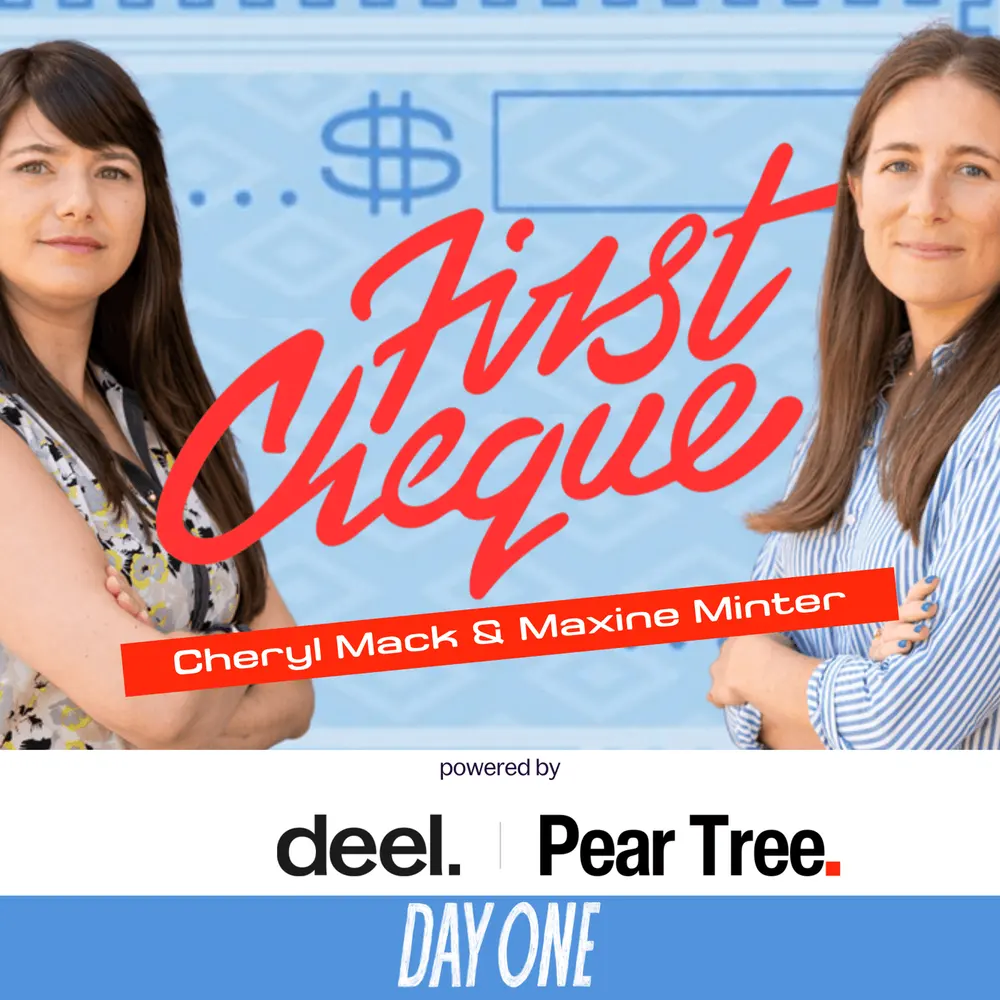 First Cheque with Cheryl Mack & Maxine Minter
Presented by Deel & Pear Tree
First Cheque with Cheryl Mack & Maxine Minter
Presented by Deel & Pear Tree 




 ▶
▶ ▶
▶ ▶
▶