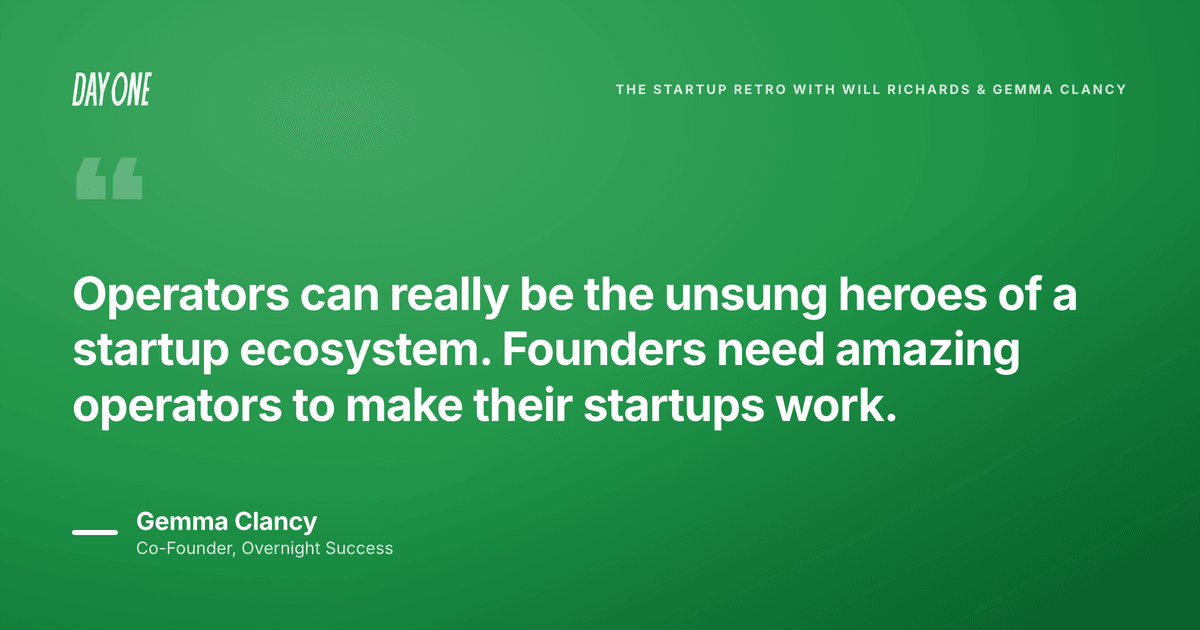
Transcript Synced · select any line to jump ▾ 0:00 Speaker: You're listening to a Day One FM show. 0:04 Gemma Clancy: The Startup Retro is recorded on the lands of the Kabi Kabi and Wurundjeri people. 0:10 Speaker: G'day and welcome to the Startup Retro, a weekly show brought to you by the team behind the Overnight Success newsletter, where we help you level up on the Australian startup ecosystem by giving you an insider's view on Aussie startup and venture capital. I'm Will Richards. 0:23 Gemma Clancy: And I'm Jen McLancy. The Startup Retro is brought to you by Day One, the podcast network for founders, operators, and investors. 0:30 Will Richards: In today's episode, we'll dive into the latest figures from the Cutthroat Venture Report, and we even got Chris from Cutthroat to jump on and ask him some questions. We'll also touch on a new innovation around angel investing and allowing non-sophisticated investors to participate in angel investment. And climate tech was actually a really interesting topic this week. A lot happening in the climate tech space. Both startups we picked as our startup of the week were climate tech startups, but there's also some question marks around startups getting funding in that space. At the end of the conversation as well, we recommend a few resources that both Gemma and I read or digested this week for you to peruse. 1:10 Gemma Clancy: Okay, Will, so let's jump into the headlines for this week. And certainly for my LinkedIn feed, it was the Cutthroat Venture report was the biggest headline across the ecosystem. They released their Q2 report covering the latest deals from across the startup ecosystem. Did you have a chance to take a look at the report? 1:28 Will Richards: Yep, managed to digest the full report and even sat down with Chris from Cutthroat and interviewed him. So we've got that interview in the back half of the podcast, but the headline news was 99 deals with $1.5 billion invested across the ecosystem. We're starting to see positive signs from some lows the last quarter, which is really good to see. 1:48 Gemma Clancy: Yeah, it's awesome. So stay tuned for the chat with Chris later. We can kind of go behind the scenes a little bit on that report. And then I guess there was also some news around climate tech funding that kind of came out around the same time as the report, which was kind of interesting. So the team at Climate Salad, which is a fantastic organization that brings together climate tech, clean tech founders and startups from around Australia, they had a piece in the AFR talking about the need for more support for climate tech companies. Particularly for the kind of over the coming year. And they said that, you know, I guess amongst their membership, which is about 600 startups, there's about 100 in there that saying, are saying based on their regular survey that they send out that they need funding to survive the rest of this year. And that funding amounts to about $100 million. So that was really interesting to see, but that kind of all also kind of came up at the same time as the Cutthroat Venture Report. And the Cutthroat Venture Report had some, what most people would see as quite optimistic data around climate tech. Yeah. 2:48 Will Richards: Yeah, it's very anecdotal, these sorts of things. Like if you look at the newsletter for this weekend, the majority of the startups that got funded were climate tech startups. 2:57 Speaker: Right. 2:57 Will Richards: And climate tech still remains in Cutthroat one of the most popular sectors that receives funding by deal and by deal size. So it's difficult because climate techs, I think there's so much passion in that area, which is fantastic. 3:13 Gemma Clancy: Yeah. 3:13 Will Richards: And Australia is so well positioned to develop some of these fantastic climate tech solutions. And I think both our picks of the week for, um, for the startup raiser section are climate tech startups. So we'll go into some detail there as well. Yeah, but yeah, it's, it's a funny timing because they're sort of complaining about not getting funding despite getting a lot of funding. So maybe there's a mismatch between the number of startups that exist and the quantum of money that's out there. 3:36 Gemma Clancy: Yeah, or it seems, I guess, that maybe startups in the climate tech space can get funding in the early days. Um, they can get like pre-seed funding, but when it comes to that follow-on funding they're struggling to get that money. And maybe that speaks to kind of some of the barriers that these companies are facing. There's quite a few unique barriers, I think, that climate tech companies face that maybe the average B2B SaaS company doesn't face when it comes to kind of the regulatory barriers. 4:00 Speaker: Mm-hmm. 4:00 Gemma Clancy: There's a lot of shifts that we have to make even as a society when we think about the action that we wanna take on climate change. And then you've even got things that like really logistical barriers, like, you know, Australia's grid and the infrastructure that we have to plug into, all of that has to shift at the same time as these companies are trying to grow and hit various milestones that VCs are looking for. So it's a very complicated and nuanced space, that's for sure. Interesting to see how it kind of evolves over the next couple of years and how many of those startups do survive this kind of valley of death. 4:28 Will Richards: It's such a broad, such a broad topic as well. Like, climate techs can be these really deep techs, they can be, you know, grid systems, they can be SaaS companies as well. So yeah, it's— I think you're sort of maybe getting some vocal minorities in there who are unfortunately, like, struggling at the moment. But hopefully, hopefully they come through. 4:47 Gemma Clancy: Yeah, I'd love to see a breakdown of that data a little bit more by those kind of subcategories. It would be interesting to see how that, how that's looking. 4:55 Will Richards: So another interesting headline that caught my eye this week was the launch of AngelClass, which has come from Elliot Spiegel, who is involved with In-House Ventures. Yeah, so AngelClass is taking advantage of a little loophole in the angel investment world that often doesn't get spoken about. It's kind of under the cloud of what we looked at a few few months ago with the changes or the proposed changes to the sophisticated investor test. And the sophisticated investor test right now is to invest in high-risk assets that don't have prospectuses and those sorts of things. You need to have a net worth of $2.5 million or income over the last 2 years of $250K or more. 5:33 Speaker: Yeah. 5:33 Will Richards: What Elliot's doing or what AngelClass is doing is taking advantage of Australia's 2012 rule, which allows a startup to give access to 20 people every 12 months who are not technically sophisticated investors. So they don't have to go through the rigmarole of preparing a big prospectus and using other platforms like crowdfunding or syndicates or those sorts of things who, well, syndicates need sophisticated investors too. So every, basically every 12 months, the startup can get another 20 non-sophisticated investors to jump on board. 6:07 Speaker: Right. 6:07 Will Richards: The minimum investment for each individual is $10,000, which is I think a significant amount of money for anyone who is potentially not sophisticated, but still interested in investing in startups. 6:18 Gemma Clancy: Yeah, it's super interesting. So like I'm not a sophisticated investor, but I could kind of invest, start investing in startups in this way if I felt like I really believed in a startup enough to give them, you know, $10,000 or more if the founder kind of wanted to include me in that 20, you know, people group. 6:32 Will Richards: Yeah, exactly. 6:33 Gemma Clancy: Every 12 months. Yeah. 6:35 Will Richards: Yeah. I think it could be a really cool mechanism that we'll start seeing being taken advantage of more as, let's say, the education around investing increases across the ecosystem where you'll start to see, let's say, people who have worked in high-growth businesses, they're really, you know, strong, solid operators who now want to found their own company. The people around them who are, let's say, just not at the age where they've generated those net assets and don't maybe have the salary like that, but really deeply understand the challenges the startup's facing or the problems they're solving, allowing them to jump on board. And, be a strategic angel investor. 7:10 Gemma Clancy: Yeah, well, it'll be really interesting to see how many people take up the offer to join something like this because I know that when there was all the conversation about their sophisticated investor test changing, you know, a lot of people were really angry about the fact that that was potentially going to cut them out of the opportunity to invest. But, you know, if this is an opportunity for people to invest, you know, and it's just a pretty high bar as a starting point, but if it is an opportunity for people to invest, we would probably see a lot of those people wanting to jump on board, you'd think, right? So we'll see what happens. 7:38 Will Richards: Yeah, yeah. And the opportunity's always been there. It's just that now there's a formal mechanism to take advantage of it. And I think what they're trying to do is build a bit of a marketplace where these startups sort of pop up on a rolling basis and you can follow along and participate. 7:52 Gemma Clancy: The last headline that I wanted to cover off this week was the closure of Girls in Tech. And if you're not familiar with it, Girls in Tech company, it was a not-for-profit that's based out of the US. And it was started 17 years ago, so it's been around for a really long time, and it's had an Australian outpost for a while now as well. So it's, you know, a group of Australians running under the Girls in Tech brand. And the whole purpose of Girls in Tech was to inspire and support women to get into the tech industry, feel, you know, confident and capable to upskill in tech and get tech jobs. And that's really powerful because most women in tech will know, and hopefully men in tech are aware, that there's a really big gap. Yeah. Between the number of men in tech and the number of women in tech. 8:34 Speaker: Mm-hmm. 8:34 Gemma Clancy: And so we need to close that as much as possible 'cause tech jobs are really fantastic opportunities for women. They're some of the best paid and most flexible roles. So that was the whole purpose of Girls in Tech was to inspire women and give them the community, the knowledge through events and programs to excel their careers in tech and eliminate that gender gap in tech worldwide. And the main way that they have been receiving funding is from companies like bigger companies, corporates, investing from their diversity, equity, and inclusion funds, saying we'll support Girls in Tech and we'll support some of our staff to potentially attend their events, go to their, be part of their programs. But I think, you know, the current economic environment, or at least over the last couple of years, has meant that that funding has dried up quite a bit. And so Girls in Tech has unfortunately had to close, which also means that the Australian version of Girls in Tech has had to close. So that's quite sad news for that not-for-profit globally. But, um, the good news off the back of it is that the team behind the Australian Girls in Tech outpost, I guess, or the— I don't know what they call it, it's almost like a franchise but doesn't really operate like a franchise— is kind of rebranding. So essentially they are starting up their own organization which is called Her Tech Circle, and they will run very similar kind of events to what Girls in Tech was running before. And they already actually have quite a few events on their calendar. Yeah. And I just really encourage people to get behind them because it's a really fantastic organization. It's not just about getting people into startups, it's about upskilling women to get into tech roles, you know, across the board. But I think it's a, you know, we want to see more and more of this because it helps all of us, you know, create a better tech industry and innovation industry. 10:16 Will Richards: Could I ask like what type of person is best suited for it? So is it someone who's maybe like never worked in technology? Is it someone who's, you know, currently working in tech trying to further themselves? 10:28 Gemma Clancy: Who's the perfect person to sort of get involved? Yeah, well, I think I would say that it's probably— they will probably want a range of people. So the people who probably get a lot of benefit out of joining are maybe people who are thinking about transitioning into a role in tech and want, or want to upskill their career. But organizations like this need people at the top of kind of the industry as well, senior people who have been around for a long time in their communities so that they can act as mentors and leaders and guides for the people who are coming in wanting that guidance. So I just say if you're really passionate about this space, that you should definitely get involved because it will, you know, help build a better, stronger innovation and tech industry overall. 11:12 Will Richards: All right, Gemma, let's pick our favorite startup raises for the week. And it was a big week for climate tech, as we said. Which climate technology startup did you pick? 11:22 Gemma Clancy: So my favorite pick of the week was a company called Fugu, which has raised $1.67 million from a range of investors, including Jelixx, Electrify Ventures, and Investable, and a London-based VC that actually specializes in what Fugu does, which is carbon capture. But if I'm honest, the main reason I chose this startup was so that I can make a Simpsons reference. It's an episode of The Simpsons where Homer and his family go to a Japanese restaurant and Homer wants to order fugu. Fugu. 11:52 Will Richards: Mm, fan fugu-tastic. 11:54 Gemma Clancy: Because fugu is like a delicacy in Japan. It's a puffer fish that is highly, highly poisonous. And if you don't prepare it right, you actually have to be a licensed fugu chef. I looked into this as part of preparation for the podcast, but you have to be a licensed fugu chef to prepare fugu so that you don't die when eating it. And the founders of Fugu obviously are aware of the puffer fish. I don't know if they're aware of The Simpsons episode, so maybe they will be after this, but they actually have the fugu fish as part of their logo. 12:20 Will Richards: Okay, so their logo is a pufferfish. Yes. So what does the actual startup do? 12:25 Gemma Clancy: So the startup is developing direct air capture technology, solid direct air capture technology, which is essentially carbon capture technology. So they are sucking CO2 out of the air. So that's the connection to the pufferfish. Pufferfish obviously sucks air in. It's— the fugu is highly toxic. And so they're making a connection. 12:43 Will Richards: I think it sucks water in, but— 12:46 Gemma Clancy: They have to suck it. I don't know. Let's not get into— let's not get into proper features. This isn't a biology podcast, it's a tech podcast, right? So, um, but yeah, so they are developing this amazing technology and there's a lot of companies already out there doing carbon capture. But what's different about these guys is that their end product of what they're hoping to produce is called e-fuels. And I never really heard of e-fuels before, but essentially e-fuels are much more sustainable fuels that are produced using renewable energy, and they are considered carbon neutral as long as the amount of CO2 that's captured from the air in the process of creating them is more or equal to the amount of CO2 that's burned in the process of actually using the fuels. So these guys are looking at potentially like the aviation industry to sell these e-fuels into. 13:34 Speaker: Yeah. 13:34 Gemma Clancy: And they'll be much more sustainable than the current fuels being used, which is great. 13:38 Will Richards: Yeah, so it's quite different to other similar startups because often they make their money through selling carbon credits to other big corporates who sort of need carbon credits to make themselves feel a little bit greener. But these guys are actually turning the CO2 back into fuel for other and then selling that product. 13:55 Gemma Clancy: Yeah, they're essentially creating a market for kind of the end product, where they're kind of meeting demand really for a growing market here. They're kind of different, say, to a company like Climeworks, which is based out of Iceland, which is capturing the carbon and then they store it permanently underground. And that essentially means that they can say that carbon is gone, it's stored underground for thousands of years, and that's why they can kind of sell carbon credits. So they can say to a company, this is like going to neutralize your emissions, whereas Fugu is looking at taking that carbon and then turning it into an end product. So they can't necessarily sell carbon credits, but they can sell a product, which is a great alternative business model. And on top of that, it's also quite innovative because One of the main barriers to carbon capture is, and the technology behind it, is its scalability, because you need lots of these kind of machines in order to capture enough CO2 to make a real impact from a carbon capture perspective or climate crisis perspective, and also to produce these e-fuels. And a lot of machines are incredibly expensive to produce. So Fugu is really, really focused on scalability and cost-effectiveness. Developed like a containerized solution. So literally, like, if you imagine shipping containers and they are made completely out of mass-manufactured off-the-shelf parts, so that's going to be able to keep the costs down much more for them, make them more able to roll this out at scale a lot faster. And that's reflected in their, their ambition. So they are hoping to extract 1 gigaton of CO2 from the atmosphere by 2032. Whereas, say, the likes of Climeworks, which is extracting and then putting it underground, is looking to do that by around 2050. So Fugu is on kind of a fast-track mission here. 15:41 Will Richards: Yeah, sounds like some very ambitious founders. I see they've also been involved in ambitious climate tech solution or climate tech problems before. 15:49 Gemma Clancy: Yeah, yeah, Sun Cable. So the founder and first engineer of Sun Cable are the two founders of Fugu. So it's Mack Thompson and Luke Marshall that are behind this one. And yet they're obviously not afraid of an ambitious mission because Sun Cable was about exporting solar power with a huge cable underwater. And it's had a huge number of kind of technical challenges. And but it's still on track, hopefully, to happen. And Mike Cannon-Brookes has purchased that company. But yeah, it's, it's— they've gone from one big, big challenge to another, which is Cool to see, and we are hoping that they can pull this one off, which will be great. 16:26 Will Richards: Very cool, good pick. 16:27 Gemma Clancy: So what was your pick of the week, Will? 16:29 Will Richards: My pick of the week was a company called Circle. They received $5 million in funding from Calara Capital, and they've got a quite interesting story in taking advantage of, let's say, another business's misfortune, and also I think like a quite interesting marketing, quite interesting market trend we're seeing. With e-waste and also just the rise of efficiency in solar panels and the fact that the solar panels eventually become obsolete. Actually, I'll go back to sort of their corporate history. So founded in 2018, and 2 years ago they acquired the assets of another business called Cypher. And Cypher was another— I was basically another climate tech startup that raised a $15 million Series B. 17:15 Speaker: Wow. 17:15 Will Richards: From the Clean Energy Finance Corporation. And they it went into administration, but what they had actually created was this quite large e-waste recycling plant in New South Wales. So a fair bit of capital went into that and it unfortunately went into administration. So creditors were owed more than $20 million. 17:34 Gemma Clancy: Boom. 17:35 Will Richards: And shareholders of that business essentially got nothing back. But Circle took advantage of that and acquired those assets for $5 million. And what they've now turned that into as part of their model is a really good springboard for what they're doing next. And essentially what they're trying to do is be an e-waste and moving forward, a solar panel recycler, which kind of just distills down into extracting the really precious metals out of e-waste using some sophisticated systems. 18:05 Gemma Clancy: Mm. 18:05 Will Richards: So up until now, they've partnered with like local councils and this sort of goes back to the Cypher business model as well, but partnered with like local councils or companies that that have a lot of e-waste. And essentially they just like collect that, run it through the processing and basically sell off the precious metals at the end of it. But moving forward, they're really gonna target this growing market of solar panels that are no longer worth being used. 'Cause what we're seeing is like, there's so much solar panels just get more and more efficient every year. It's a little bit like Moore's Law. Every so often they just get a little bit better. So solar panels that were created, you know, 5, 10 years ago are sort of no longer efficient, but they can now be recycled and— Yeah. And put back into basically more efficient solar panels. 18:50 Gemma Clancy: That's great. So e-waste has been a problem for a really long time, and I'm kind of interested, how's what these guys are doing to solve this problem different to necessarily what's been done in the past? 19:00 Will Richards: Yeah, it's Australia on a per capita basis is actually one of the biggest generators of e-waste. I think everyone, you know, loves to upgrade to the next iPhone or the next laptop or TV as soon as they can. But historically, we've essentially sent this waste overseas. So it goes to developing countries, and there are some pretty disturbing images of people sorting through this e-waste by hand. 19:21 Gemma Clancy: Mm. 19:22 Will Richards: It's not a very nice process to watch happen in these situations because it's, you know, there's a lot of fumes and a lot of basically people who are too close to it. So what they've established with this recycling facility is a really clean Australia-based, it's a New South Wales plant to process the e-waste, and they're taking advantage of salt baths. So essentially it goes through a big grinder, which breaks up the, the e-waste into smaller chunks, and then those chunks then get dropped into these salt baths. And the salts essentially work out what is junk— so let's say plastic, for example, or stuff that isn't the precious metal— and separates those on a molecular level from the less valuable bits. Um, so it's all completely automated. There's no human contact with this process, or no excessive human contact. And this sort precious metal slurry is then siphoned off and can be used to, to create— I was going to say create more e-waste down the line, but basically create more products that can then re-enter the market, like solar panels or computers or iPhones or whatever it is. 20:28 Gemma Clancy: Yeah, well, that's great. Well, we, we're always going to need more of these tech products. I mean, we're certainly not going to be advocating for less tech— that wouldn't be on brand for us— but we want to see that it's kind of done in an ideally circular way, hopefully. And especially with solar panels, I mean, we're all going to need solar panels more and more into the future, but that we can't have them just thrown in the tip. That just is not sustainable. 20:55 Will Richards: The Startup Retro is supported by Teamified. So I'm super excited to be joined by Simon Lee, the co-founder of Teamified. Simon, I'd love to get your thoughts on the rise of fractional roles for startups in Australia. It's, it's a trend that I'm seeing really start to kick off lately. How do you sort of see that in the market at the moment, and what does what does Teamified do to help? 21:13 Speaker: Yeah, I don't know about you, but everywhere I'm seeing fractional everywhere now. If you actually look at the biggest cost on people's balance sheet, it's their labor costs, right? And 90% of businesses, it's their labor costs is the biggest cost. And so building remote teams is a great way to reduce the cost, but fractional services is also, you know, if you're a small business, do I need to hire a full-time CFO? Do I need a full-time CMO? We'll hit $18 mil revenue this year, and I've still got a fractional CFO and a fractional CMO, and they do an amazing job. When you're trying to start a business, trying to find who should I partner with, and having someone that at least a vetted CMO or a vetted CTO is just going to make it that much simpler. 21:51 Will Richards: To learn more about how Teamified can help scale up your business, head to teamified.com.au. 22:01 Gemma Clancy: So next time we've got your interview with Chris Gillings from Cutthroat Venture, Will. 22:05 Will Richards: Yeah, let's get into it. So super excited to be joined by Chris Gillins, the man behind Cutthroat Venture. He's also an investor at Firefly Capital. So Chris, thanks for joining. Before we get stuck into the latest Q2 report for 2024, I would love to sort of understand a bit of the background behind Cutthroat Venture. You've been going for a few years now. 22:25 Speaker: Yeah. 22:26 Will Richards: What got you started and yeah, how's it going so far? 22:29 Chris Gillings: Well, first of all, thank you so much for having me and loving what you guys are doing with the podcast and everything else. So well done on that. Yeah, so Cutthroat's been around for, I guess we're in our fourth, this will be the fourth year. So the background of Cutthroat, so I'd been living in the US. I moved there around sort of in my eighth year of being there. My wife and I had just started thinking about moving home after having our first child. And we were in the depths of COVID at that point. And so I started to spend a lot of time looking back at the Aussie market to see where I could get a job, frankly. I was working in venture capital on the corporate side at MasterCard in New York, and that job wasn't gonna carry me home. So I started looking into the funds that were active down here. And we had access to all the platforms, PitchBook, CrunchBase, CB Insights. And my conclusion when cruising through those platforms was that either not a lot was happening in Australia or it wasn't being covered very well. 23:30 Speaker: Yeah.? 23:30 Speaker: And so I set about just trying to figure that out. And it became very obvious quite quickly that they just weren't picking up a lot of the deals that were getting done, even when you just looked at the press. So this was peak of the market, 2021. So there were some weeks where there were 50 or 60 deals getting announced. 23:50 Will Richards: Yep. 23:51 Chris Gillings: And PitchBook and Crunchbase even wasn't, weren't picking it up. I started to sort of document that and trawl the internet for everything that I could find. And then in the first quarter of 2021, we launched our first newsletter, which was genuinely sending it out to 50 of my friends and family who I assumed wouldn't block me. None of whom really had an interest in startup investing, but I needed someone to send a newsletter to. So I started with them, really just as a commitment mechanism to continue to do the work of sort of researching. So it was very self-serving. To get me up to speed. And then what happened was, is that weirdly it grew very quickly. So people started to share the newsletter on LinkedIn and within the first couple of months, we went from 50 to literally 1,000 subscribers in a very, very quick amount of time. And what I realized was, is that a lot of those subscribers were the investors that we were covering and startup founders themselves. So it then, we had some very lucky breaks in terms of, of, some coverage in the mainstream press and on Startup Daily. And that just sort of compounded and compounded and we got a really good followership and I started getting requests from the AFR and from Simon at Startup Daily. And it really just grew from there. And then sort of fast forward to the end of that year, we partnered with Folklore Ventures to release the State of Australian Startup Funding. So their head of comms, Steph, was living in the US and she reached out to me and we were sort of collaborating in COVID. Mm-hmm. To release that report and then we're off to the races and sort of have since become, I guess, the source of truth for startup funding data in Australia. We've shifted away from the newsletter when our quarterly report and then continue to do the annual reports and we very small team, we got two, my business partner and I here based in Australia and then we have a team of people overseas that are in charge of data entry and— Yeah. Initial modeling and insights, and then we rely very heavily on agencies. So that's sort of the business, and we try and keep it simple. We don't, we don't want to do too many things except for try and do the best job possible of picking up all the deals that we can, and really just trying to put Australia on this, the Australian ecosystem on, on the same level footing from a reporting standpoint as, as other markets around the world. 26:16 Will Richards: Yeah, I'd love to know, do you get many international investors or readers engaging with the report? 26:22 Speaker: Yeah, I mean, that's been the most exciting thing about, I guess, from my perspective, I lived in the US for the better part of a decade. And so we spent a lot of time trawling through our subscribers and the annual report, more than 50% of downloads come from overseas. So investors from all of the big firms in the US, Singapore, Hong Kong, Israel, they're all interested in investing in Australia. And I guess they view our report as a, a digestible way to find out about what's going on. I think the other great way that we get exposure overseas is that a lot of investment banks and law firms, consulting firms use our data either without permission or just with screenshots to put it in their own marketing documents as they go and do roadshows in the US or— In Europe. All through Asia to talk about the ecosystem because up until we started producing our reports, there really wasn't the sort of formalized reporting that the likes of a PitchBook and Crunchbase and CB Insights do on other parts of the world and other markets. So the move to a quarterly reporting cycle was in large part so that when all of the other markets were talking about what they had done in Q1 or the trends that they were seeing, that we had a document as an ecosystem that we could point to. 27:51 Speaker: Yep. 27:51 Chris Gillings: To look at Australia. But yeah, the short answer is yeah, great readership overseas and we get a lot of 5V, a big part of our model is to work very closely with overseas investors. So it's been beneficial on a personal level from that standpoint as well. 28:05 Will Richards: Amazing. Keen to jump into this report. And what I'd love since you've been doing it for 4 years is you can really see the trend lines across the years and how they change and, It's obviously been an interesting environment the last couple years in particular, but it's really useful for some trend analysis. So the Q2 report, let's get stuck in. What were the sort of main takeaways for investors and founders that you noticed? 28:26 Chris Gillings: Yeah, so I think like looking back one quarter, Q1 of 2024 was frankly a little bit spooky. It was very, very quiet. So we had sort of the slowest quarter that we'd seen in our data set really since, since 2020, which was to be expected at the first quarter of the year, just given Christmas, et cetera. But it was a lot quieter than what we'd hoped. Q2 was a really good bounce back. So we saw $1.5 billion of deals announced. That was 99 deals. So we fell short of the 100, but— 29:01 Speaker: Yeah. 29:02 Chris Gillings: Yeah, it was substantially up on Q1 and really the strongest quarter from a funding perspective since we saw the big fall at the end of 2022. Now that $1.5 billion, to be clear, of that $1.5 billion, there were 6 really large deals that, that took up more than half of that $1.5 billion. But I think still a very good sign for the ecosystem in that for the last few years or the last 18 months, where we've seen the real drop-off in volume of deals getting done is at that later stage. And at the end of the day, whether you're a pre-seed company or a seed company, or you are a company that's ready to raise that big deal, being able to see other companies or other, that investors are willing to deploy very large sums of capital into later stage businesses is super important. And so the return of those mega deals, as we call them, was really pleasing. So from a high-level standpoint, really, really pleased. The, the trend line basically has us marginally above where we were this time last year, just given the fact that Q1 was particularly weak. And hopefully we've set a good foundation for a, for a strong finish for the year. 30:23 Will Richards: The other trend I noticed was pre-seed funding in particular seemed to be really up. 30:28 Speaker: Yeah. 30:29 Will Richards: But there was also the unfortunate statistic that female funding in particular is also quite down. 30:33 Chris Gillings: Yeah. 30:34 Will Richards: So I think there are some green shoots coming through, but also a little bit of work to be done. It's interesting though, you sort of seen the valley of, I hate calling it the valley of death, but startups graduating to those mega rounds is, it is so challenging. But I think there's a lot of dry powder in the ecosystem as well. So it's just gonna take a bit of time. 30:52 Chris Gillings: Yeah, look, the female founder result was was frankly terrible. At the pre-seed, you saw the number of deals or the share of deals that female founders or mixed-gendered teams participated in did hit a record high, which is great. But by virtue of them being at the pre-seed, those are very small amounts of money, generally speaking. And so this has been a trend that we've tracked since day one. And certainly— 31:23 Will Richards: Yeah. 31:23 Chris Gillings: Since the time that we've been tracking, I think the outcome for female founders at the earlier stages has, I mean, I think objectively got much better in that there has been a lot of effort within the ecosystem to try and do a better job of removing biases in processes, in some instances starting dedicated funds, but really the only part of the funding life cycle where we've seen really movement has been at that very, very early stage. Now, the optimist would say, well, you know, we're setting this, this new platform of, of these pre-seed female-led businesses that will graduate into seed companies, which will graduate into Series A, which will graduate into Series B, and so on. But it hasn't come through yet. Um, and so again, that's the optimistic viewpoint. I think— The silver lining for female founders this quarter was that it was a really fantastic outcome at the earlier stages, but undeniably, you know, it was an extremely weak overall funding environment as it relates to female and mixed-gendered teams. 32:36 Will Richards: Yep. And to be specific about what we're seeing in 2024, we've only seen 11% of deals include one female founder or 4% female only. 32:44 Chris Gillings: Correct. 32:45 Will Richards: And I think that 4%, like, that's, Or you can count them on your hand probably, the amount of deals I'd say in that. 32:52 Chris Gillings: Yeah, so that's the percentage of capital. So the percentage share of actual deals is higher, but that is largely because of the success that, or the early signs of success that we're seeing at the pre-seed and the seed stage. So at the seed sta— at the pre-seed stage, we sort of hit 40% of total deals. At the seed stage was sort of bumping up against 30, not quite there yet. But then as you get at the later stages, the participation sort of plows off a cliff. And at those later stages is where the big dollars are deployed. And so I've been very public and stated in the reports, my view is that that share of capital stat is not gonna move until the later stage deals start coming. Mm-hmm. There's no amount of work that the pre-seed funds or the angel syndicates in we can do to back female founders that are going to help move that number forward from a funding perspective. 33:52 Will Richards: Well, really appreciate your time, Chris. I'm sure many people listening have enjoyed the conversation too. So definitely check out the last quarterly report from Cutthroat Ventures, and we'll, yeah, we'll stay tuned and hopefully get you back on when these, these next reports come out too. Okay, Gem, every week We are gonna leave you the same way we wrap up our weekly newsletter, which is with a section we call KaaS, which is of course knowledge as a service. And this week we've both picked a different one. So I noticed you picked a podcast. 34:25 Gemma Clancy: It's one of my favorite podcasts from the Australian startup ecosystem. 34:29 Will Richards: Oh, just because you've been on it. 34:30 Gemma Clancy: And it's, we've both been on it. Okay. And I think it was really fantastic. And the host of Calling Operator Podcast, Paloma Newton, was very kind to let us on the podcast. I think it was actually the first ever podcast interview that we did, so we were very, very green, and I was incredibly nervous. But she was an incredible host, and she's since done, uh, you know, over, I think, 25-odd interviews on that podcast of operators who are working for some of Australia's biggest startups. And it's a really fantastic, uh, podcast. And I think one of the reasons why it's so fantastic is that I think kind of— I might be a little bit biased because I identify a little bit more as an operator than I do as a founder, even though these days my title is a little bit more of a founder. Um, but operators can really be the unsung heroes of, of a startup ecosystem. Founders need amazing operators to make their startups work. And what Paloma has done with the, uh, Call the Operator podcast is really hone in on highlighting and showcasing those amazing people who really make startups work. Paloma is currently building her own startup in stealth, and hopefully we'll be able to talk about it a little bit more soon. But she's, um, handing over the reins of the podcast, the Calling Operator Podcast, to Laura Nichols, who is a really interesting individual. She's actually the chief of staff to Maxine Minter, who was the first solo female GP in Australia, and she's behind CoVentures and CoLab, which is a great service for executive coaching. And Laura is featured on the latest episode of Calling Operator Podcast, which I listened to this week. It's kind of a handover episode between Paloma and Laura, introducing Laura, talking about her background. And I think if you listen to that, you be absolutely sold on Laura being a fantastic new host of that podcast and certainly kind of living up to the big shoes that Filone is leaving behind. 36:23 Will Richards: Yeah, I love— I always listen to Calling Operator comes out. I think it gives you a really good perspective on the different challenges, but also the resources that some of Australia's best operators use in their day to day. And I'm keen to sort of see where Laura takes it next. 36:38 Gemma Clancy: For sure. So, Will, what was your pick? 36:41 Will Richards: I got sent this resource from a previous boss of mine who is is, I suppose, a little bit of a mentor as well. And he's also, let's say, a little bit trepidatious about certain bubbles as they pop up. And it's called Pop Culture, and it's by a guy called Edward Zitron. And it's a sort of long-form essay, and it's a bit of a counterpoint to the AI bulls at the moment. And it was a really— I think it's a really interesting read for people who are in the tech space who get caught up in these sorts of Optimistic Bubbles. I'm a tech optimist. I think everyone probably listening is as well. But it was a really well-researched piece that basically explained that, or argued that AI potentially won't capture as much, or won't actually create as much economic value as people portray it will. 37:31 Speaker: True. 37:32 Will Richards: And the main thesis behind that, and it's well-researched and there's a lot of tangents you can go down and some great people and research that they quote in the article, but The main argument is that AI can't necessarily do hard work, which is kind of the piece that humans can do really, really well, which is creating things in context. And let's say like it's not the compute power stuff, which AI can do really, really well. It's potentially more of the stuff around like, oh, if you're in a restaurant, let's say, maybe the AI can potentially like understand the order quite easily. 38:05 Chris Gillings: Yeah. 38:06 Will Richards: But to actually create the food and process the food and serve the food and give someone that hospital, experience. That's something that AI is going to struggle with. That's a very loose example and a very, like, simple example, but it's kind of the hard work that separates AI from people. 38:22 Gemma Clancy: Yeah, I know that Economist has done a lot of work reporting on a similar issue, just kind of tempering— not necessarily saying that AI isn't necessarily going to be a huge game changer for our economies, but just tempering people's expectations and adding a bit of nuance to the way people think about it. Because I think it's really easy, especially in our bubble, to get caught up in the wave of thinking about all the different ways that AI could be implemented. But then you almost lose sight of all the things that AI can't do and maybe will never be able to do. And to your restaurant example, I had an amazing experience at a restaurant over the weekend, and I just think about what made that experience amazing. And it was, it was the person-to-person interaction. 39:02 Speaker: Mm-hmm. 39:03 Gemma Clancy: It was the fact, yes, they remembered my name at the door, but I think that's so impressive when a person remembers your name at the door. If an AI remembered my name later for my order, I'd probably be like, I'm like, yeah, cool, it's a robot. I don't really care that they remember my order. Of course he's going to remember my order. So yeah, I mean, of course there's things that AI is probably never going to replace, and it's just interesting to keep your mind open to thinking about, well, where's the opportunity for AI really, and where do we still need to, you know, have that human influence? 39:30 Speaker: For sure. 39:30 Will Richards: Yeah, actually, just on the, the restaurant side of things as well, as an example, the report actually calls it out. Apparently McDonald's in the US trialed an AI ordering system and it had in 100 restaurants and it's basically just pulled that back because it wasn't working. So, it's kind of like one example which I actually pulled from where it hasn't quite worked, and I think it'll get there eventually, but it's just sort of tempering those expectations. The other reason I'm probably talking about restaurants too much is I just watched season 3 of The Bear, and it was fantastic. Episode 1 in particular. 40:00 Gemma Clancy: What's a bear? 40:01 Will Richards: You not watch The Bear? 40:02 Gemma Clancy: No, what's The Bear? 40:03 Will Richards: It's like a story about a chef. It's on Disney+. It's in its third season. 40:08 Gemma Clancy: I don't have Disney Plus. 40:09 Will Richards: Oh my God. 40:10 Gemma Clancy: I need to get a new streaming subscription. I'll send you. You can send me your login. Great. Yeah, don't say it on the podcast, otherwise everyone will log in. 40:17 Will Richards: Okay, I'm not going to tell you my password. I think it's my sister's as well, so that's all right. 40:23 Gemma Clancy: All right, what's a free bonus, Cass? Watch The Bear this weekend and let us know what you think. And if you can make a loose tie to startups, then you get bonus points. 40:32 Will Richards: Oh no, there's so many ties to startups in The Bear. Every second counts. 40:37 Gemma Clancy: Thanks for joining us for this episode of The Startup Retro. We would love to hear what you thought of the show, so feel free to reach out to us directly on LinkedIn, or even better, follow us on your favorite podcast player or leave us a review so more people can find us and we can hear what you think. 40:53 Will Richards: Yeah, my favorite review this week was on Apple Podcasts, actually. We got a 5-star review from a small founder called Mel Perkins. So awesome to see some founders coming up in the Australian startup ecosystem checking out the podcast. So thanks, Mel. 41:08 Gemma Clancy: Thanks so much, Mel. Wow, I can't believe somebody would do that. 41:12 Will Richards: I don't think it was Mel, but. 41:15 Gemma Clancy: Growth hacks, people, growth hacks. You gotta do what you gotta do. And if you enjoy the podcast, I think you would also really enjoy our weekly newsletter. Our newsletter Overnight Success, which goes into even more detail on the news headlines and startup raises and much, much more. So you can subscribe to our newsletter at overnightsuccess.vc. That's it for us this week. Catch you next week. 41:37 Will Richards: Catch you next week. 41:44 Speaker: Listen to the Unfunded Podcast brought to you by the Day One Network and hosted by me, tech writer Joan Westenberg. We're sharing the no-holds-barred untold stories from entrepreneurs who have decided to build a business on their terms. I'll be interviewing successful founders and operators on the grit and ingenuity it takes to build and scale independent startups without the support of traditional venture capital funding. Subscribe to the Unfunded Podcast now, wherever you get your podcasts.