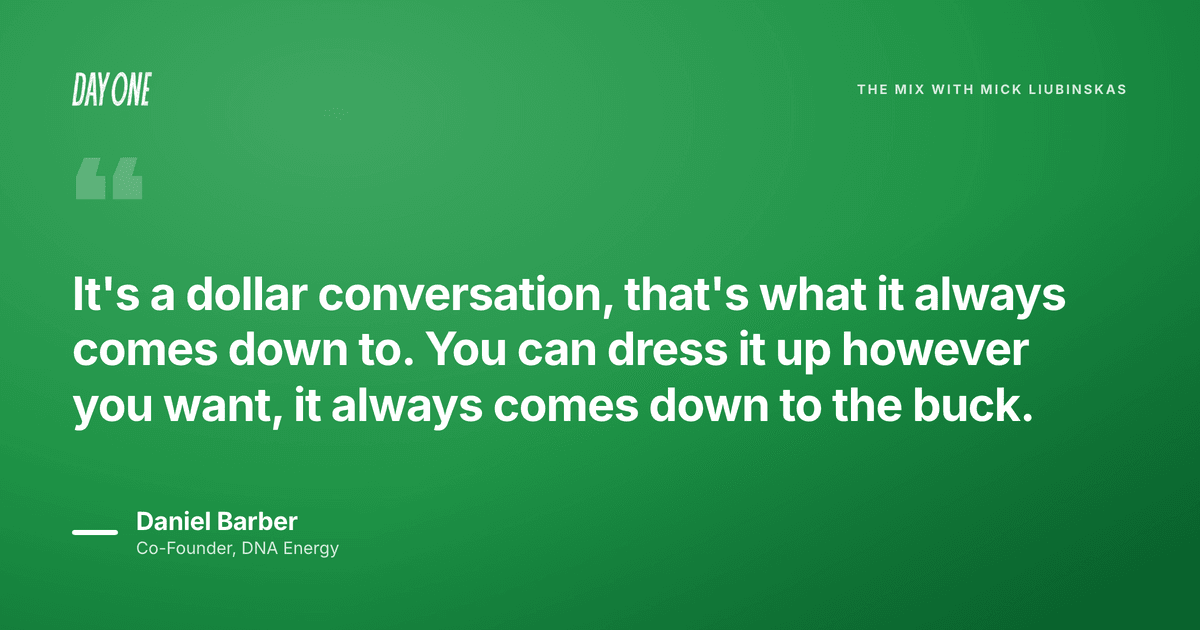
Transcript Synced · select any line to jump ▾ 0:00 Speaker: You're listening to a DayOne.fm show. 0:05 Speaker: What drives you to make bold moves, to build something that didn't exist before, to live, lead, and choose life with intention? Welcome to Perspective X. I'm Pauline Fatowi, and this is not your typical business podcast. Each episode, I get to speak to extraordinary entrepreneurs and leading innovators to unpack what truly fuels their journey. Not just the wins, but the inner work, the overlooked decisions, the mindset shifts, and the personal moments that sparked something bigger. This show is about the ripple effect of choice, the kind of deep accountability that lets us respond to life rather than react to it. Because when you realize everything is temporary, and you are the creator of your own experience, you start to play the game differently. So if you're curious about how people build meaning alongside success, how they evolve through challenges and shape the world with intention, this is your invitation to listen in. Perspective X, where we go beyond the highlight reel and into the moments that changed everything. Available now wherever you get your podcasts. 1:16 Mick Liubinskas: Hey everybody, it's Mick Lubinskis here from Climate Salad. Um, we're here from another chat with an Australian company building out incredible climate solutions for the world. Massive thank you to the New South Wales Government and the Department of Climate Change, Energy, Environment and Water for their support building the climate tech industry here in New South Wales, in Australia, and helping us take these companies to the world. Today we have Dan from DNA Energy. Dan, great to have you. 1:47 Daniel Barber: Thanks, Nick. Likewise. Good to be here. 1:49 Mick Liubinskas: And Dan, we've known each other for a while now. We've seen the company really develop and grow. We've been on at least a couple of major events and some trade missions. But for those who obviously don't know the, you know, what you do and the story, let's start with the basics. Give us the DNA Energy pitch. 2:06 Daniel Barber: Yeah, cool. So we help businesses and energy utilities expedite their energy transition. The way we do that is we install a bunch of tech hardware and software in commercial buildings, connect to stuff like HVAC, solar batteries, heat pumps, and then we turn all those assets into digitized nodes that's then controllable by them, us, or their energy utility. 2:28 Mick Liubinskas: Fantastic. Tell us a bit about why are companies wanting to do that? What's their big benefit they get out of it? And what kind of people within the company do you interact with normally? 2:40 Daniel Barber: We started off thinking we're going to solve some problems and how scalable is that? But there are a lot of problems in the energy transition. So it turns out it's very scalable. A lot of the work we've done is around constrained supplies. So like schools or aged care sites who are building new wings or they're putting EV charging in something like that and there's not enough supply to the site. And so their one option is, you know, you've got a 100 $150,000, $200,000 supply upgrade and a 15-month wait, or you can install our system for a fraction of that cost and we're in and out with a month or so. We're starting to see the ESG movement transfer from CEOs made a statement to, we actually gotta do something about this, you know? And so we understand, you know, we're not yet in a world where people are doing it 'cause they want to do it. It's gotta make economic sense. And so how can we frame a business case around that ESG story? 3:27 Mick Liubinskas: Yeah. 3:28 Daniel Barber: We do a bunch of reporting. The more recent piece we've got onto, which is actually, which is the original thing that we always wanted to do in the company, is monetizing those assets in VPP or demand response programs. And so bringing in the energy utility to that story, A, is like turbocharging for the grid transformation, but also adds really nice revenues around it as well. So it puts it all in a nice neat package. The people we deal with across Facilities, finance, sustainability are always stakeholders. You know, the facilities manager needs to know what's going on. The finance guy needs to know what they're paying for. Sustainability, you always want to frame a story around it. When we're dealing with the retailers and utilities, you know, trading desk sales, commercial, a really wide spectrum of stakeholders for sure. 4:13 Mick Liubinskas: Okay, fantastic. So there's definitely a few things in there to drill into. I want to start by, you're thinking about Where are we in terms of the transition? So you mentioned the end consumers of the environment would like us to be in a climate-positive state right now, but we're talking about changing nearly every system and asset in the world. And as you said, but the distance between the CEO saying, we would like to be sustainable and setting a big goal that might be long-term in the future and actual action, and you're dealing with a dozen different people and groups doing really complicated, hard things. Where is your— is your sense that we're still having early conversation and doing the first part of that? Are we somewhere in the middle? Are we years away? How are you feeling about the progress we're all making? 5:03 Daniel Barber: I think we're frighteningly early in the process and earlier. I think if you read some of the journals in our industry, there's a bit of high-fiving going on. I think it's a bit too early, to be honest with you. I think saying we've set a target and saying there's, you know, 8 gigawatts of, you know, of generation backed up. It's a great story, but it's not— we're not high-fiving yet. And I think the gap is huge, actually. And the gap is huge partly because people, I think, are just starting to realize what it means. And then they're looking at it and it's really difficult. You know, the energy gods unfortunately won't just make everything just kind of work. You've got to orchestrate it. You've got to manage it. You've got to think it through. There's a labor shortage. There's a supply shortage. There's a there's an emotive shortage across the business. And so I think there's a lot of challenges that we're just starting to get into actually. 5:51 Mick Liubinskas: A lot of these things, they happen really gradually and then really suddenly. What you're doing is complicated because people going through it the first time, but do you get a sense that people going through the second time or people sort of following the early adopters, like is it gonna speed up or is it gonna be hard, slow work for 20 years? 6:13 Daniel Barber: No, I think the slow, slow, slow, fast thing is very accurate actually. We had a conversation this morning actually about a specific application and it's taken us about a year and a half to get this one application over the line. I think we'll do two of them and I know the next one will take two weeks or four weeks, you know. We had an instance recently, you know, the retailer's been a real focus of ours and we had an amazing case study with the retailer and an awesome customer and it took us about a year and a half to get the deal over the line and then a year to get the case study, proof case, and then we took that case study to another retailer and it took 3 months to get them on board. And I think that's a case of just people are wary, it's new, how does it work? We've got trading risks, we've got these problems that we understand them and we know how to manage them. And I think people want to see that case study and no one wants to be first of the kind, first in the market, right? Yeah. And so a lot of the challenge I think is having that stickability and the staying power to see it through and the belief, you know, the startup founders out there, they doubt themselves, you just got to keep on kicking the doors down right and you've got to keep on believing. It's tough, but it does take off. 7:15 Mick Liubinskas: You brought up first of a kind there, F-O-A-K. Some people say FOAK, FOAK, whatever. 7:20 Daniel Barber: There's another way you could produce that, is that you could say that if you're a founder as well, isn't there? 7:23 Mick Liubinskas: Yeah. That's true, that's true. It depends where you are on the emotional rollercoaster on any particular day. I share that as well. So it's really interesting that it's obviously been around a lot in other big technology infrastructure, but it's particularly, I think, climate It is a big factor and it goes towards that point you said about the timing and the pressure of the CEO going, "We've said stuff, now you have to do stuff." And that's— can you talk a bit about like from, I think in the sense of the economic benefit, 'cause obviously if you can go to someone and say, "We just save you millions of dollars a year," and it's easy and obvious, you'd think you get lots of customers, but it's not necessarily that easy, but— 8:05 Speaker: Yeah. 8:05 Mick Liubinskas: Can you tell us about like what's driving either the increased demand for Conversations and Solutions or the increased economic benefit? Like what's driving it to be a better proposition? 8:16 Daniel Barber: I think the complexity of what companies are doing is a big driver. You know, people want to get more efficient stuff. They want to look at EVs. You know, their mate works for a company that got solar and they're looking at batteries and the pressure to do that is increasing rapidly. I mean, that's really exponential to be honest with you, but it's complicated. It's really hard. You know, you don't just, buy a battery and it works. And you don't just say, I want to get some EVs installed and they charge, you make money out of it. It's not that simple. And so I think the way the industry is going is putting a lot of pressure on that, and that's unearthing a lot of these challenges which require the solutions. It's a dollar conversation. That's what it always comes down to, right? You can dress it up however you want. It always comes down to the buck. And there's one or two companies, I think, who would genuinely want to do it and they're willing to take a risk. But most companies just either want to be seen to do it or there's pressure to do it, or they think it's a really cool idea, but it's got to be cash positive, not even cash neutral. You've got to make money from it. 9:07 Mick Liubinskas: And for DNA Energy, is this, um, you mentioned the first one taking a long time, the second one might take 2 weeks. In terms of actual implementation and, and being able to point to clear value, is, is like, what's that like? What's that cycle look like in terms of how we deliver projects? Yeah, yeah, yeah. 9:25 Daniel Barber: There's a lot of variables around there. A lot of it comes to the customer interaction, to be honest with you. If you've got an engaged customer that's got the information, you know, and turn around something in a week or two if you have to. It's normally not that simple though. You know, there's multiple stakeholders, you miss a board meeting, they don't have the information you want, they don't understand why it's important. And so, you know, with some things drag on, some simple things drag on for months and months, it's really, really frustrating. Where we're trying to fix that is to systemize things and automate them and clear the message up. And, you know, we did it wrong last time, how can we do it slightly better? What was that customer engagement? Did we speak to the right person? Are they going to buy it? Do they really want to buy it? Is there budget for it? You know, all those, a lot of the 101 sales things that I think are quite hard to forget when you're in tech and you're trying to do something really cool and you forget, did I even check if there's budget for this? You know, I've got a sales background. I remember the first time it happened, it was like, how did I not make that the very first question? You know, can you write that check? Because if you can't write that check, I really need to speak to the person that does or make sure they're on the next meeting, you know? And I think there's just a lot of complexity around it and a lot of it is new and, you know, people are waking up to it. But yeah, getting stakeholders on board, and budget and timing and you want to deal with the school. If you're not there by September, you miss their 2025 budget and you're not getting this into the year after. And there's those things you have to understand around the cyclical nature of it, of course. 10:44 Mick Liubinskas: Yeah, there's a ton of lag in it, right? I think that's the reality. And some of the systems we're talking about have been kind of slowly evolving over 200 years. And there are some things which are big lumpy decisions like buying big assets or like a company, country thinking about their energy sources, as you know, it's a bit harder. Your speed of value is a little bit better, right? But is that helpful or is it actually sometimes better to be having the bigger conversations that are $100 million deals? But do you feel that potential faster sales cycle, I know it's been hard, yeah, how do you find that? 11:21 Daniel Barber: See, it's a great question. We get kind of a few sides of the same coin. We sometimes get, oh yeah, we were speaking to people that do that and it's like, my messaging must be wrong 'cause that's not the case. I know you're not speaking to 5 people who are doing the same thing as we're doing. I think the ticket size makes it very challenging sometimes, and we don't think about it that often. You know, the first system we sold, we charged X for, then we charged 2X and then 3X. It's like, well, someone's still paying this, you know, it's incredible. And it's an interesting piece, you know, you want to, you sometimes want to slip under that level that it requires scrutiny. But at the same time, if you're below a certain level, people taking it that seriously, you know, and getting the pricing right when you're doing something where there's not 10 years of industry, it's actually really difficult to do it. You know, you want to create value, you want to make enough money to keep on developing and growing the business and, you know, paying the bills and all that kind of stuff. So yeah, it's a really interesting case. You know, sometimes, you know, we sell $20,000, $30,000, $50,000 systems. Would it make it easier for a million dollar? Maybe for sure, because it gets taken more seriously and it goes through a more known process of, okay, checkpoint A, checkpoint B, checkpoint C, tender it to 3 people, you're the winner, great. That's really easy to understand. But, you know, I'm going to buy this $35,000 system that's telling me they're going to solve that problem that I didn't really think would be solved like that. You know, that's— that is tricky sometimes. 12:38 Mick Liubinskas: Yeah, that's— and I know you've seen the back of your shirt a number of times. Energy is a revenue. And business model innovation, is that as important as technological innovation in solving climate problems, do you think? 12:53 Daniel Barber: Yeah, the business model is really important. We only kind of worked out this year what problem we're solving, which sounds ridiculous after 5 years. But, you know, you have a pivot or two and as a startup, you kind of realize what that is. We realize now that the problem we're solving is the grid problem and it's not a business problem per se. That's just the, that's just something that happens as part of it. And so the business model that we now have is we want to work with, we still do directly with customers, but really we want to work with retailers and that's our business model. And how do we make it as easy as possible to deal with the retailers so they don't have to worry about dealing with 1,000 customers. We'll do that because we do it anyway downstream. And that's not been done before. And, you know, that's, you know, the same previously, it took a year and a half or 2 years to get the first retailer over the line, then a year of running it before, you know, everyone goes, yeah, it's really successful, but can we scale it? And they're like, let's just wait for a bit longer and a bit longer because this really is new and how do we do this? And so I don't think we've finished our business model evolution. I think we'll refine it and we'll get better at it. If I ever tell you that we've nailed everything through feel free to give me a slap because you've got to keep moving. But yeah, I think that's a lot of what climate tech founders in these years go through is actually how do I do that? I've got an awesome product, I need to make money and I can't just pay the bills, I've got to have money to develop and I've got to create something that my customer's just not used to doing. That's 2 or 3 pretty profound challenges there. 14:16 Mick Liubinskas: And I know we got to watch some English Premier League over in San Francisco. So as Australians doing that, we've got a bit of a global perspective there. Can you tell us a bit about how you see the different markets around the world and how are they responding to the DNA product differently? 14:34 Daniel Barber: Yeah, I'm going to preface it by saying that the best advice I've heard about going global is in the Climate Salad Going Global program, specifically around don't hone your model locally and then wait till it's perfect to take it overseas because you'll change it. And conceptually, we kind of knew that, and I heard it a lot this year from yourself and other people in the cohort. And it really makes sense. You know, we're looking at the US market and although we will actually have a slight product change, but the business model is completely different because the industry is different there. You know, same language, there's electrons, there's transmission, distribution and retail. You think it'll be the same. It really— how we apply ourselves is completely different. We're looking at the— it's kind of scrambling my brain, but the US, the UK market as well. And people keep saying you should look at the UK market. There's a lot of opportunity. There's a lot of stuff in Malaysia and Vietnam. That's really, really exciting. And they've got so many nuances for the same product. You know, we want to control stuff, we want to control electrons. It should be the same everywhere. But yeah, I feel that if you're looking at a new market, you pretty much got to start from scratch. Know what you do, know what your strengths are. But I think if you're not going to the trade shows, you're not meeting people, you're not having 50 calls a month and speaking to those people, speaking to suppliers, speaking to the customers, speaking to maybe partners, maybe frenemies, you know, I think you've got to build that picture. It's taken us year and a half, I'd say, maybe a bit more, scope in the US to really understand what our place is there and how we really smash it. Take any less than that, if you have hardware particularly, I think if you're taking less than that, then you're probably doing yourself a disservice. 16:04 Mick Liubinskas: And that recent trip to San Francisco for the Verge event, we had a massive week of activities. Any particular surprises or insights that you got from that trip that particularly influenced the work you're doing at DNA? 16:21 Daniel Barber: We had a doubling down really of a lot of things. A lot of them was basic human stuff that you often forget, you know, face-to-face meetings worth a million phone calls. Sometimes it's an infinite amount of phone calls because you might just never get that piece. I think I'm going to be a bit cheesy about it, being around the cohort and being around other startup founders and then adding on, you know, we're in a different country. It just— there's a lot of security and familiarity around it that I think is really, really important. You know, I got to have a one-on-one chat with the CEO of one of our target customers in what I now know is 100% going to be our business model in the US. And so things like that were just really, really exciting. I've probably been there enough recently that the insights would probably have had a trip or two ago, but it was a great opportunity to go there and take all those learnings and go, I'm really confident now what we're going to do. We're going to stop searching for the model and I'm going to try and apply the model. And I think you just got to be in country to do that, right? It's pretty much impossible to not be the case. 17:17 Mick Liubinskas: Yeah, the two really big hypothesis we had is going early and that's actually, I think, significantly harder for hardware companies because it's just, you need a place where you can build your product, but then deployment is a whole other story, right? I think so. I think that is really, really key. And then actually just being able to spend the time and it was a big topic of conversation about, for Australian companies is like, can you do the old SaaS model and stay in Australia and ship it around the world? Or do you need someone in country and, Yeah, I think it's, um, I think that the, the consensus was that, um, depending on your model, but most, most people are going to have to have someone in country or someone spending at least half of the year there. So, um, is it— was that your sense as well after a couple of trips? 18:02 Daniel Barber: Scarily, it was the first trip. And yeah, each time I go there, it's the same. You know, we've, we've got a guy now, um, in the US who's working on behalf of us, um, on a contract basis. Just kind of our first toe in the water. And by complete awesome chance. I think we're about to get our first pilot, you know, touch wood, in the same city as the guy works. It's just, it's just turned out very fortuitously. But to scale it, someone's got to be there. You know, the cost— I haven't been to other countries, but the cost in the US and the risk of hiring a country manager that's not already in your world is, it's unreasonable. It's just, it's just not palatable, to be honest with you. Um, you know, it'd be cheaper for me to fly over every other month, to be honest with you, and stay in a nice hotel, than it would be to hire an in-country person. And then the risk factors and the uncertainty and all that, all that kind of scary stuff is a as a startup. Um, yeah, you just got to be there. You just— there's no way around it. 18:49 Mick Liubinskas: Yeah, interesting. You mentioned as well, in terms of frenemies, uh, it's in the, um, in the Climate side, we have over 700 companies, and obviously there's not 700 completely different businesses with different approaches. Um, can you talk about, in terms of, like, uh, and you've been, been in business for a while, um, in, in doing other things, like, how do you find the industry in terms of collaboration and working together and any any good stories to share about working with other companies building solutions? 19:16 Daniel Barber: I think as long as everyone's got their big boys pants on, I think it can work really well. There's one or two companies, you know, in the current Climate Accelerator cohort who really, they don't do what we do, but it's close enough. And to the untrained eye and the untrained customer in particular, they might think you guys sell, you kind of feel a little, you know, doing it different, but you feel like the same kind of outcome. I think it's doubly important to have relationships with those people. Partly because you learn off them. You know, we all have different experiences and I think if everyone's sensible about it, you know, I'm not talking to you as another founder because I'm trying to rip your customers off. I might just want to learn stuff or might want to impart something I know and then everyone kind of does better for it. I think one of the dangers of being kind of, you know, new or first of a kind, it's really bloody hard to get traction if no one's talking about it, you know, really, really difficult. And so the more people that do it, if you back yourself to do well, there's more than enough food to go around, right? 20:05 Speaker: Absolutely. 20:06 Daniel Barber: Probably the best example of where it's worked out well was in the Climate Salute event this week, talking to a co-founder who I've chatted before. I've got huge respect for their products, an amazing product, very small crossover with what we do, an absolute crossover, but really not much. You know, just great guy, great founder, great company. Been to the office soon. The product is amazing. And we were talking about jobs that we're pitching for and he said, oh, you know, I'm pitching for this job, you know, so I actually think DNA could do part of the job. And I'm thinking, yeah, we've got one. I think you could probably fill the piece as well. And it was the same tender. And I think we're one of two on the tender. And so we're potentially looking to collaborate on that. And rather than be one of two, why don't you be two of two? And that's the kind of piece that I think that you would unlikely find in another industry. I can't imagine two banks or two recruitment companies or two Googles thinking, yeah, I want to buddy up with you because I think I will deliver an awesome product to the customer. Yeah. B, you never know what's going to happen. Let's just make sure we win the damn business, right? And so I can't think of many industries where you get— I can't imagine BMW and Mercedes collaborating to try and do something or Androids and iOS. So I think it's a real kind of unique industry in that respect. And yeah, the power of the cohort is strong. 21:24 Mick Liubinskas: Dan, it's been an incredible year. It's been really great to see how far you've come. Tell us what's coming up next. What's 2025 look like? 21:32 Daniel Barber: Busy, which is awesome. We're going to really focus on this retailer piece. For us, the energy retailers and maybe the DNSPs in Australia are a big focus. We've cracked the nut of how to deal with them and we understand a lot more nuances than we did previously around how they want to interact with us and companies like us. So that's our key focus. We've got a bunch of customers that we've got that want to do more business with that we're absolutely going to service. But I think bringing those retailers into the conversation just makes so much more sense. It makes it more valid for us. The revenues are insane in some cases, to be honest with you, and we make a genuine difference to the businesses, but to the energy transition. And I genuinely believe that what we're doing at scale makes a difference. The overseas piece is very important to us. I do hope and believe that we're about to get this pilot, which would be pretty exciting in the US, which is with a big brand name that will be a fantastic arrival place for us, a great line in the sand and a beachhead. Let's see, So I think those will be the two key focuses, noting you never know what's around the corner and things happen, hopefully more great things than not great things, but that is the focus for 2025 for sure. 22:40 Mick Liubinskas: Fantastic. And how do you think about building your team? Like, are you investing for growth? Is it step by step? Is it just finding great people and building them around you? Any thoughts on team strategy? 22:54 Daniel Barber: Yeah, really challenging to get that right. We're very much of the belief of, get the people when you need them. Don't get the people and plan for success. I think there's a lot of companies, particularly tech companies, and Lucy in our space have done really badly in that, you know, they've thought, great, we're going to do this great thing, we're going to hire 20 devs or 20-somethings, and then the business just doesn't come and you've got this, you know, suffocating OpEx every month. You know, you've been found yourself making orders like when monthly pay cycles come around, it's terrifying sometimes. And I think a lot of companies have maybe ambitiously made some poor choices there. We've got an amazing team working for us. We've made one or two hires that haven't quite worked out for, you know, for various reasons, but we've got a really strong team. We've got capacity to do more, which is exciting. We always took the belief of systemize and automate and process improvement before you hire someone. You know, where can we shave half the headcount? We've always taken that view. We're a tech company. It'd be crazy if we didn't, to be honest with you. And so, you know, literally every day, you know, Darren, my co-founder, and I have a conversation around something around how we can do it better, what can we do. I think a big problem in the industry is human resource. Software devs are, geez, they're hard to find, right? Really good devs who get your business, who appreciate the culture, and who are good at their job, really, really hard to find. I think you have to accept, as any company now, you've just got to pay the money for people. We've unearthed a couple of incredible grads. One of our, you know, one of our star employees was not that long out of university, has been with us for a few years now. Incredible growth. We've just taken on an amazing grad. She's an absolute superstar, but they're hard to find. They're really, really hard to find, you know, people who you think you're going to trust quite soon. And so, you know, adding on experience to that is just really, really difficult. So I can't, can't understate that enough. Yeah, but no, we're a grow, grow the staff when we're at capacity bursting, can't, can't handle it anymore. 24:49 Mick Liubinskas: Fantastic. And you mentioned your co-founder as well. Is there any particular— you mentioned a couple of the regular conversations— any tactics you use to kind of keep developing and partnering as a co-founder? I think it's great to have that teamwork approach, but yeah, especially with lots of travel, lots of business. Yeah, what are some of the tools you use with your co-founder and also your team maybe to help stay connected? 25:15 Daniel Barber: Yeah, we talk a lot. We talk a lot, very frankly. Darren, my co-founder, you know, we often say, you know, we've got, you know, 95% shared values, but about 5% shared skills, which has actually seen us in very good stead. We're both really candid with each other, which is, I think it's incredibly important. You know, the founder piece, it wins or it loses, you know, if you've got more than one founder, I think. And so we talk a lot. We always talk about cross-training around how we can do stuff. I learn as much as I can about his world without having to do it and vice versa. Most of our staff are more on the technical side of things, which is not overly my strength. It's Darren's strength. When we have team meetings, it's all of us. When we have a job meeting, it's all of us. We've got a support person. She's in all the sales meetings and the technical meetings. And I think as a small company, as we grow, partly to ensure the culture is hopefully going in the right direction, but just to cross-train and everyone knows everyone's got an opinion, no one's afraid to Don't be afraid to say, hey, should we be doing this differently? And I think that has to come from just collaboration and everyone kind of being in the mix together. But we talk a lot, like we talk a lot. 26:21 Mick Liubinskas: Yeah, that's great around the communication side. Yeah, amazing, mate. Really, really great to hear all the stories of how it's progressing, a bit about how it's coming up. And lastly, just I guess on a side note, any like favorite podcasts or books you've read that have kind of helped your thinking in this area or guided you anyway? Anything, any resources for, for, um, maybe first-time entrepreneurs or people trying to get into this space? 26:46 Daniel Barber: I think the biggest resource is other founders. I can't stress that enough. There's some great books out there and podcasts. I like football podcasts, soccer football podcasts personally. Uh, Peter Grouch, one's my favorite. A little bit of a plug there. Um, but yeah, I just think talking to other founders and don't be ashamed of it. Um, I've found it so therapeutic sometimes just to have a, you know, you have to have, you have to have trust with with other founders, but I think there's this unspoken trust sometimes that you say things that you wouldn't say to anyone else. You know, you download, you cry on a shoulder, you ask questions that you wouldn't feel you should ask anyone at all. And I think that's the biggest resource. And there's thousands of us in Australia, you know. And so, you know, buddy up, find a cohort, you know, find a climate side or a bootcamp or something that you feel comfortable in and just kind of open yourself up and be a bit exposed. I think it's the best way to learn. So it's really helping. I've been on a few of the accelerators and things like that. Yeah, it's phenomenal learning. Yeah. 27:38 Mick Liubinskas: Fantastic. And one last one as an extra to that. I get a lot of people saying, you know, I'd love to work in climate, but I don't have any credentials. Like I don't have an environmental degree or sustainability degree. In terms of you, your team, like is that a valid concern? 27:54 Daniel Barber: No, not at all. Our ops person was working in hospitality me before, which is amazing. Everyone else, there's 5 of us in total. The others are absolutely educationally or heavily work qualified. My background before I was in tech was I was in corporate for 20-odd years. Absolutely no idea. Couldn't change a light bulb. And so I think you've got to love it and you've got to apply yourself to it and keep on asking questions. It's the basic stuff. It's one of the most easy industries in the world to break into, to be honest with you, because all you've got to do is want to do it. Probably wouldn't apply that to medicine or law, but if you want to get into climbing, you just got to appreciate it, learn, rock up to events and just jump in. Pretty simple. 28:36 Mick Liubinskas: And Liverpool's got a big game on the weekend against Man City. Let's predict the score. It's coming in advance. By the time this comes out, people will know it'll be real. What do you think? 28:46 Daniel Barber: 3-1 Liverpool. 28:47 Mick Liubinskas: I'm going 2-0 Liverpool. 28:50 Daniel Barber: Yeah, okay. I do honestly think we'll win, but you can't deny the Man City, I think it's too early for them, but if they turn on, it'll be a great game anyway. But yeah, 3-1, pretty confident. Luis Díaz double, I'm just going to pick that. 29:04 Mick Liubinskas: We've doubled outside of the climate industry, but added a bit of fun for ourselves. And I think it's important, again, this is a marathon, not a sprint. I think we're in for a really, I think there's a big danger of aiming for 2050 years goals, but there's also an equal danger of expecting everything to change instantly. So staying healthy, enjoying a bit of side projects here and there is also really healthy. And Dan, it's been great to get to know you, work with you over the last few years and seeing DNA grow and grow and thrive. Thanks so much for sharing today. And again, a huge thanks to the New South Wales Department of Climate Change, Energy, Environment and Water for their support of this industry and the importance of its future. And again, Dan, thanks for sharing. 29:54 Daniel Barber: Thanks, Nick. Really appreciate it. Enjoyed it. Have a great day.
 ▶
▶  ▶
▶  ▶
▶  ▶
▶  ▶
▶  ▶
▶  ▶
▶ ▶
▶ ▶
▶