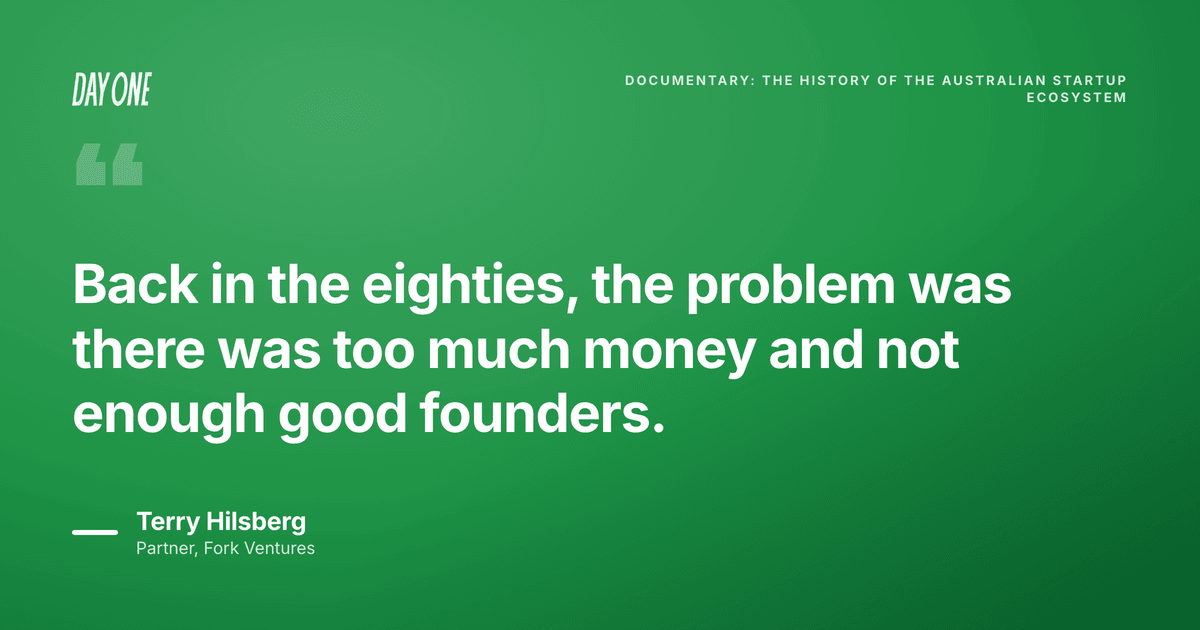
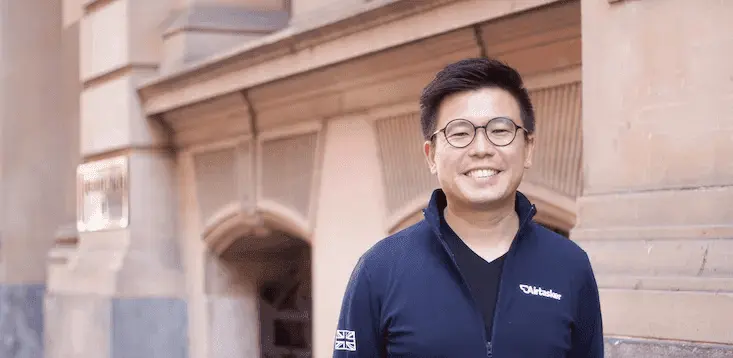
Transcript Synced · select any line to jump ▾ 0:00 Speaker: Hi, I'm Adam Spencer, founder of the Day One Network, which is bringing the history of the Australian startup ecosystem to you. I believe in founders. It's why I do everything I do at Day One and our media company, W2D1 Media. And that's why the Day One Network exists, to create helpful content for founders. We've got some great shows in development, but a large part of what we do couldn't be done without support from our partners and sponsors. And I couldn't be happier than to be working with NTP, who get community better than any other technology recruitment company out there. A Newcastle company like mine, NTP are invested in seeing the growth of the local tech community in Newcastle, Sydney, and more broadly Australia. So thank you NTP for helping us bring helpful content to founders and the startup community in Australia. Back to the interview. 0:53 Speaker: As of March, Atlassian has a market cap of $75 billion and employs over 6,000 people, making it an undisputed giant of Australia's growing tech sector. 1:04 Speaker: Easy-to-use design tools have made Canva a $40 billion juggernaut. 1:08 Speaker: Economies globally have been massively disrupted by the ongoing pandemic, but many tech companies have seen huge boosts in revenue, with some reporting that profits have surged to record highs in the wake of the coronavirus outbreak. 1:21 Speaker: Australia's tech sector is now equivalent to the third third largest industry in Australia, employing almost 1 million people and contributing $167 billion to our economy per year. 1:34 Speaker: Today, the Australian startup ecosystem is a crucial pillar of our nation's economy and is closely tied to the future prosperity of Australia. And this economic impact is only one part of the story and doesn't fully capture the positive change being made by many of Australia's leading innovators. But the future is never certain, and in a rapidly changing world, well, we either innovate or get left behind. 2:00 Speaker: You've gotta recognise that we're living in a time of very rapid change. So how do we deal with that? Well, we deal with that by being agile, innovative, and take advantage of these disruptions and rapid changes so that we can stay at the front of the pack. 2:17 Speaker: So what does the future hold for the Australian startup ecosystem? Well, before we even begin to tackle that question, First, we need to go back to day one. [FOREIGN LANGUAGE] Hi, I'm Adam Spencer, and over the past 12 months, with the support of major sponsors, MYOB, AWS Startups, Investment New South Wales, and CSIRO, along with our other sponsors and partners, my team and I have conducted more than 150 interviews with amazing people from all corners of the Australian startup community. We've spoken to founders. 3:00 Speaker: Hey, I'm Cameron Adams. I'm one of the co-founders and Chief Product Officer of Canva. 3:05 Speaker: Investors. Hi, I'm Rachel Newman. I'm one of the founding partners of Flying Fox Ventures. Academics. 3:11 Speaker: My name is Alan O'Connor. 3:13 Speaker: I'm with the University of South Australia. Policymakers. 3:16 Speaker: Yeah, hi, I'm Malcolm Turnbull. 3:18 Speaker: All with a single goal in mind. To tell the history of the Australian startup ecosystem. We'll kick off our story after these messages from our sponsors. The story of the Australian startup ecosystem is more broadly the story of how technology shapes our world. In the 18th century, the Industrial Revolution dramatically reshaped the way our societies live and work. In the 20th century, the development of modern computing and the internet would usher in the Information Age. And once again, with new technologies came great change. Small teams of innovators could reshape the world with a speed and at a scale never before seen. Larry Page and Sergey Brin, to give a classic example, started working on Google from their dorm rooms in the '90s and would go on to revolutionize the way information is accessed around the world. We call these teams of innovators startups, but what defines a startup? According to Pete Lied, author of The Startup Guide and lecturer at the University of Sydney, the answer may not be so obvious to everyone. 4:34 Speaker: I run some startup classes at University of Sydney, and I start the first class by asking people, well, what is a startup? And most people don't even have a guess at what a startup is. Or they say, you know, it's just a company that's just starting, or like it's a small business. So when we're in the ecosystem, we think we know what startups are, and, you know, startups are this big booming thing. And I think we forget that most people only see the word startup when it comes up in the news. 5:06 Speaker: The limited visibility of the startup ecosystem throughout the general public is a theme we will touch on throughout the series. In the hopes that this podcast might serve as an introduction to anyone unfamiliar, we're going to start with the basics. So how do we define a startup? 5:24 Speaker: Startups are technology-based companies that are using innovation typically to disrupt markets to grow globally. 5:35 Speaker: Kate Cornick is the CEO of Launchvic. 5:39 Speaker: And so when you break that down, We say technology-driven, and we mean technology in the broadest sense. We say that they're innovative because they are disrupting, typically. And global is really important for us. We don't believe there are very many startups at all that can function purely on a domestic basis. That doesn't mean to say that they don't have a solely domestic focus for a period of time, but we are such a small market in Australia, they necessarily have to be thinking global. This is not about muesli bar companies. Great businesses, love them, eat a lot of muesli bars, Your average music bar is not a global brand. And so when you add all of that up together, what are we trying to say? We're really trying to get behind companies that have a very rapid growth trajectory, can reach a billion-dollar valuation, and can hire many hundreds of staff. 6:32 Speaker: Pete Lead's definition is slightly different, suggesting that a startup is, by definition, temporary. 6:38 Speaker: A startup is a temporary organisation. Used to search for a repeatable and scalable business model. It's a temporary organization, so it could be a group of people forming for the first time. It could be part of a larger existing organization, say, in a corporate setting. It's used to search, so it's defined by a lot of uncertainty or a lack of certainty. It's searching for a business model because for me, the super interesting part about startups is not creating a new product, but creating a new business model, a new way that the business works and makes money. and the business model should be scalable and repeatable because you don't want to just do it one time. You want to be able to grow either into new product lines, new markets, new geographies, etc. 7:25 Speaker: There may not be one universal definition, but for our purposes, a startup is an organization innovating a new product, service, or business model that has the potential to grow into a global company. But this series isn't just about startups. It's about the Australian startup ecosystem. So what do we mean when we use the term startup ecosystem? 7:47 Speaker: One of the most powerful things about any kind of ecosystem, I think, is that you need to kind of have proven success and proven experience. 7:55 Speaker: Tim Fung is the founder of Airtasker. 7:58 Speaker: If you look at like why Silicon Valley or like San Francisco is like so awesome, you know, I guess you had folks in the '60s building silicon chips and then That experience and that capital got pushed into the next era, you know, personal computing or whatever, and then that gets pushed into the next era of e-commerce on the internet. That just keeps compounding. 8:17 Speaker: Silicon Valley may have been the first true startup ecosystem, though today there are many examples globally. 8:23 Speaker: So in the early or late '90s, early 2000s, the world sort of looked in on Silicon Valley as just being the epicenter for change. It still is to some extent, but it's spread further around the world now. 8:36 Speaker: Phil Hayes Sinclair is co-founder and CEO of DropBio. 8:41 Speaker: You look at places like the Ukraine, Nigeria, the UK, Belgium, Germany, New York, Massachusetts. There are so many places you can go in the world that are now doing such great work, but they all have one thing in common. There is a collection of people that have decided to come together, which is, typically the formation of founders and really interesting and productive investors. 9:07 Speaker: The support programs for early entrepreneurs need to be there, so I call this startup infrastructure. 9:13 Speaker: James Alexander is the co-founder of Galileo Ventures. 9:17 Speaker: So one, you need support infrastructure and programs that can help people develop the skills and education and knowledge to launch their ventures, and we're seeing that happen at university level, which is really, really great, but we're also seeing it happen generally across the market. 9:34 Speaker: To me, it's something like a collection of organizations who are supporting startups, and what makes an ecosystem is that there is connectivity between those organizations. 9:50 Speaker: Maxine Sherren is Program Director of Spark Festival. 9:53 Speaker: So they're not operating fully independently and without knowledge of each other. In fact, they know about each other so they can Just to give the most trivial example, like when someone comes along to your accelerator and they're not right for you, you don't just say to them, "Go away." You say, "Have you considered these guys here?" And in a network system you can do that, whereas when people aren't finding out about each other, then you don't have that knowledge, that startup probably doesn't have that knowledge, and they're 6 months behind before they finally find out that this might be a really good idea for them. 10:27 Speaker: So again, while there may not be one universal definition, when we use the term startup ecosystem, we are referring to a community of startup founders and their teams, as well as the infrastructure that supports them. This includes investors, accelerators, and educators working collaboratively in a way that makes the whole greater than the sum of its parts. In this series, we'll be exploring many aspects of Australia's startup ecosystem, how it came to be, and where it might be headed. And one last note before we dive in, we are aiming to tell this story as holistically and accurately as possible, but we won't possibly be able to cover everything or fully credit all the incredible people and organizations that have contributed to the growth of the ecosystem in this series. If you'd like the full story, you might like to start by listening to the more than 100 interviews we've released as standalone episodes. In this series, we will be presenting a roughly chronological history and telling some of the key stories of Australia's startup ecosystem. 11:33 Speaker: We wanted to go right back to the beginning. The medical device industry here in Australia is one of the early catalysts for the whole ecosystem we see around us today. 11:42 Speaker: Because there's no one universal definition of a startup, it's difficult to point to a specific date or company and say this is where Australia's first startup was founded. But Hamish Hawthorne, who has been deeply involved in the Australian startup ecosystem for decades, makes a compelling argument that it began with the Nucleus Group, founded by Paul Traynor in 1965. The Nucleus Group would go on to become the parent company of a multitude of medical technology businesses. 12:11 Speaker: So Teletronics was an implantable pacemaker company. The Nucleus Group also was the parent company for Cochlear. There were also a bunch of other companies there. Osonics, which is a highly innovative ultrasonic company. ResMed's another one. These are all fantastic entrepreneurial organizations that are led by outstanding and great entrepreneurs themselves. So all of these businesses were part of the Nucleus Group, headed up by a gentleman called Paul Traynor. 12:39 Speaker: Paul Traynor was a true pioneer and could be considered one of Australia's first startup founders. In 1964, he sold his home and left his secure job working for the medical distribution company owned by his father. He went on to build the Nucleus Group into a company exporting medical technology globally. When Paul sold the Nucleus Group in 1988 for $180 million, Nucleus dominated the world of cochlear hearing implants and held 15% of the global market for heart pacemakers. And the group achieved all this without any of the support infrastructure that exists for Australian startups today. 13:15 Speaker: So he is somebody that is somewhat little known outside of the medical device industry, but he is definitely, you know, the original, the OG entrepreneur, I would suggest. You know, somebody that was both a visionary, somebody who could really understand the commercialization of technology, who could really build exceptional teams. 13:33 Speaker: The list of Australian companies that were linked to the Nucleus Group includes Teletronics, Cochlear, Medtel, Domitica, BGS Medical, and Ausonics, all of which made important contributions to medical technology in the '60s, '70s, and '80s. But the medical technology industry was not the only industry being disrupted by Australian innovation. 13:54 Speaker: Fairlight was an Australian company, uh, founded by Peter Vogel and Kim Ryrie. 14:02 Speaker: Founded in 1975, Fairlight worked on developing cutting-edge audio and media technology, including the Fairlight CMI, one of the earliest digital synthesizers. The Fairlight CMI helped revolutionize popular music and was used by artists such as Peter Gabriel and Stevie Wonder. Bruce Tullock, co-founder of Bitscope Designs, worked with the Fairlight team in the mid-'80s. 14:24 Speaker: And a large part of my early career was both working for Fairlight initially and then in joint venture in a company that I set up where we developed audio post-production systems for the film and television industry in conjunction with Fairlight. They developed editing systems, we developed dubbing systems, and the highlight of that was we successfully got quite a presence throughout Hollywood, the major film studios, and we secured an Academy Award in Science— Technology Award in 2001 for, as they put it, I think, transforming the way Hollywood makes sound for picture. I would consider Fairlight itself back in the '80s Australia's first hardware incubator, even though it was a company. The number of founders that have come from employees at that organisation to successful businesses since then is quite stellar. 15:12 Speaker: Another company that could be considered among Australia's first startups is Computershare, founded in 1978. 15:19 Speaker: Computershare was one company that sort of became the leader in the share registry market globally. 15:23 Speaker: Paul Bassett is co-founder of Square Peg. 15:26 Speaker: Computershare was certainly one company that built a successful startup that people knew. 15:31 Speaker: It's like one of the classic Australian startup stories. 15:36 Speaker: Hayden Williams is a senior product manager at MYOB, which was initially founded as Teleware in the '80s. 15:43 Speaker: We talk about it at MYOB that like we're one of the OG startups. You know, it was the same story as you hear so often. It is just a couple of founders that are starting a business from a garage that are trying to solve a really specific problem that they're really close to. It grows legs and it sort of almost gets away, gets away from them, and they're just trying to sort of hold on for dear life. So like when MYOB started out, it was very much about enabling small businesses to do accounting. You know, there were a handful of kind of money management products that were out there, but, you know, universally accepted to be pretty terrible. And really having a real tool that you could use to, to manage the books was like a pretty novel thing in the industry. So like that was kind of, I think, the first age of MYOB was very much about, you know, that, that enabling small businesses to do their own accounts, which they couldn't really do before, certainly couldn't do easily. 16:35 Speaker: These early Australian startups were pioneers working in a time before we had anything resembling a startup ecosystem. 16:42 Speaker: I think the idea of a startup wasn't as easily constrained around a word back in 1982. I mean, yes, there was a young technology business and we would call that a startup today, but back then I think we just called it a young technology business. 16:55 Speaker: That's Mark Pesci, host of the podcast This Week in Startups Australia. 17:00 Speaker: There were pockets of places that you could think of that were kind of startupy, but there was nothing formal. There was no formal venture capital infrastructure. There was no way really to get seed money or angel money into the country. Even angel wasn't really even a word at that point in time. But everything was not just immature, but so immature as to be basically practically non-existent. 17:26 Speaker: Unlike Australia, Silicon Valley already had a booming startup ecosystem in the '80s. A number of Australians spent time working in Silicon Valley during those early years and gained a ton of valuable experience that they could then bring back and apply in Australia. 17:39 Speaker: Back in the '80s, the problem was there was too much money and not enough good founders. So the great venture capitalists of that era, like Roger Backridge, would go out and literally create the companies. And bring the Australians back home to create them around. 17:54 Speaker: That's Terry Hillsberg, an investor who has been involved in startups in Australia and globally since the '70s. 18:01 Speaker: A classic story like this, which not many people remember now, there was this guy called John Shine who was one of the early biotech people in the Valley, a world leader. He was an Australian. So he was brought home to live in Sydney and run a research institute. The CEO that was recruited to run that was a fellow called Brian McNamee. And Brian did such a good job and everyone said, God, this guy's world class, that he was then invited basically to take over CSL and turn a crappy old government blood transfusion type factory into what is today's— if it's not the largest company in Australia, is one of the top 5 companies in Australia. To give another story. Peter Farrell had been a senior vice president at Baxter-Travenol, had come back to Australia, and he figured out that this whole sleep apnea thing was, was a thing. And so he then created a company around that. And lo and behold, some Japanese venture capitalists put some money in and Peter went on and founded ResMed. And ResMed to this day has the single largest concentration of engineers in Australia out in the northwest part Park, of you know, is a foundation of the New South Wales economy. And that came out of a venture capital investment. They were backing this Australian expat who returned to Australia after a stellar career in America. And I can give you 10 stories like that that occurred in the '80s. 19:26 Speaker: Terry argues that favourable economic conditions and government policies of the '70s and '80s helped start what he refers to as the first great wave. Of Australian startups and venture capital. 19:39 Speaker: By the late '70s, early '80s, the so-called failure of the Australian economy to adapt and become a highly valued economy was already an interest of the day. So the Hawke-Keating government came in in '83 and started putting very significant money into R&D subsidies and subsidies of venture capitalists. And so You had the first great wave of that taking place from 1983 to 1987. And during that period, many of the venture funds that were started and some of the great iconic Australian unicorns were created— companies such as Cochlear and slightly later companies such as ResMed. 20:23 Speaker: Both the Fraser and Hawke governments presided over times of high inflation and high unemployment. And sought to introduce sweeping economic reforms to modernize the Australian economy. 20:33 Speaker: Some of the smart things that early Australian federal governments did back then was relatively smart. 20:39 Speaker: That's Alan "The Nice One" Jones, startup investor and advisor. 20:43 Speaker: If you wanted to be a big IT vendor selling into Australian government, you had to commit to doing some R&D here in Australia. You had to spend a bunch of money on a computer lab, employ a bunch of computer engineers. You'd usually import some senior talent from your headquarters overseas to come and sort of get things started here. You might work with Australian Computer Society, which is kind of the trade union of programmers in Australia, to come up with a scholarship system. And you'd start recruiting talent at universities and you'd try and influence the way that universities were teaching their computer science students so that they were more familiar with, you know, because the ecosystem was very, very siloed back then. 21:23 Speaker: Mm-hmm. 21:23 Speaker: But favorable economic conditions would be short-lived. On the 19th of October, 1987, the global stock market crashed spectacularly. Known as Black Monday, or Black Tuesday in Australia because of the time zone difference, all major world markets declined sharply, with Australia's market dropping by more than 40%. Investment in Australian startups, which was still in its infancy, was hit hard. 21:49 Speaker: We learned firsthand what a stock market crash can do to the owners of a business that are fairly highly leveraged. 21:55 Speaker: Again, Bruce Tullock. 21:57 Speaker: Fairlight Instruments, as it was then, went out of business and I became unemployed. But also it was an interesting insight to see what happens when a company that was very successful— Fairlight was very successful. They had a huge order book that they couldn't fulfill for lack of capital because the MICs that owned them were struggling from the wake of the '87 stock market crash, and it highlighted to me how closely related market action can have for, shall we say, high-risk investors. 22:26 Speaker: With the local market for startup investments stalled, some founders looked elsewhere. 22:33 Speaker: The Australian capital markets had basically collapsed for venture after '87. 22:37 Speaker: Again, Terry Hillsberg. 22:39 Speaker: And it turned out that the only place in the world that really wanted to give us a lot of money was in Japan. So I moved to Japan and raised a fund called the Japan-Australia Venture Capital Fund,, which was by then probably the only fund raised in the early '90s in Australia. Plus, I also was associated with and helped raise a thing called the Apple Computer Australia Fund, which was— not many people realised that Apple Computer in fact had a venture capital arm in Australia in the early '90s. Roger Allen, who I think we owe a lot to. 23:12 Speaker: Trevor Folsom is co-founder of Investable. He was investing then as Allan and Buckridge. He was obviously a very successful investor and entrepreneur himself, and he's still investing today, and he's still a close mentor and friend of mine. 23:26 Speaker: And the fact that he's gone through major changes and challenges in the industry, he's been incredible. 23:32 Speaker: While there were pioneering investors such as Allan Buckridge and Roger Allan, venture capital would remain limited in Australia until at least the 2000s. Matt Barry, founder and CEO of freelancer.com, argues that early Australian VCs struggled to discover and invest in tech startups that would go on to become successful. 23:50 Speaker: The Australian venture capitalists missed every single major Australian technology company until it would have been, I don't know, I might be corrected here, but I would say the late 2000s and the first decade of the 2000s, bar one, bar LookSmart. LookSmart was invested in by by Macquarie. But at the time, the VCs were very small in terms of their fund size, maybe a $30, $40 million fund would be about the size. Most of the funds were captured, so they were part of an investment bank. So Macquarie Bank would have their own venture arm, and this, that, the other. You had CHAMP, Castle Highland Aussie Mezzanine Partners, which is— 24:29 Speaker: Bill. 24:30 Speaker: Bill Ferris. So Bill Ferris had pioneered venture capital in Australia and he had his own fund. But really, up until the dot-com crash, every single major technology company that started in Australia had been missed by the Australian venture capitalists. 24:50 Speaker: We'll continue our story after these messages from our sponsors. So to recap our story so far, during the '60s, '70s, and '80s, Australia's first tech startups emerge. Though the term startup isn't yet in common use, some Australians are bringing home new ideas from Silicon Valley, and economic conditions of the day both help and hinder the development of Australian startups and venture capital. The startups that are able to survive are pioneers, working without any of the modern support infrastructure we have today, and crucially, for the most part, they are still working independently from one another. without organized communities. Most people we spoke to for this series agree. Before the year 2010, there was no startup ecosystem in Australia. In the '90s, a new technology was emerging, which not only would enable a new wave of startups globally, but would ultimately impact almost every aspect of modern life. While early versions of the internet had been developed in the '60s, '70s, and '80s, the first web browsers as we know them today weren't created until the '90s. One of the earliest such browsers was Netscape. 26:08 Speaker: I remember clear as a bell. 26:10 Speaker: Evan Thornley co-founded the internet search company LookSmart in 1995. 26:16 Speaker: And a friend of mine in the New York office at McKinsey said, "I've got Netscape on my computer, do you wanna see it?" And I said, "Oh yeah, I've heard all about this thing, I really wanna see it." And, you know, he fires up his Netscape 1.0 browser and 5 seconds later we're searching for apartments to rent in London. You know, point and click. And I just— the light just went on and I said, wow, this is going to change the world. The usability of that point and click interface, you know, HTML interface of the first browser compared to the sort of really clunky, very technically complex environment that online services had been to that date. Just, you know, it was a blinding flash for me. And 6 weeks later, I left McKinsey and started the business. 27:02 Speaker: So— 27:03 Speaker: I started getting involved in the tech sector in the early '90s. 27:07 Speaker: Before entering politics, former Prime Minister Malcolm Turnbull was a lawyer and an early investor in internet technology. 27:14 Speaker: The first tech company that I was involved with was a company called Future Technology Resources. Or For the Record. And that was in the early '90s. And we financed that ourselves and ultimately we backed it into a public listed company. But the most significant company was, of course, Aussie Mail, which Shaun Howard founded with the support of myself and Trevor Kennedy. And that was in '94. And at that time, there was no money available for tech at all. In fact, we showed Ozemail to a bunch of people and the internet was just getting going. And they turned it down. We had a very memorable meeting with Kerry Packer in which he dismissed the idea and said the internet— he wasn't impressed with the internet. It would only be used for gambling and porn. And I must say, when we got out of the meeting, We looked at each other and said, "Well, you know, even if he's right, it's still going to be a pretty big thing, isn't it?" Turnbull purchased a stake in the internet service provider Aussie Mail in 1994 for $500,000. 28:29 Speaker: In 1999, just 5 years later, he sold this stake for $57 million, an example of the huge growth many internet startups would enjoy in the coming years. But while we take it for granted today, The early internet was often slow, clunky, and difficult to access. 28:46 Speaker: Prior to Wi-Fi, you had to connect your computer to everybody else's computer via an Ethernet cable. And generally speaking, that meant there had to be, you know, a little socket in the wall where you could plug in. And the cable and the sockets and the device that connected them all together and connected that to the internet was, you know, pretty expensive and non-trivial to install. 29:06 Speaker: Again, Alan Jones. 29:07 Speaker: So offices had them. And corporate campuses and maybe universities, but almost nowhere else, right? So if you and 3 friends were thinking about getting started and doing your own startup, almost though, like the first thing you had to figure out was like, where are we gonna collaborate on this from? You know, you couldn't just go and sit in a coworking space. You couldn't have a coworking space. You couldn't afford to put in enough internet ports in the space unless, you know, you were a corporation and, you know, you were paying a big property manager serious money every year to lease a corporate headquarters. And so when we started Yahoo Australia and New Zealand, we actually, we got a favor from APN, the media company, and we kind of sublet one of their meeting rooms. Now from memory, you know, for probably maybe almost a year, we were all working from this little meeting room with a limited number of Ethernet ports and cable snaking away from the one meeting room table where we all sat. You had to be careful, you know, coming and leaving because you could trip over somebody's Ethernet cable. Yeah. Bugger up what they were doing. 30:07 Speaker: During this period of the '90s, while adoption of the internet was growing but still very limited, once again it was the pioneers working without established business models or support infrastructure that found innovative ways to build companies using this new technology. 30:23 Speaker: I had a company called eWAY that I started 25-something, I dunno, long time ago. 30:28 Speaker: Matt Bullock founded eWAY in 1998. 30:31 Speaker: And that company was a payment company. And if you bought something in Australia, I probably did the payment. So I was doing $6 billion a year, 25,000 customers. 30:39 Speaker: eBay, which Matt would ultimately sell for $50 million US in 2016, had humble beginnings. 30:47 Speaker: When I was doing it, there was no real thing as a startup or community or anything. It was weird. It was like when I was at school and I went to Parkes High, which is near Dubbo. And there was like 4 or 5 of us who were into computers and everyone else just thought you were a nerd and weird. And startups that time was the same thing. You're gonna do what? I mean, I remember at the time asking 10, 15 good friends, you know, what do you think of the idea? And they all told me I was stupid. Like, you're gonna do what? Yeah, tough thing to do. I mean, just to understand that the servers were in my house. I used to have a 64K ISDN line. I had a modem that dialed up to the bank, you know, bing, bing, bing sounds for 30 seconds to do the payment. So it was very, very different to what it is now. And you had to build everything yourself. Like now you can just get so many things and plug them in and use them and just build something very quickly. But I was the hosting provider, I was everything. It's just how things used to be. You used to have to just do everything yourself. 31:51 Speaker: Often these new internet startups were disrupting existing companies and over time entire industries. News media, for example, would be turned upside down by the internet, but this disruption didn't happen overnight. 32:05 Speaker: Well, I think that first generation of Australian tech startups were media companies. We put content on pages and sold ads on them. 32:12 Speaker: Again, Alan Jones. 32:13 Speaker: The news publishers were really, really cautious about putting any of their precious editorial content on the internet. In it in the early days. The first media licensing deal, I think, in Australia was one that I did with The Australian. And we needed to have some news headlines and as much of the news story itself on Yahoo Australia and New Zealand as we could. And what we wanted to do was serve that news, run ads on it, and share the revenue with our news partner. But News Limited, you know, would say, "Don't you know who the hell we are? You know, we're News Limited. We don't need any help selling ads." Yeah. "and this content costs us a lot of money to produce, you can go jump." And we would say, "Yeah, but you don't understand about these online ads. It's not like selling print ads, it's different, it takes different people, you need different relationships with brands. We're gonna be much, much better at this." And they would say, "Oh yeah, come back in 3 years when you've given up and we'll talk about how little we'll pay for what you've made." So it was very hard. So I ended up, that first news deal was just the headline and I think the first 250 characters of each story, and then at the end of the story there was an ellipsis, you know, a dot dot dot, and then a link to the full story on the Australian website. So content was really, really valuable and very, very expensive in the early days. 33:31 Speaker: Outside of the media industry, there were other Australian pioneers seeking new business models on the internet. A number of these companies found huge success building Australia's first online marketplaces. Marketplaces. It was the marketplace businesses that did really well. So realestate.com, carsales.com, and Seek. Alfred Lowe is co-founder of Harvestbee. They classically took what around the world was happening, the classifieds businesses, and put them online. That was happening the world over. And they've survived, and they've not just survived, they've gone on to be real pillars for the Australian tech scene. 34:09 Speaker: The internet as a medium was very nascent. 34:12 Speaker: Paul Bassett co-founded Seek in 1997. 34:15 Speaker: There were probably worse than people I knew that were internet users, but very few, and I wasn't really in a techie circle, if you like. And so, you know, when Evan first rang me to say he was setting up an internet company, I didn't really know what the internet was, and quickly got on the internet and learnt a little bit about it. You had a few venture capital funds that did emerge in the sort of mid to late '90s, '90s. None of them are still around, and so that probably reflects the fact that they struggled to back amazing businesses. You know, candidly, if you look at most of the successful businesses that emerged through that period in the late '90s, and Seek was a bit of an exception, most of those successful companies either bootstrapped or had quite unusual sources of funding. RealEstate.com.au, News Corp bought the controlling stake there. They had Ray White, the real estate agents, back them. Car Sales was sort of seeded out of the Australian Reynolds Reynolds by Wal Pashoda and Greg Robach, and Greg became CEO and built an amazing business. But they had their own funding, they had some angel investors, they had car dealers, etc. What If, Graham Wood, I think was backed by his accountant and a few of his accountant's clients. So you didn't really have regular sources of funding that could both back companies right through their life cycle, but also provide them with the putting advice of people who have these experiences themselves. 35:33 Speaker: Despite the limited funding available, adoption of the internet continued to expand throughout the '90s, and a number of Australian startups built global companies on the back of this growth. 35:44 Speaker: If you have a look at like, you know, Seek.com from the first wave of the internet, it's actually like a juggernaut on a global scale. 35:51 Speaker: Again, Tim Fong. 35:53 Speaker: I think REA, realestate.com.au, also an Aussie homegrown company, juggernaut on a global scale in, in that space. What I kind of think, uh, here is interesting is that Australia is an awesome pilot market for these kinds of build local but then, you know, go and build it again overseas type models. You know, being a smaller country, you can sort of build a network effect very quickly, be able to monetize that network effect, uh, quickly, and then you can go and invest that into upscaling that overseas. And I think we've seen that with Seek, we've seen it with realestate.com. Yeah, I think that actually one thing that probably doesn't get as much of a mention because it's less sexy than sort of like the global day one mega companies is potentially these sort of like local businesses that can be replicated again overseas. 36:40 Speaker: Seek, realestate.com, LookSmart Group, Open Telecommunications, carsales.com, App Unlimited, and Webjet, all Australian startups founded in the '90s. They were innovating new business models and proving to anyone paying attention that the internet was becoming a big deal. The Australian startup sector was growing, but it was still very niche and nothing compared to what was happening in the US. Amazon, eBay, Google, and PayPal were all founded in Silicon Valley in the '90s, and companies like these brought the term startup into the mainstream for the first time. Peter Davison, an Australian who was one of the first investors in PayPal, told us about his time in Silicon Valley during the '90s. 37:23 Speaker: You know, when I talked about business in Australia, a guy like me, people were like, ah, you know, you know, settle down, wait your turn, and who do you think you are, that sort of thing. I walked around Silicon Valley pretending I was a venture capitalist. I mean, I was a venture capitalist, but I felt like I was pretending, and people just embraced it. I was young, I was ambitious. It seemed that I had money and my friend did. You know, I had a briefcase and it just had an air of like, "Yeah, yeah, I'm not going to laugh at you because you might be the next big thing." And it was very, very young, vibrant, and I really— it was the best experience of my life. I really felt, "Yes, there is another place to be and it doesn't have to be like where you are right now." And there's a place that embraces your crazy dreams and where young people are kind of heralded. It was fantastic, man. I know it sounds a bit romanticised and it probably is still in my mind, but at that stage I just was getting doors opened. There was no question of who I was, you know, wait my turn or whatever. It was embraced. It was fantastic. 38:28 Speaker: As the end of the millennium approached, Millennium approached, the excitement surrounding the internet was reaching a fever pitch. In the US, between 1995 and the peak of the dot-com boom in March 2000, the NASDAQ stock market index rose 400%, with investors scrambling to invest in any dot-com company. And with so much cash pouring into the tech sector, many startups were running at a huge loss, spending heavily on advertising and promotions, and prioritising growth over profitability, startup founders once obscure were becoming celebrities, and the future of startups was looking bigger and brighter than ever before. On the next episode of the History of the Australian Startup Ecosystem, the bubble bursts.







 ▶
▶  ▶
▶  ▶
▶  ▶
▶  ▶
▶  ▶
▶ ▶
▶ ▶
▶