Transcript Synced · select any line to jump ▾ 0:02 Georgie Healy: Founders scale faster on Deel. Set up payroll for any country in minutes, hire anyone anywhere, get visas handled fast, and get back to building. Visit deel.com/dayone. That's D-E-E-L dot com slash day one. 0:22 Andrew McCarthy: Just mapping out what is AI good at and then what is the risk. If it's a high-risk environment and AI is not very good at it, don't do it. If it's a low-risk and AI is really good at it, do it. And that 2x2 framework I think has been really helpful with organizations understanding how to adopt AI. 0:40 Georgie Healy: Respectfully, what is your skincare routine? How does someone with your career tenure and 3 kids have that good skin? In brackets, in a non-creepy way. Facts. Facts. You're going to a dinner party, you get to invite 2 people from the tech industry. Who are they? 1:03 Speaker: Are you? 1:05 Georgie Healy: I'll give you your merch later. 1:09 Andrew McCarthy: The answer to that is looking at what AI is not good at. And so it's not good at creativity. It's good at looking along like big data sets and producing the most likely result of what it's already seen. But creativity is a fundamentally human aspect. 1:23 Georgie Healy: How does your strategy for scaling Notion change as your audience grows? 1:29 Speaker: Wow, guys, a bit of a different one this week because it's a bit of a different episode. This is the recording of our live show, which we did at UNSW in Sydney, a very special venue. UNSW is recognized as Australia's leading university for entrepreneurship. Particularly through their UNSW Founders Program. Special venue, special guest. We had Andrew McCarthy, General Manager at Notion for Australia, New Zealand, and Asia, join us. The feedback from this evening and about Andrew was genuinely incredible. And for a live show, we did want to make a big splash, so it was a sold-out event. We had merch, people are rocking it, sending me photos. Thank you so much everyone that came. We'll have to do it again in future. Now I'll do a proper intro for the show as part of the live recording, but this episode had AI hacks, the Notion origin story, and even skincare tips. Andrew's glow was real. And now that we're streaming video on Spotify, you'll be able to see that glow for yourself. I'm excited for you guys to hear this. Let's dive in. 2:42 Speaker: You're listening to a Day One FM show. Wow. Wow. 2:52 Speaker: Hey, Georgie. 2:53 Speaker: Hey, Andrew. 2:54 Georgie Healy: What brings you here? 2:57 Speaker: You. 2:58 Georgie Healy: Yes, oh yeah, I did actually plan this for months. Thanks everyone for coming. Look, I'm genuinely so excited to do this live show. This was a thing I manifested one night, and then when UNSW said yes, I was like, oh wow, that's really exciting. Now I need the most incredible guests possible, and some suggestions were given to me that were great suggestions and I was like, "Thank God." And we did that and we got Ace through. Thank you so much for being here. Show of hands, who has used Notion before? Ooh. 3:35 Andrew McCarthy: That could have gone one of two ways. I'm glad it went that way. 3:39 Georgie Healy: Okay, raise your hands if you've used it in the last week. There we go. 3:45 Andrew McCarthy: Decent. There we go, yeah. 3:46 Georgie Healy: That's a pointed question because A lot of new AI features rolled out last week. 3:52 Andrew McCarthy: They did. 3:52 Georgie Healy: I'm gonna dive into that. Awesome. So we're gonna start the official part of the recording now. 3:58 Andrew McCarthy: Perfect. 3:58 Georgie Healy: So hello and welcome to In the Blink of AI, where I talk to the brightest AI startups and innovators each week. I'm Georgie Healey. It's the 30th time I've done that, so I didn't need the script until now. I am speaking to Andrew McCarthy. He's the general manager at Notion. For Australia, New Zealand, and Asia. Notion is the AI workforce where you can— workplace where you can find every answer, automate the busy work, and get projects done. 80% of users are located outside the US, and users have grown from 1 million in 2019 to 100 million last year. Australia has about 26 million, so— Yeah. It's a lot of it. Now, when I was researching Notion, doing a bit of searching online, the first comment on Reddit was, "Notion's too good. I'm afraid it's going to get acquired." So if that's the biggest of your problems, Andrew, I think things are going quite well at Notion. 4:58 Andrew McCarthy: Yeah, thank you. 4:59 Georgie Healy: Tell me, you're a podcaster? 5:02 Andrew McCarthy: I am. Oh, my first live show tonight. Yay! So I'm going to get sick. I can feel the energy in the crowd. But I do love podcasts. Listen a lot. 5:12 Georgie Healy: Yeah. Any particular ones you like? 5:14 Andrew McCarthy: In the blink of an eye? I was actually listening to your one with Jackie Coe on the way in today. 5:20 Georgie Healy: Hey, relevance, man. Yeah. 5:23 Andrew McCarthy: And you gave a plug and you said, "We've got a live show and I kind of spicy questions they can't get away." And I was thinking, "Uh-oh," on the way through. That's me. That's me. 5:30 Georgie Healy: Right. 5:30 Andrew McCarthy: On the way. Other ones I like, BG2 for markets. 5:36 Georgie Healy: Yes. 5:36 Andrew McCarthy: Fall of Civilizations or The Rest Is History if I want to go to sleep at nights. It's like a very soothing voice. You can like listen to Rome go off in the distance. And yeah, I love all podcasts. 5:47 Georgie Healy: Thank you. The Roman Empire, your Roman Empire? 5:51 Andrew McCarthy: I don't know. I don't know. 5:53 Georgie Healy: Maybe. 5:54 Andrew McCarthy: We'll reflect on that one. 5:55 Georgie Healy: So General Manager of Notion Australia, Asia, everywhere, all the Pacific Islands, I'm sure. What is a general day in the life like for you then? 6:05 Andrew McCarthy: I'm not everywhere, just in case my boss is watching as well. Lots of parts around the world that I don't have the privilege I work with Notion for. But, so I have 3 young kids. So a day in the life probably usually starts with me yelling, "Put your shoes on," into an abyss. And like, "Get in the car." And ends with like, "Go to bed." Yeah. And in between that, a lot of Notion. I think that great leaders do 2 things really well. They build an engaged team and they deliver customer value. And so a lot of what I concentrate on is building an engaged team, a team that sees Notion as a talent destination, a place where they can change their life and their career, and making sure that diverse ideas and opinions come forward and we can really help the team thrive. And the other side, we think a lot about how to deliver customer value and what that looks like to our customers, how we can help them ship their products faster, go to market, achieve their dreams. And so most of my thought during the day is on one of those two things, which is bringing in great people and helping them grow, or talking to great customers and helping them grow. 7:05 Georgie Healy: Yeah. You've recently launched in Australia, and last week you were in Singapore. 7:09 Andrew McCarthy: We were, yes. 7:11 Georgie Healy: I saw that all over LinkedIn. That was quite viral. How's that going, and what does success look like for you in APAC specifically? 7:18 Andrew McCarthy: So it's going really well. Many thanks to Seth Mackay, our incredible marketing leader, who ran the whole events in Singapore last week. We now have millions of users in Australia, which completely blows my mind considering the Australian population is just north of 26 million. And success for us really looks like success in the eyes of our customers. So a lot of it is making sure our users get great value from Notion. I'm really personally proud that some breakout Australian success stories use Notion, like Linktree use Notion to halve the amount of time they spend in meetings and take tasks that used to take 5 hours and do it in seconds. So that's really inspiring to see great Australian companies take on the world and use Notion as their knowledge backbone. And then globally, we've been really privileged to work with companies like OpenAI, which is pretty hot in the space right now. Yeah. 8:02 Speaker: Yeah. 8:03 Andrew McCarthy: And what they're doing is they're using Notion to reduce the time to iterate on models really fast. They actually reported they saw a 70% reduction in the time to iterate on models, which I think is amazing because they're ultimately in the business of producing really intelligent models that get slightly faster and better every week. And privileged to work with them as well. So going really well, but a long way to go. And it comes back to us listening to our customers and really really grown with them here. 8:31 Georgie Healy: You know, I've been in tech and startups for the last 5+ years. It's quite stressful, I find, and productivity is kind of a bit cultish because everyone's really trying to optimize their day and their life and fit in the ice bath and the sauna and the longevity hikes as well. Do you lean into that yourself, Andrew? And are you part of this cult of productivity? Sorry for the cult word, but, or do you kind of get a little bit overwhelmed by it and actually go back to pen and paper? 9:05 Andrew McCarthy: It's an interesting question. I actually think that there's a big opportunity to simplify and reduce. I have a bit of a Marie Kondo, like, flair here. And I think about a lot of my life, but also the life of people at work, is managing all these different software solutions and tech float across companies. And that creates a lot of productivity challenges, because any productivity benefit that one app gives gets eroded by the fact that you need to move out of that and find information somewhere else. And so I think there's a big opportunity to simplify and reduce, and that's how I view productivity. 9:38 Georgie Healy: Amazing. I was very excited to have a briefing call with you because I got to kind of peek behind the scenes about the early days of Notion. And one of the things that you said that I picked up on really quickly is that you said Notion's an anti-SaaS company. Now, in the last 5+ years in VC, it's always been all about B2B SaaS. Yeah. What's anti-SaaS and in the context of Notion? 10:05 Andrew McCarthy: It's interesting you mentioned the last 5 years 'cause I like to view this on a longer horizon. And so if I think about like the 1970s, the early computer pioneers, all that creating tools for thought to help augment human intellect. And in 1980s, they went a different path, right? Microsoft released Word in 1983, Excel in 1985. They kind of feel exactly the same today as they felt in the '80s. 10:28 Speaker: Yeah. 10:29 Andrew McCarthy: But at that time, that was the process, which was, Let's take physical world items, let's make a digital copy, and let's put a PC on every desk. And they succeeded. There is a PC on every desk now. And so it's the 2000s and something magical happened. The cost to launch an internet company went into freefall. So what cost $5 million to launch in the year 2000 only cost $5,000 11 years later through open source and cloud computing. And that actually opened the door for hundreds of thousands of entrepreneurs to attack the Microsoft suite. Mm-hmm. And the ethos at the time was find your niche and smash it, right? So think about one thing you can do better. We're going to be a better bug tracking tool than Excel for engineers. Or we're going to be a better program management tool than Excel for marketers. And in that period, called the G2 crowd, over 130,000 software providers were created. A lot of them are probably in our inbox today, right? Okay. And we think about that, that spectrum. And if you look at project management tools, there's now over 480 rated tools on G2 Crowd. There is a tool for every niche and for every vertical. There is, and they compete with each other. They want to build better workflows for their specific use case. I think the insight that Notion had is if you look at all 130,000 software providers, they actually all have the exact same building blocks. They're all like similar in database and some text input and some automation. And so Notion's vision has been to deconstruct software back to its individual building blocks, to look at software like Lego. And if you could do that, you could create an environment where someone's able to build a solution that works for them, not just today but also in the future. That solution could evolve and work with you as you grow and change as well. Mm-hmm. And that really inspired me. I think about where this could go going forward right now. I think that most of the value of the last 20 years, by value I mean money, has been captured by people that own tech companies, right? Like 7 of the 10 richest people in the world own tech companies today. And there is a divide between those people that build software and those that use software. I'm in the, like, the use software side of the world. 12:47 Georgie Healy: Exactly. 12:47 Andrew McCarthy: And so, The ability to have some control over how you work the software around your process and not change your process to the software, I think, can unlock creativity and value for a lot of people around the world. And that's why I'm really excited. And that's why we see ourselves as like an anti-SaaS platform, which is we don't want to be one individual point solution. We want to have a horizontal platform that can grow and evolve with people. Mm-hmm. And help them build the tools that make them live the life they want to live. 13:20 Georgie Healy: 100 million users. I read that a $10 billion evaluation. Was it always hockey stick curves and this amazing, perfect product from day one that everyone just was obsessed with? Or was there a little bit more going on behind the scenes? 13:37 Andrew McCarthy: Notion almost died in 2015. It's a really interesting story, actually. And this is well before my time. This is Ivan and Simon. Our founders, they launched Notion in 2013 with this vision to build no-code software building tools. And they built it and they put it into markets and no one used it because no one knew where to start. 14:00 Georgie Healy: Mm-hmm. 14:01 Andrew McCarthy: And their round of money actually moved to Kyoto in Japan and they used, I think the rent difference between San Francisco and Japan ended up like funding parts of the ability to keep working working on the product. And when they went there, they went with the realization that most people's work starts with a blank piece of paper, starts with some word processing typing thing. And so they rebuilt Notion as that blank piece of paper to start and then hid all of the software building tools behind. And so that's why when you look at Notion today, it looks like a piece of paper to start. 14:35 Speaker: Mm-hmm. 14:35 Andrew McCarthy: But as you start going into it, more and more evolves and you can start building out different workflows. So no, it wasn't a hockey stick. It was a lot of effort and passion. I think about like the vision of Sam and Ivan to work on this program project for so long and the long-term horizon they have. And that's something I personally feel inspired to be part of as well. 14:57 Georgie Healy: We have a lot of founders that listen to the show and I love to hear that story. I recently listened to the Airwallex episode on 20VC, and again, that was a real up and down story. So I hope that people in the audience that are building companies listen to that and know that it's not always what it looks like in the papers. 15:18 Speaker: Yeah. 15:19 Georgie Healy: Last question about the Notion background and building the product. The interface which you mentioned is quite iconic. How important is that UI/UX and that, you know, that visual way that it's the product itself? 15:36 Andrew McCarthy: Yeah, well, UI and UX is everything. Because that's how you engage and interact. I've actually been thinking more broadly recently that there's a race to the surface level application. So if you think about what's happening in AI today and we juxtapose that with what happened with PCs, do you remember the little like Intel chip on a PC? Yes. 15:56 Georgie Healy: Remember that? 15:57 Andrew McCarthy: Yeah. 15:57 Georgie Healy: He's a millennial. 15:58 Andrew McCarthy: And so like— And what's interesting is we think about like the PC, HP or Dell created these PCs and then Intel had the processing chip on the inside. And then a lot of the value was captured through the application layer. So Windows or Office or on top of that was built Facebook and Google. And if you think about where we are right now with AI, I think there's a really good correlation with NVIDIA being the hardware and the models, OpenAI and Anthropic being the Intel chip. Mm-hmm. And there is a race right now to the surface, the application level, because that's ultimately where all the value is captured. Now we're at a point in history where I buy a laptop and trust that the laptop has the best chip, and I don't necessarily look into what the chip is, but I'm interested in the application layer and the usability of it as well. So to your question, like, UI and UX is everything, because that's ultimately how people capture value and they interact with the product as well. 16:57 Georgie Healy: Especially in this time in AI, right, when there's so many tools and there's so many options Yeah, it can be overwhelming sometimes and that education of learning one tool is taking away from all the other tools. So if it doesn't catch you quickly, I think, yes, you lose customers. We're learning too much, guys. Look, honestly, everyone loved Notion as it was. Why add AI to it? 17:23 Andrew McCarthy: I think AI is fundamental to productivity. I've been thinking about a lot of the work that I do each day. I personally feel that I am 2 to 4 times more productive today than I was 6 months ago. And the reason for that is I used to spend 20, 30 minutes per day just like recrafting my emails, my notes to make them shorter. Remember that saying, "I would have written a shorter letter if I didn't have time." Yeah. And AI is just really good at shortening things and making the language more simple. The second is I spend a lot of time like searching information across different tools and AI is really good at finding information in different parts of the organization and bringing it to the surface. It's also great at drafting reports from existing knowledge bases as well. And one thing I've been doing recently is also on using meeting, AI meeting notes where you get the opportunity to record a conversation. I do that with myself and it's like I dictate to it and it summarizes it. I remember watching my dad who was a lawyer growing up would speak into a dictaphone and someone else would type it up. Yeah. Then someone else would sit down and go through information that takes a while. And that whole process can take me 5 minutes. And so I think about like why AI to Notion is like AI is fundamental productivity. And I think there are these building blocks that we can build that can help people achieve their goals, which goes back to our mission. 18:40 Georgie Healy: Your dad did law here on campus, right? He did. We just passed it before. That was so cool. So I have been playing with the Notion AI integration now, which is just part of Notion now. You don't switch it on or go to a different part of the application. It does writing assistance, it does search, content summaries, data analysis. And I wanted to ask you what you think— it launched last week. Yeah. But what do you think people will use most of all out of all the options? 19:08 Andrew McCarthy: The thing that I've been blown away with is people using it in combination with each other. I think individually building blocks are fantastic, but when you start using building blocks in combination with other parts, it actually unlocks a whole bunch of new value. I spoke to a chief medical officer at a great Australian startup yesterday who talked about how they were recording all of their internal meetings and intelligence using the AI tool, and that was then adding to their company knowledge base. And they have this view now that their knowledge is actually an asset they can build and compound on, and then other people are able to search that asset in real time. I think that that unlocks a whole whole bunch of new opportunities if you start thinking about the combination of these tools and bringing them together to create value to ultimately help get where you want to get to. 19:56 Georgie Healy: Yeah, what I found I was doing before was, you know, searching in say Gemini or ChatGPT and then copy-pasting that into Notion and then, and then, oh, I need a little bit more, so I go back into the tool. So it is good that you don't have to keep going across platform. 20:12 Andrew McCarthy: That's it, right? Like most of our work doesn't happen in 10 different places. Like, our work is a flow, and the ability to bring the tools and the building blocks into the flow is actually how you remove friction and increase visibility. I think that's a huge opportunity for society. 20:31 Georgie Healy: Yeah. Now, when we first connected, bit of story time, you mentioned the incredible template marketplace, which I haven't used before, but now I feel like I have to. Yes. 20:43 Andrew McCarthy: Yeah, it's been, there's a marketplace with over 30,000 templates on the platform. We have creators that have sold $1 million of templates for the platform, just blows my mind. And for another example is like Figma recently put their internal company operating system on the platform. So if you're a startup and you wanna operate like Figma and see their like one-on-one docs and their templates and their OKRs, you can download that. And that's actually creating huge value for startups and entrepreneurs, be able to say like, I'd love to work like this company and see how they set their systems up. One of the stories that like really sort of struck a chord with me is I was in Melbourne for a community event end of last year and there was this student from Nepal who'd come across and he was supporting himself by building templates on Notion and selling on the marketplace. The ability to build productivity templates templates or CRMs for small companies. I had this moment where I was like, when in history could a university student compete with major CRM providers? Like, when could they compete with these big tech companies? I think that the ability to have the building blocks that people put time and effort to craft great templates and then the channel to sell those to other people creates value on multiple sides, and that's something I personally get really jazzed about and feel proud to work of Notion. Yeah. 22:02 Georgie Healy: And last question before we get to the Q&A. Look, there is a lot of noise about AI out there, and I speak to— I work in a tech company, and I also talk to people that are overwhelmed by AI. And I feel like it doesn't matter where on the spectrum you are, there's so many products and so many tools and so many apps and so many updates. How do you know between the noise and what's actually valuable, like for the people listening? 22:33 Andrew McCarthy: Harvard did a study recently where they looked at our C-level executives if they thought AI was important for the future of the company, and over 90% said yes. And they said, how well do you think you're implementing AI today? And only 3% said okay. It's like, yeah, I've never seen anything else in history where there's been this gap between the aspiration and the ambition and like what the reality feels like on the ground. 22:55 Georgie Healy: Mm-hmm. 22:55 Andrew McCarthy: And so I, I think that to use AI effectively, there's a couple of tactics that I've used I think people could use here. The first is just get familiar with the building blocks it's really good at. So it's really good, you mentioned them before, at improving writing. It's really good at creating a draft document from existing knowledge base. It's really good at transcribing conversations and summarizing those. The other thing, it's really good at universal search across different apps. Like there are things that it's just good at. And so I'm saying those building blocks is a first place to start. The second is, I think it's opportunity to put those building blocks together in ways that create value for you and your company. And so I was using the example before, it's like if you're collecting knowledge over here, make sure that knowledge is captured in the company brain so that other people can search for that and it creates leverage for that knowledge as well. And the third stage, I would say, is like rethinking the end-to-end process and thinking about how you can ultimately optimize and more efficient. I heard a great example recently of a startup in Australia that's performing like a 25-person marketing team with 5 people. 23:57 Georgie Healy: Mm. 23:57 Andrew McCarthy: And the way they've done that is they've just gone and broken down all the parts of the process into blocks. And most knowledge work is part of knowledge, there's some intelligent part on top, and then there's some automation on the other side. And so you think about, let's say I'm a reporter, we're doing the journal, right? You have some knowledge, I have some knowledge, knowledge comes together, I apply intelligence on top of that to produce a report, that report goes through a process. You can start optimizing that whole process effectively, and that's a huge opportunity. So that's how I think about it. Know the building blocks, start kicking them together, and then start thinking about how the end-to-end process can deliver the business outcome in a really efficient way. 24:37 Georgie Healy: Love it. I think we might get some questions from the audience now for the next part. Oh wow, guys, well done with all the questions. Incredible. This is the top question. I want to know what the most random Notion use case you've ever come across. How are people using it? 24:59 Andrew McCarthy: So what I would say is beauty in the eye of the beholder and random to me is someone else's life. So I wanna wait for that 'cause one example that I saw that was like, wow, was this one gentleman had done 365 pages of origami. He'd organized origami, his whole origami set. Sorry, I'm getting cramp. 25:22 Georgie Healy: That's fine. 25:23 Andrew McCarthy: Should have gone to the gym this morning. And he'd used it to organize his origami. And I was like, firstly, I didn't know that friends would think about different origami. 25:34 Georgie Healy: Oh, did he design that or just— 25:35 Andrew McCarthy: So he made the origami. He'd taken a photo of it. He'd then written all the instructions down. Then done like a short video on it, and he documented that every day, right? 25:46 Georgie Healy: Hahaha. 25:47 Andrew McCarthy: For 365 days. And then what happened, which is the amazing part, is he went into his workplace, and this is how I found out about it, and he thought the way that we're organizing our knowledge internally feels really clunky and old, and started organizing the internal knowledge at the company using that process. And there's now 800 people at the company that use Notion. And I think this cuts back to like, we have what we call a B2C2B model, which is we want to do great jobs with people at home and let them take that into their workplace. I think about how the Apple iPhone has evolved, right? I used the iPhone firstly at home, 'cause it was the best tool to use and I got used to it and I enjoyed it. And then I started to take it to the workplace and wanted to use it there. And so there's a lot of wonderful ways people use Notion, and yeah, I'm continually inspired by how they use it. 26:37 Georgie Healy: I got distracted by this next question. I have thoughts on who this might be, and whoever it is, it's amazing. Respectfully, what is your skincare routine? How does someone with your career tenure and 3 kids have that good skin? In brackets, in a non-creepy way. Facts. Facts. Olay? 27:06 Andrew McCarthy: Remember that Olay ad? Take 10 years off your life? I'm 72, believe it or not. No, I'm not. 27:12 Georgie Healy: Wait, you're that Brian Johnson song, Jeremy knows. 27:15 Andrew McCarthy: I'm not him. You've got a blood boy. 27:19 Georgie Healy: Yeah. Have you heard of blood boys in Silicon Valley? No. So, you can have a teenage boy, like, give you their blood. Yeah. What? Plasma? 27:31 Andrew McCarthy: Yeah. 27:31 Georgie Healy: I think, I think Old Mate does that. Didn't know that when you voted, did you guys? You were condoning that. Okay, there's so many great questions. How does your strategy for scaling Notion change as your audience grows? 27:47 Andrew McCarthy: So the best strategy is focusing on what's already working. And when we look at ANAC, we've really divided it into countries and see where there's the most usage and adoption and growth. That's been our strategy globally. So interestingly, the first office outside the US was Japan because Japan had a really strong organic use case. And then there was an office in Dublin and then, and then Korea. And the reason why Notion chose Sydney as its APAC headquarters was because of the strength of the community that's already here and how they're using it today. Mm-hmm. And so the answer to the question is, is like listen to users and customers and continually strive to deliver better solutions to help them meet their needs and then double down on what's working. That's probably the simplest way to put it. 28:37 Georgie Healy: Do you still have an office in Kyoto, by the way? 28:39 Andrew McCarthy: So there's an office in Tokyo. 28:41 Georgie Healy: Tokyo. 28:42 Andrew McCarthy: But I do team visit Kyoto. 28:44 Georgie Healy: Yeah, amazing. What's the average time a new user spends on a free plan before they convert to a paying user? I'm not sure if you're that into the weeds. 28:55 Andrew McCarthy: Yeah, true. I actually don't know the answer to that. 28:57 Georgie Healy: Yeah, yeah, yeah. 28:58 Andrew McCarthy: I think the best answer to that is we want people to continually get value from the solution and then make easy ways for them to continually get more value as well. But I don't know the time. 29:09 Georgie Healy: What about enterprise customers? 29:11 Speaker: Yeah. 29:12 Georgie Healy: Do they co-build with AI features in Notion? 29:15 Andrew McCarthy: Yeah. 29:15 Georgie Healy: And like, how do you see partners partnerships with enterprises evolving? 29:20 Andrew McCarthy: So one of my favourites is Toyota. Do you know the Kanban board? Have you used that? Do you know who invented the Kanban board? 29:27 Georgie Healy: Wait, what's the Kanban board? 29:28 Andrew McCarthy: It's like, it's a process to organize projects, right? So it was invented inside Toyota. They invented this thing called the Kanban board, and then Toyota now use us to do their Kanban boards internally, which is this full circle moment, which is inspiring. And I would say, like, particularly with the enterprise, like, there is this really interesting moment in time where a lot of CEOs are asking their teams to adopt AI. And this is different to previous technology innovations, like cloud, or like, came usually through like a sales-first approach that came from— Mm-hmm. It's not talking to IT team. Whereas this is coming— people are introduced to AI at home and using it. And so I think the way that we're really looking at this is how can we partner with enterprises to help them fulfill their goal, to help the organization become more productive and adopt AI in a really meaningful way. I think one of our— what's a lot of success recently is just focusing on like practical applications. The thing I mentioned before, improving writing, searching across the database, finding information. Be able to draft reports, like they're all like fundamental things that most knowledge workers do a lot per day. If we're able to move the needle there for companies, the value will continue to come as well. 30:46 Georgie Healy: Everyone's learning Python/AI but not logic. Everyone is learning Canva but not design. Do you think we should focus on the fundamental and then hypes? Or like, I think they're asking the frameworks are more important or the UI/UX or the tools. That go over the top? 31:06 Andrew McCarthy: The way that I think about this is around the business outcome, which is what is the business outcome you're looking to achieve? And then how can technology help you deliver that business outcome in a really efficient way? And the approach that Notion has had is to build really flexible horizontal building blocks or Lego that can help people build that process effectively. But I think if you come back to what's the goal, then you can usually find the answer on the best way to get there. 31:34 Georgie Healy: Guys, these questions are really good. This is the last one. It's got 8 upvotes. Okay. What do non-tech companies get wrong about AI adoption? How should they change? 31:46 Andrew McCarthy: Has everyone read Software is Eating the World by Marc Andreessen? It's a post about 2011. It's a really good one to read. And I actually, the argument of that post is that most companies are becoming tech companies. So if you were a retailer 25 years ago, being a retailer was fine, right? But then as technology evolves, you have to understand technology and how that helps with processes and help with go-to-market, how to impact the internet, impact that. And so I think that a lot of companies right now are becoming AI-first companies as well, and it's— 32:22 Georgie Healy: Yeah. 32:22 Andrew McCarthy: I find it hard to distinguish between like tech and non-tech, which I think that tech is starting to work its way into all organizations. What I would say is a really great way to start is, as I mentioned before, is like look at the individual building blocks, what AI is good at, and then develop a process off the back of that. One 2x2 I've seen has been really helpful is just mapping out what is AI good at and then what is the risk. Right? So if it's a high-risk environment and AI's not very good at it, don't do it. If it's a low-risk environment and AI is really good at it, do it. And that 2x2 framework I think has been really helpful with organizations understanding how to adopt AI. 33:05 Georgie Healy: There's someone in the audience and I won't, I won't call them out specifically, but they've got an incredible candle business called House of Scandal. And for the marketing, are using AI. 33:16 Speaker: Yeah. 33:17 Georgie Healy: Which is like, that's not a tech business, but using AI to do all the marketing campaigns, which is pretty incredible. 33:24 Andrew McCarthy: I think it's, the future's so bright. 33:26 Georgie Healy: Yeah. 33:28 Andrew McCarthy: Particularly for, talk about that, we're here at the university today, so students entering workforce, entering places, and quite often something that holds people back is experience and knowledge in a certain sector. But anyone can join a company now and get the experience and knowledge that already exists in the company. And I've heard examples recently of people who are new to firms delivering the same output as someone who's been there for 10 years because they've been able to leverage the collective intelligence of the organization. And so I think that is super exciting, like not just for Amazing Candle Business, but for any business. You can start to create leverage and opportunity and create a new world for yourself and the world. Yes. 34:07 Georgie Healy: Future is bright, and what's even brighter and spicier is the rapid fire questions, Andrew. I've got 5 questions here for you. Are you ready? 34:18 Andrew McCarthy: No. 34:19 Georgie Healy: If you didn't work at Notion, where would you be? 34:24 Andrew McCarthy: I would want to be a sports star, but I was never quite— I was never like good enough. 34:30 Georgie Healy: What sport? 34:33 Andrew McCarthy: I would have loved to, like, my kids love all the swimmers, like Emma McKee. And I remember, actually, it's a good start, the Olympics a few years ago, my youngest kids thought that Emma Wiggill and Emma McKee was the same person. And they're like, this person is the best person I've ever seen in my life, right? They'd handstand because it's like, go Emma, go Emma. And so I'd be a sports star. But that said, knowing that I'm not physically gifted enough to do that. 34:58 Georgie Healy: You did get a cramp before, maybe. 35:00 Andrew McCarthy: I did get a cramp. Sports star side. 35:05 Georgie Healy: Yeah, um, maybe a figure skater would be the closest I get to— 35:09 Andrew McCarthy: Figure skater? 35:10 Georgie Healy: Yeah, well, I don't know. 35:11 Andrew McCarthy: Can you do 360s? 35:12 Georgie Healy: No, no, I can't. 35:14 Andrew McCarthy: Are you good with speed? 35:15 Georgie Healy: No. 35:17 Andrew McCarthy: What's the attraction? 35:19 Georgie Healy: I can lift my leg high in yoga, so I feel I could do like that thing. 35:23 Andrew McCarthy: Yeah. 35:23 Georgie Healy: You know that? 35:24 Andrew McCarthy: I get that. 35:25 Georgie Healy: Yeah, thanks. 35:26 Andrew McCarthy: I can't do that, like— 35:27 Georgie Healy: I wasn't supportive of you at all and you were so supportive of me. So, you know, I'm humbled. What do the students who use Notion do or know that you don't? 35:40 Andrew McCarthy: I've seen some students recently toggle between different AI models, get better outcomes. I think it's a really interesting way to use AI, which is they ask a question to OpenAI or ChatGPT and they get an answer and they go to Anthropic and say like, 'Pick holes in this answer,' and they take it back to OpenAI and they go, 'Pick holes in this answer.' And it's actually part of the reason now that in Notion you can toggle between different AI models. You have like the enterprise version of ChatGPT and Claude in our tool, and you can toggle between them. I think that's a really interesting way of getting diversity of thought and opinion and poking holes in things by leveraging models really effectively. And that's what they taught me. 36:19 Georgie Healy: Yeah, I really love that dropdown actually, 'cause sometimes you're just like, "I can't be bothered, I'll just take that answer." But if it's that easy, yeah, it's quite good. You're going to a dinner party, you get to invite 2 people from the tech industry. Who are they? 36:34 Speaker: Are you? 36:36 Georgie Healy: I'll give you your merch later. 36:40 Andrew McCarthy: Jack Dorsey, who did Twitter. He had this line which is, "Great design is speed to understanding." I've taken that a lot in my life. I just thought, that's such an impactful line. And Iva Zhao, who's our CEO. I'm not sure what I would say to them because they're both like master at their craft. I think I would just like, I think I would get water. I would like sit there and be like, "Hey, want any drinks?" Yes. I would love to hear them vibe on all things tech and craft. 37:09 Georgie Healy: Yes. We both have children and something that is a while away for us that increasingly concerns me is what's what skills should they have in this age of AI? The things that I thought was the most prestigious that required the best, you know, scores and things were like things like law, and that's one of the most disrupted industries of all right now with AI. So skills-wise, what do you think is important and what would you tell them? 37:40 Andrew McCarthy: Well, the answer to that is looking at what AI is not good at. And so it's not good at creativity. It's good at looking along like big datasets and producing the most likely result of what it's already seen. But creativity is a fundamentally human aspect. And so I think tell my kids, lean into creativity, relationship building would be really important because ultimately AI should be a tool to help us. And I think that creativity and relationship building will be consistent for, yeah, for eternity. 38:11 Speaker: Love it. 38:12 Georgie Healy: Last question, similar to before, but I want to know if there was any Notion page that really kind of blew your mind or changed the way you approach life and think. 38:24 Andrew McCarthy: I saw one today, actually, that actually touched me. So I hit record. 38:29 Georgie Healy: Yeah. 38:29 Andrew McCarthy: So Vanessa, our Head of Community, shared some feedback she received from a university student who just left university They said that, I've been journaling my life at university, and she saw a post in her freshman year where the person said, "What is depression? Will it end?" And then she then saw a post 3 years later of, "I love life." And she wrote a note to Vanessa saying it was so wonderful to see the journey of her life, and she'd captured all her journals and photos in Notion over a period of time. Mm-hmm. And that really struck a chord with me because ultimately we're all human and the ability to connect with yourself and to see how you've changed and to look back on artifacts of your own life, I think is really impactful. And that really struck a chord because it was just a human element that wasn't around technology, it was around a person finding themselves. And that was wonderful. 39:26 Georgie Healy: That's beautiful. You've been such a great sport. Get it? Thanks. Sportson. You peaked. Is there anything— You haven't peaked. The best is yet to come. 39:42 Speaker: No, no. 39:42 Georgie Healy: The best is yet to come. Is there anything you would like to shout out to the listeners? 39:47 Andrew McCarthy: So, two things. Firstly, thank you for coming and thank you for listening online. We're really well aware that our success is on the success of our customers and users. And a lot of you have been with Notion a lot longer than I have. I've been there for a year. I've only been using Notion for many years. So thank you for being early adopters. Thank you for using the tool and thank you for giving us feedback to help us get better. That's heartfelt from the start. And the second is we really wanna support the startup ecosystem here as well. So we're giving any startup that starts 6 months free to Notion AI to use the tool and build out a team. And so there's a QR code behind, there's gonna be a link on the website. Yes. But ultimately, we want to be in a place to help wonderful startups take on the world and do what they want to do. And we're grateful for your use, your support, and we're here to help. 40:37 Georgie Healy: So thank you. Can we give a huge clap to Andrew, please? Thank you for listening to In the Blink of AI. You can check out the the show notes for anything discussed in this week's episode, and we will be back next week. This podcast was produced by Day One with music by Dan Hansen and visual artwork by Sophie Tyrell. If you loved the episode, please tell your mates, and I love AI news. Please share your thoughts and suggestions to georginarosehealy@gmail.com.

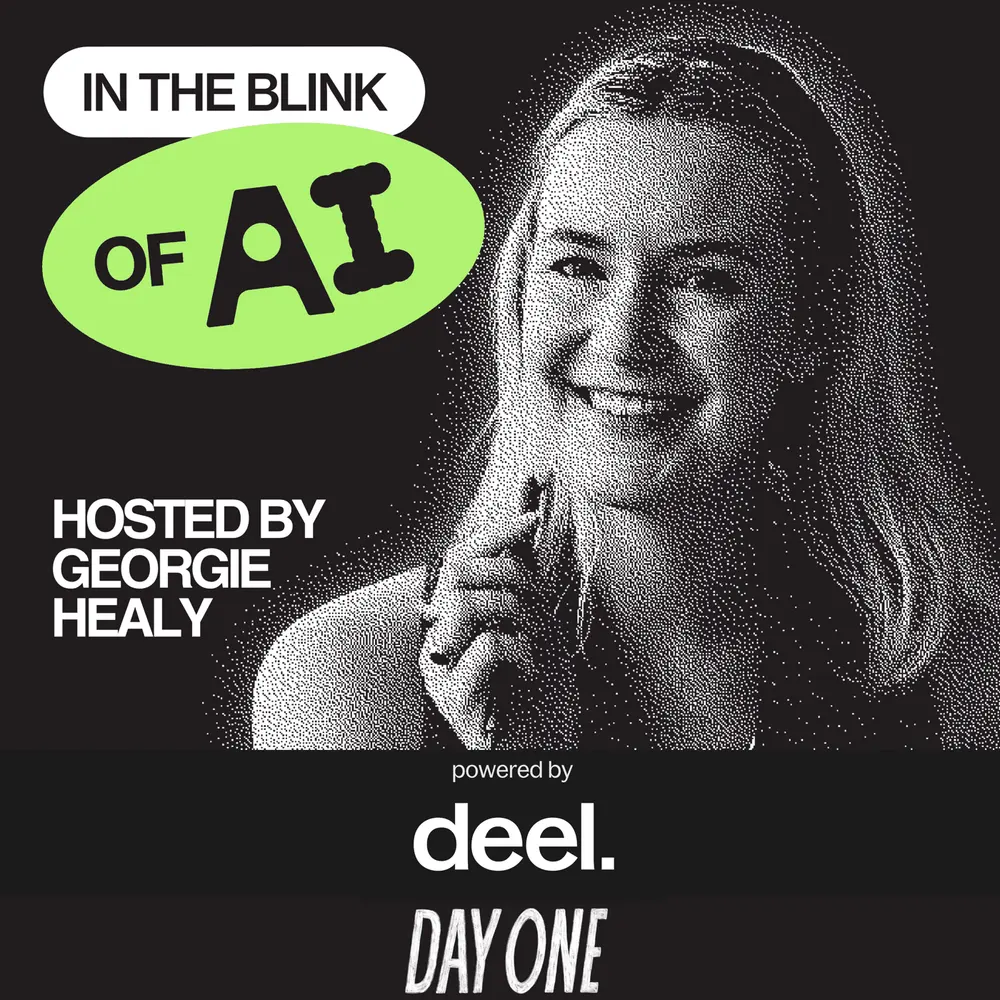 In The Blink Of AI with Georgie Healy
Presented by Deel & Stripe
In The Blink Of AI with Georgie Healy
Presented by Deel & Stripe 

 ▶
▶  ▶
▶  ▶
▶  ▶
▶  ▶
▶ ▶
▶ ▶
▶