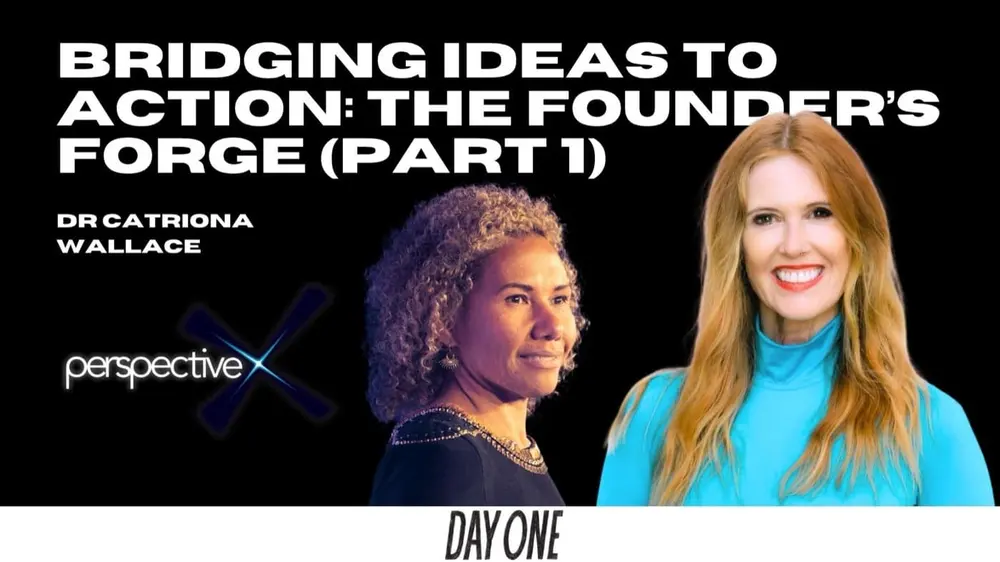
Transcript Synced · select any line to jump ▾ 0:00 Pauline Fetaui: Welcome back to Perspective X. I'm your host, Pauline. This is part 2 of my conversation with Dr. Katrina Wallace. If you haven't listened to part 1 yet, please stop, go back, and listen to part 1 because it sets up everything you need to understand in order for us to go deeper into this episode in part 2. Regenerative versus extractive AI, transhumanism, and whether we are already living in a simulation and how to stay grounded as a leader when the world is moving faster than any of us can truly comprehend. Let's go. 0:32 Speaker: You're listening to a Day One FM show. 0:38 Pauline Fetaui: Founders scale faster on Deel. Set up payroll for any country in minutes, hire anyone anywhere, get visas handled fast, and get back to building. Visit deel.com/dayone. That's D-E-E-L.com/dayone. Given your experience, obviously, from the police force to Flamingo AI, you know, raising capital, obviously the heartache of exiting the business and ASX listing, you've had a full spectrum exposure to behavior and all different leadership types and the reality of power and power in the modern world as well. I'm curious what then led you into the world of the shamanic path. And because of those things, is that why you went deeper into your world of ritual, the ritual that you explained before that helped you take you through those days where you woke up and you had to center yourself? What was your journey into shamanic world? And tell us, what is a shaman and what are you? Because I didn't talk about that either. 1:53 Dr Catriona Wallace: Great, well, I'm definitely not a shaman, but we do use the language of a medicine woman. So I'm trained as a medicine woman, and I'll explain what that means in a minute. But we do use the term shamanic path. So a shaman is, in historical anthropological terms, somebody in a community who essentially facilitated interactions with the dead, with people who are on the other side, or interacted with spirits and otherworldly beings. That would be kind of a loose definition of a shaman. And they were typically a medicine man or a medicine woman. In South America, we would call them a maestro if they're a male, a maestra if they're a female, or a curandero, curandera. 2:47 Pauline Fetaui: Mm-hmm. 2:47 Dr Catriona Wallace: And these are people who have trained to work often with sacred medicines, plant medicines that are often psychoactive or psychedelic in nature. So this could be plants like ayahuasca, wachuma, which is also known as the Pedro, peyote, acacia in Australia for DMT. So these are like the plant-based medicines, psilocybin, for example. In a modern sense, modern therapists would work with psychoactive compounds such as LSD and ketamine and MDMA for therapy, for example. But my path started when I was in my late 20s and I had a strong sense of calling. And in the book, Rapid Transformation, we talk about that sometimes people get this calling. It's just like an interest, it's a glimpse, it's a thought or you keep sort of bumping into things that are of interest. And for mine, it was, I was very interested in the way Indigenous communities interacted with nature. And so I ended up when I was 28, 29, apprenticing to a Native American elder who lived in Albuquerque, New Mexico. And I started to learn about the way Native American communities and cultures interacted with the spirits of the earth. So plants having spirits, rocks having spirits, how respectful they were to animals that they were hunting and eating. And so it was a very interesting time for me, but there was no plant medicine involved at all. It was all about spiritual cleansing and healing and a lot of ritual. And so at that stage, I was really interested in maybe I'll continue on this path of learning more how to be in relationship to nature as a healer or as something like that. But life had other plans for me, and I was a single mom with an unplanned pregnancy at that age. And so I sort of had to step out of that world and into the full corporate world. And what I said at the time to myself was like, Okay, I have to put all this shamanic stuff on hold for now. But one day I will invite it back in and hopefully I can walk in the two worlds together. And so pretty much from then, I put a lot of my spiritual self and interest in shamanic stuff on hold as I was being a single mom and building this, you know, very big, busy career. But in the last maybe 5 years before I sold the tech company, This calling came very loud. And the calling was to work with the medicine of ayahuasca, which is a sacred medicine from the Amazon in South America, made from the ayahuasca plant and the chacruna plant. The brew is mixed together and called the ayahuasca brew. And I'd had friends who've gone overseas and sat with this medicine. And I had a very strong connection into this, the spirit of this medicine, kept reading things, hearing things, or lots of podcasts. So Tim Ferriss, Aubrey Marcus, Joe Rogan, Sam Harris were starting to talk openly about their experiences with ayahuasca. So it ended up being just by coincidence that the day I sold my tech company was the same day that I first sat with this sacred medicine, ayahuasca. 6:25 Pauline Fetaui: Crazy. Sorry, jammed a lot into that one day. 6:29 Dr Catriona Wallace: It was a big day. So I closed my computer at 2 o'clock in the afternoon. I was in my suit. It was COVID time. So again, it was, everything was online and I, you know, changed my outfit into, you know, much more sort of Byron Bay hippie girl outfit and, and and drove half an hour to where the ceremony was being held. Now, important to note that medicines like this, like psilocybin, like cactus, all natural medicines that grow in the ground, are in countries like Australia classified as being illegal. 7:05 Pauline Fetaui: Mm-hmm. 7:05 Dr Catriona Wallace: And so, you know, I was aware that this was an illegal medicine to take, even though it was only a plant mix in water that you drank. And the history of that, you know, is another whole story, being closed down really in the '60s and '70s by the Nixon regime. 7:22 Pauline Fetaui: Mm-hmm. 7:23 Dr Catriona Wallace: But these sacred medicines are classified as illegal. So I was aware of that, and that's why I didn't do any of that while I was the CEO of a public company because of the risks that it was illegal and I didn't want to do anything untoward. But now I was kind of free and would take just the local risk that I would sit with this medicine. So off I went. And by 7 o'clock that night, I was sitting drinking my first cup of ayahuasca. And my intention was, I've just sold my tech company, what might be the new chapter for me? What vision might the medicine have for me? And I was conscious that— I could have been a bit blocked 'cause I was struggling to think of what I was going to do next. And what happens with these sacred medicines is your intention is the rudder and what you ask for will almost always be delivered, just mostly not in the way that you expect. So my experience in that first night was terrible. 8:31 Pauline Fetaui: Terrible. 8:32 Dr Catriona Wallace: It was the medicine guiding me to all of the shadow behaviors that I had, that I was ego-driven, that I was identity-focused, that my reputation was the most important thing I had, that I was disconnected from my children, that I occasionally told lies, as you end up doing in business, um, that I was not a good friend to all the people that had loved me. And so I went through this, what I described like the washing machine of hell. Mm-hmm. To just see kind of the person I had become. And yeah, on the face of it, yeah, I'm still a loving, beautiful person, good mother, good friend. But inside me, these behaviors had become really a big part of me, and I didn't like it, and I didn't like that I was like that. And so what the medicine does, it's kind of— we say 7 hours of ayahuasca is 7 years of psychotherapy. It just opens up your subconscious of your psyche, reaches down, grabs these things out, shows them to you in a way that is so visceral and so repulsive that you want to purge it. You want to kind of vomit it out. And that's what happens. The ayahuasca vine in the ayahuasca brew is a purgative, so it will help you expel these things from your body. And in Buddhism and other traditions, we might call what you expelled a samskara. Samskara is, is a wound or a trauma or a negative energy that's locked in your energetic system. And this medicine helps you eject it. And once it's out, it's pretty much gone. And it's incredible, the technology of this medicine. And so I spent 7 hours with my head in a bucket purging out these behaviors of mine. And the way I understand it works, it's so visceral. Mm-hmm. That the next days and weeks I couldn't think about being disconnected from my children. I couldn't think about doing anything that was identity-driven because it, it was— I had such a visceral experience. I'd feel nauseous if I went back to those behaviors. So it was almost like in one intense sitting, I purged a lot of my shadow self out. 10:50 Pauline Fetaui: Wow. Founders scale faster on Deel. Set up payroll for any country in minutes, hire anyone anywhere, and get visas handled fast so you stay focused on scaling. Deel takes care of onboarding, HR, IT, EOR, benefits, and compliance so your team can grow without borders. It's why more than 40,000 fast-growing companies trust Deel to move fast fast. Visit deal.com/dayone. That's deal.com/dayone. And then in regards to your intentions that you had set in the start, did you come out with clarity and the next chapter? 11:41 Dr Catriona Wallace: No, I didn't. Not in that way. What had happened was I realized I can't have a vision for the future whilst I've got all of this other stuff going on inside me. And so first of all, it needed to be cleared out. And so we then— I then did a couple of months of integration. And then once that integration work had been done, then I was able to see very clearly what my next step was. And that next step was taking everything I'd learned about in my 7 years as an early AI founder, all the unethical things that I'd seen my clients and other tech companies do, and to create an advisory firm called Ethical AI Advisory. And so then I started working around the world and with businesses and politicians in Australia to help coach them on how to do AI ethically. 12:38 Pauline Fetaui: Okay, interesting. So that experience led you to really hone in on the ethics side of AI. 12:45 Dr Catriona Wallace: Correct. But I wouldn't have been able to know that until I'd done this. 12:51 Pauline Fetaui: Cleansed yours. Yeah. Understood your— 12:53 Dr Catriona Wallace: Healing and cleansing. 12:54 Pauline Fetaui: Right. Yeah. Wow. So, so let's talk about your book. We've mentioned it, you know, salt and peppered around the place, talking you through your journey. I just, I've got my own recap of your book because I read it and I was a bit hooked on it and I didn't put it down. And then I already feel like I need to go back and look at parts of it again. And the reason for that, I wrote something because I wanted to make sure I captured the components that I thought were really important. So the book took me on a journey through your own trauma, some of which you've mentioned already on this episode, to then heartbreak, which is probably the, you know, the biggest sort of confronting human emotion that you could ever feel in your life, to the origins of innovation of technology that has occurred during, you know, the height of Silicon Valley and how it links to psychedelics, to how our brains work with the default mode network, DMN. I thought that was really fascinating. To the outcomes of AI and where we are as humanity. And you really enforce this sort of imperative and the essential need for all of us as leaders globally to transform ourselves rapidly because the rise of AI and what it could potentially do to our world and humanity as we understand it, can be quite catastrophic. And you, I'll let you rattle off the numbers. So for me, and I said this to you earlier, it felt like it was a journey of parts of your memoir, which there's so much more to cover and we're not going to do it all on this episode. It was educational. It gave me a real insight into the positives and the potential of AI and how it could truly create utopia, the utopia I always envision and dream about. Mm-hmm. It was visionary in not only us and the human potential and what we could become, but obviously society as a whole. And it does also felt a little bit— I'm a bit of a biohacker, so it felt like I was— you've given me some toolkits to biohack myself to that next level. Obviously biohackers want to constantly level up and this gave a sort of, you know, the altered state pathway to do that. 15:11 Dr Catriona Wallace: Mm-hmm. 15:12 Pauline Fetaui: So, Over to you. Can you give us a bit of understanding of, okay, so why did you write the book? What does being a leader in the age of AI actually mean? And what is the imperative? And how does that link to your work now in the shamanic journey and medicine world? 15:29 Dr Catriona Wallace: Mm, fantastic questions. Thank you. So I wrote the book because I spend a lot of time with leaders around the world, politicians. I've spent a day at the UN in the General Assembly. I work with CEOs from around the world. And I started to see that the four big global problems that we have, AI, climate change, mental health, and war and polarization, just weren't being addressed. And we, the trajectory for those challenges is very dire outcome for humans. And the most dire is actually AI. Mm-hmm. And if we look at the existential risk professors from Oxford University, they put AI at a 1 in 10 chance that it'll wipe humanity out by the end of the century. 16:16 Pauline Fetaui: Mm-hmm. 16:16 Dr Catriona Wallace: So I'd say that again. AI, the number one existential risk that we have beyond nuclear war, climate change, or a solar flare, for example, is AI with a 1 in 10 chance that it will destroy humanity by the end of the the century. 16:34 Pauline Fetaui: Wow. 16:34 Dr Catriona Wallace: Yep. Wow. And then the wars in Gaza and Ukraine and the barbaric nature of them. And there's 80 other wars that are being fought currently as well that we don't even hear about. And for me, it was like, man, this is tough. I don't know a young person that doesn't have a mental health condition now. And we're well aware of what's happening with climate change. So for me, it was like, hang on a minute. These things are not shifting. These things are not changing, or if they are, it's a glacial pace and we don't have that time. If AI has only got just over 70 years to land and change direction, then we need to do something now. And we don't have time for leaders to do their MBA, have 15 years training, get mentored, and in 15, 20 years' time, these young leaders or new leaders are ready. We need leaders in the next 12 months, in the next 18 months, who are radically different to the one, the leaders that we've got. So how do we do that? How do we rapidly transform leaders? So I looked at that and like, what is available to have that speed of transformation so that leaders can meet the speed of the trajectory of these four significant problems? And it was, is to me a return to ritual. And why that is, is that ritual enables leaders or people to connect to multiple levels of the cosmic life that we're in. So it can be physical— 18:11 Pauline Fetaui: Mm-hmm. 18:11 Dr Catriona Wallace: So body, mental, spiritual, emotional, energetic, connects us to community, connects us to the nature, connects us to the stars, connects us to planet. And so a return to ritual is a way that people can get very centered and connected so that they can do their work from a place of connection rather than a place of separation. And so ritual became a big part of what I do personally and what all Indigenous communities do. All Indigenous communities all have ritual. Ritual is essential part of being human, but in our Western society, we kind of lose it. 18:49 Pauline Fetaui: Mm-hmm. Hmm. 18:51 Dr Catriona Wallace: So then I also looked at, all right, so let's bring ritual back for leaders. Then I looked at what is, what do I know I'm aware of is the fastest way to transform a leader. And in the medicine I was showed when I was doing a journey one time in the Andes, right up on the cold mountaintops of the Andes in Peru, that leaders need to be healed, cleansed, reconnected to their heart, to nature. They need a new vision and they need a mission. They need to know how to do it. So healed, cleansed, connected, vision, mission. 19:30 Pauline Fetaui: Mm-hmm. 19:30 Dr Catriona Wallace: And so in the book, we use that model all the way through of, you know, a whole leader who's ready to lead from heart, from soul, in service, that's regenerative rather than extractive, I believe has to have gone through those healing, cleansing, connecting vision and mission. What is the best way that I know to do those things is to work with sacred medicines, is to enter altered states of consciousness, and in that liminal state, rewire the brain, the mind, the body, the soul, Heal traumas that we talked about before. So you're not leading from your sacred wound, you're leading from a whole and healed self. Get rid of addictions. Most entrepreneurs I know are either addicted to alcohol, food, cocaine, drugs, sex, or work. Get rid of those. Be connected back to self, to partner, to family, to nature, to, to society. And to actually be able to think outside of the mainstream way that we think because we need alternate ways to solve problems. And then they need to know what to do. So, so for me, the fastest way to do that is to work with sacred medicines, which in my years of studying and working with them will do all of those things. Heal, cleanse, connect vision and mission. You ask for it, it'll deliver it. Just sometimes not in the way that you expect. And so I— we built a whole section of the book around how to work with altered states of consciousness and why and how the brain works and why this can benefit leaders. 21:11 Pauline Fetaui: Mm-hmm. 21:12 Dr Catriona Wallace: And then we, I called on the, the other pillar, which is embracing emerging technology, particularly AI, but to do it in a different way than we currently do. To do it so that it is a transformative force for good. It is a force for regeneration rather than a force for extraction. And we explain in the book how AI could be designed and developed so that it becomes a partner to humanity and humanity doesn't become a slave to it. 21:44 Pauline Fetaui: Mm. I— those are the sections of the book that I want to go back and listen to constantly because you spent a lot of time obviously in research with all the different applications of regenerative AI. Across the world and industries and from B2C models to B2B models. It's like you gave a whole bunch of all the founders listening who are not sure on what they're working on yet, the whole secrets are in that book of what could be worked on to go down that path. I, um, that's the part that is just so beautifully put. It's because you're focusing on the self in the book and then you're focusing on society and the work we have to do to get to leverage AI to what it could be. And it could be a beautiful thing. But at the other end, if we don't do this stuff, We don't do enough, 1 in 10 chance by the end of the century we won't be surviving. So it's a real do or die sort of call to arms in the book. The— obviously with plant medicine and, you know, I've previously had Dr. Prash on Perspective X. So he's given— we kind of set the tone and the basis for those listening on. And if you wanna go understand a little bit more about plant medicines and Australia has now legalized it in clinical use, obviously with a practitioner who would take you through that. It is already finding its way to mainstream as a healing modality, as a preventative modality to deal with significant traumas. So your, your book unpacks all the different types of plant medicines, what they mean, how they're used, what sort of journey experience it is. And also you've got a lot of obviously disclaimers in there on when it's not to be used because not everyone can use it. Just so I thought I'd call that out as well is you, you definitely need to understand who can and can't use it. So with that, and for those who can use it, and for those who are listening to this and going, oh, look, but I don't feel like I'm broken. Or if I go down this path, is this gonna mean that my knowledge and my, like I asked the question before randomly, is your fire gonna go out? You know, if I have wounds to work on, I know personally that mine could be a micro thing that has a sort of actually creating a really bad pattern for me in society and the way I move in the world. Or it can be a gigantic wound that I, it rears its head only every now and then when I'm completely triggered. I kind of get a feel for that. But to someone else, you're explaining this, how if I'm walking around with a wound and I don't think there's anything wrong with me and I'm just going about building my startup, how would I even recognize? Why should I have to do it? 24:26 Dr Catriona Wallace: Hmm. Yeah, great question. So I think probably most people have a, a sense or an awareness that they have some shadow aspect of themselves. It might be a way that they react or that they get triggered or feedback from loved ones. Now, if someone feels they don't have any shadows or traumas, the very best way is to sit with your own family and ask them and just remain open because without any question you will get— Mm-hmm. Really useful feedback. So I think it's very rare that anyone gets through to adulthood that doesn't have a trauma of some sort. So, and these traumas, as you said, can be just tiny little, little things. And I'll give you a quick example of something that came up for me, which I had no idea about. When I was 8 years of age, I used to walk to school with a boy who was— I was 7 years of age, and we used to walk to the station, get on the train, and go up to school and come back. One day he didn't appear, and I said to my mum, 'Oh, where's— where was Adam today?' And my mum looked very upset, and she said— that was on a Monday— she said, 'Oh, unfortunately Adam was playing on the railway tracks on the weekend and was run over and killed.' And so I'm an 8-year-old, here's my little best friend I walk to school with every day, That was it. That was it. That was— there was no counseling. There was no— there was not. And it's like, and I literally haven't thought about that for 50-odd years. Haven't thought about it. So I would have just gone shock, horror, suppress, suppress, suppress. And during an ayahuasca journey, the— we call it the mother, the mother spirit of the medicine said, we're going to, we're going to go and we're going to get something out that you haven't thought about for a long time, but it sits as a trauma in your very young self. So let's get this out. And I had no idea. And then out came the whole reliving Adam and then him being killed on the railway tracks. And then I sobbed and I cried and I sobbed for hours and I sobbed for my little friend who was dead. I sobbed for the horrendous way that he had died. And then it was gone. And then I, you know, I was able to wish him best wherever he was. And then I also realized, like, I've got a thing about trains. Don't love trains. Like, really don't, don't love trains. I've got, you know, other, other ways that that would have come out and, and affected me. 27:02 Pauline Fetaui: Hangups. 27:02 Dr Catriona Wallace: Hangups and things. It's like a very strange thing. So, so all of these things that we've kind of suppressed that happened to us as children and and young adults can be very gently pulled out and examined and released. And so for me, the ideal leader or just person is free of those samskaras or those energy traumas that are so hidden that we don't even know that they're there. 27:33 Pauline Fetaui: Mm-hmm. 27:34 Dr Catriona Wallace: This medicine will help clear those. Beautiful thing we say about With the Medicine is once you've cleared something out, then the universe doesn't love a vacuum, right? So something will come in and it's normally something beautiful. It's a vision, it's a sense of love, it's a sense of compassion. 27:51 Pauline Fetaui: Hmm. 27:53 Dr Catriona Wallace: And then you start to move. I think, I think all of this is about moving towards alignment, moving towards alignment with who you truly are, to what you really value, what your soul's calling and your soul's path is. And I think you can only come into alignment if you've done some of this work. Not necessarily with plant medicine. You can do it with breathwork and— 28:22 Pauline Fetaui: Meditation. 28:23 Dr Catriona Wallace: Yoga, meditation, lots of other modalities. 28:26 Pauline Fetaui: Yeah, absolutely. And the, I guess the subtle, and I'll just give, so when my first experience with understanding that I had a whole bunch of stuff buried deep down, because I had no idea. I was just working. I was very disconnected from my body, working in corporate, in technology, in corporate for a long time. And I wasn't in a startup yet. The startup started to bring the stuff out when I started my startup, as it does. And, and what I found myself operating in is I carried a lot of heavy energy around that was a lot of anger and suppressed anger. And I carried around, I would, I, how that showed up in my corporate world is I would get triggered if, if I came into interaction with someone, it was a particular persona, persona that was someone from my childhood. I had no idea at the time, of course. I would just see that person and they would show particular traits that obviously reminded me of the same person from my childhood. And I would have an instant disdain. My energy would change, my response to them. I would be more hyper-triggered. But if someone else did the same thing that this person was doing, there would be nothing. I would be a lot more tolerant, a lot more forgiving. Mm-hmm. I'd be like, you know, water off a duck's back. Yeah, so I find— so when I started to go down the journey of working on my stuff and the shadow work, which I just felt like was just a bunch of undealt with emotions that I have no idea how to deal with, so I pushed it far, far down and pretended it didn't exist, and it just stored in my body. I put on a lot of weight. I was a lot— I was about 27 kilos heavier about 5 years ago, and I Carrie, a lot of that was built over time because I felt like the more I didn't process stuff and I suppressed it and I just kept on working like a robot and a machine, I was A, getting miserable, more miserable by the moment, really empty inside and just on this rail tracks till I try and get to my next mission or milestone or goal. But the part of me that was like, I was losing myself. I was like the who, the person that was happy, the person inside that had joy and could relax or not have such high stress levels and be more, I guess, connecting with more people was sort of like being buried and it was like an avalanche. And the moment that I just started to understand, okay, well that's what's happening. I'm disconnected from my body and I really need some help. So yeah, I tried the meditation path and I tried other things and then anyway, eventually I found bufo and which is another pathway, plant, not a plant medicine, but a medicine. 30:56 Dr Catriona Wallace: You can talk to it. Earth medicine. 30:57 Pauline Fetaui: An earth medicine. You can talk to it more than I can. And wow. Like. I, I felt like it was 1,000 therapy sessions or more. I don't even know how, what happened, but the level of heaviness that I had and the joy that was sort of the fire had gone out, even though I was working on a startup, I was just catapulted to the universe and I felt like I came back with much higher capacity and expansion of capability. I was able to see with a lot more clarity and presence, and I was a lot more calm inside, and it was just revolutionary to me. So I, you know, headfirst, I was like, I gotta learn more about this and understand it. And hence why you are obviously on this podcast as well, because I think it's such a, it's a tool that the earth's given us and we don't use it. And, and it now in modern medicine, it's starting to come back and Big Pharma's grabbing onto it and everyone's grabbing onto it around the world in the race to now be more preventative and in health. So yeah, so sorry, I thought I would share a bit of that because I thought I have a lot of people who don't understand and say that they, oh, I'm fine, I don't need it. Especially a lot of males that I found as I work with are working, walking around with this sort of heaviness they don't even know until it's really far gone. 32:18 Dr Catriona Wallace: But yes. Right. 32:19 Pauline Fetaui: Operating on these wounds, I think for me was was completely revolutionary. 32:25 Dr Catriona Wallace: Great. And we are seeing now business leaders, politicians, tons of Hollywood actors, CEOs, entrepreneurs now starting to work with these medicines. And we, and I loved you sharing your story and I'll talk a little bit about Bufo. We've also just done some research in Australia and America where 34% of of the population in both countries, no difference between two countries, have already used psychedelics or are currently using, and another 7% haven't but would like to. So it's 41% of the population in both countries is all adult population is already— 33:06 Pauline Fetaui: Right. 33:07 Dr Catriona Wallace: Around the psychedelic field. And a lot of this is now microdosing, microdosing MDMA, microdosing psilocybin, microdosing LSD, for mental health benefits. But what we looked at also was the who was using it to improve leadership. And there was those who used it for non-recreational purposes. They, 73% said, this is, using these medicines has helped our leadership capacity, particularly with regard to empathy and self-awareness. They also said, over half said it increased their creativity and 3/4 also said that it, they thought it would help them be more innovative in their leadership work. So we're also now seeing very strong evidence of people who've worked with psychedelics saying that it does help improve them as leaders. But let me go back to the medicine that you use, which is the bufo alverius, which is also known as the Sonora Desert Toad medicine, or 5-MeO-DMT. 34:10 Pauline Fetaui: Mm-hmm. 34:10 Dr Catriona Wallace: So this medicine is regarded also as the god molecule, is the most potent psychedelic in the world. And it comes from the glands of the Sonora Desert toad. That's the only place it comes from. And those toads are underground for 9 months. And if you think about it, like absorbing all of the frequency of the earth, they come up in monsoon times, July, August, hop around. The Mexican farmers catch them, milk the glands, this sort of gold hormone syrup out of their glands on their neck onto a plane of glass, dry it, scrape the medicine off. And then the way you ingest it is you heat it up and inhale it. You vaporize it. And again, this medicine is illegal in Australia, but decriminalized in Mexico and other countries in South America. 35:01 Pauline Fetaui: Mm-hmm. 35:01 Dr Catriona Wallace: And I've done a lot of training. I trained for 2 and a half years with this medicine and spent a lot of time in Mexico. And so what happens is when the person who's sitting with the medicine ingests it, within 10 seconds they're into immediate ego dissolution. So the ego and the mind gets turned off and is resting, and the body is kind of also set free from the mind, and you essentially become one with all things. Mm-hmm. 35:31 Pauline Fetaui: That's how it felt. 35:32 Dr Catriona Wallace: That's how it felt. And 5-MeO-DMT is endogenous to the human body. We produce it ourselves. We produce it at birth, we produce it at orgasm, we produce it at death. And so it, it is a naturally occurring substance in our body. What we do is we just give it in a higher dose so that the person can have what we call a non-dual therapy, non-dual state. So you no longer See see yourself. yourself or experience yourself as separate from other things. You become one with all things. And the very first time I had it, I— it changed my life forever because I had the medicine. And then when I was coming back, I opened my eyes and I saw that I was the clouds, I was the trees, I was the ground. There was absolutely no separation between me and all things. And I cried and I sort of threw myself on the ground. I said, Oh my God. I thought, now I get it. When in all the doctrines and all the religions, it's all about we are one, we're just one source having these human experiences. 36:40 Pauline Fetaui: Mm-hmm. 36:40 Dr Catriona Wallace: And bufo allows you to actually feel that and have that experience. And in doing so can heal amazing amount of conditions. Because if you think about everything is energy and vibration and illness and disease is kind of like a low vibration. Once you're in connected to the collective consciousness or source, or if you're religious, you might say God, then those things can just, they just get blown off and go away. So this medicine, we often treat people with severe addictions. So heroin, crack, cocaine, alcohol, cigarettes can sometimes be healed in even one session because it just completely rewires. Mm-hmm. Their entire system. It's literally like we say, you've got 15 minutes, you go and touch God and you come back. Powerful. 37:33 Pauline Fetaui: Is exactly what it felt like. And so every now and then I go, God bless the toad. 37:39 Dr Catriona Wallace: I know. And what an incredible thing is nature to provide such a powerful thing in a toad. 37:48 Pauline Fetaui: Yeah. 37:49 Dr Catriona Wallace: Or in an ayahuasca tree or in a, Cactus called peyote or wachuma. 37:54 Pauline Fetaui: Yes. Thank you for explaining that. And that's exactly the experience that was felt. Taking back to the AI and rapid transformation. So I get the understanding of, you know, working on our wounds and the potential it has to be a better evolved self. Couple that then with AI and the age of AI and where we're at now in that, you know, the dilemma of how we're gonna save humanity, keep it as it is without, or make it better, obviously integrate it and make it better, I think would be the thing. You talked about the regenerative versus extractive. Can you give me an example of what you would classify as working on something regenerative versus extractive? 38:36 Dr Catriona Wallace: Hmm. So, so let's take it back to what the whole economic system is. And if we think about what economics is. It really is a process of extraction. So it's a process of extracting minerals, extracting value, extracting labor. And very rare is it designed to be— And then that gets concentrated into an elite few who are the richest people in the world. And there's some small value exchange that goes down to all the other people. But largely the way the way Western society works and the way technology is being built is to be extractive. And if we think of AI itself, there's 20 minerals that go into making AI and computers. There is an enormous amount of carbon emission from AI. AI is equal to the aviation sector in its emissions. Enormous amount of water used to cool the data centers that produce AI models and outputs. So AI in itself is one of the most extractive technologies that we have. And so that's one thing on a physical level, it's extractive. The other thing is that when we talk about AI, we hear now it's about productivity hacks and it's about better analysis. That's pretty much— and content generation. And in that sense, we even see these machines being extractive around intellectual property and copyright, where Claude AI, for example, has been in the courts and looking at— it's got so many books that it's ingested. How is that being extractive to the artist? With music that's generated by AI, art that's generated by AI is all an extractive model. And none of that is going to serve humanity well. So the concept we're introducing is what if we had core principles of AI put in place so that whatever AI is doing, it is adding value and regenerating something back to the community that it's serving. And so we go into some core principles and some ways to think about AI having— and diversity also very important, having teams that do have Indigenous people, representation of minorities, different genders, essentially whatever is the population that you are serving. And to start to think about not how can these machines be taking, but how can they work more in like nature does, which is cyclic. So there might be some taking, but there needs to be some giving as well. 41:20 Pauline Fetaui: Mm-hmm. 41:20 Dr Catriona Wallace: And the very best people, I believe, who know about regenerative living is often our Indigenous communities who live in reciprocity with the land and with the trees and with the animals. And I think have a lot to offer in the way we design technology. And if we think about our own Aboriginal and Torres Strait Islander people who are regarded as the greatest pattern makers in the world, then AI is all about pattern making. And so why are we buying AI from Silicon Valley and applying it in Outback Australia, why are we not building place-based AI where we have representation from communities who are going to use it and we building it in that way? That's what we should be doing. Yeah. 42:12 Pauline Fetaui: Got it. Thank you. I think it's really important because I think obviously a lot of the companies that I work with, they have responsibility to do that. It's a bit hard to imagine what, how they can actually create an ecosystem within themselves to replenish. But the necessity to do so is needed. And like you say, like, well, like it's facts is a lot of the AI companies that are being built are going to be failing. So what, what, how are you creating, maybe we do need to slow down a little bit to create with a little bit more intention and make it a little bit more regenerative. It might create different business models. It might create different value chains that don't just relate to that one extractive thing that you're doing. I had the pleasure of joining South by Southwest Sydney last week, and Mo Ghoddad spoke. He was the keynote speaker. He also has featured on many podcasts, and his books, of course, talk about this, but he talked about us slipping into a level of dystopia for the next 8 to 12 years, given the trajectory, the potential of, you know, 1 in 10 of us not surviving with AI. And how AI is just really mirroring us and what we put into it, which is why as leaders we need to level up and heal the work, the stuff that we're carrying around and the shadows that we're carrying around. We could just amplify it in either direction. And definitely I can imagine going into a dystopia for the short term. Do you share the same concern of going into a dystopia as Mokgadagat? I do. 43:42 Dr Catriona Wallace: I think we are already headed into it. And like I've been listening to recently, obviously my field is predominantly AI and I take a very dystopian view on AI, but listening to in front of the courts at the moment in the US is some of the cases against ChatGPT or OpenAI and Character AI where the AI has encouraged or instructed young people to— 44:03 Pauline Fetaui: Suicide. 44:04 Dr Catriona Wallace: Kill themselves, to suicide, to take their own lives. And so this is now, Like, where else have we ever had where an organization can be found to have a product that's killed a child and it not be shut down? Now we are in the situation where there are multiple children being killed by AI's instructions and these companies are not being shut down. And so that is the tip of the iceberg about what, what is going to happen. And again, if we go the luminaries, Geoffrey Hinton, who is the— won the Nobel Prize with regard to his work in AI, he is kind of the godfather of AI. And his prize-winning speech is about, "This is going to go very badly. We need you to wake up now. We need you to wake up now and do something different." Yeah. I say exactly the same thing. So, and there's more and more evidence every week of where this dystopian worldview that AI will enable will come from. 45:16 Pauline Fetaui: Do you feel with AI, we, it's a machine obviously, but it's, it's, we're in the race to superintelligence with some of these large giants, the tech companies and the backing by governments to run to superintelligence. It seems like it seems too far, it's too fast now, and we can't even catch up with it, and we can't really chase it. Your pathway is to go down, obviously, the us, us as humans and individuals evolving. Makes complete sense that we can work on ourselves in order to create a better outcome for everyone as a mass community. You talked about we only need about 25% of leaders to get to that tipping point in your book to be able to do that. So, so the race is on, and I encourage everyone who wants to dive really into this to read book to truly understand what they could do personally as also in their own communities and sharing this out as a vehicle to sort of counterbalance that race to superintelligence. My question is, do you think AI now in the new world, let's say we get over the dystopia and we, I assume, Mohnish Pabrai] Mohnish Pabrai. Mohnish Pabrai talks about utopia being on the other side because we will find balance. There will be costs that will be along the way. Utopia, is AI a new species or is it an integrated form of human? And if AI, sorry, it's a long question. If AI, 'cause it keeps me up at night, if AI is a new species and we ourselves programmed AI and now it can program other things, is this not all just a simulation and are we not the original AIs? 46:51 Dr Catriona Wallace: So this is so great. In fact, I held a philosophy, a philosophy dinner about 2 weeks ago with 17 key minds. And our inquiry was, are we living in a simulation? 47:06 Pauline Fetaui: Okay, yeah. 47:07 Dr Catriona Wallace: So let's go to the dystopian, utopian. So I think we're at a phase where we've entered a new phase of human evolution, which we've called transhumanism. And transhumanism is when we now have technology that's embedded in our bodies. So we can see now there's lots of, YouTubes and TikToks and Instagrams about exoskeletons that are really available and easy to get. So for people with disability, but for people that just want to walk longer, they can just put a very light exoskeleton on and the exoskeleton will walk for them. So there's the agentic AI is coming in the next 1 to 2 years. We will have lots of this robot stuff around us. Then the technology within 10 years will be embedded into our bodies. So things like Elon Musk's Neuralink, so the brain chips, where we then have the phone, which is already a brain extension, isn't external to us, it's inside. And we see this with augmented reality, virtual reality glasses, it's all getting closer and closer until it's inside our bodies. So a true transhumanism moment will be when a percentage of the population welcome having the technology, the brain chips, the other things, in their body. Me, I'm one of those, would absolutely welcome it, but I understand it comes with immense danger. So I see, and again, I probably subscribe to Noah Yuval Harari, who says species have to bifurcate to survive. And so the bifurcation for us in this new era of evolution may be those who choose to go a digital experiencing path and a transhuman path. And those, the organic experiencers who go, "Oh, actually no, I don't want any of that. I just want to be the human having human experience with nature." And hopefully those two don't come into conflict. But so I see there will be the transhuman people, the organic people, and then the third will be the species who is AI itself, its own living intelligence. Mm-hmm. Its own agency, to a degree its own consciousness. It's just not human consciousness. It's awareness of itself. So I would say we will have the three streams within the next 20 years. Wow. 49:29 Pauline Fetaui: Glad I'm living right now to be able to see this unfold. 49:34 Dr Catriona Wallace: Yeah, yeah, right, exactly. 49:37 Pauline Fetaui: Mm-hmm. What a privilege. And so your views on us being in a simulation? 49:43 Dr Catriona Wallace: Ah, yes, big question. I don't think it's a simulation as, and normally when we talk about simulation theory, it is about code and— 49:53 Pauline Fetaui: A God and creator. 49:54 Dr Catriona Wallace: A God, a great integrator. I don't think so quite like that, but I do believe that we are living in a multidimensional, multi-universal, beingness, and that this experience that you and I are having is just one. This could be the dream actually, and the reality is that our consciousness is actually somewhere else. And I think this will be discoverable in the next 50 years with the coming of quantum meets AI, I think will give us access to the fact that we already in the law of physics know that there are multiple dimensions and things going on at the same time. Yeah. But quantum computing along with AI should be able to open us up to seeing that there are dimensions and that this reality is only one. 50:41 Pauline Fetaui: Wow. 50:43 Dr Catriona Wallace: Okay. It's gonna get crazy. 50:45 Pauline Fetaui: It is, and I'm all for it. I'm here for it. So, and we'll be living longer, so hopefully we'll make to the quantum 50-year cycle, of course. Okay. Given all that we've talked about, which is so much, I would love some— last question is your parting words to how people who are listening to this and going, oh my God, what, what, what, wow, what do I do now? Apart from going and reading your book, which is my advice to them to truly get deeper into these topics, how can leaders stay grounded in right now in the face of all of these things? How do they get up? Like, you know, people can go into doomsday sort of thinking. How do they get up and continue on, wake up, continue on with the work, continue on with life knowing that these things are coming? How, what's your advice and maybe some of your ritual? 51:37 Dr Catriona Wallace: Yeah, so my advice would be just to do morning practice where you take some quiet time and be in gratitude. Gratitude for this exquisite life with all its joy, all its pain, all its suffering, all its mystery, be gratitude for what particularly those of us here in Western world have compared to other places like, for example, Gaza at the moment or Ukraine at the moment. 52:03 Pauline Fetaui: Mm-hmm. 52:03 Dr Catriona Wallace: So to be in, to really be in gratitude and then to do what was taught by me, by my indigenous wise friends is to ask not what, is my purpose, my thing, my— it's like, what is needed of me? Like, if this is the world that we're facing, and particularly those who have children and they want to see their children, their children's children, and I always talk about the 7 generations to come, that's what we need to be planning for. It's like, what is needed of me rather than what do I want to do? That's kind of over here. What is needed of me? And for my business, How is my business truly in service and how can my business be regenerative? How can I be a regenerative leader so I'm not adding to the extractive nature of the way the world is at the moment? And I would say just asking, no need to have answers yet, but just have that as a daily inquiry and meditation. And my experience is that the universe, spirit, your own psyche will start to deliver answers to that, and show you a path. I think that's what I'd love to leave the listeners with. Listen for your calling. 53:19 Pauline Fetaui: Thank you so much. That's sage, sage advice. What can I do to be of service? What is needed of me right now? 53:26 Dr Catriona Wallace: I love that. 53:28 Pauline Fetaui: Dr. Katrina Wallace, thank you so much for the long, long conversation that definitely only touched the surface of the depth of who you are and what you bring to the world. I am absolute privilege and honor to have the chance to speak to you like this and share your journey and your story and also your guidance to the Perspective X audience. I will be definitely recommending the book to everyone and will dive in again to it and look forward to your other books that I'm sure are going to come from you. 54:00 Dr Catriona Wallace: Thank you. Thank you, Pauline. Yeah, it's my absolute pleasure. Thank you so much. 54:08 Pauline Fetaui: Thank you for tuning in to the Perspective X podcast. If you enjoyed this episode and want to hear more, please hit the subscribe button wherever you get your podcasts. This podcast was produced by the media gurus and our friends at Day One, the podcast network for founders, operators, and investors.

 Perspective X with Pauline Fetaui
Presented by Deel
Perspective X with Pauline Fetaui
Presented by Deel 

 ▶
▶ ▶
▶ ▶
▶