Transcript Synced · select any line to jump ▾ 0:02 Cheryl Mack: Founders scale faster on Deel. Set up payroll for any country in minutes, hire anyone anywhere, get visas handled fast, and get back to building. Visit deel.com/dayone. That's d-e-e-l.com/dayone. 0:21 Maxine Minter: Okay, 3, 2, 1. 0:26 Cheryl Mack: Hey, I'm Cheryl. 0:27 Maxine Minter: I'm Maxine. 0:28 Cheryl Mack: This is First Check, part of Day One, the network dedicated to founders, operators, and investors. 0:32 Maxine Minter: Investors. If you want to be a better early-stage investor, this is the show for you. 0:35 Cheryl Mack: So TL;DR, if you don't want to suck at investing, listen up. Okay, so now we get to talk about one of the funnest parts of angel investing, which is— 0:50 Maxine Minter: I love this bit. It's my absolute favorite part of investing. 0:54 Cheryl Mack: I know, right? That is actually deciding on what you want to invest in. And it's something that I feel like has huge ramifications, but so many people don't think about it enough in the early days. And there's totally a good reason for that, right? Like, I didn't think about it a lot in the early days because I simply just didn't know what I was supposed to be thinking about. And that's understandable. But now we've got lots and lots of data around how you can build your thesis. 1:22 Maxine Minter: I love that extended drum roll where we're like, it's really great, we love it so much, it's the best part, it's the most important, we're talking about investment thesis. 1:31 Cheryl Mack: Yay! 1:33 Maxine Minter: No, but I think it's really important, right? Like, as the saying goes, if you have better information against the market, you should in theory be much better positioned to make better decisions and therefore invest in better companies. Even better, better information, better decision-making abilities, then you get a much better, or in theory, a much better outcome from an investing perspective. But you're right, very often I see folks step into the ecosystem and be like, my investment thesis is I like it. I'm like, well, that's not really a thesis, is it, if we're honest? 2:05 Cheryl Mack: And if you don't wanna be honest about that, then that's cool too. 2:08 Maxine Minter: It's not gonna be a great outcome, but that's cool. 2:12 Cheryl Mack: Eh, I have seen outliers, to be fair. But I also think that the investors who have a stronger investment thesis tend to be happier with their outcomes and more confident in their decisions and outcomes, even when those outcomes are not good. 2:27 Maxine Minter: Oh, interesting. That's fascinating. 2:29 Cheryl Mack: Anecdotally. 2:30 Maxine Minter: Anecdotally, yeah. I believe that to be true, you know? 'Cause I think a lot of people, especially in angel investing, acknowledging that there's a lot of people that invest as an angel, not necessarily purely for financial returns. There might be some social benefit that they're trying to push forward. 2:44 Cheryl Mack: Education. 2:44 Maxine Minter: Yeah, they're trying to learn about a new space. And so they develop their thesis to kind of hone in behind that. And so financial returns is a very important part, but not the only part of the way that they, or kind of what they're looking to get out of it. So do you wanna start us off with the definition? What is an investment thesis and why does it matter? 3:02 Cheryl Mack: Ooh, definition. I shouldn't— Okay, so I'll come up with one. I don't have one off the top of my head, but— Just riff on the investment thesis as I stall so I can get it clear in my mind here. So I think your investment thesis is the set of predetermined parameters, heuristics, and criteria that you use to determine the optimal portfolio construction for your level of risk and desired outcomes. 3:34 Maxine Minter: I love it. I think that that was a pretty good crack. I probably have a much less erudite sounding definition of an investment thesis. 3:43 Cheryl Mack: Yeah. I mean, that sounded really formal. 3:46 Maxine Minter: You did. 3:47 Cheryl Mack: I should put that in ChatGPT and be like, ELI5 version of this. Yes. Can you do it, Maxine? What's the 5-year-old version of that? 3:56 Maxine Minter: Ooh, I think my 5-year-old version, an investment thesis is, your belief on what you think will win for your stage and your strategy. Okay, yeah. Do you reckon a 5-year-old would grok that? I reckon that's more like 15. 4:12 Cheryl Mack: Yeah, that's probably more like a 15-year-old. Let me try, okay. It is the number and type of investments you want to make that best achieves the type of return you want to get, accounting for the risk you want to take. 4:30 Maxine Minter: That's pretty good. I think that's pretty solid. Yeah. I mean, you can hear us here fumbling through our definitions of investment thesis, but essentially it is, you know, what you want to invest in, where you think that that is going to be valuable or why you think it's going to drive value, and then therefore your predicted return and also your portfolio construction, right? How many companies you're going to be investing behind. And over what kind of timeframe? 4:53 Cheryl Mack: Yeah, I think an important one that often gets forgotten is like, it has to account for the level of risk that you want to take. Because if you're just like, ah, I really like this and I want to invest in lots of this, that often doesn't take into account the level of risk that you're trying to take. So, but like, let's break it down, right? So there are a number of things that I think are important to think about. And I can probably put them into a couple of buckets. So one of them being focus areas of industry or sectors. So things like you can choose things like, I want to invest in fintech and edtech and HR tech and not invest in biotech and hardware and AI. 5:38 Maxine Minter: Yeah, I think, I mean, maybe some examples here of industry-based theses that we see out in the market. One, AI. God, we see it everywhere. So there are a bunch of funds that were raised in '23 that were all focused behind theses around AI, believing it to be a platform shift or a fundamentally game-changing technology. And so you had investors stepping out and saying, we're investing in AI as a thesis, right? The thesis, the theory being that AI will fundamentally shift the way that value is created in businesses, that there will be huge outlier companies built in this platform state. And then they are investing in companies everywhere between pre-seed all the way up to growth stage companies, trying to buy positions in companies that we think will fit to that thesis. Another thesis that you see out there in terms of industry are particular verticals. So there is a fund, for example, based in the US that is all chief people officer, chief HR officers, chief, et cetera. And they have an industry belief that there is fundamental reshaping going on in the HR stack. And so they pull their capital together and they invest into companies that are in the HR stack. And so they have a fundamental thesis about a particular industry, right? HR tech. And that's all they're investing behind. It's also where they value add. Yeah. 7:03 Cheryl Mack: What I think is interesting about that example is like AI is a horizontal across all. AI can be applied to HR tech or it could also be applied to fintech or it could also be applied to any other industry versus HR tech is a vertical, right? 7:17 Maxine Minter: And then there's a whole bunch of other kind of intersections of lines. 7:21 Cheryl Mack: And if you could see me, I'm waving my arms wildly. But you can kind of layer things on. So, you can decide to invest in AI and then layer things on top of that, or you can decide to invest in a vertical. But like the next layer could be something like the stages, right? So, if you're doing AI, you may want to choose to invest across stages versus you could also just decide, I'm going to do pre-seed AI only. So that's like another layer that you can add on to the, your investment thesis, which is, all right, well then let's decide what stage to invest in. And it could be that you just choose one stage, or it could be that you decide to invest across one or two or three or across any stage. 8:01 Maxine Minter: Yeah. I mean, obviously in Australia, our largest venture funds, right? Airtree, Blackbird, Square Peg, they are all stage-specific theses. They invest early stage and then they have an opportunity fund that follows off on from them all the way up, or they have a multi-stage Right. I think Blackbird is the least thesis-oriented fund of all of them, at least when it comes to stage. So they'll invest from pre-seed all the way to the end. But there are funds out there, for example, us, where we just invest in one stage. So pre-seed, that is all we invest in. We don't invest in seed, we don't invest in Series A, we don't invest in anything else. And so some people invest behind— Their thesis is on a stage basis as opposed to an industry vertical or horizontal. Thesis. 8:46 Cheryl Mack: Another layer that can be added on is business model. So we often see funds that then add another layer on top and say, in addition to AI at the pre-seed, I am only going to invest in B2B SaaS, or only invest in B2C, or only invest in B2B, but it could be anything from marketplaces to SaaS to fintech to, or to any type of business model, but the customer is B2B. So that kind of business, we group it as a, the whole layer is business models, but that's another layer that you can add on top to say, okay, this is something I want to also filter by. 9:26 Maxine Minter: Right. And FX jumps to mind here as an example, right? The Network Effects Fund that's based in the US. I mean, they grew up in the marketplace era where network effects were everything, but now they apply those network effects to say data moats, and network effects as they apply to LLMs and generative AI. There are lots of companies, also every single B2B SaaS fund you've ever encountered fits into this category. 9:51 Cheryl Mack: Yeah. Every fund in Australia. So we invest in B2B SaaS. Oh, okay, great. Yeah. What about you? So we're B2B SaaS. 9:59 Maxine Minter: Which I mean, each of these theses, there's a why behind them, right? There's a reason that they invest just in B2B SaaS. In theory repeatable, in theory, long-term lock-in, in theory— 10:12 Cheryl Mack: High margin. 10:13 Maxine Minter: High margin, very lucrative business overall. But then, you know, there is a reason that people invest in the other theses as well. 10:21 Cheryl Mack: And then I think the last layer in this bucket— there's lots of layers and buckets in this, in this podcast— but I think the last layer in this bucket of things that you can use to form your thesis is geography. So some investors will choose to focus on a particular geography or be agnostic. Most funds in Australia do focus on the Australian geography, partially because of the rules around the ESG CLP fund mandate needing to invest in at least 80% Australian companies. But I think the other piece, and I think this is probably true for you and me, is that we just genuinely believe that there is alpha. I was trying not to use a jargon word there and couldn't come up with one, so I still used it. 11:01 Maxine Minter: I paused, I paused, I paused, and then I said the word alpha. Definition of alpha means that it's the amount that you return above the average for the market. So the beta for the market, the alpha is the difference between the average for the market and the amount that you've returned. 11:20 Cheryl Mack: Arbitrage was the word I was looking for. There's arbitrage to be had here. 11:24 Maxine Minter: Alpha and arbitrage. You don't wanna arbitrage without alpha. That sucks. 11:28 Cheryl Mack: Don't, never arbitrage without alpha. 11:31 Maxine Minter: So obviously for us, we are a semi-geography-focused fund, geography being the humans that come from Australia. So we invest in Australians all over the world. Someone actually did make the point to me that they were very confused why all of Australia seems to focus just on Australians, where in other markets they focus on the rest of the world. I think you're exactly right. I think the ESG CLP is a forcing function that means that we are domestically focused. I've made this point before, but I will shout it from the rooftops again. I think it's a really useful and was a really useful incentive to get capital flowing into the domestic economy. But I think actually we might be starting to get to a scale where it's becoming slightly problematic by forcing capital in Australia just to be investing into Australian companies, as opposed to raising capital in Australia that gets deployed internationally in the same way that you will see out of the US. Which, crazy statistic, but PitchBook reported that 30% of the capital that was raised globally came out of San Francisco last year. 12:34 Cheryl Mack: Wow. 12:35 Maxine Minter: 30%. 12:36 Cheryl Mack: 30%. 1/3 basically of the world's capital. 12:40 Maxine Minter: Yeah. Came out of San Francisco. 12:42 Cheryl Mack: Like San Francisco, not California. We're talking about like the city of San Francisco. 12:46 Maxine Minter: Yeah. Yeah. We're talking about— 12:47 Cheryl Mack: Not even like Bay Area. 12:49 Maxine Minter: Mm-mm. Nope. San Francisco. 12:51 Cheryl Mack: How are we defining that though? Like surely— 12:54 Maxine Minter: It's an area code. You just assign the area codes or the collection of area codes to where those funds are based. Wild, right? 13:02 Cheryl Mack: Yeah. Totally wild. That is nuts. What is it then? California was 50%? Like, what? 13:10 Maxine Minter: I don't know. That's interesting. Yeah, because then you would include LA. I'm not sure. 13:15 Cheryl Mack: Yeah, right? Like LA and even like Bay Area. There are a lot of funds that are in the Bay Area, but not specifically in San Francisco. 13:21 Maxine Minter: Yeah. 13:22 Cheryl Mack: I have follow-up questions for this stat. Anyway, carry on. 13:25 Maxine Minter: Lots of questions. But can you imagine in Australia if we had funds that were investing really well globally into global companies, and then that carry was accruing back to Australia? That would be extremely material. Now, I think you can make the argument, which we're going to talk about in a moment, with a thesis. Part of it is thinking about product-market fit. Part of it is thinking about why should you win over everyone else that has the view that this might be a place that value is generated. But I think we can be more ambitious as an ecosystem to think about why do we win in global deals in the same way that, you know, there's lots of global funds that invest out of Europe and out of the US that win in excellent deals. 14:09 Cheryl Mack: Yeah. Look, I think your thesis is right there and perhaps the regulations haven't quite caught up, But yeah, we'll see what happens, honestly. I think there is an argument to be made for opening that up and allowing more returns to come back into the Australian market that would potentially actually benefit the Australian market more than forcing money here. But anyway, topic for a different time. I think there's a few things that can be helpful to ask yourself as an angel to determine what makes sense for you in those. So, the 4 buckets— or sorry, the 4 layers that we just named was industry-focused, business model focus, stage focus, and geography focus. So, when thinking about how you may want to refine your investment thesis based on those 4 layers, a couple questions that I tend to ask investors and asked myself when I went through it, things like, what areas do I most enjoy or do I want to learn most about? How much risk do I feel comfortable taking? This pertains particularly to the stage one. Where do I believe there is likely to be the best opportunities for strong returns? Where do I believe I may have an outsized advantage for identifying the best opportunities for strong returns? What types of companies do I want to spend my time with? For example, if you, you know, you may know a lot about fintech, but you might be really, really interested in edtech and those are the types of companies you want to spend your time with. And the last one that I think is probably one of the most important is where do you want to have an impact? You are deploying dollars. Don't forget that. And wherever you deploy dollars is likely to have an increased— even if it's small, increased value-add, impact, benefits, valuation uplift, you know, wherever you're putting money is going to grow in some way, shape, or form. So, think about where you want to have an impact. That is the reason that a lot of funds tend to have a no tobacco, no alcohol, no gambling rules, because they don't want to have a positive impact in those spaces. 16:09 Maxine Minter: Yeah, they don't want to accelerate them. And that's largely driven from their big institutional investors, right? It's kind of like a term, it's called a vice clause that they pass down, but also that they don't want to be part of that. 16:21 Cheryl Mack: Yeah. But even other funds that don't take in STO money have that. 16:25 Maxine Minter: True. Yeah. Yeah. They don't want to fund those activities. Exactly. 16:30 Cheryl Mack: Family offices often will have that as well. 16:32 Maxine Minter: Yeah. 16:32 Cheryl Mack: So yeah, I think the impact question is like, where do you want to have an impact? 16:35 Maxine Minter: Absolutely. And you'll also see this. So one of the other, I'm assuming demographics kind of fit into the geography bucket here. Right? Meaning sometimes, and actually increasingly in the US, there's lots of funds that have a particular demographic filter, i.e., they're looking to invest in people of color, they're looking to invest in— 16:52 Cheryl Mack: Oh, that's my whole other bucket, Maxine. 16:54 Maxine Minter: Oh, it's a whole new bucket. We're into new buckets. There's a whole new bucket. Okay. Okay. I won't jump ahead then. But you know, that obviously is a material one as we look at the demographics of where capital is deployed today. That's a common one that we see people angel investing behind in particular, but also family office. Investing behind to try and change the demographics of the people that get access to capital so that the companies that are built and the ideas that get an opportunity to prove that there is something to them is meritocratically spread as opposed to concentrated in certain populations in our country and in others. 17:31 Cheryl Mack: Yeah, absolutely. So on that note, I guess the, the whole other bucket here is, this is, uh, again, it's another layer, but like this is another bucket of, of things that will help you build your investment thesis, which is essentially So what are actually the company criteria that you use to determine whether a company is something you want to invest in or not? Now, this is where it gets less like I can't give you 4 specific layers. What I can give you is things that many investors tend to share similar criteria for. And it ends up looking somewhat like kind of like a checklist where not every box needs to be ticked, but each additional box that is ticked counts as a plus 1 for this investment. So let me give you some examples. Probably the one that is most similar across almost every investor that I know, and it's a really interesting one, is essentially this concept of a strong founding team. Sometimes investors call it an A+ founding team or amazing founders doing their life's work. But it's interesting because this concept of a strong founding team, while is similar across most investors, it almost universally means different things to different investors. So, sometimes that means things like co-founders instead of a A solo founder. Sometimes it means feeling like the founder is doing their life's work, or they are running through walls to get where they're going, or that they have hustle culture. Or other times it means that the founder has deep domain expertise and a really unique life insight or earned insight. It could mean other things. It could also mean that there is diversity in the team, or that there is a specific team dynamic or a specific skill, or exclusively, like Maxine said, the diversity piece. It could mean like the team is all female or the team is all people of color. So, strong founding team means a lot of different things, but it is usually one that is in the list. And I would encourage you to put it in your list. And then as a next layer, think about what does strong founding team mean to you? Yeah. 19:37 Maxine Minter: I think that's a really good nudge. Most people that invest in early stage, there is a team bet that they're making, right? To some degree. Actually, Ilya Strabilev, who is a professor at Stanford Business School who studies investor decision-making, a couple of years ago, he did a wide-reaching survey of US investors, the degree to which they chose certain features behind their decision-making, right? Like essentially he was asking the question like horse or jockey. Or in another analogy, surfer or wave. And I think it was 60% of them in all stages, like all the way up through growth, said it was all about the founding team, or the founding team is the thing that they pick the most of. So just to kind of validate that, there is a lot— I mean, as investors, you have to be looking at the founding team because without them, you don't have a lot of enterprise value for the first maybe 3 to 5 years, or standalone enterprise value if they're not willing to keep executing. And there's an argument you can be made, you know, that's important all the way through, even post-IPO, even, you know, the ability for founders to generate enterprise value post-exit is also really strong. 20:43 Cheryl Mack: And I think this is where that concept of like, it's hard to determine what you think good looks like if you are not exposed to what good looks like enough before making some of these decisions. Like if I think back to the first few investments that I made, And if I had sat down and tried to build my investment thesis at that time, I might have picked things that I wouldn't agree with now because I just hadn't been exposed enough to what a good founding team looks like at that stage. 21:12 Maxine Minter: Right. Yeah. It's all about lifting that bar over time. Because a reminder, we all live and breathe the power law. 21:20 Cheryl Mack: Yes. 21:20 Maxine Minter: All hail the church of the power law. 21:22 Cheryl Mack: Which is where I think syndicates can be really helpful in those early days to get exposed to what good looks like by joining a few syndicates, getting a few deal notes, seeing a few reps, seeing what others are investing in. Even if you don't make your own investments via those syndicates, it can be really good to see what good looks like from someone who has done it multiple times. 21:42 Maxine Minter: 100%. Yeah, very, very valuable. 21:45 Cheryl Mack: And on that note, if you are interested in joining any syndicates, I would definitely recommend that you head over to AussieAngels.com and join a couple syndicates. There's no cost to join or requirement to invest, but it is a great way to see reps of what it looks like. 22:01 Maxine Minter: Absolutely. Yeah. Also for those syndicate leads, right? Those syndicate leads, by showing them, by showing you kind of how you get to conviction on a deal, showing what kind of information they're collecting will give you some indication on what their thesis is. In fact, some of those syndicate leads might even talk to why a particular thesis, right? There are syndicates on Odyssey Angels that are focused on on, say, climate in its broad sense, maybe electrification in particular, or focus theses on particular business models on particular spaces. And so it will also give you a really interesting kind of overview of a bunch of different theses of how they are developing, where they think value sits in the market today, and how they're investing behind that value. 22:44 Cheryl Mack: Yeah, absolutely. There's a few more I'll maybe, maybe call out under this bucket of like things that many investors tend to put in their criteria list. Another one is a large market opportunity. And again, this comes in different forms, where it could be like, you know, Blackbird, for example, is global from day one, or a huge TAM, total addressable market, or even like a lot of VCs tend to have a like $1 billion requirement, like we have to believe that this company can be can get to a billion-dollar valuation. 23:19 Maxine Minter: Or more now. 23:21 Cheryl Mack: Yeah, I think it, I think actually it's, it's 10x in the last little bit. Like, definitely we get to a $10 billion valuation now. 23:26 Maxine Minter: Right. And I think this is something worth calling out as well, because as these funds get bigger, the math that they're doing is essentially they need to see their investment in the business return their fund. So if you're investing out of a billion-dollar fund, then you, and you're planning on as an investor stepping in and buying 20% of that company, and defending that the whole way up, that means essentially that company needs to be a $5 to $10 billion enterprise value for you to be able to return your fund on that investment. And so you can do a quick back of the envelope, the number of companies that have just raised billion-dollar funds and are investing out of those funds. And so that also helps you if you're thinking about, as a founder, you're thinking about, okay, what is the thesis of these funds and am I a good fit for them? Is it even worth my time reaching out to them? 24:12 Cheryl Mack: I think what's interesting is that angels don't necessarily have that same requirement, right? And so, angels can be investing for a shorter time horizon or even dividends, if it's a cash-generating business. 24:26 Maxine Minter: I'm seeing lots more of those out in the market. 24:29 Cheryl Mack: Yeah. 24:29 Maxine Minter: Yeah, the market is hot for dividends right now, which I understand, cash dollars. 24:33 Cheryl Mack: Cash dollars. So, I think as an angel or as an investor, as part of your thesis, thinking about what does the returns model look like for you is also part of developing your thesis. Actually, that's a whole other bucket. Next is your time horizon risk versus return. But sorry, going back to the market opportunity, deciding as to like how, like what does a big market opportunity look like to you, or is it not something that matters? An interesting like kind of conflict dichotomy is Blackbird's requirement for global from day one, but at the same time they have publicly stated several times that they're not that concerned with a huge market size. So that tells you that while they want a potential large market, they don't so much look at the TAM numbers on a slide. 25:20 Maxine Minter: Yeah. I mean, that's not an uncommon one that we hear out there. And that's largely because of a view that you can't pick a market from its outset. Small niches can grow into huge companies, which I think there is some truth in that. I also think that it's tough to build $10 billion in enterprise value out of pink lipstick? Well, actually, I ate my hat. Bernard Arnault would be like, "I have." But, you know, the point that I'm making is there are certain niches that I think it would be really hard to believe you can grow them into certain kind of particular verticals. But I think to Blackbird Bird's point and Lutz, there are many a small niche that have grown into enormous companies. So it's not a hard filter. 26:01 Cheryl Mack: Another one that I'll call out is the, like, painful versus not painful. So like for me, I have to see a problem that the company is trying to solve as something that is very painful and that customers are going to be like willing to put down their credit card to solve this problem or work through a really challenging UI because this problem is so painful. That being said, I probably would not have invested in Instagram because the problem of not having enough photos to scroll through on my phone it simply wouldn't have felt painful enough to me. Now, of course, we can see where Instagram has gotten to now in terms of how businesses are using it. And it is solving very painful problems. But in the early days, it was literally just a photo sharing app. And so there's an argument to be made there that if you are choosing the thesis that I have chosen, which is I have to believe this is a very painful problem, then you're most likely going to miss out on more consumer stuff that is— It's a good argument. Meeting an unmet desire versus solving a very painful problem. There's no right or wrong answer here. I'm just calling out that these are different ways that people think about how they build their investment thesis. Would you have invested in Instagram if you'd seen it, Maxine? 27:18 Maxine Minter: Who knows? Yes, why not? I do think— no, to be intellectually honest, I wouldn't have because when it first came out, I was like, why? I don't need filters. I don't take enough photos, let alone filters. But I am conscious that I think the need that they were solving was a very painful one, which was ego. The forever most painful one, a desire to feel good about oneself. Because remember, it was just at the beginning of selfies. It was just the beginning of the— when they put the camera on the other side of iPhones. So I think it was like 2012, maybe. So suddenly we were taking a whole bunch of selfies. And similar to the spike in makeup sales when everyone was spending time on Zoom and you could see your face all the time, I think what we were looking at was a very, very painful problem of feeling better about the way that we look by putting filters on our photos and then posting them into a social group where we could feel like other people could see how grand we looked or our ability to take good photos. I think that ultimately is the driver. It's rumored, and I don't know if this is true, but it's rumored that the reason that Peter Thiel got as excited about Facebook as he did is because of mimesis, right? The way that we choose what we like and we don't like is in big part driven by who we think of as our reference group. And essentially what Instagram and Facebook both did is meant that a much wider group of people are our reference group. And then once you've changed what I want, you can then sell me stuff that I want. And so he guessed that that was the direction they were going to end up in, as opposed to just a photo and the kind of life update sharing. That once you have done that, you have built sufficient painful demand of, I must be Kim Kardashian, otherwise my life will end. And then I will buy butt implants and I will buy whatever the shaper things are that wrap you into a certain shape. And I will buy hair products and makeup products and I will just give you my credit card. Just shut up and take my money. Just take my money. Which, if that's true, is pretty prescient. 29:30 Cheryl Mack: Yeah, okay, fair. I feel you on that one. I wasn't around, I guess, when it very first started. 29:36 Maxine Minter: Wasn't focused on it. 29:38 Cheryl Mack: I accept that argument as a premise around the painful problem. I still, to me, it doesn't seem painful enough. Maybe I don't have a problem with my ego, so that could be why. 29:49 Maxine Minter: You're a Zen monk. 29:50 Cheryl Mack: Those are a couple. There's so many others. There's things like true innovation versus fast follows, where is something brand new or is somebody building a business that is following a successful model that we've seen in other markets or in other geographies? There's odd ones, like I know funds that only invest in founders who have previously failed a business, or funds that only invest in second-time exited founders. Any odd ones you can call out? 30:19 Maxine Minter: Oh, so many. There's so many. I mean, like the US is such a large market. So niche strategies are quite common. So I wouldn't call them odd necessarily, they're just very niche. So one very niche one is they just invest behind graduates from certain schools. I know certain funds that just invest in second-time founders out of certain schools, right? Just gives you a sense of how many founders are graduating from these schools. So a whole kind of $30 to $50 million strategy behind that. Wow. I think one of them actually even has a referral requirement. So it's referred to them by a person that they know who is graduated from a certain school and is a second-time founder. 31:00 Cheryl Mack: You'd think that'd be a small pool, but— 31:02 Maxine Minter: Yeah. Yeah. It turns out no. So yeah, there's very niche strategies. There are also strategies of kind of theses that are the exact opposite of that, which is very data-driven, right? I believe, and we've had one on this podcast, a belief that you can kind of algo invest or algorithmically invest in startups. And so you should be investing only if a company has certain features, um, certain people around it, certain kind of CVs, and then it's just kind of automatically executed behind that. I would put that in a bit of an odd strategy because of the nature of this asset class. Um, I've seen a bunch of those. Trying to think, are there any other quirky folks that I've seen? Around there. And then there's a whole bunch of alumni theses, like funds behind particular alumni. So you worked at a certain company in a certain period of time, that is where the value lies. 31:55 Cheryl Mack: Yeah. There's also, I mean, this one kind of fits under stage, but like traction. There's also a whole bunch of thesis around like, I only invest once you've hit 50K in MRR, or I only invest in B2C companies once you've got 1,000 daily active users, or you know, countless others. So that one kind of fits under stage a little bit, but I think is one of those like company criteria things that you could determine. Now, I'm not an advocate for things like that because I think that personally, I think that you're likely to miss some really good opportunities if you are too strict. And my thought here is like, for example, I've got 3 things on my list of like company criteria. I also filter by those 4 buckets that we mentioned above, but in my like company criteria, there's 3 things that I really need to see. So I would encourage people to keep it simple because a longer list is, is going to be difficult to evaluate and get to, um, on— and especially get to all buckets, right? 32:58 Maxine Minter: Yeah. And I think anecdotally I've heard people say their outliers are driven by the time that they broke their rules. 33:04 Cheryl Mack: Maybe reevaluate your rules then. 33:06 Maxine Minter: Yeah, every single operator I know, and every single investor I know has broken their rule at least once or twice, or kind of stretched it in one direction or the other. And so, you know, again, anchoring on the fundamentals here, the reason you develop a thesis is to form a view. Where do you think you have better information against the market? Where do you think is the opportunity that isn't fully maximized yet? Where do you think you can access deals that no one else can? We're really starting to drive towards where are the places that you can drive a better return. I.e., alpha, than just the average of the market. Because if you think you can't outperform the market, you should not individually stock pick. It is a learning that we all took from the advent of EFTs, and we should apply it here. We should be thinking about, okay, if I don't think I can outperform the market, then I should just invest in a fund that will give me broad spread, or a collection of funds that will give me broad spread at cost across the startup ecosystem, as opposed to try to individually stock pick, i.e., individually invest in companies. 34:09 Cheryl Mack: Yeah, and that kind of brings us to our next bucket, which is how do you actually get access to these deals and maintain great access? So this one is more about like your value prop and thinking about how do I attract the best deals? And the question I ask investors who want to get access, and this is more for investing directly, if you're going to invest via syndicates or funds, this isn't as relevant because you are leveraging someone else's access to get into those. But if you want to invest directly, i.e., you give the founder money, you wire them money, and they give you a piece of paper that says you may or may not own some shares now or sometime in the future. If you listen to our recent structures episode, that's a throwback to that. But in this scenario, it is important for you to invest in places where you know you can build a solid value prop. So, thinking about What space do I have better access? What space do I have better connections or unique, like, experience or understanding? So it's basically how are you bringing value to the startup so that they will want to take your money over someone else's? 35:13 Maxine Minter: Exactly right. Because at the end of the day, money is the ultimate commodity. 35:17 Cheryl Mack: Yeah, they can get money from anywhere. 35:19 Maxine Minter: Why should they take yours and why will they refer you to other people? And so the best way, again, outlier is everything. We worship at the church of the outlier. So you need to make sure that if you are going directly, you have a reasonable view on why do you think you will see the outlier for your thesis, right? For your demographic or for your stage or for your, et cetera, et cetera. So thinking about how do I meet them? And then once I do meet them, how do they refer me to the next great founder? And then the one after that and the one after that. And that happens most likely, if you're able to meaningfully add value in those interactions. So that can be anything, you know, I have seen, don't get kind of too tight around your definition here. I've seen investors add value by just simply being a thought partner, being available to riff ideas with. I've seen investors be valuable on a single thing, like their equivalent of the Hulk smash. 36:13 Cheryl Mack: Like I opened one door. 36:15 Maxine Minter: Yeah. And my, what a door. 36:17 Cheryl Mack: You know, it was a whole oasis behind there. 36:21 Maxine Minter: Yeah, exactly. So if you— if there is just one thing that you do and you do it really well, and there are certain kinds of businesses that are really served by that thing, then investing behind that thing can be really, really valuable, right? A certain intro, a certain piece of access, right? That Serena Ventures— that is essentially the whole thesis behind Serena Ventures. —Hulk smash of, I can accelerate you into the sporting. Yeah. 36:49 Cheryl Mack: I am Serena Williams and you get me. 36:52 Maxine Minter: You get me. Hulk smash. It's worth it. Yeah. And she gets into some amazing deals. So, you know, as you're thinking about developing your thesis and thinking about your thesis fit for where you can be valuable, think about what is the places that you can add value so that you can get companies referred back to you over and over again. 37:10 Cheryl Mack: And that's not even factoring in the extra value that your connections or value brings that actually helps the company grow, which if you're thinking about, well, if I'm going to deploy my money here, wouldn't I want to deploy it somewhere where I can actually have a small influence on the outcome, even if it is just a tiny little thing that helps them get that extra 10%, whatever? Then why wouldn't you want to deploy your money in that space? So, yeah, think about what do you have you have access to that others don't? What unique experience or insights do you have? What expertise, like skills? Sometimes it is literally just like, I am a master coder and I can review your code and make sure that it's amazing, or something that is very skills-driven. Or what are you really good at and what can you teach others? One of the things that I think gets overlooked a lot is the HR piece. Like, that's something that I am not particularly good at, and it is consistently the thing that my portfolio companies come to me and I'm just I'm sorry, I can't be helpful in that. When I went to invest, I gave you a list of things that I can be helpful in, and that was not on the list. I will share your job ad, but I'm not the one that's helping with hiring. So, if you have that skill of finding and cultivating a great team, that is a really valuable one, and I think that one is undervalued. 38:24 Maxine Minter: 100%. Hiring, I think it's one of the reasons that you saw a16 build hiring support as one of their core pillars of their platform. 38:31 Cheryl Mack: Yeah. 38:32 Maxine Minter: It's one of the most common requests you get as an investor and as an angel, you know, it's pretty much in every second investor update I've ever read. 38:39 Cheryl Mack: Yeah. Okay. Last bucket. I promise this is the last bucket. The last bucket is your risk return and timeline profile. So thinking about under what time horizon are you looking for returns and what level of risk are you willing to take in this time horizon? If you are on the older range of things, I'm not going to say any numbers here, then you may be looking at a shorter time horizon until you may want to retire and stop dealing with, you know, startup people in t-shirts sprouting a bunch of jargon. And if you are on the younger end of things, then you may be looking at really long-term, highly risky, huge plays. So my callout here, I guess, is like, think about— Yeah. What's your time horizon? Think about what types of returns you might want to be looking at and exits. I initially started with very, very long-term risky things, and I think I'm probably not alone in recently looking at more like, all right, well, let's see if I can add a couple like 3 to 5 year return things to my list. 39:43 Maxine Minter: Absolutely. Yeah. Oh, I mean, think, I think the entire ecosystem is looking for shorter term time horizons. 39:49 Cheryl Mack: Yeah. 39:50 Maxine Minter: The old liquidity crunch will do that. 39:52 Cheryl Mack: Mm-hmm. 39:53 Maxine Minter: But I think, yeah, this is a really important thing to call out for anyone who's listening, who's running a family office, maybe taking over that part of their family's wealth, or maybe looking for family offices who, or kind of putting together a strategy for a family office. This is a really important one to be thinking about because, but also for everyone is kind of thinking about liquidity time horizons and cash flow time horizons to make sure that you can continue to keep investing. Do not, under any circumstances— 40:21 Cheryl Mack: Don't run out of money. 40:22 Maxine Minter: Run out of money. 40:24 Cheryl Mack: Don't run out of money. Oh, I hope Adam makes a song out of "don't run out of money." That would be amazing. Don't run out of money. Don't run out of money. Don't run out of money. 40:35 Maxine Minter: Incredible. I really hope that happens. 40:38 Cheryl Mack: I'm going to regret doing that. 40:40 Maxine Minter: I know I'm going to regret doing that. That is the kind of thing that TikTok loves. I wish you all the best in the wild channels of TikTok and your "don't run out of money" song. 40:48 Cheryl Mack: Oh dear. 40:50 Maxine Minter: But I think it's a really important thing to call out as an investor to think about, okay, liquidity construction over time. In startups, that's especially thinking about the maturity of the company that you're investing in. If you invest in a pre-seed company, you should be expecting to lock up your capital between 10 and 12 years. If you invest in a Series B company, you should be thinking about, you know, closer to the 5 to 7 years, maybe even less. Pre-IPO, you want to see liquidity in kind of 2 2 to 3. And so thinking about how do you construct your portfolio to make sure you get exposure kind of across that portfolio. 41:22 Cheryl Mack: Or go all in on the like 10 to 12 year. 41:26 Maxine Minter: Yeah. On pre-seed, just pre-seed, no liquidity and just strap in. 41:30 Cheryl Mack: I don't need no liquidity. 41:32 Maxine Minter: Sure. If that, if that works for you, if you have a liquidity profile from something else, then that can work, but it can be helpful to be thinking about timeline. And, uh, risk profile as a result. 41:42 Cheryl Mack: Yes. Okay. That is all of the buckets. And I think we've given everyone some great basics to get started thinking about your own investment thesis. But if you do want to go deeper and really build out your investment thesis or just expand your learning from here, uh, we highly recommend jumping into the Angel Academy course. There is a whole module on developing your own investment thesis, including a questionnaire and form and much more. Um, so jump onto www.angelacademy.com. 42:09 Maxine Minter: Venture.academy. Fabulous. Well, hopefully you've learned a lot here about how to develop your thesis and would love to hear your theses because this, as I said, is the funnest part of investing for me, you know, where people see opportunities, where they feel fit to those opportunities. And so please hit me up, tell me your investment thesis. 42:27 Cheryl Mack: Yes, please email us your investment thesis. 42:30 Maxine Minter: That would be excellent. Thanks everyone. Good luck investing. We'll see you out there. 42:35 Cheryl Mack: Oh, I hope Adam makes a song out of don't run out of money. Do not. 42:40 Maxine Minter: Under any circumstances? 42:42 Cheryl Mack: Don't run out of money! I don't run outta money! 42:49 Maxine Minter: Hahaha! Incredible! I really hope that happens. 42:52 Cheryl Mack: I'm gonna regret doing that— Don't run outta money! Don't run outta money! Don't run out of money! 43:01 Maxine Minter: Haha! Incredible! Incredibly incredible! Oh dear...

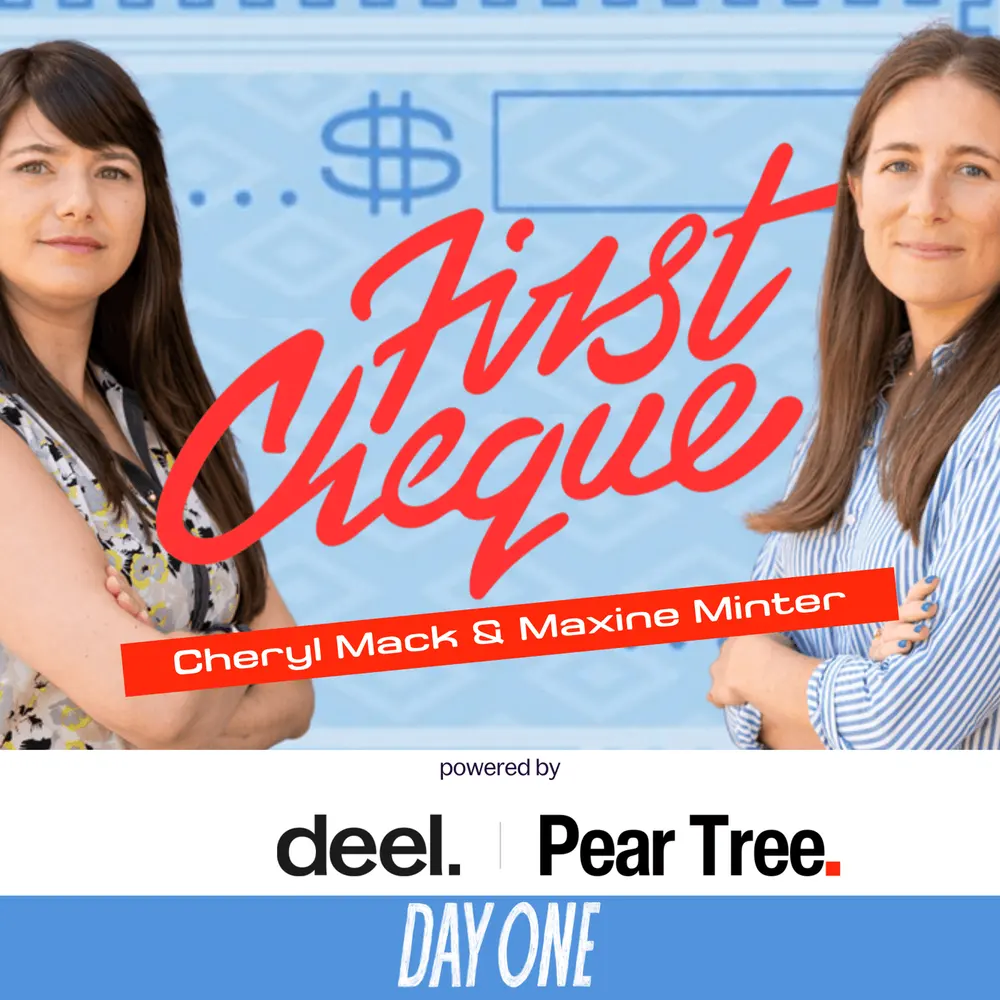 First Cheque with Cheryl Mack & Maxine Minter
Presented by Deel & Pear Tree
First Cheque with Cheryl Mack & Maxine Minter
Presented by Deel & Pear Tree 

 ▶
▶ ▶
▶ ▶
▶