

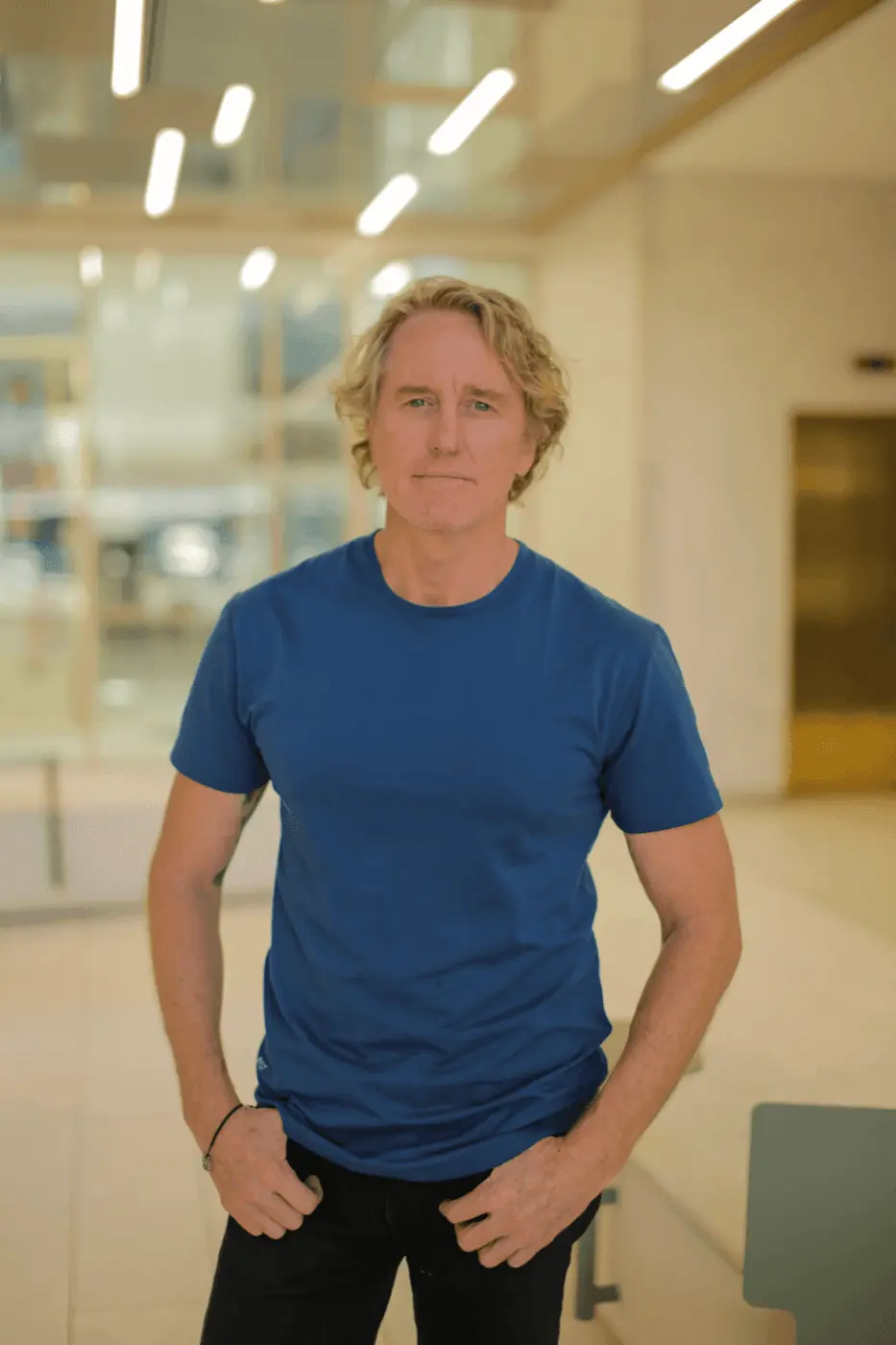

Hi, and welcome to day one, the podcast for regional startups and the organisations that support Australian entrepreneurship. Welcome to day one is brought to you by the city of Newcastle and Newihub. Newihub is a growing and vibrant community of Newcastle's startups & founders. It's a central hub where you can learn about what's going on in our ecosystem, with events, available jobs and other resources. I'll tell you more about Newihub later in the episode, but for now, let’s jump into the story of Damien Mahoney.
Today, Stackla is a global company with dozens of employees and offices in the US and UK. Many of their clients are household names: McDonald's, Nintendo, Toyota, and Sony just to name a few. But the growth of the company has not always been smooth sailing, and in recent years they've weathered two major storms: the pandemic, which all but wiped out many of their key clients, and a legal battle with Facebook which required Damien to make an incredibly difficult decision to keep the company afloat.
But before we hear about how Stackla has been able to emerge from multiple catastrophes, first we need to go back to day one, and hear the story of how a part-time job in radio that was too good to pass up would ultimately lead Damien to become the CEO of a global technology startup.
Transcript Synced · click any line to jump ▾
Adam Spencer: You're listening to a DayOne.fm show.
Damien Mahoney: What drives you to make bold moves, to build something that didn't exist before, to live, lead, and choose life with intention? Welcome to Perspective X. I'm Pauline Fatowi, and this is not your typical business podcast. Each episode, I get to speak to extraordinary entrepreneurs and leading innovators to unpack what truly fuels their journey. Not just the wins, but the inner work, the overlooked decisions, the mindset shifts, and the personal moments that sparked something bigger. This show is about the ripple effect of choice, the kind of deep accountability that lets us respond to life rather than react to it. Because when you realize everything is temporary, and you are the creator of your own experience, you start to play the game differently. So if you're curious about how people build meaning alongside success, how they evolve through challenges and shape the world with intention, this is your invitation to listen in. Perspective X, where we go beyond the highlight reel and into the moments that changed everything. Available now wherever you get your podcasts.
Adam Spencer: Hi, I just wanted to jump in here really quickly before the episode started. So this is an old episode. It was an interview I did with Murray back in 2018, I think, about Startup Master. This, I wanted to just drag this out of the archives because Startup Master is back in 2023, first time in 5 years. And we are currently taking questions until June 12th. So if you have a question you'd like to submit, to Startup Master, please head to startupmaster.com, scroll to the bottom, there's a form and you can put your question in there. Let's get into the episode.
Speaker C: Our export profile in Australia is things that we dig up or grow and ship overseas. For the first time in human history, you can address every customer in the world and service every customer in the world from a laptop in Sydney as a 16-year-old. And we're not doing that. Uh, we're still going into the same jobs and trying to dig things up or grow them and ship them overseas. We have a wonderful export opportunity that doesn't care that we're in Australia and provides much bigger opportunities than what we're realizing through any other industry at the moment. We're not pursuing it and we need to.
Adam Spencer: Hi, I'm Adam Spencer and welcome to Day One, the show that goes back to the very beginning to share the untold stories of incredible Australian startups and the organizations that support them. Today, you're going to hear the story of StartupMaster through its founder, Murray Herbst.
Speaker C: I'm Murray Herbst, I'm the Director of Entrepreneurship for UTS, also co-founder of StartupMaster.
Adam Spencer: StartupMaster is a report that produces the most comprehensive data on the Australian startup ecosystem with the goal of measuring and publishing the progress, challenges, and opportunities within the startup ecosystem. Startup Master is important because the startup world here in Australia is in no sense of the word booming, but it could be, and Startup Master aims to make the data available for us to course correct our ship. All hands on deck, let's go back to day one where this story begins. We start this story off with Murray taking taking us back to when he was a teenager starting his little startup.
Speaker C: When I was 16 starting my little startup, there was no incubators, accelerators, not as we know them today. All the investors that I spoke to were overseas. All the people we hired were overseas. It was a very different time and that company did okay, but I wonder how it would have gone if I would have started it today. With the wonderful opportunities that are all around us now. And I wonder how far we can push that and what kind of potential we can realize through the work that I'm doing.
Adam Spencer: Murray is an amazing champion for startups in Australia, and by listening to that little snippet, we can begin to understand what drives him to be that champion. But he's too modest to ever admit what he is. Startup Master started in 2015, and by started I mean the first report was released. Well before that though, Murray was doing a lot of groundwork all in his spare time.
Speaker C: I've got a terrible habit of coding things myself because I like coding. It's why I started doing what I was doing when I was 7 years old, I started coding. I was kind of consulting out doing reverse engineering work when I was 14. Launched AdBuncher when I was 16. Never kind of figured out that I should stop coding. So the first version of Startup Master was this myself developing the survey. I knew this was a transient audience and we needed a lot of data points collected. So to develop a custom survey that showed you how you fit into the ecosystem as you progressed through it. Tried some interesting kind of sharing mechanisms to help virality of the survey and help it spread within the community as well. and just pursuing that while also doing a lot of consultation with different organisations who support startups to, to ask, what do you need to understand to better support startups? And incorporating all of those data points into what was being collected.
Adam Spencer: Murray is steadfast in his conviction that Australia needs Startup Master or an equivalent organisation for the purpose of that which I alluded to in the introduction. Things aren't going as well as they could be, and we need data to help us get a clear picture of where we are now to help us move forward into the future.
Speaker C: 5 years ago, imagine, a nascent startup industry in Australia, a couple of small spaces opening up. Fishburners had been open for a couple of years at the time. I was a member at Fishburners, but wasn't involved in running it, and was doing a little bit around Startup Oz and different organizations that were trying to support the creation of more startups in Australia. And was becoming a little bit frustrated that there wasn't good data available. There'd been a few reports out around the time from respectable organizations, but if you look at the underlying data, there's definitely big question marks over the data sources that were in use at the time. And I thought, if this industry has any hope of succeeding, it needs to be able to communicate what it's doing, what impact it's having, what problems it's having, and communicate it freely and broadly so people that want to support it or even people that don't understand it know why it's important and how it can be supported. Like, we're flying blind in so many ways that a lot of money is spent in different programs and different policies that are designed with good intentions but without the kind of data that I think people expect them to be incorporating into those decisions.
Adam Spencer: The bottom line is the potential of the startups in Australia to positively impact our whole country cannot be overstated. And the future could be very bright. However, in order to get to that future, or indeed reach any meaningful goal, we need to measure our progress.
Damien Mahoney: It's really important to manage what you measure, and if you don't measure, you're not progressing. And Startup Muster measures the performance of the innovation and entrepreneurship ecosystem and reports on its health, and nothing else is comparable in the country.
Adam Spencer: That's Maria. She's on the board of Startup Muster.
Damien Mahoney: My name is Maria McNamara, and I'm a non-executive director on 3 boards, the Spark Festival, the Australia-Israel Chamber of Commerce, and the International Women's Forum. I also have my own company, Portal Ideas, and I'm chief cheerleader for a number of other organizations. The first, the newest one is neweconomy.media, which is a new news site that we're creating. And then I'm also on the advisory board for the China-Australia Millennial Project. I'm a chief cheerleader for Fathom, Fathom AI, which is the world's data source on the future of work. And of course, I'm on the advisory board of Startup Master.
Adam Spencer: As we've heard, Murray started Startup Master mostly in his spare time in the beginning, doing all the work himself. But having worked in the startup world for quite some time before starting Startup Master, Murray had connections and people he could turn to for help, Maria being one of those people, but another one was Startup Master's to-be CEO, Monica Wolff.
Speaker C: I was putting by far the most time in at the time. There was a couple of people involved as advisors that were incredibly helpful. Monica Wolff I managed to get the ear of at the time when she was at the ABS, and she's an incredible person, much more incredible than I can explain in a in a podcast of this length, but she was happy to volunteer some time to making sure that some of the statistical approaches we were using were relatively valid.
Adam Spencer: Monica would go on to be the CEO of Startup Master, and although Murray and Monica were the two main people involved in the operations of Startup Master, there were many other people behind the scenes making sure a report as comprehensive as Startup Master was beyond reproach. Running an operation that relies so much on trust and accuracy is a time-consuming endeavor. Startup Master has put out reports for the past 4 years, starting in 2015, and funding has been integral to being able to do that. But the early days of Startup Master were the 2-minute noodle days. Murray and Startup Master were—
Speaker C: Self-funded for the first 2 years and then managed to recruit Google and the Department of Industry, Innovation and Science as major supporters for the following 3 years.
Adam Spencer: Finding partners that truly want to support and support Australian startups have been absolutely crucial to the survival of Startup Master and allowing it to make the contribution it has made, often an underappreciated and unnoticed contribution.
Speaker C: We managed to get Google first. And bless Alan Noble, the lead of engineering in Sydney. He is an incredible person. And I think Google has a wonderful track record at supporting startup support organizations around Australia. And with good reason. I think they realize that if there's a vibrant tech scene in Australia, that makes it easier to operate a company like Google, makes it easier to attract talent to the country, makes it easier to find talent within the country. Mm-hmm.
Adam Spencer: Getting Google on board proved to be an important step because it allowed Startup Master to land other vitally important partnerships.
Speaker C: I think there's an altruistic approach from Google that I haven't seen from many other companies. But as soon as they were supportive, the department, I think, was more willing to match funding and support once they were on board.
Adam Spencer: The department Murray was referring to is the Department of Industry, Innovation and Science.
Damien Mahoney: Startup Master is, was funded by the Department of Industry, Innovation and Science for a number of years. Yeah. And it also received some funding from Google and UTS and others. We don't have sufficient funding for it to continue, and we're in the market now and have been for almost 2 years looking for ongoing funding.
Adam Spencer: When I spoke with Murray, he was really hoping to have the support to make the Startup Master 2019 report happen.
Damien Mahoney: The thing about Startup Master is that it's not something that can be commercialised in a way like any other business. It's a service, and in order to retain its integrity, we have to be really careful who we take money from. The most logical place for it to come is from government. And I appreciate that everyone knocks on government's door, but in this instance, it, um, in order to guarantee the objectivity and the independence, it absolutely has to be from government.
Adam Spencer: Today, Murray is the director of Startup Master and is determined to see Startup Master survive.
Speaker C: I don't think it's a question of whether Startup Master will continue. I think it's a question of when. It will continue. We've got some partners on board in terms of data preparation and report preparation and some of the expensive parts of what we do. We still need funding, and we need funding to a point where I'm confident we can do it well, that we're not doing a half-assed job that doesn't properly represent the wonderful things that are happening in Australia.
Adam Spencer: The future of Startup Master is unclear. One thing is crystal clear though, Australia needs Startup Master.
Speaker C: If we can't get the funding in time for this year, we will take this year to think about what we're doing to better prepare for next year, but we'll come back and we'll come back better.
Adam Spencer: And here's why Startup Master is so valuable and what it does well.
Speaker C: What Startup Master does well is collect data from busy people, so the technology and the completion rate of the survey is, for the length of survey we have as well, is quite remarkable. Our ability to get in front of a lot of startup founders and supporters across Australia, we do better than anyone else has so far, I think. And the third thing we do well is generate trust in people. So for 5 years, all we've done is collect data and publish it for the benefit of people in the industry. That's a very hard thing to manufacture overnight. We're asking very sensitive questions of people, like their revenue, their investment, their plans, their concerns. And I think it's very hard to get in that position, and I think something that needs to continue, or rather not be wasted once that trust has been established.
Adam Spencer: All of Murray's professional life has been devoted to driving entrepreneurship and startups forward.
Speaker C: Everything that I do is finding larger and larger levers to drive entrepreneurship in Australia.
Adam Spencer: And he says it is a challenge to do so. That's part of why Startup Master as an organization is so important. It was mentioned earlier in this story that measuring where you are is really important because it allows you to see how far you have to go. And without knowing that, it's really hard to make plans to get there.
Speaker C: Startup Master has taught me that we've got a lot of work to do in Australia. That what I thought was a booming industry is actually a little bit in trouble at the moment. It's not growing in the way that it could, and it's nowhere near the size that it could be or the impact that it could be having. We need good data on what is happening here so that people can understand that problem, that there's not enough happening here and why there's not more happening here. Whether it's Startup Muster or someone else or some government body or whatever, it needs to be collected, it needs to be freely available, it needs to be transparent, and we need it soon.
Adam Spencer: Thank you for listening to the story of Startup Muster. I hope you enjoyed it. I hope you got something out of it. Everything that was mentioned in the episode today is on the show notes page on welcometodayone.com/startup-master. You can follow us on Twitter, Instagram, or Facebook by searching Welcome to Day One or clicking the links on the show notes page for this episode at welcometodayone.com/startup-master. Thanks for listening to the Startup Master story on Welcome to Day One. This episode was created by me, Adam Spencer. Interviews conducted by me, Adam Spencer. A big thank you to Murray Herbst from Startup Muster and Maria McNamara for taking the time to be involved. The script was written by me, Adam Spencer. Music by Lee Rosevere, full attribution on our website at welcometodayone.com. This episode was produced by me, Adam Spencer, and edited by Natalie Holland. Thank you and see you next time.