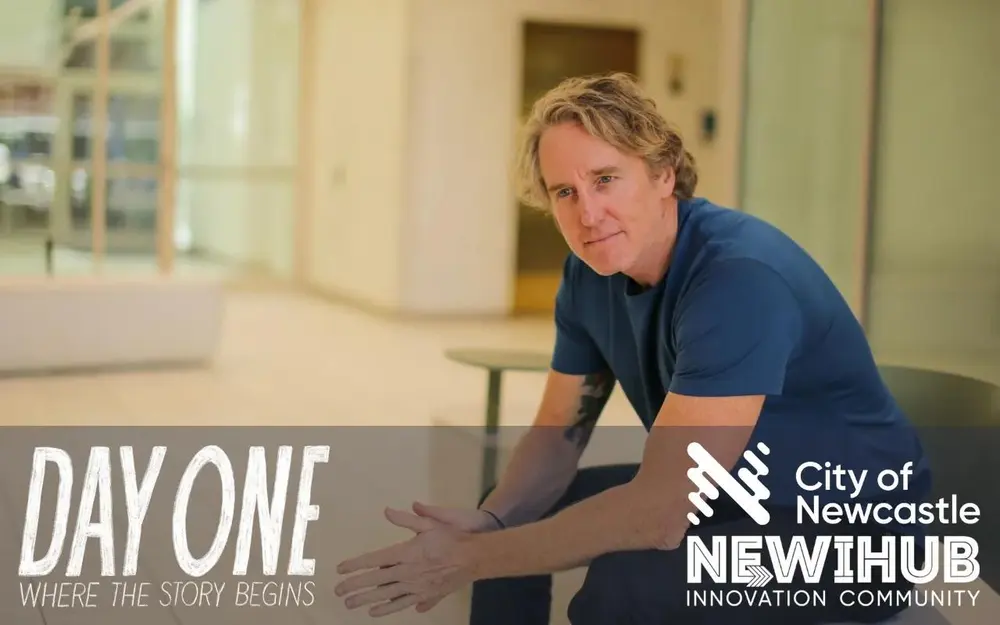
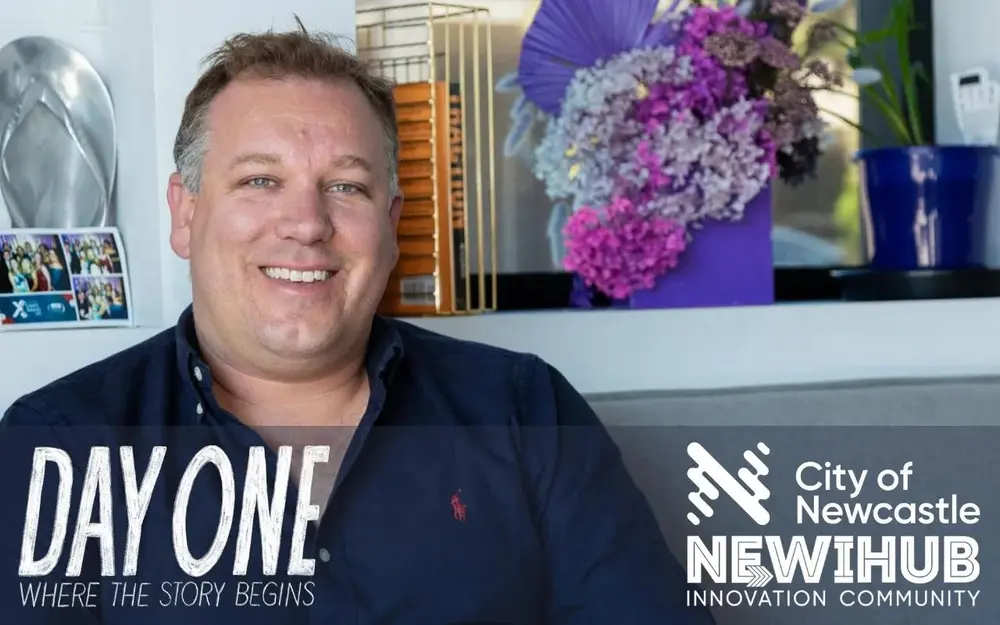
Hi, and welcome to day one, the podcast for regional startups and the organisations that support Australian entrepreneurship. Welcome to day one is brought to you by the city of Newcastle. The City of Newcastle is a big supporter of entrepreneurship in our region and has recently launched a brand new digital hub called Newihub. Newihub is a growing and vibrant community of Newcastle’s startups & founders. It’s a central hub where you can learn about what’s going on in our ecosystem, with events, available jobs and other resources. I’ll tell you more about Newihub later in the episode, but for now, let’s jump into the story of Mike McKiernan.
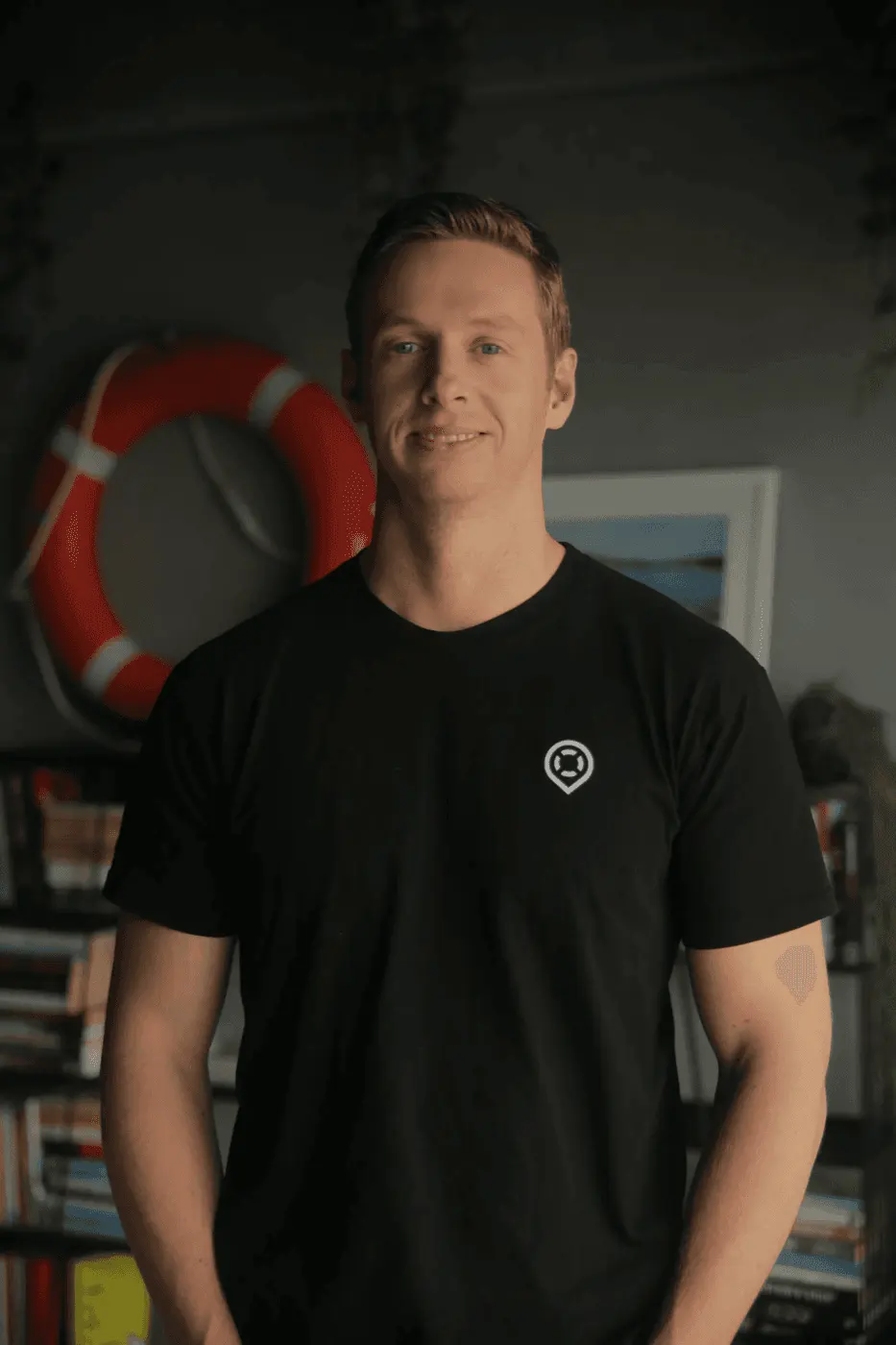
Deckee is a free mobile app designed to provide up to date information to people out on the water when boating, fishing or sailing in order to keep them safe. Deckee is approaching a million dollars raised through investors and is officially endorsed by three state governments in Australia. The Deckee app is also available for use worldwide, and international expansion is one of the priorities for the company moving forward. So how did Mike go from studying visual communications at Newcastle University to becoming an investor-backed entrepreneur overseeing a team of employees and scaling a tech company internationally? To answer that question, first, we need to go back to day one, and hear how a job Mike got as a student would reveal a whole set of problems he didn’t even know existed.
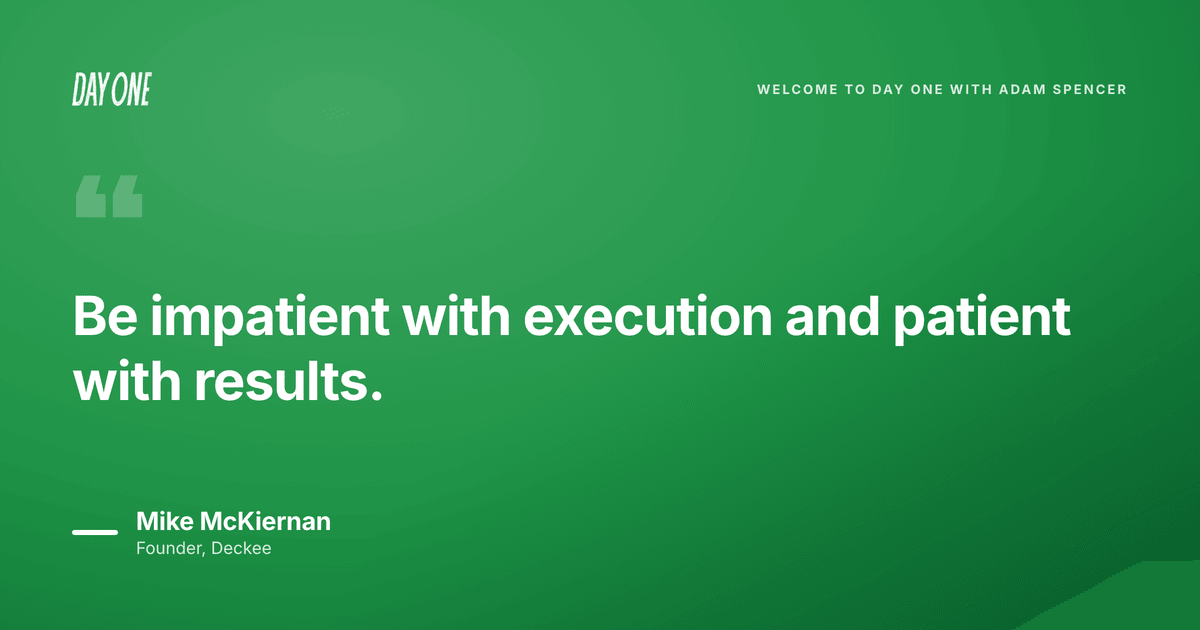
Transcript Synced · select any line to jump ▾ 0:00 Adam Spencer: You're listening to a DayOne.fm show. 0:05 Speaker: What drives you to make bold moves, to build something that didn't exist before, to live, lead, and choose life with intention? Welcome to Perspective X. I'm Pauline Fatowi, and this is not your typical business podcast. Each episode, I get to speak to extraordinary entrepreneurs and leading innovators to unpack what truly fuels their journey. Not just the wins, but the inner work, the overlooked decisions, the mindset shifts, and the personal moments that sparked something bigger. This show is about the ripple effect of choice, the kind of deep accountability that lets us respond to life rather than react to it. Because when you realize everything is temporary, and you are the creator of your own experience, you start to play the game differently. So if you're curious about how people build meaning alongside success, how they evolve through challenges and shape the world with intention, this is your invitation to listen in. Perspective X, where we go beyond the highlight reel and into the moments that changed everything. Available now wherever you get your podcasts. 1:22 Mike McKiernan: Yeah, something I heard that always stuck with me was to be impatient with execution and patient with results. You're measuring your progress as a team, like almost by the hour at some times, or at least daily, but the results that you're expecting, you tend to be a lot more forgiving in terms of, you know, what it generates for you. 1:45 Adam Spencer: Hi and welcome to Day One, the podcast for regional startups and the organizations that support Australian entrepreneurship. Welcome to Day One is brought to you by the City of Newcastle. The City of Newcastle is a big supporter of entrepreneurship in our region and has recently launched a brand new digital hub called Nui Hub. Nui Hub is a growing and vibrant community of Newcastle startups and founders. It's a central hub where you can learn about what's going on in our ecosystem with events, available jobs, and other resources. I'll tell you more about Nui Hub later in the episode, but for now, let's jump into the story of Mike McKinnon. 2:24 Mike McKiernan: Hi, my name is Mike. I'm the founder and CEO of DEKI. 2:28 Adam Spencer: DEKI is a free mobile app designed to provide up-to-date information to people out on the water when boating, fishing, or sailing in order to keep them safe. DEKI is approaching $1 million raised through investors and is officially endorsed by 3 state governments in Australia. The DEKI app is also available for use worldwide and international expansion is one of the priorities for the company moving forward. So how did Mike go from studying visual communications at Newcastle University to becoming an investor-backed entrepreneur overseeing a team of employees and scaling a tech company internationally? To answer that question, First, we need to go back to day one and hear how a job Mike got as a student would reveal a whole set of problems he didn't even know existed. 3:20 Mike McKiernan: Most people are surprised to hear that I didn't come from a boating family, so my parents didn't have a boat. However, we were definitely an ocean family growing up in, in a place like Port Stephens. It's pretty easy for that to happen, I suppose. We were at the beach, you know, every weekend. I ended up taking up surfing and bodyboarding as hobbies. So in hindsight, it was probably obvious that I would end up doing something deeply connected to being on the water in some way. So after I finished high school, I started at university. Around that time, I got a job at the local marina. Up at Port Stephens, and that led to many years of working in and out of marinas in Australia. I had various roles, but probably the one that's most interesting, just a general dockmaster is what the title is. 4:14 Adam Spencer: Yeah. 4:14 Mike McKiernan: And it's basically you're responsible for ensuring that all the customers on the marina, all the boat owners, have everything that they require, helping them come and go from their berths in the marina and supporting them with any requirements that they might have. While they're staying. So what I learnt was that even as an experienced boater, say you've been boating for 10 years already, you're still learning things all the time. It's not like you get to a point where you know everything. There's always some new variable that you need to take into consideration, especially when it comes to safety. For beginner boaters, you're talking about a whole new world, right, that people need to familiarize themselves with. And during that time, literally speaking with thousands of different boat owners, quite literally, I come to understand many of the problems and the challenges that they face on a day-to-day basis with boat ownership. And it become apparent that there would be an opportunity there for a technology product of some kind to help them with that. And maybe this is a bit of a side note, but It's, in my opinion, it's far too easy to get a boat license at the moment. So right now to get a license, you typically have to do a 1-day course, which is part theory, part practical, and then provided that you don't fail miserably, you're good to go. Whereas compared to a learner driver's license, you're required to rack up tons of hours on the road with a qualified driver. Of course, it's not that easy to get tons of hours out on the water with a qualified skipper, but that's sort of where the opportunity lies for a technology product as well, to provide some of that education and information that the beginner boaters need to ensure that they're not having accidents as well. Yeah, so at university I was doing a degree called visual communications, which is effectively design and marketing more or less combined. 6:13 Speaker: Yeah. 6:13 Speaker: So I was doing that through study. I was working at a marina and noticing problems. So it sort of, it was inevitable that those two things were going to swell together in some combination. I actually recall being at the marina on lunch breaks and so on way back in the day where I was actually sort of thinking through what this product would be and things like that. I had this idea at that point. I was obviously playing with it in my spare time using my design and marketing sort of knowledge and skills to try and shape that into something. I remember reading about the Slingshot Program. I think it might have been in a newspaper or something just by chance, and that was kind of where I become aware of the whole startup culture and ecosystem. 6:58 Adam Spencer: The Slingshot Program is a startup accelerator which provides promising founders access to funding, mentors, and potential investors. Starting around 2014, Slingshot helped Mike take his fledgling ideas and start turning them into reality. 7:14 Mike McKiernan: I think maybe growing up in a regional area, entrepreneurship isn't the typical career path for kids or teenagers or young adults. You typically fall into a more common career. So anything that can encourage entrepreneurship and innovation I think is a very good thing. For me, it was the Slingshot program which provided a bit of a launch pad for me. If I didn't find my way through that, I don't know what DECI would be today if it existed at all. So I had no coding experience at the time. I did have, as I mentioned, the design and marketing sort of skills to be able to put together, you know, prototypes and things that actually looked legitimate, which is a nice sort of thing to have. Yeah. Sort of coming up with lean startup ideas and trying to get people to buy into what you're doing. After going through the Slingshot program, I managed to secure some small investment from some local investors that were boaties themselves, so they understood the general sort of challenges that we were trying to solve. And with that, we were able to sort of start investing a bit more in some legitimate technology. 8:29 Speaker: Mm-hmm. 8:30 Mike McKiernan: I ended up going and contracting that work out, basically because I was impatient and wanted to get things happening and get some momentum. And also because finding a high-calibre technical partner or developer in regional New South Wales isn't the easiest thing to accomplish either. So I felt that if I was able to show some initiative, go and build something with some contractors initially, and then I'd have some good stuff to show and tell potential technical partners further down the track. 9:04 Adam Spencer: The first iteration of Decky was very different than the service it has become today. 9:13 Mike McKiernan: We didn't start as a mobile app. We actually started as a very crude online forum-style website where boaters could share reviews and recommendations of just about anything that they come across. Yeah. Whether it's marine services or places to go or products to buy or which boats to actually purchase as well. It was designed to be this place online, very sort of one-dimensional sharing of information and advice and recommendations between one another. 9:45 Adam Spencer: Yeah, right. 9:46 Mike McKiernan: So maybe an analogy is kind of like a TripAdvisor-style website where you can go on and get advice from other, other travelers. In our case, it was other boaters. Yeah, so the first business model that existed was kind of like a subscription-style advertising product for businesses in the industry. 10:03 Speaker: Yeah. 10:04 Mike McKiernan: So much like a hotel pays TripAdvisor for a certain level of exposure on their website, we would provide marine businesses with the same opportunities to get more leads and acquire more customers. So the very first customer of Decky was actually the marina group that I worked at. 10:23 Speaker: Ah, yeah. 10:23 Mike McKiernan: So I managed to convince the CEO of the marina group, it was a group of 5 marinas, to pay for priority positioning on the website. So that was the first win and understandably I felt like I'd already solved the world's problems because it was so easy to get the first customer. We ended up getting maybe 2 or 3 more pretty quickly thereafter, but then it dried up pretty quickly after that and we realized that maybe we need to rethink how we were going to monetize and scale. There was definitely some challenging times there where there was a lack of direction, had to sort of completely rethink where we were taking things. We were still sort of toying around with the idea of paying for services, advertising models, unlocking features through premium plans, things like that. So all those different types of things, no stone was left unturned really in that regard. So the revenue model, for the first couple of years really was very much up in the air. We knew that there was sort of a problem and solution in there to solve. We just had to try and get to the bottom of it, and it took us a little longer than probably what we would have liked. 11:28 Adam Spencer: Despite a lack of a clear revenue model for the first couple of years, Mike persisted in developing DEKI, holding on to the belief that there was a real potential for a product which provided valuable safety information to people setting out on the water. And he was able to convince investors of this potential. 11:47 Mike McKiernan: At the very beginning, yeah, it was challenging, but sort of realized through trial and error that the opportunity where I could attract investment would be finding people at the intersection of entrepreneurial ventures, technology, and an interest in boating. Because if I can find people that sit in the middle of that Venn diagram, there's a pretty good chance that I'll at least hit it off with them and see where that takes us. So I kind of built out a curated list of people that I'd like to speak to, knowing what their background and experience is and their lifestyle interests as well on the water. 12:24 Adam Spencer: This early investment allowed Mike to expand the team and bring on Decky's first full-time engineer. 12:31 Mike McKiernan: It was at that point really that we started gradually transitioning away from what we'd built with the contractors towards sort of internalising our technical development. We came to the realisation that DECI would have to be a mobile-first product, a map-based experience, if we're really going to have the impact on boating safety that we wanted to. 12:51 Adam Spencer: There's an old saying, "Luck is when opportunity meets preparation." After a couple of years of failed revenue models and significant changes to the product itself, DECI were about to run into a serious bit of luck that would set them up for a great deal of their future success. 13:13 Mike McKiernan: So around the time when we started focusing all our energy on the mobile-first DECI, the move towards the mobile format, the New South Wales government, so Transport for New South Wales, put out a public call for someone to build a boating companion app, which was very serendipitous because the list of requirements that they were hoping to get from the boating companion app were the, all the things that we had been working on. We ended up winning it, which was probably always going to happen given we'd already put so much groundwork into the solution that they were looking for before it had even started. Mm-hmm. So like I said, it was quite serendipitous in that sense. When that relationship and partnership was formed, there was a commercial investment that they put towards the business at that point as well to provide further funding towards developing its capabilities. And as it sort of turns out, the world of maritime authorities and governments is a pretty small connected network. When one is developing certain capabilities, it's generally going to be of interest to the others, and that then led to us forming further partnerships with other states as well. That was really the catalyst for, I guess, where we've now ended up a few years later in becoming what is really a government technology company in many respects from a commercial standpoint. 14:44 Adam Spencer: Winning the innovation challenge set up by Transport NSW allowed DEKI to develop a new new business model, one in which it is not reliant on ad revenue or subscription fees from the user. This was a major step towards DEKI becoming the service that it is today. 15:01 Mike McKiernan: So DEKI is a mobile app designed to keep you safe and informed on the water. We do that by combining information from 3 different distinct categories. So the first is we supply alerts and information from government partners. The second is we provide safety information like weather conditions and aids to navigation out on the water. And the third category is crowdsourced content, which the community on DEKI are regularly contributing to the app, whether it's points of interest or reports, which are always keeping the app current at all times. However, the users of the app are not the customers, so the app is for free. We work actively with government maritime authorities as partners to help them improve boating safety. And we do that in two particular ways. The first is we provide them with a platform where they can distribute key safety alerts and information in an interactive format at scale. And the second thing is we provide them back insights around boating activity to ensure that they're keeping their citizens safe. Yeah, so we've kind of made a decision that Decky will always be free and it will always be an ad-free experience as well. Better for the end user and it's just more compatible with actually how we're commercializing the app, which is through the, the different government capabilities that we provide. 16:29 Adam Spencer: Mm-hmm. 16:29 Mike McKiernan: If we were trying to charge both sides of the business, both the users and our partners, you, you run into different problems there and, and trying to make that a nice harmonious scenario. 16:41 Adam Spencer: Another key moment in the growth of Decky was when Jessica Watson, the youngest person to ever sail solo and unassisted around the world, joined the Decky team. 16:52 Mike McKiernan: So for those that aren't aware or need remembering, so Jess sailed around the world solo when she was 16. She became the youngest female to circumnavigate the world. She ended up coming on initially in a bit of an active role as a communications and marketing manager for us, but also with the ambassador and public profile to come with it. In hindsight, it was also a really important development in the story that we were sort of telling to the world, just that Decky would become the place that you would go for any information or guidance that you needed if you're heading out on the water. It validated what we were doing to some extent to have Jess involved. 17:32 Speaker: Mm. 17:32 Mike McKiernan: In the early days, Jess's profile and status as an ambassador brought audience. So a lot of people that had followed Jess since her adventures suddenly became interested in what we were doing. And Jess also came on as a small owner— ownership share in the business as well. So that was an important thing, is that she would feel ownership in what we were doing and would really help drive it to success. 17:58 Adam Spencer: Becky has come a long way. From just an idea in the head of a visual communications student with no background in boating to a team providing safety to people boating around the world. 18:12 Mike McKiernan: I wouldn't say it's been easy, but the guys that we have now, I couldn't ask for a better development team. We've got a team now which combines geospatial background, former graphic designer, and Jack, who used to be a hardware engineer who's now sort of working on software. So we've got so many different sort of skill sets and backgrounds which are coming together to create the product that we're doing. That's another thing that we say too, is that the, the product that we're building is the resume of our team. I think that's a really nice way of thinking about how you work together as a unit. DECI is officially endorsed by 3 state governments now in Australia. As the recommended boating app. From a geographic perspective, it's effectively half the country now that's being told to actively download this app if you're heading out on the water. So that in itself is like a huge achievement for us. So to provide some context about what that means, it would be like the government telling you that you should use Strava to exercise or Google Maps to drive somewhere. You just never see it. So that really gives you an indication of the— how unique and important the partnerships are that we have. You just don't really see it in any other industries. So in terms of the impact of those relationships, in the states that we do have those partnerships, in some cases we have 1 in 3 voters that have downloaded the app in those areas. So they're very meaningful relationships that we have. They're quite symbiotic in the sense that government partners help distribute the app to the public, which helps with our user acquisition, of course. But, you know, we're in turn able to give them a lot of capabilities back that they've been sorely missing. Yeah, so we've, we've started spending more and more time and resources now on the international expansion. DECI is available worldwide to use right now. It's just that we don't have the government partnerships available in those places. That said, I guess the nice thing about our product is we aren't completely reliant on government partners to create a great experience. It only just adds to it. 20:30 Speaker: Mm. 20:30 Mike McKiernan: So it means that from an expansion point of view, we can actually launch in a particular area with a ton of information and features and capabilities for boaters, we can build up a community in that area, and then we've actually got the audience and the capabilities that a maritime authority is ideally looking for. 20:51 Adam Spencer: I finished my interview with Mike by asking if he had any advice for founders. 20:59 Mike McKiernan: Persistence is a really important thing. I think that most founders give up too early. I think probably many would succeed if they kept pushing. So much of startup success, I think, is working on the right problem at the right time with the right people. And if you get one or two of those things wrong the first time or the second time, you gotta keep going beyond that, 'cause it's pretty likely it's gonna happen. 21:27 Speaker: Yeah. 21:27 Speaker: So that's probably one thing that I've that's become ingrained in me that even now, you know, with different sort of challenges we're facing as we aim to continue scaling and grow is that just because you get a no from someone for whatever reason doesn't mean you just throw in the towel. Yeah, persistence is definitely an important thing. Patience goes hand in hand with that. 21:49 Adam Spencer: Mm. 21:50 Mike McKiernan: I sort of told myself from the very beginning like this would be a 10-year journey type thing, maybe longer, who knows. But there was never like an expectation I set for myself that it was going to be some crazy overnight success. Particularly with what we're doing, the industry in, I knew that it was going to take some time to figure it out and grow it. The third thing I'd probably say is that you really need to be obsessed. You need to be, and not in a forced way, but rather like everything that you think about from sunrise to sunset is about furthering the business in some way. I don't know if you can really achieve big things as a startup in particular if you don't have that mentality about what you're doing. 22:36 Adam Spencer: Mm. 22:37 Mike McKiernan: Not in the sense where it overwhelms your entire life, but even now it's all I'm thinking about throughout the day, but not in a way where it's annoying or frustrating, but genuinely. Always trying to solve problems and figure out what's next. Yeah, so I figured out a while ago that it's not practical to just work 24/7. I put a lot of priority around getting enough sleep every night. I get to a certain point in the afternoon that regardless of what I'm working on, I'll close up for the day because there's always going to be something to do or something that you should be doing. It's a never-ending list as a founder, so you have to know when to call it quits for the day. In terms of how Newcastle helps that as a location, I mean, it's obviously a very relaxed place to live. I'm a big advocate of Newcastle's lifestyle. I have many friends and colleagues that live in Sydney and I feel sorry for them all the time. So for us, we have a very flexible work environment. We support remote working. We work asynchronously in a lot of cases as well, but I think it's the lifestyle benefits of setting up here. I think the type of people, the culture here is very much sort of what resonates with me and the type of team that I'm looking to build out. 24:05 Adam Spencer: Thanks for listening to the story of DECI, and a huge thanks to Mike McKinnon for taking the time to speak with me. Next week on Welcome to Day One, we have a brand new founder story to share with Anthony Martin from Hone. These founder stories are made possible by our supporters. We can't do it without them, and I'm just incredibly grateful for their commitment to our local startup community and in helping us spotlight these amazing founder stories who inspire me, and I hope who inspire you too. The City of Newcastle's Nui Hub is our major sponsor and I'd just like to take a second to express my gratitude for their support. Nui Hub is a great new initiative from the team at the City of Newcastle. It's an online community to keep up to date with what's happening in our region from an innovation perspective and a hub of great resources. I encourage you to check it out and sign up to be a free member. You can learn more by clicking the link in today's episode notes at welcometodayone.com or by going to Nui Hub. Nui Hub. Www.welcometodayone.com. This episode was produced by me, Adam Spencer, with scripting and audio editing by Andy Jones. Information about everything mentioned in this episode can be found on the show notes page at www.welcometodayone.com. Music by Lee Rosovie, full attribution on the Welcome to Day One website. If you'd like to support this show, please consider leaving us a review or supporting us on Patreon. I'm Adam Spencer. Thanks for listening.