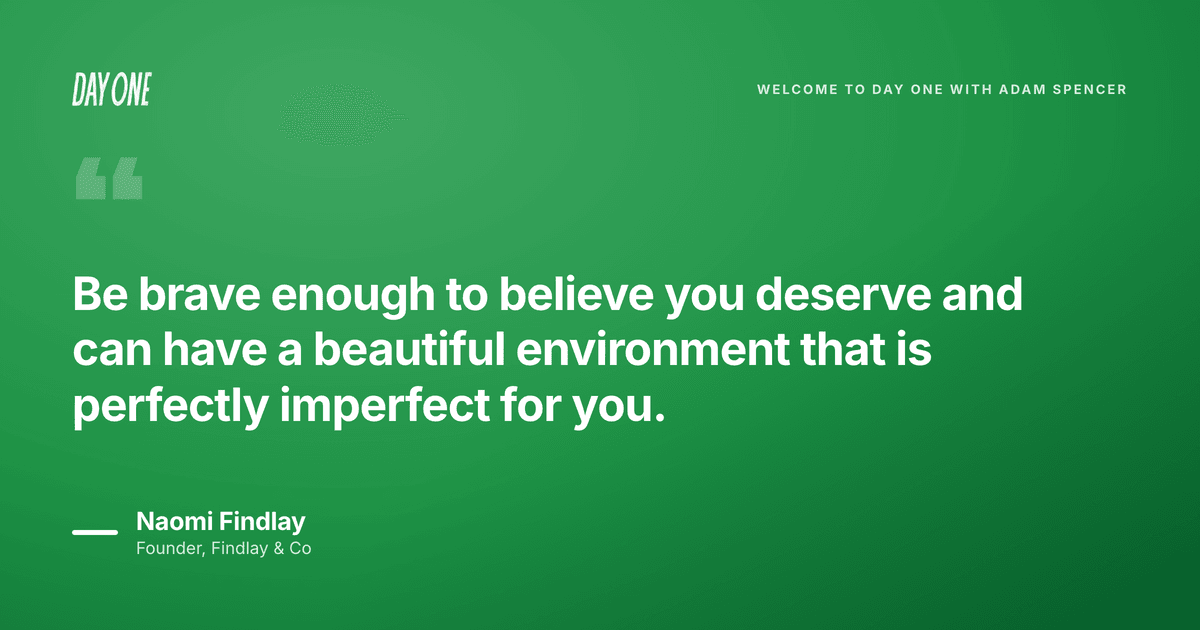
Transcript Synced · select any line to jump ▾ 0:00 Adam Spencer: You're listening to a DayOne.fm show. 0:05 Speaker: What drives you to make bold moves, to build something that didn't exist before, to live, lead, and choose life with intention? Welcome to Perspective X. I'm Pauline Fatowi, and this is not your typical business podcast. Each episode, I get to speak to extraordinary entrepreneurs and leading innovators to unpack what truly fuels their journey. Not just the wins, but the inner work, the overlooked decisions, the mindset shifts, and the personal moments that sparked something bigger. This show is about the ripple effect of choice, the kind of deep accountability that lets us respond to life rather than react to it. Because when you realize everything is temporary, and you are the creator of your own experience, you start to play the game differently. So if you're curious about how people build meaning alongside success, how they evolve through challenges and shape the world with intention, this is your invitation to listen in. Perspective X, where we go beyond the highlight reel and into the moments that changed everything. Available now wherever you get your podcasts. 1:22 Naomi Findlay: When you love something so much, you know, I have to work really hard on my money mindset. It is amazing that I get to earn a great income doing what I do, but at times I'm like, "Oh, I'd do it for free," 'cause I love it so much, you know? 1:39 Adam Spencer: Hi, and welcome to Day One, the show for regional startups and the organizations that support them. I'm Adam Spencer, and today I'll be sharing with you the story of Naomi Findlay. 1:50 Naomi Findlay: Hey everyone, I'm Naomi Findlay and the founder of naomifindlay.com, where I get the pleasure of creating amazing spaces, inspiring others to do it, and then teaching them how. 2:04 Adam Spencer: Naomi is a remarkably hardworking woman with a ridiculous amount of active projects, all of which aim to position her as Australia's queen of property renovation and home styling. She has a digital video series, Renovi, hosted on YouTube with nearly 200 episodes and approaching 2,000 subscribers. She has a blog and hosts a weekly podcast, Reno Radio. She has appeared on TV shows including Channel 9's Location Lifestyle Living and Channel 10's The Home Team. She created an app, Rapid Renomate, designed to make home renovation a breeze. She has designed and runs courses and workshops to assist people in many facets of renovating, styling, and selling their home, and this is just the tip of the iceberg. The list goes on and on. Perhaps even more remarkable is that creating beautiful spaces was not the first career path Naomi chose for herself. In fact, Naomi is Dr. Naomi Finlay, PhD, and in a previous life worked for around 15 years in radiation oncology in Australia and around the world. To learn why Dr. Finlay would completely overhaul her career in pursuit of a new life, first we need to go back to day one and hear the story of how two conversations with two mentor figures spaced a decade apart would end up sending Naomi down two very different paths. How did Amazing Spaces enter your mind? Like, what, at what point did you start to get attracted to the idea of beautiful spaces and creating the spaces around us? 3:43 Naomi Findlay: If I'm totally frank with you, it was always there. 3:46 Speaker: Oh really? 3:46 Naomi Findlay: Yeah, it was always there. I was that kid that painted their furniture, that rearranged the Tupperware cupboard. I was always like that and I was always really arty and I loved, you know, tech drawing at school, woodwork at school, art at school. And then in year 11, I had a meeting with my careers advisor and he was a voluptuous middle-aged man, and he, he literally said to me, "Naomi, I don't know what you're thinking. Smart girls like you don't do art, they do science." Huh. And then, so my HSC comprised of extended physics, extended chemistry, extended math, extended English, and then I end up in a science career. 4:36 Speaker: Isn't that incredible how— 4:38 Naomi Findlay: One conversation, literally, hey. 4:41 Speaker: Why did you, there might not be a good answer to this, but why do you think you listened to him? 4:46 Naomi Findlay: I listened to him 'cause I was a rule follower. I was brought up really conservatively, really conservatively. My parents, my parents are absolute rock stars, hey. They're salt of the earth, blue collar workers, like they're amazing and I had everything I wanted as a kid, not as in, you know, I'm sure I wanted another Barbie or something, but I could not have dreamt of a better upbringing now that I'm a parent. Like, I look back and I go, wow, Mum, wow, Dad, you smashed it, you did good. Um, because realistically, most of the stuff that I know and I do, my mum and dad taught me. 5:24 Adam Spencer: Mm-hmm. 5:24 Naomi Findlay: Mum taught me to sew and knit and crochet. Dad taught me to do a grease and oil change on my car and how to frame a room and You know, like, they taught me everything I know. So why didn't I listen? I think I listened because somewhere deep inside of me, my really conservative upbringing was like, "That's right, I am a really clever kid, and so I should use that." You know, I should use the most of my talents. And I guess I didn't value my talent, my innate talent, like I do now. I know it does not look like I'm a rule follower right now, where we're sitting, but I was a crazy, crazy rule follower at school. I did all the things that, you know, Mum and dad asked and I did well in my HSC, went to school, studied medical science, medical radiation science. And then I worked in radiation oncology for around 15 years in Australia and around the world. I came back, you know, did the good girl stuff, got married, had babies, started my PhD. And then I went from working clinically to teaching at uni. Mm-hmm. In medical radiation science and then went, wow, I'm really young. Like, I remember being 28 and looking at all these professors and as profs all around me and going, they're my next steps. You know, as a senior lecturer, I was like, wow, my next step is associate professor. Will I look like that when I become one? 6:49 Speaker: Haha. 6:49 Naomi Findlay: Like, I just, it freaked me out. I was only, you know, I think I was, 28 or 29, at which point I remember having a really pivotal conversation with another lecturer. And he used to call me Gnomes. He goes, "Gnomes, what do you want in life?" And I went, "Oh my gosh." John was his name. "John, all I want in life is I just wanna create amazing spaces." And he looked at me and he went, "Well, just go do it." And I'm like, "I can't. I'm throwing away everything. Oh my God, I studied so hard. What will my parents think? What will people think?" And then he went, "I can't believe you care." And I went, "Oh." And that started everything. I then studied design whilst I was still teaching and then started up my own business. And then as soon as I could afford to, I left one career and started in another. 7:43 Speaker: How important do you think that advice was from John to say, "Just do it." Oh, it was epic. 7:48 Naomi Findlay: It was permission. You know, it was permission from someone I respected, someone who knew me well, and someone who interestingly on reflection, and I've never said or thought this before, but he was a very conservative man, similar to what my dad is. 8:08 Speaker: Right. 8:09 Naomi Findlay: And so if I think about it, it's kind of like a younger version of my dad going, well, why not? You know, why not do it? You can do it, just go do it. You know, which is, I guess that level of permission on a subconscious level is quite powerful. 8:23 Speaker: So what was that next step after that conversation with John? 8:27 Naomi Findlay: So that next step was, because I am a rule follower, going, cool, what do I need to do then? What are the qualifications I need? Where do I need to learn? What do I need to learn? What courses do I need to study? What do I need to put in place? How can I break down everything I've got on right now, plan it out, and then rebuild a better version of me? I had 2 kids at the time, and during that time when I was studying, I then became a single mum, and so it was like, how do I blend that? 8:59 Speaker: So 28, John says go and do it, you— 9:02 Naomi Findlay: Go and do it. 9:03 Speaker: Be very, you break everything down, and then you go and study design. 9:06 Speaker: Correct. 9:07 Speaker: Whilst being a single mum at the time? Yes. And still working? 9:13 Naomi Findlay: That's true, yeah. 9:14 Speaker: Okay, can you talk, how did you feel at that point in time? Like, that seems like a lot. 9:19 Naomi Findlay: Yes, it is a lot, but you know, I do subscribe a little bit, sometimes to my detriment, my close friends might say, that there is always always enough time. There truly is always enough time. 9:38 Speaker: Yeah. 9:38 Naomi Findlay: It is really how you picture time, you know, and how you manage it and whether you fear it, whether you embrace it. There is always enough time and I don't know if it was an Olympic motto once, I don't know, but I do believe that if there's truly enough will, there is always a way. 9:58 Adam Spencer: So was it that degree that was, was that the only thing stopping you from Was it having a degree? 10:05 Naomi Findlay: No, so I didn't actually get a degree in design, I only got a diploma. Ah, right, okay. Which was one of my sticking points in my head, 'cause I'm like, well, you have a PhD in medical science, you need a PhD in design. You know, it's been one of my biggest— 10:19 Speaker: Really? 10:20 Naomi Findlay: Yeah, it's been a really interesting mind game for me that for me to be really recognized and really successful, I need to, you know, be as traditionally and hierarchically recognized in this as I was in my previous field, which is quite an interesting kind of mind jump that I've given myself. 10:43 Speaker: How do you feel about that now? 10:45 Naomi Findlay: It's rubbish. 10:46 Speaker: Okay. 10:48 Naomi Findlay: It's rubbish. So part of it was, for me, one of the challenges wasn't just getting officially trained, which I, you know, you really need to be. But it was also, it was money and time. Like, I didn't, couldn't just walk away from a career that supported me and my kids, and then eventually my now husband. Like, I had to, you know, I had to work out how I could tear it off. I had to work out how I could start to build a business as well as a nest egg so I could taper off one, start the other and have a buffer. It was very much like a titrated process. 11:32 Speaker: Okay, how did you do that? 11:34 Naomi Findlay: With a plan, 3-year plan. 11:36 Speaker: So like, okay, 3-year plan. Is this an actual, you sat down and wrote this plan out? 11:40 Naomi Findlay: Yeah, yeah, absolutely. If it's not written, it's not real. 11:42 Speaker: Okay. 11:44 Naomi Findlay: And so yeah, wrote it out. So these were the things I would need to do this is how much money I'd need to save up to last me a certain amount of time while the new business got traction, and this is how I could taper off in the other. 11:57 Speaker: Okay, how did you actually get your first customer? 12:02 Naomi Findlay: Do you know what? My first ever customer, I remember the day that they called. So randomly, 'cause we all know how hard SEO is and being up on Google's page, randomly I had a website and I had a website up and I was driving I was driving out of my street and I reached the top of the hill and my phone rang and I pulled over to answer it and it was someone who randomly found my website, called me and asked me if I could do work for them. Random, hey? 12:34 Speaker: Uh, yeah. How much work had you done prior to that? Like how long had you been trying to get a customer, I suppose, before that? And what had you been doing in terms of marketing? 12:48 Naomi Findlay: Not long, I hadn't been trying for long. 12:50 Speaker: Right. 12:50 Naomi Findlay: I hadn't been trying for long. And what had I been doing? 12:53 Speaker: Yeah, like in terms of marketing. 12:56 Naomi Findlay: At that point, very little. At that point, very, very little marketing. So I feel like it was kind of a universal intervention that gave me that kind of, that confidence, that reassurance, that sign that you're heading in the right direction and just keep going. Keep going. 13:15 Speaker: Yeah, because right then, at that point in time, it wasn't really a business at all yet because no one had given you any money. 13:22 Naomi Findlay: No! 13:22 Speaker: Yeah, okay, so what, how did that conversation go? Like on the phone, can you take us there? I wanna tell that story. 13:29 Naomi Findlay: There was lots of like, there was lots of like foot banging, you know, in the car going, "Oh my God, someone called me, someone called me, someone called me!" And then there was an external dialogue and there was an internal dialogue, without doubt. So the internal dialogue was like, what do I say, what do I say, what do I say, what am I meant to say? And there was internal dialogue at that time, to be honest, of this isn't me, I'm not this, I can't do this, because I had been in the one profession doing the one thing since I left school. Like, that's a really long time. And the external dialogue went with the I need a hand with my property. I saw your services on the internet. And I was like, great, you know, how, what sort of assistance do you need? Tell me more about the job. They're like, look, we've looked at your packages. We think this one's a good one for us. I'm like, fantastic. Oh my God, oh my God, oh my God. Fantastic. When would you like me to visit site? Yeah. 14:30 Speaker: Yeah. 14:31 Adam Spencer: Okay, and so then it was just a case of, you know— 14:33 Naomi Findlay: It just rolled. 14:34 Speaker: Yeah, you still, you just keep working at uni, doing your— 14:37 Naomi Findlay: I keep working late at nights. And then late at nights. I work on weekends. 14:41 Speaker: Yeah. 14:42 Naomi Findlay: Absolutely. 14:42 Speaker: And people, the calls just coming in through phone or through email for people finding you on— 14:48 Naomi Findlay: Yeah, they were just coming in through email. 14:50 Speaker: Right. 14:50 Naomi Findlay: Generally, so I'd get home at night or of an afternoon and I'd clock on to my other self. So I'd take my lecturer hat off and I'd put my designer hat on and I'd clock on and off I'd go. 15:05 Adam Spencer: After 4 years of balancing her old career and her new one, Naomi was finally in a position to commit to her new life full-time. She's remained committed to a new direction ever since, though her career trajectory has been anything but a straight line, with lots of twists and turns and pivots and new projects along the way. 15:25 Naomi Findlay: Mum struggles now. So people say to Mum, "What's Naomi doing now?" And she'll go, "I don't really know." You know, I don't really know. 15:33 Speaker: When people come to you or people ask you at a party, like, what do you do? How the hell do you answer that? 15:39 Naomi Findlay: It's so interesting, 'cause it's a bit like my mom. At times I've struggled. And that's because what, like, I am a designer and I am a stylist and I am a renovator. And I, you know, speak, I present, I teach, I train, I do lots of things and from, 10 years ago to now, my business has had so many pivots and so, so many changes in the same space, but pivoting and changing and pivoting and changing based on market needs, based on market climate, based on what I thought I wanted, and then I achieved it and I went, "Oh no, that's not what I want to pivot again." You know, it's like I find my business journey, it is definitely a trajectory, but in the middle of it, there's like multiple, multiple, like dozens of tiny pivots, like brand new little startups inside, a new direction, a new twist. So if someone asks me right now, what do you do? I create amazing spaces. I help others do so. I inspire others to do so. And I teach others to do so. That's what I do. Mm-hmm. 16:52 Adam Spencer: One of Naomi's many ventures is a digital video series, Renovae, in which viewers can catch a behind-the-scenes glimpse of Naomi and her team working on all kinds of renovation projects. 17:04 Naomi Findlay: So the motivation behind Renovae was that I truly believe, as you know, that we can all renovate our life. Like we can renovate life by renovating the spaces around us. And there's so much that I do as part of my everyday world that can help teach and inspire others to do so. Whether it's dyeing your tea towels for a new season, whether it's creating a garden wall, whether it's knocking down the back like we're going to be at this office. Whatever it is, it's a level of renovating life. We've been doing it for quite a few years now. 17:40 Speaker: Has it been really good for the business? Like, have you seen, has it been helping bring in, what is the like goal of it? It's to bring in getting new customers right? 17:49 Naomi Findlay: Well, the goal of it is brand, brand awareness. And for me, everything's about know, like, and trust. And some clients will come to me because they would have heard me speak or they would have watched one of my videos where I mentioned the impact of space, or they might see one of the rooms that I've renovated and feel that, you know, they feel that impact. Like, it's a tangible feeling that you get. It's a physical, physiological change in your body that you feel. It's like when you drive up to the beach and you see the waves crash, you get a surge. And when you create truly amazing spaces that your audience or your clients can connect to, they get that surge, you know. 18:34 Speaker: What are the plans? 18:36 Adam Spencer: Do you feel good with where you're at today? 18:39 Speaker: Or are your ambitions much, much, much grander. 18:43 Naomi Findlay: They're much, much, much grander. 18:46 Speaker: Good answer. 18:47 Naomi Findlay: Without doubt. Like, they're big. Scary big sometimes. 18:53 Speaker: Do you want to talk about it? 18:55 Naomi Findlay: Do I want to talk about it? Well, I once had a really wise man tell me that when, you know, when you share your visions, there's a level of accountability. My My visions for my business are big and exciting, and I made a commitment 12 months ago to only do what I love in business. So it really has twisted and pivoted my trajectory. So 12 months ago I went, regardless of whether it earned me an income or not, I will only do things I love. And I spent 12 months doing that and loved it, and the energy and vibe I had for business after sort of that 8-year mark where you can get a bit itchy-feety, was amazing. And so my focus now is like, right, how am I going to monetize that? How am I going to create a business that will let me continue to do that for another decade, just what I love? So I have, yeah, I have huge plans. I am going to continue to grow and develop the Weathered to Wonderful and Farms to Fortune brand, which is all about helping people look at what they already have and how to bring life and love and happiness to that, as well as helping our regional communities take a lot of their buildings and outhouses and old halls through looking at it with the right lens, from, from what might be derelict to income-generating. Mm-hmm. So that's one big goal, and the other big goal is to take my textiles and homewares range to hotels all through Asia. 20:45 Adam Spencer: You've got a lot of different, lots of projects. 20:49 Naomi Findlay: Yeah, I love a project, and I love projects that make people feel good. 20:54 Speaker: Is there anything that you wanna talk about that's important that we haven't touched on? And we probably haven't touched on a lot because there's a lot going on. 21:04 Naomi Findlay: 'Cause I talk a lot? 21:05 Speaker: No, no, no. You've got a lot going on in your business. 21:10 Adam Spencer: As much as I'd love to cover it, it'll take about 6 hours probably. 21:13 Naomi Findlay: Yeah, look, I think in work, in life, in home, in workplace, in properties you own. Be brave enough to believe you deserve and can have a beautiful environment that is perfectly imperfect for you. I think that's my big thing. It's not about Instagram perfection, it is about what is perfectly imperfect for you. And when you have that space around you, when you surround yourself in that environment that fills your cup, that empties your stress cup when you need it, that increases your creativity and your productivity, like, that is when you are in tot— you know, you're supporting yourself to be as inflow as possible. And there are, if you can't do it, there are people all around the country that can help you. 22:15 Speaker: Thank you. 22:18 Adam Spencer: A huge thank you to Naomi Finlay for taking the time to speak with me. You can see the full enormous list of Naomi's projects on her website, naomifinlay.com. This episode was produced by me, Adam Spencer, and edited by Andy Jones. Music by Lee Rosavere, full attribution on the Welcome to Day One website. If you'd like to support the show, please consider leaving us a review or supporting us on Patreon. A big thank you to some of our existing patrons, Brian Hill, Murray Herbst, and Pat O'Flaherty. Your support really helps to make these stories possible. Thank you. I'm Adam Spencer. 22:57 Speaker: Thanks for listening.