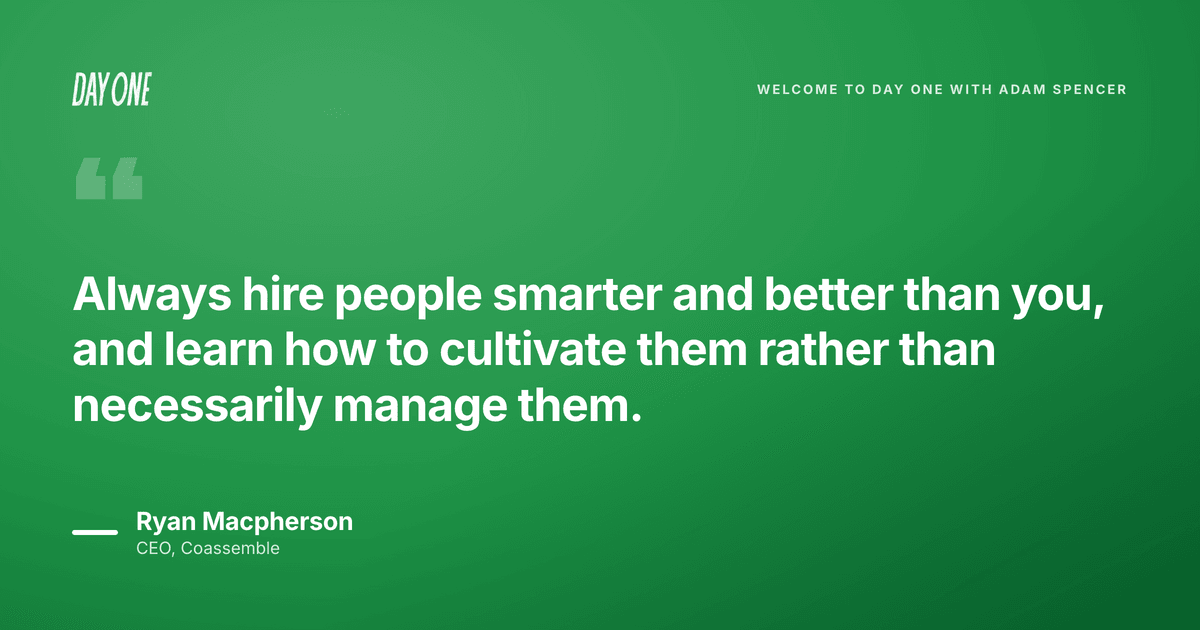
Transcript Synced · select any line to jump ▾ 0:00 Adam Spencer: You're listening to a DayOne.fm show. 0:05 Speaker: What drives you to make bold moves, to build something that didn't exist before, to live, lead, and choose life with intention? Welcome to Perspective X. I'm Pauline Fatowi, and this is not your typical business podcast. Each episode, I get to speak to extraordinary entrepreneurs and leading innovators to unpack what truly fuels their journey. Not just the wins, but the inner work, the overlooked decisions, the mindset shifts, and the personal moments that sparked something bigger. This show is about the ripple effect of choice, the kind of deep accountability that lets us respond to life rather than react to it. Because when you realize everything is temporary, and you are the creator of your own experience, you start to play the game differently. So if you're curious about how people build meaning alongside success, how they evolve through challenges and shape the world with intention, this is your invitation to listen in. Perspective X, where we go beyond the highlight reel and into the moments that changed everything. Available now wherever you get your podcasts. 1:22 Ryan Macpherson: But let's be honest, my experience on running a company is zero. I'm a PE teacher, I kick balls around for a living for 6 years and, you know, taught sex ed. You know, that's where I am, that's where I'm formally trained, right? So, you know, here I am today running a team of 31, a multi-million dollar company. 1:40 Adam Spencer: Hi and welcome to Day One, the podcast for regional startups and the organizations that support Australian entrepreneurship. Welcome to Day One is brought to you by the City of Newcastle. Today I'd like to share the story of a Newcastle startup that has been flying under the radar for some time. A local Newcastle startup that has customers internationally. That startup is Coassemble and its co-founder, Ryan McPherson. 2:07 Ryan Macpherson: Hi, I'm Ryan McPherson, co-founder and CEO at Coassemble, a Newcastle startup revolutionizing the online training game for small to medium businesses. 2:15 Adam Spencer: But first, I'd like to tell you about another organization that is helping startups succeed in our region. The City of Newcastle is a big supporter of entrepreneurship in our region and has recently launched a brand new digital hub called Nui Hub. Nui Hub is a growing and vibrant community of Newcastle startups and founders. It's a central hub where you can learn about what's going on in our ecosystem with events, available jobs, and other resources. I'm really grateful for the City of Newcastle's support of this series. I love telling these stories and their support helps make that possible. Let's get back to the story. Coassemble is a service which helps businesses create their own interactive online courses, which can be used to educate their teams or their customers. They are a global company with staff in Denver, Wisconsin, LA, Canada, and Newcastle. They are backed by venture capital, and their latest Series A raise was $4.5 million. So how did Ryan go from being a PE teacher to CEO of a global multimillion-dollar company overseeing 30+ staff? To answer that question, first we need to go back to day one and hear the story of how a policy of the Kevin Rudd government would dramatically alter the course of Ryan's career. 3:34 Ryan Macpherson: So I guess I come out of uni and I'm targeted as a targeted teacher to Mount Druitt, which is, you know, an interesting area to teach in and I absolutely loved it. I spent 6 years there probably forming probably who I am today. I absolutely loved the experience. But Kevin Rudd actually drops a laptop in everyone's hands as a kid essentially in about 2007 and there is no way in hell that teachers were prepared to teach with technology. I was kind of a bit of a young gun, up and coming, think I could tackle the world. I literally just started playing with some of the best edtech tools back then who are now the tools that we kind of look up to, you know, Prezi, Edmodo. I started playing with those tools and could see the power straight away of engaging a cohort of kids or, you know, learners in technology. It just made a massive difference in the classroom. So I— 4:22 Adam Spencer: Yeah. 4:22 Ryan Macpherson: I focused on that, started educating other teachers. I guess I found a bit of a calling there where, you know, I was able to impart good ideas, also get into the tech quite quickly and understand how it could benefit, merge the two in an explanation to teachers and say, hey, if you were thinking about using this tool, you know, you don't need you don't need to use it every day, but maybe you bring it in on Wednesday and you use this technology to drive the idea further, right? And I guess I got a passion for that. 4:50 Adam Spencer: Ryan's experiences in the classroom in the mid-2000s help him see the potential of technology to revolutionise the way people learn. After years working as a PE teacher, he leaves to pursue a career in the e-learning space. 5:05 Ryan Macpherson: And then that kind of led me to working with a digital agency at some point in my career where, you know, I was lucky enough to work with the ABC ABC, Commonwealth Bank, Fitness First on some of these educational revolutionary ideas in the workplace, you know, to move education through the business, right, and think about technology in a way that could do that, right? 5:25 Adam Spencer: Yeah. 5:25 Ryan Macpherson: And they were expensive projects and they were exciting. We were using things like beacons when you walked past a water cooler, your mobile phone would pop up and tell you to have more water. You know, it was really innovative, exciting stuff. 5:38 Adam Spencer: Ryan is able to build his experience and credentials in the e-learning space, working in various roles, including a stint as Head of Innovations at the Department of Education. In 2015, he and his wife moved from Sydney to Newcastle, and with this change, Ryan looks to make another— to take his passion for combining technology and education and build a business. 6:01 Ryan Macpherson: I was around 2015, and I was looking for the first time to probably launched myself into a business, and I didn't really know what it was going to be like, to be honest, but I felt like I had enough experience in the technology education space to be able to either sell something, build an idea around something, but I'm not technical, right? So, you know, there's no way I could produce the software, and I was lucky enough in 2015 to kind of run across this company called Futura Group, which was run by a guy called Reinhold, who's still, you know, a massive part of the business on the board today. 6:31 Adam Spencer: Ryan starts working for Futura Group, a company providing digital education resources and meets two people who would be key to the future of CoAssemble. Reinhold Foster, CEO of Futura Group, and Jude Novak, a talented developer who had all the technical skills that Ryan lacked. 6:51 Ryan Macpherson: What I love about Reinhold, he had this vision of truly investing in the technology, you know, not thinking always about the profit first and saying, hey Jude, build what you think is amazing. And then Jude had this amazing capability ability to actually do that. When I met Jude, who, you know, designed some of the best apps on the App Store, growing fast, he had this fun, colorful way of bringing technology to education that I hadn't seen before. I thought it was really cool. 7:18 Adam Spencer: Having worked in the e-learning space, Ryan felt that this fun and colorful way of using technology to educate had enormous potential to reach a large audience. Given the resources that were available at the time, —weren't always super compelling. 7:34 Ryan Macpherson: I think if you look at the online training space or e-learning space, it's kind of like websites probably 10, 12 years ago. So there's a lot of what I'd call large cumbersome platforms that are kind of put in the hands of, you know, agile team members, and there's just not a good product fit for what they're trying to achieve in their business. And so we felt like there was an opportunity to really kind of, I guess, revolutionize the content creation piece of that for team members so they're not stuck with clunky old-school technology. 8:05 Adam Spencer: Futura Group had developed a tool called eCoach, which was being used internally to create educational content, which they would then sell to TAFEs, registered training organisations, and universities. And when Ryan joined the team, he saw enormous untapped potential for eCoach, which had made the creation of educational courses much more efficient. 8:25 Ryan Macpherson: Basically, they'd taken, you know, what was almost a year's worth of work to create these 400 assets, right? And they included heavy content, deep knowledge around cookery and, you know, barista skills and all these sorts of, you know, tourism skills that they would then sell on to those students who were training in those spaces. They'd taken this, they used to create it, and Jude talks about this all the time, they used to create asset files for every single screen and then, you know, design that and then put that into a course and then roll that out. And Jude had created this tool with some of our early, you know, developers and engineers that revolutionized that into like 6 months. So they'd halved the time, and that, I was so excited about that. 9:07 Adam Spencer: Seeing the remarkable efficiency of eCoach, Ryan believed that rather than selling the content, eCoach itself should become the product. Ryan is able to convince Jude Reinhold and others at Futura Group to make eCoach its own separate entity and transition into a SaaS, or software as a service, business. 9:26 Ryan Macpherson: And I guess that was an important part where we described earlier that this had to be its own brand. It had to be its own entity. So we, in 2016, we launch in beta. We get a lot of good traction off the back of it. We're coming out of an existing business, so there's a lot of structures that allow us to get to really quick customer traction. 9:42 Adam Spencer: eCoach launches as its own entity, and due to having been developed within Futuro Group for years, the product now being sold as a service is able to gain traction quickly. They start by targeting Australian customers, but soon they receive interest from the US. Ryan credits a significant part of their success to the decision to implement live chat on their website using a service called Intercom. 10:07 Ryan Macpherson: If you're not familiar with Intercom, it's a live chat tool that we implemented back in 2016. Like, we're early on the board for live chat to our customers. 10:15 Speaker: Yeah. 10:15 Speaker: And it's actually driven probably a lot of our success. We talk to our customers over 400 tickets a day. You know, it's a massive part of our engine, if that makes sense, and we've continued it. But this tool allowed us to start talking to website visitors. And so I'm the, you know, we've got 2 developers and Jude essentially at this point in time, and I'm the person that's meant to commercialize and sell it. So I just start talking to people, you know, arrive on the website, you know, hey, where I'm from, Arkansas. I start talking to these customers and we end up signing UMKC, so the University of Kansas Missouri, purely through live chat on the website in a $5,000 deal. And, you know, at that point in time I'm like, Man, we didn't even get on a plane. Like, I did this from Coles, and I'll never forget it. I was actually at Coles of the Junction, and, you know, my wife's there going, "Hey, Ryan, go get some bananas," or something. I'm trying to live chat this customer, and it's like popping up that it's UMKC, and I'm like, "It's University of Kansas. Shit, I've gotta get on this." So I remember standing in Coles for like 15 minutes, and my wife just come and slapped me on the back of the head going, "What are you doing?" You know, like, "You gotta get the bananas," or whatever it was we were purchasing at the time. At the time. So yeah, it's interesting. That kind of led our US, I guess, instincts that we were onto something. And those guys are still a customer today. They now train most of the first-year university students at University of Kansas, Missouri, go through a Coles and Bull course on literacy and research in university and a whole bunch of cool stuff. So signed them off a 45-minute live chat at Coles to the Junction. You know, a lot of people, I think, when they talk about SaaS or they talk about startups, they're like, cool, make sure you grow first in Australia and then you tackle another market. You know, you don't want to go to another market without, you know, nailing your home first. And I kind of thought that was rubbish. So in my mind, our market wasn't yet mature enough here in Australia to actually understand what we had. And I thought the US was already there. So we actually saw so much organic growth in 2017 coming out of the US that we said, no, let's go there first. And, but basically we go to the US and we find out about this company called eCoach. And we're named eCoach at the time. 12:14 Adam Spencer: Right, right. 12:14 Ryan Macpherson: And hilariously, I mean, they're a small company backed by the NFL. So, literally, it's a coaching app which allows you to coach golf, tennis, and they've got NFL players on their website, and they've trademarked essentially the name eCoachin'. So we wanna go to the US, we definitely wanna kinda tackle this market, but we don't have a name that can actually do that legally, or whatever, we never thought about that. So opens up the trademarking discussions, legal discussions, and me and Jude actually driving down the freeway, we spent 2.5 hours talking about what name we should we should have for Coassemble, thinking that, you know, us two geniuses will just come up with a name. And we come up with Stick and all sorts of other crazy, terrible names. But in the end, we went to a local company and actually Scott, who worked at that company, Shorthand, you know, kind of helped us come up with the brand and the name around assemble, which is what we first started with. And the idea was we help people assemble content that they then share with their teams. So it made a lot of sense. And then we went for that one, and that was also taken So, you know, the lawyer in the US, actually I'm on a call and I'm actually in LA at the time and I'm there trying to think about this naming and we're like, oh man, we've hit another brick wall. And the lawyer goes, well, you know, you could put something in front of it, right? He goes, you know, like Co. And we're like, shit, that's not bad. And CoAssemble is born, thanks to the lawyer. I don't remember his name, but I'm sure we paid him heftily for it. 13:38 Adam Spencer: So CoAssemble is born and thanks to their origins in Futura Group, Assemble is able to get a running start, attracting clients from both within Australia and overseas. But they quickly decide that to grow at the pace that they envisage, they'll need to seek investment. 13:57 Ryan Macpherson: We come out of a business that was bootstrapped by the original owner. Cash from the original business was used to form that initial part of the company, and we're very thankful for that start because that's what really allows us to kind of take eCoach back then out of the company and do what we're we're doing today. We then kind of look for our seed round, right? And they call it a seed round because they assume that they're planting the first seed or something like that. I'm sure there's a great analogy for it. But really at that stage, and I talk to the team about this a lot, they're really only investing in an idea. I mean, you've got very little traction on the table. You might think you're a mature business, you've got 5 people and they're doing great jobs, but you're not really. And they're really thinking, does this idea you, or this market, or this product, or whatever, have the potential to be a serious player one day. And they're taking a massive gamble on that, and you've really gotta convince them on one thing, that you have a vision and you know how to execute on it, and it's as simple as that. 14:52 Adam Spencer: Coassemble are successful in securing investment and continue to grow. At this point, Ryan has gone from PE teacher to CEO of a venture capital-backed company. That right out of the gate is a global operation providing services in the US and Australia. It was a big transition to make, and the journey wasn't without its turbulence. 15:14 Ryan Macpherson: So I guess Jude and me, like, early days, you know, he'd probably say that now that I was a good guy and he likes me, but I think at the time he probably thought, who is this kind of PE teacher coming in to commercialize this product? He's got no experience, like, what the hell is happening here? So I think if you were to really get Jude, you know, to answer that question and deeply push on him, he'd probably be like, yeah, I didn't really like the dude that much when we first started. Now I think, you know, me and Jude have proven that there's a really nice balance between having someone that's super passionate and talented and skilled on the product side, and me not wanting to play with that, actually wanting to foster it to allow it to grow, and then me focusing heavily on how I can build I've got a team to probably commercialize this product and take it to market. So when you have that combo, yeah, it's a nice combo. At the end of the day, if you're familiar with running a company, any shape, size, cafe, right through to, you know, Westpac, for example— I've got no idea what that looks like— but I think there's always this responsibility, the way that I see it at least anyway. I've got a responsibility to the team. At the end of the day, they're actually the ones that are delivering the experiences to our customers. The one time where you get really nervous especially as a startup who is investor-led, you know, and growth is really the only thing that you can really report back on, right? You're not here to necessarily talk profit at this point in time. We're really about where is the growth, where are we going, what's the direction. At the end of the day, I have two jobs. I have the ability and a necessary need to raise money. Like, we are investor-led, we need people to invest in our vision, and that's part of my job. But the second is just to allow our team to have the opportunity to grow. And so when you have those moments of like, oh, can I do this? Maybe I'm just a PE teacher. What the hell am I doing? Because I have those moments a lot, you know, where's my whistle? I should be back on the top oval, basically. I think there's these moments that you kind of reflect and you say, at the end of the day, what would I be doing? I'd be letting the team down. And I think if you've got that approach to, you know, shareholders matter. Yes. Hey guys, you matter. But at the end of the day, the team and what they're actually doing for our customers and the opportunities they have to grow, you know, some of our team members have grown from, you know, 3 years, 4 years in the business to now be heads of the business, if that makes sense. That opportunity is probably what you don't wanna give up on. So fires are everywhere in every startup 'cause you're always under-resourced for what you're meant to achieve. Yeah, you just gotta ask yourself, what is it, what are we really doing this for at the end of the day? For me, it's the team. 17:40 Speaker: Mm-hmm. 17:40 Speaker: If they've got great opportunities, then I think we're doing something amazing. And so I think we see good culture out of that and we see a lot of opportunity for our team members. 17:48 Adam Spencer: With a great team with technical skills delivering the product and Ryan at the helm as CEO, Coassemble have grown rapidly in just a few short years to a staff of over 30 employees. 18:01 Ryan Macpherson: We now have almost 15 people in customer support, right? It's something you have to scale, you have to invest in. It's not something that comes for free. I'm not at Coles anymore doing 400 tickets a week, right? So there was a time where I was still at Coles and, you know, I'd go out to dinner with the missus and she'd be like, put the goddamn phone down. But the point is, I guess, if you're going to invest in your strategy, then it probably pays off in a metric at some point in time. So we invested in talking to our customers. It's my true belief that that pays off in retention. I think our strongest stat is a 99% retention rate. People don't leave us. 18:31 Adam Spencer: Today, people who join the Coassemble team are trained in part by courses made using the Coassemble service, but it hasn't always been that way. 18:42 Ryan Macpherson: So it's a hilarious story that I probably shouldn't share on a podcast, but you know, for the first 3 years, we don't use our own product. We're an LMS, we're an online training tool. We've got these amazing content creation tools and we're still using Google Docs. Now why that is, I'm not 100% sure, 'cause we had the technology for free right in our house. But I think it comes down to probably what we say to our business. Businesses, there's almost this threshold where formal kind of educational pieces online make sense to a business. And Jude and me have talked about it, right? When we're 6 people, and me and Jude, like, we were doing our absolute best, but I mean, at the end of the day, you're talking about a PE teacher and a guy that's designed apps running a company, right? What do we know really about using an LMS from an HR perspective, if that makes sense? So not much. Yeah. You know, so we use our traditional methods, you know, meetings, me talking to people, and then all of a sudden, you know, we get a bigger team, we're now 30, and hilariously, Dimity in our ops team says, you know, like, it'd be interesting if we used our tool, hey, you know, and signs up, literally signs up, goes through the process and says, wow, I found a few problems for us in terms of, you know, took me too long to create it, and I found this issue here, and you know, And they come back and go, "Yeah, so guys, about this button here." It doesn't work. 20:00 Adam Spencer: You know, exactly. 20:01 Ryan Macpherson: That button doesn't work. And you know, sometimes when your customers are telling it, you're like, "Yeah, yeah, yeah, but you guys, you know, we, yeah, you just, you don't know exactly what's going on." When an internal team member's sitting there going, "No, you missed it." You know, like, it's so much more powerful to have that. So I think that was a good experience. 20:16 Adam Spencer: 60% of CoAssemble's business is now from the US, and Ryan has spent lots of time overseas during the growth of the company, which gives him an interesting perspective on new Newcastle and the opportunities it holds for aspiring entrepreneurs. 20:30 Ryan Macpherson: You know, I've worked in Sydney 12 years. I've worked in, as I said, I spent 6 months in San Fran, 6 months in Austin. We've got an office in Denver. I've spent almost a year there. You know, New Year's, this perfect balance of like, have the lifestyle you really are looking for, enjoy that, you know, kind of cultural experience plus good food plus activities. We're very active, right? But do so in a way where your business is not going to sting you for your rent. You know, I know that we pay about 5K, right, per month. In Denver, for example, we pay, you know, around 8, for example, for half the space. And so first is financial, right? Newry is a great place to find great spaces that are financially viable for starting a business when you don't have much cash, right? And today we pay 5, but I first, you know, got our office at 1, you know, and it was the stairs to hell. I— it was pretty scary heading up stairs to this place. But, you know, you have lots of great opportunities in Newcastle to think about team having balance in their life. You know, we have a fully flexible working arrangement, they come and go. If Jude, for example, is a surfer, wants to go down to Carryhole, he can do so. Newcastle presents this unique balance of lifestyle and talent and passion. I think we've got that in spades. Startups really breed a culture of excitement around business. Right? And I think there's a real opportunity for Newcastle to be seen as a place that can not just innovate, but build things that go global. And I think when you go global, that brings a lot of people to your city thinking about the opportunities that exist in a global business. So for me, startups allow global thinking from day one, because if you don't have that, then to be honest, like, maybe it's, it's not big enough. So I think startups generally They think that way, so that entices people to come in on a big journey, and I think that helps the city kind of grow its experience, talent, and in its environment. 22:22 Adam Spencer: I finished my interview with Ryan by asking him if he had any advice for founders. 22:28 Ryan Macpherson: There's 3 things that I've lived by. The first thing is always hire people smarter and better than you. You know, and I absolutely have that belief that surround yourself with people that can do a better job than you can and learn how to cultivate them rather than necessarily, you know, manage them. And that's a massive part of how I think we've grown this business, which is hire in talent, let them be free, but give them the strategy that allows them to run in one direction. The second thing is believe in your vision and mission. You've got to have something you're driving towards, otherwise this is a 20-hour out of 24-hour day job. And I don't mean that I'm sitting behind a computer for that long, but you think it, live it, breathe it, you know, you, you never leave it, right? It's like that girlfriend you can't get rid of. So essentially, I think, you know, there's a part of making sure that you are committed to that because your team absolutely requires that. That's vital that they have that commitment from you, that you're going to go out there and do that so they have that opportunity. And the third thing is just make it fun. This is is a stressful enough job as it is, you know, so if you aren't coming to work with a smile on your face, then your team, you know, is in the trenches. They're not, you know, they're not in a business that's stable, they're not in a business that's giving them the best perks in the world, so you gotta at least have a culture that allows them to dive deep, be passionate about what they do, but, you know, come out the end of the day loving what they do as well. 23:56 Adam Spencer: Thanks for listening to the story of Coassemble, and a huge thanks to Ryan McPherson for taking the time to speak with me. Next week on Welcome to Day One, we have a brand new founder story to share with you with Colin Gowdy from Social Pinpoint. These incredible founder stories are made possible with the help of our supporters. We can't do it without them, and I'm really just incredibly grateful for their commitment. To our local startup community and in helping us spotlight these amazing founder stories who honestly inspire me and I hope who inspire you too. The City of Newcastle's Nui Hub is our major sponsor and I'd just like to take a second to express my gratitude for their support. Nui Hub is a great new initiative from the team at the City of Newcastle. It's an online community to keep up to date with what's happening in our region from an innovation perspective. Perspective and also a hub of great resources. I encourage you to check it out and sign up to be a free member. You can learn more by clicking the link in today's episode notes at WelcomeTodayOne.com or by going to NewyHub.com, that's N-E-W-I Hub dot com. This episode was produced by me, Adam Spencer, with scripting and audio editing by Andy Jones. Information about every Everything mentioned in this episode can be found on the show notes page at welcometodayone.com. Music by Lee Rozavier, full attribution on the Welcome Today One website. If you'd like to support this show, please consider leaving us a review or supporting us on Patreon. I'm Adam Spencer. Thanks for listening.