Transcript Synced · select any line to jump ▾ 0:02 Cheryl Mack: Founders scale faster on Deel. Set up payroll for any country in minutes, hire anyone anywhere, get visas handled fast, and get back to building. Visit deel.com/dayone. That's D-E-E-L dot com slash day one. Are you building a SaaS business and looking to achieve compliance with SOC 2 and ISO 27001 or other security and privacy frameworks? 0:32 Maxine Minter: Compliance can unlock major growth and build essential customer trust, but let's face it, it's usually time-consuming and expensive. 0:37 Cheryl Mack: And like really kind of a pain. That's where Vanta comes in. Vanta automates up to 90% of customer compliance tasks, making you audit-ready fast and saving you up to 85% of the associated costs. Plus, Vanta scales with your business, offering a market-leading trust management platform to continuously monitor compliance, unify risk management, and streamline security reviews. Join 7,000 global companies, including Atlassian and Dovetail, that trust Vanta to build and prove their security in real time. 1:03 Maxine Minter: And for our listeners, Vanta is offering 10% off. 1:06 Cheryl Mack: Just go to vanta.com/first. That's vanta.com/first. 1:14 Maxine Minter: Okay, 3, 2, 1. 1:19 Cheryl Mack: Hey, I'm Sheryl. 1:20 Maxine Minter: I'm Maxine. 1:20 Cheryl Mack: This is First Check, part of Day One, the network dedicated to founders, operators, and investors. 1:25 Maxine Minter: If you want to be a better early-stage investor, this is the show for you. 1:28 Cheryl Mack: So TL;DR, if you don't want to suck at investing, listen up. Man, like, I'm just so excited to talk to Ash. To the point where when you said he was coming to town and I was like, "Maybe he'll have lunch with me." And for the record, that lunch was amazing. 1:51 Maxine Minter: It was very tasty. Very, very tasty. 1:53 Cheryl Mack: Oh, I meant the company. 1:55 Maxine Minter: Oh. Ah. Um. I— It was good. I actually am so excited for this podcast. I think he is one of the brightest people I've ever met and definitely the most inspiring in my early investing career. I feel like I have learned so much from him, everything from the way he thinks about company evaluation through to like the discipline around investing, through the discipline in life that is required to support investing. I really like just the wide-ranging, very thoughtfully considered, well-developed opinions he holds on investing. I have found really inspiring, so I'm so excited to have this conversation with him. 2:30 Cheryl Mack: I guess he's got, like, he's got such a wide range of experience, right? Like, early days at AngelList, then actually investment banker first, something about oils I read on his LinkedIn, or batteries or something. 2:43 Maxine Minter: Yeah. 2:43 Cheryl Mack: And then AngelList, and then starting his own fund, and even like living in Italy and just, you know, supporting companies from Europe as well, I think. So just talking to him about some of those things, I'm really excited to ask him like, "Hey, what has that been like in the early days when you first started investing?" And also he wrote a book about AI, "The AI First Company." Yeah. He must have been investing and like looking into AI from the earliest days before you and I even like knew the concept of AI. So I think we'll hopefully get to ask him a little bit about that. 3:14 Maxine Minter: Right. Well, yeah, one of the items on his incredible CV is that he co-built Zetta. Which was, at least I understand, the first AI-specific fund in the world. And so he was specifically investing in AI and certain applications of AI way before. Actually, his partner at the fund is now the head of MIT. And so they were very early in the space. So yeah, there's just so many topics I can't wait to cover off with him. 3:42 Cheryl Mack: I wonder what he thinks about investing in AI now. 3:45 Maxine Minter: Oh yeah, we'll have to wait and see. 3:47 Cheryl Mack: We will wait and see. All right, let's get on to it. 3:49 Maxine Minter: Let's dive in. 3:55 Cheryl Mack: This is gonna be fantastic. I'm excited. I hope you're excited. 3:58 Ash Fontana: Yeah. Well, this is the first time I've suggested myself for a podcast rather than being asked. 4:04 Maxine Minter: It was so smooth. 4:05 Cheryl Mack: I was actually also surprised when Maxine was like, "Hey, Ash asked to be on the podcast." I was like, "Really?" We're still in the phase of like us asking other people to be on it, not having someone like Ash come to us and be on it. Now I feel like we're basically celebrities. 4:17 Ash Fontana: Well, exactly. I liked what you guys are doing and I thought that I might have something to offer people that are in this phase of their career where they're either just starting to write first checks or thinking about it or thinking really experienced and then going back to writing first checks. So I've done all of those three things and I really liked how you're approaching the topic. 4:37 Cheryl Mack: Thank you. 4:38 Maxine Minter: I would toss one back. I think you are probably one of the best placed people to share all of the different versions for folks that are thinking about starting either at the very beginning of their investing career or managing other people's money, right? Like that they have just started thinking about funds. You've had an incredible vantage point across multiple peaks in the ecosystem at different moments in history that I think are really valuable. 4:59 Ash Fontana: Yeah, I've done a lot of things poorly. 5:01 Cheryl Mack: You learn the most when you do them wrong though, right? 5:04 Maxine Minter: Something like that. 5:06 Ash Fontana: That's what we like to believe. 5:07 Cheryl Mack: So the first question we always ask our guests when they come on is what is the first thing that you ever invested in? Anything from like, a book, you know, our last podcast guest invested in books, to your education, to a stock? 5:19 Ash Fontana: I think the most significant investment I made was in mockups for my first website business. And so we had a designer friend and we paid him a bit of money. It was probably a couple of hundred bucks at the time, which when you're in high school was a lot. And he did these really beautiful mockups for this website we were creating. It was a website where you could buy services related to school formals and running events. And we took those mockups and like laminated them. And then we went to sales meetings with them and we sold our first subscriptions, like signed our first contracts, got the first money in the door so that we could then afford to build the website and run the business and everything else. 'Cause, you know, we were both okay at programming and design, but we weren't, our designs weren't that good. So we decided to pull a little bit of money together, do the mockups, see if people bought it and then go away and build it. Mm-hmm. And that was the right move. And, but it was, it was a big investment for us at the time and it worked out. 6:15 Cheryl Mack: And is that the investment or the company that ended up funding your whole college? 6:20 Ash Fontana: That did fund college for me. 6:23 Cheryl Mack: That's a pretty good return on your first investment there. 6:26 Ash Fontana: Yeah. I mean, college in Australia is not that expensive, but, and I got some other help from the government and everything else, but yeah, it did effectively fund all the college and it was fun. And it's just the experience of going through it, right? It's like, before content management systems were really around, or when like that content management system space was changing. And it's when web-based marketplaces were really becoming a thing. And so at the time I didn't really know it because I was just building a little web-based marketplace, like a tiny one that really had no exposure beyond Australia to any significant market opportunity. Never really became that big, but I realized later By going through the process of building that, I understood a lot of other webplace marketplaces a little bit better. 7:13 Maxine Minter: How painful was it to build websites in that moment in history? I tried to build one at the same time. Oh my God. And then when Squarespace became a thing, it was just like a true blessing. Like the idea of modular blocks. 7:27 Ash Fontana: Yeah. 7:27 Maxine Minter: Really, I love it. 7:28 Ash Fontana: Not having any graphical interface at all. 7:30 Cheryl Mack: Any drag and drop. 7:33 Maxine Minter: Any drag and drop or any, you know, like ability to work with your own website without being technical at the time. Yeah. 7:39 Ash Fontana: Yeah, we were working with the very first version of something called ColdFusion, which was remarkable at the time 'cause it was really fast. I think building websites at that point in time, and we're talking like basically the year 2000 or slightly after, was easy until you wanted to do anything interesting, and then it became really hard. 7:59 Cheryl Mack: Just past hello world. 8:00 Ash Fontana: Yeah, exactly. Like, you know, if you wanted to add payments, if you wanted to add, like more complicated listings and different types of media, it became a lot harder. But that's how we evolve as like an ecosystem. Well, that's how like the web evolved, right? It's like you wanted to do more. And so then another product appeared and then another one, another one. And all these products became really big, eventually became big companies. 8:26 Maxine Minter: Your kind of early investing career in startups, what was your entry point there and how did you get enamored with it? 8:34 Ash Fontana: Yeah, I'd say investing in startups for me began with starting my own startups, you know, whether it was a website at high school or a company I started with two friends of mine about a year after I left university in New York. That was probably what I invested in first in terms of my own time. And then I really started seeing the startup investing world in more detail when I joined AngelList. And I joined when there was about 5 engineers and the founders and 1 or 2 designers. And through that, I really started to understand venture capital a lot better. Now I should say, before that, I was really into investing in stocks. Like when I was in high school, I was really into value investing and understanding companies from their fundamentals up rather than say macro down. I was really into that. 9:31 Maxine Minter: Mm-hmm. 9:32 Ash Fontana: And I had explored the idea of going into venture capital because I was in, initially I was meant to do investment banking, but I very quickly got placed because of my interests and sort of background knowledge into more private equity in technology. So I was working in battery technology and making private equity investments in small battery companies in 2010. And then I thought about going into venture capital. Then I started a startup, then I went to AngelList. And then I left AngelList and started a fund. And so that's how it started and that's roughly how it evolved. 10:05 Cheryl Mack: And do you remember the first, 'cause you do a lot of AI investing now, do you remember the first time that you got excited about AI? 10:10 Ash Fontana: I do. And it was probably in primary school and it was actually to do with studying the brain. And so I was really obsessed with anatomy as a kid. And then the anatomy that is fun to study because you can just memorize stuff pretend to know it is bones and muscles. But the anatomy that's really, really hard because you can't really see it, it's the brain. And so I started like challenging myself to understand more about the brain. And obviously didn't get very far because I never became a neurosurgeon, but I was really interested in that. And then I think that somehow led me to a Ray Kurzweil book about singularity and all that sort of stuff. And then he obviously invented Kurzweil keyboards. And I was really into music at the time. Yeah. I was playing a lot of music and then I started thinking about synthesizers and then electronic music. And so I sort of went from being interested in the human body to reading one— it's non-fiction but science fiction book— and then going back to my hobby, which was music, and thinking about how you could get machines to create music. And then, you know, by then I realized there was a thing and it was called artificial intelligence and it was made up of all these statistical methods and whatnot. So that's how I got interested in it. It was sort of that late primary school into high school era. 11:29 Cheryl Mack: It's so interesting to me because the AI that we know now is this like hot startup tech, like AI that will change your life and design your house for you and what all these things. But at the earliest moments of AI, it was much more about like studying the brain and all of these really base fundamental things that doesn't factor into my day-to-day thinking about AI anymore. 11:53 Ash Fontana: Yeah, I think that's a really good point to make, and it is helpful to recontextualize it in that way. And in fact, this was something I did with my book about AI that came out a couple of years ago, is I made sure at the beginning to say like, hey, this whole thing started with people experimenting with the nervous system of frogs and then trying to recreate very simple neuronal circuits. On computers and so on and so forth. And I think that's really important because we need to remember that these are now very big, complicated systems, but they started by trying to simplify a complex system and then built out from there. And I think it helps you understand AI a little bit better if you go back to what were these original simple neuronal circuits that we're trying to model what was a perceptron and what was that whole movement about? Because then you can sort of build an understanding from the bottom up rather than just sort of jumping into a really easy to use library or framework and then sort of hacking your way back to building some sort of intelligent system. Another good angle to approach AI, I think, is from probability and just starting with statistics and a probability textbook, which is something I've also done. And I did sort of midway through my AI investing, I was like, hang on a sec, I need to go back to this and really get at it from that angle as well. Because then you build an understanding up from basic betting equations really, or basic statistics. So I think it is important to remember that AI had a basis in that. And also if you think about it just from a tooling or like a utility perspective, The first AIs were programmers trying to automate their work 'cause they were lazy. 13:44 Maxine Minter: Like all best tools. 13:45 Ash Fontana: Yeah, exactly. Like all best tools, they were trying to get leverage on their time. And that's what AI needs to do. It needs to be a lever for something. And, you know, if we think about where AI is gonna be really impactful, it's gonna be impactful in saving us time and money and whatever else. And that's what it's always been about. 14:05 Maxine Minter: Like so many other tools. I really like the vantage point of understanding this space from a probabilistic perspective. I have— I'm familiar with the neuronal one. That's net new information to me. For me. So maybe just purely selfishly, would love you to continue that exploration. Can you paint that picture for me a little bit more? Like you're thinking about the way that you would think about an early stage company and building in the AI space. How do you use— That your knowledge of the history— 14:36 Ash Fontana: That framework. 14:36 Maxine Minter: Yeah. 14:37 Ash Fontana: I could selfishly go on about this for hours and hours, but I would say this, uh, which is if you think about why the brain's really powerful, it's because it's a network of neurons that can somehow manage to make connections between different neurons in different parts of the brain really quickly and somehow intuitively. And so, for example, you know, we hear a song and it reminds us of a time and a place and a smell or a certain person or something like that. And it's completely bizarre how quickly and effectively we can bring back that memory. But we can because of the way that the brain is a very, very highly efficient computer and a very, a very well networked set of neurons that sort of sit layers upon layers upon layers of each other. And so what I'm getting at is I think keeping that in mind helps you try to figure out what AI applications are going to be really powerful. And the ones that are going to be really powerful, at least I argue in my book and elsewhere, are the ones that have a data learning effect. And the core of a data learning effect is critical mass of data a process to turn that data into information, but a data network effect. And just remembering that all the data that something's collecting, that a piece of software is collecting, has to be relevant to the data it's previously collected for it to add additional insight. And so I think thinking about the brain as a very, very effective network, a very, very dense network of neurons, helps you remember that any highly effective AI, not natural intelligence, artificial intelligence, has to have that similar density of data for it to be something that can deliver a result really quickly. That's my super abstract way of connecting those two things. 16:39 Cheryl Mack: Wow. 16:40 Maxine Minter: Yeah. Maybe to kind of apply it also on the other side is there's a kind of upper max on how much you can learn in a particular field. 16:47 Ash Fontana: Yeah. 16:48 Maxine Minter: Right. And so once you get to— 16:51 Cheryl Mack: 'Cause what, you don't have enough data in that particular— 16:54 Maxine Minter: Well, let's take EQ for example. 16:57 Cheryl Mack: Yeah. 16:57 Maxine Minter: Right? If you have a very low EQ, there's a huge amount of return for you to learn the next increment up the ladder of EQ. And so in Ash's example, your ability to collect new information, integrate it, turn it into information and integrate it, then allows you to materially change your prospects by stepping up that thing. But once you become like, top 10% of the world on EQ, like if you become top 9% of the world, you're not getting that much better. Top 8, top 7. Is that a fair application of the— 17:29 Ash Fontana: Yeah, I think often you see these diminishing returns to scale on data. You very much see these in a lot of AI-based applications and you see the data learning effect sort of peter off, but not always. I think you see this in humans too, but I won't go down that tangent. As in, I sort of agree with what you're saying in that you can reach a natural limit in terms of a skill or knowledge or whatnot. I think it's probably true of knowledge and not skills. I'm not sure. And I don't know that we should go down that tangent right now. Yes. But I will say in AI-first applications, you see both. You see a lot of applications that have a diminishing return to scale on data. But some that have an increasing return to scale on data. And figuring out which one it is is incredibly important because the former won't have a very, won't be very durable. It won't have a very sustainable competitive advantage. The latter has an incredibly powerful form of competitive advantage and no one can catch up. It's a rich get richer sort of dynamic. Yeah. A Matthew effect at play. And figuring that out is not easy in my experience. And like, that's what I spent 10 years, the last 10 years of my life doing is figuring out how much of an advantage a startup is gonna have. And in the venture capital sort of context, figuring out if in the 10-year period in which I have to return the money that I've promised I'm gonna invest well, is that startup gonna end, be at the end of that 10-year period and still be so competitive that it can have pricing power and earn a really good margin and therefore be very capital efficient and therefore return a lot of the capital that was invested in it. 19:17 Cheryl Mack: Wow. I mean, for us, I think trying to think about that as a way, like a heuristic of making investment decisions, I think is really important because we aren't, like Australia is not creating the next, or at least I don't think we believe that Australia is going to be creating the next neural network, machine learning, generative, model, but there are a lot of AI companies here who are doing some really exciting things and are absolutely capturing market share. But using that heuristic around, well, actually we need to understand how competitive is this company going to be in the next 10 years is a really important question. 19:52 Ash Fontana: I think this is a really good question for the whole ecosystem, Australia and the machine learning ecosystem in general, which is There's a couple of sub-questions here. Is it worth putting a whole bunch of money into building foundation models and maybe vertical-specific foundation models, like a foundation model for the natural environment and weather, a foundation model for industrial robotics, a foundation model for certain types of languages or certain types of language models? Is that worth, for example, the government or even the private investment industry here investing in? Or should we invest in things that sit above that? Or should we invest in things that sit below that, like chip companies? Or where should we be playing? And I certainly think that at the moment, there is broad brush far too much money going into companies that don't have a competitive advantage. And, and this seems like a contradictory statement, far too much money going into foundation model companies. And actually there's far too little money going into companies that take a very basic version of a foundation model and just spend a huge amount of time tuning it with their own and collecting their own data and blah, blah, blah. So I think the sweet spot is in the middle of those two things. And that's what I've been doing for 10 years. And I think that's where most of the returns are gonna come from. But it is a question for Australia. And you say, well, Australia's not really, someone the other day said to me, well, Australia's not really at the forefront of this machine learning wave, are they? Like they're not really known for that. They're known for quantum maybe and this and that. And I said, maybe, but Canva, like arguably it has more users of an AI-first product than a lot of other companies in the world. But what have they done? Have they built a foundation model to generate images? No, Stable Diffusion did that and all these other companies did that, Midjourney and whatnot. Have they just taken Midjourney and like thrown it into Canva? No, they did something more sophisticated than that. So what is an AI company and what should we, what part of the ecosystem should we to be investing in, I think, is an incredibly important question. 22:15 Maxine Minter: As you said, I think a lot of people are grappling with it, not just in— well, I wouldn't necessarily think of the number of investors investing into AI companies at the moment. I wouldn't just ring fence around the machine learning ecosystem, right? More and more it becomes an input into an app layer development. And so there's lots of people using these tools that don't really understand them in the way that there's lots of people building SaaS businesses that don't understand the fundamentals of computer science. 22:42 Ash Fontana: Yeah. 22:43 Maxine Minter: And maybe you can kind of continue to explore that and opine, like, should we be investing at the app layer? Are these actually the same substrate to be building on? 22:52 Ash Fontana: Yeah. 22:52 Maxine Minter: Or are they not? 22:54 Ash Fontana: It depends on what sort of return you're going for. And it depends if you have another source of competitive advantage. Just to pick a couple of examples that are quite simple, but I think add some color or help us sort of understand what we're talking about here, a lifestyle SaaS business, like something that is a really good product that automates something for a pretty niche industry like lawn mowing companies. If you're going for a certain sort of return, as in not some 1000x return, if you want to build a cash flowing business and blah, blah, blah, that's a really good investment that doesn't necessarily need AI. Maybe throw some AI in there to help sort of pass invoices or something like that, or do some customer service stuff. I think the AI question there is not fundamental to you because of the return profile you're going for. I think there are a lot of other businesses where you might be going for more of a venture side scale return and AI might be helpful in building that product and building that business, but it's not the core competitive advantage. The competitive advantage is coming from something else. Like you have a super valuable integration or you are already the system of record in that industry and you've built apps on top of that system of record, sort of like Salesforce, right? Like is Salesforce core competitive advantage AI? They're incredibly good at AI. They've invested a lot in AI, but I would argue it's not, it's ecosystem actually. 24:28 Maxine Minter: Yeah. 24:28 Ash Fontana: And Benioff's superpower is building ecosystems. And so, you know, AI is more of a sustaining innovation for Salesforce and not core to its competitive advantage. And so I just, I think it depends on what you're going for and what you have. And that will determine whether, you know, you have to really make the bet that AI is gonna give you your competitive advantage or help you create a product that is of a certain scale or not. 24:55 Cheryl Mack: I would love to go deeper into all of these. 24:59 Maxine Minter: Yeah, exactly. 24:59 Cheryl Mack: I know. But you did come on this podcast with, another slightly adjacent topic in mind, which is around some thoughts you have around first checks and why that is a really good strategy for you at this moment. So I'd love to just learn a little bit more about what your thoughts are there. 25:18 Ash Fontana: Yeah, yeah, that is the name of the podcast. Exactly. We should probably talk about that. 25:21 Cheryl Mack: I was thinking that, but you spell it a little bit differently in your country now where you live. Although in Italy, I don't know how they spell check. Can you say it like Italian? Can you say it in Italian? 25:30 Ash Fontana: We don't really use checks. 25:32 Maxine Minter: Oh. 25:32 Ash Fontana: Yeah, we're a little bit more sophisticated with our banking these days than America. Fair enough. So a founder once said to me, and I was the first investor in this guy's company, and he said to me, "You know what? The only value an investor ever adds," 'cause we're talking about value-add investors, is when they write you your first check. And it, you know, hearing that as his first investor, you would think I was offended. Because it would suggest that like everything I've done subsequently was completely useless to him, which is not true in that case. But I actually really like that because it's the case that the existence proof of adding value is that you allowed the entity through which all subsequent value is created to exist. And so I think first check investing is the only way to really ensure that as an investor, you're adding any value to the world. 26:24 Cheryl Mack: Mm-hmm. 26:25 Ash Fontana: And if you're not the first investor in something, I think figuring out if you've done anything useful is really hard. So that's one thing I would say about first check investing. The other thing I would say is it's been my experience, and people could argue this all day long, but— 26:43 Cheryl Mack: And we might. 26:44 Ash Fontana: And we might. We've got some time. It's been my experience that the culture of a company is set really early. Like what's the bar of excellence for engineering, design, product and whatnot? That bar is set really early. And also like how people treat each other and everything, that's all set really early and determines who you can hire subsequently. And the first product you usually build at a company is a product you're still selling in 10 years. You might have built other products and add-ons and whatnot, But that first product is really the product that exists forever. And the positioning of the company initially really determines whether it, you know, succeeds or fails. As in, you either have good competitive positioning at the start or you don't. As in, you're either entering a super crowded market or you're entering a market that's sort of on the come and you're entering way before everyone else and you give yourself enough of a head start to truly, have a chance of succeeding. And all of those things are determined really early. And so I think like the fundamental decisions you make with a founder early on about where to go, what to build, who to hire are really, really important. They're decisions that have an outsized effect down the line. So that's why I've always liked being first and why I continue like being first if I can. And there's a nuance here. There's like first, first, first check or first institutional investor that like really sits on your board and makes stuff happen. There's investing enough money to let someone leave their job and go full-time on something or investing enough money so that someone can really, you know, incorporate the company, hire their first person and launch their first product. I think they're both important. You could say that both are first checks because they put someone into business, but either way, and I've done both, Either way, I like, I like doing both of those things and not later. Like, I don't like being the angel check that's coming in at the same time as a VC fund, because by then you're just marginal money. Um, and I don't like being a VC fund that's coming in, you know, at the Series B or C, because again, by then you're just, you're marginal money. 28:56 Maxine Minter: And that shifted for you a little over your career, right? As you mentioned there at the top, you've done a whole bunch of different roles around the investing landscape and when you were building Xetta, you were doing first institutional checks, but that didn't mean you were always the first dollar into the bank account for them. And then now you are doing personal checks. And so are you also thinking, are you seeking to be that kind of first dollar in the bank account or? 29:19 Ash Fontana: Trying, yeah. 29:20 Maxine Minter: Trying. 29:20 Ash Fontana: Yeah, trying to be the first or one of the first. I think the nuance there is it's very easy to lose all of your money if you only ever invest by yourself and you're writing smallish checks, call it like, like $20 to $200K because it just doesn't last very long with a lot of applications that people want or need to build these days or seeking funding for. So you sort of wanna maybe go in with at least some other people so that you have enough cash to go from zero to one. So maybe like in the group of checks that allow a company to go from zero to one is how I would generally say I'd like to invest. 30:00 Maxine Minter: Yeah. 30:00 Cheryl Mack: On that point though, like, I do find that I find myself in that situation a lot of time where I know that my check when I write with the syndicate is about $150,000, $200,000, but often the startup will, I estimate, need about a million bucks or like at least $500,000, right? So I can have conviction and get excited about something, but then if I don't know what else, like how else that round is coming together, then it can be difficult to make that first decision. And I know a lot of investors, particularly in Australia, tend to like feel that pain point of like, well, like, let me know how your round's going and then I'll come in. Like, how do you manage that balance of wanting to invest, but also being conscious that like, if you're only writing $200K, then the chances, and you're the only money, the chances of them getting to that 0 to 1 are lower. 30:45 Ash Fontana: I tend to solve this in a way that is not very common, which is through coaching or advising. As in I will put in a lot of time as a coach or an advisor. Coaching is paid if they can afford it. And if they can't, I'll advise and then say, look, we'll figure out an equity deal later or something like that. Or you'll just let me invest sometimes if it comes together really quickly. And I try to give them as much help as I possibly can so that they get to a point where they're more compelling to, a few other, at least a few other investors or to a critical mass of investors. And then we can all invest at the same time. So more simply, just put in a bunch of time to try and get them there. That's one way. 31:34 Cheryl Mack: Are you building a SaaS business and looking to achieve compliance with SOC 2 and ISO 27001 or other security and privacy frameworks? 31:42 Maxine Minter: Compliance can unlock major growth and build essential customer trust, but let's face it, it's usually time-consuming and expensive. 31:47 Cheryl Mack: And like really kind of a pain. That's where Vanta comes in. Vanta automates up to 90% of customer compliance tasks, making you audit-ready fast and saving you up to 85% of the associated costs. Plus, Vanta scales with your business, offering a market-leading trust management platform to continuously monitor compliance, unify risk management, and streamline security reviews. Join 7,000 global companies, including Atlassian and Dovetail, that trust Vanta to build and improve their security in real time. 32:14 Maxine Minter: And for our listeners, Vanta is offering 10% off Just go to vanta.com/first. 32:19 Cheryl Mack: That's vanta.com/first. 32:24 Ash Fontana: Another way is to just do it anyway. And what I mean by that is you just write that check, but you just break down the milestones and try to figure out a higher resolution picture of risk mitigation points along the way. 'Cause it's very easy to say, all right, let me know when you get to this much traction or you launch product. Like that's a very low resolution picture of what it would take to raise more money or get a critical mass of investors. But they're actually higher resolution pictures you can build. So like, I know an investor that has invested in something like your company before and really appreciates that this is actually the critical point. And I think with— Yeah. 50 or 100K, we can get to that point, get them involved. No one else in the world will be interested at that point, but they will be interested enough because they've seen this play out before and they think that's a crucial point and whatnot. Then they'll give us enough money to get to the point where everyone will see that this is the real deal and this company is fundable. So sometimes I do that where I like, I'll invest just enough if I have specific knowledge of a risk mitigation point that's like, just a little bit further. And I have specific knowledge of an investor that will invest at that point. 33:40 Cheryl Mack: You must need to know the ecosystem pretty well then. Like how often do you know that like next point of that person? 33:46 Ash Fontana: Pretty often, but like, that's not because I have some extremely good knowledge of the global technology ecosystem. It's 'cause I only really do one thing. 33:55 Maxine Minter: Right. 33:56 Ash Fontana: Which is machine learning and AI. 33:59 Maxine Minter: Okay. So if you're really focused, then it's easy to know. 34:02 Cheryl Mack: Yeah. 34:02 Maxine Minter: It's one of the benefits, I think, of being a specialist. Yeah. Right? 34:05 Ash Fontana: Yeah. 34:05 Maxine Minter: A couple of episodes ago, we did one on diversification, kind of thinking about consolidation versus diversification and the trade-offs folks are making. And I think this is a really important thread to pull out, right? Like if you specialize, right, sure, you consolidate and expose yourself to a bunch of risks, but you can also de-risk in different ways than if you are diversified. 34:24 Ash Fontana: Yeah. I think there's nuance there, which is For me, the diversification comes through the end market that you're approaching. And so I invest, I just do machine learning and AI, but they're exposed to all sorts of industries from insurance to healthcare to pharmaceuticals to infrastructure and roads to whatever, agriculture, all sorts of stuff. So they're exposed to a whole bunch of markets that have a whole bunch of different macro considerations. That have all sorts of different cycles. The one thing I'm trying to understand is the technology cycle. Like, I invest in technology cycles, not market cycles. And the market cycle diversification is sort of natural because the technology is applicable to multiple industries. And that's why I don't really get industry-specific funds unless they're attached to a corporate that is in that industry. That totally makes sense. Yeah, like CBCs. But industry-specific funds don't make sense to me. They seem to be a really bad, way to construct a venture capital strategy. Private equity or later stage stuff, maybe. Um, but I think technology-specific funds, uh, are really smart in venture capital. That's a good way— a basis on which to have a venture capital fund strategy, because you can understand the de-risking points of building certain types of technology, like a consumer hardware-specific fund, or again, AI/ML, or you see this in bio a lot. Like a lot of biotech funds focus on like very specific types of technologies or disease states or therapeutic areas because the technology risk or the science risk is around like a certain biological, set of biological processes. So I think that's really smart. 36:12 Cheryl Mack: Can you make the argument that technology changes so quickly that like on the life of a 10-year fund, is the same technology still going to be relevant? 36:20 Ash Fontana: Ah, I think, uh, you can, but I think that's even more of a reason to specialize. As in, you can't keep up with the changes unless you're highly specialized. Like, there's no way even 10 years ago— today there's definitely no way— but even 10 years ago, there's no way you could keep up with all of the research in machine deep learning, computer vision, which is— was my original specialty, not just machine learning, but deep learning computer vision, unless you were specialized, because then there were about 10 really good papers coming out every couple of weeks, really good papers, maybe every month. And reading all of those papers, understanding all of those papers, understanding the implications, understanding how they're connected to other innovations, understanding who wrote those papers and whether they're going to start companies or not, that's a month's work right there. And then the next batch comes out. 37:08 Maxine Minter: Yeah. 37:08 Ash Fontana: I could do that because it's all I did. And that became quicker and quicker and quicker as in more and more papers started coming out. The innovation became a lot, cycle became a lot faster. But by then I had such a good basis in the research and I had such a good network that I could ask, is this relevant? Who's doing what? That I built up in the beginning that as it got faster, I could keep up with it. And I don't think you could have done that if you jumped in 4 years later. It's like when the first Transformer paper came out, I was onto that because again, that's all I did. I'm not particularly prescient or smart or anything. If that's all you do and you miss that, then you just had your eyes closed. And if you got into Transformers in 2017, then you were able to— you knew when Cohere was starting and when Anthropic was starting. You knew that because you'd been tracking these people since the day they published a paper. Or even before, and you knew that research was going on at Google before. If you jumped into transformers when everyone started hearing about transformers, as in when GPT came out or when GPT-2 or 3 came out, it was already too late. Like, what are you gonna invest in at that point? 38:19 Cheryl Mack: I don't know, what are we investing in then? 38:21 Ash Fontana: Well, everything, if you want to invest in the fundamental technology, like everything was already worth billions of dollars. 38:26 Maxine Minter: Yeah, okay. 38:27 Ash Fontana: So I think you have to specialize to keep up. In very fast-moving tech environments. 38:32 Maxine Minter: Yeah, it's a distinct perspective. How do you think about that? 'Cause I think one of the interesting perspectives or spicy opinions you've shared recently is fund or solo. 38:41 Ash Fontana: Oh yeah. 38:42 Maxine Minter: Right, as an angel or, you know, at scale, solo capitalist, but without anyone else's capital behind you, or— 38:48 Cheryl Mack: And you've done both. 38:49 Maxine Minter: You've done both. You know, especially from our last conversation on this, you know, you're trending individual, you're trending, it is actually, if you can, big qualification, but if you can invest yourself, you should, as opposed to run a fund. 39:04 Ash Fontana: Yeah, my view on this is very particular and there's a lot to disagree with. 39:12 Cheryl Mack: Great, let's get into it. I'll be the disagreeer. 39:15 Ash Fontana: Who's red teaming? Who's not? There's a lot to disagree with here, but picking up from where we left off, I think AI is super competitive now. A lot of funds, a lot of people investing, as I said, at the foundation model layer, at the sort of what I call light AI, which is AI plugged into SaaS layer. And there's some stuff in between, but it's just very, very crowded. And when something's crowded, I don't want to be there. My view is as soon as you're competing, you're losing. You should just aim to be in non-competitive situations. Otherwise you have no hope of even thinking about winning most of the time. So That's one reason I've sort of pulled back from deploying a lot of other people's money because I think it's very, very competitive at the moment. Second reason is I think we're in a very long equity bear cycle and a very long debt bull cycle. And then there's all sorts of other risks around stagflation, which will cause a lot of volatility in equity markets. Which will make a lot of things difficult. It'll make it hard to raise funds. It'll make follow-on rounds hard to get done because everyone's struggling to raise funds except a select few. It will cause a huge amount of disruption in the industry. A lot of the middle of the venture capital ecosystem's going to fall out and blah, blah, blah. And so I think that makes venture capital, which is essentially private equity, very hard for the next 3 to 5 years at least. Mm-hmm. So that's another reason to pull back from raising funds and managing other people's money. Another reason I think to sort of move away from fund investing to first check investing is just sort of a collection of lessons I've learned around what causes funds to fail, what causes funds to succeed, what are good incentives to set for funds, management fee versus carry, and where the industry's at. Yeah. Versus where I think it needs to go. And there are a lot of views around that that you're just not really allowed to have if you're running a fund because you can't run a fund business if you have those views. And whereas if you're an individual, you can have whatever views you want and people can take it or leave it and you'll either succeed and be able to eat or you won't and you have to get a job. 41:34 Cheryl Mack: And which bucket are you in currently? 41:36 Ash Fontana: I'm okay. I don't really invest for me. Like, I don't really keep anything. I invest sort of for like a charitable trust. Yeah. 41:46 Maxine Minter: I'd be really interested as you're thinking about like that portion, there's a whole bunch of macro reasons that you mentioned at the top there, but it sounds like there's some micro reasons, like specifically for funds where incentives lie. I wonder if you could flesh out any of those ideas, 'cause I think there isn't a whole lot of innovation in the business model. 42:06 Ash Fontana: No. 42:06 Maxine Minter: Like the 20 and 2 model? Yeah, the 20 and 2. 42:08 Cheryl Mack: Yeah. I've heard that the US has a lot of different, whereas like Australia's standard— 42:13 Maxine Minter: I think it's a relative statement. 42:15 Cheryl Mack: Is that? 42:16 Maxine Minter: But like, as an objective statement, there's very little innovation in the business. It's my opinion, there's very little innovation in the business. Being thoughtful about incentives, being thoughtful about construction. 42:26 Ash Fontana: Yeah. 42:27 Maxine Minter: Thoughtful about value creation, who you're creating value, all of these kinds of things. It sounds like you're hinting at some of those areas. Yeah. For your, just maybe not casting a broad brush, but just specifically for your decision to invest just your dollars and not raise capital and not invest other people's money. How do you think about those incentives? 42:46 Ash Fontana: Yeah, I think you're right. Like the model hasn't changed since my great-great-great-great-great-grandparents were sending people off from Venice on shipping expeditions. It really hasn't changed. Like that's what, that's where Carry comes from, the concept. Of carry comes from. You send people off on expedition, you say, if you come back, you get to keep 20% of what you bring back and I'll keep the other 80% of the spice haul that you got. And it hasn't changed. That's not to say things have to change for the sake of changing, but I do really have a problem. And it's, I wouldn't call it an ethical problem because everyone knows what's going on, but I'd say it's a bit of a moral problem with like charging management fees. As opposed to just sharing costs. I think it's fine to share costs of like fund admin setup, et cetera, but charging management fees on something that is purely an intellectual capital business doesn't really make sense to me because you don't have any cash outlays as someone who is practicing the craft of venture capital in its most pure sense. All you're offering companies is your advice and your time at most. Sometimes you don't even have to give much advice or time. 'cause they just have it all figured out themselves. And you're not spending money on anything really except sourcing, but sourcing is just, you know, as a lot of people say, it's just shoe leather. Like you've just gotta get out there and be there. So I just really don't think that a lot of things that firms spend money on are useful or relevant in the case of a lot of portfolio services or amount to that much in the case of just getting out there and going to meetings and having coffees with people. Just buy your own coffee or have it at home. So I don't really get the notion of management fees. Also, I think as much as possible, you want to incentivize people to have big wins. And so for example, I think sharing costs and then charging higher carry, like 30% or something like that, is a much better model for a fund. And if I were to start a fund today, I'd start there and work backwards based on feedback from the people that I'm working with on getting the fund started. And I think another thing is just, it's really important to recognize, which is the industry's performance is terrible. It's absolutely terrible. We don't beat the benchmark as an industry, the benchmark being the S&P, and we're certainly not beating it this year. And I would argue in, if you take like the last 1 or 2 years and the next 2 or 3 years, we're not gonna beat it as an industry. 45:21 Maxine Minter: Yeah. 45:22 Ash Fontana: And so what have we gotta do? We've gotta reduce the fee drag on returns, on net returns, and we've gotta change the incentives so we are incentivized to actually make different sorts of investments, price different sorts of risks than people can otherwise get access to or are well priced by the public markets. So I think it's imperative on the industry to just really think about what we need to do to solve this returns problem or it won't exist. 45:49 Cheryl Mack: I think our last guest was saying that 45% of venture funds in the US like aren't deploying at the moment. 45:57 Maxine Minter: Mm. Mm, that was during '23. 45:59 Cheryl Mack: Oh, during '23. Still weren't deploying last year, which like that contributes to the like fee drag, right? If you're not deploying. 46:05 Ash Fontana: Yeah, 'cause they're still charging management fees. 46:06 Maxine Minter: Yeah. 46:07 Ash Fontana: And not putting any money to work. 46:09 Maxine Minter: Yeah, yeah. 46:11 Ash Fontana: And 90+ percent don't beat the benchmark. 46:14 Cheryl Mack: —90+ funds in the US. 46:16 Ash Fontana: 90+ percent of funds don't beat the benchmark. Of funds don't beat the benchmark. 46:18 Cheryl Mack: Yeah. Crazy. You invest in funds though, don't you? 46:21 Ash Fontana: Not really, no. 46:23 Maxine Minter: You have. 46:23 Ash Fontana: I mean, sure, I've invested in super big funds that are amazing, like Sequoia, and super tiny funds that are amazing, like Background Capital, which no one's ever heard of by sort of definition. People like solo GPs that I really trust. I've invested in, with some funds, but like I really only invest in a fund, same as with a startup, if they really want me there and I'm like fundamental to the formation of the fund in terms of helping them with their core strategy, getting their team together and raising their fund. And then I'm not charging fees on that because I've helped them so much get it off the ground. I just don't see the point in paying for something that I can do myself. Like I'm a venture capital investor. Why would I pay someone else to be venture capital investor. I pay people to invest in property for me 'cause I'm so bad at that. I'm very good at intellectual property. I'm very bad at real property. 47:15 Maxine Minter: Physical property. 47:15 Ash Fontana: Very, very, very bad at it. And so I'm very happy to pay fees. 47:18 Cheryl Mack: At least you know your strengths. 47:19 Ash Fontana: Yeah, I'm very happy to stay within my circle of competence. It's very small and I just stay there. Yeah, I'm happy to pay fees on something I don't know how to do. It's like I'm happy to pay a dentist to work on my teeth 'cause they're the expert. But if it's, it's something that I know how to do myself, like cook my own meat, my own dinner. Like I don't need to pay someone necessarily to do that unless they're much better than me. So no, I don't really invest in venture funds. I just like to help certain people start certain types of funds that I think should exist. 47:51 Cheryl Mack: And are they using different models on the fees? 47:54 Ash Fontana: Yeah, some of them are using different fee models and some of them have different incentives. So two funds that I've been helping a bit in the last year last year. I won't name them 'cause I don't need to. And because they're, some of them are public and some of them are not. One, for example, the GPs themselves are putting a gigantic portion of their net worth into the fund. Like they're putting most of their personal net worth into the fund and they're going for a very heavy carry, very low fee model. And they're starting a fund that's going to invest mostly in Europe. And I think we need more good Series A investors in Europe. So I've helped them. And another fund is using a heap of software, a lot of really good process and community and good sort of networking tools to build a fund that invests in hundreds of startups per year. And so I'm very happy to help them because I think they're really innovating on the venture capital model. These are people that came from AngelList. Mm-hmm. And they're seeding just a huge amount of companies, again, mostly in Europe, not just, but mostly. And I think that needs to happen, both the innovation and seeding more companies. 49:05 Cheryl Mack: So that you can write more personal checks. 49:07 Ash Fontana: That is helpful. Yeah, I mean, I do— 49:10 Maxine Minter: You're like, oh no, I hadn't thought about that. 49:12 Ash Fontana: I do co-invest with them, but I don't really, I don't invest solely in Europe. Like I, in fact, the super majority of the companies I invest in are in the US. 49:20 Cheryl Mack: Any Australian? 49:22 Ash Fontana: Not that I can think of, as in yes, like a couple, but percentage of portfolio, it would be 10 or so, 10%. 49:32 Cheryl Mack: And the rest of the world, Asia, anything there? 49:34 Ash Fontana: Not a lot, no, not really. I stay away from markets I don't know very well. 49:41 Maxine Minter: Fair, fair. So as you have been, I mean, already you have been part of so many incredible moments in ecosystem development. As you think about from here on out, thinking open question for me is, right, is there a season to be an investor in our lives, or is this actually a forever thing? Can you be an excellent VC investor regardless of fund or individual, or maybe it differs, for a very long time, or do you have a career? 50:11 Ash Fontana: Big topic. Um, so to start this off with an opinion of someone that I cannot name, but I can say has recruited probably the most successful venture capital fund partners in history. She's a myth. She said the ideal, like the ideal time or the most productive period for a venture capital investor is 35 to 45. So that's something just to think about. Not my opinion. 50:41 Cheryl Mack: That's a very, 10 years? Like that's it? 50:42 Ash Fontana: That's the ideal. Yeah, well, it's 3 investing periods, right? Yeah, okay. 3 by 3, roughly. That's something to think about. Here's my view on this. And I break it down a few different ways. I think I find this sort of skill-luck spectrum or dichotomy, that is a bit more of a spectrum, really useful, which is, are you in a skill-based profession or a luck-based profession? You know, skill-based profession would be like— What do you think this is? Yeah, a skill-based profession would be like making shoes. A luck-based profession would be like a movie star. I think VC is far more luck-based than skill-based. 51:17 Maxine Minter: Yeah. 51:19 Ash Fontana: And I map that spectrum to, are you in an industry that requires high competence or good networks? So do you need to be very, very competent at executing a certain skill, certain way, or do you need to have a huge network so that you can get very lucky? And again, I think VC is very much network-based. And so to get back to the question, what's the ideal period? I think you start as early as possible. So you start building your network as early as you possibly can, as soon as you have any semblance of credibility such that you can go around the world and start building a network in a certain area. And I think you finish when you no longer have the energy for networking. And for some people, that's pretty young and based on certain lifestyle factors. But some people, like my partner Mark at Zetta, He's older but has all the energy in the world for networking all day long. And so it really, the age I don't think is not the thing. It's when you don't feel like you have the energy for networking in a very extreme way. Now I think, what does this mean? Do you get better or worse as an investor over time? I think it means you get, you definitely get better because of the network effect, like quite literally Metcalfe's Law. 52:34 Maxine Minter: Mm-hmm. 52:34 Ash Fontana: Every additional node you add to your network, it provides more value for every existing member of your network. And so I think the bigger the network you can build, the better, the better you will be, the more useful you will be, and therefore the more lucky you will get. And your career should be only determined by your ability to get started networking and keep up the energy for it. 52:57 Cheryl Mack: That makes me feel super good about my trajectory. I'm like, cool, I'm on the luck network path. And I absolutely love just like, I'm an extroverted heart, so I'll never run out of energy because that's how I get energy. So I'm good to go. 53:10 Ash Fontana: Okay. You're on the right path. 53:11 Maxine Minter: You're like, that has to be right. Cause it like resonates exactly what I want to be true. 53:16 Cheryl Mack: I'm here for that. 53:18 Ash Fontana: I mean, there's some reasonably good, like empirical evidence for this in analogous professions. And Michael Mauboussin wrote a really good book about this. And covered a lot of different professions, but has, he himself, the author, has applied it to venture capital very convincingly. And so it's not my argument. There's some good numbers behind it, but it also matches my experience. 53:44 Cheryl Mack: Excellent. Two final questions? One final. One. So like, you're in a position now where you've experienced like working at funds, starting funds, also writing your own first checks. If you were starting again as a new investor, would you start from this strategy, like only investing personally or what? 54:06 Ash Fontana: Absolutely not. 54:07 Maxine Minter: Okay. 54:07 Ash Fontana: No way. I would work at a big fund that has amazing investors to learn from, that has a really good process. Don't necessarily take that process to your own fund or to your own first check investing. Sort of activities, but at least know what a good process looks like that has existing networks to pull from, experts to consult for due diligence, or people to bring in to help companies, CFOs to bring in or whatever else, that has other investors to follow to see how they build their network, to see how they maintain their network, to see how they provide value to their network, and that has scale so that you can just be in the game. Mm-hmm. I mean, rule number 1 of a job that compound, where your ability to do the job compounds over time, as it gets better and better over time, is rule number 1 is stay in the game. Don't get yourself out of the game by losing all your money. 55:06 Cheryl Mack: Don't run out of money. 55:07 Ash Fontana: And I think that's really easy to do if you're writing your own checks to start and you don't know what you're doing. So no, if I did this all over again, I mean, this is easy to say. In reality, I would've never done this and I didn't do this because I find it really hard to work for other people and in big companies and whatever else. But I would've worked for, you know, a big growth stage or growth stage fund like Insight, Summit, Bain, you know, one of them. Or now I guess you could say like Sequoia Growth or Andreessen Growth. That's right. I would've worked for one of them and learnt as much as I possibly can. Early on before going out and starting my own thing. 55:46 Cheryl Mack: Yeah, okay. All right, well, I don't know how many of our early investors can go work for big funds, but I'm sure there's lots of lessons to be learned there. 55:53 Maxine Minter: I think with enough time, effort, on target, and tenacity, they can get there. They might just have to make some sacrifices along the way. 56:00 Cheryl Mack: Or they could just listen to our podcast where we talk to big funds and learn the learnings from that. 56:04 Maxine Minter: Yeah, totally the same. Yeah, one for one. 56:06 Ash Fontana: Well, yeah, we are We are lucky. I think we have to recognize we are lucky these days in that a lot of the knowledge is shared. It used to be such a cottage industry, so to speak, that you couldn't learn anything from the outside. Now you can, you can learn something, but I'm sort of with you on that. But I'm also with Max in that like, you gotta be there every day and you gotta be in the office like next to these people all day long to really learn how that's done. 56:30 Maxine Minter: Yeah. And trying to learn from both the like explicit lesson and implicit lessons of watching them operate. 56:36 Ash Fontana: And going through portfolio reviews of like 100 portfolio companies that last for days at a time, like sounds incredibly boring, but that's where the good learning comes from. It's like, why is this company doing really well? Why is this company doing really poorly? What can we do about it? How does this fit into how this whole fund's looking? Do we have to make some decisions in this fund to get dollars out earlier? Should we put more money in this company or not? Like, you know, all these very, very complicated considerations. You don't even get to ask those questions when you have a small portfolio, a young portfolio of just like companies that started in the last few years, a portfolio of companies that are in like only certain industries or exposed to certain technology cycles. You just don't get to learn that much from small sample sizes. 57:26 Maxine Minter: It's a masterclass in doing drills on the thing you wanna be excellent at. 57:29 Ash Fontana: Yeah, exactly. 57:30 Cheryl Mack: Or sitting in 100 IC meetings. 57:31 Maxine Minter: Yeah. So very sadly, we are nearing the end of our time together, which means that we get to ask you the question we ask everyone at the end of our podcasts. What is your biggest big kahunas moment? A moment where you felt super brave. 57:47 Ash Fontana: Um, so I've always been one to not really care what other people think, so I don't know what's brave or not because I don't know what's stepping out of the norm or not because I sort of am a bit oblivious to norms. And in a sense, this is like something that gets in the way of functioning in society, but in a sense, it's a superpower. I'll give you a couple. When I was 11, I felt like my appendix was bursting, and so I called, and adults were out of contact for various reasons. Mobile phones were tough in those days and whatnot. I called— not only called my own ambulance, but I ordered the surgeon to do emergency surgery, even though she didn't agree with me that my appendix was bursting. And I basically convinced her with my 11-year-old knowledge of the human body, which was not nothing, but not as good as hers. 58:42 Cheryl Mack: You hadn't studied the neurons yet, right? 58:44 Ash Fontana: No, not yet. Well, partially. I convinced her to do emergency surgery and lo and behold, like it was within an hour of bursting. And so that was pretty brave for an 11-year-old to convince someone open you up. 58:58 Cheryl Mack: It was very specific. Like you had a very specific idea with what was going on in your own body. 59:04 Ash Fontana: Yeah. It was very, it was very odd that I sort of not only had any idea what was going on, but was able to sort of have a conversation with a doctor about it and make it happen. So that, that was pretty brave, I think, 'cause no one likes having surgery, especially not 11-year-olds. But I don't know, I do all sorts of random stuff like certain mountaineering objectives. But I think relevant to this podcast, leaving the fund that I helped start and launch in a period where, for context, this was around the end of 2021 where we were an AI fund and AI was going— 59:42 Maxine Minter: Hot. 59:43 Ash Fontana: Yeah, going pretty strong. It's pretty hot. And the fund was doing really well and we had a great team and blah, blah, blah. Not to mention the obvious, like there are management fees on the table that you can just keep getting by staying. But I left for a whole bunch of reasons, which is a whole nother podcast, but that no one will listen to, nor should they be interested in, 'cause they're personal reasons. But yeah, I think leaving a fund is something that takes a lot. 60:09 Cheryl Mack: Especially a fund that's doing really well at a time when— 60:12 Ash Fontana: Yeah, no problems. Yeah. 60:13 Maxine Minter: Wow. It's also a huge step just in life, right? It is your entire project, your craft, as you said, and to step out from underneath that, in some ways you're still the identity that you are. 60:25 Ash Fontana: Yeah, it is a big identity thing for a lot of people. They identify with the title and having something around them, having an office, having a place to go, having a team that cares about them, having a group of founders they work with. And yes, like you get to keep a lot of that, but for me, I think like having a diverse identity is really important for this reason so that you can, be more rational about a lot of decisions in life that tend to have you pulled by what you identify with. And just as there were a lot of really good reasons to stay and keep investing in AI very aggressively then, there are also good reasons, which I've given earlier in this podcast, to go, which is that AI was arguably getting too hot. The macro cycles were getting very challenging. 61:09 Maxine Minter: Mm-hmm. 61:10 Ash Fontana: And so I ended up on one side of that debate And, uh, you know, I'm very happy with the decision, but at the time it was not obvious, and a lot of people didn't think it was, you know, very smart. 61:22 Cheryl Mack: Big kahunas, I love it. Thank you so much for coming on our podcast today. This has been our first actually recorded in-person episode, so I hope you know that you are our in-person guest of honor. 61:34 Ash Fontana: Wonderful, thanks for doing it. 61:36 Maxine Minter: Thank you.

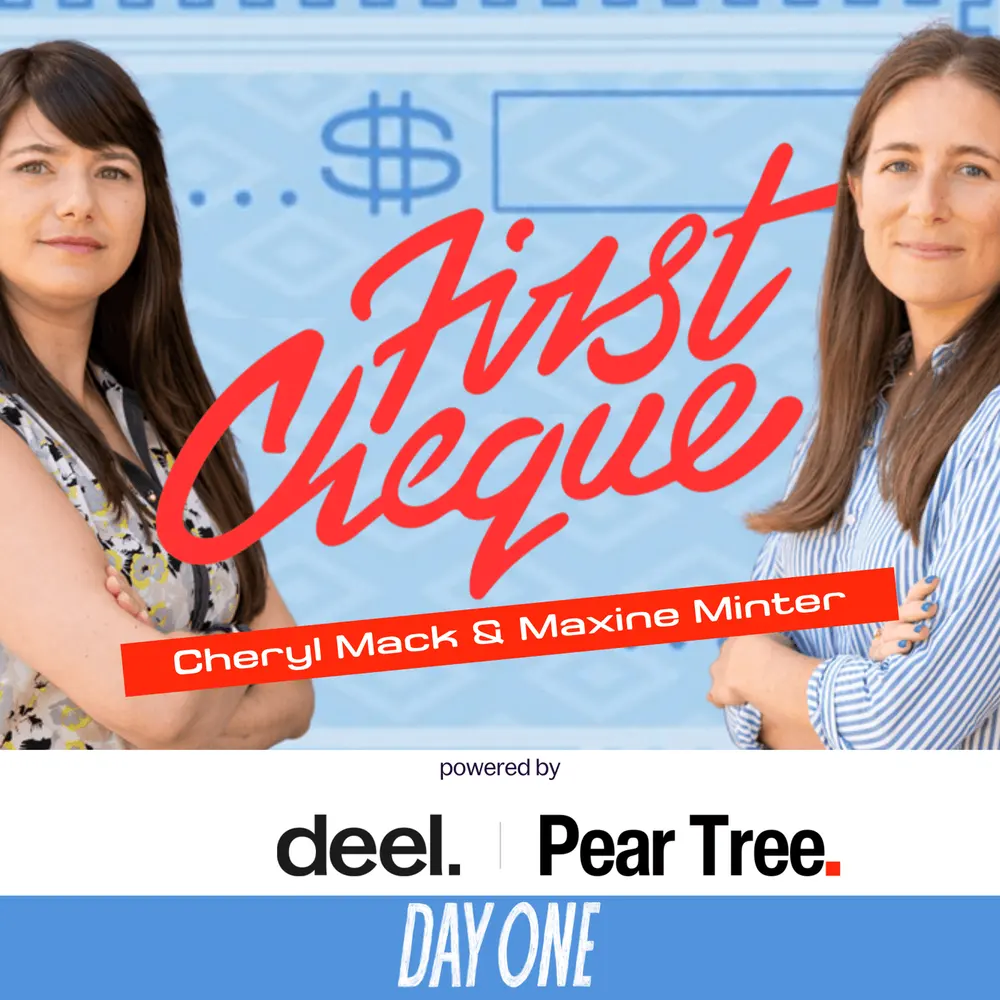 First Cheque with Cheryl Mack & Maxine Minter
Presented by Deel & Pear Tree
First Cheque with Cheryl Mack & Maxine Minter
Presented by Deel & Pear Tree 
 ▶
▶ ▶
▶ ▶
▶