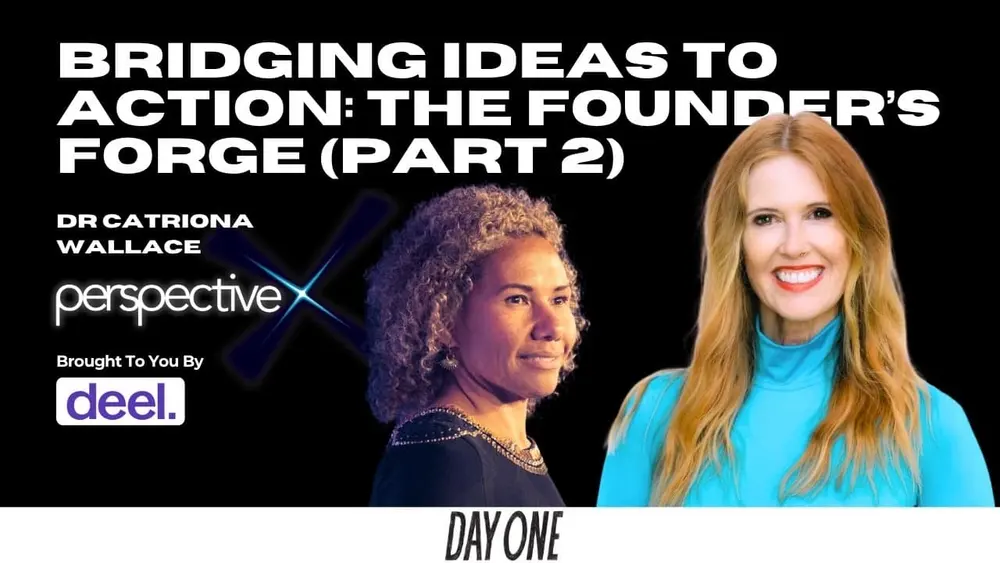
Transcript Synced · select any line to jump ▾ 0:00 Dr Catriona Wallace: Every day as a founder, I've been in the fire and it feels bad and you think you're being destroyed. But what I believe is it's a forge. It's like you're metal in a forge. You know, in the fire is the forge and it's forging of humility, it's forging of integrity, and of course it's forging of resilience and stamina. Your role as the founder and CEO is to unfuck the business. Investors tell me that they would give me the company $1 million if I would take my money my nose ring out. Oh my God. I had investors ring and complain to my board that they saw me talk and my, my hair was not brushed and that I should brush my hair. Like, it was just crazy times of just, oh my God, are we still dealing with this? I think it's technology. I think technology will be the ultimate substitute for leadership. And I had a lot of pushback on that where people said, that's ridiculous, technology is just a tool. I said, look, pretty sure it's coming and it's going to come in a big way. 1:00 Pauline Fetaui: If AI is a new species and we ourselves programmed AI and now it can program other things, is this not all just a simulation and are we not the original AIs? Welcome back to Perspective X. I'm your host, Pauline. Today I get to share a conversation that genuinely improved the trajectory of my year. Dr. Katrina Wallace, police officer turned AI entrepreneur and investor turned medicine woman. She listed one of Australia's first AI companies on the ASX before it became a buzzword, raised $20 million, and has spent the last decade becoming one of the world's leading voices on AI ethics, conscious leadership, and what it takes to evolve as a human being in the era of exponential technology. This conversation was so big, it's brought to you in two parts. Today is part 1. Let's go. 1:55 Dr Catriona Wallace: You're listening to a Day One FM show. 2:01 Pauline Fetaui: Founders scale faster on Deel. Set up payroll for any country in minutes, hire anyone anywhere, get visas handled fast, and get back to building. Visit deel.com/dayone. That's D-E-E-L.com/dayone. Dr. Katrina Wallace, welcome to PerspectiveX. I am absolutely excited, honored, privileged. I must use that word, privileged, to have been able to have met you and now be able to share some of your many paths that you've already roamed through the world and your story, as well as what's ahead of you now with the audience of PerspectiveX. Thank you for being here. 2:49 Dr Catriona Wallace: That's my absolute pleasure. 2:52 Pauline Fetaui: Just so we really understand who you are, we're obviously not gonna capture all of it. I wanna start by doing a little bit of my intro of you and what I've been able to research and gather and some insight obviously from our first conversation that I did not pick up initially. So I'm gonna, I'm gonna go through what I think is a little bit of your bio. It's definitely not in-depth enough nor broad enough, but please correct me if I get anything wrong and we'll go from there just so that everyone knows who we're dealing with on this podcast. So, Dr. Katrina Wallace, your career is absolutely nothing short of extraordinary. I think I've stressed that enough. You started off originally wanting to be a farmer, but instead you began your working life as a police officer at 19, where you spent 4 years. After leaving the force, you completed a PhD in organizational behavior and leadership. You built multiple ventures focused on customer experience and human-centered design. Long before artificial intelligence was a buzzword, you founded Flamingo AI, one of the world's first enterprise AI platforms, becoming one of the very few women globally to list a technology company on the ASX. You built Flamingo through the years of experimentation, fundraising, expansion, and all while raising 5 children. And you navigated a frontier that barely existed back then. That was 2013. 4:20 Dr Catriona Wallace: Yeah? Yeah. 4:21 Pauline Fetaui: Today you're recognized among the top 10 AI ethics experts in the world. You're a founder of Responsible Metaverse Alliance, chair of Boab AI Ventures. In amongst your many other different endeavors, you have featured on podcasts, TV, from 16 Minutes to many other different channels across the world. You speak at, I can't even imagine how many events and conferences you speak at to thousands of people. But for a little old country like Australia, you also were featured on the Australian Shark Tank version televised in the last couple of years as our, one of our own sharks. 4:59 Dr Catriona Wallace: Right. 5:00 Pauline Fetaui: So now your work is expanding beyond that and you are working in the new frontier. Well, the new frontier when it comes to mainstream and commercial world as it is today, exploring how ancient ritual, altered states, and emerging technology can coexist in service of our human evolution. For those of the people who've listened to Perspective X know that this is something completely a passion of mine to explore, especially talking to experts like you have not only dove into it, but actually studied it and practice it. And not only that, you're in a unique position. You straddle across two worlds. You know, you are living a world to understand our own human consciousness as well as technology. Some would say sometimes that those two worlds are very separate. But in your recent book, Rapid Transformation, it very clearly shows the roots and origins of some of the most innovative technologies in the world. And I hope we can dive a bit into that and where they stem from. And they actually obviously came from some level of altered states that is all about human consciousness. So, so I'm excited to have a chat to you. I, I'm really excited to talk more about Rapid Transformation. I have read the book. The book is about inviting leaders to grow not only their intelligence in emerging technology, and you lean absolutely into AI, obviously, given your esteemed background, but also me personally and for so many others, especially the founders who are listening and the investors who are listening, you talk about how we can evolve our own leadership capability and reach higher levels of consciousness to create a better world and the world we want to be in. So, wow. 6:49 Dr Catriona Wallace: Thank you. 6:50 Pauline Fetaui: What did I miss? Did I miss anything? 6:53 Dr Catriona Wallace: No, you missed no— oh, well, you might have just missed my deep relationship and time spent with indigenous elders in Australia and North America and Mexico, and more recently deep in the jungles of Peru and the Andes of Peru, which is where I get a lot of my teaching from around leadership. Is working with these many, many thousands of years old communities and cultures. 7:22 Pauline Fetaui: Yes. So yeah, so I kind of danced around that because I have a whole sworry of questions to ask you about your journey into shamanism. The one thing I love about your story, and I know that everyone else will get a feel for it, is that you've not only, you haven't touched on these things and skated around them, you've spent your whole life journey delving directly into the research and practicing and teachings, you've immersed yourself directly in the cultures as well as the technologies. You've basically eaten your own dog food all along the way. And that is just such a skill. So I don't know how you did that, but especially raising a family at the same time. So yeah, so thank you for pointing that out. I cannot forget that. That's another few books as well, just on that whole journey. [LAUGHTER] So from policing to psychedelics, from machine learning to awakening the human consciousness. It's been an incredible arc so far, and I know there'll be so much more to come. So I'm really excited to deep dive into you. So to kick off, like, you know, the beginning of your journey from wanting to be a farmer to go into policing, then organizational behavior and AI, I can only imagine that that wasn't some blueprint that you had designed yourself, 'cause it just seems a little bit, a bit of a crooked path or an unplanned path. What were the sort of defining moments of your career choices and how did that come about? 8:51 Dr Catriona Wallace: Well, definitely my interest, my career interest was to be a farmer and I went to James Ruse Agricultural High. Our family had a farm that I spent a lot of time on and then I went and I started a university degree in agricultural economics. And so I thought that was my path to being a farmer. When I was at uni, I recognized that all of the people studying agriculture were actually becoming investment and merchant bankers and not becoming farmers. So at that stage I went, wow, I don't think this is the path for me. What do I want to do? And at that stage it was like a time of rebellion against my otherwise, you know, very conservative middle-class upbringing. And it was like, what, what do I think is a job that would be exciting but where I'm in service? So I dropped out of uni after almost 2 years. Studying ag and joined the police force. So that was a really pivotal moment, but also a moment of rebellion. I think it's like, this is not what's expected of me. But in the, in the police for the, the 3 to 4 years I was there, I learned a great deal. One, I learned about the dark side of humanity because I was in the Rocks, Kings Cross, Darlinghurst, and these were in the underbelly days, the late '80s, right, where it was It's very corrupt and dangerous. And so it was my first kind of walk in the shadow side of humanity, and I learned a lot about that. And that's where I also learned about organizational behavior and systems that create poor behavior, that create corruption, that create criminal behavior, not from the criminals, but from the police themselves. And so then when I left the, the cops, I went on to I studied that and that's what took me through into doing a PhD in organizational behavior. 10:44 Pauline Fetaui: And you also did another PhD, you had a doctorate after that as well. You've got two, don't you? 10:50 Dr Catriona Wallace: I have two. So the one I studied is in, at the Australian Graduate School of Management at University of New South Wales. And my topic was technology as a substitute for human leaders. So that, I started that in 1999 when there was no concept really of what was coming. So I was one of the first in the world to be broaching this topic that technology can take the role of humans. And then recently, the University of New South Wales and the Chancellor David Gonski awarded me an honorary PhD in business for the work that I've done internationally in the field of artificial intelligence and ethics, diversity and inclusion, and responsible tech. 11:35 Pauline Fetaui: Yes, it makes absolute sense looking through your career why that happened. So what made you pick that focus area of tech substituting leaders? 11:48 Dr Catriona Wallace: You know, I don't really know. It was suggested to me by my professor that we wanted to, 'cause I was interested in leadership and we came across this theory that existed around there are other things that substituted for human leaders that weren't human. And then it occurred to me, well, what do I feel is coming? And I've always had a really good kind of sixth sense of what's coming 2 or 3 years down the track, 5 years down the track. I can kind of feel it into the future. And I said to my supervisor, I think it's technology. I think technology will be the ultimate substitute for leadership. And I had a lot of pushback on that where people said, that's ridiculous. Technology is just a tool. I said, look, pretty sure it's coming and it's going to come in a big way. So that they— my supervisor took a gamble on me. I took a gamble on this being a subject that people thought was ridiculous and went on to write and do my thesis in that. And that's when my first technology and leadership are so enmeshed and inseparable, really. 12:53 Pauline Fetaui: Yeah. Can you give me an understanding of what, what was that study like? How was that undertaken? Was that a global study? Was it sort of local in Australia? Just to give some more context to your understanding. 13:06 Dr Catriona Wallace: Yeah, so it was a study across Australia and New Zealand of 56 organizations. And what we did is we, we studied the technology they had and the leadership they had. So the technology behaviors of functionality, leadership behaviors, and we looked at the impact that technology and leadership, human leadership had on the subordinate or the employee. And we looked at how either the technology enhanced, neutralized, or detracted from the outcome for the employee. And the employee's outcome was their inter-role performance, so how well they did their job, and their extra-role performance, so how, what a good employee of the company corporation that they were. And we looked at the combination of where technology was actually— got better results, where it got worse results, or where it completely neutralized the leader's ability to lead. And so we came up with these recommendations about how technology and human behaviors should be organized in order to optimize performance. 14:13 Pauline Fetaui: Okay. And then what led you into working in the space of AI and subsequently founding Flamingo AI? 14:24 Dr Catriona Wallace: Right, it was a pretty clear path. So when I finished the PhD, I co-founded a market research firm called ACA Research, and then we created another firm called Fifth Quadrant. And there we were looking at a couple of areas of specialty of research. One was technology, one was customer experience, one was automotive, and one was finance, one was health. And so I ended up doing, leading all the technology and the customer experience as part of the business. And so worked with big global technology providers all over Asia Pacific and the world doing research on their behalf. So the great thing about owning a research company or being a researcher is you become an expert at what it is your clients are studying. So within a few years, I became very knowledgeable about technology, what was good, what was bad, and particularly with relation to customer experience. Mm-hmm. And after running that company for 8 years, I saw an opportunity where I could combine what I'd learned in my PhD and then all this research I'd done to say, I think that technology's evolved enough now that we could actually have technology guiding customers through their experience. 15:38 Pauline Fetaui: Mm-hmm. 15:38 Dr Catriona Wallace: Or supporting the employee. And so I decided I would found a tech company and also very naively at that time, I thought, oh, 'cause I've been running professional services companies, which is all about humans and human capital and managing, you know, 30 consultants and blah, blah, blah, I thought, oh, if I run a, if I have a tech company, I don't have to be doing all the human resource side of it. Where in fact— 16:04 Pauline Fetaui: Right. 16:04 Dr Catriona Wallace: That's the exact opposite. Running a tech company as a CEO, all you're doing pretty much is running human resource. 16:12 Pauline Fetaui: Humans. 16:12 Dr Catriona Wallace: Humans, you do. So that was a naivety. So in 2013, I founded the company Flamingo AI. Flamingo was initially just kind of like a name. It was Project Flamingo, but everyone fell in love with the idea of the flamingo, so we kept the name. And we decided that we would build a robot or a software machine that would guide customers through their experience completely autonomously, so no human involved. And then we evolved into creating a brain that employees would use as a subject matter expert rather than their internal systems. So, very much a precursor to what generative AI is today, but there was no free AI back in the day. We couldn't get it off the shelf or— No. Borrow some GPTs from somewhere and plug them all together. We had to, we had to build our own from scratch and we ended up patenting a new type of AI called semi-supervised machine learning. Most machine learning is either supervised or unsupervised and then this reinforcement learning and other types. But we, we came up with a whole new way of doing this. So we were one of the very first virtual assistant chatbot companies in the world. And I moved the company to be based in the US, in New York, where all our clients were Fortune 200 big American companies. And we list, but we listed on the Australian Stock Exchange. 17:45 Pauline Fetaui: Wow. Interesting. And I can only imagine doing this 20 years ago, well beyond before it was popularized with an interface, like you had to do a lot of the change management. Across the industry, not only the industry, your clients obviously were adopting it and subscribing, but I couldn't imagine the investor conversations at that time. What was that like? Can you, can you share a bit, a bit about that? 18:12 Dr Catriona Wallace: Yeah, that was a difficult time when in 2013 to 2014 when we started to raise money, there was only $20 million of venture capital in the whole country, in all of Australia. It was $20 million. So this was, whereas now there'll be billions of dollars, there was $20 million. So Australia was very slow and certainly to women-led companies, it was less than 1% of any venture capital went to women-led companies. So that being said, I did a reasonable job because I was an experienced business person with some credibility in raising capital for the company. And then when we listed on the stock exchange, we obviously raised money through the public markets. But it was very difficult. I had many comments made to me such as, oh, you've got 5 children, how can you be a mother and be a CEO of a tech company? That's impossible. You need to choose one or the other. I had investors tell me that they would give me the company $1 million if I would take my nose ring out. Oh my God. Investors ring and complain to my board that they saw me talk and my, my hair was not brushed and that I should brush my hair. Like, it was just crazy times of just, oh my God, are we still dealing with this? 19:34 Pauline Fetaui: I'm definitely not surprised at those comments. How much did you actually raise? Were you able to raise? 19:41 Dr Catriona Wallace: Yeah. So over the course of the, the company, which we listed in 2016 and then essentially sold in 2020 when COVID came because that was a very, very difficult time between the start of the company, which if we go back to the start, 2013 to 2020, we would have raised around $20 million. 20:03 Pauline Fetaui: Yeah. Wow. Like, that's no easy feat. That is huge. Like, if that was these days, that would, you know, triple that. In size and effort. Wow. Okay. So I can imagine, and I do want to delve into a little bit about your journey as a female founder. You talked about, you know, ridiculous comments on your personal traits. You know, how was it working? You had 5 children, you moved to New York. What was that transition like? And raising capital at the same time, were the investors right? Like, what was going on? How was it? How did you manage it? 20:41 Dr Catriona Wallace: Mm. So a very good thing was that initially I had a woman chair, a woman called Kathy Reid. So between the two of us, we were a very strong story. And Kathy was a very successful businesswoman in the pharmaceutical field. And so we did a good job as a team in raising money. And Kathy was also, 'cause she had two children, supportive of me. So I had my children lived in Australia, but I had the business in New York and I would fly. I'd be 2 weeks in New York, 2 weeks Sydney, and fly back and forward for 4 years. Every— 21:22 Pauline Fetaui: Wow. 21:23 Dr Catriona Wallace: Third time I was away, I'd take the 2 youngest children, Indigo and Saxon, who were probably 9 and 11 at that stage. I would take them out of school. Even though the school was very unhappy about that, I would take them out of school and I would take them with me. Or if I was going to be away for more than 3 weeks, I'd just take them with me. And what happened, and I credit the Americans for this, is that the Americans were very welcome that I was a startup founder and CEO and female. They were very encouraging of that, whereas I didn't find that in Australia at the time. And also sometimes I had to say to these big Fortune 200 American companies and executives, I'm going to need to bring my children to the meeting because they're traveling with me from Australia. They'll sit in the back. Is that okay? And I found the Americans were absolutely delightful and absolutely said, of course, yes, bring them in and we'd love to have them there. So, and then with children in big meetings, it kind of just drops all the posturing and the— seriousness in it and it's more like a kind of a family discussion. And so it kind of worked really well. And then for the kids, and they sat, they went to Silicon Valley with me, they sat in venture capital meetings, they saw me pitching, they saw me hiring staff, firing staff. And so I think by osmosis, the children learnt a lot about life and business. Mm-hmm. Possibly more than they would've been learning, you know, at school. 22:58 Pauline Fetaui: Absolutely. 22:59 Dr Catriona Wallace: Absolutely. 23:00 Pauline Fetaui: It's funny, you know, I, I always look at the school system that we still have today and I imagine what's ahead with, well, what's currently happening with AI and the future of education. And it just blows my mind how kids aren't still taught the practical things in the world. Like, you know, how to actually use the healthcare system, let alone getting sort of a masterclass that your kids would've seen. In business and entrepreneurship and technology. So kudos for you for taking the bold move and doing it. I can imagine there also is some downfall to that, right? And— 23:33 Dr Catriona Wallace: Yes. 23:33 Pauline Fetaui: It's not an easy thing traveling 2 weeks out of every month for 4 years with 5 kids. You know, is there any— do you ever think back and go, oh, I should have done this or I should have done that? 23:45 Dr Catriona Wallace: Oh yeah. 23:47 Pauline Fetaui: What was the sort of fallout? 23:49 Dr Catriona Wallace: Yeah, so definitely there were times where I was away that the kids, particularly the young ones, really needed me. So one of the things I said to them all was, you know, we're going to do this journey, but we're gonna do it as a family. So you are, I'm gonna tell you everything that's going on, what I'm trying to do, the hardship, the wins, all of it. I'm going to have, we're gonna sit around, we're gonna talk about it. So one thing was that I enrolled all the kids into the journey. It wasn't just me being away. They were on the journey in the part. And even Saxon, my youngest, ended up joining the technology team and learning how to code and, and being part of the team when he was like 9 and 10, which was a beautiful experience. 24:31 Pauline Fetaui: So cool. 24:31 Dr Catriona Wallace: But the other thing I did was I set aside some money, which I call the, the, the Mother's Founders Fund, which was for when my children got to a certain age and realized that I was the cause of all of their problems, that we could go into therapy together. And I literally did that, and they've literally done that. So, uh, I've got two of the children have taken me multiple times into therapy where they have talked about some of the things that hurt them when I was working, or that they missed, or that— Mm-hmm. They've got behaviors now that, that may have come from the fact that I wasn't there for them. And we've worked through that, I think, in a good way. And, and there, for me, probably was like just me having to take absolute radical responsibility for, yes, I was away. 25:25 Pauline Fetaui: Hmm. 25:26 Dr Catriona Wallace: It didn't mean that I didn't love you, but it meant that I had to do some important work. And I'm sorry that it hurt you, and I'll do whatever I can to help you heal and repair now. And so that was hard. There's lots of tears. There was anger. There's some abandonment in there. And so, so I think, yeah, it didn't come without a cost. And would I do it differently? Probably. Yeah, I would probably do it. I would probably do it differently. Mm-hmm. But all the kids are now thriving, are really thriving and strong and resilient and, um, happy that we had that journey regardless of the challenges. 26:15 Pauline Fetaui: Yeah. Like I could imagine, like it surprises me that you said you would do it differently. So I'm curious to hear what that is because, you know, I often find that the most successful leaders and entrepreneurs that I get to meet there is a cost of that success. You know, it's always a juggling act. It's, you can't have everything you want at the same time. So something has to give. And the net result for the impact, of course, is sometimes it's dire divorce, things like that. I experienced my own problems in that space. But then the, I find that, okay, well, The entrepreneurs themselves who had that experience a lot of the time experienced that sort of cost as well growing up, which actually created the drive within them to innately follow something so deeply and passionately. So I don't know if the secret to success is actually a lot of these sort of wounds or problems we carry around. And, you know, the success is the compensation thing to overcome that or deflect or distract from it. So it's kind of, yeah. So what's your thoughts on that? 27:25 Dr Catriona Wallace: Yeah, I got big thoughts on that. So, so A lot of the work I've done post-selling the company in 2020, and a lot of the work that I've done in ceremony and with plant medicine is looking at where did the fire come from for me to do all this big important work in the world? So much so that I would leave my children and go and live in another country and fly back and forward. And how was I not exhausted? Where is the fire for that coming? And through a plant medicine journey, I learned that, well, I knew this, I didn't learn this, but I learned that I had a sacred wound. And in that wound came the fire to do this work. And my sacred wound was a result of being sexually molested as a child from 9 until 13, 14. And then at a later stage when I told my parents, them, not believing me and saying that I was lying. And so— and that was at about 19. And so the imprint of that trauma of the abuse and then the rejection by family and me feeling that I was not important or valued by my own family created a rupture. And the fire in that rupture was one of, "Oh, I better go and do important work in the world that is valuable." And so here comes the, you know, the fire and the motivation, but completely subconsciously. Like, I'm not thinking this consciously. It's just, "Oh, I'm very motivated—" No. —to do this work and to do important work and to help people and be of service and to continually achieve. Even so, I leave my children at home and I go and run a company in another country. I think that came from my wound. It came from my wound. And that's why I said, would I do it differently? The thing I would do differently is fully heal the wound that's driving my leadership. But what do you know when you're in it, right? What do you know? 29:35 Pauline Fetaui: Exactly. Oh my gosh. Firstly, thank you for sharing. And I'm sure that that would relate to a lot of people who, you know, that sort of deep fire, where does that come from? And then trying to link it to something. The way you've actually tied it to that and the result of that, and then not being seen as the key sort of motivator, not being seen, not being believed, and then that fueling, you know, I guess my next question to that, and sorry that you experienced those things, um, is if you had done that healing earlier, like, would that have changed your motivation? Would it have put out the fire? 30:13 Dr Catriona Wallace: Hmm. I think it would've changed the fire. I still think I had a fire, like an innate, really, drive to be of service. But I think the fire ended up being more around ego and identity and reputation rather than being a more humble, genuine leadership in service. Even though I think I was a good leader and I was very kind and a very nice, good leader, etc. But I think there was too much importance placed by me on reputation and identity and being the first woman who's doing that and the first AI company and blah, blah, blah. That— And then I was always asked to go and speak here and there and do all these things which I thought were helping the business. But actually, you know, I probably shouldn't be doing that. I should have been with my customers asking them, how can my product be improved to be more value to you? And so if I was not being driven from the fire of the wound, I think I would have been a better leader. 31:23 Pauline Fetaui: Yeah. And a better founder. 31:25 Dr Catriona Wallace: And a better mother. And a better mother. 31:27 Pauline Fetaui: And a better mother. 31:28 Dr Catriona Wallace: Mm. 31:29 Pauline Fetaui: Yeah. You know, I work with early-stage founders And one of the things we talk about is not getting on the hype train too early, you know, and going in just because you're, you know, the startup ecosystem has quite a lot of sort of, I guess it's like quite cultish, the level of sort of hype and, oh, I'm a founder, so I'm this and then I'm that. And then you do get asked to speak at all these different things and there's events and we treat them like rock stars. And, you know, it's on one hand, it's beautiful because it's like community supporting. Yeah. The mission and getting behind them. But on the second hand, you look at the founder in the middle of it and they're pulled from pillar to post, not able to focus on those things. And they can easily get carried away on that ego drive down the getting more addicted to the actual events and the hype rather than the business. Not to say that you would ever have done that, because I'm not saying that at all, but it's part of it. You've just connected dots for me to think a lot of that And the chasing of that could be tied to the sort of that needing that value, the validation to be seen or wherever that comes from. Yeah. Wow. Geez. Okay. Well, how do I go on talking about capital raising? Who cares? Right? It's like— What a big, big, huge insight into the psyche of an exceptional person. Okay. So down, back down to, of course, you do some things a little bit differently. You did have a safety net for your kids, which I don't know how you had the foresight for that. Did you read it somewhere to actually build a fund for my— your future? I'm sure a lot of people are taking notes for your future therapy sessions. Like, what— where did that come from? 33:12 Dr Catriona Wallace: No, it just occurred to me, this is a very good idea. It's like, my children are blaming me for their— some of their problems. Probably fair enough. I don't think I can sort this out. Why don't we go to therapy? So it just occurred to me to be a really good idea, which I think it most definitely has been. And even just calling that out when they were very early. See, I've got a, I've got a couple of agreements with my children that I had right from word go. One agreement is that none of them are to be married or pregnant before they're 30. And if they achieve that, that they get to 30 and they're not married or pregnant, they get $5,000 cash. And so the top, the 3 oldest ones have all achieved that. They've got their payout. And now, and I've told them this since they were tiny little boys and girls. And so that was a lot of money back in the day, right? And so I've just instilled these sorts of things. I've got 2 to go to get through to 30. The youngest is now 21. But also in, when I started on the journey of being a founder, I had this sewed into them. It's like, this is gonna be tough. There's gonna be times that I'm not gonna be there. You're gonna suffer as a result of that. And probably eventually you're gonna need some therapy. So let's just set that up as we go along. And so then it wasn't a shock. 34:35 Pauline Fetaui: Mm-hmm. 34:35 Dr Catriona Wallace: Oh, Mom, like I've got this trauma now and I think it's you that's caused it. It's like, of course it's me that's caused it, right? Let's go into therapy. And eventually also they learn that it probably isn't all me that's caused all their trauma. Problems that they eventually take ownership for it. So I think it's that thing that I've said before. It's like really enrolling the kids and the partner or family really early in the journey into all of it, all the good and the bad, not just all the rah-rah of the hype associated with being a founder, running your own business. It's like, you know, all of your listeners know it is a shit show. In being a founder. And it's a shit show for your health, for your relationship, for your kids, for your investors, for your clients, for your suppliers. It's constantly like— I love this. One of the first things I learned when I went to Silicon Valley and had the business over there for a while, it's like your role as the founder and CEO is to unfuck the business. 35:35 Pauline Fetaui: I say that about my adult life is to unfuck my childhood. 35:41 Dr Catriona Wallace: Yeah, right. 35:43 Pauline Fetaui: That's interesting. They said that at Silicon Valley. 35:46 Dr Catriona Wallace: Silicon Valley, that's your primary role because everything is on fire. And so it's a family and kids and relationship. No, I'm going to do this. And most times I'm— it's going to be on fire. I need your support. And there are going to be times when I'm not going to be there. But it doesn't mean I don't love you and I don't care about you. I do. And this is our path together. 36:08 Pauline Fetaui: Yeah. It's a beautiful and very honest way. And I definitely can see having that radical honesty with your whole environment around you and bringing them on the journey. It's, that must, it would be so challenging just to even explain what's ahead or what you're doing, let alone for them to understand it and come on the journey. So kudos to you for just being upfront and being, taking the honest route. Cause so many people do hide, hide it and for guilt, for shame of like, oh, I don't sacrifice. I'm just, I'm not spending enough time. Just keep apologizing, keep trying to pretend and hold it all together. But it ends up falling apart later anyway. Yet going down that path is no ordinary life. Like, it's not a life really. It's building to get to the next milestone. So you had a number of successes, obviously, capital raising, building the company over there, and then listing. One of the first female CEOs to list on an AI company on the ASX as well. When that happened, you talked a little bit about ego earlier. At the time, I can't imagine you weren't thinking about that, but what what was that moment for you and what did it represent and sort of how did it change the destiny of your business? 37:17 Dr Catriona Wallace: Hmm. 37:17 Pauline Fetaui: Or you? 37:18 Dr Catriona Wallace: So yeah, so it was a big, a very big moment because I said this in 2016, we were the second ever woman CEO, woman chair business ever to list on the Australian Stock Exchange in its, all its history, which I didn't take that so much as a kudos. I took it as a, Wow, that's disturbing that it's so, so low numbers. And we were one of the very first AI companies to list on the stock exchange. And we were also one of the first startups. So it was at a time where the mining sector had crashed and the tech sector was rising and there was money going in the capital markets. Mm-hmm. From mining into tech. And so we were, even though we were a pre-revenue early-stage startup based in America, we were allowed to list on the stock exchange, which wouldn't be allowed. There's maybe an 18-month period where that was allowed. 38:22 Pauline Fetaui: Mm-hmm. 38:22 Dr Catriona Wallace: And so in we went, and then it was, and so the, the moment of, you know, Kathy and I rang the bell at the stock exchange and, and the shares started trading was a fantastic moment in getting the business to that level. And so then we were the darling of the stock exchange for a number of years. Things went really well until the market started to turn. And then what happens as a public company owner or leader is you have to announce everything that happens. So if you are a startup and you've gone in with a trial for a particular company, you have to announce that. And let's say that company, so we had one of our big clients who then actually, because they were downsizing, shut the whole division that was working with us. So we couldn't continue with the trial because they'd got rid of that part of the business. 39:21 Pauline Fetaui: Mm-hmm. 39:21 Dr Catriona Wallace: And so we have to come back onto the Australian Stock Exchange to say, oh, we're not continuing with the trial and the market doesn't care, oh, because they've lost, they've— 39:31 Pauline Fetaui: Closed that appointment. 39:32 Dr Catriona Wallace: No, the market goes, oh, they did a trial and now it's not going ahead, share price drops. And so there was this mass fluctuation, share price up, share price down, share price up, share price down, as we, the startup, announce things that we've been successful in, announce things that we haven't been successful in, as we were sort of, and at one stage we, Amazon and Google came in and essentially exactly the same product that we had, gave it away for free to all our clients. And so we had to pivot out of a customer-facing robot into an employee-facing one, which we did very successfully, but that takes time and money. 40:08 Pauline Fetaui: Mm-hmm. 40:08 Dr Catriona Wallace: And so share price is down, share price is up, et cetera. And so it was a hell of a ride. It was a hell of a ride. 40:15 Pauline Fetaui: Mm-hmm. 40:15 Dr Catriona Wallace: And in the capital markets, the investors, when they're unhappy, they are going to hunt you down and they're going to let you know how unhappy they are on social media, by email, if they see you in the street, and they are angry if they've lost money, or they send flowers when they've made money. You know, it's this absolute continual dichotomy of happy, sad, happy, sad. And then it got to a stage where we're in 2020, beginning of 2020, when COVID, COVID started and everything got shut down. And so I was grounded in Australia, whereas I needed to be in America with the sales team. And we had maybe 50 employees. And then all our American clients put all their projects on hold because they were just waiting to see, does everyone have to go at home? 41:06 Pauline Fetaui: Of course. 41:06 Dr Catriona Wallace: And so with that came a real drop in the share price. And at that stage we, and we didn't know how long that was gonna go on. So we decided that we would sell the company, sell the company out of the shell that was listed on the ASX and repurpose the shell, take all the investors over, repurpose it into another business. And so that we started an M&A strategy there, which was incredibly difficult again because it was COVID and no one had money. 41:37 Pauline Fetaui: Mm-hmm. 41:37 Dr Catriona Wallace: And so it was, was immensely stressful. And it was one of those times where I would go, oh my God, this can't get any worse. Like, our clients have, you know, put everything on hold. Oh look, now my CTO has been headhunted over to another company, or oh, our supplier has just folded, or, you know, it was one thing after the other. So I read a book, The Hard Thing About Hard Things, I've read that. Yeah. 42:06 Pauline Fetaui: Yeah. 42:06 Dr Catriona Wallace: Recommend to everyone, which is like, oh, you think that's hard? Wait, it's going to get harder. And you think that's hard? Oh, did you know that hard had a dungeon? And through the dungeon is a trapdoor, and through the trapdoor is like the bowels of hardness. Like you hadn't touched it yet. And so it was that whole journey where it just got everything on fire, harder and harder. Anyway, we eventually We eventually agreed to a sale of the business, which was really stressful and hard and had to manage employees and customers. And, and that was in, in 2020. 42:41 Pauline Fetaui: My God. Like, I, that is such a huge experience. What do you think that was preparing you for? Like all of that and going through from the highs and the lows, listing, being the darling to being, you know, chased down by investors to having to actually close a business or exit a business that obviously you were on the frontier of. And then Google and Amazon just spin up something for free, which still happens and is very common. How do you personally cope with that? 43:15 Dr Catriona Wallace: So, so at the time was enormously difficult. And this is when I started using ritual. So I'd get up at 5:30 in the morning, I'd sit and do meditation, I'd do some, some movement, some yoga, and I, I'd to sit in mindfulness. And I did mindfulness meditation practice every day just to come in into center to set the day up so that I could go, maybe for an hour, so then I could go into the day fully present and fully charged to have the resilience to handle whatever next fire was coming my way. And that was an absolute discipline that I had. And what I learned and what I teach now when entrepreneurs are coming to me to say, look, you know, the business when we've gotta go into M&A or something really different, and it's prolonged. Like it goes for capital raising, 6 months, 9 months of every day being in the hell pits, or M&A can be like a year. What I say is in the fire is the forging. You know, in the fire is the forging, and it's forging of humility. 44:21 Pauline Fetaui: Mm-hmm. 44:21 Dr Catriona Wallace: And to me it's forging of integrity. And of course it's forging of resilience and stamina because these processes, they're not just like, oh, I had a bad weekend or I had this week was terrible. It's like this entire year, 24/7 was on fire, or it's a year and a half now, or it's the last 3 years. Every day as a founder, I've been in the fire and it feels bad and you think you're being destroyed. But what I believe is it's a forge. It's like you're, you're metal in a forge, and when you eventually come out, you are changed, you are transmuted. And we don't necessarily know what into, but the transmutation, which is the whole notion of rapid transformation, the transmutation will be in service to you on your path for the future. You might just not know what that path is yet. 45:16 Pauline Fetaui: Yeah. Like, I completely agree, just only with, you know, obviously my own personal experience, but also so many other founders in the stories. And I hear them going through that, you know, you watch them and work with them going through the fire and then, you know, it may come out in a negative way or in a positive way, but the person that gets created on the back of that is, you know, remarkable. Like they're— 45:41 Dr Catriona Wallace: Changed forever. 45:41 Pauline Fetaui: They're so changed. And sometimes it's funny, you know, you think of the, I subscribe to a bit of Buddhism and I love the pathway to enlightenment. And I think it's a modern day pathway to enlightenment. If you wanna get to enlightenment, go and build a tech startup and see how you go. See how you come to the other side of that. My question to you is, would you do it again? Would you do a tech startup again? 46:11 Dr Catriona Wallace: I would. I wouldn't do it now because I've got other interests, but if I had my time again, absolutely unequivocally, yes, I would 100%. And with the wisdom that I have now, oh my God, it would be, it would be great. 46:33 Pauline Fetaui: You'd be unstoppable. 46:34 Dr Catriona Wallace: Not to say that you won't have different fires. But different fires now. 46:40 Pauline Fetaui: Yeah, yeah, you would have a different treatment for each of the types of fires that came out, I'm sure. 46:45 Dr Catriona Wallace: And it was, it was the humility. The humility is a big one. 46:50 Pauline Fetaui: Yeah, what does humility mean to you, and how, what does that look like, I guess, when you show up as a leader? 46:57 Dr Catriona Wallace: So I think it's along the lines what we talked about before, not being caught in the glamour of it Mm-hmm. And it is about actually what are we here to do? We're here to be in service. And what are we here in? We are actually in service of our customers or our clients. That's it. That's all, literally it. Are we in service of our investors? Mm, potentially as a second stakeholder, but we're actually just in service of our customers. That's the whole purpose of business. How do we create value for them? That's, that's better than the exchange they're giving us. And that's where the entire focus should, should be. And whereas me, I was out raising money on stage, talking to investors, all the things, I would have done a much better job if I'd just put all that aside and just spent more time with the customers solving their problems. Mm. 47:52 Pauline Fetaui: Completely agree. I've interviewed a few individuals who've taken companies to unicorn status, and their obsession with customer is the whole conversation. That's right. And you can just see that shining through. So yeah, I understand. So the level of humility is you are just in service to that customer or whatever the goal and the mission is, the problem you're trying to solve. And if you are in service of that and it works out, your customer wants more, and then the results of that and the byproduct is happy investors, happy stakeholders, shareholders, and everything else. Yeah. 48:28 Dr Catriona Wallace: Anyway. Right, exactly. And another thing I have to say, and I think, I don't know, we talk about this enough. So I chair a venture capital fund and we know of the AI companies we invest in, of 10 that we invest in, 7 are going to fail, 2 will do average, and 1 will do really well. And that 1 and the 2 average will make up for the whole thing. So the other thing that I learned was in the ecosystem of businesses in AI, less than 5% of AI companies are successful. So in my field, so 90 to 95% will fail. And that's like, wow, that's a huge number of fa— and we were eventually one of those. We were hugely successful until eventually we failed. 49:13 Pauline Fetaui: Hmm. 49:14 Dr Catriona Wallace: But what I understand in also just looking at evolution and adaptation and survival of the fittest, is there has to be those companies that come and fail. There just has to be because then the 5% out of the 100 that start will pop up and will then go on to some success. But they won't do that unless the ecosystem of the 95 other companies are there trying, learning. 49:45 Pauline Fetaui: Mm. 49:45 Dr Catriona Wallace: And then eventually not succeeding. It's just like, I see it now like an ecosystem, like a biological system, an organism where we have to have those that fail and drop off, and then some of the good things that they didn't have, which certainly I know in my company, 'cause I trained a lot of team members who went on to be very successful in other successful companies, even that is the role of those who've come and then don't have the success perhaps that they wanted. They've still played an important role in the ecosystem. Mm-hmm. 50:20 Pauline Fetaui: Yeah, I completely can see that and I would agree with that. The— it's the experiences that get created out of the journey that is contributing to the whole way the ecosystem works and it's the market dynamics. So yeah, absolutely. Obviously winner and loser. Yeah, makes complete sense. And we don't talk about that enough. No, VCs do obviously. So they're completely expectation is that I guess as an individual who was a founder and you would absolutely understand this is is, you know, you are putting your mortgage, your family, all the costs, like starting out and building a business is on your side of the fence. And so it's a bit harder to understand that. So I, when I work with companies who are capital raising and we're working together to try and get them raised, I try and explain to them that, look, it's just a numbers game. It's a sales process. You're gonna have to just go through it. But every no sometimes feels like, you know, 10,000 bricks just landed on my heart. And— and they really struggle. Some of them struggle to recover just from one conversation. I'm like, oh, you got like 100 more calls to have. 51:27 Dr Catriona Wallace: Yeah. And I used to say, I used to say it's like 99 punches in the face to 1 win. And that you should get up every morning and just eat a bowl of rejection for breakfast. You need to be getting on the phone expecting that 99% of the time you are going to be told no and rejected. And even worse, In reverse, in America, Americans go, "Yes, yes, yes, yes, yes, no." Whereas I found in Australia, Australian business people say, "No, no, no, no, no. Oh, okay, yes, we'll do business with you." But in America, we were like way down the track, 6 months in building a relationship, and then suddenly they say, "Oh, well actually, no, we really like and think your product's great, but we've changed our mind," or, "We don't have the budget anymore." It's like, "Oh my God." So, right. 52:19 Pauline Fetaui: So there's a long no and ours is— Australia is a quick no. Is that what you're saying? 52:25 Dr Catriona Wallace: No, no. Australia is— it feels like a no. So no, no, not interested. No, not interested. Then it gets you. And yes, yes, a long yes. And Americans like a slow no. 52:39 Pauline Fetaui: Got it. So continuing on the vein of giving some advice out, you've raised capital obviously in the US. And you've— and in Australia, as a female founder, you understand the challenges that comes with, and you, you expressed disappointment in that as well, of being the first of many things. Do you wish, or is there something that you think investors could do today that can better understand female founders, or do you think female founders should be taking a different pathway to seek investment? 53:12 Dr Catriona Wallace: Well, I know that the level of funding internationally going to female-led organizations is still less than 3%. And that's really, I think when I was raising money, which is almost 10 years ago, it was— 53:27 Pauline Fetaui: Less than 1. 53:29 Dr Catriona Wallace: Yeah, less than 1, less than 2%. So, you know, it's, it's glacial improvement. But I would still say that the most important things for in raising money for not only females but males is the numbers so that all of the metrics are right, a really detailed understanding of your finances. So I coach a lot of startup companies now, and the very first thing I get on, on a monthly call is I'd say, hey, Pauline, what were your sales last month? What's your cost of acquisition? How much money's in the bank? And 99% of CEOs of startups can't answer that. And that should be every day looking at the numbers and knowing how much did we sell today? What's our operation? What's our burn? What's our runway? How much cash in the bank? 54:25 Pauline Fetaui: Yeah. 54:25 Dr Catriona Wallace: And so that is an Australian thing too, I've found that we are not, good at that. So the numbers and the metrics that you know them, you know them, you know them. Also that you know your market size, you know your competitors, your daily basis tracking what's happening in the market and happening with your competitors. And you could even get your CFO to prepare this, that the founder should always know this, 'cause eventually over time it becomes intuitive. I know that's the flow, that money's flowing in and out, that market's happening here, and you can make decisions much better because you've got a sense of the market and a sense of your own financial health of the business. So I think, I think that's important. I also think that having strong product knowledge is really, really important for women and men founders. They need to really deeply understand their product and deeply understand how it's solves the problem. And so those things being presented to investors, but also most important is that what's in it for the investor? What the person's going to give capital, what should they expect? Because I see a lot of founders go, oh yes, give me your money and we'll do this and we'll do that and we'll do this. It's like, that's not that enticing to— an investor. Investor wants the whole story given to them about if you invest this money in, here's the likely return, here's how it's going to benefit you, here's what we'd hope you'll get your money back, and some projections about what's in it for the investor rather than, oh, you give us your money and we'll go and do these magical things with the company. Having a good understanding what of an exit strategy could be and who would be your likely companies to exit to. Also very important, investors want to know that you're across that. And then with being a female, what I have done is worked in the, with VCs and investors to say that, and say, for example, if I'm listening to, if I'm the only female VC in a room and I'm listening to a female founder presenting, and females do speak in different ways to men some of the times, I will make sure that I potentially say, "Ah, so I understand what you're saying is this, is that right?" And then she can say, "Yes, it is," or, "No, it's not quite right." So to amplify what the woman might be saying. So I think it's always looking for other allies in a room that will support. And then the other thing I did find with a lot of the female entrepreneurs that I worked with is they would bring their personal story into some of the investment meetings. Like, you know, I was a single mother and I was doing this, or I was doing this and doing this. And it's like, oh, actually we never hear the men telling their personal stories quite like that. If this is going to add value to an investor, do so, say it. But if it is just you kind of telling your hardship story as a female, it's probably not going to be useful. Hmm. Does that make sense? 57:52 Pauline Fetaui: Yes. And very radically honest. I think it's, it's absolutely, because at the end of the day, I think the trap a lot of female founders do fall into is because they've had so many nos and they've taken it like the 10,000 bricks on their heart, they're not real. They're forgetting that, okay, even even though this is their personal journey to build this company and it's— they've sacrificed a lot, the investors are looking to do business. So that kind of doesn't have to come into the equation for them. So when they hear that, it's a bit of a turnoff and they don't even know what to do with it. 58:23 Dr Catriona Wallace: Right. I think that's harsh but true. And those stories about the additional hardship women have had to overcome to be founders, whether it's, you know, being mothers, being single mothers, being, you know, having sicknesses or whatever it might be. Tell those stories to your community. 58:43 Pauline Fetaui: In the right audiences. 58:45 Dr Catriona Wallace: Yeah, in the right audiences there. But for investors, it's pretty clinical in what they want to hear, and it is a formula about what they want to hear. 58:55 Pauline Fetaui: Do you have any advice for investors when dealing with female founders? 59:01 Dr Catriona Wallace: Yes, I do. So I would encourage investors to be, to one, to be very present to the fact that the way women present and how they talk and the things they talk about is going to be different to the way males present. And here, let's go male and female. I know if we're talking about gender, there's many other genders that we're not gonna talk about. But if we're just talking about women at this point in time, or those that identify as women, It will be around being aware of different communication styles, being aware of not their own bias coming in. So, you know, this woman looks like she's probably a mother. I don't think I want to invest in mothers. You know, all of those biases that are societal-based, just being aware of those when they, when they come in. I would also strongly encourage investors to have a female in the room, even if it's not another VC, even if it is a research analyst or someone else to be there in the room. So it's not just one female founder and a— 60:08 Pauline Fetaui: Mm. 60:10 Dr Catriona Wallace: Lot of men. And then also for the investors to know that there's very strong research now linking the returns that female-led companies have to better returns than mostly male-led companies. So I think to be across the research that is highly supportive of female-led businesses and their returns to investors. 60:33 Pauline Fetaui: Yeah, and that's a fact now, and it's well validated. You, like you said, research is out there saying that. It makes me feel like I think your advice around the language and understanding that men and women and also all the cultures, so diverse minority groups, if they're raising capital culturally, there are difference in language and It reminds me of what we were talking about earlier, the long yes or the long no. So the process, if we understand Australian investors are a long yes and the other ones are a slow no, maybe we can understand that, well, different cultures, different diverse people who are not, you know, stereotypical white men who are raising capital, there may be different ways for us to approach them and meet them where they're at. And the process is not gonna be that straightforward. So we have to design a system of capital that actually understands that, trains for it. And like, I, I love the strategy about bringing another female or bringing another diverse minority group person in to the actual investment committee meeting or the preparation meetings to talk about the company and the founder, or be there when they're pitching. Great advice because that is the reality. We are all different. We communicate differently. 61:45 Dr Catriona Wallace: Mm-hmm. 61:46 Pauline Fetaui: And matter of fact is the VC world specifically was designed to be exclusive by lawyers and accountants. So it was designed in a very particular way. And, you know, the book Venture Deals talks about that blatantly in the foreword. And so the reality is we have to redesign a system that understands that. And there are many different pathways to a yes. So how do we, I guess, balance out both sides of the fence of work that we have to do? Thank you for that. So like, given your experience, obviously, from the police force to Flamingo AI, you know, raising capital, obviously the heartache of exiting the business and ASX listing, you've had a full spectrum exposure to behavior and all different leadership types and the reality of power and power in the modern world as well. And I'm, I'm, I'm curious what then led you into the world of shamanic path? And because of those things, is that why you went deeper into your world of ritual, the ritual that you explained before that helped you take you through those days where you, you know, woke up and you had to center yourself? What was your journey into shamanic world? And tell us, what is a shaman and what are you? 'Cause I didn't talk about that either. And that is where we leave part 1 of my conversation with Dr. Katrina Wallace. I hope you can feel what I felt, the rare quality of someone who has not just lived at the frontier of technology and consciousness, but who has gone all the way in. I hope you understood the sacred wound, the fire behind the ambition, and at times the cost to build something extraordinary. Part 2 of this interview goes even deeper. We talk regenerative versus extractive AI and why Dr. Kat believes we are sliding into dystopia if leaders don't transform now. We talk about transhumanism, simulation theory— my favorite— and what she sees as 3 streams of human evolution emerging in the next 20 years. We go deeper into her book Rapid Transformation, which I love. It's part memoir, part leadership philosophy, part field guide to altered states of consciousness, and an urgent call to arms about where AI is taking humanity if we don't wake up now. Dr. Kat makes the clear case and evidence we don't have time for 15-year leadership development pathways. The trajectory of AI, climate, mental health, and geopolitical conflict demands leaders transform rapidly, and Dr. Kat shows us how. I genuinely recommend you read this book before part 2 drops, as it will change how you understand and hear the second part of this conversation. Thank you for being here with me on Perspective X. This show exists because of you and guests like Dr. Kat, who are shaping the perspectives of many through aligned purpose and right action. Part 2 drops in 2 weeks. See you then. 64:39 Dr Catriona Wallace: Thank you.


 Perspective X with Pauline Fetaui
Presented by Deel
Perspective X with Pauline Fetaui
Presented by Deel 

 ▶
▶ ▶
▶ ▶
▶