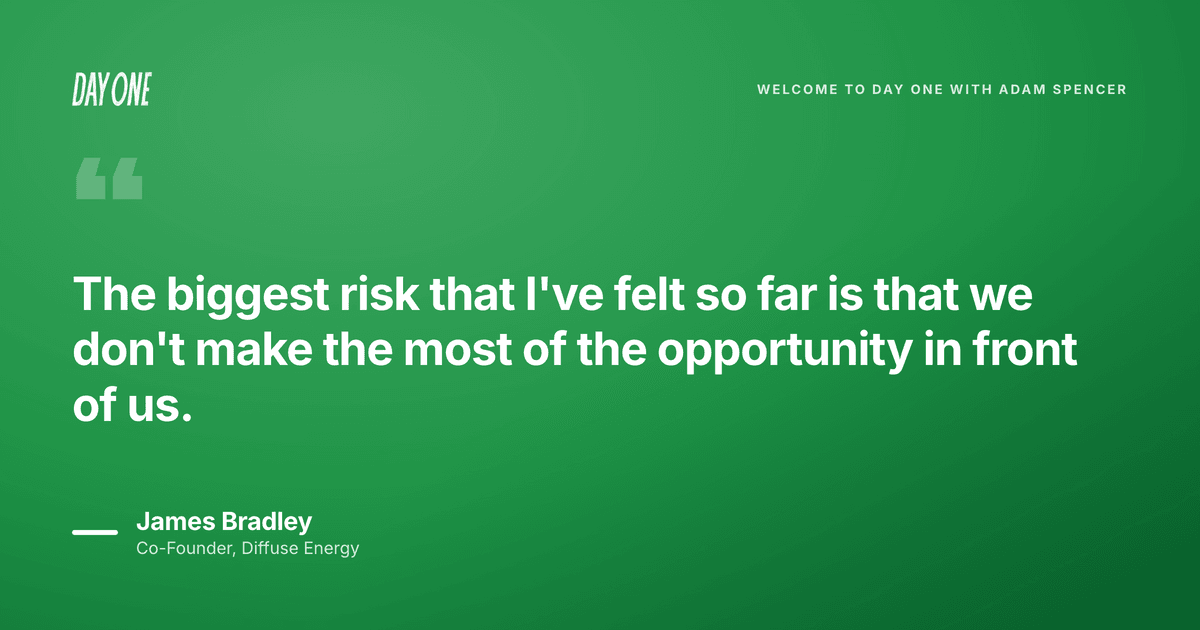
Transcript Synced · select any line to jump ▾ 0:00 Adam Spencer: You're listening to a DayOne.fm show. 0:05 Speaker: What drives you to make bold moves, to build something that didn't exist before, to live, lead, and choose life with intention? Welcome to Perspective X. I'm Pauline Fatowi, and this is not your typical business podcast. Each episode, I get to speak to extraordinary entrepreneurs and leading innovators to unpack what truly fuels their journey. Not just the wins, but the inner work, the overlooked decisions, the mindset shifts, and the personal moments that sparked something bigger. This show is about the ripple effect of choice, the kind of deep accountability that lets us respond to life rather than react to it. Because when you realize everything is temporary, and you are the creator of your own experience, you start to play the game differently. So if you're curious about how people build meaning alongside success, how they evolve through challenges and shape the world with intention, this is your invitation to listen in. Perspective X, where we go beyond the highlight reel and into the moments that changed everything. Available now wherever you get your podcasts. 1:23 Joss Kesby: In every challenge lies an opportunity, and that's what we've recognized. 1:28 Adam Spencer: Hi, I'm Adam Spencer, and welcome to Day One, the show that goes back to the very beginning to share the untold stories of incredible regional startups and entrepreneurs. Today, you're going to hear the story of Diffuse Energy and its founders, Josh Kesby, James Bradley, and Sam Evans. 1:45 Speaker: My name is Josh Kesby, and I have a PhD in mechanical engineering, and I am the managing director and co-founder of Diffuse Energy. 1:53 Adam Spencer: Diffuse Energy is a company that right now is building wind turbines that are twice as efficient as their competitors. But the vision that Joss and his team have for the company is, well, the sky is the limit. And we will hear all about that, but for now, let's go back to day one where this story begins. 2:14 Speaker: I have the option of becoming an academic, but I didn't want to be a I really didn't want to be an academic, essentially. I didn't want to be an academic for the rest of my career. I liked the idea of developing my own technology and then making that my business, because I really have a passion for renewable energy. 2:32 James Bradley: I love renewable energy. 2:33 Joss Kesby: Yeah. And that's what I wanted to get into. So I submitted my thesis last year, and while I was writing my thesis, I was thinking, well, this is, you know, this is really exciting, but what do I do with it? 2:43 Adam Spencer: Before we find out what Joss decided to do with his research, it's important that we learn a bit about what Joss's research was actually about and what the technology actually is. You're going to meet James Bradley properly in a couple of minutes, but James explains what Diffuse Energy's core technology is very well. Here's James. 3:04 James Bradley: Most people can understand a normal open-bladed wind turbine, much like you see in most places. A diffuser-augmented wind turbine Wind turbine has essentially a cylinder around the blades that has an aerodynamic shape. What that diffuser does, or that tube, is it draws more air through the turbine. 3:23 Joss Kesby: Yeah. 3:24 James Bradley: So it essentially makes the turbine look like a bigger turbine than it really is, is a nice way of putting it. And so for a smaller size turbine, we can get a bigger output than a similarly sized turbine that doesn't have that diffuser around it. The idea's not new, it's been around since I think the '60s is when it first came about. Typically what people did was take an existing wind turbine and then try and make a diffuser and add the two together and then have a crack. And typically that, you know, trial and error was mainly error. And what, so what Joss's PhD was about was coming up with a method to design the two in collaboration with each other. 4:06 Adam Spencer: Right. 4:06 James Bradley: Because there's some pretty nasty aerodynamics that go on in that hole. Relationship between the turbine and the diffuser. And so he cracked it. 4:16 Adam Spencer: Okay, perfect. Now back to Joss, who is a few years into his PhD, trying to figure out what to do with his research. 4:24 Joss Kesby: So I was basically, I don't know, 3 and a half years into my PhD, writing my thesis, trying to think about, you know, what I was going to do with the research that I'd done. Looking to commercialize my research, but not really knowing where to start. I found a flyer at a cafe that I was having breakfast at with my family, so, and that was for the i2n Hub, and that was for the Startup Stories with Heath Raftery. And basically that sort of started the whole journey to get to where we are now. So I went to the Startup Stories, I had a, you know, really enjoyed his presentation. I was thinking, geez, that sounds fantastic, that's something that I'd like to get involved in. And I was talking to Jevon and Mickey Pinkerton who was there at the time. 5:03 Adam Spencer: And they said, "Oh, you know, you're a researcher, you should really go and check out CSIRO's On Prime program." I want to hit pause to let Josh explain exactly what the program is that the team at the University of Newcastle's Integrated Innovation Network recommended they check out. And this is Josh speaking about CSIRO's On program. 5:24 Joss Kesby: So On Prime, there are groups all across Australia where you are basically forced to go out and talk to who you think your customers are, to listen to them to see, first of all, if they actually are your customers, and secondly, if what your product is or what your research is, is actually filling a pain of theirs, actually improving their way of going about things. So that is the On Prime part, which is looking at the product market fit. Fit, and then from those OnPrime, from that OnPrime cohort, the lucky ones get to go to OnAccelerate, which is all about, okay, this is your product market fit, go and make a business out of that. And so every fortnight you go to basically a different capital city, and they do, they call them level-ups, and each level-up is a 2-day intensive course in a certain aspect of how you start a business. So it might be team dynamics, the next one might be protecting your IP and getting it out of your home institution, the next one might be, you know, how do you set up a business model, how do you fill out the business canvas, how do you show that your product is actually going to help people. 6:44 Adam Spencer: So to use Joss's words, CSIRO's ON programs are rapid commercialisation programs. Now, let's pick up from where we left off. 6:53 Joss Kesby: So I went to the information day and I was all for it, but I realized, well, I asked them and I said, you know, can you go as a single, as a single entry? They said, no, you have to have a team. 7:03 Adam Spencer: Joss had been at the university for some time at this point, and that's how Joss met two colleagues who would eventually become his co-founders at Diffuse Energy, James Bradley and Sam Evans. 7:14 James Bradley: Hello, my name is James Bradley, and I'm one of the co-founders of Diffuse Energy. 7:18 Adam Spencer: Sam couldn't be with us on the day that we sat down to record. 7:21 Joss Kesby: That's why Sam isn't here today, he's just gone to China for another, basically a pitch event over there. So I managed to convince them to come on board as part of my team for OnPrime, and you know, we really enjoyed it, had a great time, found out some pretty good learnings and some pretty good market fits for our client, and then we basically applied to OnAccelerate, They sort of checked your hustle to see how good you were at doing that. Yeah. And then they took 10 teams of that to do the actual OnAccelerate program. And then that's what we, that's what we did, OnAccelerate. 7:55 Adam Spencer: Getting their start in the OnPrime program from CSIRO, thanks to itoan's recommendation, is a great start and has proven to be invaluable. But businesses need money to grow, either from bootstrapping or receiving funding from elsewhere. 8:09 Joss Kesby: CSIRO has provided us, so, $10,000 funding for being a high-performing team within the Accelerate program. So they— I've also, as part of that Accelerate program, I received the CSIRO Stanford Australia scholarship. So that was $30,000 to attend Stanford Graduate School of Business. So I'll be going there in July. So that's gonna be great. Prior to that, there was $3,000 from the On Prime program. 8:39 James Bradley: Yep. 8:39 Joss Kesby: So we have a good relationship with Natalie Gillam and Tim Cotter up from AusIndustry, and so we went and had a meeting with Natalie and she stepped us through all the different grants that we may be eligible for. So we've used that MVP grant to get all of our manufacturing processes in place so that once we've had a successful trial following that grant, um, we can just press the go button. 9:03 Adam Spencer: Throughout this whole process, the team have built several prototypes for testing, partly from the funding just mentioned and partly from funds they have injected themselves. 9:12 James Bradley: We've built several prototypes for lab testing, and they've all worked pretty— they've worked really closely to what we thought they would. And so in a lab environment, we're super confident with what we can develop. 9:28 Joss Kesby: Basically, we've proven up my simulation method, my technology. So now we're on the verge of getting a properly manufactured product to our customers, and that's like— it's a different— it's a whole different ball game once you, once you're at that level. It's a really exciting time. At the moment, things are progressing really well. 9:49 Adam Spencer: Speaking about customers, that's the next step in our story. Joss and the Diffuse Energy team are deep in the On Accelerate program now, and it's in the midst of this extensive program that they find their first trial customer in the remote telecommunications industry. 10:05 Speaker: So we're still in the middle of the On Accelerate course, so there was still all those level-ups going on And it was just one of many, to be honest. There was a lot of other opportunities presenting themselves. At the time, Sam did a pitch event with Innovation Bay down in Sydney, who are basically angel investors, high net worth individuals who are interested in innovation technology space. And Sam at the end said, oh, this guy came up to us, he's the head of a company, He's trialling one of our competitors' turbines at the moment. Gave me a card. The CEO said, "I need to go now, but you need to come and see me. Here's my card. Get in touch." I was excited because who wouldn't be when someone comes up to you and says, "You need to trial, we want to trial your product." But it wasn't like hallelujah. It was, okay, how do we get this into a trial? Because we're also talking to 4 or 5 other people as well about trials for them. It just happens that this was the one. So we've talked to the CEO and then he's handed us off to the engineers to actually make it happen. So that's basically the process that we've been going through. So, and now we are tying into their systems and getting a turbine actually on one of their towers. 11:22 Adam Spencer: It has not been smooth sailing though. Originally the target customers were yacht owners and well, The team never really set sail with that idea. 11:31 James Bradley: Oh, we got belted by a VC. He politely gave us a really nice talk. 11:35 Joss Kesby: You need to speak Hakka. 11:36 James Bradley: Yeah, he did. That's because his thing was, well, you're aiming this at yachts, and I'm not interested whatsoever in investing in a business that's gonna sell wind turbines to yachts. If you're gonna talk to a VC, they want you to solve some kind of global problem, or at least a problem globally, either or other. 11:56 Joss Kesby: And they want the potential for your company to be 100x what they put in. 12:00 James Bradley: Yeah, so, and that's never gonna happen if, you know, the entire market's $52 million and you're not gonna take all of it. As good as we may think we are, we're never gonna get every last cent of that. And so he was right that having a whole sole focus on yachts was the wrong thing to do. Yeah, and I think it was probably at about a similar time that the telecoms thing came about, we went, "Oh, okay, so here's another prong." And then we were lucky enough, I went to Southeast Asia towards the end of last year and got talking to a pile of people and other opportunities arose. All of a sudden you can start seeing a whole pile of niche markets that are big that we can tap into that are way beyond just the yacht owners. Yeah. 12:48 Adam Spencer: The journey is never a straight path, and that's why it's really important to have the reason why you are doing whatever you are doing firmly in your mind to get through all of the twists and turns. As the managing director, Joss has his why. 13:05 Joss Kesby: I was working as a project engineer and project manager for a local construction company, and I was building a lot of I was building infrastructure for coal mines, so diesel storage facilities and things. And while I love working with the company, I didn't like what I was building for them. Like, so infrastructure for the coal mines, I wasn't that comfortable with doing. 13:32 Adam Spencer: Mm-hmm. 13:32 Joss Kesby: And I always wanted to get into renewable energy. There is definitely a better way that we can be doing things, and I think that energy can, you know, be life-changing, can be life-changing. And if you can no longer be living in poverty, or if you are living in Australia, you're probably not living in poverty, but you can become a part of the solution. You can make a positive impact on your life and the environment around you. And I'd love to become a part of that. 14:06 James Bradley: I'd love to— 14:06 Joss Kesby: for Diffuse Energy to be, to allow that to happen. 14:10 Adam Spencer: As I mentioned at the beginning, Diffuse Energy currently builds wind turbines, but the vision for the future is much larger than just one product. 14:19 Joss Kesby: What we are now and what we're going to be in the future are two quite different things. So what we are now, we have a wind turbine that is twice as efficient as their competitors and it's quieter and safer, and that we're going to get that into the market. But ultimately we want to become a renewable energy company that provides systems to people to allow them to become entirely energy independent, and not only that, but to feed energy back into the grid to allow Australia to be— Australia and the world to power the future of renewable, essentially. 14:53 James Bradley: So in the short term, we've got some big goals to kick in the next 12 months, I would say. And if we, we kick those appropriately, at least here in Australia, we stand to do quite well. And that will set us into a position where probably we'll next head into Southeast Asia, and we'll have to set up because of taxes, etc. We'll have to set up manufacture elsewhere. That's a pretty both exciting and scary proposition. 15:33 Adam Spencer: So— 15:34 James Bradley: But I think that's where, that's where it's heading, right? Longer term, further than that, we have other opportunities for our core IP to make impact in other areas. And in those cases, we'll likely design those out and then license them to another person. Let them go for it. 15:52 Joss Kesby: Yeah. And it's not just wind turbines. So wind turbines are our initial products, but we've realized that our technology is not just applicable to wind turbines, it's applicable to any system that is essentially using fluid, whether it be air or water, to rotate another system or vice versa for the system to rotate the air or fluid. So industrial ventilation, HVAC systems for large buildings such as, you know, such as we have here at the uni. We can improve the efficiency of those, of the air or fluid movement systems within those things. So, and they are much larger markets than wind turbines. But ultimately we see wind turbines as our beachhead product. We want to tie them in with other renewable systems to allow people to basically go off-grid completely or produce their own energy to become part of the energy network with, you know, so solar panels, batteries, whatever other renewable generation there may be out there. We love all that and we want to become a part of that. 16:58 Adam Spencer: Do you see a world in the future where it is all renewable? 17:02 Joss Kesby: 100%, absolutely. It's going to have to be. And we're going to be part of that and we're going allow people to become a part of that future. 17:12 Adam Spencer: What's the biggest challenge in overcoming that? People's perceptions, I think. Yeah. 17:17 Joss Kesby: I think the perception of it. 17:19 James Bradley: There's a bunch of challenges still. 17:21 Adam Spencer: Yeah. Speaking about people's perceptions of renewable energy, this is a great insight by James about changing those perceptions. 17:29 James Bradley: Yeah, so if you think currently, and I say this often, 20 years ago, when I recall seeing the first set of solar panels on someone's roof, and the general consensus was, who would put such an ugly pile of shiny glass on their roof? That's disgusting. It totally ruins the street appeal of a house. Oh my God, that's a disaster. Now no one gives a second look. And it was similar for the hot water systems, right? People stuck this big silver thing on the roof and they were like, wow, who would do that? Totally, all that's totally normal now. And so if you live in a sunny location in the world, it's quite normal to put solar panels on your roof. It should also be, if you live in a windy location in the world, it's quite normal to put some kind of wind power on your roof. Be it our turbine or any other, right? 18:16 Joss Kesby: Yeah. 18:17 James Bradley: And that normalization might take 5, 10, 15, 20 years, but wouldn't it be great to be the people that made that normal? 18:25 Adam Spencer: There are a lot of challenges still, but with teams like Diffuse Energy working towards those challenges, it makes me feel very confident that we are on the right path. I want to wrap up the Diffuse Energy story with advice for anyone looking to get started from two of Diffuse Energy's founders. 18:44 James Bradley: I think the biggest thing is just resilience. So I think in nearly every case now where we've thought, oh yeah, we'll this will happen pretty easily. It hasn't. And so you've just got to muscle down and deal with those things. And that's fine, that's not the end of the world. And I think the other thing is to enjoy it. So we've actually had an absolute ball in the last year. 19:10 Adam Spencer: Yeah. 19:10 James Bradley: Like, yes, we've been super busy, worked really hard, but we have had a rock-solid our time of it doing it. I'll just make one point. I think the biggest risk that I've felt so far is that we don't make the most of the opportunity in front of us. Right, it hasn't been a, "Oh, if this goes pear-shaped, you know, I stand to lose." It's that, "Man, I've got to make sure that this doesn't go pear-shaped because I stand to win." And now for some advice from the creator of the technology that Diffuse Energy is built on. 19:43 Adam Spencer: Joss Kesby. 19:44 Joss Kesby: So my advice would just be to have a go at it because a lot of times, and myself included, you think about doing things, but you think, oh, it's gonna be too hard, or my technology's not good enough, or for whatever reasons you think you're not capable of doing it. It's not true. Everything can be learned. Everything is possible. Anything is possible. Just give it a go because if you don't, then there's 100% chance you'll fail, okay? It won't succeed. But if you do, there's a good chance that it will. 20:18 Adam Spencer: Thank you for listening to the story of Diffuse Energy. I hope you enjoyed it. Everything that was mentioned in the episode today is on the show notes page on welcometodayone.com. Next time on Welcome to Day One, Christina Gerakides from UtopiaX. 20:35 Speaker: I think I'm just a big kid at heart. I keep waiting for the day that I'm gonna grow up, Adam, and I don't, I hope it never comes, really. 20:42 Adam Spencer: Ratings and reviews help to keep us going, and they help more people discover our stories. You can rate the show on most podcast platforms by going to Ratedayone.com. That's Ratedayone.com to leave a rating on the podcast. And thank you for giving this episode of Welcome to Day One your attention. This episode was created by me, Adam Spencer. Interviews conducted by me, Adam Spencer. Adam Spencer, and a big thank you to Josh Kesby and James Bradley from Diffuse Energy for taking the time to be involved. And thank you to the Newcastle University's Integrated Innovation Network for partnering with Welcome to Day One to bring you this story. Without partners like these, our team wouldn't be able to continue creating these episodes. The script was written by Adam Spencer, music by Lee Rosavere, full attribution on our website, welcometodayone.com. This episode was produced by me, Adam Spencer. Spencer and edited by Natalie Holland. Thank you and see you next time. [FOREIGN LANGUAGE]