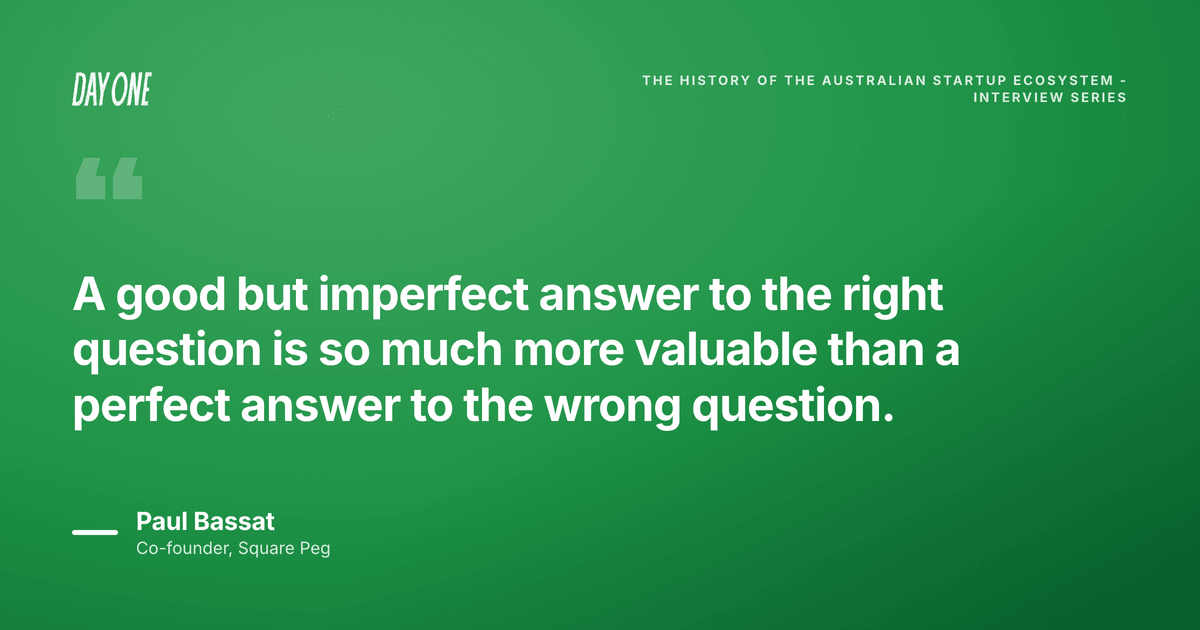
Transcript Synced · select any line to jump ▾ 0:00 Adam Spencer: Let me tell you about our partner, Teamified. If you need to build a top-notch team quickly, Teamified is your go-to solution. They not only provide fractional CTOs, they can also do contractors and even remote team members tailored exactly to your needs. And whether you're looking for expertise in the Philippines, India, or Sri Lanka, Teamified has you covered. What's amazing is that Teamified uses a blend of AI and human expertise to cut hiring times by 50%, cent. The platform handles everything from automated onboarding to day-to-day management and even performance tracking. You can also handle rewards and recognition, buy equipment, and order training all through their platform. Simplify your hiring process and get the best talent fast with Teamified. Check them out now and transform your team. Go to dayone.fm/teamified. That's dayone.fm/teamified. Thank you, T-E-A-M-I-F-I-E-D, and get started today. Hi, I'm Adam Spencer, founder of the Day One Network, which is bringing the history of the Australian startup ecosystem to you. I believe in founders. It's why I do everything I do at Day One and our media company, W2D1 Media. And that's why the Day One Network exists, to create helpful content for founders. We've got some great shows in development, but a large part of what we do couldn't be done without support from our partners and sponsors. And I couldn't be happier than to be working with NTP, who get community better than any other technology recruitment company out there. A Newcastle company like mine, NTP are invested in seeing the growth of the local tech community in Newcastle, Sydney, and more broadly Australia. So thank you, NTP, for helping us bring helpful content to founders and the startup community in Australia. Back to the interview. Hi, I'm Adam Spencer, founder of the Day One Network, which is bringing the history of the Australian startup ecosystem to you. I believe in founders. It's why I do everything I do at Day One and our media company, W2D1 Media. And that's why the Day One Network exists, to create helpful content for founders. We've got some great shows in development, but a large part of what we do couldn't be done without support from our partners and sponsors. And I couldn't be happier than to be working with NTP, who get community better than any other technology recruitment company out there. A Newcastle company like mine, NTP are invested in seeing the growth of the local tech community in Newcastle, Sydney, and more broadly Australia. So thank you, NTP, for helping us bring helpful content to founders and the startup community in Australia. Back to the interview. Hi, I'm Adam Spencer and welcome to Day One, the podcast that spotlights Australian startups, founders, and the organizations that empower Australian entrepreneurship. We go back to the beginning to tell the story of Australia's most inspiring founders and how they built their companies. You're listening to a special interview series as part of a documentary W2D1 is producing about the history of the Australian startup ecosystem. On the episode today, we have— 3:18 Paul Bassat: Hi, Paul Bassett, co-founder and partner at Square Peg. We invest in disruptive early-stage technology companies building amazing businesses across Australia, Southeast Asia, and Israel. 3:33 Adam Spencer: So, you know, such a deep history. Take us back as far as you think is relevant. What was your first exposure to startups? 3:43 Paul Bassat: Yeah, look, first exposure, Adam, came in about actually 1995. So I was a lawyer. Evan Thornley and Tracey Ellery co-founded LookSmart, which was an early search engine competing with the likes of Yahoo and Lycos and Infoseek and Excite. They came back to Australia to set up LookSmart, and Evan rang me one day and said, "We're looking for a lawyer." And so that was when I first learned about the internet. I was LookSmart's lawyer for their first 2 or 3 years before I left the law to co-found Seek. 4:11 Adam Spencer: In '95, in Australia, were there any precursors to what we see today? 4:16 Paul Bassat: Look, not really. I mean, firstly, the internet as a medium was very nascent. I'm not sure that I knew, there were probably were some people I knew that were internet users, but very few, and I wasn't really in a, in a sort of a techie circle, if you like. And so, you know, when Evan first rang me to say he was setting up an internet company, I didn't really know what the internet was and quickly got on the internet and learned a little bit about it. And then broadly from a startup ecosystem perspective, there were very few startups, very few. I mean, Computershare was one company that sort of became the leader in the share registry market globally. And Computershare was certainly one company that built a successful startup that people knew. Yeah. I think MYOB had probably started then. Dave Sheen had founded ComTech. So there are a few businesses that we would refer to today as startups, and those people were really pioneers, but it was few and far between. 5:04 Adam Spencer: I find it really interesting. So you were looking at a property with your wife and then you went and jumped on and realized there's a lot of websites, marketplaces, and you briefly thought about going into real estate. Instead of jobs. 5:19 Paul Bassat: That's right. And that was sort of the original idea. As you say, we were looking to buy a house. I guess I'd been inspired by the opportunities for the internet as a result of doing the work for LookSmart. And we saw that the Netscape IPO had occurred, I think August '95, the Yahoo IPO occurred pretty soon after. There was a lot of talk about the internet, certainly, particularly in the Bay Area in the US, obviously. And so there was a lot of hype within a small group of people. And so that was sort of a context and standing in an auction one day, Sharon and I looking to buy a house. She was pregnant with our second child. It was in March 1997. Jasmine was born in June. And so she was 6 months pregnant and really keen to get some, I guess, certainty and stability in terms of where we were living. And that kind of was where the idea came from. I chatted to my brother about it a week or two later. We started doing some work on the idea and that idea over a couple of months it's morphed for a bunch of reasons from real estate into jobs. 6:13 Adam Spencer: You say that you never really wanted to be an entrepreneur or a startup founder. You never went looking for the idea, but you just had the idea one day and you really explored it. Do you think with the startup culture today that maybe founders are approaching it the wrong way? There's a lot of people maybe out there that are, you know, they just want to be a founder, they want to be an entrepreneur, so they go looking for things. 6:35 Paul Bassat: Look, it's a hard question to answer. Certainly one of the things that we always do as investors at Square Peg is we really want to understand the founding story and why people are solving the problem they are and how authentic that problem is. And you know, one of the things about someone experiencing a personal problem, I mean problem in the broader sense of the word, problem, opportunity, something that doesn't work as well as it could, a market that's inefficient, et cetera, et cetera. One of the great things about that is you know that at the very least there's an audience of one for that product. That person, or maybe that person's partner, or friends, or a group of people have experienced a problem. And so it's a very authentic way to start a business. Look, I've certainly seen plenty of startups that, you know, have perhaps approached it a slightly different way. Sometimes it's about seeing trends in other markets, in other geographies. You know, look, By and large, I think sitting around a room saying, "Hey, we want to do a startup. What idea are we going to do?" You know, feels a bit less authentic, but there's certainly plenty of examples of businesses that have been very successful where people sort of had a clean sheet of paper and said, "Look, you know what? Let me just think through what the issues are. Let me think through what the problems are." But yes, I think by and large, it is much better when it's a problem looking for a solution than a solution looking for a problem. 7:50 Adam Spencer: Was it '94 or '95 when you started thinking about the marketplace business. 7:54 Paul Bassat: It was really '95 when I first learned about the internet. It wasn't like I was thinking I was gonna start a business. It was just that I was learning about it for LookSmart and, you know, in order to provide them with good advice, needed to understand the medium, but also it was hard not to get excited about it as you learned about it. 8:11 Adam Spencer: And today, again, just comparing the two kind of time periods today, there's so much around to help new founders. Back in '95, '97, who did you lean on for support? What was around? 8:21 Paul Bassat: Yeah, it's a really good question. There were very few people specifically that, there wasn't accelerators, there wasn't really anything the way of venture capital funds. And well, there was some people that did a little bit of early stage investing, either as angel investors or funds that had a sort of a slight technology lens to them. We didn't know any of those folks when we got started. Evan was a good source of advice. And so I had several conversations with Evan. We chatted to a bunch of people in recruitment firms because obviously in setting up SEEK, we were going to be providing a service to the recruitment industry. I remember chatting to the guy, I'm going to forget his name for the moment, who was running what was the Yellow Pages, became Census. Again, a very different business and certainly not a startup, but you know, it was a sort of a marketplace business, a directories business. Someone introduced me to him, so it was a good opportunity to get some insights from him. But yeah, look, the resources, the group of people you could hire to bring into the business, You didn't have people who had lots of startup experience, had rolled out of successful startups into sort of younger, earlier stage companies. And so a lot of the learning, a lot of the thinking was sort of first principles, for want of a better term. You had a few venture capital funds that did emerge in the sort of mid to late '90s. None of them are still around, and so that probably reflects the fact that they struggled to back amazing businesses. As it turned out, through the later stages of Sequoia, we had funding from— Sequoia.— sorry, I had funding from a number of angel investors and other people, but 3 investors that you might loosely refer to as sort of venture-type investors. One was Macquarie, Dan Phillips' team that was doing early-stage investing. And they're still doing that 25 years later, a little bit in Australia, a little bit offshore, more sort of growth stage, a little bit later stage. But Dan's team at Macquarie invested. Champ Ventures, which was part of Champ. They had one or two funds where they were doing a lot of tech investing in including backing LookSmart, and that's how I got to know them and they invested in us. And unfortunately, even though they had one fund that was very successful, they discontinued doing tech investing and went to more young, you know, PE-style investing of mid-market companies rather than technology. And Champ Ventures doesn't exist anymore. There was another fund called Amwin who had backed us as well, seeded out of Gresham. And again, they're not around anymore. And so what we saw is there was a little bit of external external capital. Allan Buckridge was another firm around at the time. But if you actually look at, candidly, if you look at most of the successful businesses that emerged through that period in the late '90s, and Seek was a bit of an exception with those 3 organizations investing, most of those successful companies either bootstrapped or had quite unusual sources of funding. realestate.com.au, News Corp bought the controlling stake there. They had Ray White, the real estate agents, back them. Car Sales was sort seated out of the Australian Reynolds Reynolds by Wal Pashoda and Greg Robach, and Greg became CEO and built an amazing business. But they had their own funding, they had some angel investors, they had car dealers, etc. What If, Graham Wood, I think was backed by his accountant and a few of his accountant's clients. So you didn't really have regular sources of funding that could both back companies right through their life cycle, but also provide them with the input and advice of people who would have these experiences. Yeah. Experiences themselves. 11:26 Adam Spencer: What advantages, you know, 6 years as a lawyer, what out of that experience helped you get started in SEEK? Was there any transfer— transferable skills? 11:37 Paul Bassat: Oh look, I think any job, I mean number one, any job has transferable skills. And so, you know, number one, there was a focus, attention to detail, a need for problem solving, a need to be very client-centric and meet the needs and expectations of clients. And so I think there were absolutely some skills and approaches and mindset that I got from that 6 years in the law. Now, no question, if I'd spent 6 years in marketing or 6 years in business development or 6 years doing something else, I would've got skills as well, but they were useful skills. Obviously being a co-founder, being a CEO, you need to be pretty broad rather than narrow. And so that suited my personality. It didn't really suit my skillset so much. So much, and there was a lot of learning on the job. 12:19 Adam Spencer: I think it was an interview that I read with your brother, I think it was, don't quote me on it, but he said you're the operations guy. 12:28 Paul Bassat: Yeah, I had, I mean, it sort of evolved over time, but certainly in the initial incarnation, Andrew was looking after the strategy, the growth, Matt, our third co-founder, was looking after sales. I had marketing report to me, I had technology, I had product, marketing, technology, product, sales, HR, etc. So, you know, pretty broad functional responsibilities. And then that changed a little bit after Matt left and after we started doing a bunch of stuff offshore. Andrew's and my responsibility sort of changed more from— it was still a little bit functional, but it was more sort of business units. Andrew continued to look after the growth and the investments, the expansion. He looked after our investments in businesses in the education area, in in Mexico, in Brazil, in Southeast Asia. I had the Australian business report to me, I had the China business report to me, and also looked after the shared services of legal, of financial, HR, and tech. But that was sort of the way it worked out, and I mean, I love being engaged in the day-to-day detail of a business. 13:28 Adam Spencer: Do you still do that these days? And if you don't, do you miss it? 13:32 Paul Bassat: Oh, look, I mean, certainly vis-à-vis Square Peg. I mean, Square Peg's not a large, complex business, but we're 30 people, we're growing. Spend a lot of time on hiring, a lot of time thinking about strategy and growth, our fundraising, our operations generally. So I spend a chunk of time on that. With our portfolio companies, I mean, you know, you sit on the board, you're not a day-to-day operator. And so it's really important to separate your role. Sometimes you do have to go a little bit deep and get involved where the company wants you to and provide input or support. But by and large, it's a much more strategic involvement across our portfolio companies. And so I— I work with about 7 or 8 of our portfolio companies, and that's obviously a very different engagement to what it would be if you're a day-to-day executive in those businesses. 14:15 Adam Spencer: Yeah. Do you miss being the day-to-day? 14:18 Paul Bassat: Look, I think I loved what I— absolutely loved what I did at SEEK. It was amazing. It was an incredible 14 years. I've loved what I've done in the last 9, 9 and a half years at Square Peg. So they're different experiences. I'm a big believer in change. I'm a big believer in going going outside your comfort zone, doing different things and new things. And so yeah, absolutely there's elements I miss, but there's also elements of what I do now and the opportunities I get with my career now that I didn't get at SEEK. And so I feel incredibly, you know, I'm really grateful in that sense. 14:47 Adam Spencer: A lot of people do point to roughly 2012 as when at least this wave of entrepreneurship starting. 14:55 Paul Bassat: Yeah. 14:55 Adam Spencer: And I find it really interesting that you decided to resign from SEEK in 2011 and Square Peg started around 2000, 2012, right? 15:04 Paul Bassat: 2012, yeah, beginning of 2012, yep. 15:06 Adam Spencer: Yeah. Did you see anything coming? Did you see something coming as why you wanted to get into the venture capital space at that point? 15:13 Paul Bassat: Yep. Well, I think there's two separate things. One was a decision to leave SEEK after 14 years, which is something I spent 6 or 12, 12 or 18 months thinking about before making the decision. And so that was completely separate from the decision to set up Square Peg. And so I didn't leave SEEK to set up Square Peg. I left SEEK because because after 14 years, it felt like time. I wanted to explore new opportunities, do different things. I absolutely loved the company. I loved the people. It was an extraordinary experience, but I wasn't as passionate about the job as I had been. And so it felt like a really good time to change. I had the view that, you know, I'd prefer to look back and say, maybe I've left a year or 2 years too early than saying, oh, I feel I've left a couple of years too late and I should have left earlier. So, I think that's the first aspect, Adam. The square peg aspect, I think we sat down at the beginning of 2012 and basically said, number one, we think it's incredibly important for Australia to build a really strong technology ecosystem. You're seeing a software, and Marc Andreessen uses the phrase, "Software eats the world," but you see a lot of traditional industries being disrupted by software-driven business models. Those businesses are winning globally, not locally. Australia wasn't producing enough of those businesses. I mean, clearly there were some great businesses produced out of Australia, like those early generation of internet companies, like the Seek and the Car Sales and a whole bunch of other companies. There was a next group of companies that were becoming very important companies like Envato. And of course, Atlassian, which is the standout tech company in Australia. It's a remarkable, remarkable business that's Scottish market built. And so we saw, it looked like there were going to be more companies emerging. And so number one, we thought there was an enormous need for Australia to produce more and more global winners. Number two, we actually thought that we were seeing more and more people going down entrepreneurial directions. We were seeing people come out of the SEEKs and seeing people come out of the Atlassians and starting their own companies, which is obviously a real exciting phenomenon. We were just seeing more founders generally, but there was a complete— 17:10 Adam Spencer: Yeah. 17:11 Paul Bassat: Completely void in terms of venture capital. And so we had the luxury that with our own capital, with some strong networks, some people have backseat, people that we knew, my partners at Square Peg, that we could raise some money, get started, provide a recurrent source of funding, really back some great Aussie startups, number 1. Number 2, get involved, help them, support them. There's no really thriving technology ecosystem in the world. Without great venture capital funds. And so we thought it was important. That was sort of where we thought we could make a difference and contribute. And of course, what we've seen is just even beyond our wildest expectations, the arrival of some remarkable founders and some remarkable entrepreneurs, remarkable businesses over the last few years has exceeded our expectations. We've been really lucky and been able to back some of them. We've missed out on a bunch of them as well. We're cheering on the sidelines, you know, we're cheering cheering for the ones who are backed, of course, and, and actively involved, and we love our engagement, but we're also cheering for the ones that we didn't back because it's just fantastic for this country to see these amazing businesses produced. 18:13 Adam Spencer: I want to try to really go down in that 2000 to 2012 period to try to uncover maybe one or two things that you have observed that have helped get us into the place where we are now. 18:25 Paul Bassat: Yeah. 18:26 Adam Spencer: What's the foundations that were laid really early on that maybe a lot of people just skim over and don't realize? 18:31 Paul Bassat: Look, there's a few things happened. One is I think, you know, people were seeing more of these great companies produced. A lot of them obviously produced offshore, but what we saw is some really good companies emerge out of Australia. And I think that inspired people, that created, there was a sort of a talent pathway and talent pools. It gave some confidence to investors that you could make money investing out of Australia. And so there was sort of the ingredients and the flywheel had started turn in that period. And the thing here is the analogy I always use is like, for whatever reason, Bjorn Borg emerged as a great tennis player out of Sweden. Sweden wasn't known as a country that produced a lot of tennis players. Probably random that he came from Sweden rather than from Norway or from a whole range of other countries he could have come from, but he happened to come from Sweden. What did we then see in the next 10 or 15 years coming out of Sweden? We saw this factory of amazing Swedish tennis players. And a lot of that is just the inspiration, the role models, kids growing up and saying, "Hey, I wanna be the next Björn Borg." Or saying, "You know what, if you're looking at a Jimmy Connors in the US," some young Swedish kids like, "Well, yeah, they can produce them out of the US, but there's no local role models for me to look at." And so I think it was the same in tech, the importance of local role models. Those founders went off and backed businesses Andrew and I and Matt were backing businesses. Scott and Mike were amazing and have continued to be amazing investors in the Aussie technology ecosystem. The guys at Carsales have been backing businesses and a whole lot of other people. So you have people working in these high-growth businesses saying, Maybe I can do this myself, or maybe I'll go and join, you know, I really enjoyed my 5 years at this organization. I'll go enjoy a much earlier organization. So they bring with them their expertise and skills. There's the capital that comes from angel investors, particularly founders who can pass on hopefully some advice and input. It's encouraged institutional investors to come back and start backing venture capital again. And in the case of Square Peg, you know, initially the support of Hostplus in our first institutional fund was pivotal. It's not just backing us, they've backed a whole range of other VC funds. So institutional investors have been really important. Australian Super, who have backed us. 20:42 Adam Spencer: Yeah. 20:42 Paul Bassat: And other VCs have also been really important. So you started to see all of the elements, all of the elements move into place. And so the last 10 years have been certainly really exciting to see businesses like Canva and Airwallex and Rockt and Linktree, you know, some amazing Aussie companies emerge in the last decade. And those companies are very, I mean, you know, Airwallex is a great example. It's 6 years into its journey. Launched its product in 2017, 4 years ago. And so these are remarkable businesses, and more and more of the, the best and brightest kids are saying, "I want to work in startups," or, "I want to start my own company." I'm familiar with all of those, and I know the name Rockt. 21:22 Adam Spencer: What do they do? 21:23 Paul Bassat: Yeah, Rockt. I mean, Rockt is probably less known because, I mean, you know, has about 150-200 people in Sydney. But Bruce Buchanan, the founder and CEO, you know, has been living in New York for the last 7 or 8 years. They're a B2B business, so they don't have the same consumer brand that a, say, a Canva has, for example. But basically what they do is they partner with e-commerce sites and other businesses sort of selling, selling product or services online, and they effectively connect that customer, that end customer, with brands who are looking to acquire new customers. And they use a lot of data. They use a lot of data to understand exactly exactly what that consumer is looking for. And let's say, for example, you've bought a ticket, you've bought a ticket to a concert on Live Nation, Ticketmaster, that then, there might then be an opportunity to buy insurance for that ticket. You might wanna buy parking in the car park nearby. You might be interested, you know, you've got purchase intent, you might, as a consumer, you might be interested in, for example, signing up with Uber Eats, and you might get a $20 voucher or something like that. And so, that's essentially their model, and they've built a really amazing business They're one of the great Aussie tech success stories of the last decade and probably a little bit less known than some of their peers. 22:34 Adam Spencer: I need to jump back on the timeline for a second. That 28 years of your life before you founded Seek. 22:39 Paul Bassat: Yeah. 22:41 Adam Spencer: Is there anything that you can point to even before going into law and the discipline and focus and level of detail that you got out of that? Like anything in your childhood that kind of helped you make the person that is Paul that was ready to start Seek? 22:55 Paul Bassat: It's a good question. I mean, I did one pretty small entrepreneurial thing at uni and that was a bit of fun and went okay. But I think the broad answer is no. 23:04 Adam Spencer: Right. 23:04 Paul Bassat: I think the more relevant answer, I think, is that, you know, my personality and my temperament was well suited to being a founder. And so I'll give you an example. One of the things that people said to me a lot of the time and continue to say 20, what is it, 24 years later, and they say, oh, that was a really, that was a Big risk that you took to start SEEK. You had a secure job as a lawyer. You were going to become a partner of the firm you're at within 12 months. You had a really good career ahead of you, great income, 2 children, a third, our son who came along a couple of years later. And that was a huge risk you took. I never thought about it that way. I think about risk really differently. For me, the risk was a much greater risk. You know, we came across this opportunity, really excited about it. We did a bunch of work. I became really passionate about pursuing this opportunity. For me, it was a much greater risk in terms of just the frustration and how I would feel looking back 20 years if I said, "Oh, I never pursued this opportunity." How would I feel if I knew that this is something I could have done, but didn't have the self-belief and the self-confidence and the wherewithal to go and do it? And so that was how I felt about risk. For me, it was more risky not to pursue it to pursue it than to pursue it. Whilst most other people would think about that differently and say, well, that's risky. You're risking your career. You've got a mortgage. You know, obviously having a wife who was incredibly supportive and parents and my brother, all those elements were really, really important. And so I'm not sure there's really an answer about our founders born and made. There are elements of both. We are, to some extent, we are the people who we are. And to some extent, we are influenced by our environment, surrounding and life's events. And in my case, obviously, there was a lot of serendipity. If Evan hadn't have called me up one day saying, "I need a lawyer," I probably wouldn't have developed that passion and interest of the internet. If we hadn't have been standing at the auction that day and just thinking about the frustration of looking for a house, wouldn't have had that idea, et cetera, et cetera. 24:58 Adam Spencer: Quick question that I didn't have written down, but I found in my research that someone, a number of people have said, "You're just a really nice guy." I don't know how to respond to that. The question is, did that serve you being a founder, or do you think people are more successful if they're not as nice being a founder? 25:16 Paul Bassat: Look, we are what we are, and so we bring our own personalities and our own strengths and our own weaknesses and our temperament, and we bring a certain approach to bear. And I think sometimes, you know, for example, you know, a lot of people watch the Michael Jordan documentary, The Last Dance, which I loved. I thought it was an amazing documentary. And he came across as a very difficult, obviously an incredibly driven person, a really difficult person, but also a person who was, you know, and obviously there was some insecurities there, which you look back and say, this is a guy who's just had a great family life, ridiculously talented. He's a big personality, extroverted, good-looking guy. Like how could this guy be insecure? Like he's got, he's, you know, maybe the greatest basketballer of all time, one of the great sportsmen of all time. But there was a sort of an insecurity that, that drove him, for example. And it was interesting, like some of the way in which he interacted with some of his teammates and was really hard and really tough on his teammates. And I think, you know, some people have said to me, "Oh, the reason he was so successful was because he was like that." And there is no question that some aspects of his personality made him successful, that drive, that ambition. But he was, if you think about the way he interacted with his teammates and treated his teammates, he wasn't successful because he was an asshole to many of his teammates. He was successful in spite of that. And so it's not like when you look at someone who's achieved, and again, I'm using him as an example because he's such an outlier. His performance is such an outlier. You could talk about a Steve Jobs again. I don't think Steve Jobs is successful 'cause he was an asshole. He just had certain demons and some of those demons were helpful to him in certain ways, were harmful to him in other ways, but we're all people. People, whatever we achieve, whatever we do, whether we work in an organization, run our own small business, we play tennis on a weekend or whatever it is, and our personality, our makeup helps drive outcomes for better or for worse. And even the most talented person, even the most successful person has flaws and traits and attributes to their personality that stand in the way of their success. Now, obviously they overcome them. But if they didn't have those attributes, they'd be even more successful. 27:21 Adam Spencer: Okay, we've covered some really good history around the startup scene and what the kind of landscape looked like then. When you guys started Square Peg, what did the landscape look like at that point in time from your perspective? 27:38 Paul Bassat: Yeah, I think we were starting to see more great founders emerge. And again, one of the things also is, is that it's not just about number of founders. Australia's got remarkable talent. But historically, not enough of our best and brightest were going in the direction of startups. And so more of our best and brightest were going in the direction of startups. We're still early in that journey, number one. More of those founders were focused on building global businesses rather than just solving a problem locally. And so Canva talks to that, Airwallex talks to that, CultureAmp talks to that, Go1 talked to that. Thinking global from day one, so much more ambitious. 28:12 Adam Spencer: Yeah. 28:12 Paul Bassat: Much more self-belief in terms of what— but again, we're really early in that journey. There wasn't much in the way of accelerators. I mean, I think Startmate was emerging or just emerged then in 2012. But, you know, we didn't have much in the way of accelerators. We didn't have much in the way of just the various aspects of an ecosystem that you really need. Lawyers and accountants have a lot of expertise advising young companies, mentors, people, you know, so those elements were nascent. Mm-hmm. And from a capital perspective, it was pretty barren. And so that was the problem that we felt we were uniquely placed to solve. As it turned out, you know, at a similar time or just afterwards, you know, some others came along, which is sort of a remarkable, you know, sort of serendipity. And I suspect, I mean, I haven't spoken to people like Daniel about this, or— and he's a really good friend of mine— or Nicky or Rick at Blackbird. I haven't asked them a specific question, but I think their thinking would have been exactly the same as ours. Yeah. Us, which was, hey, there's some green shoots coming out of startup ecosystem Australia, but there needs to be some capital, there needs to be funding for these folks, because if there's no funding, it makes it much, much more difficult. 29:16 Adam Spencer: What's the biggest thing that surprised you about the Australian startup ecosystem over the last 2.5 decades? 29:22 Paul Bassat: I think the rate of change in the last few years, and particularly the last 3 or 4 years. I think we've got a long way to go, and we're lucky we invest in Israel and we get to compare the Aussie ecosystem, the Israeli ecosystem. But if you'd said to me, even 5 or 6 years ago, let alone 25 years ago, if you'd said to me, oh, Atlassian is going to have a market cap over $100 billion US and be one of the largest companies in Australia. You know, Canva is going to raise money as a private company at $40 billion US. And you know, you have revenue in the order of, you know, a million dollars, 9 years after founding, a billion $1 billion ARR 9 years after founding, 6 or 7 years after first generating revenue, that their wallets was going to basically build this sort of global financial services infrastructure, basically start in China in terms of the first market was really focused on, raise money from Tencent, one of the great technology giants as a pre-revenue business, et cetera, et cetera, and on and on and on. Afterpay. Talked about what Ant and Nick have achieved. It is remarkable. You know, again, one of the great business stories in Australia in the last 30, 40 years, not one of the great technology business stories, one of the great business stories in Australia. I remember when we got to a billion-dollar market cap, we were listed already. We listed in 2005 and we would've got to a billion probably in 2005, 2006. And so that was sort of 7 years in, 8 years in. And that was a big deal, like for us and for the market. And it was like, well, you know, produced a billion-dollar market cap company. I don't know if we were the first, but we certainly would have been, well, one of the first, if not the first, of listed Aussie tech companies. And like today, I mean, you know, in market cap terms, Atlassian over $100 billion US. And again, market caps, that's not the kind of the main thing. The market cap is just an output. The point is, is these companies produce amazing products, incredible teams, high growth. Their customers love what they do. They have a great love from their users, whether their businesses or consumers, or in the case of Canva, both. And it's just a remarkable story. So that's the thing I'm most excited about because I think we were very bullish, but the last 5 years in particular has exceeded our most bullish expectations. 31:28 Adam Spencer: I have a follow-up question. How does it feel to build a company like Seek? How does that make you feel? 31:36 Paul Bassat: Look, I think when you, when you put the question that way, I mean, it feels great. I mean, you have a lot of pride in A, just building something from scratch. The incredible group of people that were and are at SEEK now, 24 years later, obviously I'm long out of the business, but just an amazing, amazing group of people who were just good people, good values, really, really cared about what they did. Really just incredible mutual respect and admiration across the team. People just loved working with each other. Obviously the fact that we were helping people looking for jobs and find jobs. I mean, that's one of the most important thing in people's lives is finding rewarding and fulfilling careers to pursue. So yeah, you feel great about it. Candidly, do I spend a lot of time thinking about it? And it's really nice when people ask you the question because you stop and reflect. But you know, to be honest, I spend every day thinking about, you know, what we need to do better at Square Peg, how we can help our portfolio companies. Obviously some of my mind space is on AFL, which I love my involvement with. What are the opportunities for us at Square Peg? What are the opportunities and threats for our portfolio companies? How can we help them more? That's the stuff you spend all your time thinking about. 32:45 Adam Spencer: Yeah, I feel a little bit bad about, you know, making you look back when you're really set on the future. 32:50 Paul Bassat: No, it's really nice. It's a great thing. I wish I did it more often. I think the comment that I probably made is that we're now doing it now, but hopefully it's of use to to some of the people listening, Adam, but I just, I find it a bit boring when people are always talking about the past. I mean, if I'm spending time with Scott and Mike, I'm going to ask them a bunch of questions about their story of building Atlassian and why they were successful and why they've been able to build an amazing business. And I've heard them do some fantastic podcasts and really enjoyed those. But if every time you saw Scott and Mike, all they were talking about is all what they've what they've achieved, you'd be really bored. The exact opposite is the truth. They're always talking about, you know, particularly where they can help the tech ecosystem, things they might be doing in relation to sustainability and climate change, opportunities to grow Atlassian. They're the people who inspire me, the people who are thinking about problems to be solved, how to help people, how to grow their businesses. And that's amazing. But I do love, I love hearing people tell their stories. I just think it's boring. Boring if that's all they do. 33:51 Adam Spencer: Okay, let's look at the future. In your opinion, where are some of the biggest kind of gaps that we need to fill? Like, where do we still need to make some big improvements in? 33:59 Paul Bassat: Look, I think there's a few things. I think there are elements of our ecosystem that are working okay and not great. We need more capital. We would welcome more competition from local players and offshore players. It's been a sea change over the last 10, 12 years, but there's still a long way to go. One of the things we see in Israel, and in the Bay Area obviously, is these incredibly sophisticated angel investors who've got really strong networks. We're seeing more and more of that here, but I think there's really opportunity here, both at the VC side and the angel side, to continue to have increased volume and sophistication investors. We need more and more of the best and brightest kids saying, "Hey, I wanna start." They don't have to be kids, obviously, but the best and brightest saying, I want to pursue startups. More and more people rolling out of these great Aussie tech success stories and founding or joining the next generation of startups. It's probably we don't need any new ingredients. We need, we need more of all the ingredients. I would love to see more great startups emerge out of places other than Sydney and Melbourne. But for example, what South Australia is doing in specific areas around space technology, around defense, around cyber is really exciting. And they've got a They've got a Premier who is ridiculously passionate about this area, which is amazing. So I'd love to see that those benefits sort of spread more widely. Love to just see more and more Australians employed in startups. I think we've traditionally shied away from some of the biggest problems. I think that's really changing. We're back— Q Control, uh, Mike Beersek in quantum computing. We're seeing a lot of companies in space, like Fleet as an example, Gilmore. Et cetera. So we are starting to solve some of the bigger problems. It's great to see funds like Main Sequence emerge, who are trying to partner with universities and research institutions. Because historically, we've been great at research. We've been pretty poor at applying that research. Other countries, the Israelis have done that incredibly well over the last 50 years, particularly in life sciences. And so, you know, I think we just need more. We need that flywheel to spin faster and we can We can't be complacent because our biggest employers, and this is not having a crack at our largest companies, most of our biggest employers are what I would call national champions. They are the best and the biggest in Australia at what they do. They're not necessarily the best in the world. And they are at risk of being disrupted by companies that are the best in the world at what they do. As you see more and more of these software-driven business models. And even if they're not disrupted, they're going to be employing more, less people as they try to get more and more efficient and use technology more. If we don't want to be a branch office, if we want to have some of the great jobs in the world, highly productive, well-paid jobs, fun, exciting jobs, there needs to be more Seeks, there needs to be, you know, more Envatos, and there needs to be more Airwallexes, there needs to be more Rocks, there needs to be more Deputies. We need more and more of these companies, and I think we're on a great trajectory, but we've got a long way to go. 36:48 Adam Spencer: One of the kind of things that you guys look for at Square Peg are founders doing their life's work. What's your life's work? 36:56 Paul Bassat: Such a great, such a great question, Adam. I don't think I've ever been asked that question before. I think I get my energy from building things, from growing things. And so by extension in seeing that investing in startups and working those startups, you don't get to have the same level of engagement as building your own startup, those that seek, but you get to see it across, in our case, 50 companies and, and growing, which is a remarkable privilege. So that's where I get my energy from. And so at this stage of my career, if I can help organizations, if I might play a small role in organizations becoming incredibly successful, achieving their, their goals, if I can help people, whether they're founders in our portfolio or other members of the team in our portfolio companies, or whether they're in the Square Peg team, help them achieve their career ambitions and help them develop and grow and learn. 37:44 Adam Spencer: Yeah. 37:44 Paul Bassat: That's sort of the stuff that I think probably motivates me the most. I get incredible satisfaction about that. But yeah, I like building in the broader sense of the word. 37:52 Adam Spencer: Thank you. I'm really chuffed that I've asked you a question that no one else has. 37:56 Paul Bassat: Yeah, you know, it's interesting. I mean, I was chatting to Stephen Lowy, who's obviously known, you know, by a lot of people as, you know, as an incredibly successful business person with Westfield. And I remember having a conversation with him recently and I said, you know, I reckon if your dad was starting out today and his father Frank is in his 90s. If he was starting out today, I bet he'd do a tech startup. And he said, "100%, without question." If he was starting out today in 2021, he would absolutely do a tech startup. 'Cause this is where most of the big problems in the world are being solved. 38:27 Adam Spencer: Yeah, well, that's interesting. 'Cause that just reminded me of another question I wanted to ask you. 28-year-old Paul starting out again today, what problem would you wanna tackle? 38:36 Paul Bassat: I suspect something related to climate change or sustainability. I'm guessing. 38:41 Adam Spencer: Yeah, interesting. So the last two questions, new founder came to you tomorrow, what one piece of advice would you give them? 38:49 Paul Bassat: Believe in yourself, be bold. That's probably two pieces of advice. Third piece of advice would be, unless you're curing cancer or sort of sending a rocket to Mars, most of the questions that we need to answer are pretty easy to answer. The hard part is working out working out the right questions. Spend as much time, if not more time, thinking about what the right questions are. A good but imperfect answer to the right question is so much more valuable than a perfect answer to the wrong question. 39:17 Adam Spencer: That's brilliant. That's good advice for me thinking about the right questions to ask as well. 39:21 Paul Bassat: Exactly, as a podcaster. 39:23 Adam Spencer: And this last question is, it's not really a question, but as you know, I'm trying to create a documentary here that will just tell the entire history as truthfully and honestly as I can. About the Australian startup ecosystem. We want everyone to listen to this— founders, investors, academics, policymakers— any one of those categories or all of them. What message do you think people need to hear from you? 39:42 Paul Bassat: What I'd sort of say to policymakers in particular— I'd probably have a slightly different message to each, but everyone sort of chatted about the policy side, and we're seeing a little bit of this, but what I'd say to policymakers is this stuff really, really, really matters. The Singaporeans get it, the Irish get it, the Israelis get it. And actually creating a framework. This isn't about handing out lots of bucks and whatever and giving money to venture funds like us. We're now self-sustaining. We can raise our own funds. It's not an issue. I mean, maybe there's some emerging funds would be great to support. That's not the point. The point is creating environment, creating a framework where we produce, you know, more and more of our best and brightest. Yeah. Brightest go in these directions. Because at the end of the day, a software engineer who writes code that's used by millions of people around the world, that is one of the most productive jobs ever in the history of mankind. It's a remarkably productive job, writing software code that's used by millions and millions of people. You couldn't do in the past. I mean, historically, you know, you'd handcraft a product that might be used by one person, a suit or a pair of shoes, shoes for a horse. If you think about it, the only way in which a country can create long-term prosperity is through productivity growth. We need more and more of our population, more and more people in our country, not just doing really rewarding jobs and fun jobs and involved with great companies, but really highly productive jobs, because that is the way in which we'll sustain the prosperity that we've come to, you know, get used to in Australia. 41:12 Adam Spencer: I hope you enjoyed that interview. More interviews are on the way. Follow the podcast wherever you're listening right now. Stay tuned for more interviews with many, many more amazing people from the Australian startup ecosystem. Thanks for listening and see you next time.